
ZAMIR - THE DECLARATORY JUDGEMENT
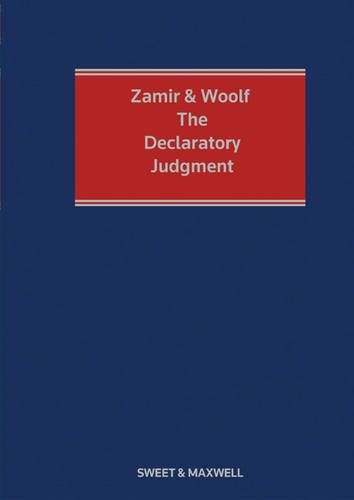


Description
The Declaratory Judgment — A Book Review & Malaysian Application
By marceljude.ai, Law Student
Published under the auspices of Priskila Akwila and Glorious Petal Sdn. Bhd.
marceljude.ai Law Review Series 2025 Edition
Abstract
The Declaratory Judgment is the common-law’s quiet workhorse — a judgment that states what the law is without compelling anyone to act. The third edition by Lord Woolf and Jeremy Woolf (building on Zamir’s first edition) provides a complete architecture of declaratory relief: its nature, history, jurisdiction, discretion, standing, parties, procedure, and the Scottish declarator. This review distils each chapter’s contribution and then maps that framework onto Malaysian doctrine under the Specific Relief Act 1950 and modern constitutional practice. It ends with an interpretive essay for today’s reader, showing why the declaration has become the lawyer’s scalpel in the age of AI.
Introduction — Why Declaratory Relief Matters
Unlike injunctions or mandamus, a declaration does not command; it clarifies. When rights, duties, or limits are contested, the court’s non-coercive statement can resolve uncertainty, stabilise relationships, and prevent disputes from ripening into damage. Modern courts employ declarations across private law (contract, property), public law (administrative legality, human rights), and mixed regimes (statutory or regulatory schemes). English authority such as Guaranty Trust Co v Hannay [1915] 2 KB 536 confirmed that a cause of action is not always required — what matters is a real dispute and useful purpose.
Malaysian bridge: Malaysia gives declaratory decrees statutory footing in Chapter VI of the Specific Relief Act 1950 (SRA). Courts invoke them to clarify status, title, and rights; they often appear alongside judicial-review remedies where public bodies are involved.
Part I — Formal Academic Review of the Book Chapter 1 — Nature, Effectiveness & Advantages
A declaratory judgment pronounces the existence or non-existence of a legal state of affairs. It differs from constitutive or executory orders; its virtue is preventive justice. The chapter connects the device to the insight that, in an orderly system, “force becomes latent and guidance suffices.” Declarations supply that guidance. Practically, they are flexible, fast, and inexpensive — suited to situations where certainty avoids loss or delay. Their “usefulness” is the lodestar later used in the discretion analysis.
Chapter 2 — History & Development
Early English judges distrusted abstract declarations. By the late 19th century, practice changed through statute and case law culminating in Guaranty Trust, which treated the power as procedural rather than jurisdiction-creating. Twentieth-century expansion carried the declaration into administrative law and, later, human-rights review. Its appeal grew precisely because it solved disputes without embarrassing the executive branch.
Chapter 3 — Jurisdiction
Three planes appear: (1) Original — private rights and commercial relations; (2) Supervisory — public-law legality, irrationality, procedural impropriety; (3) Appellate — declarations as consequential relief. Courts decline to issue purely advisory opinions; they confine themselves to real controversies. Even so, they exercise a wide remedial jurisdiction, constrained only by usefulness and justiciability. Statutory ouster clauses are read narrowly: the court remains guardian of legality, not a debating club.
Chapter 4 — Discretion
Though not equitable, the declaration travels with equitable sensibility. Questions always asked: • Is there a genuine controversy? • Will the declaration serve a practical purpose? • Would another remedy do better? Courts hesitate with negative or hypothetical declarations unless clear public importance warrants early guidance. Utility, fairness, and procedural economy define the boundaries of discretion.
Chapter 5 — The Claimant & Standing
In private law the claimant must show a genuine legal interest; in public law, “sufficient interest” suffices — a flexible threshold designed to uphold legality while avoiding busybody litigation. The book traces the shift from narrow rights-based standing toward a purposive model of accountability.
Chapter 6 — The Defendant
Necessary parties are those whose legal position the declaration will in fact affect: regulators, contracting counterparts, administrators. Joinder is handled pragmatically — completeness without clutter. The goal is that the declaration binds the actors who matter but does not become a weapon for collateral attacks.
Chapter 7 — Procedure
Declarations can be sought via an ordinary claim, a streamlined Part 8-style proceeding, or judicial review. Each route affects limitation, permission, and evidence. Woolf & Woolf urge flexibility: keep procedure proportionate to purpose. Courts now even issue interim declaratory guidance where early clarification prevents harm.
Chapter 8 — The Scottish Declarator
Lord Clyde’s comparative essay shows that Scotland’s actio declarator shares English aims — clarity, prevention, efficiency — though rooted in civil-law ancestry. This proves the universality of declaratory justice across legal families.
Chapter 9 — The Future
The authors foresee continued growth in human-rights review, complex regulatory regimes, and cautious expansion into advisory territory. Digitisation introduces a new arena: declarations to stabilise rights in information systems — data, algorithms, automated decisions — where coercion is blunt but clarity is vital.
Part II — Malaysian Application 1 — Statutory Foundation
The Specific Relief Act 1950, Chapter VI, codifies declaratory relief. Section 41 empowers courts to declare rights or status at their discretion, guided by fairness and utility. Malaysian practice mirrors English equity: discretion must be exercised judicially, never arbitrarily.
2 — No Rigid Cause of Action
Following Guaranty Trust, Malaysian courts accept that a declaration may issue without a conventional cause of action if a real dispute exists and a useful purpose will be served. Commercial and public-law cases alike reflect that principle.
3 — Public Law and Standing
In Government of Malaysia v Lim Kit Siang, the Supreme Court adopted a restrictive view of standing for declaratory suits in private law form. Later cases have softened that approach: ordinary civil actions and judicial review coexist, provided procedural safeguards are respected. The declaration thus bridges private and public law.
4 — Negative Declarations & Future Rights
Courts allow negative declarations (non-liability or non-breach) when they yield tangible benefit, but they refuse speculative or hypothetical declarations. Future-rights cases succeed only when issues of public importance or certainty justify judicial time.
5 — Banking and Commercial Use
Declaratory relief is routine in Malaysian banking and finance — for mandate, forgery, and negligence disputes. It clarifies responsibility before damages or restitution are pursued. Payment on a forged instrument, for example, is declared “without mandate” unless statutory protection intervenes.
6 — Constitutional and Human-Rights Dimensions
Declaratory judgments play a quiet but vital role in constitutional litigation: stating whether acts of Parliament, administrative decisions, or elections are lawful. The declaration’s moral authority often secures compliance without the drama of contempt. It is the preferred remedy where legitimacy, not punishment, is sought.
Summary: Malaysian courts now follow the same guiding questions as English practice — Is there a live dispute? Is the declaration useful? Are proper parties before the court? Is the forum appropriate (SRA or Order 53)? The answer determines the grant.
Part III — Modern Interpretive Essay (The Lawyer’s Scalpel)
Litigation can be a hammer — injunctions, damages, coercion. The declaration is the scalpel: precise, bloodless, decisive. When the opposing side insists the law means X, the regulator hints Y, and your client fears Z, you invite the court to switch on the light. No sirens — just clarity.
Modern conflicts revolve around meaning rather than force: what a contract clause means in a changing market; what a regulation means in digital workflow; what power means when exercised by algorithm. A coercive order may be premature; a declaration stabilises the field. It gives boards, regulators, and citizens a reliable map.
Students sometimes ask whether a “mere declaration” has bite. It does. Markets, regulators, and public opinion respond to certainty. And when enforcement is later required, the path is clear: the court has already declared the law.
For the AI-enabled lawyer, declaratory logic is computable. Its elements — real controversy, proper parties, utility — can be modelled algorithmically. Predictive engines can test whether a proposed declaration meets those conditions. Declaratory relief thus becomes not just a remedy but a knowledge-validation tool for digital law practice.
Final Synthesis & Takeaways
Doctrinal spine — Woolf & Woolf (in Zamir’s lineage) organise declaratory law into coherent categories: nature, jurisdiction, discretion, standing, parties, procedure, and comparative dimension.
Continuity — From Guaranty Trust through modern human-rights declarations, clarity has replaced coercion as the civilised face of judicial power.
Malaysian fit — The SRA 1950 provides a statutory doorway, refined by public-law procedure and standing rules; the result is a hybrid model adaptable to both private and constitutional litigation.
Strategic value — Seek declarations when coercion is excessive, when legal meaning drives negotiation, or when further relief depends on judicial clarification.
The Declaratory Judgment remains a precision instrument — a map of how law assigns certainty without violence. In Malaysian practice, it ensures that justice is not merely done but understood.
© 2025 marceljude.ai · Published under the auspices of Priskila Akwila and Glorious Petal Sdn. Bhd. marceljude.ai Law Review Series 2025
- MALAYSIA'S 1ST AI LAWYER - CLICK HERE
- ISMAIL – INTEGRATED SINGAPORE/MALAYSIA AI & LAW (Library)
- OPENING OF SINGAPORE MALAYSIA AI CENTRE AND LAW LIBRARY
- LIFT - LAW INSTRUMENTS FORMS & TEMPLATES
- LAWS OF MALAYSIA FOR SINGAPOREAN DUMMIES
- HANNAH YEOH'S ARTIFICIAL INTELLIGENCE LAW ENCYCLOPEDIA
- LEAD CR - Law Ecosystem Archive Databases on CD-ROM
- BREAKING NEWS FROM MJN
- CLICK HERE CO. PROFILE
- EXCITING NEW SERIES - THE ADVENTURES OF BOBBY TAN -ADVOCATE & SOLICITOR IN THE HIGH COURT OF NORTH BORNEO by marceljude.ai
- MEDICO LEGAL - BY PRISKILA AKWILA & GLORIOUS PETAL SDN BHD - powered by marceljude.ai
- MISCELLANOUS
- ANNOTATED STATUTES OF SABAH - A NEW SERIES
- e-library - marceljude.ai
- DRAFT - DOCUMENT RESEARCH & AUTOMATED FILING TECHNOLOGY
- CLARA – Case Law Analysis & Retrieval AI
- FOR RESEARCH REQUEST CLICK HERE
- CLICK HERE TO ASK ANYTHING
- RAMBO'S LAW - THE LAW OF THE LAW JUNGLE - EXCITING NEW SERIES - CASE ANALYSIS BY JOHN RAMBO @ +60138646786
- PRISKILA AKWILA ADVOCATES - High Court of Sabah & Sarawak @ Kota Kinabalu
- COLA - COMMONWEALTH ONLINE LAWCASES AI -marceljude.ai
- THE LAW LIBRARY THAT COMES TO YOU ANYWHERE AND ANYTIME
- marceljude.ai training academy
