
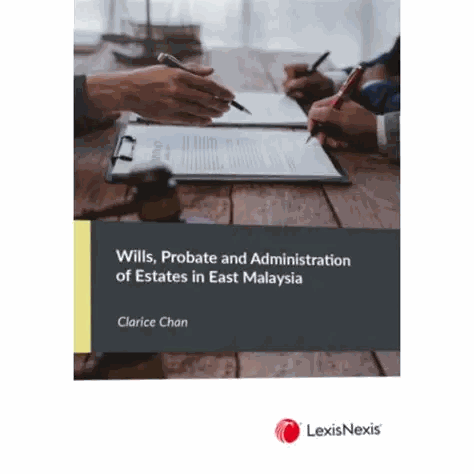
Wills, Probate and Administration in East Malaysia Clarice Chan


Description
Wills, Probate and Administration in East Malaysia
Clarice Chan
LLB, GDLP (Vic), CLP; Solicitor, Supreme Court of Victoria, Australia; Advocate and Solicitor High Court in Malaya, Sabah and Sarawak (Sarawak)
Book Review by marceljude.ai
Chapter-by-Chapter Review of Wills, Probate and Administration in East Malaysia
I read the book. This review treats it as a legal text: not merely whether it is “useful,” but whether its structure, doctrine, statutory comparison, procedural guidance, and treatment of East Malaysian plural legal systems succeed at the level expected of a serious probate and succession reference work.
The book’s central achievement is that it does not treat Malaysian succession law as a single uniform subject. Instead, it insists that succession, probate, administration, distribution, and native customary inheritance must be understood jurisdiction by jurisdiction: West Malaysia, Sabah, and Sarawak. That is the correct legal starting point. The book is at its strongest where it shows that the apparently ordinary vocabulary of probate law—“will,” “executor,” “administrator,” “grant,” “beneficiary,” “heir,” “property,” “custom”—changes meaning depending on location, personal law, native status, and forum.
The work is framed as a comparative and practical clarification of wills, estates, inheritance, and grants of representation across Malaysia’s different legal regimes. Its own preface explains that death, succession, inheritance, and grants of representation vary across the Federation, and that care is needed to give effect to the deceased’s personal law and expressed wishes.
Contents with Actual Book Page Numbers
The book’s contents are as follows, using the book’s own page numbering.
Foreword by Tan Sri Datuk Seri Panglima David Wong — page v
Foreword by Simon Siah Sy Jen — page vii
Preface — front matter
Table of Cases — page xvii
Table of Legislation — page xxxv Table of Foreign Legislation — page li
Chapter 1: Introduction — page 1 Overview/Legislative history — page 1 West Malaysia — page 2 Sabah — page 3 Sarawak — page 5
Chapter 2: Wills — page 10 Introduction — page 10 The Nature of Wills — page 10 Testamentary Capacity and Suspicious Circumstances — page 13 Appointments, Roles and Responsibilities — page 17 4.1 Executor — page 17 4.1.1 Can executors seek remuneration from the estate? — page 20 4.2 Beneficiary/donee — page 21 4.3 Provisions for minors — page 21 4.4 Witnesses — page 23 Preparation and Execution — page 24 Trusts — page 26 6.1 Secret trusts — page 27 Alterations, Revocations and Revival of a Will — page 28 7.1 Alterations — page 28 7.2 Revocations — page 28 7.3 Revival — page 29 Gifts and Other Forms of Apportionment — page 29 Survivorship Clauses in Joint Accounts — page 31 Insurance Policies and Nominations under Provident Funds — page 32 Muslim Wills in Sabah — page 33
Chapter 3: Grant of Probate — page 36 Introduction — page 36 Probate in West Malaysia — page 36 2.1 Applicable laws — page 36 2.2 Resealing in West Malaysia — page 39 2.3 Practice and procedure — page 40 2.3.1 For a grant of probate — page 40 2.3.2 To add a personal representative to the grant of probate — page 42 2.3.3 Resealing a grant — page 42 Probate in Sabah — page 43 3.1 Applicable laws — page 43 3.2 Resealing in Sabah — page 45 3.3 Practice and procedure — page 46 3.3.1 Applications for a grant of probate — page 46 3.3.2 Resealing a grant — page 48 Probate in Sarawak — page 49 4.1 Applicable laws — page 49 4.2 Resealing in Sarawak — page 52 4.3 Practice and procedure — page 52 4.3.1 Alterations and revocations — page 53 Muslim Estates — page 54
Chapter 4: Grant of Letters of Administration — page 56 Introduction — page 56 Letters of Administration in West Malaysia — page 57 2.1 Applicable laws — page 57 2.2 Limited grants — page 59 2.3 Administration bond — page 60 2.4 Resealing in West Malaysia — page 61 2.5 Revocation — page 62 2.6 Practice and procedure — page 62 Letters of Administration in Sabah — page 63 3.1 Applicable laws — page 63 3.2 Resealing — page 65 3.3 Practice and procedure — page 65 3.3.1 Resealing a grant — page 67 3.4 Muslim estates — page 68 Letters of Administration in Sarawak — page 68 4.1 Applicable laws — page 68 4.2 Distribution of the estate — page 71 4.3 Resealing — page 73 4.4 Practice and procedure — page 73 4.5 Muslim estates — page 75 Small Estates — page 75 5.1 The Small Estates (Distribution) Act 1955 — page 75 5.2 Amanah Raya Berhad — page 77
Chapter 5: Distribution of Assets and Liabilities — page 81 Introduction — page 81 Distribution of Assets According to the Will — page 83 Administration of Assets According to the Distribution Act 1958 — page 85 3.1 “Children” and “Issues” — Legitimacy vs paternity — page 87 3.1.1 DNA tests — page 90 Administration of Assets According to the Intestate Succession Ordinance 1960 — page 91 The Legitimacy Act 1961 — page 94 Insurance Policies and Nominations under Provident Funds — page 95 Renunciation/Release of Entitlements — page 96 Duties — page 96 Inheritance (Family Provision) Act 1971 — page 97 Practice and Procedure — page 98 10.1 West Malaysia — page 98 10.2 Sabah — page 98 10.3 Sarawak — page 100
Chapter 6: Contentious Proceedings — page 102 Introduction — page 102 Concurrent Grants in East Malaysia — page 102 Citing a Will — page 104 Removal of Executors or Administrators — page 104 4.1 West Malaysia and Sabah — page 105 4.2 Sarawak — page 107 Revocation of Grants — page 109 5.1 West Malaysia and Sabah — page 109 5.2 Sarawak — page 110 Proceedings for an Interest — page 111 6.1 Executors or administrators — page 111 6.2 Beneficiaries — page 112 Removal of Trustees — page 115 Kin Inquiries — page 116 Caveats — page 117 9.1 West Malaysia — page 117 9.2 Sabah — page 117 9.3 Sarawak — page 117 Practice and Procedure — page 118 10.1 West Malaysia — page 118 10.1.1 Citations — page 120 10.1.2 Writ actions — page 120 10.1.3 Administrative actions — page 122 10.2 Sabah — page 123 10.2.1 Locus — page 123 10.2.2 Citations — page 124 10.2.3 Contested actions — page 125 10.2.4 Revocation of a grant — page 125 10.2.5 Caveats — page 126 10.3 Sarawak — page 127 10.3.1 Locus — page 128 10.3.2 Limitation — page 131 10.3.3 Caveats — page 132 Disputes under the Small Estates Distribution Act 1955 — page 134
Chapter 7: Death, Inheritance and Property According to Native Customary Laws — page 136 Introduction — page 136 Sarawak — page 139 2.1 Adat Iban 1993 — page 144 2.2 Adat Bidayuh 1994 — page 147 2.3 Adat Kayan-Kenyah 1994 — page 148 2.4 Adat Bisaya 2004 — page 150 2.5 Adat Lun Bawang 2004 — page 151 2.6 Adat Kelabit 2008 — page 152 2.7 Adat Penan 2011 — page 154 Sabah — page 155 3.1 Administrative codes — page 157 3.2 The Native Court — page 158 3.3 Native Estates — page 160 3.4 The Small Estates (Distribution) Act 1955 — page 162 3.5 The Land Ordinance — page 163 3.6 Judicial decisions — page 165
Appendix 1 — page 167 Appendix 2 — page 321 Index — page 351
The table of contents confirms that the book contains seven substantive chapters, followed by appendices and an index.
Overall Thesis of the Book
The book’s thesis is that succession law in East Malaysia cannot be properly understood by simply importing West Malaysian probate assumptions. It must be read through three overlapping lenses: territorial law, personal law, and customary law.
That thesis is persuasive. The book repeatedly shows that what looks like one legal subject is actually several systems operating side by side. In West Malaysia, probate and administration are largely structured around the Wills Act 1959, Probate and Administration Act 1959, Distribution Act 1958, Small Estates (Distribution) Act 1955, and the Rules of Court 2012. In Sabah, different statutes apply, including the Wills Ordinance, Burials Ordinance, Administration of Native and Small Estates Ordinance, and Probate and Administration Ordinance. In Sarawak, the Administration of Estates Ordinance and Distribution Act form the foundation, but the lack of a comprehensive wills statute makes the legal position more delicate.
As a law professor, I would describe the book as a doctrinal-practical hybrid. It is doctrinal because it traces statutory authority and case law. It is practical because it explains the applications, grants, affidavits, resealing, caveats, beneficiaries, bonds, and probate-officer processes that lawyers and estate representatives actually face. The book’s deepest scholarly contribution is Chapter 7, where it brings native customary law into the centre of probate discourse rather than treating it as a side issue.
Chapter 1 Review: Introduction Page 1
Chapter 1 performs the essential jurisprudential task of unsettling the reader’s assumptions. It begins by reminding us that succession disputes arise at an emotionally charged moment. That matters legally because estate litigation is rarely just about property. It is also about status, recognition, family hierarchy, religious identity, native identity, burial rites, and control over memory.
The chapter’s strongest point is its legislative cartography. It does not start with “the law of wills” in the abstract. Instead, it asks the correct prior question: which jurisdiction and which personal law applies? That is the most important lesson in the book.
1. Overview/Legislative history — page 1
This subsection explains that Malaysian succession law developed out of parallel legislative frameworks. Before uniform statutory consolidation, different states had separate systems governing administration, testamentary power, and intestate succession. The book rightly frames this history as both a source of flexibility and a source of confusion.
The legal significance is substantial. A practitioner who ignores legislative history may assume that a grant, a will, or a distribution rule valid in one Malaysian jurisdiction operates identically elsewhere. Chapter 1 warns against that assumption.
2. West Malaysia — page 2
This subsection identifies West Malaysia as the most statute-structured jurisdiction in the book. The relevant statutes include the Wills Act 1959, Probate and Administration Act 1959, Distribution Act 1958, Small Estates (Distribution) Act 1955, and Orders 71 and 72 of the Rules of Court 2012. The review value of this subsection is that it gives the reader a baseline against which Sabah and Sarawak can be compared.
Doctrinally, West Malaysia functions as the reference jurisdiction. It is not treated as the universal model, but as the most familiar statutory framework.
3. Sabah — page 3
This is where the chapter begins to show its distinct East Malaysian value. Sabah’s succession framework includes the Wills Ordinance, Burials Ordinance, Administration of Native and Small Estates Ordinance, and Probate and Administration Ordinance. Importantly, the book notes that proceedings under Sabah’s Probate and Administration Ordinance are not governed by the Rules of Court 2012, and that common law principles continue to apply only where compatible with local laws, circumstances, and customs.
The treatment of Sabah is especially useful because it foregrounds Native Court jurisdiction. Natives in Sabah may choose between Native Court processes and civil court processes, but that choice carries consequences. The book’s discussion of the definition of “native” is valuable because status determines forum, rights, and succession path.
4. Sarawak — page 5
Sarawak is presented as the most complex jurisdiction because there is no overarching statute governing the preparation of wills. The chapter notes that Sarawak’s main statutes for grants, succession, and inheritance are the Administration of Estates Ordinance and the Distribution Act 1958. It also explains that not all native races have codified adat, but that courts may still consider customary practices if properly proved.
The strength of this subsection lies in its refusal to overstate certainty. Sarawak succession law is shown as a field where probate officers, civil courts, native custom, statutory modification, and local administrative practice all interact. That is exactly why the book is necessary.
Assessment of Chapter 1
Chapter 1 is an excellent orientation chapter. It gives the reader a jurisdictional map before entering doctrinal detail. Its main limitation is that it could have used a clearer conceptual framework distinguishing “testacy,” “intestacy,” “grant of representation,” “distribution,” and “customary inheritance” at the outset. Still, as an introduction, it succeeds because it teaches the reader to ask the right threshold questions.
Chapter 2 Review: Wills Page 10
Chapter 2 is one of the book’s most doctrinally dense chapters. It moves from the nature of a will, to capacity, suspicious circumstances, executors, beneficiaries, minors, witnesses, execution, trusts, revocation, gifts, survivorship clauses, nominations, and Muslim wills in Sabah.
The chapter’s central message is that making a will is not a mere clerical act. It is a legally fragile process that can be defeated by incapacity, suspicious circumstances, improper witnessing, unclear drafting, failed gifts, or conflict with personal law.
1. Introduction — page 10
The chapter begins by locating wills within the Wills Act 1959 for West Malaysia and the Wills Ordinance for Sabah. Sarawak is treated differently because it has no specific statute governing wills, though courts may be guided by West Malaysian principles. This is a crucial structural point: the validity and construction of wills in Sarawak cannot be lazily assumed to follow a single statutory code.
2. The Nature of Wills — page 10
This subsection defines a will as a legal declaration of intention concerning property or other matters to take effect after death. The book carefully distinguishes wills from mutual wills, mirror wills, joint wills, inter vivos gifts, survivorship arrangements, and statutory nominations. That distinction is academically important because each mechanism has different legal consequences.
The discussion of residuary clauses is especially practical. A will that distributes only specific items but omits a residuary clause may create partial intestacy. From a drafting perspective, this is one of the most important warnings in the chapter.
3. Testamentary Capacity and Suspicious Circumstances — page 13
This is the intellectual core of Chapter 2. The book explains testamentary capacity as mental capacity, intention, free will, and comprehension. It also explains that the burden of proving capacity lies on the person propounding the will, while the burden of proving vitiating elements lies on the challenger.
The chapter is particularly strong in its treatment of suspicious circumstances. It does not reduce the doctrine to old age or illness. Instead, it recognises that suspicion may arise from language barriers, undue influence, fraud, a sudden change in solicitors, rushed preparation, a beneficiary’s involvement in drafting, unexplained changes, or questionable execution formalities.
As a law professor, I would say this subsection is doctrinally sound because it understands probate litigation as a fact-sensitive inquiry into whether the court’s conscience is satisfied.
4. Appointments, Roles and Responsibilities — page 17
This subsection explains the functional architecture of a will: executor, beneficiary, minors, and witnesses.
4.1 Executor — page 17
The executor is treated as the personal representative who administers the estate and gives effect to the will. The book correctly distinguishes an executor from an administrator: an executor derives authority from the will, while an administrator derives authority from the grant.
This distinction is foundational. It determines when authority begins, who may sue, what acts may be validated, and whether probate is evidential or constitutive of authority.
4.1.1 Can executors seek remuneration from the estate? — page 20
The book explains that executors and trustees are generally not entitled to remuneration unless the will or court permits it. The court may allow a commission, but that depends on conduct, effort, and the estate’s circumstances.
This is valuable because many lay executors assume they can charge automatically. The book prevents that misconception.
4.2 Beneficiary/donee — page 21
This subsection explains who may benefit and who may not. It deals with beneficiaries who predecease the testator, beneficiaries not yet in existence, and attesting witnesses or their spouses. The book’s warning about beneficiary-witness problems is especially important because a will can remain valid while a gift to the witness fails.
4.3 Provisions for minors — page 21
This subsection addresses the age of majority, guardianship, trusts, and deferred distribution. Its importance lies in showing that a will involving minors is not complete merely because the minor is named. The drafter must also think about trusteeship, guardianship, investment powers, and timing of distribution.
4.4 Witnesses — page 23
The witness discussion is practical and doctrinal. The book explains that two witnesses are generally required, that witness status can affect gifts, and that disputes may arise over execution details such as signing practices and attestation. It rightly encourages disciplined execution.
5. Preparation and Execution — page 24
This subsection emphasises the solicitor’s duty to explain the will and its consequences. The book’s approach is commendable because it treats will-making as an exercise in legal understanding, not merely signature collection. This is particularly important for elderly, blind, illiterate, or language-limited testators.
6. Trusts — page 26
The book introduces trusts through certainty of words, subject, and object. This is concise but necessary because estate planning often uses trusts to manage minors, life interests, family arrangements, and long-term control over property.
6.1 Secret trusts — page 27
This is one of the chapter’s more sophisticated sections. The book explains secret trusts as a mechanism by which a testator gives property to an intermediary who has promised to hold it for another. It identifies full and half secret trusts and the need for intention, communication, and acceptance.
The doctrinal value is high. Secret trusts sit at the intersection of wills law, equity, fraud prevention, and testamentary privacy.
7. Alterations, Revocations and Revival of a Will — page 28
This subsection reminds the reader that a will is not static. It may be altered, revoked, or revived, but only through legally recognised methods.
7.1 Alterations — page 28
The discussion of alterations is practical: handwritten changes after execution must be properly signed and witnessed. This is a common real-world problem.
7.2 Revocations — page 28
The book explains revocation through marriage, new wills, written declaration, or destruction with intent. The treatment is useful because it distinguishes intention from legally effective revocation.
7.3 Revival — page 29
The revival discussion is short but important: a revoked will is not revived casually. Re-execution or a properly executed codicil is needed.
8. Gifts and Other Forms of Apportionment — page 29
This subsection is among the most practically important parts of Chapter 2. The book distinguishes testamentary gifts from inter vivos gifts and gifts made in contemplation of death. It also recognises that failed gifts fall into the residue or intestacy. The foreword highlights the practical importance of asking testators about inter vivos gifts and whether those gifts were perfected, because unperfected gifts may create disputes.
9. Survivorship Clauses in Joint Accounts — page 31
The book’s treatment of joint accounts is useful because it does not treat survivorship clauses as conclusive proof of beneficial ownership. This is correct. A bank’s contractual right to pay a survivor is not always the same thing as determining who beneficially owns the funds.
10. Insurance Policies and Nominations under Provident Funds — page 32
This subsection separates statutory nominations from ordinary estate distribution. EPF and insurance nominations may operate outside the will and intestacy framework. The practical consequence is major: a beautifully drafted will may not control nominated funds.
11. Muslim Wills in Sabah — page 33
The chapter closes by addressing Muslim wills under Sabah’s specific enactment. The book notes differences such as oral wills, acceptance by beneficiaries, invalidating circumstances, and wills to non-heirs. This is valuable because it prevents civil-law assumptions from overriding Islamic personal law.
Assessment of Chapter 2
Chapter 2 is strong, detailed, and practice-oriented. Its great merit is that it treats will validity as a chain: capacity, knowledge, intention, proper execution, proper witnessing, and proper legal effect. A weakness is that the chapter could have more explicitly separated “validity,” “construction,” and “administration,” because those categories can blur for students. But overall, it is a very solid doctrinal chapter.
Chapter 3 Review: Grant of Probate Page 36
Chapter 3 shifts from the will itself to the legal machinery that allows the will to be acted upon. It explains probate as the official grant of representation for a testate estate and repeatedly stresses jurisdictional limits: grants in West Malaysia, Sabah, and Sarawak are not automatically interchangeable.
1. Introduction — page 36
The introduction explains that once a testator dies, the will must be produced and probate may be necessary as proof of the executor’s title. This is a good practical opening because it connects estate planning to estate administration.
2. Probate in West Malaysia — page 36
The West Malaysian discussion is structured around the Probate and Administration Act 1959 and Order 71 of the Rules of Court 2012. It addresses who may receive probate, how many executors may act, what happens when executors are absent or incapable, and how expenses and commissions may be treated.
2.1 Applicable laws — page 36
This subsection is clear and conventional. Its value lies in identifying the High Court as the usual probate forum and explaining the statutory basis for grants.
2.2 Resealing in West Malaysia — page 39
Resealing is one of the most important practical topics in the book. The chapter explains that a foreign or other-jurisdiction grant must be resealed before the executor can act locally. This is crucial in Malaysia because assets may be spread across West Malaysia, Sabah, Sarawak, Labuan, Singapore, or other Commonwealth jurisdictions.
2.3 Practice and procedure — page 40
This subsection makes the chapter practical. It explains the form of application, supporting affidavit, documents, death certificate, will, asset list, beneficiary list, and administration oath.
2.3.1 For a grant of probate — page 40
The book gives the procedural steps for obtaining probate. From a teaching perspective, this is useful because it converts doctrine into workflow.
2.3.2 To add a personal representative to the grant of probate — page 42
This subsection addresses post-grant modification. It is important because estate administration can change when a representative must be added.
2.3.3 Resealing a grant — page 42
The practical resealing discussion is necessary for cross-border and inter-territorial estate work.
3. Probate in Sabah — page 43
The Sabah discussion is one of the chapter’s strengths. It explains that non-Muslim and non-native estates in Sabah or Labuan are governed by the Probate and Administration Ordinance and its rules, and that the Rules of Court 2012 do not apply.
3.1 Applicable laws — page 43
This subsection identifies Sabah’s probate regime and makes clear that probate may only be granted to an appointed executor. The book also notes that the appointment may be express or implied.
3.2 Resealing in Sabah — page 45
The chapter explains that grants from Commonwealth jurisdictions may be resealed in Sabah. This is important because Sabah’s separate probate regime makes resealing more than a formality.
3.3 Practice and procedure — page 46
The Sabah procedure differs from West Malaysia. The book explains the petition, affidavit, probate forms, verification by witnesses, and possible administration bond.
3.3.1 Applications for a grant of probate — page 46
This subsection is a useful procedural checklist. It shows the kind of factual detail required: time of death, will, execution, assets, executor status, jurisdictional connection, and prior applications.
3.3.2 Resealing a grant — page 48
This subsection complements the earlier resealing discussion by identifying Sabah’s petition-and-affidavit process.
4. Probate in Sarawak — page 49
The Sarawak section is perhaps the most legally interesting part of Chapter 3. The book explains that the Probate Officer has significant discretion, and although the High Court theoretically has jurisdiction, civil courts generally decline to exercise concurrent jurisdiction because Order 71 does not apply in Sarawak.
4.1 Applicable laws — page 49
Sarawak probate is governed by the Administration of Estates Ordinance. The book explains who the Probate Officer is and how jurisdiction can vary by locality and ethnicity.
4.2 Resealing in Sarawak — page 52
Sarawak resealing is treated as “reauthentication” under a simpler but distinctive statutory framework. The book correctly warns that foreign grants do not confer authority unless reauthenticated.
4.3 Practice and procedure — page 52
This subsection is valuable because Sarawak practice is often localised. The book explains applications to the Probate Officer, inventories, affidavits, asset lists, and amendments.
4.3.1 Alterations and revocations — page 53
This subsection addresses revocation of grants by the Probate Officer, including the need for gazette notice. It is a short but important administrative-law point.
5. Muslim Estates — page 54
The chapter concludes by noting the role of the Majlis Islam Sarawak and Syariah Court processes. This is important because Muslim estates may still require interaction between civil grants, inheritance certificates, and Islamic family law.
Assessment of Chapter 3
Chapter 3 is an excellent procedural chapter. It is especially helpful for showing that “probate” is not a single national procedure. Its main limitation is that it assumes some reader familiarity with court forms and registry practice. For practitioners, that is acceptable. For students, a short glossary of “grant,” “resealing,” “probate officer,” and “letters with will annexed” would make the chapter easier.
Chapter 4 Review: Grant of Letters of Administration Page 56
Chapter 4 concerns intestacy and administration where there is no valid will, no executor, or no executor able to act. Its central distinction is between executor and administrator. An executor derives authority from the will; an administrator derives authority from the grant. That distinction affects almost every later issue.
1. Introduction — page 56
The book defines an administrator as a person appointed under letters of administration to administer and distribute the estate according to law. It also introduces the doctrine of relation back, under which certain acts done before the grant may be validated if made for the benefit of the estate.
2. Letters of Administration in West Malaysia — page 57
This section explains the West Malaysian framework for intestacy, including the Probate and Administration Act 1959, Distribution Act 1958, administration bonds, limited grants, resealing, and practice.
2.1 Applicable laws — page 57
The book explains that intestate estates are administered under the Probate and Administration Act and distributed under the Distribution Act. It also explains that Amanah Raya Berhad may have a role where no application is made.
2.2 Limited grants — page 59
This subsection is particularly useful. Limited grants may be needed where a will is suspected but not produced, where a minor or person of unsound mind is entitled, where property needs preservation, or where litigation is pending.
2.3 Administration bond — page 60
The book explains the function of administration bonds as security for proper estate administration. This is a necessary topic because administrators, unlike executors chosen by the deceased, are court-appointed and may need to provide safeguards.
2.4 Resealing in West Malaysia — page 61
The resealing discussion mirrors Chapter 3 but for administrators. The key point is that a foreign administrator cannot act locally without resealing.
2.5 Revocation — page 62
This subsection introduces revocation and amendment of letters of administration for sufficient cause.
2.6 Practice and procedure — page 62
The book gives practical detail on originating summons, affidavit, domicile, persons with prior rights, minority or life interests, aliases, relationships, delay, death certificate, asset and liability list, beneficiary list, and power of attorney.
3. Letters of Administration in Sabah — page 63
The Sabah discussion is again jurisdictionally distinct. The book explains that an intestate estate of a person domiciled in Sabah is distributed under the Intestate Succession Ordinance 1960 through letters of administration.
3.1 Applicable laws — page 63
The subsection explains that letters of administration may be granted by the High Court, Native Court, or Syariah Court depending on the estate and personal law. It gives useful advice: if assets are in multiple jurisdictions, the civil court route may be more practical; if the estate consists entirely of native assets and customary land, the Native Court may be more appropriate.
3.2 Resealing — page 65
The book explains that resealing is required before a foreign administrator may deal with assets in Sabah.
3.3 Practice and procedure — page 65
The Sabah procedure is petition-based and requires specific factual statements. The book’s treatment is practical and precise.
3.3.1 Resealing a grant — page 67
This subsection covers resealing by petition and affidavit, and the possible need for an administration bond or affidavit on foreign law.
3.4 Muslim estates — page 68
The chapter recognises that Muslim intestacy in Sabah may be governed by Islamic law, including Syariah Court determination of interests and devolution.
4. Letters of Administration in Sarawak — page 68
The Sarawak portion is one of the most important parts of Chapter 4. It explains that intestate estates are distributed under the Distribution Act 1958, but the grant process is governed by the Administration of Estates Ordinance and handled through Probate Officers.
4.1 Applicable laws — page 68
The book identifies who may apply and in what order. This is not a mere procedural issue; it reflects hierarchy, family structure, and statutory entitlement.
4.2 Distribution of the estate — page 71
This subsection is particularly strong. It explains that administrators must collect assets, pay debts, and distribute the residue according to recognised law or custom. Administrators may not arrogate to themselves the right to decide who should inherit contrary to law, grant obligations, oath, bond, or custom. The book uses case law to demonstrate that administrators are fiduciary officers, not family judges.
4.3 Resealing — page 73
Sarawak requires reauthentication of foreign grants before the administrator may act. This reinforces the book’s recurring theme: grants are territorial.
4.4 Practice and procedure — page 73
This subsection explains in-person applications to the Probate Officer, required documents, inventories, proof of assets, and amendments.
4.5 Muslim estates — page 75
This subsection deals with Syariah High Court jurisdiction, inheritance certificates, and the role of Majlis Islam Sarawak.
5. Small Estates — page 75
The small estates discussion widens the book’s practical utility beyond High Court probate.
5.1 The Small Estates (Distribution) Act 1955 — page 75
The book explains the land administrator’s role, petitions, hearings, distribution orders, and appeals. It also notes the territorial limits of SEDA.
5.2 Amanah Raya Berhad — page 77
The book explains Amanah Raya Berhad’s public trustee functions, powers, jurisdiction, documents, fees, and role as executor, trustee, administrator, or representative for minors.
Assessment of Chapter 4
Chapter 4 is highly practical and one of the most useful chapters for working lawyers. Its main academic contribution is the careful distinction between personal representative status, beneficial entitlement, and actual authority to deal with property. Its main weakness is that the sheer volume of procedural material can feel dense; however, that density is a strength for practice.
Chapter 5 Review: Distribution of Assets and Liabilities Page 81
Chapter 5 is about the moment when formal representation becomes substantive distribution. It asks: once a personal representative has authority, how are assets and liabilities actually dealt with?
1. Introduction — page 81
The chapter begins with the proposition that the personal representative must administer assets and liabilities according to the will or succession laws. This is correct and important: a grant is not the end of probate; it is the beginning of accountable administration.
2. Distribution of Assets According to the Will — page 83
This section explains that the executor must identify assets and beneficiaries properly, pay charges where necessary, and distribute according to the will. It also addresses residuary estates and partial intestacy.
The subsection is important because many disputes arise from poor drafting: an unclear gift, a missing residuary clause, or property not specifically addressed.
3. Administration of Assets According to the Distribution Act 1958 — page 85
This is a doctrinally important section. The Distribution Act applies to intestacy in West Malaysia and Sarawak, with modifications, but not to Muslims and not to native estates in Sarawak. The book correctly treats the Act as a distribution code, not a probate code.
The book explains that entitlement arises by operation of law and that the estate must be distributed after administration expenses are paid.
3.1 “Children” and “Issues” — Legitimacy vs paternity — page 87
This is one of the most intellectually important parts of the book. The book distinguishes “child” from “issue” and explores legitimacy, paternity, adopted children, and the effect of marriage validity. The discussion of illegitimate children and lineal blood connection is especially significant because it shows the modern law’s movement away from purely formal family categories in certain contexts.
3.1.1 DNA tests — page 90
This subsection addresses consent, paternity disputes, best interests of the child, and the limits of court power to compel DNA testing. It is valuable because succession disputes increasingly involve biological evidence, but law cannot treat DNA as a simple automatic answer.
4. Administration of Assets According to the Intestate Succession Ordinance 1960 — page 91
This section deals with Sabah intestacy. The book explains that the Intestate Succession Ordinance 1960 regulates intestate distribution in Sabah, but does not affect native or Muslim estates if those estates proceed under the Administration of Native and Small Estates Ordinance. It also explains how “child,” “issue,” “parents,” and “next-of-kin” operate under the Ordinance.
5. The Legitimacy Act 1961 — page 94
This subsection explains how parties may seek legitimation and how legitimation affects rights and obligations. It is a necessary bridge between family status and succession entitlement.
6. Insurance Policies and Nominations under Provident Funds — page 95
The book again stresses that nominations may operate outside the will or intestacy regime. This is practically crucial because EPF, CPF-style funds, and insurance proceeds often form a large portion of a deceased person’s wealth.
7. Renunciation/Release of Entitlements — page 96
This section explains that beneficiaries may renounce rights to administration or entitlement, but the effect depends on whether the entitlement arises under a will or intestacy. This is a subtle but important distinction.
8. Duties — page 96
The book briefly addresses estate duties and stamp duties. The important legal point is that although estate duties were abolished in Sabah and Sarawak, stamp duties may still matter.
9. Inheritance (Family Provision) Act 1971 — page 97
The book discusses maintenance claims by dependants who were insufficiently provided for. This is important because succession law is not only about testamentary freedom or statutory distribution; it also contains a limited family-protection jurisdiction.
10. Practice and Procedure — page 98
This section closes the chapter by comparing procedural steps in West Malaysia, Sabah, and Sarawak.
10.1 West Malaysia — page 98
West Malaysia allows administrative orders by originating summons for distribution and winding up.
10.2 Sabah — page 98
Sabah gives different powers to executors and administrators, especially regarding dealings with immovable property. The book explains the order of payment: funeral expenses, testamentary and administration expenses, certain wages, debts, and then legacies.
10.3 Sarawak — page 100
The book notes that Sarawak has no specific process for estate transactions after the grant; the representative deals with the Land and Survey Department and relevant forms.
Assessment of Chapter 5
Chapter 5 is one of the best chapters for students because it links family law, succession law, property law, evidence, and civil procedure. Its most impressive feature is the discussion of legitimacy, paternity, and “issue.” Its weakness is that its distribution rules are sometimes necessarily dense; a reader must slow down to avoid confusing West Malaysian/Sarawak distribution with Sabah distribution.
Chapter 6 Review: Contentious Proceedings Page 102
Chapter 6 is the litigation chapter. It deals with disputes over wills, executors, administrators, grants, interests, trustees, caveats, and small estate decisions. It is especially valuable because probate litigation is procedurally technical and unforgiving.
1. Introduction — page 102
The chapter begins by identifying common contentious proceedings: citing a will, removing or replacing executors or administrators, and revoking grants. It correctly states that the court’s concern is the benefit of the estate and smooth, economical administration.
2. Concurrent Grants in East Malaysia — page 102
This is a very important East Malaysian issue. The book explains that one estate may have concurrent grants, especially where assets are dealt with under different jurisdictions or where a will covers only part of the estate. It also discusses concurrent civil and Native Court grants.
The subsection is excellent because it captures a problem that purely West Malaysian probate texts often miss: estate authority can fragment.
3. Citing a Will — page 104
The book explains that interested persons may seek production of a will. The key issue is who counts as a “person interested.” The discussion is useful because it prevents speculative fishing expeditions while allowing genuine estate interests to be protected.
4. Removal of Executors or Administrators — page 104
This section explains the fiduciary nature of estate administration. Removal is not based merely on dislike or family disagreement; the test concerns proper administration and the welfare of beneficiaries.
4.1 West Malaysia and Sabah — page 105
The book discusses sufficient cause or just cause. Examples include conflict of interest, failure to act, dishonesty, inaction, hostility affecting administration, absence, fraud, and medical incapacity.
4.2 Sarawak — page 107
Sarawak is different because the Probate Officer plays a central role in determining whether a representative is unfit to act. The book’s treatment is strong because it brings administrative law into probate law.
5. Revocation of Grants — page 109
The book explains the grounds and procedures for revocation.
5.1 West Malaysia and Sabah — page 109
The subsection explains sufficient cause and just cause, and compares the statutory language.
5.2 Sarawak — page 110
The Probate Officer may revoke for good cause. The book also discusses uncertainty over the High Court’s review role, which is a useful academic point.
6. Proceedings for an Interest — page 111
This section addresses who may sue in relation to estate property.
6.1 Executors or administrators — page 111
The book explains that representatives must generally have a grant before suing, though limited exceptions may exist. This is crucial because lack of locus can defeat an otherwise meritorious claim.
6.2 Beneficiaries — page 112
This subsection is especially valuable. The book explains the general rule that beneficiaries have no proprietary interest before administration is complete, but also recognises exceptions where beneficiaries may sue to protect the estate in special circumstances.
7. Removal of Trustees — page 115
The book explains the trustee-removal jurisdiction through the welfare of beneficiaries. This section complements the executor-removal discussion by showing that trust administration and estate administration overlap but are not identical.
8. Kin Inquiries — page 116
This section is practically important in intestacy disputes. Courts may need to determine children, issue, next-of-kin, and relationship status before distribution can occur.
9. Caveats — page 117
The book explains caveats as mechanisms to preserve notice, prevent grants, or protect land interests.
9.1 West Malaysia — page 117
The caveator must establish caveatable interest.
9.2 Sabah — page 117
The book distinguishes land caveats from probate caveats under the Probate and Administration Ordinance.
9.3 Sarawak — page 117
Sarawak caveats are governed largely through the Land Code rather than the Administration of Estates Ordinance.
10. Practice and Procedure — page 118
This is the procedural heart of Chapter 6.
10.1 West Malaysia — page 118
The book distinguishes probate actions from administration actions.
10.1.1 Citations — page 120
Citations are treated as procedural prerequisites in certain revocation contexts.
10.1.2 Writ actions — page 120
The book explains that contentious probate actions proceed by writ and require careful pleading of interests.
10.1.3 Administrative actions — page 122
Administrative actions are used for distribution and estate-administration issues, often by originating summons.
10.2 Sabah — page 123
The book emphasises that Sabah probate proceedings under the Ordinance are exempt from the Rules of Court 2012.
10.2.1 Locus — page 123
Sabah adopts a flexible approach where a grant exists, but the representative’s authority still matters.
10.2.2 Citations — page 124
Sabah citations arise before grants in specific situations.
10.2.3 Contested actions — page 125
Once appearance is entered, the matter may proceed summarily, by issue, or by pleadings.
10.2.4 Revocation of a grant — page 125
Revocation proceeds by notice of motion supported by affidavit.
10.2.5 Caveats — page 126
Caveats before the Registrar protect against grants being made without notice.
10.3 Sarawak — page 127
The book notes that Sarawak has no single mode of commencement for contentious probate proceedings. Writ, originating summons, or judicial review may be appropriate depending on the dispute.
10.3.1 Locus — page 128
The Sarawak locus discussion is especially important because representatives should ensure the asset or claim is within the grant or inventory, though case law shows some flexibility.
10.3.2 Limitation — page 131
This subsection warns litigants about limitation periods in estate claims. It is one of the chapter’s most practical warnings.
10.3.3 Caveats — page 132
The book explains caveats under the Sarawak Land Code and the need to preserve them when challenged.
11. Disputes under the Small Estates Distribution Act 1955 — page 134
This closing section explains how disputes over small estate matters may be brought before the Land Administrator, with investigation and hearing before decision.
Assessment of Chapter 6
Chapter 6 is excellent. It is procedurally dense, but that is appropriate because probate litigation is technical. Its best contribution is its treatment of concurrent grants and Sarawak/Sabah procedural differences. It would be particularly useful for litigators who do not regularly practise in East Malaysia.
Chapter 7 Review: Death, Inheritance and Property According to Native Customary Laws Page 136
Chapter 7 is the book’s most distinctive and scholarly chapter. It is also the chapter that gives the book its strongest claim to originality. The foreword by Simon Siah identifies this chapter as a highlight because it deals in detail with native customs in Sarawak relating to death and inheritance, including rituals, burials, and cemetery upkeep.
The chapter’s core insight is that native customary law is not ornamental. It affects property, family status, burial, mourning, inheritance, adoption, longhouse membership, land, and forum selection.
1. Introduction — page 136
The introduction explains that Sarawak has up to 31 recognised native tribes and Sabah at least 39 known ethnic groups. It defines custom as long usage accepted as binding and explains customary law as social behaviour, dispute resolution, ceremonies, land systems, and community order.
This is a strong jurisprudential opening. The chapter does not reduce adat to folklore. It treats adat as law, or at least as a normative system that may be recognised by law.
2. Sarawak — page 139
The Sarawak section is sophisticated because it shows the interaction between common law, statute, codified adat, Native Courts, civil courts, and proof of custom. It also explains that codified adat is governed by the Native Courts Ordinance 1992, the former Native Customary Laws Ordinance 1955, and the Native Customs (Declaration) Ordinance 1996.
The book correctly notes that not all customs are codified. This creates a problem: uncodified customs may be socially authoritative but harder to enforce in court.
2.1 Adat Iban 1993 — page 144
The book describes Adat Iban as the first codified adat after the Majlis Adat Istiadat Sarawak Ordinance 1977, applicable to Ibans in Sarawak. It addresses death, burial or transportation of corpses, mourning, compensation for death, upkeep of cemeteries, and widowhood rites.
On inheritance, the book discusses inherited property reverting to the original owner upon divorce, income from developed inherited property, return of inherited property after annulled adoption, lanting, childless spouses, and property of unmarried persons. This is legally rich because property is treated not simply as individual ownership but as embedded in family, household, and longhouse relationships.
2.2 Adat Bidayuh 1994 — page 147
The Bidayuh section addresses death and mourning customs, inheritance, children, half siblings, step-siblings, adopted siblings, divorce, property of previous marriages, childless spouses, single persons, and annulled adoptions. The book notes that disputes or breaches not expressly codified may be brought in the Native Court.
This section’s importance lies in how it treats family membership. Inheritance is not merely biological; it is tied to household membership, adoption, longhouse unit, and social continuity.
2.3 Adat Kayan-Kenyah 1994 — page 148
The book treats Kayan and Kenyah as distinct but similar Orang Ulu communities. It notes death rituals, burials, grave or cemetery upkeep, written wills witnessed by headmen and elders, oral bequests, household property, heirlooms, spousal inheritance, children’s equal inheritance, and the position of half siblings, step-siblings, and adopted siblings.
This subsection is legally important because it recognises both written wills and oral bequeathments within a customary framework. It also highlights the continuing importance of the longhouse as a property-holding and inheritance community.
2.4 Adat Bisaya 2004 — page 150
The Bisaya section is strong because it gives attention to death, mourning, burial, funerals, grave upkeep, parental distribution to children, rights in parental property, inherited property upon divorce, childless spouses, adopted children, and the effect of annulled adoption.
The review significance is that the book shows how adoption can radically alter inheritance rights. In Bisaya adat, an adopted child may inherit within the adoptive family but not from natural parents, and annulment may cause inheritance to revert.
2.5 Adat Lun Bawang 2004 — page 151
This section explains that Adat Lun Bawang also applies to Tabun and Tagal communities. It recognises written wills signed before the headman and witnessed by longhouse elders, oral bequests, property held by individuals or family members, equal rights to household property, surviving spouse rights, children’s equal inheritance, and the position of half siblings, step-siblings, and adopted siblings.
The chapter’s treatment of Lun Bawang law is valuable because it shows a blended model: written will recognition alongside customary household inheritance.
2.6 Adat Kelabit 2008 — page 152
The Kelabit section notes that the codified adat applies to Kelabit and certain Sa’ban communities. It is less focused on death and widowhood than some earlier adat codes and more focused on social life, property responsibilities, and community relations. It recognises written wills, oral bequests, priority of full-blood siblings over half, step, and adopted siblings, property of deceased children, and property from prior marriages.
The legal importance is that Kelabit adat appears more status-sensitive in inheritance ordering than some other adat systems.
2.7 Adat Penan 2011 — page 154
The Penan section is particularly interesting because it recognises the transformation of Penan communities from nomadic traditions to more settled longhouse life. The book notes farming and gardening customs, death traditions, cemetery upkeep, written wills, property inheritance by spouse or children, and transfer to closest relatives or caretakers where there are no heirs in the longhouse.
This section shows law responding to social transition. Custom is not frozen; it adapts as communities change.
3. Sabah — page 155
The Sabah section explains that Sabah has at least 39 ethnic groups and many languages and dialects. It also explains that Sabah’s definition of “native” is broader than Sarawak’s and can include persons indigenous to Sarawak and Brunei.
The subsection is significant because it situates Sabah native inheritance within status, forum, and land law.
3.1 Administrative codes — page 157
This subsection discusses Woolley’s Codes and Native Affairs Bulletins. These administrative codes dealt with customs including inheritance, marriage, divorce, and compensation. The book notes that although not heavily relied upon, they remain valuable historical guides to native customs in Sabah.
This is an excellent historical section. It shows that native law was not simply oral and unstructured; it was observed, compiled, and administratively recorded.
3.2 The Native Court — page 158
The book explains Native Court jurisdiction and its relation to civil courts. The key point is election: parties must choose the appropriate forum and accept the consequences of that forum’s jurisdictional limits.
3.3 Native Estates — page 160
This subsection explains that an applicant must elect whether to apply through the High Court, Syariah Court, or Native Court. It also explains the role of the Collector and the Administration of Native and Small Estates Ordinance, including applications, notices, Native Court referral, custodians, bonds, and sale of land to pay debts or satisfy claims.
This is one of the most practical parts of Chapter 7 because it shows how native estate administration actually proceeds.
3.4 The Small Estates (Distribution) Act 1955 — page 162
The book discusses the possible future relevance of SEDA to small native estates and explains the amendment framework. It notes provisions for small native estates, Collector referral, Native Court procedure, and distribution orders.
This subsection is valuable because it identifies a developing statutory pathway.
3.5 The Land Ordinance — page 163
The Land Ordinance subsection is one of the strongest parts of the chapter. It explains that native customary land in Sabah can be inherited and transferred without a document of title, and lists categories such as customary tenure, fruit-tree land, plants of economic value, grazing land, cultivated or built land, burial grounds or shrines, and rights of way. It also explains customary tenure, Collector jurisdiction, communal titles, native reserves, and revocation or variation of reserves.
This is essential because inherited property in Sabah is often land, and native land cannot be understood through Torrens-style title assumptions alone.
3.6 Judicial decisions — page 165
The book closes the chapter by noting that older Native Court decisions are difficult to source and often unrecorded, yet remain crucial to native law. This is an important scholarly observation. A legal system cannot develop predictably if its decisions are inaccessible.
Assessment of Chapter 7
Chapter 7 is the book’s finest chapter. It is ambitious, necessary, and unusually attentive to legal pluralism. It recognises that native customary inheritance is not merely a cultural supplement to civil probate. It is a distinct body of norms concerning death, belonging, land, family, and continuity.
Its limitation is also the field’s limitation: some customs are uncodified, some decisions are hard to access, and Native Court reasoning is not always systematically reported. But the book does not hide that problem. It makes the problem visible, which is itself an academic contribution.
Whole-Book Evaluation
As a law professor, I would classify Wills, Probate and Administration in East Malaysia as a significant contribution to Malaysian succession literature. It is most valuable for four reasons.
First, it treats East Malaysia seriously. Many legal texts use West Malaysian law as the default and discuss Sabah and Sarawak only as exceptions. This book reverses that tendency by making territorial difference the organising principle.
Second, it integrates doctrine and procedure. Succession law is not useful if it stops at principles. A practitioner must know how to obtain grants, reseal grants, identify beneficiaries, handle bonds, file affidavits, deal with Probate Officers, lodge caveats, and litigate disputes. This book provides that practical pathway.
Third, it recognises legal pluralism. The book does not flatten Malaysia’s succession law into civil probate alone. It accounts for Muslim estates, Syariah processes, native status, Native Courts, adat, and customary land.
Fourth, it gives Chapter 7 the seriousness it deserves. The treatment of Sarawak adat and Sabah native customary estates is the book’s standout contribution. The forewords rightly identify Chapter 7 as especially important because it addresses complexity that has often been under-discussed in mainstream probate writing.
The book’s weaknesses are mostly structural rather than substantive. It could benefit from clearer summary principles at the end of each chapter. It could also distinguish more visibly between “law as enacted,” “law as practised,” and “law as uncertain.” Some sections are dense, especially those involving procedure and distribution rules. But given the subject matter, density is not avoidable.
The strongest audience for the book is legal practitioners in Sabah and Sarawak, probate litigators, judges, Probate Officers, law students studying succession, and scholars of legal pluralism. Lay readers can benefit too, but some sections require legal background.
The book’s greatest legal lesson is this: estate law is not just about death and property. It is about authority. Who has authority to speak for the deceased? Who has authority to administer? Who has authority to inherit? Which court or officer has authority to decide? Which custom has authority as law? The book’s answer is careful, jurisdiction-specific, and deeply aware of Malaysia’s plural legal structure.
Final Verdict
This is a strong, necessary, and practice-sensitive legal text. Its best chapters are Chapter 2, Chapter 6, and especially Chapter 7. Chapter 2 gives doctrinal grounding in wills. Chapter 6 prepares the reader for litigation. Chapter 7 supplies the book’s most original and important contribution by placing native customary law at the centre of East Malaysian succession analysis.
For a legal-academic audience, the book is not merely a manual. It is a map of jurisdictional complexity. For a practitioner, it is a warning against assuming uniformity. For a student, it is a lesson in how statute, custom, procedure, and family status interact. For East Malaysian probate law, it is a meaningful and much-needed contribution.
- MALAYSIA'S 1ST AI LAWYER - CLICK HERE
- ISMAIL – INTEGRATED SINGAPORE/MALAYSIA AI & LAW (Library)
- OPENING OF SINGAPORE MALAYSIA AI CENTRE AND LAW LIBRARY
- LIFT - LAW INSTRUMENTS FORMS & TEMPLATES
- LAWS OF MALAYSIA FOR SINGAPOREAN DUMMIES
- HANNAH YEOH'S ARTIFICIAL INTELLIGENCE LAW ENCYCLOPEDIA
- LEAD CR - Law Ecosystem Archive Databases on CD-ROM
- BREAKING NEWS FROM MJN
- CLICK HERE CO. PROFILE
- EXCITING NEW SERIES - THE ADVENTURES OF BOBBY TAN -ADVOCATE & SOLICITOR IN THE HIGH COURT OF NORTH BORNEO by marceljude.ai
- MEDICO LEGAL - BY PRISKILA AKWILA & GLORIOUS PETAL SDN BHD - powered by marceljude.ai
- MISCELLANOUS
- ANNOTATED STATUTES OF SABAH - A NEW SERIES
- e-library - marceljude.ai
- DRAFT - DOCUMENT RESEARCH & AUTOMATED FILING TECHNOLOGY
- CLARA – Case Law Analysis & Retrieval AI
- FOR RESEARCH REQUEST CLICK HERE
- CLICK HERE TO ASK ANYTHING
- RAMBO'S LAW - THE LAW OF THE LAW JUNGLE - EXCITING NEW SERIES - CASE ANALYSIS BY JOHN RAMBO @ +60138646786
- PRISKILA AKWILA ADVOCATES - High Court of Sabah & Sarawak @ Kota Kinabalu
- COLA - COMMONWEALTH ONLINE LAWCASES AI -marceljude.ai
- THE LAW LIBRARY THAT COMES TO YOU ANYWHERE AND ANYTIME
- marceljude.ai training academy
