
SHACKLETON ON THE LAW AND PRACTICE OF MEETINGS
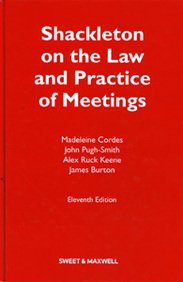


Description
LAW AND PRACTICE OF MEETINGS
MADELEINE CORDES, LLB, FCIS
JOHN PUGH-SMITH, MA (Oxon),
FSA ALEX RUCK KEENE, MA (Oxon), MA (Johns Hopkins)
JAMES BURTON GERALDINE CAULFIELD, ACIS
Review Author: marceljude.ai
Mode of review: doctrinal, practical, and critical legal commentary
I read the book and reviewed it as a legal text on public law, company law, local government law, insolvency procedure, deliberative procedure, and meeting governance. The book is entitled as Shackleton on the Law and Practice of Meetings,
List of Contents with Page Numbers
Front matter: Preface, p. v; About the Authors, p. vii; Table of Cases, p. xxiii; Table of Statutes, p. xlii; Table of Statutory Instruments, p. liii.
Chapter 1, The Legal Right, pp. 1–14.
Subsections: historical view, p. 1; assemblies, p. 2; public assembly conditions, p. 2; trespassory assemblies, p. 4; stopping persons proceeding to trespassory assemblies, p. 5; local variations, p. 6; processions and marches, p. 7; advance notice, p. 7; procession conditions, p. 8; procession prohibition, p. 9; organiser’s position under public order legislation, p. 9; use and abuse of the highway, p. 10; obstruction, p. 11; public nuisance, p. 12; election meetings, p. 12; parliamentary election meetings, p. 12; local government election meetings, p. 13; election expenses, p. 13; meeting rooms supplied by a local authority, p. 14.
Chapter 2, Breach of the Peace and Other Aspects of the Criminal Law, pp. 15–25.
Subsections: breach of the peace, p. 15; police duties and powers, p. 16; freedom of speech, p. 19; statutory offences, p. 19; disruption of meetings, p. 19; uniforms, p. 20; proscribed organisations, p. 20; terrorism stop-and-search powers, p. 20; public order violence offences, p. 21; riot, p. 21; violent disorder, p. 21; affray, p. 22; provoking violence or fear, p. 22; harassment/alarm/distress, p. 23; intentional harassment/alarm/distress, p. 23; racial hatred offences, p. 23; election-meeting disturbances, p. 24.
Chapter 3, The Maintenance of Order, pp. 26–30.
Subsections: role of the chairman, p. 26; ejection, p. 26; exclusion, p. 28; adjournment, p. 29; assistance from and to the police, p. 29.
Chapter 4, A Public Meeting, pp. 31–36.
Subsections: practical checklist, p. 31; agenda, p. 31; attendance sheets, p. 31; audience, p. 31; background papers, p. 31; budget, p. 31; chairman, p. 31; chairs, p. 32; comments sheet, p. 32; confidentiality, p. 32; creche, p. 32; disabilities, p. 32; disorder, p. 32; enquiries, p. 33; equipment, p. 33; fire alarm, p. 33; first aid, p. 33; insurance, p. 33; language, p. 33; minutes, p. 33; organiser, p. 33; platform, p. 34; press/TV/radio, p. 34; publicity, p. 34; punctuality, p. 35; refreshments, p. 35; security, p. 35; speeches from the floor, p. 35; stewards, p. 36; timing, p. 36; venue, p. 36; vote, p. 36.
Chapter 5, Convening the Meeting, pp. 37–51.
Subsections: general principles, p. 37; notice, p. 37; valid notice requirements, p. 37; date/time/place, p. 37; statement of purpose, p. 38; special business, p. 39; statutory/legal obligations, p. 41; clarity and honesty, p. 41; authority, p. 42; prescribed manner, p. 43; length of notice, p. 44; notice to all entitled persons, p. 45; compliance with rules, p. 46; validation of irregular notice, p. 46; challenging notice validity, p. 47; adjourned-meeting notice, p. 48; agenda, p. 48; agenda order, p. 49; precedent of notice plus agenda, p. 50.
Chapter 6, Constitution and Adjournment of the Meeting, pp. 52–62.
Subsections: venue, p. 52; quorum, p. 52; quorum definition, p. 52; minimum number, p. 53; counting the quorum, p. 53; no prescribed quorum, p. 54; absence of quorum, p. 54; lapse of time, p. 55; chairman, p. 56; qualities, p. 56; appointment, p. 56; basic duties, p. 57; preservation of order, p. 57; proper conduct, p. 57; sense of meeting, p. 58; removal, p. 59; adjournment, p. 59; definition, p. 59; adjournment by resolution, p. 60; adjournment by chairman, p. 61; procedure, p. 62; companies, p. 62.
Chapter 7, The Conduct of the Meeting, pp. 63–84.
Subsections: debate rules, p. 63; motions, p. 63; amendments, p. 65; putting the main question, p. 66; motion with amendment example, p. 67; chairman’s ruling, p. 68; termination of debate, p. 68; closure, p. 69; previous question, p. 69; next business, p. 69; lying on the table, p. 70; reference back, p. 70; adjournment of debate, p. 70; adjournment of meeting, p. 70; chairman vacating chair, p. 71; points of order, p. 71; voting methods, p. 71; acclamation, p. 72; ballot, p. 72; division, p. 73; show of hands, p. 73; poll, p. 74; poll arrangements, p. 76; proxy voting on a poll, p. 77; postal voting on a poll, p. 78; recount, p. 78; declaration of result, p. 78; casting vote, p. 79; majority, p. 80; majority definition, p. 80; majority binding minority, p. 80; special majorities, p. 82; ultra vires rule, p. 83; rescission, p. 83.
Chapter 8, Minutes, pp. 85–93.
Subsections: introduction, p. 85; minutes versus reports, p. 85; obligation to keep, p. 86; minutes as business aid, p. 86; drafting essentials, p. 86; confirmation, p. 89; amendment, p. 90; minutes as evidence, p. 91; inspection rights, p. 91; form and safekeeping, p. 92; company minutes, p. 93.
Chapter 9, The Committee System, pp. 94–98.
Subsections: general principles, p. 94; kinds of committees, p. 96; procedure, p. 97; committees in company matters, p. 98.
Chapter 10, The Principles of Natural Justice, pp. 99–111.
Subsections: introduction, p. 99; evolution, p. 100; present application, p. 101; principles, p. 103; hearing both sides, p. 103; no one judge in own cause, p. 106; decision-maker’s interest in result, p. 106; bias, p. 107; proper procedural requirements, p. 109.
Chapter 11, Applicable Law and Other Matters, pp. 112–118.
Subsections: applicable law and company classification, p. 112; classification, p. 112; community interest companies, p. 113; Societas Europaea, p. 113; charitable incorporated organisations, p. 113; public and private companies, p. 114; regulation, p. 114; ultra vires rule, p. 115; rule in Foss v Harbottle, p. 116; general meetings and accounts, p. 118.
Chapter 12, Members’ Meetings: Status and Convention, pp. 119–127.
Subsections: authority of the general meeting, p. 119; kinds of general meeting, p. 120; AGMs, p. 120; basic AGM obligation, p. 120; elective resolution not to hold AGM, p. 121; laying accounts, p. 121; accounting reference date, p. 122; general meetings, p. 122; meetings convened by directors, p. 122; member requisition meetings, p. 123; meetings convened by members where directors cannot do so, p. 124; court-convened meetings, p. 125; auditor-requisitioned meetings, p. 126.
Chapter 13, Constituting a Members’ Meeting, pp. 128–149.
Subsections: definition of member, p. 128; notice, p. 128; persons entitled to notice, p. 129; deceased/bankrupt members, p. 129; auditors, p. 130; members abroad, p. 131; joint holders, p. 131; transferor/transferee, p. 131; persons excluded by articles, p. 131; accidental omission, p. 132; force majeure, p. 132; notice form, p. 133; Stock Exchange requirements, p. 133; special business principles, p. 133; special business under articles, p. 134; explanatory statement, p. 135; special notice, p. 136; procedure under Companies Act 2006, s.312, p. 136; service, p. 137; notice length, p. 138; short notice consent, p. 139; postponement/cancellation/force majeure, p. 141; circulation of members’ resolutions and statements, p. 142; practical points, p. 143; precedents, pp. 144–145; chairman, p. 146; quorum, p. 147.
Chapter 14, Members’ Meetings: Attendance and Voting, pp. 150–172.
Subsections: corporation representatives, p. 150; voting generally, p. 152; voting qualification, p. 153; CREST qualification, p. 155; show of hands, p. 155; poll, p. 156; casting vote, p. 159; voting-right restrictions, p. 159; proxies, p. 160; proxy authority, p. 160; proxy form, p. 161; Stock Exchange requirements, p. 162; specimen, p. 162; proxy deposit, p. 165; proxies at adjourned meetings, p. 166; revocation/change, p. 167; joint holders/personal representatives/nominees/creditors, p. 169; duties of proxy holder, p. 169; adjournment of company meetings, p. 170.
Chapter 15, Members’ Meetings: Resolutions, pp. 173–181.
Subsections: ordinary resolution, p. 173; extraordinary resolution, p. 173; special resolution, p. 173; written resolutions, p. 174; general written-resolution rules, p. 174; private-company written resolutions, p. 174; single-member company decisions, p. 176; unanimous consent in lieu of meeting, p. 176; amendments to company resolutions, p. 177; ordinary-resolution amendments, p. 177; special-resolution amendments, p. 178; other resolution amendments, p. 180; conclusiveness of chairman’s declaration, p. 180; filing resolutions with Registrar, p. 181.
Chapter 16, Members’ Meetings: Minutes, pp. 182–184.
Subsections: obligation to keep, p. 182; minutes as evidence, p. 182; where kept and inspection rights, p. 184.
Chapter 17, Class Meetings, pp. 185–192.
Subsections: variation of class rights, p. 185; procedure, p. 186; court review, p. 188; the meetings, p. 188; example in practice, p. 191.
Chapter 18, Meetings under Section 425: Compromises and Arrangements, pp. 193–199.
Subsections: scope, p. 193; procedure, p. 195; majority, p. 196; court sanction, p. 197; compliance with Companies Act 2006 ss.896–897, p. 197; fair representation of classes, p. 197; objective reasonableness, p. 197; mergers and divisions of public companies, p. 198.
Chapter 19, Meetings of Members of Companies: Examples in Practice, pp. 200–229.
Subsections: AGM, p. 200; normal AGM, p. 202; choice of hall, p. 202; preparation, p. 203; press arrangements, p. 205; directors’ report, p. 206; notice and agenda precedent, p. 206; AGM agenda notes, p. 207; opening, p. 207; notice convening meeting, p. 208; auditors’ report, p. 208; current trading, p. 208; resolutions, p. 208; close, p. 209; difficult AGM, p. 210; articles, p. 210; venue, p. 212; before meeting, p. 213; questions, p. 215; amendments, p. 216; poll on amendment, p. 216; other points, p. 217; additional/substitute director, p. 218; voting points, p. 218; after meeting, p. 219; EGM, p. 220; director-convened EGM, p. 220; requisitioned EGM, p. 221; poll procedure, p. 223; before meeting, p. 223; poll demanded, p. 224; before poll begins, p. 224; during poll, p. 224; after poll, p. 225; decisions without meetings, p. 228.
Chapter 20, Powers and Duties of Directors, pp. 230–237.
Subsections: relationship with shareholders, p. 230; validity of acts, p. 232; defective appointment, p. 232; delegated powers/duties, p. 233; number below prescribed minimum, p. 235; subsequent ratification, p. 237.
Chapter 21, Appointment to and Departure from Office, pp. 238–248.
Subsections: appointment, p. 238; first directors, p. 238; subsequent directors, p. 238; nominated directors, p. 239; casual vacancies/additional directors, p. 239; age qualification, p. 240; rotation, p. 240; director appointment at general meeting, p. 242; removal under section 303, p. 243; procedure, p. 243; vacation of office, p. 247; resignation, p. 247; removal, p. 248; suspension, p. 248.
Chapter 22, Constitution and Conduct of Directors’ Meetings, pp. 249–260.
Subsections: directors acting as a body, p. 249; sole director meetings, p. 251; board-meeting notice, p. 251; chairman, p. 252; quorum, p. 253; conflict of interest, p. 255; voting, p. 256; written board resolutions, p. 257; minutes, p. 258; duty to keep minutes, p. 258; minutes as evidence, p. 258; Companies Act 2006, p. 260.
Chapter 23, Board Meetings: Examples in Practice, pp. 261–269.
Subsections: first board meeting, p. 261; public-company board meeting, p. 264; notice and agenda, p. 264; chairman’s role, p. 266; corporate governance, p. 266; minutes, p. 267; secretary’s duties, p. 267; before meeting, p. 267; during meeting, p. 268; after meeting, p. 268.
Chapter 24, Meetings in Insolvency Situations, Short of Winding Up, pp. 270–280.
Subsections: voluntary arrangement, p. 270; proposal, p. 270; meetings, p. 271; quorum, p. 272; voting/resolutions, p. 272; approval, p. 274; creditor points, p. 274; administration order, p. 275; administrator appointment, p. 275; administrator proposals, p. 276; creditors’ committee, p. 277; members’ meeting, p. 278; culmination, p. 278; creditor points, p. 278; administrative receivership, p. 278; creditor points, p. 280.
Chapter 25, Meetings in Insolvency Situations: Winding Up, pp. 281–296.
Subsections: winding up by court, p. 281; reasons, p. 281; petition and order, p. 282; first meetings of creditors/contributories, p. 282; liquidation committee, p. 284; later meetings, p. 285; final meeting, p. 286; creditor points, p. 286; voluntary winding up, p. 286; initial resolution, p. 287; members’ meeting, p. 287; first creditors’ meeting, p. 287; creditor points, p. 289; liquidator appointment, p. 290; liquidator powers/vacancies, p. 291; liquidation committee, p. 291; later creditors’ meetings, p. 292; generally applicable rules, p. 293; company personnel attendance, p. 293; advertisement-only notice, p. 294; venue, p. 294; resolutions, p. 294; chairman as proxy-holder, p. 294; suspension/adjournment, p. 294; quorum, p. 294; creditor voting entitlement, p. 295; proof delivery, p. 295; proof admission/rejection, p. 295; proofs/claims, p. 295; minutes, p. 296.
Chapter 26, Proxies and Company Representation in an Insolvency, pp. 297–301.
Subsections: proxy definition, p. 297; proxy forms, p. 297; use of proxies, p. 298; inspection right, p. 299; exception, p. 300; proxies at first creditors’ meeting, p. 300.
Chapter 27, Members’ Voluntary Winding Up, pp. 302–304.
Subsections: declaration of solvency, p. 302; liquidation effect, p. 303; liquidator appointment, p. 303; periodic meetings, p. 303; insolvency arising during process, p. 304; final meeting, p. 304.
Chapter 28, Meetings of Local Authorities, pp. 305–336.
Subsections: local government structure, p. 305; introduction, p. 305; constitutional arrangements, p. 306; elections, p. 307; local authority administration, p. 308; valid-meeting requisites, p. 308; standing orders, p. 308; delegation, p. 309; political balance, p. 312; decisions, p. 313; attendance records/minutes, p. 314; vacancy or defect, p. 314; conduct of members, p. 315; personal/prejudicial interests, p. 315; interests register, p. 319; standards committees, p. 319; investigation, p. 320; adjudication, p. 321; order at meetings, p. 322; ombudsman, p. 323; ultra vires, p. 325; principal councils, p. 325; holding meetings, p. 325; convening, p. 326; chairman, p. 327; vice-chairman, p. 328; quorum, p. 328; business order, p. 328; executive arrangements, p. 329; parish/community councils, p. 330; holding/convening/chairman/conduct/quorum/voting/public participation, pp. 330–332; parish/community meetings, p. 332; holding, p. 332; standing orders, p. 333; convening, p. 333; chairman, p. 333; voting, p. 334; minutes, p. 335; committees, p. 335; community meetings, p. 335.
Chapter 29, Local Authorities and Other Bodies:
Access to Meetings and Information, pp. 337–353. Subsections: introduction/history, p. 337; principal councils—access to meetings, p. 338; exclusion because of information, p. 340; press rights, p. 342; principal councils—access to information, p. 342; general access, p. 342; before meeting, p. 343; after meeting, p. 344; background papers, p. 345; press rights, p. 346; council-member rights, p. 347; additional publication duties, p. 349; bodies other than principal councils, p. 349; exclusion by resolution, p. 350; necessary arrangements, p. 351; order, p. 352; minutes, p. 352.
Chapter 30, Defamatory Statements, pp. 354–364.
Subsections: libel and slander, p. 354; malice, p. 354; statement, p. 355; publication, p. 355; defences, p. 357; justification, p. 357; fair comment, p. 357; privilege, p. 358; media reports, p. 361; offer of amends, p. 363; leave and licence, p. 363; limitation, p. 364.
Index begins at p. 365.
Chapter-by-Chapter Review
Chapter 1 — The Legal Right, pp. 1–14
This opening chapter performs the essential jurisprudential work of the book. It does not treat meetings as mere administrative events; it treats them as an expression of liberty. The chapter begins from the common-law proposition that a citizen is free unless restrained by law, contract, or statute. That idea becomes the foundation for the right to public assembly, political protest, public speech, and collective expression.
The chapter’s treatment of assemblies is particularly strong because it balances liberty against public order. The analysis of Public Order Act powers shows that the right to meet is not absolute. Conditions may be imposed on open-air assemblies where disorder, damage, disruption, or intimidation is reasonably feared. The discussion of trespassory assemblies adds a property-law dimension: public protest may be politically legitimate, but it cannot be detached from land rights and public-order control.
The sections on processions and marches are practical and doctrinal. The requirement of advance notice, the police power to impose conditions, and the possibility of prohibition are presented as a legal architecture for movement-based assembly. The chapter is strongest where it refuses to romanticize protest: it accepts peaceful protest as constitutionally valuable but insists that organisers must understand statutory limits.
The highway sections are especially important. The book distinguishes use of the highway for passage from occupation of the highway for meeting or protest. The professor’s point is that public space is legally layered: it is not simply “public” in an unlimited sense.
The election-meeting material widens the chapter’s scope. Parliamentary and local-government election meetings receive special treatment because democratic participation sometimes requires access to rooms, schools, public halls, and lawful campaign forums. The final subsection on local authority meeting rooms adds a public-law fairness concern: where a local authority makes facilities available, it should not discriminate on irrelevant grounds.
Overall, Chapter 1 is an excellent opening because it establishes the book’s central thesis: meeting law is the law of collective action under constraint.
Chapter 2 — Breach of the Peace and Other Aspects of the Criminal Law, pp. 15–25
Chapter 2 moves from civil and constitutional liberty into criminal regulation. It asks: when does a meeting cease to be a lawful exercise of association and become a criminal-law problem?
The breach-of-the-peace section is doctrinally central. Breach of the peace is not reduced to noise or inconvenience; it turns on harm, threat, fear, violence, or likely harm to person or property. This gives the police preventive power, but it also imposes a discipline: police action must be grounded in real apprehension, not speculative discomfort.
The section on police powers is valuable because it shows the elasticity of public-order law. Police may act to prevent disorder, but they must do so impartially. The treatment of freedom of speech is therefore not isolated; it is embedded in a conflict between expression and order.
The statutory-offence sections are dense but useful. The chapter covers disruption, political uniforms, proscribed organisations, terrorism powers, riot, violent disorder, affray, provoking violence, harassment, racial hatred offences, and disturbances at election meetings. In a law-school classroom, this chapter would be an excellent case study in the difference between expressive conduct and criminal conduct.
Its major strength is that it explains criminal liability in meeting-specific terms. Its limitation is that it inevitably reflects the statutory framework as at the book’s date. But as a historical and doctrinal account of how criminal law interacts with meetings, it is strong.
Chapter 3 — The Maintenance of Order, pp. 26–30
This short chapter is one of the book’s practical jewels. It places the chairman at the centre of meeting order. The chairman is not treated as ceremonial; he or she is the constitutional officer of the meeting.
The subsection on the chairman’s role explains the core duties: calling speakers, regulating speeches, deciding points of order, putting motions, controlling votes, and handling heckling. The best part of the chapter is its realism. It accepts that heckling may be part of public speech, but organised disruption may defeat the meeting’s purpose.
The ejection and exclusion subsections are legally important. They distinguish between meetings where admission is free and meetings where payment creates contractual rights. They also emphasize proportionality in using force. A person may be removed, but only lawfully and reasonably.
Adjournment is treated as a remedy for disorder. This connects back to the chairman’s legal duty: sometimes order cannot be restored without suspending proceedings. The police-assistance section completes the practical framework by explaining when police involvement is proper and when organisers must rely on their own stewards or venue arrangements.
For students of administrative and company law, this chapter teaches that procedure is not decorative. It is the condition of legitimacy.
Chapter 4 — A Public Meeting, pp. 31–36
Chapter 4 is almost a manual within the treatise. Its checklist format covers the practical mechanics of a public meeting: agenda, audience, papers, budget, chair, venue, equipment, accessibility, media, publicity, security, speeches, stewards, timing, and voting.
From a law professor’s perspective, this chapter is valuable because it translates legal principles into institutional competence. Law is not enough; a meeting can be lawful and still badly run. Poor acoustics, inadequate papers, inaccessible venues, uncontrolled microphones, bad timing, or weak chairing may undermine procedural fairness even if no formal rule is broken.
The disability and language subsections are especially significant. They show that access is not merely about formal permission to attend; meaningful participation may require physical accessibility, legible materials, hearing support, language planning, and child-care considerations.
The chapter also treats publicity and press arrangements not as public relations but as part of democratic participation. A public meeting must be findable, understandable, and manageable.
This chapter’s legal value lies in preventive governance. It helps organisers avoid disputes before they arise.
Chapter 5 — Convening the Meeting, pp. 37–51
Chapter 5 is one of the foundational chapters of the entire book. A meeting’s legitimacy begins before anyone enters the room. It begins with notice.
The chapter identifies the essential requirements of valid notice: date, time, place, purpose, special business, statutory compliance, clarity, authority, proper service, adequate notice length, circulation to all entitled persons, and compliance with governing rules. In doctrinal terms, the chapter teaches that notice is not a technicality; it is the procedural expression of the right to participate.
The discussion of special business is particularly important. A member cannot decide whether to attend, oppose, support, appoint a proxy, or remain silent unless the notice fairly discloses the business. The chapter also rightly emphasizes that notice must be honest and definite, not misleading or conditional in a way that deprives members of understanding.
The agenda sections are equally important. The agenda is not merely a list; it structures power. What appears on the agenda may be decided. What is omitted may be excluded. The “any other business” discussion is valuable because it warns against ambush.
As a matter of legal pedagogy, Chapter 5 teaches that procedural invalidity often arises from apparently small omissions. Bad notice can invalidate everything that follows.
Chapter 6 — Constitution and Adjournment of the Meeting, pp. 52–62
Chapter 6 deals with the question: when does a gathering become a valid meeting?
Venue, quorum, chairman, and adjournment are treated as constitutive requirements. The quorum discussion is central. Without a quorum, there may be discussion, but there is no valid decision. The chapter’s treatment of minimum numbers, counting, absence of prescribed quorum, loss of quorum, and lapse of time provides a rigorous account of collective legal personality in action.
The chairman section is excellent. It defines the qualities of a chairman and the legal nature of the chairman’s authority. The chairman preserves order, ensures proper conduct, interprets the sense of the meeting, and may be removed in appropriate circumstances.
Adjournment is treated both as an ordinary procedural tool and as an emergency safeguard. The chapter distinguishes adjournment by resolution from adjournment by the chairman. It also explains that an adjourned meeting is usually a continuation of the original meeting, not a new meeting.
The legal insight of Chapter 6 is that a meeting must be constituted before it can deliberate. Law does not simply validate outcomes; it validates the institutional conditions under which outcomes are reached.
Chapter 7 — The Conduct of the Meeting, pp. 63–84
Chapter 7 is the book’s core procedural chapter. It explains how a meeting thinks, speaks, amends, votes, and concludes.
The discussion of motions and amendments is especially important. A motion gives the meeting a question to decide. Amendments allow the meeting to refine, redirect, or alter that question. The chapter’s treatment of amendment order, scope, and admissibility is a useful safeguard against procedural manipulation.
The termination-of-debate devices — closure, previous question, next business, lying on the table, reference back, adjournment of debate, adjournment of meeting, and chair vacating the chair — reveal the book’s procedural sophistication. These mechanisms are not mere parliamentary ornament. They control time, suppress obstruction, prevent ambush, and allow orderly decision-making.
The voting sections are particularly strong. Acclamation, ballot, division, show of hands, poll, proxy voting, and postal voting each carry a different theory of representation. A show of hands treats members equally as persons present. A poll may weight votes by shares or legal entitlement. Proxy voting extends participation beyond physical attendance. Postal voting changes the democratic geometry of the meeting.
The chapter’s final sections on majority, special majority, ultra vires action, and rescission show that even a majority cannot do everything. Law limits collective power.
This is one of the most useful chapters in the book for lawyers, company secretaries, chairs, union officers, local authority members, and judges assessing meeting disputes.
Chapter 8 — Minutes, pp. 85–93
Chapter 8 gives minutes the legal dignity they deserve. Minutes are not clerical afterthoughts. They are evidence, memory, accountability, and governance infrastructure.
The chapter distinguishes minutes from reports. Reports may narrate or advise; minutes record formal proceedings. That distinction matters in litigation because minutes may prove what was done, decided, or authorized.
The drafting section is practical and legally sophisticated. Good minutes should be accurate, clear, concise, structured, timely, and free from unnecessary opinion. They should record decisions, essential context, and resolutions, but not become transcripts.
The sections on confirmation and amendment are particularly important. Once signed, minutes should not be casually altered. Errors should be corrected through proper later procedure. This preserves evidentiary integrity.
Inspection and safekeeping complete the chapter. The discussion anticipates modern transparency pressures, especially for public bodies.
Chapter 8’s major contribution is to show that minutes are the legal memory of the meeting. Without them, authority becomes difficult to prove.
Chapter 9 — The Committee System, pp. 94–98
Chapter 9 explains delegated deliberation. Committees exist because full bodies cannot efficiently perform every task. But delegation creates legal risk.
The chapter begins with the principle that a committee cannot exceed the powers committed to it. The delegatus principle is central: a delegate cannot normally sub-delegate without authority. The chapter’s examples show how easily committee action may become invalid if the terms of reference are unclear.
The kinds of committees — executive, standing, special, sub-committee, joint committee — are treated with useful distinctions. An executive committee may make decisions. A special committee may merely investigate and report. A sub-committee depends on the parent committee’s authority. A joint committee introduces inter-institutional authority.
The procedure section emphasizes notice, agenda, quorum, voting, reports, and the need to return matters to the parent body where the committee lacks executive power.
The company-matters subsection links committee practice to board governance and corporate governance committees.
Chapter 9 is concise but conceptually rich: it teaches that committees are creatures of authority, not free-standing mini-legislatures.
Chapter 10 — The Principles of Natural Justice, pp. 99–111
Chapter 10 is doctrinally one of the most important chapters. It connects meeting procedure to administrative justice.
The chapter explains natural justice as procedural fairness: the right to be heard, the right to an unbiased decision-maker, and the requirement that proper procedures be followed. It also notes the influence of human rights principles on public authority meetings.
The “hear both sides” principle is vital in disciplinary, licensing, expulsion, planning, and local-authority contexts. Notice is not enough if the affected person lacks a real opportunity to respond.
The bias sections are equally important. A decision-maker must not have a pecuniary or other disqualifying interest, and must not appear biased. The chapter’s emphasis on appearance is sound: justice must be seen to be done because legitimacy depends on public confidence.
The final procedural-requirements section matters because fairness may require more than the bare common-law minimum where statutes, rules, constitutions, or standing orders provide additional safeguards.
Chapter 10 elevates the book from a manual of meeting mechanics into a work of public law.
Chapter 11 — Applicable Law and Other Matters, pp. 112–118
Chapter 11 begins the company-law portion of the book. It classifies companies and explains the legal environment in which company meetings operate.
The classification material covers companies limited by shares, limited by guarantee, unlimited companies, community interest companies, European forms, charitable incorporated organisations, and the public/private company distinction. This matters because meeting obligations differ by corporate form.
The regulation section situates company meetings within statutory and constitutional sources: Acts, articles, listing requirements, and common law.
The ultra vires discussion is doctrinally important. Historically, corporate capacity was limited by objects and powers; modern law has softened much of that, but the problem of authority remains. A meeting may purport to decide something, but the decision must be within the company’s powers.
The rule in Foss v Harbottle is crucial: wrongs to the company are generally for the company to pursue, not individual shareholders. That rule shapes when meeting decisions can be challenged.
The general-meetings-and-accounts section bridges corporate classification with reporting duties.
This chapter is short, but it supplies the conceptual map for the later company chapters.
Chapter 12 — Members’ Meetings: Status and Convention, pp. 119–127
Chapter 12 explains the authority of the general meeting. The general meeting is described as the ultimate source of shareholder authority, even though modern company management is usually vested in the board. It elects directors, receives accounts, passes special resolutions, and may ratify certain defective acts.
The AGM discussion is historically and practically important. The book notes that private companies no longer have to hold AGMs under the Companies Act 2006 regime, while public companies remain subject to AGM expectations and accounting/reporting obligations.
The general-meetings subsections are especially useful because they distinguish who can convene a meeting: directors, requisitioning members, members acting where directors fail, the court, and auditors. The court-convened meeting discussion is important because it shows judicial intervention where the constitutional machinery breaks down.
The auditor-requisitioned meeting section adds an accountability dimension. Auditors are not merely financial technicians; in certain circumstances, they may force members to confront matters arising from resignation or report.
Chapter 12’s main value is that it explains the general meeting as a constitutional forum of corporate accountability.
Chapter 13 — Constituting a Members’ Meeting, pp. 128–149
Chapter 13 is a detailed treatment of how a shareholders’ meeting is validly brought into being.
The definition of member begins with the register: membership is not merely economic ownership but legal recognition. That becomes especially important in CREST and nominee contexts.
The notice sections are extensive and rightly so. They address who must receive notice, including deceased or bankrupt members, auditors, members abroad, joint holders, transferors and transferees, and persons excluded by articles. The book recognizes that notice problems are among the most common grounds of challenge.
The discussion of special business, explanatory statements, and special notice is doctrinally important. Where a proposed resolution affects directors, auditors, capital structure, or members’ rights, clarity and statutory timing become essential. The special-notice rules under Companies Act 2006 s.312 are especially important for removal of directors and auditors.
The chapter’s treatment of short notice, postponement, cancellation, force majeure, circulation of members’ resolutions, chairman, and quorum completes the validity architecture.
The quorum section is especially strong. It explains that quorum is not ceremonial: without it, business cannot be validly transacted. It also notes the special rule for single-member companies and the importance of articles.
This is among the most practically significant chapters in the company-law part of the book.
Chapter 14 — Members’ Meetings: Attendance and Voting, pp. 150–172
Chapter 14 examines who may attend and how corporate will is counted.
The corporation-representative section is significant because corporate members do not attend physically as natural persons. They act through authorized representatives. The Companies Act 2006 development allowing multiple corporate representatives is especially important for institutional shareholding.
The voting sections distinguish voting generally, qualification, CREST, show of hands, poll, casting vote, and voting restrictions. This chapter’s strength lies in showing that “the vote” is not one legal thing. On a show of hands, persons present matter. On a poll, voting rights may reflect shareholding. In listed companies, voting mechanics carry governance consequences.
The proxy sections are highly practical. They cover authority, form, deposit, adjournments, revocation, joint holders, personal representatives, nominees, creditors, and duties of proxy holders. The book correctly treats the proxy-holder as an agent who should follow instructions.
Adjournment of company meetings closes the chapter by connecting attendance and voting to continuity of proceedings.
Chapter 14 is indispensable for understanding modern shareholder democracy, especially where beneficial ownership, nominee structures, proxy solicitation, and institutional voting complicate the simple idea of members in a room.
Chapter 15 — Members’ Meetings: Resolutions, pp. 173–181
Chapter 15 focuses on the formal expression of corporate will.
The ordinary-resolution section explains the simple-majority principle and the treatment of abstentions. Its practical clarity is excellent: abstainers are not counted as votes against unless the relevant rule says otherwise.
The treatment of extraordinary resolutions notes their disappearance under the Companies Act 2006 framework, leaving ordinary and special resolutions as the central categories. The special-resolution section is important because special resolutions alter matters of constitutional significance and require heightened majority support.
Written resolutions are a key modern development. The chapter explains how private companies may make decisions without physical meetings, reducing procedural burden. This is one of the places where the book is most aware of the shift from meeting-based corporate governance toward written-consent governance.
The sections on single-member companies and unanimous consent explain the pragmatic edge of company law: substance sometimes prevails over formal meeting ceremony where all who matter have assented.
The amendment sections are essential. Company resolutions cannot always be amended freely because members received notice of a particular proposal. The chairman’s declaration and filing with the Registrar complete the formal validity chain.
Chapter 15 is a crisp and effective account of how meeting discussion becomes corporate law.
Chapter 16 — Members’ Meetings: Minutes, pp. 182–184
Chapter 16 narrows the general law of minutes to company members’ meetings.
The obligation to keep minutes is treated not merely as recordkeeping but as statutory compliance. Minutes are evidence of proceedings and decisions, and the right location and inspection rights matter because members must be able to verify the company’s formal acts.
This chapter is short but important. It reinforces the book’s broader message that corporate governance depends on disciplined documentary practice.
Chapter 17 — Class Meetings, pp. 185–192
Chapter 17 addresses one of the most technically sensitive areas of company meeting law: class rights.
A class meeting arises where rights attached to a particular class of shares or members are varied. The chapter’s key contribution is its insistence that not all shareholders are always similarly situated. A majority of the whole company may not fairly speak for a class whose rights are separately affected.
The procedure and court-review sections are important safeguards. Courts may intervene where class definition, consent, or procedure is defective. The meeting itself must be properly convened and conducted, but the court’s role ensures that majority power does not improperly prejudice class rights.
The practical example helps translate abstract class-right doctrine into meeting procedure.
Chapter 17 shows the book at its most equity-conscious: meeting law is not only about counting votes, but about identifying whose votes should count for which legal question.
Chapter 18 — Meetings under Section 425: Compromises and Arrangements, pp. 193–199
Chapter 18 explains scheme meetings, now framed through Companies Act 2006 provisions. These meetings are used for compromises or arrangements between a company and creditors or members.
The scope and procedure sections are important because scheme meetings are court-supervised. Unlike ordinary shareholder meetings, these meetings sit within a judicial approval process.
The majority section is central. Schemes require special statutory majorities, but numbers alone do not end the inquiry. Court sanction requires three safeguards: statutory compliance, fair representation of each class, and objective reasonableness.
The chapter’s treatment of mergers and divisions of public companies adds a transactional dimension. It shows how meetings facilitate restructuring, acquisition, and corporate reorganization.
This chapter is doctrinally dense but well structured. It demonstrates that meeting procedure can be a mechanism of corporate transformation, not just ordinary governance.
Chapter 19 — Meetings of Members of Companies: Examples in Practice, pp. 200–229
Chapter 19 is the most operational company-law chapter. It converts the prior doctrinal chapters into AGM and EGM practice.
The normal AGM sections address hall choice, preparation, press, directors’ report, notice and agenda, opening, auditors, trading updates, resolutions, and closing. This is a complete governance script.
The difficult AGM sections are especially valuable. The book recognizes shareholder activism, pressure groups, hostile questions, amendments, polls, substitute directors, and post-meeting consequences. The chapter also refers to reform debates about AGM usefulness, shareholder apathy, proxy voting, institutional investors, and poll voting.
The EGM sections explain both director-convened and requisitioned meetings. This matters because requisitioned meetings are often adversarial.
The poll-procedure sections are excellent. A poll is not simply a vote; it requires planning, documentation, scrutiny, timing, and accurate announcement.
The final section on decisions without meetings is important because it recognizes written resolutions and unanimous assent as alternatives to formal physical meetings.
Chapter 19 is one of the book’s most useful chapters for company secretaries and legal advisers.
Chapter 20 — Powers and Duties of Directors, pp. 230–237
Chapter 20 examines the relationship between the board and shareholders. It begins from the principle that corporate powers are exercised according to the constitution, usually with management vested in directors.
The chapter’s strongest section concerns validity of acts. Defective appointment may not necessarily invalidate acts done in good faith. This protects third parties and commercial certainty. But the book also makes clear that validation provisions are not a license for bad faith or complete disregard of appointment rules.
Delegation is treated carefully. Directors generally act as a board, but committees, executive directors, and local boards may act where properly authorized. The chapter’s legal point is that board power is collective unless validly delegated.
The section on too few directors is practical and important. The company may still be bound in favor of innocent third parties, but directors may be in breach. Subsequent ratification completes the picture by showing how irregular acts may sometimes be cured.
Chapter 20 is a useful bridge from members’ meetings to board meetings.
Chapter 21 — Appointment to and Departure from Office, pp. 238–248
Chapter 21 concerns the life cycle of directors: appointment, qualification, rotation, removal, resignation, and vacation of office.
The appointment sections distinguish first directors, subsequent directors, nominated directors, and casual vacancies. This is important because appointment routes determine validity.
The age-qualification discussion reflects Companies Act 2006 reforms: the upper age rule was removed, while a minimum age requirement applies.
Rotation is treated as a shareholder accountability mechanism. It gives shareholders periodic opportunity to review board composition. The chapter explains how failure to hold required meetings or retire directors may create serious governance consequences.
The removal section is legally significant. Removal of directors by members requires statutory procedure and notice protections. Departure by resignation, removal, and suspension completes the governance cycle.
Chapter 21 is a strong procedural account of board composition.
Chapter 22 — Constitution and Conduct of Directors’ Meetings, pp. 249–260
Chapter 22 is the core board-meeting chapter.
It begins with the principle that directors must act as a body. Informal encounters may sometimes qualify as meetings, but not where one director attempts to manufacture a meeting against the will or understanding of another.
Notice of board meetings is crucial because each director has a right to participate in collective decision-making. Quorum ensures that the board acts through a legally sufficient number.
The conflict-of-interest section is one of the most important in the chapter. Directors must disclose interests, and interested directors may be unable to vote or count toward quorum depending on the articles and applicable law.
Voting, written resolutions, and minutes complete the procedural framework. The minutes sections link back to the evidentiary function of records.
Chapter 22 is doctrinally careful and practically essential. It teaches that board authority is collective, procedural, and fiduciary.
Chapter 23 — Board Meetings: Examples in Practice, pp. 261–269
Chapter 23 turns board-meeting doctrine into practice.
The first-board-meeting material is useful for newly incorporated companies: appointment of officers, bank mandates, share issues, registers, accounting reference dates, and administration often begin here.
The public-company board-meeting sections address notice, agenda, chairman’s role, corporate governance, minutes, and secretary’s duties. The secretary’s role is especially important. Before the meeting, the secretary prepares papers and agenda. During the meeting, the secretary monitors procedure and records decisions. After the meeting, the secretary implements decisions, communicates outcomes, and prepares minutes.
The chapter’s strength lies in its insistence that board meetings are legal events and managerial events at the same time.
Chapter 24 — Meetings in Insolvency Situations, Short of Winding Up, pp. 270–280
Chapter 24 shifts into insolvency. It identifies five main ways to regulate an insolvent or near-insolvent company: voluntary arrangement, administration, administrative receivership, court winding up, and voluntary winding up.
The voluntary-arrangement section is important because it shows how meetings can preserve business value. The company may propose a compromise with creditors, supervised by a nominee, with meetings convened to consider it.
The administration section emphasizes rescue and creditor management. Administrator proposals, creditors’ committees, members’ meetings, and culmination procedures show that insolvency meetings are not ordinary governance forums; they are collective mechanisms for managing distress.
Administrative receivership is treated more briefly but remains important as a creditor enforcement structure.
Chapter 24 is valuable because it reorients meeting law around creditor democracy rather than shareholder democracy.
Chapter 25 — Meetings in Insolvency Situations: Winding Up, pp. 281–296
Chapter 25 is a detailed procedural treatment of winding-up meetings.
The winding-up-by-the-court sections explain reasons for winding up, petition/order, first meetings of creditors and contributories, liquidation committees, later meetings, final meetings, and creditor concerns.
The voluntary-winding-up sections are equally practical: initial resolution, members’ meeting, first creditors’ meeting, liquidator appointment, liquidator powers, liquidation committees, and subsequent creditor meetings.
The generally applicable rules are highly valuable. They address attendance of company personnel, notice by advertisement, venue, resolutions, chairman as proxy-holder, adjournment, quorum, creditor voting entitlement, proofs of debt, admission and rejection of claims, and minutes.
The chapter’s most important insight is that insolvency meetings are meetings of economic loss allocation. Procedure therefore matters intensely because creditors’ rights may be altered, prioritized, or compromised.
Chapter 26 — Proxies and Company Representation in an Insolvency, pp. 297–301
Chapter 26 is narrow but very practical.
In insolvency, creditors often cannot attend personally. Proxy forms become the mechanism through which creditors exercise power. The chapter covers proxy definition, form, use, inspection, exceptions, and practical completion points.
The detailed advice on first creditors’ meeting proxies is useful: correct company name, creditor identity, proxy-holder identity, voting instructions, signature authority, dating, return instructions, and avoiding defective faxed forms.
This chapter’s value is procedural accuracy. In insolvency, a defective proxy may mean a lost vote on liquidator appointment or committee formation.
Chapter 27 — Members’ Voluntary Winding Up, pp. 302–304
Chapter 27 deals with solvent winding up. The key feature is the declaration of solvency, made by directors after full inquiry and stating that debts can be paid within the statutory period.
The effect of liquidation is that normal corporate life changes: powers shift to the liquidator, share transfers may be restricted, and the winding-up process becomes the company’s central legal purpose.
The liquidator appointment section explains the members’ role. The periodic-meetings section ensures accountability if the liquidation takes longer than a year.
The most important subsection is the position in case of insolvency. If the liquidator concludes that the company cannot pay debts in full, creditors must be brought in, and the process shifts toward a creditors’ voluntary winding-up structure.
The final meeting closes the process through accounts, explanation, Gazette notice, return, and dissolution.
This chapter is concise but clear. It shows that even a solvent liquidation needs procedural discipline.
Chapter 28 — Meetings of Local Authorities, pp. 305–336
Chapter 28 is a major public-law chapter. It begins with the structure of local government in England and Wales: principal councils, districts, counties, London boroughs, parishes, communities, and unitary structures.
The administration sections cover valid meeting requirements, standing orders, delegation, political balance, decisions, attendance records, minutes, vacancies, member conduct, interests, standards committees, investigation, adjudication, order, ombudsman review, and ultra vires limits.
The personal and prejudicial interests sections are especially important. Local authority decisions must not only be lawful but publicly credible. Interest rules prevent members from participating where private interests compromise public duty.
The principal-council sections cover holding, convening, chairing, vice-chairing, quorum, order of business, and executive arrangements. The parish and community council sections add another level of local democratic procedure, including public participation.
Chapter 28 is one of the strongest parts of the book. It shows the special nature of public meetings: local authority meetings are not private associational gatherings but exercises of public power.
Chapter 29 — Local Authorities and Other Bodies: Access to Meetings and Information, pp. 337–353
Chapter 29 is the transparency chapter. It traces the historical movement from private local authority meetings to statutory public and press access. It explains the development through the 1908 press-access legislation, the 1960 public-admission framework, the Local Government Act 1972, the 1985 access-to-information reforms, executive arrangements, freedom of information, and environmental information rules.
The principal-council access sections address when the public may attend and when exclusion is justified because of confidential or exempt information. This is a difficult balance: openness is the default democratic value, but confidentiality may be legally necessary.
The access-to-information sections are crucial. They cover agenda and report availability before meetings, minutes and records after meetings, inspection of background papers, press rights, council-member rights, and publication duties.
The bodies-other-than-principal-councils sections are practical for parish councils and similar bodies. They cover notice, agendas, press facilities, public attendance, disorder, and minutes.
Chapter 29 is essential reading for anyone involved in local public governance. It treats access not as an administrative courtesy, but as a democratic right structured by statute.
Chapter 30 — Defamatory Statements, pp. 354–364
Chapter 30 closes the book by warning that meetings create speech risk. The chapter explains that a meeting itself cannot defame or be defamed, but individuals and corporations may be liable for defamatory statements made at or through meetings.
The libel/slander section is useful because meetings may involve spoken words, written papers, recordings, broadcasts, and media reports. The distinction between oral slander and written or recorded libel has become blurred by technology.
The malice section matters because qualified privilege may protect some meeting communications, but malice can defeat that protection. The statement and publication sections explain what makes words actionable and why publication to third parties is essential.
The defences section covers justification, fair comment, privilege, media reports, offer of amends, leave and licence, and limitation. The offer-of-amends section is particularly practical because it provides a statutory mechanism to resolve defamation risk without full litigation.
This chapter is an excellent closing warning: speech in meetings may be protected, but it is not lawless.
Overall Review of the Entire Book
Shackleton on the Law and Practice of Meetings is not merely a procedural manual. It is a legal anatomy of collective decision-making.
Its greatest strength is its range. It covers public meetings, protest, criminal law, private associations, companies, committees, natural justice, local authorities, insolvency, and defamation. Few legal subjects cut across so many fields. The book’s unifying insight is that meetings are where legal personality, democratic participation, corporate authority, public power, and procedural fairness become visible.
As a law professor, I would describe the book as a doctrinal-practical hybrid. It is doctrinal because it explains rules, cases, statutory powers, and legal principles. It is practical because it tells chairs, secretaries, directors, councillors, auditors, creditors, and organisers what to do before, during, and after a meeting.
The book’s central themes are:
First, notice is justice. Whether in public law, company law, or private association law, a person cannot participate meaningfully unless properly informed.
Second, quorum is legitimacy. A decision made by too few people, or by the wrong people, may be void.
Third, the chairman is a constitutional actor. The chair is not merely a moderator; the chair preserves order, ensures fairness, rules on procedure, ascertains the sense of the meeting, and protects the meeting from disorder or manipulation.
Fourth, minutes are institutional memory. The book repeatedly shows that decisions without records are legally fragile.
Fifth, majority rule is limited. Majorities bind minorities only within legal powers, procedural rules, class rights, natural justice, and statutory limits.
Sixth, meetings are not all the same. A protest meeting, company AGM, board meeting, creditors’ meeting, local authority meeting, and parish meeting all involve collective procedure, but each is governed by a different legal logic.
The strongest chapters are Chapter 5 on convening, Chapter 7 on conduct, Chapter 10 on natural justice, Chapter 13 on constituting members’ meetings, Chapter 19 on company-meeting practice, Chapter 22 on directors’ meetings, and Chapters 28–29 on local authorities and public access.
The book’s main limitation is inevitable: much of its statutory detail reflects the law as treated in the book itself. A modern practitioner must check current legislation and later cases before relying on any statutory rule. But as a structured exposition of meeting law and as a guide to legal reasoning about meetings, the book remains exceptionally valuable.
The final judgment: this is a serious, practice-facing legal treatise. It teaches that meetings are not informal gatherings that law occasionally notices. They are legal institutions. When properly convened, constituted, chaired, recorded, and concluded, they allow groups to act with legal authority. When mishandled, they create invalidity, liability, unfairness, and litigation.
- MALAYSIA'S 1ST AI LAWYER - CLICK HERE
- ISMAIL – INTEGRATED SINGAPORE/MALAYSIA AI & LAW (Library)
- OPENING OF SINGAPORE MALAYSIA AI CENTRE AND LAW LIBRARY
- LIFT - LAW INSTRUMENTS FORMS & TEMPLATES
- LAWS OF MALAYSIA FOR SINGAPOREAN DUMMIES
- HANNAH YEOH'S ARTIFICIAL INTELLIGENCE LAW ENCYCLOPEDIA
- LEAD CR - Law Ecosystem Archive Databases on CD-ROM
- BREAKING NEWS FROM MJN
- CLICK HERE CO. PROFILE
- EXCITING NEW SERIES - THE ADVENTURES OF BOBBY TAN -ADVOCATE & SOLICITOR IN THE HIGH COURT OF NORTH BORNEO by marceljude.ai
- MEDICO LEGAL - BY PRISKILA AKWILA & GLORIOUS PETAL SDN BHD - powered by marceljude.ai
- MISCELLANOUS
- ANNOTATED STATUTES OF SABAH - A NEW SERIES
- e-library - marceljude.ai
- DRAFT - DOCUMENT RESEARCH & AUTOMATED FILING TECHNOLOGY
- CLARA – Case Law Analysis & Retrieval AI
- FOR RESEARCH REQUEST CLICK HERE
- CLICK HERE TO ASK ANYTHING
- RAMBO'S LAW - THE LAW OF THE LAW JUNGLE - EXCITING NEW SERIES - CASE ANALYSIS BY JOHN RAMBO @ +60138646786
- PRISKILA AKWILA ADVOCATES - High Court of Sabah & Sarawak @ Kota Kinabalu
- COLA - COMMONWEALTH ONLINE LAWCASES AI -marceljude.ai
- THE LAW LIBRARY THAT COMES TO YOU ANYWHERE AND ANYTIME
- marceljude.ai training academy
