
Principles of Statutory Interpretation by Guru Prasanna Singh
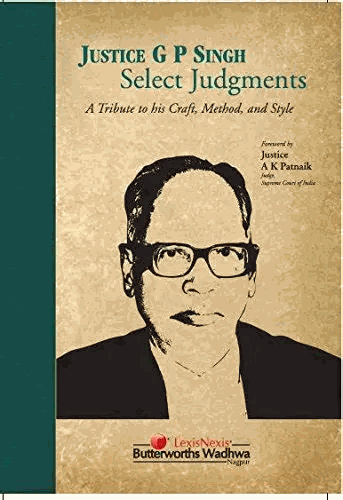


Description
Principles of Statutory Interpretation
Guru Prasanna Singh Llb & Lld (Hon.)
Chief Justice, High Court of Madhya Pradesh, 1978-1984; Chairman, Madhya Pradesh Law Commission, 1990-1992.
Review by marceljude.ai
This is a doctrinal treatise on statutory interpretation. Its structure is ambitious: it moves from foundational theory, to interpretive rules, to internal and external aids, to specialized interpretive problems involving repeal, tax, penal law, remedial legislation, delegated legislation, and the General Clauses Act. The book is arranged into twelve chapters, followed by an appendix on the General Clauses Act, which is treated not as decorative material but as part of the working machinery of interpretation.
Overall Character of the Book
This is not a light introduction to statutory interpretation. It is a lawyer’s and judge’s working book. Its method is cumulative, case-based, and heavily doctrinal. The author does not merely list interpretive maxims; he shows how maxims compete, overlap, qualify one another, and often require judicial judgment rather than mechanical application.
The central intellectual contribution of the book is its refusal to treat interpretation as either purely literal or purely purposive. The book repeatedly shows that statutory meaning is formed by text, context, purpose, legal history, consequences, constitutional limits, and institutional restraint. It is therefore a book about legal judgment, not just language.
As a law professor, I would describe the book as a classic common-law method text: it teaches statutory interpretation through principles, exceptions, sub-rules, illustrations, and judicial experience. Its greatest strength is depth. Its greatest difficulty is also depth. Students may find it dense, but advocates, judges, researchers, and serious law students will find it unusually rich.
Chapter 1 — Basic Principles
Chapter 1 lays the jurisprudential foundation. It begins by distinguishing interpretation and construction, while recognizing that in ordinary legal usage the two are often treated as overlapping. The chapter then turns to the “intention of the Legislature,” not as a mystical inquiry into what individual lawmakers privately thought, but as the legally discoverable meaning of statutory language read through accepted interpretive principles. The chapter also establishes three recurring ideas: a statute must be read as a whole; it must be construed to be effective and workable; and where meaning is genuinely plain, courts must ordinarily give effect to it even if consequences appear inconvenient.
The real value of this chapter is that it destabilizes simplistic literalism. The author explains that “plain meaning” is not discovered by staring at a word in isolation. A word becomes plain only after context is considered. This is a crucial point. In statutory interpretation, context is not a rescue device used only after ambiguity appears; it is part of the process by which ambiguity or clarity is discovered in the first place.
From a professor’s perspective, this chapter is particularly useful because it teaches institutional discipline. Courts interpret; they do not legislate. Yet interpretation is not clerical. Judges must sometimes choose between plausible meanings, avoid futility, and give life to statutory design. The chapter therefore introduces a theme that runs through the whole book: judicial creativity is legitimate only when anchored to the statute.
Its weakness is that the concept of legislative intention remains somewhat traditional. Modern jurisprudence might press harder on whether a multi-member legislature can truly be said to possess a single “intention.” But the author’s answer is practical rather than philosophical: courts need a disciplined method, and “legislative intention” is the conventional name for that method.
Chapter 2 — Guiding Rules
Chapter 2 is the book’s first major operational chapter. It examines the rule that statutory language should be read as it is. This includes avoiding addition, substitution, or rejection of words; dealing with casus omissus; knowing when departure from the literal wording is permissible; and recognizing when words may be treated as superfluous only with caution. It then addresses literal construction, natural and grammatical meaning, exact versus loose meaning, technical terms, legal terms, regard to subject and object, the mischief rule, purposive construction, consequences, harmonious construction, and avoidance of uncertainty or friction in the statutory system.
This chapter is one of the book’s strongest because it shows that interpretive rules are not rigid commands. They are disciplined presumptions. The rule against adding words protects legislative supremacy. But the author also recognizes that statutory drafting is imperfect. A court may sometimes supply or reject words where the statutory scheme clearly demands it and where the alternative would defeat the statute.
The discussion of casus omissus is especially important. The author’s treatment reflects the classic judicial caution: a court should not fill a legislative gap merely because the court thinks the legislature should have done so. Yet the book also shows that courts must avoid creating a gap by overly rigid interpretation. This is a sophisticated point. The real danger is not only judicial activism; it is also judicial under-reading.
The treatment of the rule in Heydon’s Case and purposive interpretation is central to the chapter. The author does not present the mischief rule as a license to rewrite legislation. Rather, it is a disciplined inquiry into what defect or mischief the statute was meant to address. The retrieved text shows the author’s nuanced position: after words are read in context, if only one construction is possible, plain meaning prevails; but context includes the previous state of the law and the mischief to be remedied.
This chapter should be taught slowly. It is not just a list of rules; it is a map of judicial restraint. Its lesson is that the judge must be faithful to language, but not blind to legal function.
Chapter 3 — Internal Aids to Construction
Chapter 3 turns inward. It explains how parts of the statute itself assist interpretation: long title, preamble, constitutional preamble, headings, marginal notes, punctuation, illustrations, definition sections, provisos, explanations, schedules, and transitional provisions.
This chapter is highly practical. Every advocate has faced the question whether a heading matters, whether a proviso cuts down the main section, whether an explanation expands or clarifies, or whether a definition is exhaustive or inclusive. The chapter gives the reader a disciplined way to approach those questions.
The treatment of definition clauses is especially valuable. Definitions may be restrictive, extensive, ambiguous, or subject to contrary context. This is one of the most important lessons in interpretation. A definition clause is not always a mechanical key. Words such as “means,” “includes,” and “means and includes” carry different implications, but the statutory context may still control.
The discussion of provisos is another major strength. A proviso is often misunderstood as automatically creating an exception. The author shows that a proviso may qualify, clarify, reassure, operate as a fresh enactment, or guide construction. This is a subtle and important point. In litigation, many arguments are won or lost on the function of a proviso.
From a teaching perspective, Chapter 3 is an excellent bridge between drafting and interpretation. It shows that legislation has architecture. The title, preamble, section, proviso, explanation, schedule, and transitional provisions are not isolated fragments; they form a legal instrument. The chapter trains lawyers to read statutes structurally.
The chapter’s possible limitation is that its detail can encourage over-technical argument. A lawyer may be tempted to overuse punctuation, marginal notes, or headings. But the book itself guards against that tendency by repeatedly reminding the reader that internal aids cannot override clear operative language.
Chapter 4 — External Aids to Construction
Chapter 4 moves outside the statute. It covers parliamentary history, English practice, American practice, Indian practice, historical facts, surrounding circumstances, later social, political and economic developments, scientific inventions, constitutional interpretation, reference to other statutes, statutes in pari materia, earlier and later statutes, incorporation and reference, codifying and consolidating statutes, usage and practice, contemporanea expositio, dictionaries, and foreign decisions.
The chapter begins from a careful premise: external aids matter especially where statutory language is ambiguous, but their use must be controlled. Parliamentary history is treated comparatively. The book recognizes the traditional English reluctance to rely on legislative debates, the American openness to legislative materials, and the more cautious Indian position. This comparative treatment is one of the book’s scholarly strengths.
The section on later social, political, economic, and scientific developments is particularly important for constitutional and technology-related interpretation. Statutes endure beyond the factual world in which they were enacted. Courts must decide whether old words can apply to new realities. The book’s discussion of constitutional interpretation recognizes that constitutional language often uses broad terms that require adaptation, while also warning that not every constitutional provision is open-ended.
The discussion of foreign decisions is also useful. The author does not treat foreign authority as binding. Rather, foreign decisions may illuminate shared legal language, common-law traditions, or international conventions. This is a mature approach. It avoids both provincial isolation and uncritical borrowing.
As a law professor, I would assign Chapter 4 to advanced students after they have already learned literal and purposive interpretation. External aids are powerful but dangerous. They can clarify meaning, but they can also become a way of avoiding the enacted text. The author’s treatment is careful because he recognizes that interpretive legitimacy depends on keeping external material subordinate to the statute.
Chapter 5 — Subsidiary Rules
Chapter 5 is the densest technical chapter in the book. It covers same-word-same-meaning, different words, the rule of last antecedent, non-obstante clauses, legal fiction, mandatory and directory provisions, judicial review of statutory powers, enabling words, discretionary words, “have regard to,” conjunctive and disjunctive words, construction of general words, the principle of legality, terrorism and human rights, noscitur a sociis, ejusdem generis, words of rank, and reddendo singula singulis.
This chapter functions as the advanced toolkit of statutory interpretation. It teaches the lawyer how to handle recurring statutory devices that are short in language but large in consequence.
The discussion of non-obstante clauses is especially valuable. Words like “notwithstanding anything contained...” are often treated by advocates as magic words. The book resists that simplistic view. A non-obstante clause may indicate overriding effect, but its scope must still be determined by context, subject matter, and the object of the statute. It cannot be allowed to swallow more than it was designed to override.
The treatment of legal fiction is equally important. Legal fictions are common in legislation. They deem something to be true for statutory purposes, even if it is not true in ordinary fact. The author correctly emphasizes that a legal fiction must be carried to its logical conclusion, but only within the purpose for which it was created. This is a crucial restraint. Legal fiction is powerful, but it is not boundless.
The mandatory-directory distinction is one of the chapter’s most practical discussions. Students often assume that “shall” is mandatory and “may” is directory. The book shows why that is too simple. The real question is statutory purpose, consequence of non-compliance, public duty, private rights, prejudice, procedural fairness, and the statutory scheme as a whole. This is an essential lesson for administrative law, election law, criminal procedure, and regulatory litigation.
The chapter’s inclusion of the principle of legality and human rights materials shows the author’s broader constitutional sensibility. General words are not always enough to override fundamental rights or basic legal principles. This gives the chapter a public-law dimension: interpretation becomes a method of protecting legality without necessarily invalidating statutes.
As a professor, I would call Chapter 5 a demanding but indispensable chapter. It is where statutory interpretation becomes litigation craft.
Chapter 6 — Operation of Statutes
Chapter 6 addresses when, where, and against whom statutes operate. It covers commencement, retrospective operation, substantive rights, procedure, succession, transfers and contracts, limitation, fiscal statutes, penal statutes, disqualification based on past conduct, remedial statutes, declaratory statutes, appeals, finality of orders, pending proceedings, constitutional limits, presumption of constitutionality, severability, territorial nexus, foreigners, international law, treaties, crimes, and international crimes.
This chapter is conceptually important because it shows that interpretation is not only about semantic meaning. A statute may be clear in wording but uncertain in temporal, territorial, or constitutional operation. Chapter 6 therefore expands statutory interpretation into questions of legal effect.
The discussion of retrospectivity is the heart of the chapter. The author distinguishes substantive rights from procedural changes, penal consequences from remedial benefits, and vested rights from mere expectations. This is vital. The rule against retrospectivity is not a slogan. It is a presumption grounded in fairness, legality, and legal certainty. But it is also subject to exceptions, especially where statutes are procedural, declaratory, or remedial.
The chapter’s treatment of constitutional operation is equally significant. The presumption of constitutionality, the rule of construction that avoids exceeding constitutional powers, and the doctrine of severability show how interpretation can preserve legislation where possible. This is a classic judicial technique: courts do not rush to invalidate; they construe within constitutional limits where the language permits.
The territorial nexus discussion is also important in a federal and international setting. Statutes must be read with awareness of legislative competence and territorial reach. The chapter’s attention to international law, treaties, foreigners, and international crimes gives the book a breadth beyond ordinary domestic statutory construction.
This is one of the book’s most intellectually ambitious chapters. It connects statutory interpretation with constitutional law, conflict of laws, criminal jurisdiction, and international legal obligation. Its difficulty lies in scope. It covers a vast field, but that breadth is also its strength.
Chapter 7 — Expiry and Repeal of Statutes
Chapter 7 examines perpetual and temporary statutes, expiry of temporary statutes, legal proceedings under expired statutes, notifications and orders under temporary statutes, repeal by temporary statute, express repeal, implied repeal, consequences of repeal, revival, saving of acquired rights, subordinate legislation under repealed statutes, and quasi repeal by desuetude.
This chapter is about legal continuity. What happens when a statute ends? Do proceedings survive? Do rights survive? Do rules made under the statute continue? Does repeal revive the earlier law? These are technical questions, but they are not minor questions. They affect prosecutions, tax liabilities, administrative orders, regulatory rights, and pending litigation.
The chapter’s treatment of express and implied repeal is especially useful. Express repeal is relatively straightforward, though even there questions arise about the effect of omission, substitution, and savings. Implied repeal is more difficult. The book rightly treats implied repeal cautiously. Courts generally presume that the legislature does not silently destroy existing law unless the later law is truly inconsistent with the earlier one.
The discussion of general law and special law is valuable. A later general law does not automatically repeal an earlier special law. Conversely, a later special law may qualify an earlier general law. These principles are essential in litigation where multiple statutes regulate the same field.
The section on desuetude is intellectually interesting. The author treats quasi repeal by long non-use and contrary practice with caution, noting the need for clarification. That caution is appropriate. Desuetude can threaten legal certainty if treated too casually. A statute should not disappear merely because officials ignored it, yet there may be rare cases where long disuse and contrary practice become legally significant.
Chapter 7 is not glamorous, but it is indispensable. It teaches that repeal is not legal death in a simple sense. Repeal creates a transitional world, and interpretation must manage that transition.
Chapter 8 — Statutes Affecting the Crown or the State
Chapter 8 is shorter but constitutionally significant. It examines the common-law rule that the Crown is not bound by statute unless expressly named or bound by necessary implication, the extent of that rule, and the position in India.
The chapter’s importance lies in its relationship to rule of law. A legal system must decide whether ordinary legislation binds the State in the same way it binds citizens. The traditional common-law presumption favored the Crown. Modern constitutionalism, especially in a republican or democratic setting, is less comfortable with that privilege.
The book’s treatment shows that this topic cannot be reduced to a simple answer. Some statutes by their nature bind the State; others may not unless expressly stated. The question is one of statutory purpose, necessary implication, and constitutional context.
As a professor, I would use this chapter to discuss the transition from royal prerogative thinking to modern public law. The deeper issue is not merely whether the State is named. It is whether the State stands above ordinary law or is governed by it. The chapter therefore has a significance greater than its length.
Chapter 9 — Statutes Affecting Jurisdiction of Courts
Chapter 9 examines statutes that affect the jurisdiction of courts. It covers the principle that exclusion of jurisdiction must be explicit or clearly implied, three classes of cases, breach of statutory duties, omission to exercise statutory power, construction of exclusionary clauses, cases of nullity, conclusive evidence clauses, and exclusion of superior court jurisdiction.
This is one of the most practically important chapters. Jurisdictional exclusion clauses are common in modern regulatory statutes. Legislatures often create tribunals and administrative bodies, then attempt to limit court interference. The question is how far such clauses can go.
The author’s treatment reflects a core rule-of-law presumption: ordinary civil court jurisdiction is not lightly excluded. If a statute creates a special tribunal and a special remedy, courts may infer exclusion in some circumstances. But where an order is a nullity, where fundamental procedure is breached, where the authority acts outside power, or where constitutional remedies are involved, exclusion clauses are construed carefully.
The discussion of nullity is especially important. A statutory body may make an erroneous decision within jurisdiction, or it may act without jurisdiction. The consequences differ. The chapter helps readers understand why jurisdictional error has such lasting importance in administrative law.
The section on conclusive evidence clauses is also valuable. Such clauses attempt to make a certificate, declaration, or official determination final. But the book shows that finality language does not necessarily protect an act done without authority, in bad faith, or in violation of fundamental statutory conditions.
For students, this chapter is a bridge between statutory interpretation and judicial review. It teaches that jurisdiction is not merely procedural. It is constitutional. A legal system that allows administrative bodies to conclusively determine the limits of their own power risks undermining the rule of law.
Chapter 10 — Construction of Taxing Statutes and Evasion of Statutes
Chapter 10 deals with taxing statutes and evasion. It covers strict construction of taxing statutes, general principles, illustrative cases, qualifications to strict construction, the American view, and evasion of statutes.
This chapter is important because tax law has historically been the domain of strict interpretation. The classic idea is that no tax can be imposed without clear words. The State cannot tax by implication, analogy, moral appeal, or administrative convenience. That principle protects legality and taxpayer certainty.
But the chapter does not treat strict construction as absolute. The author recognizes qualifications. Machinery provisions may require workable construction. Exemption provisions may be interpreted differently depending on whether the taxpayer first falls within the exemption. Anti-evasion provisions may call for a purposive approach. The retrieved material on exemption notifications shows the author’s sensitivity to the tension between strict eligibility and liberal effect once eligibility is established.
The chapter’s treatment of evasion is especially valuable. Taxpayers may arrange affairs lawfully, but courts are increasingly alert to artificial devices, sham transactions, and schemes that defeat statutory policy. The author’s discussion reflects the broader movement from formal literalism toward substance-sensitive interpretation in tax law.
As a law professor, I would describe this chapter as a sophisticated account of tax legality. It preserves the principle that taxation requires clear authority, while recognizing that legal interpretation cannot be made blind to contrived avoidance. The chapter’s importance lies in its balance: it protects citizens from unauthorized taxation and protects the revenue system from purely artificial manipulation.
Chapter 11 — Remedial and Penal Statutes
Chapter 11 treats remedial and penal statutes together, which is an excellent editorial choice because the two are often contrasted. It covers the distinction between remedial and penal statutes, liberal construction of remedial statutes, strict construction of penal statutes, mens rea in statutory offences, offences by legal persons such as the State and companies, vicarious responsibility, and mens rea under the Indian Penal Code.
The chapter’s treatment of remedial statutes emphasizes that statutes designed to cure social wrongs, protect vulnerable persons, confer benefits, or advance welfare should ordinarily receive a liberal construction. But the author does not allow “liberal construction” to become judicial rewriting. Courts may advance the remedy, but they must not do violence to statutory language. This balance is crucial.
The retrieved index material captures the chapter’s remedial concerns: welfare legislation, debt relief, rent control, nationalization laws, benefits, and social justice-oriented statutes all appear as part of the remedial discussion.
The penal side of the chapter is equally important. Penal statutes are generally construed strictly because liberty, stigma, and punishment are at stake. The citizen should have clear notice of what conduct is criminal. However, the book also shows that strict construction does not mean hostile construction. Penal statutes are read fairly, in light of text, purpose, and subject matter.
The discussion of mens rea is a major contribution. Modern statutes often create regulatory offences where mental fault may be reduced or excluded. The chapter addresses the presumption of mens rea, its rebuttal, strict liability, corporate offences, and vicarious responsibility. This is essential for modern criminal and regulatory practice.
The treatment of legal persons is also important. Companies and the State do not act like natural persons, but statutes may impose liability on them. The interpretive question becomes how intention, knowledge, fault, and responsibility are attributed to artificial legal entities.
This chapter is normatively rich. It shows that interpretation is not morally neutral. In remedial statutes, courts often protect the weak. In penal statutes, courts protect liberty and legality. The judicial role shifts depending on statutory character, but fidelity to the statute remains constant.
Chapter 12 — Delegated Legislation
Chapter 12 is a major public-law chapter. It covers forms of delegated legislation, constitutional limits of delegation, conditional legislation, delegated legislation, judicial review, natural justice, conformity with the Constitution, conformity with the enabling Act, retrospectivity, taxation by delegated legislation, clauses attempting to curtail judicial review, procedural requirements, previous publication, publication after making, laying requirements, consultation, approval, powers implied from the General Clauses Act, relationship between rules and the enabling Act, and sub-delegation.
This chapter is indispensable because modern governance depends heavily on delegated legislation. Legislatures enact broad statutes; ministers, departments, regulators, local authorities, and other bodies fill in detail through rules, regulations, notifications, orders, schemes, and bye-laws. The interpretive problem is therefore constitutional: how much law-making may be delegated, and how is delegated power controlled?
The chapter’s distinction between conditional legislation and delegated legislation is important. Conditional legislation involves applying the law upon satisfaction of a condition or contingency. Delegated legislation involves making subordinate rules under legislative authority. Confusing the two leads to doctrinal error.
The judicial review discussion is one of the chapter’s strengths. Delegated legislation must conform to the Constitution and the enabling Act. It may be invalid for excessive delegation, lack of authority, procedural defect, unreasonableness, retrospectivity without authority, improper taxation, or unlawful sub-delegation. The author’s treatment of provisions such as “as if enacted,” conclusive evidence clauses, and the so-called “Ganga” clause shows a sophisticated understanding of legislative attempts to shield subordinate law from review.
The discussion of publication, laying, consultation, approval, and previous publication is practically important. Delegated legislation is not valid merely because an official wrote it. Procedure matters because procedure is part of legality. The citizen must be able to know the law, and the delegate must comply with the conditions imposed by the legislature.
The section on sub-delegation is especially valuable. A delegate cannot ordinarily re-delegate unless authorized. This principle protects legislative control. The retrieved material gives examples where further delegation of statutory power was held impermissible.
As a professor, I would call Chapter 12 one of the book’s most important chapters for modern administrative law. It shows that statutory interpretation is not merely about Acts of Parliament or primary legislation. It is also about the legality of the administrative state.
Appendix — The General Clauses Act
The appendix on the General Clauses Act is not a mere add-on. It is a statutory interpretation engine. It provides definitions, general rules of construction, rules on commencement, repeal, revival, computation of time, gender and number, powers and functionaries, orders and rules made under enactments, service by post, offences punishable under multiple enactments, citation, savings, and application to ordinances.
The General Clauses Act matters because it supplies default rules. Unless a statute indicates otherwise, these rules help determine how words, powers, repeal, time, gender, number, appointments, notifications, rules, and statutory references operate. The retrieved index material emphasizes that definitions and interpretive rules in the Act are to be read into statutes unless displaced by context.
The provisions on repeal are particularly important. Sectional rules on repeal, revival, references to repealed enactments, and continuation of orders prevent legal chaos when statutes change. The provisions on powers are equally significant: a power to appoint may include power to suspend or dismiss; a power to issue rules or orders may include power to amend, vary, or rescind; and rules may sometimes be made between passing and commencement of an enactment.
The appendix therefore turns the book from a doctrinal treatise into a practical manual. A lawyer interpreting Indian legislation must know the General Clauses Act. Without it, many interpretive arguments remain incomplete.
The Book’s Major Strengths
The book’s first strength is doctrinal completeness. It does not confine itself to the familiar triad of literal, golden, and mischief rules. It takes the reader into provisos, explanations, repeal, retrospectivity, jurisdictional exclusion, tax, penal law, delegated legislation, and the General Clauses Act. That breadth makes the book unusually useful.
Its second strength is contextual intelligence. The author repeatedly shows that meaning arises from the statute as a whole, the prior law, the mischief, the statutory purpose, constitutional limits, consequences, and the wider legal system. This is the correct modern approach. It avoids crude literalism without collapsing into free judicial choice.
Its third strength is judicial realism. The book recognizes that interpretive rules often point in different directions. A rule against adding words may conflict with the need to make a statute workable. Strict construction may conflict with remedial purpose. Plain meaning may conflict with constitutional avoidance. The author does not hide these tensions. He teaches the reader how to reason through them.
Its fourth strength is public-law depth. Many books on interpretation remain linguistic. This one is constitutional. It treats judicial review, legislative competence, territorial nexus, human rights, delegated legislation, exclusion of court jurisdiction, and the State’s relation to statute as part of interpretation.
Its fifth strength is practical litigation value. Advocates can use this book to frame arguments on whether a provision is mandatory, whether a tribunal’s jurisdiction is excluded, whether a notification survives repeal, whether an exemption applies, whether a penal statute requires mens rea, or whether delegated legislation is ultra vires.
The Book’s Limitations
The book’s density is its main limitation. It is case-heavy and sometimes encyclopedic. That is useful for lawyers, but students may struggle to see the hierarchy among principles. A more explicit methodological roadmap would help: first text, then context, then purpose, then consequences, then constitutional limits, then external aids, and so on.
The second limitation is that the book sometimes treats interpretive principles as doctrinal clusters rather than as a single theory of interpretation. That is not a fatal flaw; it reflects common-law method. But readers seeking jurisprudential theory may want more sustained engagement with textualism, intentionalism, purposivism, pragmatism, and constitutional hermeneutics.
The third limitation is organizational. Some topics overlap across chapters. Judicial review appears in the discussion of powers, delegated legislation, jurisdictional exclusion, constitutional operation, and public law. That overlap is natural, but it can make the book feel less linear.
The fourth limitation is that its comparative material is strongest when tied to common-law systems and constitutional democracies. That is appropriate for the book’s legal tradition, but a modern comparative scholar might want broader engagement with civil-law interpretive methods, legislative drafting theory, and contemporary regulatory interpretation.
Still, these limitations are outweighed by the book’s authority, range, and practical value.
Final Assessment of the Entire Book
This book is best understood as a disciplined treatise on legal meaning. Its deeper message is that statutes are not interpreted by slogans. “Plain meaning,” “legislative intent,” “mischief,” “strict construction,” “liberal construction,” “mandatory,” “directory,” “non-obstante,” and “legal fiction” are not shortcuts. They are tools, and tools must be used with judgment.
As a law professor, my final evaluation is strongly positive. The book is rigorous, mature, and institutionally aware. It teaches that courts must respect legislative text, but also that statutes live within a legal system. Interpretation must therefore preserve language, purpose, coherence, rights, jurisdictional order, constitutional limits, and practical workability.
Its highest value lies in showing that statutory interpretation is not a mechanical science but a disciplined legal art. A poor interpreter asks only, “What do the words literally say?” A reckless interpreter asks, “What result do I prefer?” A good interpreter asks, “What meaning does this statute bear when its words, structure, purpose, context, consequences, and constitutional setting are honestly read together?” That is the method this book teaches.
For judges, it is a source of restraint. For advocates, it is a source of argument. For students, it is a demanding but rewarding education in statutory reasoning. For scholars, it is a major doctrinal map of interpretation in the common-law tradition.
 marceljude.ai @ + 60128285778 |
- MALAYSIA'S 1ST AI LAWYER - CLICK HERE
- ISMAIL – INTEGRATED SINGAPORE/MALAYSIA AI & LAW (Library)
- OPENING OF SINGAPORE MALAYSIA AI CENTRE AND LAW LIBRARY
- LIFT - LAW INSTRUMENTS FORMS & TEMPLATES
- LAWS OF MALAYSIA FOR SINGAPOREAN DUMMIES
- HANNAH YEOH'S ARTIFICIAL INTELLIGENCE LAW ENCYCLOPEDIA
- LEAD CR - Law Ecosystem Archive Databases on CD-ROM
- BREAKING NEWS FROM MJN
- CLICK HERE CO. PROFILE
- EXCITING NEW SERIES - THE ADVENTURES OF BOBBY TAN -ADVOCATE & SOLICITOR IN THE HIGH COURT OF NORTH BORNEO by marceljude.ai
- MEDICO LEGAL - BY PRISKILA AKWILA & GLORIOUS PETAL SDN BHD - powered by marceljude.ai
- MISCELLANOUS
- ANNOTATED STATUTES OF SABAH - A NEW SERIES
- e-library - marceljude.ai
- DRAFT - DOCUMENT RESEARCH & AUTOMATED FILING TECHNOLOGY
- CLARA – Case Law Analysis & Retrieval AI
- FOR RESEARCH REQUEST CLICK HERE
- CLICK HERE TO ASK ANYTHING
- RAMBO'S LAW - THE LAW OF THE LAW JUNGLE - EXCITING NEW SERIES - CASE ANALYSIS BY JOHN RAMBO @ +60138646786
- PRISKILA AKWILA ADVOCATES - High Court of Sabah & Sarawak @ Kota Kinabalu
- COLA - COMMONWEALTH ONLINE LAWCASES AI -marceljude.ai
- THE LAW LIBRARY THAT COMES TO YOU ANYWHERE AND ANYTIME
- marceljude.ai training academy
