
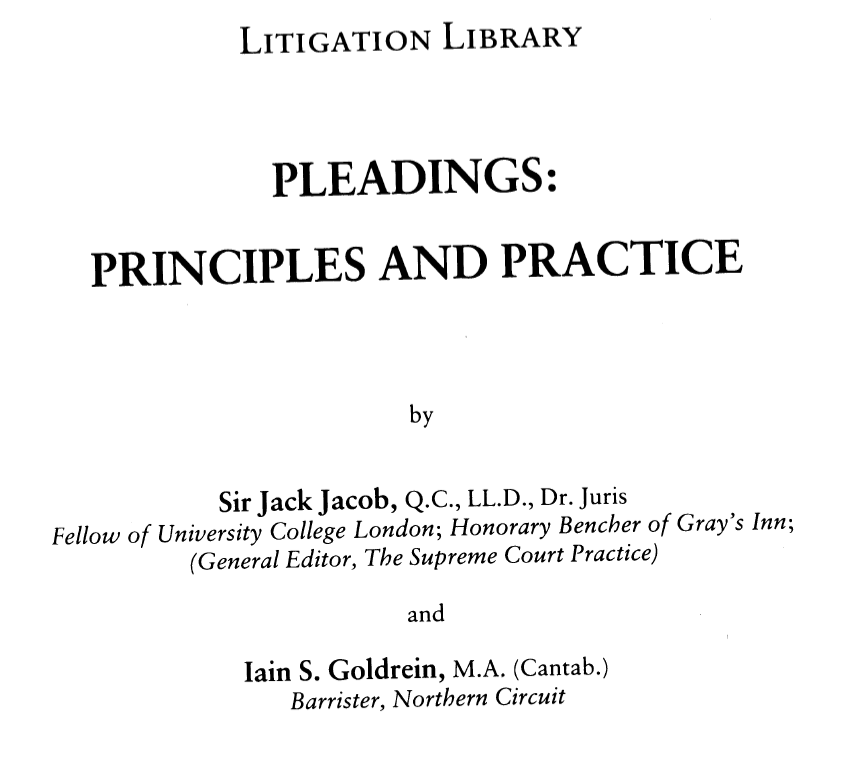
Pleadings: Principles and Practice by Jacob & Goldrein (Litigation Library)


 "Pin It")
Description
Pleadings: Principles and Practice
Review by marceljude.ai
Sir Jack Jacob, Q.C., LL.D., Dr. Juris Fellow of University College London; Honorary Bencher of Gray's Inn; (General Editor, The Supreme Court Practice)
and
Iain S. Goldrein, M.A. (Cantab.) Barrister, Northern Circuit With A Foreword By The Right Hon. The Lord Goff of Chieveley
This is not merely a practitioner’s handbook, and it is not merely a book of forms in disguise. It is a jurisprudence of pleading written by lawyers who understand that procedure is never just clerical technique. The authors’ declared ambition is to rescue the “system of pleadings” from being overshadowed by precedent collections and to present pleading as a live, integrated discipline in which principle and practice “dovetail.” They insist that pleading is at once science, art, and craft; that bad pleading can lose a good case; and that the subject matters because it structures the whole administration of civil justice. Lord Goff’s foreword reinforces the same theme: the book is about the principles that underwrite the art of good pleading, not just specimen documents.
My overall judgment is that this is an exceptionally serious procedural work. Its great strength is that it treats pleadings as the architecture of litigation rather than as an afterthought. Its secondary strength is that it moves repeatedly between doctrine, drafting, strategy, and institutional purpose. Its third strength is comparative vision: the appendices are not decorative; they are there to show that English pleading occupies a middle ground between stricter and looser procedural cultures. Its chief weakness is also the source of its authority: it is deeply invested in system, taxonomy, and rule-consciousness. Readers impatient with technical detail may find parts of it dense. But that density is earned. The book is trying to show that technicality, rightly understood, is often the grammar of fairness rather than its enemy.
Chapter 1: Nature and Functions of Pleadings
This is the right opening chapter, because the authors do not begin with drafting rules. They begin with theory. Pleadings are presented as the agenda for pre-trial and trial, the means by which parties define the controversy, notify one another of the case to be met, and confine the court to adjudicating only what has been properly put in issue. The chapter’s deepest claim is that pleadings are central to adversarial justice because they convert raw dispute into triable issue. That is not a minor bureaucratic point; it is a constitutional one.
What I admire here is the breadth of vision. The chapter links pleadings to fair notice, burden of proof, admissibility of evidence, discovery, the right to begin, relief, and even res judicata. In other words, it refuses the lazy idea that pleading is just the first exchange of paperwork. It argues instead that the whole litigation turns around the pleadings. That is doctrinally sound and pedagogically excellent. The chapter also earns respect because it includes a historical perspective: common law and Chancery practice, reform, and the emergence of the modern code. So the reader sees not only what the rules are, but why this system took the shape it did. As a law professor, I would say this is the chapter that gives the book its intellectual legitimacy.
Chapter 2: Formal Requirements of Pleadings
A lesser book would treat headings, titles, signatures, paragraphs, dates, and endorsements as dead matter. This chapter does not. It shows that formal requirements are the discipline that makes substantive clarity possible. A pleading is not merely what it says; it is also how it presents itself as an authoritative litigation document. Identity of parties, the title of proceedings, numbering, signatures, and service details all matter because they secure precision, continuity, and procedural seriousness.
The merit of this chapter is that it teaches respect for legal form without fetishizing it. The authors understand that errors in form may be amendable, yet they also insist that formal sloppiness is not innocent. It produces uncertainty, invites embarrassment, and weakens the pleading as an instrument. I think this chapter is particularly valuable for young lawyers, because it trains them to see that “mere form” is often the visible expression of professional discipline. The risk, if one wanted to criticize it, is that the chapter may seem severe to readers formed in a more relaxed procedural culture. But the severity has a point: a pleading that cannot even identify itself properly is unlikely to present its case well.
Chapter 3: Service and Close of Pleadings
This chapter addresses timing, sequence, service, extension of time, and the close of pleadings. On the surface that sounds procedural in the driest possible way. In fact it is about litigation rhythm. The authors show that sequence matters because each pleading is an answer to the previous one, and time limits matter because litigation requires disciplined progression toward defined issues, discovery, and directions.
What is especially good here is the treatment of “close of pleadings.” The book explains why closure matters: not because the system loves deadlines for their own sake, but because later procedural steps depend on knowing when the issues are fixed. That is a subtle but important lesson. Procedure is temporal as well as substantive. This chapter will not be the most glamorous for readers, but it is one of the most professionally useful. It teaches the student that civil process is not just argument; it is also sequence, and sequence creates fairness.
Chapter 4: Principal Rules of Pleading
This is the conceptual heart of the book. The chapter distills the central demands of the pleading system: plead material facts only; plead all material facts; plead facts, not evidence; plead facts, not law; plead in summary form. That cluster of rules is the grammar of classic pleading. The authors do very well to show that each limb matters separately. A pleader may fail by pleading too much, too little, too evidentially, too legally, or too diffusely.
As analysis, this chapter is first-rate. It takes what practitioners often repeat as slogans and turns them into differentiated concepts. “Material facts only” is not the same as “all material facts,” and “not evidence” is not the same as “not law.” The discussion of alternatives to fact pleading is particularly interesting because it opens a comparative and jurisprudential question: should the system remain rooted in fact pleading, or move toward notice-based approaches? That is exactly the sort of question that separates a doctrinal manual from a serious legal text.
Chapter 5: Subsidiary Rules of Pleadings
This chapter is a fine example of procedural realism. Once the principal rules are stated, the authors immediately show that practice becomes difficult in the exceptions, refinements, and borderline cases: inconsistent allegations, condition of mind, conditions precedent, criminal convictions, documents and conversations, judicial notice, knowledge, matters whenever arising, notice, points of law, presumptions. These are the pressure points where pleading ceases to be a clean classroom exercise.
The intellectual virtue of this chapter is modesty. It tacitly acknowledges that no single master-rule can govern all pleading problems. Legal process requires subsidiary doctrines precisely because litigation facts are messy. The discussion of inconsistent pleading and mental state is particularly important because it shows how the system accommodates uncertainty without collapsing into incoherence. This chapter is less rhetorically grand than Chapter 1 and less architectonic than Chapter 4, but it is where the book starts to feel truly experienced. One hears practitioners speaking through doctrine.
Chapter 6: Statement of Claim
This is one of the strongest chapters in the book. It moves from general function and technique into the anatomy of a claim: cause of action, joinder of causes of action, contract, tort, damage, prayer for relief, foreign currency claims, interest, recovery of land, mesne profits, the relation between the writ and the claim, and withdrawal. That breadth matters because a statement of claim is where procedural theory must become litigable form.
What makes the chapter valuable is its refusal to stay abstract. The authors do not say merely that a cause of action must be pleaded; they show how that works in contract and tort, how damages must be handled, and how remedies must be framed. They clearly understand that students often know substantive law but do not know how to translate it into pleading form. This chapter performs that translation. It is especially strong on relief, which many procedural books treat as an appendix to the real case. Here relief is treated properly as part of the legal theory of the pleading. My one criticism is that the chapter’s density may intimidate beginners. But for serious readers, it is indispensable.
Chapter 7: The Defence
The defence chapter is more subtle than the statement of claim chapter, because defence is structurally different. A defence is not simply a negative statement of the plaintiff’s case. It may admit, deny, not admit, traverse specifically, confess and avoid, raise special grounds, tender, deny damages, or force the plaintiff to prove matters that remain in issue. The chapter’s treatment of admissions and traverse is particularly strong. It shows that the difference between denial and non-admission is not verbal nicety but procedural consequence.
What I especially appreciate is the insistence that traverse must be specific and non-evasive. This is where pleading ethics emerges. The defence cannot merely obscure. It must identify the real point of controversy. That is a deeply important idea, and one often forgotten in adversarial culture. The chapter also clarifies confession and avoidance, which is a concept every law student hears but few initially grasp in practice. Here the authors explain it as a live pleading technique, not just a fossil from old common-law terminology. This chapter is less sweeping than Chapter 6, but it is more tactical, and very well done.
Chapter 8: Set-off and Counterclaim
This chapter is doctrinally rich and practically necessary. The authors distinguish set-off from counterclaim, explain the historical background, discuss the nature of a cross-claim, show how set-off is pleaded, and then move into the nature and practice of counterclaim, including claims against added parties, separate trials, and costs. The book is especially clear that the labels are not decorative: a set-off is not the same juridical thing as a counterclaim, even if both answer the plaintiff’s demand.
As a teaching chapter, this is excellent because it sorts out one of the places where procedural confusion is most expensive. Lawyers sometimes speak as though every responsive monetary claim is functionally the same. The authors refuse that laziness. They explain the legal character, pleading structure, and cost consequences of each form. That is classic Jacob: doctrinal precision in the service of practical litigation intelligence. A student who masters this chapter will begin to think procedurally rather than merely substantively.
Chapter 9: Reply and Subsequent Pleadings
This is a shorter chapter, but a very important one. It explains the function of reply, the rule against departure, defence to counterclaim, joinder of issue, and the limited role of subsequent pleadings. The authors are wise not to inflate reply into something it is not. A reply is sometimes necessary, but it is not a routine opportunity to rewrite the action. Its discipline lies in staying responsive without departing from the claim already pleaded.
The treatment of the rule against departure is especially valuable. Students often assume that once litigation has started, a party can keep recharacterizing the case in response to pressure. The chapter reminds us that the integrity of pleading depends on continuity. One may amend; one may not simply mutate. That is a profound distinction. This chapter rewards the attentive reader because it teaches procedural self-restraint, which is as important in advocacy as aggression.
Chapter 10: Particulars of Pleadings
Few chapters are likely to be more useful in actual litigation. The authors discuss necessary particulars, their functions, requests and orders, timing, procedure, particulars before defence, the relation between particulars and discovery, form and service, amendment, voluntary particulars, specific matters needing particulars, and even the exchange of witness statements. This is where the book shows how one moves from pleaded issue to usable forensic detail.
The chapter’s greatest strength is conceptual balance. It does not collapse particulars into evidence, but neither does it treat them as trivial embellishment. Particulars are shown as an instrument for preventing surprise, narrowing controversy, and compelling clarity without prematurely converting the pleading into proof. The discussion of witness statements is especially shrewd because it shows that evidentiary disclosure may complement pleadings without replacing them. This is one of the most practically sophisticated chapters in the whole work.
Chapter 11: Amendment of Pleadings
This is another major chapter. The book presents amendment as the procedural mechanism that prevents litigation from being trapped by initial error, incomplete information, or misformulation. It covers amendment without leave, by consent, with leave, time to amend, amendments not allowed, amendment after expiry of limitation periods, the effect of amendment, practice, and amendment of the record. The authors are admirably clear that the aim is to permit adjudication on the true merits while still preserving procedural fairness.
The jurisprudence here is mature. Amendment is not portrayed as a free indulgence; nor is it treated as a confession that pleading rules do not matter. Instead, the chapter shows amendment as the safety valve of a disciplined system. That is the correct view. The strongest insight is that amendment law mediates the tension between accuracy and finality. The weakest part, if one is looking for one, is that the analysis is so thorough that readers may lose the governing theme in the detail. But the detail is real life. This is a chapter a practising litigator returns to.
Chapter 12: Striking Out Pleadings
This chapter gives the book its sharpest edge. It addresses summary powers to strike out pleadings, no reasonable cause of action or defence, scandalous matter, frivolous or vexatious pleadings, pleadings that prejudice, embarrass, or delay fair trial, abuse of process, and the court’s inherent jurisdiction. The authors understand that a pleading system is not only constructive; it is also exclusionary. Courts must be able to protect themselves and litigants against hopeless, abusive, or oppressive proceedings.
What is impressive is the dual emphasis on power and restraint. The court has “wide and ample powers,” but the chapter also recognizes the seriousness of driving a claimant from the seat of judgment. That balance gives the chapter authority. It is not written in the spirit of procedural brutality; it is written in the spirit of institutional responsibility. As a modern reader, one might wish for a more sustained access-to-justice reflection on how summary powers can be misused against weaker litigants. But within its own framework, the chapter is excellent. It is one of the book’s most judicially minded discussions.
Chapter 13: Default of Pleadings
This chapter is procedural discipline in its starkest form. It deals with default in serving the statement of claim, default of defence, default of defence to counterclaim, and setting aside default judgment. In many classrooms this material is rushed. Here it is treated with the seriousness it deserves. That is right. Default rules are where the system proves that procedure is not advisory.
The chapter’s practical value is obvious, but its conceptual value is easy to miss. Default rules force a party to take the adversarial process seriously. They also reveal the moral economy of civil procedure: there are opportunities, there is sequence, there is time to answer, but at some point silence has consequences. I would not call this the most elegant chapter, but I would call it one of the most necessary. It gives procedural backbone to the book’s larger theory.
Chapter 14: Parties and Pleadings
This is a fitting final chapter because it expands the book from two-party litigation into the real world of complex proceedings. It addresses necessary and proper parties, joinder, misjoinder and non-joinder, amendment as to parties, change of parties, intervention, third-party proceedings, interpleader, separate trials, and particular classes of parties. The chapter’s importance lies in showing that pleading doctrine cannot be fully understood in isolation from party structure.
This chapter is especially useful for advanced students and practitioners, because multi-party procedure is where elegant doctrinal principles are most tested. The authors do not sentimentalize the subject. They show plainly that party structure affects service, pleading, amendment, liability, and trial management. In that sense the book closes by reminding the reader that pleadings are not static texts. They are procedural instruments operating within changing configurations of persons and claims. It is a strong closing movement.
The Comparative Appendices
The appendices are one of the book’s most intelligent features. The authors themselves say that they included four foreign-jurisdiction appendices to help readers understand the home system better by contrast. That is exactly right. Comparative procedure is not ornament. It is a method of self-understanding. The preface explains the contrasts clearly: Scotland as highly disciplined fact pleading supported by law; West Germany as a system in which facts, evidence, and law are all stated; the United States federal system as notice pleading tied to broad discovery; and the European Court as requiring facts, evidence, and legal argument together.
Appendix A on Scotland appears to stress disciplined written pleading and model forms in the Court of Session. Appendix B on West Germany highlights the role of judges, written pleadings, evidence, and an inquisitorial cast. Appendix C on the United States points toward federal notice pleading, affirmative defenses, counterclaims, and broad discovery. Appendix D on the European Courts places pleading within a transnational and institutional framework where facts, evidence, and arguments are more integrated. Lord Goff was right to praise these appendices. They widen the book’s horizon and prevent it from becoming parochial. In my view, they transform the work from a domestic manual into a contribution to comparative civil procedure.
Final Judgment on the Book as a Whole
Taken as a whole, this is a formidable legal text. It teaches that pleadings are not merely documents but acts of legal ordering. They define issues, discipline proof, govern disclosure, shape remedies, and police the boundaries of adjudication. The book’s signal achievement is to make pleading look intellectually serious again. It does so not by romanticizing old technicality, but by showing that clarity, specificity, and discipline are conditions of justice in an adversarial system.
Its best chapters are, in my judgment, Chapter 1 for theory, Chapter 4 for conceptual clarity, Chapter 6 for practical translation of cause of action into pleading form, Chapter 10 for real litigation usefulness, and Chapter 12 for judicial control of abuse. Its most quietly valuable chapters are Chapter 3 and Chapter 13, because they teach procedural time and consequence. Its comparative appendices are a genuine scholarly bonus, not padding.
If I were to state the book’s limitation in one sentence, it would be this: it is so committed to the integrity of procedural form that it sometimes leaves less room than a contemporary reader might want for questions of inequality, cost, and access. But that limitation should not be mistaken for blindness. The authors know that pleading exists to prevent surprise, confusion, and injustice. Their faith is simply that disciplined form is part of the cure, not the disease. That is a serious position, and the book defends it with learning, experience, and force.
As a law professor, I would describe the book this way: it is a master-class in how legal process turns dispute into adjudication. It is exacting, sometimes stern, often dense, and consistently intelligent. Above all, it respects the reader enough to insist that pleading is worth thinking about deeply. That is why the book lasts.
 marceljude.ai @ +60128285778 |
- MALAYSIA'S 1ST AI LAWYER - CLICK HERE
- ISMAIL – INTEGRATED SINGAPORE/MALAYSIA AI & LAW (Library)
- OPENING OF SINGAPORE MALAYSIA AI CENTRE AND LAW LIBRARY
- LIFT - LAW INSTRUMENTS FORMS & TEMPLATES
- LAWS OF MALAYSIA FOR SINGAPOREAN DUMMIES
- HANNAH YEOH'S ARTIFICIAL INTELLIGENCE LAW ENCYCLOPEDIA
- LEAD CR - Law Ecosystem Archive Databases on CD-ROM
- BREAKING NEWS FROM MJN
- CLICK HERE CO. PROFILE
- EXCITING NEW SERIES - THE ADVENTURES OF BOBBY TAN -ADVOCATE & SOLICITOR IN THE HIGH COURT OF NORTH BORNEO by marceljude.ai
- MEDICO LEGAL - BY PRISKILA AKWILA & GLORIOUS PETAL SDN BHD - powered by marceljude.ai
- MISCELLANOUS
- ANNOTATED STATUTES OF SABAH - A NEW SERIES
- e-library - marceljude.ai
- DRAFT - DOCUMENT RESEARCH & AUTOMATED FILING TECHNOLOGY
- CLARA – Case Law Analysis & Retrieval AI
- FOR RESEARCH REQUEST CLICK HERE
- CLICK HERE TO ASK ANYTHING
- RAMBO'S LAW - THE LAW OF THE LAW JUNGLE - EXCITING NEW SERIES - CASE ANALYSIS BY JOHN RAMBO @ +60138646786
- PRISKILA AKWILA ADVOCATES - High Court of Sabah & Sarawak @ Kota Kinabalu
- COLA - COMMONWEALTH ONLINE LAWCASES AI -marceljude.ai
- THE LAW LIBRARY THAT COMES TO YOU ANYWHERE AND ANYTIME
- marceljude.ai training academy
