
MJLR - Marcel Jude Law Reports: A New Era of AI-Powered Legal Research for Malaysia and Singapore


Description
MJLR - Marcel Jude Law Reports: A New Era of AI-Powered Legal Research for Malaysia and Singapore
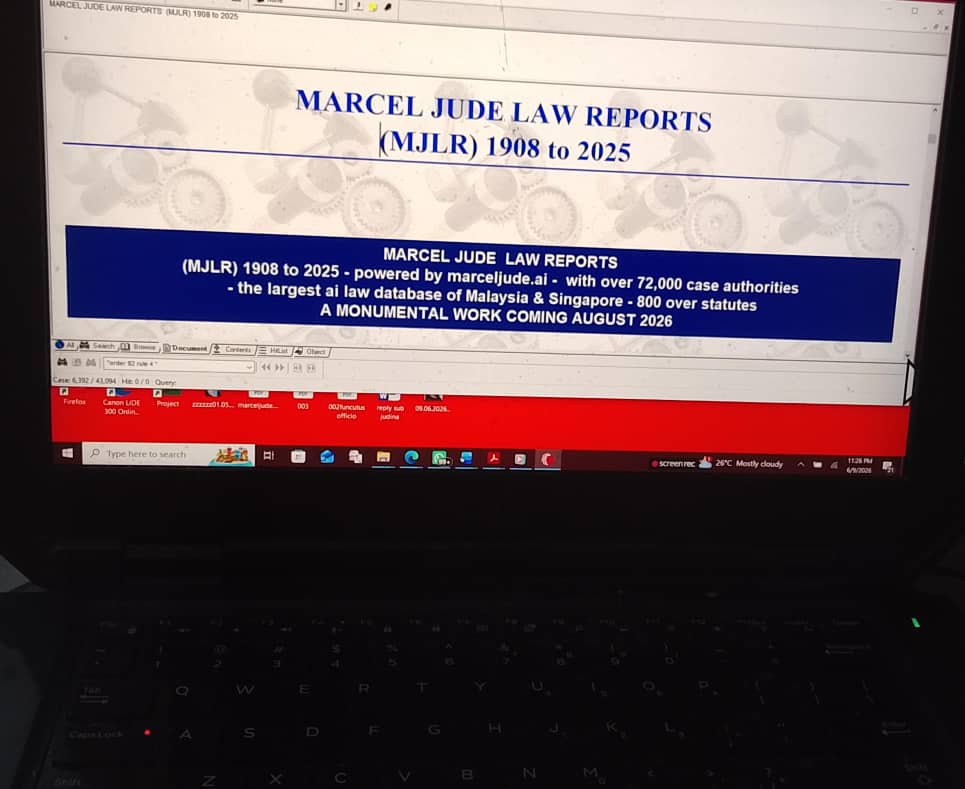
Legal research in Malaysia and Singapore is set to enter a new phase with the upcoming launch of Marcel Jude Law Reports (MJLR) 1908 to 2025, an ambitious AI-powered legal database developed through marceljude.ai. Scheduled as a monumental work coming in August 2026, MJLR is positioned as a major legal research platform for lawyers, judges, legal researchers, law students, and institutions that require fast, reliable, and practical access to case authorities and statutes.
Covering the period from 1908 to 2025, MJLR aims to provide access to more than 72,000 case authorities and over 800 statutes, making it one of the largest AI-driven legal databases focused on Malaysia and Singapore. In a legal environment where accuracy, speed, and proper citation are essential, a comprehensive platform of this scale can significantly improve how legal professionals prepare submissions, conduct research, and compile authorities.
One of the standout features of MJLR is its batch download function. Traditional legal research platforms often require users to download authorities one by one, which can be time-consuming, especially when preparing for trials, appeals, hearings, or urgent submissions. MJLR is designed to allow users to download multiple authorities with one click. This feature can greatly reduce repetitive work and help lawyers and researchers focus more on analysis, strategy, and drafting.
Another major advantage is the platform’s focus on readable PDFs. Legal documents are only useful if they are easy to read, search, organize, and upload. MJLR is expected to provide PDFs that are clear, accessible, and suitable for everyday professional use. The platform also emphasizes huge legal data in light PDF format, meaning files are designed to remain small enough for easy uploading into case management systems, court platforms, and internal law firm databases.
This is especially important for modern litigation and legal practice. Many courts, firms, and institutions now rely heavily on digital filing and electronic case management. Large, heavy, or poorly formatted files can slow down preparation and create unnecessary technical problems. By offering lighter PDF files, MJLR aims to make legal document handling faster and more efficient.
MJLR also introduces two practical download options. The first is the full report, suitable for users who require the complete case authority. The second is a redacted authority version, designed for faster reading and practical use in submissions, research, or oral argument preparation. This dual-format approach recognizes that legal professionals do not always need the same level of detail for every task. Sometimes a full judgment is necessary; at other times, a shorter and more focused authority is more useful.
The redacted authorities may be especially helpful for preparing written submissions, research notes, case summaries, bundles of authorities, and oral submissions. By giving users a more targeted version of the authority, MJLR can assist in reducing reading time while still supporting effective legal argument.
A further feature of MJLR is customization. Users will be able to insert their own case headings and prepare materials in a format suitable for their specific matters. This is particularly valuable when preparing case bundles, authorities bundles, hearing notes, or research files. Instead of spending hours manually formatting documents, users can prepare bundles more quickly and with greater consistency.
For legal practitioners, time is often one of the most valuable resources. A platform that combines legal research, downloading, formatting, and document preparation can offer real practical benefits. MJLR appears to be designed not only as a legal database, but also as a workflow tool for lawyers and researchers who need to move quickly from research to submission.
Another important feature is the proposed pay-per-use model. Many legal databases require high subscription fees, which may be difficult for smaller firms, individual practitioners, young lawyers, students, and occasional users. A pay-per-use system can make legal research more flexible and accessible, allowing users to pay for what they need rather than committing to expensive long-term subscriptions.
The launch of Marcel Jude Law Reports also reflects the growing role of artificial intelligence in legal research. AI-powered tools can help users locate relevant authorities faster, organize information more efficiently, and reduce the time spent on routine research tasks. However, the value of any AI legal platform depends on the quality, coverage, readability, and usability of its content. With its wide historical coverage and practical document features, MJLR aims to meet those demands.
For Malaysia and Singapore, where legal systems rely heavily on case law, statutory interpretation, precedent, and persuasive authorities, access to a strong digital law database is essential. Lawyers must often search across decades of judgments and legislation to find the right authority. A database covering more than a century of legal materials can become a powerful resource for legal practice, academic research, and judicial preparation.
Ultimately, Marcel Jude Law Reports (MJLR) 1908 to 2025 presents itself as more than a collection of cases and statutes. It is being introduced as a modern legal research solution built around speed, accessibility, affordability, and practical document preparation. With batch downloads, readable and lightweight PDFs, full and redacted reports, customization features, and pay-per-use access, MJLR has the potential to become a valuable tool for the legal communities of Malaysia and Singapore.
As the legal profession continues moving toward digital and AI-assisted research, platforms like MJLR may play an important role in shaping the future of legal work. Its expected arrival in August 2026 marks a significant development for lawyers, researchers, and institutions seeking a faster and more efficient way to access legal authorities.
- MALAYSIA'S 1ST AI LAWYER - CLICK HERE
- ISMAIL – INTEGRATED SINGAPORE/MALAYSIA AI & LAW (Library)
- OPENING OF SINGAPORE MALAYSIA AI CENTRE AND LAW LIBRARY
- LIFT - LAW INSTRUMENTS FORMS & TEMPLATES
- LAWS OF MALAYSIA FOR SINGAPOREAN DUMMIES
- HANNAH YEOH'S ARTIFICIAL INTELLIGENCE LAW ENCYCLOPEDIA
- LEAD CR - Law Ecosystem Archive Databases on CD-ROM
- BREAKING NEWS FROM MJN
- CLICK HERE CO. PROFILE
- EXCITING NEW SERIES - THE ADVENTURES OF BOBBY TAN -ADVOCATE & SOLICITOR IN THE HIGH COURT OF NORTH BORNEO by marceljude.ai
- MEDICO LEGAL - BY PRISKILA AKWILA & GLORIOUS PETAL SDN BHD - powered by marceljude.ai
- MISCELLANOUS
- ANNOTATED STATUTES OF SABAH - A NEW SERIES
- e-library - marceljude.ai
- DRAFT - DOCUMENT RESEARCH & AUTOMATED FILING TECHNOLOGY
- CLARA – Case Law Analysis & Retrieval AI
- FOR RESEARCH REQUEST CLICK HERE
- CLICK HERE TO ASK ANYTHING
- RAMBO'S LAW - THE LAW OF THE LAW JUNGLE - EXCITING NEW SERIES - CASE ANALYSIS BY JOHN RAMBO @ +60138646786
- PRISKILA AKWILA ADVOCATES - High Court of Sabah & Sarawak @ Kota Kinabalu
- COLA - COMMONWEALTH ONLINE LAWCASES AI -marceljude.ai
- THE LAW LIBRARY THAT COMES TO YOU ANYWHERE AND ANYTIME
- marceljude.ai training academy
