
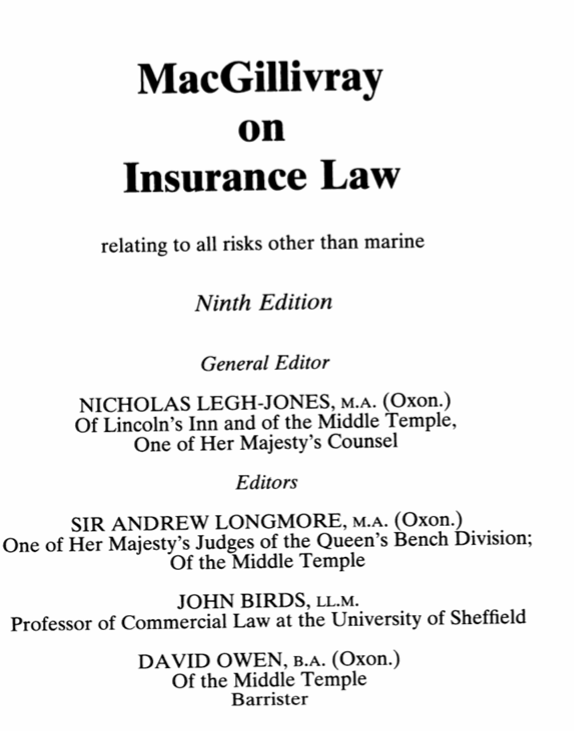
MacGillivray on Insurance Law


Description
MacGillivray on
Insurance Law
Book review by marceljude.ai
General Editor
NICHOLAS LEGH-JONES, m.a. (Oxon.) Of Lincoln's Inn and of the Middle Temple, One of Her Majesty's Counsel
Editors
SIR ANDREW LONGMORE, m.a. (Oxon.) One of Her Majesty's Judges of the Queen's Bench Division; Of the Middle Temple
JOHN BIRDS, LLM Professor of Commercial Law at the University of Sheffield
DAVID OWEN, BA. (Oxon.) Of the Middle Temple Barrister
This work is not merely a textbook on insurance law. It is a full-scale legal treatise. It proceeds with the discipline of a serious common law text: first, it identifies the juridical foundations of insurance; second, it examines the formation and structure of the insurance contract; third, it moves through vitiating factors and interpretive doctrines; fourth, it addresses claims, remedies, and allocation mechanisms; and finally, it turns to major classes of insurance and regulatory control. That architecture is one of the book’s greatest strengths. It does not treat insurance law as a scattered collection of special clauses. It treats insurance as a coherent body of contract law, commercial law, restitutionary reasoning, and statutory intervention.
As a law professor reviewing this work, I would say immediately that the book’s major virtue lies in its doctrinal seriousness. It does not oversimplify. It recognises that insurance law is a hybrid field. It is about bargains, but not ordinary bargains. It is about risk allocation, but not in the abstract. It is about regulation, but not merely public law regulation. It is about private rights and commercial expectations under conditions of uncertainty. The book consistently keeps those tensions in view.
The text is also impressive in the way it handles principle. It does not merely collect authorities. It organises them. It distinguishes insurance from guarantee, from wager, from maintenance contracts, from indemnities, and from other risk-bearing arrangements. It shows that insurance law cannot be mastered by memorising clauses. One must understand why courts classify contracts as insurance, why insurable interest matters, why utmost good faith matters, why warranties historically attracted special severity, and why causation and subrogation sit at the centre of insurance litigation.
Pedagogically, the book is very strong. A student who reads it carefully will come away with a genuine understanding of how insurance law thinks. A practitioner will value its structure and authority. A judge will value its habit of working from doctrine outward rather than from rhetoric inward. It is the sort of text that rewards slow reading. It is not light reading, but it is intelligent reading.
From a Malaysian lawyer’s perspective, even though the book is rooted in common law insurance doctrine, it remains highly valuable. Many of the conceptual issues it examines are foundational: contract formation, construction, misrepresentation, non-disclosure, warranties, causation, indemnity, assignment, subrogation, contribution, and statutory control of insurers. These are matters that recur across common law systems. A Malaysian advocate reading the book would not simply be learning foreign law; he or she would be sharpening the conceptual tools required to litigate and analyse insurance disputes at a high level.You also need to consider Section 5 of the Civil Law Act which stipulates that for Sabah, Sarawak. Penang & Melaka in respect of mercantile law the law of England applies as of today. Insurance law would come under the category of mercantile law.
What follows is a chapter-by-chapter review of the book.
Chapter 1: Definition of Insurance and Insurable Interest
This opening chapter is foundational and properly so. The book begins by asking the question that lesser texts often glide over: what exactly is a contract of insurance? That is a deceptively difficult question. The chapter makes clear that insurance cannot be reduced to a slogan. It is a contract under which one party, for consideration in the form of a premium, undertakes to provide money or an equivalent benefit on the occurrence of a specified uncertain event. But the chapter does not stop at that formulation. It carefully explains the constituent elements of the insurance idea: premium, uncertainty, risk distribution, benefit on occurrence of peril, and the difference between insurance and other forms of commercial undertaking.
The discussion of insurable interest is especially important. The chapter shows that insurance law historically resisted turning insurance into speculation. The doctrine of insurable interest marks the law’s effort to ensure that the assured has a legally recognised relationship with the life, property, or event insured. In that sense the doctrine is both conceptual and moral. Conceptual, because it identifies the juridical basis of the assured’s right to insure. Moral, because it separates insurance from wagering.
The treatment of insurable interest in lives and in property is one of the chapter’s strengths. The text does not treat the topic as a static formula. It demonstrates how the law assesses whether a person stands in such a relationship to the subject matter that loss, prejudice, or deprivation would affect him. The book’s survey of creditors, contractors, bailees, mortgagees, and others helps the reader see that insurable interest is not a single rigid concept but a family of relationships recognised by law.
As a scholarly opening, this chapter performs exactly the task it should. It lays the theoretical groundwork for everything that follows. A student who misses Chapter 1 will read the rest of the book mechanically. A student who masters it will understand why insurance law is its own discipline.
Chapter 2: Formation of the Contract
This chapter turns to ordinary contract doctrine in its insurance setting. It asks when a binding insurance contract comes into being and what must be agreed before the law recognises that the parties are bound. The discussion is doctrinally careful: offer and acceptance matter, but so does agreement on all material terms. Insurance contracts are not formed merely because parties are in discussion or because a proposal form has been submitted.
The book identifies the material elements of the bargain with admirable clarity: the nature of the risk, duration of cover, premium, and amount or mode of indemnity or payment. This is valuable because insurance disputes often arise not from dramatic fraud but from uncertainty as to whether agreement was ever reached on the essential matters. The chapter explains why courts refuse to “write the contract” for the parties when those essentials are lacking.
This is also where the reader begins to appreciate the commercial character of insurance law. Insurance contracts are frequently formed through intermediaries, proposal forms, correspondence, counter-offers, premium tenders, and market practices. The chapter shows that insurance law is not merely doctrinally contractual; it is procedurally commercial. It is about how bargains are actually struck in the marketplace.
As a chapter, it is analytically disciplined and highly useful. It teaches the reader that one cannot assume cover simply because a business relationship exists or because documents have passed. One must ask the precise juridical question: was there a concluded contract, and if so, on what terms?
Chapter 3: Form of the Contract
This chapter addresses the form that insurance contracts may take. Its significance lies in showing that insurance law, notwithstanding its technicality, often begins from ordinary contractual flexibility. No special form is generally required at common law; insurance may, subject to statutory exceptions, be concluded informally and even orally. That proposition has important litigation consequences.
The chapter is valuable because it teaches the lawyer not to fetishise the formal policy document. The policy is often central, but the legal contract may predate it or arise independently of a later formal embodiment. By analysing the role of informal writings, slips, correspondence, and oral arrangements, the chapter demonstrates that the law looks to substance and consensus, not mere paper formalism.
The chapter also performs a classificatory function. It identifies areas where legislation imposes formality requirements and thereby shows the limits of common law flexibility. This is a strength of the work throughout: it does not preach abstraction; it always returns to the interaction between common law principle and statutory intervention.
For teaching purposes, this chapter is especially useful because it helps students understand why commercial practice cannot be reduced to final documents alone. Insurance law is built in stages, and the form question is really a question about where legal commitment resides.
Chapter 4: The Period Prior to Issue of the Policy
This chapter is practically important and often litigated. It addresses what happens in the critical gap between proposal and final issuance of the policy. The legal and commercial significance of this period is immense. Many disputes arise precisely because loss occurs before the formal policy is issued.
The chapter’s examination of temporary cover is one of its strengths. It explains why the market developed interim protection: applicants often need immediate risk cover while insurers consider whether to accept the proposal. The text shows that the law must therefore deal with cover notes, temporary assurances, and conditional forms of protection. These are not marginal matters. They are central to modern insurance practice.
The chapter also sensibly addresses increase of risk before the policy is issued. This is where insurance law reveals its sensitivity to changing facts. The risk initially proposed may not be the same as the risk existing at the moment of final acceptance. The chapter therefore sits at the intersection of formation doctrine, good faith, and risk evaluation.
From a law professor’s viewpoint, this chapter is excellent because it brings real-world timing problems into the doctrinal frame. It teaches students that insurance law is a law of sequence and timing. When the loss occurred, when cover began, what interim promise existed, and what conditions attached to it—these are not details; they are the case.
Chapter 5: Execution and Delivery of Policy
This chapter examines the significance of execution and delivery of the policy and distinguishes between policies under seal and those not under seal. It is a chapter about legal effect and formal completion. It asks when the policy becomes operative and how that moment affects rights and liabilities.
The value of the chapter lies in its insistence that the final policy document can serve different functions in different cases. Sometimes it merely evidences an already binding contract. Sometimes it is itself the act of acceptance that concludes the contract. That distinction is crucial, especially in disputes concerning whether cover existed at the moment of loss.
The discussion of delivery is also analytically rich. Delivery may not be a mere administrative act; it can be the event that activates the juridical force of the policy. The chapter thereby deepens what the previous chapters began: insurance law cannot be understood unless one keeps track of when the contract was formed, how it was evidenced, and when the formal policy assumed legal effect.
This is a strong technical chapter. It may not be dramatic, but it is indispensable. It teaches precision, and insurance law rewards nothing more than precision.
Chapter 6: Commencement and Termination of Risk
This chapter focuses on the temporal boundaries of insurance coverage. It asks when risk begins and when it ends. Those questions sound simple until one encounters policies tied to dates, events, payment of premium, delivery of documents, renewal arrangements, or cancellation machinery.
The book’s treatment here is excellent because it shows that commencement of risk is not always identical to the date written on the policy. The legal question depends on the wording, the contractual sequence, and the surrounding arrangements. The chapter thereby builds on earlier discussions of formation and interim cover.
Equally important is termination. Insurance disputes frequently turn on whether cover had expired, lapsed, been avoided, or ceased by operation of a clause. By addressing both commencement and termination in one chapter, the text teaches the student to see insurance cover as a temporal corridor rather than a static entitlement.
This chapter is doctrinally essential and practically sharp. It reminds the reader that insurance is an agreement about risk over time. The law must therefore define the beginning and end of the risk period with great care.
Chapter 7: Payment of Premium
This chapter is more than an account of money due. It is about the premium as the economic foundation of the insurance bargain. The text reviews general rules of payment, renewal premiums, days of grace, consequences of non-payment, waiver, and the role of agents.
The great merit of this chapter is that it resists treating premium payment as a trivial administrative matter. In insurance law, premium issues often determine whether the contract ever attached, whether it continued, whether renewal was effective, and whether an insurer waived strict compliance. That means premium questions are at once contractual, factual, and equitable.
The treatment of days of grace and renewal is particularly useful because it illustrates how strict legal obligations are moderated by commercial practice. The law recognises that insurance business operates with routines and expectations, and those routines may affect whether the insurer may insist on literal punctuality.
This chapter is practically excellent. It would be especially valuable to litigators because premium disputes often appear straightforward until waiver, agency, or renewal practice complicates them. The chapter handles those complications with welcome rigour.
Chapter 8: Return of Premium
This chapter addresses the circumstances in which premium money may be recovered. It is built around the powerful principle often summarised as “no risk, no premium,” but the book is careful not to treat that phrase as exhaustive.
The chapter’s strength is its analytical subtlety. It shows that the return of premium depends on why the insurance failed, whether risk ever attached, whether illegality tainted the arrangement, and whether the parties themselves contracted around default principles. The topic therefore sits between contract failure, unjust enrichment, illegality, and the peculiar logic of insurance.
The section dealing with illegal insurance is especially instructive. It demonstrates how restitutionary logic is constrained or shaped by public policy. Where the contract is unlawful, the question is not simply whether consideration failed, but whether the law will assist either party.
As a piece of legal writing, this chapter is commendably clear. It takes what might otherwise be a narrow procedural question and reveals its deeper conceptual basis. It is a fine example of the book’s ability to turn a seemingly technical matter into a serious legal inquiry.
Chapter 9: Salvage Premiums
This chapter is relatively specialised, but that is precisely why its inclusion is valuable. The topic of salvage premiums concerns situations where a third party pays premiums to preserve a life policy or similar benefit and later seeks recognition of that expenditure.
The chapter’s importance lies in its treatment of the intersection between property in policies, equitable interests, and reimbursement. It reminds the reader that insurance rights do not exist in isolation; they are often entangled with family arrangements, assignments, creditors, and other beneficial interests.
In pedagogical terms, Chapter 9 is useful because it exposes students to a less familiar aspect of insurance law and demonstrates the breadth of the field. Insurance law is not only about claims against insurers. It is also about the internal ordering of interests around the policy itself.
Though narrower in scope than some other chapters, it performs a valuable doctrinal function. It teaches that insurance law extends beyond the insurer-insured dyad into the world of equitable adjustment.
Chapter 10: Warranties and Other Policy Terms
This is one of the most important chapters in the book. Historically, few areas of insurance law have been as harsh, technical, and consequential as warranty. The book rightly devotes significant attention to classifying policy terms and surveying warranties in detail.
The chapter’s great strength is its seriousness about classification. Not every clause is a warranty, and the legal consequences depend decisively on how the term is characterised. By analysing warranties alongside other policy terms, the text prevents the reader from treating all insurer-protective clauses as equivalent.
The historical severity of warranty doctrine is one of the major themes one expects in a serious insurance text, and this chapter meets that expectation. A breach of warranty traditionally had consequences independent of causation and could discharge the insurer even where the breach seemed only tangential to the loss. The chapter therefore reveals insurance law at its most stringent and formal.
For students and practitioners alike, this chapter is indispensable. It teaches meticulous reading of policy language. It also reveals one of the central tensions in insurance law: the tension between commercial certainty for insurers and fair treatment of insureds. This chapter sits right at that fault line.
Chapter 11: Construction of Policies
No insurance treatise would be complete without a sustained chapter on construction, and this is a strong one. The text examines ordinary meaning, special meanings, the documents to be considered, inconsistency and ambiguity, and the admissibility of extrinsic evidence.
The chapter is excellent because it situates insurance construction within general contractual interpretation while still respecting the distinctive features of insurance drafting. Insurance policies are often standard-form, highly layered documents with schedules, endorsements, conditions, exceptions, and definitions. Construction in this context is therefore both general and specialised.
The discussion of ambiguity is particularly important. Insurance litigation often turns less on heroic disputes about fact and more on the meaning of a clause. The book helps the reader see how courts navigate conflicting provisions, technical expressions, and incorporated documents.
As a law professor, I would say this chapter is one of the most pedagogically valuable in the entire work. It trains legal method. It teaches the reader not merely what insurance law says, but how insurance law reasons from text. That is an essential skill.
Chapter 12: Rectification
Rectification is a narrow but powerful remedy, and this chapter explains it with commendable clarity. Where the policy as written fails to reflect the parties’ true agreement, equity may intervene to correct the document. That proposition, however, is accompanied by demanding evidential and doctrinal requirements.
The chapter is valuable because it distinguishes rectification from interpretation. Courts do not rectify merely because a term seems inconvenient or because one party regrets the deal. Rectification depends on proof that the written instrument misrecords the actual agreement. In insurance contexts, that can be particularly difficult because policies are often produced through intermediaries, standard forms, and complex communications.
The chapter thus illustrates the relationship between formal documents and substantive agreement. It is also a reminder that equitable remedies remain alive in commercial law. Insurance law is not only a law of strict wording; it is also a law of correction where wording fails to capture what was truly agreed.
This chapter is concise but important. It would be especially useful in litigation where the insured or insurer argues that the policy document is not the final truth of the bargain.
Chapter 13: Conflict of Laws
This chapter broadens the horizon of the work. Insurance transactions frequently cross borders, and the chapter addresses jurisdiction, proper law, and related matters. This is an area where insurance law becomes overtly international and private international law principles take centre stage.
The text is strong because it recognises that insurance relationships are often geographically dispersed: the insurer may be in one country, the insured in another, the risk elsewhere, and the loss in yet another place. That complexity makes questions of forum and governing law unavoidable.
The chapter’s analysis of proper law is particularly important. Insurance disputes can produce very different outcomes depending on which legal system governs issues such as disclosure, warranties, limitation, or interpretation. The book therefore performs a vital function by showing how courts identify the law most closely connected to the contract or chosen by the parties.
This chapter has strong academic and practical value. It is especially useful for advanced students and practitioners dealing with transnational insurance, aviation, reinsurance, or large commercial risks. It shows that insurance law is not only substantive law; it is also a law of legal systems competing for application.
Chapter 14: Illegality
This is a serious and intellectually rich chapter. It explores the effect of illegality upon insurance rights, including claims tainted by illegality, losses caused by the assured’s unlawful act, and related public policy constraints.
The chapter’s real strength lies in refusing easy slogans. Illegality in insurance law is not simply a matter of denying recovery whenever something unlawful appears in the facts. The legal question is more refined: what is the nature of the illegality, how closely connected is it to the claim, and what policy considerations justify refusing enforcement?
Insurance law here intersects with broader doctrines of ex turpi causa and public policy. That intersection is conceptually significant. Insurance is about shifting financial consequences, but the law is reluctant to permit insurance to undermine legal norms by cushioning or rewarding unlawful conduct in inappropriate ways.
This chapter is excellent because it reveals insurance law’s moral boundary. Insurance cannot become a vehicle for neutralising the consequences of every unlawful act. At the same time, the book’s careful treatment shows that courts must analyse the precise relationship between illegality and the claim. It is a nuanced and strong chapter.
Chapter 15: Mistake
The chapter on mistake is compact but doctrinally important. It considers the different ways in which mistake may affect the validity of an insurance contract. That includes mistakes going to existence of the subject matter, identity, or other fundamental assumptions.
The importance of the chapter lies in its refusal to detach insurance law from general contract law. Insurance contracts are special in many ways, but they remain contracts. Mistake can therefore invalidate or disrupt the bargain where the assumed basis of agreement fails.
The chapter is especially useful because insurance is a domain of uncertainty, and that makes the boundary between insured uncertainty and invalidating mistake especially delicate. Not every false assumption is a mistake that avoids the contract. Insurance exists precisely to deal with uncertain events. The challenge is therefore to identify when the mistaken assumption concerns something so fundamental that the law treats the agreement as defective.
As a teaching chapter, it is valuable because it shows students how classical contract doctrines continue to matter even in a specialised field. It is a reminder that insurance law is not self-contained; it is fed by broader principles of obligation.
Chapter 16: Misrepresentation
This is another major chapter and one of the pillars of insurance law. The book begins with fraudulent misrepresentation and then moves through the consequences of false statements in inducing the insurance contract.
Its strength lies in the careful explanation of what makes a statement actionable: falsity, dishonesty in the fraudulent context, and inducement. The book is legally disciplined in distinguishing fraud from negligence and from mere error. That distinction is vital because insurance disputes often involve allegations that sound morally dramatic but must still be analysed with precision.
The chapter also performs an important doctrinal task by explaining the consequences of misrepresentation. It shows when the contract is voidable, what rescission means, and how the law treats the unwinding of insurance transactions. Because insurance contracts are formed on the basis of information supplied by the proposer, this chapter stands close to the very heart of the field.
This is a very strong chapter. It teaches both principle and litigation method. It would be of great assistance to any lawyer confronted with disputed proposal answers, incomplete forms, or arguments about whether the insurer was induced.
Chapter 17: Non-Disclosure
If misrepresentation is one great axis of insurance law, non-disclosure is the other. This chapter deals with the doctrine of utmost good faith and the duty of disclosure that historically required parties, especially the proposer, to reveal material facts even if not asked.
The chapter is central because it captures the distinctive asymmetry of information in insurance law. The insured knows more about the risk than the insurer. The law’s response was the doctrine of uberrimae fidei. The chapter explains that doctrine and the meaning of materiality with the sophistication one would expect from a leading treatise.
What makes the chapter especially strong is that it shows non-disclosure is not merely a moral duty to be honest. It is a legal duty to volunteer material information. That is far more exacting than ordinary contract law. The text also helps the reader appreciate why the doctrine became controversial: it protects insurers against hidden risk, but it can operate harshly against insureds who did not appreciate the significance of omitted facts.
From a scholarly standpoint, this is one of the most important chapters in the book. It brings together risk assessment, fairness, inducement, and contractual validity. It is essential reading for anyone studying insurance law seriously.
Chapter 18: Fraud, Misrepresentation and Non-Disclosure by Third Parties
This chapter is particularly interesting because it moves beyond the direct conduct of insurer and insured. It asks when fraud, misrepresentation, or non-disclosure by third parties affects the insurance contract.
The chapter’s conceptual value lies in its treatment of attribution. In contract law generally, the acts or knowledge of a third party do not automatically affect the rights of a contracting party. Insurance law complicates that principle because proposals are often completed through agents, brokers, employers, family members, or others connected to the insured.
This chapter therefore explores a subtle but crucial question: whose dishonesty or omission counts, and against whom? The answer depends on agency, authority, relationship, and the structure of the transaction. That makes the chapter highly useful in practice, where disputes often arise because inaccurate information came through an intermediary.
I regard this as a very good chapter because it shows the maturity of the treatise. A less careful book would discuss misrepresentation and non-disclosure only in bilateral terms. This book recognises the commercial reality that insurance is often transacted through others.
Chapter 19: The Loss
This chapter turns from contract formation and validity to the claim stage. It addresses causation, burden of proof, amount of loss payable, notice of loss, proof of loss, and fraud or non-disclosure in making claims. This is one of the most practically significant chapters in the entire work.
The chapter’s opening emphasis on proximate cause is exactly right. Insurance liability is not triggered merely because a loss occurred during the period of cover. The loss must be proximately caused by the insured peril. That principle lies at the centre of countless insurance disputes, and the book is right to give it prominence.
The treatment of burden of proof and quantification is equally important. Insurance litigation often depends on who must prove what: that the peril occurred, that the loss falls within the insuring clause, that an exception applies, or that the measure of indemnity has been established. The chapter also sensibly addresses notice and proof requirements, reminding the reader that claims are legal processes, not merely notifications of misfortune.
The section on fraud in claims is particularly significant. Insurance law distinguishes sharply between valid claims and dishonest claims, and the law’s response to fraudulent claims has always been stern. Overall, this is a superbly practical and doctrinally rich chapter.
Chapter 20: The Claimant
This chapter examines who may enforce the insurance right. That question takes the reader into assignment, title, and limited interests in property. It is a deceptively important chapter because insurance rights often become entangled with transfers, securities, deaths, insolvencies, and commercial reorganisations.
The book’s strength here is its insistence on distinguishing assignment of the policy from assignment of the subject matter insured. Those are not the same thing. The chapter teaches the reader to ask whether the contractual chose in action has moved, whether the insurable interest remains, and whether the claimant stands in the relevant legal position.
This chapter is especially useful for litigators because a valid claim can fail if brought by the wrong claimant or without establishing title. The doctrinal analysis helps prevent loose thinking about who is entitled to sue and under what mechanism.
It is a strong chapter because it shows that insurance rights are not merely substantive protections; they are also transferable, divisible, and sometimes procedurally complex rights. The law of claims is, therefore, also a law of title.
Chapter 21: Reinstatement
This chapter concerns one of the most interesting remedies in insurance law. Instead of paying money, the insurer may in some cases reinstate, repair, or replace the damaged property. The topic is highly important in fire and property insurance.
The chapter is commendable because it shows that reinstatement is not a vague practical option but a legal mechanism with structured consequences. Once the insurer elects to reinstate, significant legal obligations follow. The relationship between insurer and insured changes, and the measure of satisfaction is no longer purely pecuniary.
The chapter also discusses statutory aspects, which is useful because reinstatement can be shaped not only by contract but also by legislative intervention. This highlights one of the book’s consistent strengths: it keeps the reader alert to the interplay between private agreement and public rule.
Reinstatement is a topic that reveals insurance law’s remedial flexibility. This chapter treats it well and helps the reader appreciate that indemnity can be delivered in more than one juridical form.
Chapter 22: Subrogation
This is one of the doctrinal high points of insurance law, and the chapter is crucial. Subrogation is the mechanism by which, after indemnifying the insured, the insurer may step into the insured’s position and pursue rights against responsible third parties. It is an indispensable doctrine for preventing double recovery and for allocating loss ultimately to the party responsible.
The chapter’s conceptual strength lies in its treatment of conditions precedent to the exercise of subrogation and the manner in which those rights are exercised. It shows that subrogation is neither assignment nor some free-standing licence to sue. It is a derivative right dependent on the insurer’s payment and the insured’s original rights.
The book also addresses commencement and conduct of proceedings, release and settlement, claims against the assured, and specific applications. This is excellent because subrogation generates many practical difficulties. Can the insured compromise the third-party claim? In whose name must proceedings be brought? What if the insured impairs the insurer’s recourse? These are real problems, and the chapter properly confronts them.
As a law professor, I would regard this as a core chapter. It reveals the structural logic of indemnity insurance. Once one understands subrogation, one understands much more about how the law seeks fairness between insured, insurer, and wrongdoer.
Chapter 23: Rights of Two or More Insurers
This chapter deals with double insurance and contribution, and it performs an important coordinating function within the law of loss distribution. Modern commercial life frequently produces overlapping covers. The law must therefore decide how multiple insurers share the burden.
The chapter’s discussion of double insurance is important because it begins from the correct premise: multiple policies do not automatically entitle the insured to multiple recoveries exceeding the loss. Insurance indemnifies; it does not ordinarily enrich. That proposition links the chapter closely to the underlying principle of indemnity.
The treatment of contribution is one of the chapter’s major strengths. It explains how co-insurers bear a common burden and how equity and contractual wording interact in determining apportionment. Questions of rateability, overlapping risk, and “other insurance” clauses are among the most difficult practical issues in insurance litigation, and the chapter’s focus is entirely justified.
This chapter is doctrinally elegant because it deals with relational justice within the insurance market itself. The law is not only concerned with insurer versus insured; it is also concerned with insurer versus insurer. That makes this chapter both sophisticated and practically indispensable.
Chapter 24: Life Insurance
This is a substantial and important chapter, covering proof of death and age, limitation, interest, title, assignment, mortgages, trusts, bankruptcy, and policies on the life of a debtor. It shows just how distinctive life insurance is within the wider field.
One of the major strengths of the chapter is that it makes clear that life insurance does not sit comfortably within ordinary indemnity logic. Life insurance is tied to contingency and payment obligations, but it is not a straightforward indemnity against calculable loss in the same way as fire or liability insurance. That gives rise to distinctive rules concerning entitlement and beneficial interests.
The chapter’s treatment of assignment and trusts is especially valuable. Life policies are often used as financial instruments, family protection devices, and security mechanisms. The law must therefore determine who truly owns or benefits from the policy proceeds. This gives the chapter a strong overlap with equity and insolvency law.
Overall, this is a rich and impressive chapter. It shows that life insurance law is not merely about proof of death. It is about the legal life of the policy as an asset, a security, and a trust-related instrument.
Chapter 25: Personal Accident Policies
This chapter addresses the meaning of “accident,” bodily injury, causation, particular clauses, and proof of claim. It sits at the edge of contract, medical evidence, and linguistic interpretation.
Its great strength is the treatment of the word “accident,” a term that seems plain in everyday speech but has produced endless legal argument. The chapter shows that accident can rarely be defined exhaustively. Instead, courts interpret the term in context, often through difficult factual disputes about intention, violence, externality, and causation.
The discussion of bodily injury caused by violent, accidental, external and visible means is especially important because this kind of wording historically dominated accident policies. The chapter reveals the complexity behind apparently simple phrasing. Was the event accidental? Was the injury accidental? Was disease an intervening cause? These are classic disputes, and the chapter handles them in a doctrinally sound way.
This is a very good specialist chapter. It demonstrates how insurance law often turns on the interpretation of ordinary language under extraordinary facts.
Chapter 26: Fire Policies
Fire insurance is one of the classic branches of insurance law, and this chapter gives it the treatment it deserves. It addresses the nature of the risk, causation, excepted perils, and miscellaneous clauses.
The chapter is strong because it begins where it should: with the meaning of “fire.” Even that apparently simple word must be given legal content. The chapter’s treatment of ignition, accidental or deliberate origins, spread, and resulting damage shows that insurance law cannot rely on common assumptions alone.
Causation and excepted perils are also treated in a way that brings out the doctrinal richness of fire insurance. Was the loss caused by fire or by an excluded event connected to it? How do exceptions interact with the insuring clause? These are the core questions of property insurance litigation, and the chapter approaches them with proper rigour.
As a law professor, I would say this chapter is exemplary of the book’s method: start with the insuring concept, define it precisely, work through causation, and then examine clauses and exceptions. It is clear, analytical, and very useful.
Chapter 27: Other Insurances on Property
This chapter groups together burglary and theft, goods in transit, storm and tempest, plate-glass, and livestock policies. At first glance it may appear miscellaneous, but in fact it performs a significant pedagogical function: it shows how general principles operate across differing property risks.
The chapter is valuable because it reveals both continuity and variation. The same broad issues recur—construction of peril, proof of loss, exceptions, and causation—but each class of property insurance also has its own vocabulary and practical problems. Theft is not the same as burglary. Transit risks raise questions of carriage and loss in movement. Storm and tempest policies require careful interpretation of natural forces and damage mechanisms.
The discussion of specialised property covers helps the reader understand that insurance law is both general and modular. The foundational doctrines remain stable, yet the application changes with the subject matter. That is a hallmark of a good treatise.
This chapter is therefore more important than its umbrella title may suggest. It deepens the reader’s ability to apply general doctrine to specific risks.
Chapter 28: Third Party Risks
This chapter is one of the most commercially important in the book. It deals with liability insurance generally, then professional indemnity policies, and employers’ liability policies. This is where insurance law becomes a law not only of protecting the insured’s own property, but of responding to liabilities owed to others.
The chapter’s great strength is that it recognises the special structure of liability insurance. The insured’s loss lies in liability to a third party, often unliquidated at the time of contracting and sometimes not established until judgment or settlement. That makes questions of trigger, coverage, notification, admissions, defence costs, and settlements especially acute.
The sections on professional indemnity and employers’ liability are particularly valuable because they address fields where the wording and public importance of cover can be highly specialised. Professional indemnity insurance raises issues of negligence, claims-made structures, and exclusions. Employers’ liability connects insurance doctrine to the law of workplace injury and social protection.
This is a very strong chapter. It is doctrinally rich and highly relevant to modern practice. It shows insurance law engaging directly with the liabilities of business life.
Chapter 29: Motor Vehicle Insurance
This chapter focuses on motor insurance, a branch of law shaped heavily by statutory intervention and practical necessity. Motor insurance is both ubiquitous and doctrinally distinctive.
The chapter’s value lies in the way it integrates ordinary insurance principles with the special statutory and public policy framework governing motor cover. Motor insurance is not only a matter of private bargain; it is deeply tied to the protection of road users and compulsory insurance regimes.
The chapter likely deals with the multiple risks typically covered under motor policies: third-party liability, damage to the vehicle, theft, and associated matters. The conceptual richness lies in how these different elements interact within one policy structure. Motor insurance therefore becomes an ideal example of insurance law’s layered nature.
This chapter is important not merely because motor claims are common, but because they illustrate the interface between private insurance contracts and public regulation. In that respect, the chapter has both doctrinal and social significance.
Chapter 30: Aviation Insurance
This chapter moves into a specialised and highly technical field. Aviation insurance involves large risks, international dimensions, and multiple categories of exposure, including hull damage, passenger liability, and third-party liability.
Its major strength is the recognition that aviation insurance cannot be understood apart from the regulatory and commercial context of air transport. Licensing, international conventions, and the scale of potential liability all shape the insurance structure.
The chapter’s discussion of standard aviation cover is useful because it gives the reader a sense of how insurance law adapts to a technologically complex environment. Loss or damage to aircraft, liabilities to passengers, and liabilities to third parties on the ground all create distinct but interconnected insurance questions.
This is a specialist chapter, but it demonstrates the breadth of the book. The treatise is not content with textbook basics; it enters complex sectors and provides the reader with conceptual access to them.
Chapter 31: Insurance Against Pecuniary Loss
This chapter is conceptually rich and practically important. It covers consequential loss insurance, credit insurance, fidelity policies, and the distinction between insurance and suretyship. These are areas where the subject matter insured is neither a simple physical object nor a straightforward liability, but a pecuniary exposure.
The discussion of consequential loss insurance is especially valuable. The chapter makes clear that ordinary property insurance does not automatically cover loss of profits or additional expenditure. Such losses must be specifically described and insured. This is a classic insurance law lesson: the law distinguishes sharply between direct physical loss and consequential financial loss.
The sections on credit insurance and fidelity policies are also important because they illustrate the diversity of economic risks capable of insurance treatment. The book’s treatment of the distinction between insurance and suretyship is especially welcome. That distinction is legally significant and conceptually subtle, as both institutions deal with risk-bearing and payment upon another’s failure.
This is one of the best chapters for demonstrating the elasticity of insurance law. Insurance is not confined to damaged things; it extends to damaged financial expectations. The chapter captures that very well.
Chapter 32: Contractors’ Risks Policies
This chapter deals with contractors’ all risks insurance and related covers. It is a highly practical area of law, particularly important in construction disputes and major projects.
The chapter’s strength lies in its recognition that contractors’ risks policies typically involve multiple parties and multiple interests. Employers, main contractors, subcontractors, and others may all be insured under a single structure. This makes questions of joint insurance, severability, entitlement, and claims handling particularly important.
The discussion of the phrase “all risks” is also valuable. The chapter rightly treats it as a term of art rather than a literal promise of universal protection. “All risks” policies remain bounded by wording, exclusions, and the nature of fortuity. This is exactly the kind of doctrinal clarification practitioners need.
This chapter is especially useful because it connects insurance law to the law of construction and project risk allocation. It shows how insurance operates as part of a larger contractual ecosystem. That makes it both sophisticated and commercially relevant.
Chapter 33: Reinsurance
This is one of the most conceptually demanding chapters in the book. Reinsurance concerns insurance of insurers. It is a separate contract by which the reinsurer indemnifies the reinsured insurer against liabilities assumed under original insurance.
The chapter is very strong because it begins by confronting the difficulty of definition. Reinsurance has evolved in many forms, and the law must identify its essential structure without becoming trapped in historical forms. The chapter captures the key characteristics: it is a separate contract, it indemnifies the original insurer, and it does not ordinarily create privity between the original insured and the reinsurer.
This chapter is particularly valuable because it teaches structural thinking. Reinsurance sits behind the primary insurance relationship, redistributing risk within the insurance market. It therefore requires the reader to think at more than one level: the original policy, the insurer’s liability, and the reinsurer’s obligation to the insurer.
From a law professor’s perspective, this is an excellent advanced chapter. It reveals the depth of the book and its capacity to handle sophisticated commercial arrangements with doctrinal precision.
Chapter 34: Insurance Companies
This final chapter in the present review turns from contract doctrine to institutional regulation. It deals with the legal form of insurance companies, the principal legislation governing them, and policyholder protection.
The strength of the chapter lies in its understanding that insurance law is not only a law of private rights under policies. It is also a law of regulated institutions. Insurers occupy a special place in the economy: they receive premiums now in return for contingent obligations later. That business model requires legal supervision to protect policyholders and the public.
The chapter’s discussion of the legal constitution of insurance companies is especially important. It shows that the ability to carry on insurance business is not merely a matter of private entrepreneurial choice; it depends on valid legal form and compliance with regulatory requirements. The analysis of statutory controls reinforces the message that insurance law has a strong public law and regulatory dimension.
The treatment of policyholder protection is also a fitting culmination. After so many chapters about coverage, claims, and remedies, the book ends this segment by reminding the reader that the law must also ensure the solvency and proper conduct of the insurance institutions themselves. That gives the work an admirable completeness.
Concluding Evaluation
As a whole, this book is a formidable work of legal scholarship. Its greatest strengths are structure, doctrinal depth, and seriousness of method. It does not trivialise insurance law. It treats the subject as a coherent and intellectually demanding branch of common law and commercial law.
The book is especially strong in four respects.
First, it is excellent on fundamentals. The opening chapters on definition, insurable interest, formation, form, and interim cover establish the conceptual architecture of the entire field.
Second, it is powerful on vitiating factors and policy doctrines. The chapters on warranties, construction, rectification, mistake, misrepresentation, non-disclosure, and third-party misconduct are among the most important in the work. They show the special severity and special logic of insurance contracts.
Third, it is very practical on claims and remedial structure. The chapters on loss, claimant, reinstatement, subrogation, and contribution are highly valuable for actual litigation and claims work.
Fourth, it has admirable breadth. The specialised chapters on life, accident, fire, property, liability, motor, aviation, pecuniary loss, contractors’ risks, reinsurance, and insurance companies demonstrate that the treatise is not merely theoretical; it is commercially and institutionally complete.
If I were to state the central achievement of the book in one sentence, it would be this: it shows that insurance law is not a loose collection of clauses but a disciplined legal system governing the transfer, management, and legal consequences of risk.
For students, it is a demanding but deeply rewarding text. For practitioners, it is a mine of principle and structure. For judges, it is a reliable doctrinal map. For serious readers of commercial law, it is a model of how a specialist treatise should be written.
Author of review: marceljude.ai
 marceljude.ai @ +60128285778 |
- MALAYSIA'S 1ST AI LAWYER - CLICK HERE
- ISMAIL – INTEGRATED SINGAPORE/MALAYSIA AI & LAW (Library)
- OPENING OF SINGAPORE MALAYSIA AI CENTRE AND LAW LIBRARY
- LIFT - LAW INSTRUMENTS FORMS & TEMPLATES
- LAWS OF MALAYSIA FOR SINGAPOREAN DUMMIES
- HANNAH YEOH'S ARTIFICIAL INTELLIGENCE LAW ENCYCLOPEDIA
- LEAD CR - Law Ecosystem Archive Databases on CD-ROM
- BREAKING NEWS FROM MJN
- CLICK HERE CO. PROFILE
- EXCITING NEW SERIES - THE ADVENTURES OF BOBBY TAN -ADVOCATE & SOLICITOR IN THE HIGH COURT OF NORTH BORNEO by marceljude.ai
- MEDICO LEGAL - BY PRISKILA AKWILA & GLORIOUS PETAL SDN BHD - powered by marceljude.ai
- MISCELLANOUS
- ANNOTATED STATUTES OF SABAH - A NEW SERIES
- e-library - marceljude.ai
- DRAFT - DOCUMENT RESEARCH & AUTOMATED FILING TECHNOLOGY
- CLARA – Case Law Analysis & Retrieval AI
- FOR RESEARCH REQUEST CLICK HERE
- CLICK HERE TO ASK ANYTHING
- RAMBO'S LAW - THE LAW OF THE LAW JUNGLE - EXCITING NEW SERIES - CASE ANALYSIS BY JOHN RAMBO @ +60138646786
- PRISKILA AKWILA ADVOCATES - High Court of Sabah & Sarawak @ Kota Kinabalu
- COLA - COMMONWEALTH ONLINE LAWCASES AI -marceljude.ai
- THE LAW LIBRARY THAT COMES TO YOU ANYWHERE AND ANYTIME
- marceljude.ai training academy
