
Malaysian Law on Division of Matrimonial Assets Wee Wui Kiat -marceljude.ai 68
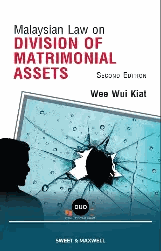


Description
Book Review: Malaysian Law on Division of Matrimonial Assets
Review author: marceljude.ai
List of Contents
The book is structured as follows:
Foreword
Preface
About the Author
Table of Cases
Table of Legislation
Introduction
Chapter 1: Division of Matrimonial Assets under the Law Reform (Marriage and Divorce) Act 1976
Chapter 2: Assets Acquired by Joint Efforts
Chapter 3: Assets Acquired by Sole Effort of One Party
Chapter 4: Assets Owned Before Marriage and Substantial Improvement
Chapter 5: Conduct of the Parties and Adultery
Chapter 6: Time and Place
Chapter 7: Resulting Trusts
Chapter 8: Manner of Division, Procedure for Ancillary Relief and Types of Orders
Chapter 9: Pool of Divisible Matrimonial Assets
Chapter 10: Enforcement and Defeating Circumvention
Chapter 11: Marital Agreements — Pre-nuptial and Post-nuptial Agreements
Chapter 12: Division of Matrimonial Assets and Succession Law
Chapter 13: Division of Matrimonial Assets under Islamic Family Law
Chapter 14: Division of Matrimonial Assets under Native Customary Law
Index
Overall Review of the Book
This is not merely a technical manual on divorce property disputes. It is a serious doctrinal work on how Malaysian law understands marriage as an economic, social, emotional, and legal partnership. Its central concern is the division of matrimonial assets: who gets what, why, when, under which jurisdiction, and according to which legal tradition.
The book’s strength lies in its refusal to treat matrimonial asset division as a simple “half-share” question. The author repeatedly dismantles the public myth that divorce automatically means one spouse receives half of the other spouse’s property. Instead, the book shows that Malaysian law is contribution-based, fact-sensitive, and deeply dependent on the classification of property. The book explains that courts distinguish between assets acquired by joint efforts, assets acquired by the sole effort of one spouse, and assets owned before marriage but substantially improved during marriage. This makes the book doctrinally disciplined and practically useful.
The book is also valuable because it does not confine itself to non-Muslim civil divorce under the Law Reform (Marriage and Divorce) Act 1976. It broadens the inquiry into Islamic family law and native customary law. This is one of the book’s most important scholarly contributions. Many family law texts treat Malaysian family law as if it were one unified system. This book understands Malaysia as a legally plural society, where civil law, Syariah law, and native customary systems each have their own vocabulary, jurisdictional logic, and moral assumptions. The chapters on harta sepencarian and native customary law are especially important because they show that the idea of matrimonial property is not simply an imported common law idea. It has local roots and indigenous equivalents.
As a law professor, I would describe the book as both doctrinally ambitious and practitioner-oriented. Its heavy use of cases makes it useful for litigation, but its conceptual discussion makes it suitable for academic study. It is not light reading. The prose is dense, and the case-law discussion can be demanding. But that density is part of the book’s value: matrimonial asset disputes are rarely simple, and the book does not pretend otherwise.
Its major weakness is that its richness may overwhelm a beginner. A student new to family law may struggle with the number of cases, statutory provisions, procedural rules, and jurisdictional distinctions. But for lawyers, judges, advanced students, and researchers, that same density is a strength. The book is best read not as a casual introduction but as a specialist work on Malaysian matrimonial property law.
Introduction
The Introduction performs an important corrective function. It begins by confronting popular misconceptions: that a wife automatically gets half of the husband’s property, that adultery necessarily determines asset division, or that matrimonial asset law is a purely Western import. The author rejects these assumptions and reframes the subject as one grounded in contribution, fairness, and the realities of matrimonial partnership.
The Introduction is particularly strong in explaining why matrimonial asset division matters in real life. Divorce is not only about the legal dissolution of marriage. It is also about housing, security, maintenance, children, accumulated wealth, and the practical ability of spouses to restart their lives. The author emphasizes that maintenance orders may be difficult to enforce and that a clean division of capital assets may sometimes provide a more realistic form of justice than monthly maintenance. This is an important practical insight.
The Introduction also sets up one of the book’s most significant ideas: division of matrimonial assets is not punishment. It is not a moral penalty for wrongdoing. It is a distribution of the fruits of the matrimonial partnership. That framing is essential because it separates property division from emotional blame.
From a scholarly perspective, the Introduction succeeds because it gives the book a jurisprudential foundation. It is not merely asking, “What does the statute say?” It asks, “What is marriage as a legal-economic partnership, and how should law respond when that partnership ends?”
Chapter 1: Division of Matrimonial Assets under the Law Reform (Marriage and Divorce) Act 1976
Chapter 1 is the doctrinal foundation of the civil-law portion of the book. It explains the statutory basis for division of matrimonial assets under the Law Reform (Marriage and Divorce) Act 1976, especially section 76. The chapter shows that Malaysian courts possess a broad discretion, but that discretion is structured by statutory categories: joint effort, sole effort, and substantial improvement.
The chapter is especially valuable because it explains the historical development of matrimonial property law. The author traces the influence of English law, the Married Women Act, the English Matrimonial Proceedings and Property Act, and the Singapore Women’s Charter. This comparative approach helps the reader understand why Malaysian law developed as it did and why Malaysian courts sometimes look to English or Singaporean authorities while still exercising caution because of local social and cultural differences.
A key theme of the chapter is “rough justice.” The law does not provide a precise mathematical formula for every case. Instead, courts weigh contribution, debts, children’s needs, and the circumstances of the marriage. This is one of the most realistic parts of the book. Divorce property disputes involve human lives, incomplete records, emotional conflict, informal family arrangements, and assets acquired over many years. A perfectly scientific division is often impossible.
The chapter also deals with jurisdiction: who can come under the Act, what happens with foreign marriages and foreign decrees, and how the Act treats Muslims, natives, customary marriages, common law wives, and unregistered relationships. This makes the chapter much more than a discussion of property. It is also a jurisdictional map of who is inside and outside the civil matrimonial regime.
As a law professor, I would say Chapter 1 is one of the strongest chapters because it provides the legal architecture for everything that follows. It is historical, comparative, statutory, and practical. Its limitation is that it is dense, but that density is necessary because the later chapters depend on the distinctions made here.
Chapter 2: Assets Acquired by Joint Efforts
Chapter 2 examines assets acquired by the joint efforts of both spouses. This is the category most closely associated with the popular assumption of equal division. But the author carefully explains that equality is not automatic. The court “inclines” toward equality, but must consider the extent of each party’s contribution, debts incurred for joint benefit, and the needs of minor children.
The chapter’s best feature is its broad understanding of contribution. Contribution is not limited to paying the full purchase price. It may include deposits, down payments, mortgage instalments, household expenditure, surrender of salary, payment of servants, groceries, renovation-related payments, or other financial support that indirectly enables acquisition of the asset.
This is doctrinally significant because many marriages do not operate like commercial partnerships. One spouse may pay the mortgage while the other pays for food, children, household expenses, furniture, or family upkeep. The book explains that such indirect financial contribution may still be legally meaningful. In this way, the chapter resists a narrow title-based view of property.
The chapter also correctly stresses evidence. A spouse claiming contribution must prove it. Receipts, bank statements, loan documents, records of salary, and proof of payments matter. Family law may be equitable, but it is still litigation. Sentiment alone is not enough.
The chapter’s discussion of debts is also important. A matrimonial asset cannot be viewed only as a gross value. If a house is charged to a bank, the redemption sum and liabilities affect the real value available for division. The book therefore trains the reader to think like a lawyer: identify the asset, identify the contribution, identify the debt, then determine the divisible value.
As a review, I would say Chapter 2 is one of the most practically useful chapters for lawyers preparing matrimonial property claims. It teaches that “joint effort” is not merely about whose name is on the title. It is about the financial reality behind the acquisition.
Chapter 3: Assets Acquired by Sole Effort of One Party
Chapter 3 is one of the most conceptually important chapters in the book. It deals with assets acquired by the sole effort of one spouse and explains how the non-acquiring spouse may still receive a share if he or she contributed to the welfare of the family by looking after the home or caring for the family.
The author gives considerable attention to non-financial contribution. This is crucial. In many marriages, one spouse accumulates assets because the other spouse performs domestic labour, raises children, maintains the household, cares for relatives, or sacrifices career opportunities. The chapter explains how modern matrimonial law recognizes that such domestic and caregiving contributions have legal value.
The chapter also traces the English development of the idea that homemaking and caregiving may be treated as contributions to family welfare. This historical discussion is valuable because it shows that recognition of non-financial contribution was not obvious under older property law. It had to be developed through legal reform and judicial reasoning.
A particularly strong part of the chapter is its discussion of the Malaysian “caveat”: where an asset is acquired by the sole effort of one party, that acquiring party must receive the greater proportion. This distinguishes Malaysian law from broader equal-sharing approaches. The chapter shows that Malaysian law recognizes homemaking, but does not necessarily equate it with financial acquisition in every case.
The chapter also deals with working wives, housewives, domestic maids, supervision of renovation, care of children, and what the author calls relationship-generated disadvantage. This is where the chapter becomes socially realistic. A spouse may be a full-time homemaker, a working spouse with domestic responsibilities, or a spouse assisted by a maid but still responsible for managing family welfare. The book wisely avoids a simplistic view of domestic contribution.
As a law professor, I find this chapter intellectually rich. It forces the reader to confront a difficult question: how should law value unpaid domestic labour? The book does not answer that question abstractly. It answers it through statutory interpretation, case law, and judicial outcomes.
Chapter 4: Assets Owned Before Marriage and Substantial Improvement
Chapter 4 deals with assets owned before marriage and asks when such assets may become divisible matrimonial assets. The central idea is substantial improvement. A property owned by one spouse before marriage does not automatically become divisible merely because the parties later marry. But if the other spouse, or both spouses, substantially improve it during the marriage, the law may treat it as falling within the matrimonial asset framework.
This chapter is important because it prevents overreach. Not every premarital asset should be swallowed into the matrimonial pool. At the same time, a spouse should not be allowed to retain the whole benefit of an asset that was significantly improved by the other spouse’s money, labour, or contribution during marriage.
The chapter examines different factual situations: houses bought before marriage, assets acquired during a previous marriage, gifts owned before marriage, sale and purchase agreements signed before marriage, and cases where the contribution is too small to matter. It emphasizes that de minimis contributions are insufficient and that payment of ordinary utility bills or assessment may not amount to substantial improvement.
The chapter also highlights pleading. A party who alleges substantial improvement must plead particulars clearly. This is a valuable procedural reminder. A matrimonial property claim is not won by general allegations. It must be built through facts.
The most interesting jurisprudential issue in this chapter is whether the contributor obtains a resulting trust proportionate to contribution or whether the asset is treated more generally as a matrimonial asset. This question exposes the tension between property law and family law. Property law asks, “What beneficial interest was created?” Family law asks, “What division is fair upon divorce?” Chapter 4 shows that those questions may overlap but are not identical.
Chapter 5: Conduct of the Parties and Adultery
Chapter 5 is short in theme but important in principle. It explains that conduct, including adultery, is generally irrelevant to the division of matrimonial assets. This is one of the book’s clearest normative positions: asset division is not a punishment mechanism.
The chapter corrects a common misconception. Many spouses believe that the morally innocent party should receive more property, or that the adulterous party should be financially penalized through asset division. The author explains that this is not the governing approach. Matrimonial asset division is based primarily on contribution and statutory considerations, not moral revenge.
This chapter is important because it separates different legal remedies. Adultery may be relevant to divorce, damages, or maintenance in certain contexts, but it does not automatically alter property division. This distinction is crucial for lawyers advising emotionally distressed clients. It prevents litigation from becoming a forum for moral retaliation.
As a law professor, I would praise this chapter for its discipline. Family law naturally attracts emotional arguments, but the chapter insists on legal relevance. That insistence is both humane and doctrinally correct. It protects the court from turning property division into punishment.
Chapter 6: Time and Place
Chapter 6 addresses jurisdiction, timing, and procedural strategy. It asks where spouses may apply, when matrimonial assets may be divided, and how property disputes should be handled before, during, or after divorce.
The chapter’s treatment of domicile is important. Matrimonial jurisdiction is not merely about where property is located or where parties happen to be. It may depend on domicile and the court’s statutory power. The chapter therefore reminds readers that before arguing about division, one must first ask whether the court has jurisdiction.
The chapter also examines timing. Matrimonial asset division under the relevant civil statute is connected to the granting of divorce or judicial separation. This creates practical difficulties when parties delay claims or when property disputes arise before divorce. The book’s discussion of the clean break principle is important because it links asset division to finality. A proper division allows parties to move on without constant financial entanglement.
Another strength of the chapter is its analysis of parallel remedies. A spouse may have claims in property law, trust law, contract law, or matrimonial law. The chapter explains that these claims may overlap, but they are not identical. This is a sophisticated point. A matrimonial asset claim is not always the same as a proprietary claim.
The chapter also discusses production of documents and why parties may apply later. It notes that maintenance for spouse and children may take priority over division of assets. This shows the author’s practical awareness: matrimonial litigation is not only about legal entitlement but also about financial survival.
Chapter 7: Resulting Trusts
Chapter 7 brings equity into the discussion. Resulting trust doctrine becomes important when property is registered in one person’s name but another person contributed to its acquisition, or where parties lived together but do not fall within the statutory matrimonial regime.
This chapter is valuable because not every property dispute between intimate partners can be solved under matrimonial legislation. Some disputes arise before divorce, outside marriage, or in relationships not recognized under the Act. Resulting trust principles may then become necessary.
The chapter explains presumed resulting trusts, the presumption of advancement, the relationship between the provider of money and the nominee, intention to make a gift, estoppel, and equitable rights. It also deals with common law wives and illegitimate children.
The chapter’s deeper value is that it shows the limits of family law. Where statutory matrimonial relief is unavailable or incomplete, equity may provide an alternative route. But equity is not the same as matrimonial discretion. It depends more heavily on contribution, intention, presumption, and evidence.
As a law professor, I would use this chapter to teach the relationship between family law and property law. It demonstrates that matrimonial asset disputes are legally hybrid. They require family law sensitivity but property law precision.
Chapter 8: Manner of Division, Procedure for Ancillary Relief and Types of Orders
Chapter 8 is the procedural engine room of the book. It explains how claims should be made and what orders the court may grant. This chapter is especially useful for practitioners because even a strong substantive claim can fail if procedure is mishandled.
The chapter discusses the Divorce and Matrimonial Proceedings Rules, including the proper use of Form 11 and the problems with defective “catch-all” applications. It emphasizes that a party should specify what relief is sought and what assets are claimed. A vague request for all assets is not good litigation.
The chapter then examines types of orders: vesting orders, sale orders, monetary awards, security for maintenance, sale to third parties, buy-out arrangements, and lump sum payments. It also discusses when an order for sale may be inappropriate, especially where it would leave a party without housing.
The discussion of lump sum payments is practically important. A court may order one spouse to pay the other a sum representing that spouse’s share, but immediate payment may be unrealistic. The chapter recognizes that courts may need to allow time to pay, or provide fallback mechanisms such as sale if payment cannot be raised.
This chapter’s main contribution is procedural realism. It reminds the reader that justice is not achieved merely by declaring shares. The order must be workable, enforceable, and fair in practical terms.
Chapter 9: Pool of Divisible Matrimonial Assets
Chapter 9 is arguably the most comprehensive and practically significant chapter in the book. It asks: what exactly counts as a matrimonial asset?
The chapter begins with the problem that the statute does not provide a complete definition. The author therefore turns to case law and comparative reasoning. The book explains that Malaysian courts often use an asset-by-asset approach rather than a global division of all wealth. This is significant because each asset may have a different history, different contribution pattern, and different legal treatment.
The chapter covers a wide range of assets: EPF, capital appreciation, windfalls, matrimonial homes, land, commercial properties, businesses, shares, unit trusts, gifts, inheritances, cars, joint bank accounts, fixed deposits, insurance policies, club memberships, jewellery, lottery winnings, industrial court awards, books, medical expenses, loans, and repatriated funds.
The discussion of EPF is especially important. Retirement savings may be accumulated during marriage, and a spouse’s domestic contribution may have enabled the other spouse to build such savings. But the legal treatment is complicated because EPF has statutory protection and may not be attachable in the ordinary way.
The chapter’s discussion of capital appreciation and windfalls is also sophisticated. If a property increases in value during marriage, should that increase be divided? If a lottery prize is won, is it a personal windfall or a matrimonial asset? The author shows that these questions are not merely factual but theoretical. They depend on whether the law sees marriage as a partnership that shares gains, risks, and accumulated fortune.
The chapter is also careful with gifts and inheritances. Generally, gifts and inheritances stand on a different footing because they come from outside the matrimonial partnership. But if they are substantially improved or converted into family assets, the analysis may change.
From a law professor’s perspective, Chapter 9 is the book’s richest chapter. It is where doctrine meets everyday assets. It would be extremely useful in practice because matrimonial disputes rarely concern only one house. They often involve mixed pools of property, savings, business interests, debts, and family transfers.
Chapter 10: Enforcement and Defeating Circumvention
Chapter 10 deals with what happens when a spouse attempts to hide, dispose of, transfer, dilute, or frustrate claims to matrimonial assets. This chapter is essential because legal rights are meaningless without enforcement.
The chapter examines discovery of matrimonial property, full and frank disclosure, disposal of assets before divorce, manipulation of redemption sums, dilution of company shares through director’s fees, statutory injunctions, orders setting aside dispositions, ex parte injunctions, Mareva injunctions, Anton Piller orders, committal proceedings, caveats, creditors, bankruptcy, and reciprocal enforcement of judgments.
One of the chapter’s strongest points is its attention to disclosure. Matrimonial litigation depends heavily on honesty about assets. If one party controls documents, companies, accounts, or land titles, the other spouse may be at a serious disadvantage. Discovery and injunctions therefore become tools of substantive justice.
The discussion of caveats is particularly useful. The book explains that a mere claim to matrimonial assets may not always create a caveatable interest in land because the right may be uncertain until the court exercises its discretion. This is an important warning for practitioners who may assume that a pending divorce claim automatically supports a land caveat.
The bankruptcy discussion is also valuable because matrimonial property claims may collide with creditors’ rights. The book shows that family law cannot be studied in isolation from insolvency law.
Chapter 10 is one of the most litigation-focused chapters. It is less philosophical than Chapter 3 or Chapter 9, but just as important. It teaches that matrimonial asset law is not only about entitlement; it is about preventing strategic evasion.
Chapter 11: Marital Agreements — Pre-nuptial and Post-nuptial Agreements
Chapter 11 examines pre-nuptial and post-nuptial agreements. Its central issue is the tension between contractual autonomy and the court’s statutory power to divide matrimonial assets.
The chapter recognizes the importance of agreements. Parties may make formal arrangements about property, maintenance, or settlement. But the book also emphasizes that such agreements cannot simply oust the court’s jurisdiction. Matrimonial law is not pure contract law. The court retains a supervisory role, especially where fairness, voluntariness, children, maintenance, or statutory policy is involved.
The chapter covers voluntariness, collateral agreements, rescission, statutory power to consider agreements, and the treatment of such agreements in other jurisdictions including the United Kingdom, Singapore, and Australia. It also discusses whether parties can bind themselves to joint dissolution by mutual consent, withdrawal of consent, part performance, and the incorporation of agreements into court orders.
One of the chapter’s most interesting points is that a marital agreement becomes stronger when incorporated into a decree or consent order. Once an agreement “morphs” into a court order, enforcement options expand and the court’s authority gives it a different legal character.
This chapter is important because wealth planning, second marriages, family businesses, inherited property, and cross-border marriages increasingly make marital agreements relevant. The author treats them neither as automatically binding nor as useless. That balanced approach is correct.
Chapter 12: Division of Matrimonial Assets and Succession Law
Chapter 12 deals with the intersection between divorce property claims and death. It asks whether a will or testamentary disposition can defeat a spouse’s claim to matrimonial assets.
The chapter’s main point is that succession law and matrimonial asset law operate according to different principles. A testator’s wishes are important and generally respected. But the question is whether a spouse’s matrimonial asset claim exists in a way that can survive death or override testamentary arrangements.
The chapter discusses the principle that the intention of the testator is paramount, the survival or non-survival of causes of action, and the effect of dissolution of marriage by death.
This chapter is short compared with others, but conceptually important. It shows that matrimonial asset claims are time-sensitive. If a claim is not pursued before death, the legal analysis may change dramatically. It also shows why lawyers must think strategically when divorce, separation, wills, and estate planning overlap.
As a law professor, I would say this chapter provides a necessary bridge between family law and succession law. It may not be the longest chapter, but it is one of the most cautionary.
Chapter 13: Division of Matrimonial Assets under Islamic Family Law
Chapter 13 is one of the book’s most significant contributions. It examines harta sepencarian under Islamic family law and Syariah court jurisdiction. The author explains the concept of matrimonial assets in Syariah law, local custom, statutory codification, and the power of Syariah courts to divide such assets.
The chapter shows that harta sepencarian is not merely a mirror of civil matrimonial asset law. It has its own doctrinal vocabulary, including joint effort, sole effort, contribution, indirect contribution, companionship, domestic help, and the treatment of gifts. The chapter also discusses the need to determine whether property is harta sepencarian before deciding the ratio of division.
A particularly important aspect of the chapter is its treatment of registration. The fact that land or property is registered in one spouse’s name does not necessarily defeat a harta sepencarian claim. This is an important parallel with civil matrimonial asset law, though the doctrinal basis differs.
The chapter also deals with specific assets such as debts, EPF, and Felda land, and procedural tools such as injunctions. It discusses claims after divorce, claims after death, lapse of time, and jurisdictional boundaries between civil and Syariah courts.
This chapter’s greatest strength is its respect for legal pluralism. It does not treat Islamic family law as an appendix to civil family law. It treats it as a full legal system with its own sources and internal logic. That is essential in Malaysia.
From a scholarly perspective, Chapter 13 also shows that Malaysian matrimonial property law cannot be understood solely through English common law. Local legal traditions, including Malay customary concepts and Islamic legal development, are central to the subject.
Chapter 14: Division of Matrimonial Assets under Native Customary Law
Chapter 14 extends the book into native customary law, especially in Sarawak and Sabah. This chapter is distinctive because many family law discussions neglect native customary systems, even though they are legally and culturally significant.
The chapter explains native court systems, jurisdiction, and the historical role of native courts in division of matrimonial assets. It discusses Sarawak customs such as Adat Iban, Adat Bidayuh, Adet Kayan-Kenyah, Adat Lun Bawang, and Adat Bisaya. It also discusses Sabah native law concepts such as pencharian, pesaka, and bawahan.
The chapter shows that native customary law often uses classifications that differ from civil matrimonial law. For example, some systems distinguish inherited property from acquired property, old property from new property, communal family property from individual property, and property affected by fault. In some customs, children’s interests and wider family structures play a stronger role than in civil divorce law.
The chapter’s discussion of Native Court jurisdiction is especially important. Where a statute creates a specific tribunal for a particular right, parties may be required to use that tribunal rather than ordinary civil courts.
The discussion of Iban concepts such as barang lama, barang bahru, bilik property, and lanting is particularly valuable because it shows that matrimonial property division may involve extended family and customary inheritance ideas, not only the two spouses.
Chapter 14 is perhaps the most culturally rich chapter. It demonstrates that family property law is not merely technical. It is embedded in kinship, land, custom, community, and identity. As a law professor, I would call this chapter one of the book’s most original contributions.
Entire Book Assessment
The book succeeds because it combines five things rarely found together: statutory analysis, case-law depth, comparative law, litigation procedure, and Malaysian legal pluralism.
Its first major achievement is doctrinal clarity. The book explains the categories of matrimonial assets and the legal consequences of each category. It makes clear that joint effort, sole effort, substantial improvement, gifts, inheritances, EPF, business assets, and premarital property must not be treated as if they were all the same.
Its second major achievement is practical usefulness. The book repeatedly shows how lawyers should plead, prove, value, divide, and enforce claims. It deals not only with what the law says but with how matrimonial asset litigation actually unfolds.
Its third major achievement is comparative sophistication. The book draws from English and Singaporean developments but does not blindly import them. It repeatedly recognizes Malaysian social and cultural differences. This is an important scholarly virtue because family law is deeply local.
Its fourth major achievement is respect for plural legal systems. The chapters on Islamic family law and native customary law make the book broader and more Malaysian than a purely common law treatment would be.
Its fifth major achievement is its insistence that matrimonial asset division is not punishment. This theme runs throughout the book. Adultery, anger, blame, and betrayal may explain why marriages collapse, but property division is governed by contribution, statutory discretion, children’s needs, jurisdiction, and fairness.
The book’s main limitation is accessibility. It is case-heavy and sometimes procedurally dense. Readers without legal training may find it difficult. But for its intended legal audience, that is not a fatal weakness. A simpler book would not have achieved the same depth.
Final Law Professor’s Judgment
This is a serious and valuable contribution to Malaysian family law. It is not merely descriptive; it is analytical. It does not merely state rules; it explains why the rules exist, how they interact, and where they create difficulty.
For students, the book teaches legal method.
For lawyers, it provides litigation strategy.
For judges, it organizes difficult authorities.
For scholars, it offers a map of Malaysian matrimonial property law across civil, Islamic, and native customary systems.
My final assessment is that the book is a strong specialist text: doctrinally rich, practically grounded, and distinctly Malaysian in scope. Its best chapters are Chapter 3, Chapter 9, Chapter 10, Chapter 13, and Chapter 14, because those chapters move beyond basic statutory explanation and confront the real complexity of matrimonial property: domestic labour, asset classification, enforcement, religious jurisdiction, and customary law.
Overall, the book’s central message is this: matrimonial asset division is not about automatic equality, punishment, or title ownership alone. It is about legally recognizing the economic reality of marriage as a partnership, while respecting statutory limits, evidential proof, and Malaysia’s plural legal traditions.
 marceljude.ai @ +60128285778 |
- MALAYSIA'S 1ST AI LAWYER - CLICK HERE
- ISMAIL – INTEGRATED SINGAPORE/MALAYSIA AI & LAW (Library)
- OPENING OF SINGAPORE MALAYSIA AI CENTRE AND LAW LIBRARY
- LIFT - LAW INSTRUMENTS FORMS & TEMPLATES
- LAWS OF MALAYSIA FOR SINGAPOREAN DUMMIES
- HANNAH YEOH'S ARTIFICIAL INTELLIGENCE LAW ENCYCLOPEDIA
- LEAD CR - Law Ecosystem Archive Databases on CD-ROM
- BREAKING NEWS FROM MJN
- CLICK HERE CO. PROFILE
- EXCITING NEW SERIES - THE ADVENTURES OF BOBBY TAN -ADVOCATE & SOLICITOR IN THE HIGH COURT OF NORTH BORNEO by marceljude.ai
- MEDICO LEGAL - BY PRISKILA AKWILA & GLORIOUS PETAL SDN BHD - powered by marceljude.ai
- MISCELLANOUS
- ANNOTATED STATUTES OF SABAH - A NEW SERIES
- e-library - marceljude.ai
- DRAFT - DOCUMENT RESEARCH & AUTOMATED FILING TECHNOLOGY
- CLARA – Case Law Analysis & Retrieval AI
- FOR RESEARCH REQUEST CLICK HERE
- CLICK HERE TO ASK ANYTHING
- RAMBO'S LAW - THE LAW OF THE LAW JUNGLE - EXCITING NEW SERIES - CASE ANALYSIS BY JOHN RAMBO @ +60138646786
- PRISKILA AKWILA ADVOCATES - High Court of Sabah & Sarawak @ Kota Kinabalu
- COLA - COMMONWEALTH ONLINE LAWCASES AI -marceljude.ai
- THE LAW LIBRARY THAT COMES TO YOU ANYWHERE AND ANYTIME
- marceljude.ai training academy
