
Malaysian Employment Law Practices: A Guide for Human Resource Practices - marceljude.ai


Description
Malaysian Employment Law Practices: A Guide for Human Resource Practices
Review author: marceljude.ai
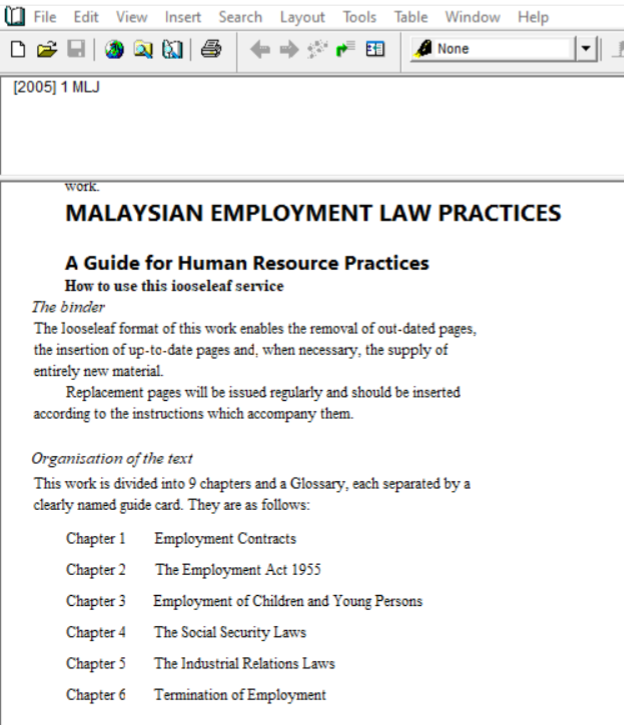
I read the book as a looseleaf employment-law manual structured around nine substantive chapters and a glossary. The work is organised by numbered paragraphs, and the index, table of cases, and table of statutes refer to those paragraph numbers rather than ordinary running pages. Its practical purpose is clear: it is not merely a doctrinal employment-law text, but a working guide for human resource managers, employers, legal advisers, and labour-relations practitioners who need to understand Malaysian employment law in operational terms. The book itself states that it is divided into nine chapters plus a glossary, and that each chapter is separated by a guide card and organised into numbered paragraphs. This review is written as a legal-academic review, not as updated legal advice. I am reviewing the book as read.
Preliminary pages: i–iv
Tables and Index: Tl (1)–(200)
Chapter 1, Employment Contracts: 1(i)–1(ii), 1(1)–1(160)
Chapter 2, The Employment Act 1955: 2(i)–2(iv), 2(1)–2(210)
Chapter 3, Employment of Children and Young Persons: 3(i)–3(ii), 3(1)–3(6)
Chapter 4, The Social Security Laws: 4(i)–4(ii), 4(1)–4(110)
Chapter 5, The Industrial Relations Laws: 5(i)–5(iv), 5(1)–5(302)
Chapter 6, Termination of Employment: 6(i)–6(iv), 6(1)–6(558)
Chapter 7, Pembangunan Sumber Manusia Bhd Act 2001: 7(i)–7(ii), 7(1)–7(8)
Chapter 8, The Laws on Occupational Safety and Health: 8(i)–8(ii), 8(1)–8(104)
Chapter 9, The Wages Councils Act 1947: 9(i)–9(ii), 9(1)–9(4)
Glossary of Legal Terms: 10(1)–10(10)
Filing Record and Checklist: CL(1)–CL(2)
List of contents
The book’s substantive contents are:
Chapter 1: Employment Contracts
Chapter 2: The Employment Act 1955
Chapter 3: Employment of Children and Young Persons
Chapter 4: The Social Security Laws
Chapter 5: The Industrial Relations Laws
Chapter 6: Termination of Employment
Chapter 7: Pembangunan Sumber Manusia Bhd Act 2001, also described as The Human Resources Development Bhd Act
Chapter 8: The Laws on Occupational Safety and Health
Chapter 9: The Wages Councils Act 1947
Glossary of Legal Terms
Overall review of the entire book
As a whole, Malaysian Employment Law Practices is best understood as a practitioner’s manual built on three pillars: statutory employment standards, industrial-relations procedure, and managerial implementation. Its central strength is that it does not treat labour law as a mere collection of statutes. It repeatedly shows that employment law in Malaysia operates through a combination of legislation, common law, Industrial Court awards, administrative practice, and practical documentation. The first chapter expressly frames employment law as a combination of legislation and case law, and then identifies the major statutes discussed in the manual.
The book’s intellectual architecture is sensible. It begins with the employment contract, because the contract is the basic legal relationship. It then turns to the Employment Act 1955, which supplies minimum statutory terms for covered employees. It separately treats children and young persons, social-security obligations, collective labour law, termination, training levy obligations, workplace safety, and wages regulation. That sequencing is pedagogically effective: the reader moves from individual contract formation, to statutory floor rights, to special categories of labour, to social protection, to collective organisation, to dismissal and redundancy, to occupational safety, and finally to wage-fixing mechanisms.
Its most valuable feature is its operational legal style. Many employment-law texts identify rights; this one often asks, “What should an employer actually do?” That makes it useful for human resource practice. For example, it includes guidance on drafting employment terms, handling warning letters, conducting domestic inquiries, managing probationers, calculating benefits, reporting accidents, and communicating statutory entitlements. At the same time, its legal orientation is not purely employer-sided. It recognises security of employment, statutory non-contracting-out rules, trade union rights, social-security protections, child-labour limits, and the Industrial Court’s role in enforcing fairness.
The book’s greatest doctrinal contribution lies in Chapters 1, 5, and 6. Chapter 1 explains how contract law is transformed by labour legislation and social justice. Chapter 5 explains how collective bargaining and industrial action are channelled through statutory procedure. Chapter 6 is the book’s most substantial chapter and clearly the practical heart of the manual: it treats dismissal not as a mechanical contractual act, but as a legally scrutinised decision requiring just cause, procedural fairness, proportionality, evidence, and defensible documentation.
The book’s main limitation is that it is strongly practice-oriented. It does not always pause for broader theoretical critique, such as whether Malaysian employment law adequately protects precarious labour, whether domestic servants are under-protected, whether foreign-worker protection is structurally weak, or whether wage council mechanisms are too narrow. A law professor would therefore praise the manual for legal clarity and practical utility, while noting that it is less a critical socio-legal study than a professional compliance guide.
Chapter 1 Review: Employment Contracts Actual pages: 1(i)–1(ii), 1(1)–1(160)
Chapter 1 is the foundation of the book. It explains employment law through the contract of employment, but it does not reduce employment law to ordinary private contract. Its major legal insight is that employment contracts are simultaneously private bargains and regulated social relationships. The chapter begins by identifying Malaysian employment law as a mixture of statutes and case law, including the Employment Act 1955, Trade Unions Act 1959, Industrial Relations Act 1967, Factories and Machinery Act 1967, Occupational Safety and Health Act 1994, Employees Provident Fund Act 1991, Employees’ Social Security Act 1969, Workmen’s Compensation Act 1952, Wages Councils Act 1947, Children and Young Persons (Employment) Act 1966, Employment (Restriction) Act 1968, and human-resource-development legislation.
The chapter’s legal method is sound. It begins with recruitment, then moves to contract formation, contractual terms, statutory minimums, probation, variation, breach, common terms, special intellectual-property clauses, restrictive clauses, privacy, suspension, medical examination, and the contract-of-service/contract-for-services distinction. The contents list includes all these subsections, from employment laws and recruitment through contract of service, contractors, special situations, and minors.
Subsection review
Employment Laws [1.1]. This opening subsection gives the reader the legal map. It is useful because Malaysian employment law is not contained in one statute. The book correctly presents employment law as an interlocking system of contract, minimum labour standards, industrial relations, social security, child-employment restrictions, safety legislation, and wage regulation.
Employment Law and Recruitment [1.2]. This section shows that employers retain broad recruitment discretion, but that freedom is not absolute. The book’s formulation is especially memorable: employers are relatively free to hire, but less free to fire. This is a legally accurate way to introduce the asymmetry between contract formation and termination scrutiny.
Employment of Foreigners [1.2.1]. The discussion treats foreign recruitment as a regulatory issue rather than a purely contractual one. It explains that foreign employment depends on work authorisation and immigration restrictions. The chapter rightly advises readers to check the latest immigration position, which is important because foreign-worker rules are administratively dynamic.
Employment of Children [1.2.2]. This subsection cross-links Chapter 3 and reminds employers that child employment is lawful only within statutory limits. The value of the subsection is that it prevents the reader from assuming that capacity to work equals unrestricted legal employability.
Employment of Public Sector Employees [1.2.3]. The chapter distinguishes public-sector employment from private-sector employment and notes that the book mainly focuses on the private sector. This limitation is useful because public-service discipline, tenure, and remedies often follow different legal regimes.
Employment of Domestic Servants [1.2.4]. This section is important because it identifies domestic servants as contractual employees while also noting that many employment laws apply only in limited ways. The book recognises that a domestic servant may still be a “workman” for Industrial Relations Act purposes and may claim reinstatement if unfairly dismissed.
Laws on Discrimination [1.2.5]. The discussion is concise and practical. It observes that, within the book’s legal framework, employment discrimination law is limited, except for statutory equality between local and foreign employees doing the same jobs under the Employment Act. As a law professor, I would note that this is one area where the book is descriptive rather than critical.
Contracts of Employment [1.3]. This is the core doctrinal section. The book explains that an employment contract requires offer, acceptance, and consideration, but also that employment contracts are special because they are affected by legislation, common law, social justice, and natural justice. This is one of the strongest conceptual passages in the book.
Definition of Contract of Employment [1.3.1]. The section defines a contract of employment as a binding agreement under which one person serves another for wages and benefits. It uses the withdrawal of an accepted job offer to show that employment rights can arise before actual commencement of work.
Establishing the Terms [1.3.2]. The book explains that terms may be express or implied, written or oral, and may appear in appointment letters, manuals, handbooks, or collective agreements. This is particularly useful for HR practice because disputes often arise from documents outside the appointment letter.
Incorporating Contractual Terms by Express Agreement [1.3.3]. This section shows that negotiated terms are binding if lawful. It is important because it recognises employee-specific bargains, such as permission to do outside consultancy work.
Terms Incorporated by Subsequent Agreement [1.3.4]. The chapter recognises that contracts can evolve. This is doctrinally important because employment relationships are continuing relationships, not one-off commercial exchanges.
Terms Must Not Contravene Any Rule of Law [1.3.5]. This subsection is central to legal compliance. It explains that unlawful contractual terms are invalid, such as broad restraint-of-trade clauses. It reinforces the book’s repeated theme: contract cannot defeat statute or public policy.
Incorporation by Reference [1.3.6]. This section is highly practical. It explains how handbooks, insurance schemes, statutory provisions, and policies may become contractually relevant through reference in the employment contract.
Implied Terms [1.3.7]. The discussion of implied terms is one of the chapter’s best academic sections. It explains terms implied by legislation, common law, custom, and courts. The implied duty of fidelity is especially important because it underpins misconduct, conflict of interest, confidentiality, and outside employment.
Duration of Employment [1.4]. The book distinguishes indefinite, temporary, and fixed-term contracts. This is essential because termination rights differ depending on whether the contract expires by time or continues indefinitely.
Rights of Employees on Fixed-Term Contracts [1.4.1]. This subsection warns employers that fixed-term workers may still enjoy statutory rights. It correctly resists the misconception that temporary contracts remove employment-law obligations.
Contracting Out of Minimum Statutory Terms and Conditions [1.5]. This section explains that statutory minimums operate as a floor. It is one of the most important employee-protective parts of Chapter 1.
Restrictions to Contracting Out [1.5.1]. The book explains that employees cannot voluntarily surrender statutory rights, and contractual terms less favourable than statutory rights are void. This is a fundamental principle of labour law and is clearly presented.
Probation [1.6]. The chapter treats probation as a contractual device, not a legal status outside employment. Probationers remain employees.
Length of Probationary Period [1.6.1]. The book makes clear that probation is not mandatory; it must be included in the employment terms if intended. This is crucial for employers who later try to rely on probation without a contractual basis.
Terms and Conditions Applying to Probationers [1.6.2]. The section distinguishes statutory rights, which probationers retain, from discretionary or contractual benefits, which may be limited. It is a careful and useful distinction.
Variation of Contractual Terms [1.7]. This section correctly states that neither party has an automatic right to vary contractual terms. Employment contracts are flexible in practice, but not unilaterally rewriteable.
Unilateral Variation [1.7.1]. The book explains that serious unilateral variation may amount to breach and potentially constructive dismissal. This links Chapter 1 directly to Chapter 6.
Implied Acceptance of a Unilateral Change [1.7.2]. The section shows that continued work without protest may imply acceptance. That is practically significant because employee silence can have legal consequences.
Breach of Contract [1.8]. The book explains breach as failure to fulfil contractual obligations and notes civil remedies. This is a concise bridge between contract law and employment remedies.
Common Terms in Employment Contracts [1.9]. This is the chapter’s practical drafting centre. It covers designation, scope of employment, remuneration, hours, benefits, transfer, secondment, retirement age, rules, place of work, relocation, and performance clauses.
Designation [1.9.1]. Job titles matter because they may influence scope of duties and disputes over work allocation.
Scope of Employment [1.9.2]. The book sensibly advises that job descriptions should not overly restrict managerial flexibility unless intended as contractual terms.
Remuneration [1.9.3]. This subsection treats pay as a fundamental contractual term and stresses clarity in wage amount, allowances, frequency, date, and payment method.
Working Hours [1.9.4]. The section links contract drafting to statutory working-hour controls under the Employment Act.
Benefits [1.9.5]. The book lists common benefits such as leave, medical treatment, loans, insurance, cars, housing, public holidays, retirement and retrenchment benefits. It shows that not every benefit is statutory; many depend on contract.
Transfer or Mobility Clause [1.9.6]. This is one of the strongest practical subsections. It explains why express transfer clauses matter and how courts may limit implied transfer rights.
Secondment [1.9.7]. The book distinguishes secondment from transfer. This is legally important because secondment may involve another entity while the original employer remains relevant.
Retirement Age [1.9.8]. The section recognises the need for express retirement clauses, while discussing case law where retirement may be implied from practice.
Requirement to Obey Company Rules [1.9.9]. This subsection explains that employees are impliedly required to comply with reasonable rules, but that express rules reduce uncertainty.
Place of Employment and Relocation [1.9.10]. The book carefully analyses express and implied place-of-work terms. This is important because relocation disputes can become constructive-dismissal claims.
Performance Management Clauses [1.9.11]. The section shows how performance targets can be contractualised, but it also warns that dismissal still requires proper procedure.
Special Employment Terms [1.10]. This section introduces intellectual property issues.
Copyright [1.10.1]. The book explains employer ownership of copyright in work produced in the course of employment unless the contract says otherwise.
Inventions [1.10.2]. The section links inventions to employer ownership but notes equitable reward issues.
Restrictive Clauses [1.11]. The chapter distinguishes lawful confidentiality from unenforceable restraint of trade.
Exclusivity [1.11.1]. The book explains that employees may owe fidelity even without an express exclusivity clause.
Restraint of Trade [1.11.2]. The section correctly treats restraint clauses as generally unenforceable under Malaysian contract law.
Confidentiality [1.11.3]. This is a strong subsection. It explains implied and express confidentiality, trade secrets, and post-employment duties.
Other Terms [1.12]. This section covers medical boarding out, medical examination, overtime obligations, search rights, suspension, privacy, and governing law.
Contract of Service [1.13]. This final major section is doctrinally indispensable. Nearly all employment statutes depend on whether a worker is an employee under a contract of service.
Contracts for Services [1.13.1]. The book distinguishes employees from independent contractors.
Tests to Distinguish Contracts of Service and Contracts for Services [1.13.2]. The control test, organisation test, and multiple test are explained. This is critical for misclassification disputes.
Special Situations [1.13.3]. The book addresses trainees, apprentices, directors, and partners.
Minors and Employment Contracts [1.13.4]. The chapter closes by linking minors’ contractual capacity to the special statutory regime in Chapter 3.
Law-professor assessment: Chapter 1 succeeds because it teaches employment contract law as regulated contract law. It is especially useful for drafting, HR policy, and avoiding mistaken assumptions about probation, fixed-term work, implied terms, and contractor status. Its limitation is that it mostly frames issues from compliance and management perspectives, but doctrinally it is strong.
Chapter 2 Review: The Employment Act 1955 Actual pages: 2(i)–2(iv), 2(1)–2(210)
Chapter 2 is the book’s statutory floor chapter. It explains the Employment Act 1955 as the central source of minimum terms for covered employees. The chapter covers purpose and history, scope, wages, termination rules, estate workers, cash benefits, women’s night and underground work, maternity, domestic servants, rest days, working hours, overtime, public holidays, annual leave, sick leave, other leave, termination benefits, retirement benefits, foreign employees, registers, returns, and Department of Labour powers. The chapter contents list these subsections in detail.
Subsection review
Purpose and History [2.1]. The book places Malaysian employment legislation in historical context, explaining that labour laws originally regulated imported labour and later developed into worker-protection legislation.
Scope of the Employment Act [2.2]. This is the chapter’s gatekeeping section. It explains that not all employees are protected and that coverage depends on location, wage level, and work category. This is essential because the Act’s benefits do not automatically apply to every employee.
Definition of Wages [2.2.1]. The chapter carefully distinguishes wages from excluded payments such as accommodation, employer contributions, travel allowances, gratuities, and annual bonus. This matters for coverage and calculations.
Exceptions to the RM1,500 Ruling [2.2.2]. The book explains that certain categories, including manual workers and specified related workers, may be covered even above the wage ceiling. The discussion of manual labour is particularly valuable because classification disputes can be factually difficult.
Employees Earning up to RM5,000 [2.2.3]. The book notes that some employees outside full Act coverage may still use Labour Department complaint machinery for wage or cash-payment disputes. This is a practical access-to-remedy point.
Part-time Employees [2.2.4]. The book treats part-time workers as protected if they fall within the Act’s scope. It also warns employers about workplace morale when benefits differ from full-time employees.
Temporary Employees [2.2.5]. Temporary and fixed-term workers are treated as employees for statutory purposes where they fall within scope. This reinforces the anti-avoidance principle.
Domestic Servants [2.2.6]. The chapter notes that domestic servants are excluded from many major statutory benefits. This is legally accurate within the book’s framework, but from a policy standpoint it exposes a vulnerability in labour protection.
Terms of Employment Contract [2.3]. This section confirms that the Act invalidates terms less favourable than statutory minimums.
Validity of Contractual Terms [2.3.1]. The book clearly explains that more favourable contractual terms are allowed, but less favourable ones are void.
Right to Join and Organise a Trade Union [2.3.2]. This subsection links minimum employment standards to freedom of association. It is a useful bridge to Chapter 5.
Termination of Contracts [2.4]. This section is important but must be read with Chapter 6. The book correctly warns that statutory notice rules do not give employers an unrestricted right to dismiss without good cause.
Fixed-Term Contracts [2.4.1]. The book states that fixed-term contracts expire according to their terms, while referring readers to the more detailed discussion elsewhere.
Regular Contracts [2.4.2]. Indefinite contracts continue until terminated by either party.
Notice of Termination [2.4.3]. The chapter explains that contracts must include notice provisions and that notice must be equal for employer and employee.
Minimum Notice in Special Circumstances [2.4.4]. The book explains the statutory minimum notice periods in redundancy, closure, transfer refusal, change of ownership, and relocation-type cases.
Notice in Writing [2.4.5]. This is a simple but important procedural point: written notice reduces disputes.
Notice Not Withdrawn Unilaterally [2.4.6]. Once notice is given, unilateral withdrawal is not automatic.
Voluntary Notice by Employee [2.4.7]. The book warns that forced resignation may amount to dismissal. This is an important employee-protective doctrine.
Waiving Notice [2.4.8]. Either side may waive notice, but waiver is discretionary.
Payment of Indemnity [2.4.9]. The chapter explains wages-in-lieu principles and Labour Department complaint routes.
Notice Period for Probationers [2.4.10]. The book recognises shorter notice during probation, while cross-linking to probation rights.
Termination for Special Reasons [2.4.11]. This subsection introduces termination for misconduct after due inquiry, downgrading, and lesser penalties. It is central to HR discipline.
Breach by Employer [2.4.12]. Failure to pay wages is treated as employer breach.
Breach by Employee: Absence [2.4.13]. The book explains the statutory treatment of absence for more than two consecutive working days, but importantly states that automatic dismissal is not the law; inquiry is still required.
Employees on Estates [2.5]. This specialised subsection protects daily-rated estate workers by requiring minimum work availability or payment where the worker is willing and fit.
Wages and Cash Benefits [2.6]. The longest practical part of the chapter. It covers wage periods, timing, mode, place, termination payment, advances, deductions, priority, principal-contractor liability, bonus, failure to pay, higher-earner complaints, and increments.
Wage Periods [2.6.1]. Wage periods cannot exceed one month.
Timing of Wages [2.6.2]. Wages must be paid within the statutory period after the wage period.
Mode of Payment [2.6.3]. The book explains lawful payment methods and employee consent for non-cash mechanisms.
Restriction on Place of Payment [2.6.4]. This prevents abusive wage-payment practices.
Payment on Termination [2.6.5]. Wages must generally be settled promptly when employment ends.
Advances of Wages [2.6.6]. The book explains limits on advances and permitted purposes.
When Wages Are Not Due [2.6.7]. Wages may not be due in specified situations such as imprisonment or custody.
Deductions [2.6.8]. This subsection is vital. It classifies deductions into those requiring no permission, employee permission, Director General permission, or further approval.
Maximum Deductions [2.6.9]. The book explains monthly caps.
Priority of Wages [2.6.10]. Wage priority protects employees in insolvency-like situations.
Principal and Contractor Liability [2.6.11]. This is important in subcontracting arrangements.
Bonus [2.6.12]. The book correctly distinguishes discretionary bonus from contractual bonus.
Failure to Pay Wages [2.6.13]. The chapter recognises both Labour Department complaint and constructive-dismissal possibilities.
Rights of Employees Earning More than RM1,500 [2.6.14]. This repeats the practical complaint-jurisdiction point.
Payment of Increments [2.6.15]. The Act does not require annual increments unless contractually provided.
Night and Underground Work for Women [2.7]. This section describes gender-specific restrictions in industrial and agricultural undertakings and underground mining.
Maternity Leave [2.8]. The maternity section covers leave length, pay, working during leave, miscarriage, termination, registers, medical expenses, and paternity leave.
Length [2.8.1]. The book states the statutory maternity leave duration within its legal framework.
Pay [2.8.2]. The chapter explains eligibility conditions for paid maternity leave.
Working During Leave [2.8.3]. The book explains when unpaid maternity leave workers may return.
Miscarriage [2.8.4]. The section distinguishes maternity leave from sick leave in miscarriage situations.
Termination on Maternity Leave [2.8.5]. This is employee-protective and legally important.
Register of Maternity Allowances [2.8.6]. The book treats recordkeeping as part of compliance.
Medical Expenses [2.8.7]. The Act is described as silent; contract may provide benefits.
Paternity Leave [2.8.8]. The Act is described as silent; again, contract matters.
Domestic Servants [2.9]. The chapter explains domestic-servant notice provisions and limited statutory benefits.
Rest Day [2.10]. The book covers entitlement, notice/roster, consolidation, work on rest days, and premium pay. It explains that employees are entitled to one rest day every seven days and must be informed in advance.
Working Hours [2.11]. This is a major compliance section. It defines working hours and sets daily, weekly, rest-period, spread-over, and flexible-hours principles.
Overtime [2.12]. The book defines overtime, explains when it may be required, distinguishes voluntary work, gives overtime rates, maximum overtime, stand-by work, and shift-work exceptions.
Public Holidays [2.13]. This section explains statutory holiday entitlement, employer communication, more favourable terms, public-holiday work, and penalties for absence before or after holidays.
Annual Leave [2.14]. The chapter explains entitlement, application procedure, forced leave, rejection, forfeiture, carry-forward, and payment on termination.
Sick Leave [2.15]. The book gives detailed rules on paid and unpaid sick leave, panel doctors, hospitalisation, notice to employer, illness during annual leave, no entitlement in some cases, medical bills, abuse, and excessive sick leave. It also uses case material to show that excessive sick leave may justify dismissal depending on the facts.
Marriage Leave [2.16]. Not statutory; contractual.
Unpaid Leave [2.17]. Not statutory; contractual or discretionary.
Other Types of Leave [2.18]. The book identifies pilgrimage, study, compassionate, paternity, and family leave as possible contractual benefits.
Termination Benefits [2.19]. This section explains when benefits are due, change of ownership, exclusions, quantum, calculation, and timing. It states that termination benefits vary by service length and must be paid within the required time.
Retirement Benefits [2.20]. The Act does not itself provide retirement benefits; EPF is treated in Chapter 4.
Foreign Employees [2.21]. The section covers Labour Department notification, discrimination between locals and foreigners, prohibition on replacing locals with foreigners, and retrenchment priority.
Registers and Returns [2.22]. The book stresses recordkeeping, returns, Labour Department registration, and notice boards.
Powers of Department of Labour [2.23]. The chapter closes with inspection, complaints, inquiries, Labour Court procedure, and appeals. It explains that Labour officers may inspect premises, interview persons, require documents, decide wage/payment disputes, and handle certain penalty-related complaints.
Law-professor assessment: Chapter 2 is a strong statutory compliance chapter. Its greatest strength is the precise explanation that statutory employment protection is conditional: one must first determine coverage. Its limitation is that it is necessarily technical and may require updating against later statutory amendments before real-world use.
Chapter 3 Review: Employment of Children and Young Persons Actual pages: 3(i)–3(ii), 3(1)–3(6)
Chapter 3 is short but legally significant. It focuses on the Children and Young Persons (Employment) Act 1966. Its purpose is protective: it does not absolutely prohibit employment of children and young persons, but restricts the kinds of work and hours permitted. The chapter contents include purpose, scope, right to employ, child employment, working hours, young persons’ employment, public entertainment, prohibitions, wage inquiries, contractual capacity, penalties, and application of other employment laws.
Subsection review
Purpose of the Act [3.1.1]. The book states that the Act provides special protection for children and young persons who are gainfully employed. This frames the legislation as protective labour regulation, not mere employment administration.
Scope [3.1.2]. The chapter explains that the Act applies in Peninsular Malaysia and defines a child as under fourteen and a young person as over fourteen but under sixteen within the statutory framework discussed.
Right to Employ Children and Young Persons [3.1.3]. This is a careful section: the law permits employment but restricts it. The legal point is that child labour is controlled, not wholly outlawed.
Children and Employment [3.1.4]. The book explains that children may only do limited work, such as suitable light work in a family undertaking, licensed public entertainment, government-sponsored work, or approved apprenticeship.
Working Hours of Children [3.1.5]. Children receive rest-day and daily-hour protections. They may not work at night except in public entertainment, may not work too long without breaks, and must receive a long rest period before starting work again.
Young Persons and Employment [3.1.6]. Young persons may work in broader categories, including suitable employment, licensed public entertainment, government-sponsored work, approved apprenticeship, and domestic service. The rule about female young persons in certain establishments reflects a paternalistic protective model.
Working Hours of Young Persons [3.1.7]. Young persons also receive special hour limits, night-work limits, break requirements, and daily limits.
Public Entertainment [3.1.8]. The chapter explains the licensing requirement and appeal route to the Minister of Human Resources.
Prohibition on Employment [3.1.9]. The book prohibits children and young persons from work involving industrial machinery and underground mining.
Inquiry into Wages [3.1.10]. The Minister may appoint a Board of Inquiry where wages paid to children or young persons are unreasonable.
Right to Enter Contract and Sue [3.1.11]. This is doctrinally important. The Act makes children and young persons competent to enter employment contracts as employees and to sue, while protecting them from certain indemnity claims.
Penalties [3.1.12]. The book identifies fines and imprisonment for contravention, with heavier penalties for repeat offences.
Application of Employment Act [3.1.13]. Selected Employment Act provisions apply to children and young persons, including trade union rights, termination, wages, maternity, registers, Labour Department powers, and penalties.
Application of Other Employment Laws [3.1.14]. EPF and SOCSO-type laws are stated to apply to children and young persons in employment.
Law-professor assessment: Chapter 3 is concise, clear, and protective. It performs well as a compliance guide. A fuller academic treatment might critique the adequacy of protection or discuss education policy, but within the manual’s practical mission the chapter is effective.
Chapter 4 Review: The Social Security Laws Actual pages: 4(i)–4(ii), 4(1)–4(110)
Chapter 4 covers three major social-protection statutes: the Employees Provident Fund Act 1991, the Employees’ Social Security Act 1969, and the Workmen’s Compensation Act 1952. The chapter contents identify EPF purpose, EPF Board, Fund, scope, employer and employee definitions, employer obligations, wages, employee rights, EPF powers, SOCSO purpose, SOCSO fund, employee rights, appeal boards, and workmen’s compensation.
Subsection review
The Social Security Laws [4.1]. The chapter defines its own scope: it discusses only sections directly affecting rights and obligations of employers and employees. This is practical but selective.
Employees Provident Fund Act 1991 [4.2]. The EPF portion treats retirement savings as compulsory social protection.
Purpose [4.2.1]. The book explains EPF as a compulsory savings system intended to provide financial security in old age. This is the chapter’s clearest welfare-law theme.
EPF Board [4.2.2]. The chapter explains the Board’s statutory composition and administrative role.
The EPF Fund [4.2.3]. The book describes the Fund as the vehicle into which contributions and income are placed, and discusses investment and use of money.
Scope [4.3]. The chapter explains that the EPF Act applies throughout Malaysia and generally covers employers and most employees.
Definition of Employer [4.3.1]. The definition is broad and includes persons responsible for payment of wages.
Definition of Employee [4.3.2]. The book explains exclusions and special categories, including domestic servants and foreign employees in the legal framework discussed.
Employer Obligations [4.4]. This is the compliance heart of the EPF section.
Requirement to Register [4.4.1]. Employers must register.
Requirement to Register Employees [4.4.2]. Employers must ensure employees are registered.
Statement of Wages [4.4.3]. The chapter specifies wage-statement information.
Keeping a Register [4.4.4]. Recordkeeping is treated as a legal obligation.
Contributions [4.4.5]. The book discusses employer and employee contribution obligations, timing, and consequences of failure.
Definition of Wages [4.5]. This section distinguishes wages for EPF purposes from wages under other laws.
Wages [4.5.1]. The book’s comparison of included and excluded payments is practically useful because contribution errors often arise from misunderstanding “wages.”
Employee Rights [4.6]. The book explains withdrawal rights.
Total Withdrawals [4.6.1]. Total withdrawal is limited to specified events such as age, death, incapacity, and certain non-citizen departure situations.
Partial Withdrawals [4.6.2]. Partial withdrawal may be available for specified purposes such as housing, medical bills, education, and other approved purposes.
EPF Board Powers [4.7]. This is the enforcement part.
Appointment of Inspectors [4.7.1]. Inspectors may enter premises, make inquiries, examine persons, and enforce compliance.
General Manager Powers [4.7.2]. The General Manager may require information and documents.
Preventing Departure from Malaysia [4.7.3]. This is a strong enforcement mechanism against contribution default.
Employees’ Social Security Act 1969 [4.8]. The SOCSO portion shifts from retirement savings to compensation for employment injury and invalidity.
Purpose [4.8.1]. The Act is framed as compensation for industrial accidents and occupational diseases.
Establishment of SOCSO [4.8.2]. The chapter explains the administrative body and Board.
Social Security Fund [4.8.3]. The book describes the fund into which contributions and income are paid.
Expenditure [4.8.4]. It explains how fund money may be used.
Investment Panel [4.8.5]. This mirrors the governance concern seen in EPF.
Scope [4.9]. The chapter identifies covered employers and insured persons.
Definition of Employer [4.9.1]. It distinguishes principal and immediate employers, important in subcontracting.
Definition of Employee [4.9.2]. The book explains insured persons and exemptions.
Employer Obligations [4.10]. The SOCSO compliance obligations include registration, employee registers, contributions, rates, accident reporting, and first aid.
Definition of Wages [4.11]. Again the book emphasises that wage definitions vary by statute.
Employee Rights [4.12]. This is the welfare core of SOCSO.
Employment Injury Insurance [4.12.1]. The book covers workplace accidents, commuting accidents, occupational diseases, medical benefit, temporary disablement, permanent disablement, constant attendance allowance, dependants’ benefit, and funeral benefit.
Invalidity Pension Scheme [4.12.2]. The chapter explains benefits for eligible employees who become invalids.
Right to Sue Employer [4.12.3]. The book explains that insured employees may be barred from suing employers for compensation or damages in respect of employment injury, reinforcing the trade-off nature of statutory compensation.
SOCSO Powers [4.13]. The enforcement structure includes inspectors.
Appointment of Inspectors [4.13.1]. Inspectors may require information, enter premises, examine documents, and examine persons.
Appellate Medical Board [4.14]. Medical decisions may be appealed.
Social Security Appellate Board [4.15]. The chapter explains disputes that may be heard, including employee status, wages, contributions, and benefit rights.
Workmen’s Compensation Act 1952 [4.16]. This section addresses compensation for foreign workers within the book’s legal framework.
Purpose [4.16.1]. The Act is presented as predecessor legislation and currently relevant to certain foreign workers.
Scope [4.17]. The chapter defines employer and employee/workman for this Act.
Employer Definition [4.17.1]. Employer is defined broadly.
Employee Definition [4.17.2]. The chapter identifies covered workmen and exclusions.
Employer Obligations [4.18]. Employers must purchase insurance, report accidents, and pay compensation where required.
Insurance [4.18.1]. Employers must buy approved insurance.
Report Accidents [4.18.2]. Accidents must be reported.
Payment of Compensation [4.18.3]. The book explains compensation for death, permanent disablement, partial disablement, female employees, and minors.
Law-professor assessment: Chapter 4 is a strong compliance chapter. Its best contribution is explaining that “social security” is not one law but a layered system: retirement savings, employment injury compensation, invalidity protection, and special compensation coverage. Its most useful warning is that wage definitions differ across Acts, so a payroll-compliance analysis cannot rely on one universal meaning of wages.
Chapter 5 Review: The Industrial Relations Laws Actual pages: 5(i)–5(iv), 5(1)–5(302)
Chapter 5 is the collective labour-law chapter. It covers the Trade Unions Act 1959 and the Industrial Relations Act 1967. It is structurally ambitious: it explains trade union rights, union registration, union membership, union funds, recognition, collective bargaining, collective agreements, trade disputes, industrial action, lock-outs, government departments, and the Industrial Court. The contents list is extensive and includes trade union rights, definition, registration, membership, recognition, collective bargaining, collective agreements, trade disputes, picketing, strikes, lock-outs, and Industrial Court powers.
Subsection review
Industrial Relations Laws [5.1]. The chapter begins by identifying the two main statutes and explaining that the discussion is arranged by subject rather than statutory sequence. This is pedagogically wise.
Sequence [5.1.1]. The book explains that the Trade Unions Act and Industrial Relations Act are designed to regulate rights and procedures in the interest of industrial harmony.
Parties [5.1.2]. The chapter identifies employees, unions, employers, employer unions, the Industrial Court, Trade Unions Department, Industrial Relations Department, Minister, and other institutional actors.
Protection of Trade Union Rights [5.2]. The chapter states the basic right to participate in legitimate trade union activity.
Right to Join a Trade Union [5.2.1]. The book explains that employers must not interfere with union membership, impose anti-union contract conditions, refuse employment on union grounds, discriminate, dismiss, threaten, or induce workers to leave unions.
Definition of Trade Union [5.3]. The definition is central because it shapes Malaysian union structure by establishment, trade, occupation, industry, and region.
Disputes over Similarity [5.3.1]. The Director General’s power to decide similarity of trade, occupation, or industry is important because it affects union registration and representation.
Employers’ and Employees’ Organisations Not Unions [5.4]. The book distinguishes societies such as MTUC and MEF from registered trade unions.
Malaysian Trades Union Congress [5.4.1]. The MTUC is treated as a national workers’ centre and consultative body.
Malaysian Employers Federation [5.4.2]. The MEF is treated as an employers’ organisation providing representation, training, research, and industrial-relations support.
Rights to Establish Trade Union [5.5]. This is the registration section.
Requirement to Register [5.5.1]. The book explains that unions must apply for registration within the required period.
Application [5.5.2]. The application must include prescribed information and union rules.
Activities Pending Registration [5.5.3]. The union’s ability to collect funds is limited pending registration.
Rejection [5.5.4]. The Director General has wide powers to refuse registration.
Cancellation [5.5.5]. Registration may be cancelled for fraud, unlawful purpose, contravention, misuse of funds, or non-existence.
Suspension of Branch [5.5.6]. The Director General may suspend branches.
Suspension of Trade Union [5.5.7]. The Minister may suspend a union on public order or security grounds.
Unregistered Unions [5.5.8]. Unregistered unions are treated as unlawful associations.
Rights and Liabilities [5.6]. The chapter explains union legal personality.
Immunity [5.6.1]. Registered unions receive limited immunity from civil suits connected with trade disputes.
Rights [5.6.2]. Registered unions may contract, sue, and be sued.
Proceedings [5.6.3]. The book explains representation and enforcement against union property.
Membership [5.7]. The chapter explains who may join unions.
Limitations [5.7.1]. Students, younger persons, public officers, statutory-body employees, and local authority employees are treated under special rules.
Employer Unions [5.8]. Employers may also form trade unions.
Executives [5.9]. The chapter explains eligibility for union executive office.
Eligibility [5.9.1]. Citizenship, age, employment experience, bankruptcy, political office, and criminal fitness are relevant.
Officers [5.10]. The book explains who may be employed by trade unions.
Employment of Officers [5.10.1]. Union employees must satisfy statutory conditions and cannot serve conflicting roles.
Miscellaneous Rights and Obligations [5.11]. This includes amalgamation, name change, registered office, dissolution, trustees, and property.
Amalgamation [5.11.1]. Similar unions may amalgamate with member approval.
Change of Name [5.11.2]. Name changes require member consent and notification.
Registered Office [5.11.3]. Each union must maintain an address.
Dissolution [5.11.4]. Voluntary dissolution requires notice.
Trustees [5.11.5]. Trustees hold union property.
Property [5.11.6]. The book explains union property powers and investment limits.
Constitution [5.12]. The union constitution is central to internal legality.
Rules [5.12.1]. The rules must cover name, objects, funds, elections, audits, dissolution, branches, secret ballots, disputes, and cessation of membership after unlawful strike participation.
Disputes [5.13]. The book discusses disputes between union and members.
Procedures [5.13.1]. Union rules must include dispute mechanisms.
Union Funds [5.14]. This section covers permitted expenditure, accounts, and false entries.
Expenditure [5.14.1]. Union funds may be used only for permitted purposes and not for political objects.
Accounts [5.14.2]. The treasurer must maintain accounts and submit audited statements.
False Entries [5.14.3]. False accounting is an offence.
Director General and Minister [5.15]. The book explains supervisory powers and appeal routes.
Federations and Consultative Bodies [5.16]. This section explains higher-level union organisation.
Federations [5.16.1]. Similar unions may form federations.
Consultative Bodies [5.16.2]. Affiliation to domestic and foreign consultative bodies is regulated.
Participation in Union Activities [5.17]. The book covers leave and communications.
Trade Union Leave [5.17.1]. Employees may obtain reasonable leave for union duties.
Communicating with Employees [5.17.2]. Union persuasion during working hours is restricted unless it does not interfere with duties or employer consent is given.
Victimisation [5.18]. This is an important employee-protection section.
Complaint of Victimisation [5.18.1]. Complaints may be lodged with the Director General of Industrial Relations; conciliation follows, and unresolved matters may reach the Industrial Court. The book also links dismissal for union activity to reinstatement claims.
Recognition and Scope [5.19]. Recognition is treated as a precondition to collective bargaining.
Scope [5.19.1]. The book distinguishes managerial, executive, confidential, security, and non-executive categories.
Disputes over Status [5.19.2]. The Director General may decide whether a worker falls into a category.
Recognition Procedure [5.19.3]. The book explains the claim, employer response, membership verification, and Minister’s final role.
Prohibitions [5.19.4]. The law restricts picketing, strike, lock-out, and dismissal while recognition is pending.
Collective Bargaining and Collective Agreements [5.20]. This is one of the chapter’s strongest sections.
Invitation [5.20.1]. Collective bargaining begins with written invitation and proposals. The book explains management prerogatives excluded from bargaining.
Reply [5.20.2]. The recipient must respond within the required time; failure can trigger Industrial Relations Department involvement.
Collective Agreements [5.20.3]. Collective agreements must be written, signed, identify parties, last at least three years, and include modification and dispute procedures.
Cognisance [5.20.4]. Agreements must be deposited with the Industrial Court.
Status After Expiry [5.20.5]. Terms may continue until a new agreement is reached.
Industrial Court Awards [5.20.6]. The book explains how awards influence bargaining outcomes.
Acquisition or Merger [5.20.7]. The status of collective agreements after corporate restructuring is treated as legally significant.
Interpretation, Variation, Non-Compliance [5.21]. The book distinguishes interpretation, variation, and enforcement of collective agreements.
Interpretation [5.21.1]. Parties or the Minister may seek Industrial Court interpretation.
Variation [5.21.2]. Variation may be sought to remove ambiguity or uncertainty.
Non-Compliance [5.21.3]. The Industrial Court can order compliance or rectification.
Trade Disputes and Conciliation [5.22]. The book defines trade disputes and explains conciliation.
Definition [5.22.1]. A trade dispute concerns employment, non-employment, terms, or conditions of work.
Conciliation [5.22.2]. The Director General may conciliate disputes and require documents or statements.
Investigation and Inquiry [5.23]. The Minister may appoint investigative bodies.
Committee [5.23.1]. Committees investigate causes and circumstances.
Board of Inquiry [5.23.2]. Boards conduct formal inquiries and report to the Minister.
Industrial Action [5.24]. This section is central to collective labour power.
Prohibition on Participation [5.24.1]. Certain persons, such as students, are restricted.
Intimidation [5.24.2]. Industrial action cannot involve intimidation.
Picketing [5.24.3]. Peaceful picketing is lawful if conditions are met.
Strike Action [5.24.4]. Strike rights are limited.
Definition of Strike [5.24.5]. The definition is broad enough to include go-slows, work-to-rule, and concerted reductions of output.
Organising Strike [5.24.6]. The book explains secret-ballot requirements and Director General oversight.
Essential Services [5.24.7]. Essential-service strikes require special notice.
Prohibitions [5.24.8]. Strikes are prohibited in specified pending proceedings and circumstances.
Illegal Strike Penalties [5.24.9–5.24.12]. The chapter explains offences for organising, participating, instigating, and financially aiding illegal strikes.
Injunctions [5.24.13]. Courts may stop unlawful industrial action.
Employer Industrial Action [5.25]. The book explains lock-outs.
Definition of Lock-Out [5.25.1]. Lock-out is treated as employer-side industrial action.
Trade Unions Department [5.26]. This section explains administrative enforcement.
Industrial Relations Department [5.27]. The chapter explains conciliation and dispute-management functions.
Industrial Court [5.28]. The final section is institutionally important.
Structure [5.28.1], Constitution [5.28.2], Immunity [5.28.3], Registrar [5.28.4]. These explain the Court’s composition and administrative role.
Reference of Disputes [5.28.5]. Trade disputes may be referred to the Court.
Representation [5.28.6]. Parties may be represented by officers, unions, organisations, or lawyers with permission.
Powers [5.28.7]. The Court has broad powers.
Awards [5.28.8]. Awards are central to Malaysian industrial jurisprudence.
Agreements During Proceedings [5.28.9], Costs [5.28.10], Evidence [5.28.11], Reference to High Court [5.28.12], Finality [5.28.13], Judicial Review [5.28.14]. These subsections complete the procedural architecture.
Law-professor assessment: Chapter 5 is an excellent institutional chapter. It shows that Malaysian industrial relations law permits collective action but channels it through registration, recognition, conciliation, compulsory procedure, and Industrial Court control. Its implicit theory is “industrial harmony through legal regulation.” A critical scholar might ask whether that model over-regulates worker power, but as a guide to the law’s structure, the chapter is strong.
Chapter 6 Review: Termination of Employment Actual pages: 6(i)–6(iv), 6(1)–6(558)
Chapter 6 is the book’s most substantial and important chapter. It is the practical and doctrinal centre of the manual. The book’s contents list covers security of employment, breach of contract, reinstatement under section 20 of the Industrial Relations Act 1967, termination benefits, public-sector employees, poor performance, misconduct, misconduct types, procedures, domestic inquiry, punishment, probationers, constructive dismissal, resignation, fixed-term contracts, retirement, death, frustration, retrenchment, voluntary separation schemes, and closure.
Subsection review
Law Relating to Termination [6.1]. The chapter begins by stating that termination law is shaped not merely by statute, but especially by case law from the Industrial Court and superior courts on dismissal without just cause or excuse. This is the correct starting point for Malaysian dismissal law.
Security of Employment [6.1.1]. The book treats employment security as linked to livelihood and constitutional values. This is a sophisticated legal framing because it shows dismissal law is not merely contractual.
Foreign Employees [6.1.2]. The chapter recognises that foreign workers’ employment security may differ because their right to work depends on permits and authorisation.
Right to Terminate [6.1.3]. The book distinguishes contractual termination clauses from the broader requirement of just cause or excuse.
Civil Breach of Contract [6.2]. Employees may sue in civil courts for breach, but this differs from reinstatement claims.
Reinstatement under Section 20 [6.3]. This is the central statutory remedy.
System [6.3.1]. The book explains the process by which dismissal claims proceed.
Time Limit [6.3.2]. The chapter emphasises time limits for representation.
Conciliation [6.3.3]. The Department of Industrial Relations first attempts settlement.
Reference to Industrial Court [6.3.4]. Unresolved claims may be referred.
Challenging Minister’s Decision [6.3.5]. The Minister’s decision may be challenged through judicial review principles.
Industrial Court Hearing [6.3.6]. The book explains representation and hearing procedure. It also notes that dismissal claims are personal and may abate if the claimant dies before award.
Court Awards [6.3.7]. Awards may include reinstatement or compensation.
Remedies [6.3.8]. The book explains that reinstatement is claimed, but compensation may be awarded.
Reinstatement [6.3.9]. Reinstatement is the primary statutory claim but not always the actual remedy.
Compensation [6.3.10]. Compensation becomes common where reinstatement is impractical.
Mitigation [6.3.11]. The employee’s post-dismissal earnings and efforts matter.
Exceptions [6.3.12]. The usual formula may be adjusted.
Termination Benefits [6.4]. Employees may claim statutory benefits under the Employment Act where applicable.
Unwarranted Punishment [6.4.1]. The book connects Labour Department remedies with disciplinary penalties that reduce wages.
Public Sector Employees [6.5]. The chapter recognises separate public-sector rules.
Poor Performance [6.6]. This is one of the chapter’s most useful employer-practice sections.
Steps [6.6.1]. The book advises structured performance management.
Warning Letters [6.6.2]. Warning letters must identify defects, expectations, and consequences.
Termination Letter [6.6.3]. The letter should state reasons, prior warnings, effective date, and pay.
Alternatives [6.6.4]. The book advises considering transfer, demotion, retraining, or other alternatives before dismissal.
Misconduct [6.7]. The chapter then turns from capability to conduct.
Definition [6.7.1]. Misconduct is conduct inconsistent with employment obligations.
Organisational Rules [6.7.2]. Rules help define misconduct.
Informing Employees [6.7.3]. Rules should be communicated.
Changing Rules [6.7.4]. Employers may change rules but must do so fairly and clearly.
Inconsistency [6.7.5]. Uneven enforcement can undermine disciplinary action.
Types of Misconduct [6.8]. The book covers common misconduct categories.
Absence [6.8.1]. Absence may be misconduct if without reasonable excuse or communication.
Computers and Facilities [6.8.2]. Abuse of IT systems, email, internet, and computer facilities may amount to misconduct.
Bankruptcy [6.8.3]. Bankruptcy may affect employment depending on role and circumstances.
Conflict of Interest [6.8.4]. This links back to the duty of fidelity.
Insubordination [6.8.5]. Refusal of lawful and reasonable instructions may justify discipline.
Sexual Harassment [6.8.6]. The book treats sexual harassment as serious misconduct, while noting evidentiary issues in case law.
Theft [6.8.7]. Theft is treated as serious, but proof and intention remain important.
Procedures for Misconduct [6.9]. This is one of the chapter’s strongest practical sections. It gives a staged process: investigate, prepare for domestic inquiry if evidence exists, hold inquiry, and follow up.
Receiving Reports [6.9.1]. Reports should be documented.
Investigating [6.9.2]. Allegations should be investigated promptly and thoroughly.
Interviewing Parties [6.9.3]. Witness interviews must be handled carefully.
Collecting Documents [6.9.4]. Documentary evidence must be gathered.
Keeping Exhibits [6.9.5]. Evidence must be preserved properly.
Employee Rights During Investigation [6.9.6]. Investigations must respect fairness and limits such as search powers.
Investigation Officer’s Report [6.9.7]. The IO report supports later decisions.
Suspension During Investigation [6.9.8–6.9.10]. Suspension is discretionary and must comply with statutory or contractual limits.
Show Cause Letter [6.9.11]. The employee should know the allegation and be allowed to respond.
Domestic Inquiry [6.10]. The chapter provides a full procedure.
Preparation [6.10.1]. Employers must prepare carefully.
Inquiry Panel [6.10.2]. Panel appointment affects impartiality.
Prosecuting Officer [6.10.3]. The presenting role should be separated.
Room [6.10.4]. Even logistics matter for orderly process.
Secretary [6.10.5]. A verbatim record should be kept. The book stresses preserving handwritten notes, citing consequences where notes were destroyed.
Notice [6.10.6]. The employee must be notified of charges and inquiry details.
Procedure [6.10.7]. The inquiry must be orderly and fair.
Evidence [6.10.8]. Evidence must prove the charge.
Standard of Proof [6.10.9]. The standard is addressed in context of employment discipline.
Panel Role [6.10.10]. The panel determines guilt on evidence, not management preference.
Absence from Inquiry [6.10.11]. The employer must handle non-attendance carefully.
Problems During Inquiry [6.10.12]. Procedural issues must be managed.
Action After Inquiry [6.10.13]. Management must decide penalty after findings.
Punishment [6.11]. The chapter properly treats penalty as a separate question from guilt.
Factors [6.11.1]. Relevant factors include seriousness, service record, past conduct, consistency, and proportionality.
Penalties [6.11.2]. Penalties range from warning to dismissal.
Warning [6.11.3], Suspension [6.11.4], Demotion [6.11.5], Withholding Bonus/Increment [6.11.6], Dismissal [6.11.7]. The book explains the range.
Appropriate Punishment [6.11.8]. Proportionality is key. The book uses case material showing dismissal may be too harsh for inadvertent mistake.
Contingency Planning [6.11.9]. The book advises retaining documentation because proceedings may be challenged later.
Probationer Termination [6.12]. This section is especially strong.
Purpose [6.12.1]. A probationer is being tested for suitability.
Misconduct or Retrenchment [6.12.2]. Probationers should not be dismissed mid-probation except for good cause such as misconduct or redundancy.
Non-Confirmation [6.12.3]. Non-confirmation must be based on suitability and fair assessment.
Fair Termination [6.12.4]. The book explains that probationers should receive guidance, standards, monitoring, feedback, appraisal, and time to improve.
Remedy [6.12.5]. Compensation may be more common than reinstatement for probationers.
Constructive Dismissal [6.13]. The book gives a clear treatment of employer fundamental breach.
Definition [6.13.1]. Constructive dismissal arises where the employer’s breach justifies the employee leaving.
Tests [6.13.2]. The book identifies examples such as demotion, non-payment of wages, reduction of benefits, cold storage, humiliation, transfer without right, and re-designation outside contract scope.
Resignation [6.14]. The chapter distinguishes genuine resignation from dismissal.
Notice [6.14.1]. Employees must give contractual or statutory notice.
Forced Resignation [6.14.2]. A forced resignation is dismissal; the book’s treatment is practically important for HR managers.
Fixed-Term Contract [6.15]. The book treats expiry by effluxion of time, but warns that sham fixed-term arrangements may be challenged.
Genuine Fixed-Term Contracts [6.15.1]. The chapter explains that courts may scrutinise serial fixed-term contracts to determine whether employment is genuinely temporary or permanent employment disguised as fixed-term.
Retirement [6.16]. The book explains retirement clauses and forced retirement issues.
Death [6.17]. Death of employee or employer may affect contract continuity.
Frustration [6.18]. Severe illness, imprisonment, or impossibility may frustrate a contract, but employers must be cautious.
Retrenchment [6.19]. This is the chapter’s second largest practical section.
Definition [6.19.1]. Retrenchment is termination due to surplus labour, distinct from misconduct or performance.
Redundancy [6.19.2]. Redundancy is the underlying condition.
Causes [6.19.3]. Business downturn, reorganisation, technological change, closure of departments, or loss of work may cause redundancy.
Onus [6.19.4]. The employer must prove redundancy.
Actions Prior to Retrenchment [6.19.5]. The book advises planning and alternatives.
Ministry Guidelines [6.19.6]. Compliance with government guidelines supports fairness.
Voluntary Separation Scheme [6.19.7]. VSS is treated as an alternative to compulsory retrenchment.
Advantages [6.19.8]. VSS may reduce conflict.
Disadvantages [6.19.9]. It may cause loss of valuable employees or be costly.
Planning [6.19.10], Implementing [6.19.11], Informing Labour Department [6.19.12], Documentation [6.19.13], Receipt [6.19.14]. These are practical compliance steps.
Conducting Retrenchment [6.19.15]. Employers must structure the exercise defensibly.
Identifying Employees [6.19.16]. Selection criteria must be fair.
LIFO [6.19.17]. Last-in-first-out is a recognised principle.
Exceptions [6.19.18]. Employers may depart from LIFO for valid reasons.
Consult Union [6.19.19]. Collective agreements may require consultation.
Notice [6.19.20]. Affected employees must receive proper notice.
Benefits [6.19.21]. The book explains statutory retrenchment benefit levels and calculation.
Timing [6.19.22]. Benefits must be paid on time.
Collective Agreement Benefits [6.19.23]. If a collective agreement provides better terms, it applies.
Other Employees [6.19.24]. Non-Act employees may depend on contract or policy.
Report to Labour Department [6.19.25]. Reporting obligations matter.
Challenging Retrenchment [6.19.26]. Retrenchment may be challenged if redundancy is not genuine, selection is unfair, procedure is improper, or victimisation exists.
Closure [6.20]. The book distinguishes genuine closure from disguised victimisation or improper retrenchment.
Law-professor assessment: Chapter 6 is the book’s strongest chapter. It understands dismissal law as a fusion of contractual doctrine, statutory remedies, industrial justice, procedural fairness, proportionality, evidence, and workplace documentation. Its practical value is very high. From a critical perspective, it is heavily employer-procedure oriented, but that is also why it is useful.
Chapter 7 Review: Pembangunan Sumber Manusia Bhd Act 2001 Actual pages: 7(i)–7(ii), 7(1)–7(8)
Chapter 7 is short but important for workforce development. It explains the Human Resources Development Bhd scheme, under which specified employers pay a levy into a fund and may claim financial assistance for approved training. The chapter contents include purpose, scope, employer and employee definitions, PSMB establishment, functions, powers, chief executive, appeals, investment panel, fund, employer obligations, registration, levy, wages, training-cost claims, and loss of eligibility.
Subsection review
Human Resources Development Bhd Act [7.1]. The chapter identifies the statute and its training purpose.
Purpose [7.1.1]. The book states that the law was introduced to encourage employers to train employees and upgrade workforce quality. It requires a monthly levy into a special fund, from which approved training reimbursement may be claimed.
Scope [7.2]. The chapter explains which employers and employees fall within the levy scheme.
Definition of Employer [7.2.1]. Employers are persons who employ employees under contracts of service.
Definition of Employee [7.2.2]. The book states that employees for this Act are Malaysian citizens employed for wages under a contract of service, excluding domestic servants; it also states that foreign workers are excluded for levy purposes, while part-time and temporary employees are included.
PSMB [7.3]. This section explains the corporation administering the fund.
Establishment [7.3.1]. PSMB is established as trustee of the Human Resource Development Fund.
Functions [7.3.2]. The organisation’s functions relate to training promotion and fund administration.
Powers [7.3.3]. PSMB is given powers needed to administer the scheme.
Chief Executive [7.3.4]. The chapter identifies the leadership structure.
Appeals [7.3.5]. Employers may appeal certain PSMB decisions.
Investment Panel [7.3.6]. Fund governance includes investment oversight.
Human Resources Development Fund [7.4]. The fund may be used for training facilities, employer assistance, retrenched-person training, PSMB expenses, employer-organisation training, and other implementation expenses.
Employer Obligations [7.5]. This is the compliance core.
Registration [7.5.1]. Covered employers must register with PSMB, and failure may lead to penalties.
Payment of Levy [7.5.2]. Covered employers must pay a monthly levy, borne entirely by the employer and not deducted from wages. The book gives the levy rate and payment timing in the legal framework discussed.
Definition of Wages [7.5.3]. Wages for levy purposes include basic wages and fixed allowances, excluding travelling allowance.
Claiming Financial Assistance [7.6]. This section explains the benefit side of the scheme.
Training Costs [7.6.1]. Employers may claim reimbursement for specified training costs.
Loss of Eligibility [7.6.2]. Failure to claim within the relevant period may cause loss of eligibility.
Law-professor assessment: Chapter 7 is administratively concise and clear. It treats training law as a statutory levy-and-reimbursement system. It is less doctrinally rich than Chapters 1, 5, or 6, but it performs its compliance function well.
Chapter 8 Review: The Laws on Occupational Safety and Health Actual pages: 8(i)–8(ii), 8(1)–8(104)
Chapter 8 covers workplace safety and health, mainly through the Factories and Machinery Act 1967 and the Occupational Safety and Health Act 1994. The chapter contents include laws applying to OSH, OSHA purpose, industries, regulations, DOSH, employer obligations, safety training, safety policy, accident notification, medical examination, safety officer, safety committee, designers and suppliers, employees’ duties, National Council, codes of practice, chemical regulations, and liability for offences.
Subsection review
Laws Applying to OSH [8.1]. The book identifies several safety-related laws: Factories and Machinery Act, OSHA, Atomic Energy Licensing Act, Pesticides Act, Petroleum safety legislation, and local rules.
Factories and Machinery Act [8.1.1]. The chapter explains that this Act remains relevant and applies to specific workplaces such as manufacturing, ship repair, packing, laundry, vehicle repair, printing, film production, gas storage, building operations, and engineering construction. It covers physical safety standards, machinery, cleanliness, space, ventilation, lighting, drinking water, first aid, training, and accident notification.
Other Laws [8.1.2]. This subsection recognises that safety law is fragmented across specialised statutes.
OSHA 1994 [8.2]. This is the chapter’s main statute.
Purpose [8.2.1]. OSHA secures safety and health of workers and persons affected by work activities, and allocates responsibility among employers, employees, manufacturers, designers, and suppliers.
Industries [8.2.2]. OSHA applies broadly across manufacturing, mining, construction, agriculture, utilities, transport, wholesale and retail, hotels, finance, business services, public services, and statutory authorities, with specified exclusions.
Regulations [8.2.3]. The chapter lists regulations concerning safety officers, major accident hazards, safety committees, hazardous chemicals, safety policy statements, and chemical labelling.
DOSH [8.3]. The Department of Occupational Safety and Health enforces OSHA.
DOSH [8.3.1]. The Director General and inspectors administer enforcement.
Entry and Inspection [8.3.2]. DOSH officers may enter workplaces, inspect, examine dangerous plant or substances, and in some cases forcibly enter.
Inspections and Safety Committee [8.3.3]. DOSH should inform the safety committee of inspections and findings.
Witnesses [8.3.4]. DOSH officers may examine persons with relevant information.
Obstruction [8.3.5]. Obstructing DOSH officers is penalised.
Improvement and Prohibition Notices [8.3.6]. DOSH may require corrective action or stop dangerous work.
Guidelines [8.3.7]. DOSH may publish guidance.
Employer and Self-Employed Obligations [8.4]. This is the chapter’s core duty section.
General Duties [8.4.1]. Employers must secure safety, health, and welfare as far as practicable.
Safety Training [8.4.2]. Training is part of the employer’s duty.
Safety Policy [8.4.3]. Employers may be required to maintain a safety policy.
Policy Format [8.4.4]. The policy must be properly structured.
Inform Employees [8.4.5]. A policy has little value unless communicated.
Policy Review [8.4.6]. Policies must be updated.
Non-Employees [8.4.7]. Employers also owe duties to visitors, contractors, customers, neighbours, and others affected by work.
No Charging Employees [8.4.8]. Employers cannot charge workers for safety measures.
No Discrimination [8.4.9]. Workers must not be penalised for safety complaints or actions.
Accident Notification [8.4.10]. Employers must report accidents and dangerous occurrences.
Inquiry [8.4.11]. Accidents may be investigated.
Mandatory Medical Examination [8.5]. The chapter explains medical surveillance where workplace health risks exist, especially exposure to specified hazardous substances.
Safety and Health Officer [8.6]. Certain industries must appoint qualified safety officers.
Industries [8.6.1]. The chapter lists building operations, engineering construction, shipbuilding, petrochemicals, chemicals, boiler/pressure vessel manufacturing, metal, woodworking, cement, and large manufacturing.
Qualifications [8.6.2]. Registration with DOSH and training/experience requirements are explained.
Duties [8.6.3]. The officer advises employers, inspects workplaces, investigates accidents and near misses, assists committees, collects statistics, and assists DOSH.
Organisational Placement [8.6.4]. The book sensibly recommends senior reporting lines where hazards are significant.
Safety and Health Committee [8.7]. Employers with forty or more employees must form a committee. The committee must include management and non-management representatives, meet at least quarterly, minute discussions, and keep minutes available for DOSH inspection.
Designers, Manufacturers, Suppliers [8.8]. The chapter’s strength is that it does not place all safety responsibility on employers.
Plant [8.8.1]. Designers, manufacturers, suppliers, and installers must ensure plant is safe and provide information.
Substances [8.8.2]. Chemical and substance suppliers must ensure safe use, testing, and information.
Employee Obligations [8.9]. Employees must take reasonable care, cooperate, use protective equipment, and comply with safety instructions. Breach may be an offence.
National Council [8.10]. The chapter explains the National Council for Occupational Safety and Health.
Establishment [8.10.1]. The Council includes employer, employee, government, and safety-related representatives.
Powers [8.10.2]. It may investigate and report on safety legislation, enforcement, cooperation, vulnerable groups, chemical control, accident statistics, healthcare, codes of practice, and rehabilitation.
Annual Report [8.10.3]. The Council submits annual reports.
Industry Code of Practice [8.11]. Codes may be approved and used as evidence of good practice.
Chemical Regulations [8.12]. The chapter covers classification, packaging, labelling, safety data sheets, exposure controls, and chemical registers.
Classification, Packaging and Labelling [8.12.1]. Suppliers must classify, package, label, and provide safety data sheets in English and Bahasa Malaysia.
Use and Exposure Standards [8.12.2]. Employers must control exposure to hazardous chemicals and maintain registers.
Liability [8.13]. The chapter closes with offences.
General Penalty [8.13.1]. Corporate officers may be charged.
Defence [8.13.2]. Due diligence may be a defence.
Onus [8.13.3]. The accused bears the onus of proving practicability limits.
Compounding [8.13.4]. Offences may be compounded where admitted.
Law-professor assessment: Chapter 8 is a well-designed safety-law chapter. Its best quality is its allocation of duties across the entire work ecosystem: employers, employees, designers, manufacturers, suppliers, inspectors, committees, and national institutions. It is practical and preventive rather than merely punitive.
Chapter 9 Review: The Wages Councils Act 1947 Actual pages: 9(i)–9(ii), 9(1)–9(4)
Chapter 9 is short and historically interesting. It explains the Wages Councils Act 1947 as a wage-regulation mechanism for vulnerable groups without effective collective bargaining machinery. The chapter contents include the Act’s purpose, establishment of wages councils, and current regulations for shop assistants, catering and hotel workers, and cinema workers.
Subsection review
Wages Councils Act [9.1]. The chapter introduces wage councils as statutory wage-setting institutions.
Purpose [9.1.1]. The book states that the Act was introduced before Independence to protect workers without trade unions from unduly low or grossly inadequate wages. This is a classic protective labour-law purpose.
Establishment of Wages Councils [9.1.2]. The Minister of Human Resources may establish a wages council where no adequate machinery exists to regulate remuneration and work conditions. Employers’ and workers’ organisations, or joint industrial councils, may also request one. Councils may submit wage and condition proposals, and the Minister may implement them by order.
Current Wages Councils Regulations [9.2]. The book identifies regulations for shop assistants, catering and hotel employees, cinema workers, and Penang stevedores/cargo handlers, though the last is not discussed in detail because of its narrow scope.
Shop Assistants [9.2.1]. The regulation applies to specified areas and specified retail-type businesses. The book explains area categories, covered businesses, exclusions, and minimum wages by age and area.
Catering and Hotel [9.2.2]. The regulation applies to specified towns and certain establishments outside those towns where a threshold number of employees is employed. It covers businesses supplying meals, refreshments, liquor, hotels, lodging houses, restaurants, and eating shops.
Cinema Workers [9.2.3]. The regulation classifies cinema workers into categories and assigns minimum wages based on job category and number of shows per day. It excludes managers and supervisors.
Law-professor assessment: Chapter 9 is valuable because it shows an older wage-protection model based on sectoral wage orders rather than broad universal minimum wage legislation. Its brevity is appropriate, but from a modern policy perspective it invites questions about whether fragmented wage councils adequately protect low-wage labour.
Final overall evaluation
This book is a serious, practically oriented Malaysian employment-law manual. Its strongest chapters are Chapter 1, Chapter 5, and Chapter 6. Chapter 1 builds the conceptual base: employment is contract, but not ordinary contract. Chapter 5 shows the machinery of collective labour law: unions, recognition, bargaining, industrial action, and the Industrial Court. Chapter 6 gives the most detailed guidance on termination, and it is the chapter most likely to prevent legal disputes if properly followed.
The book’s major strengths are clarity, procedural usefulness, careful cross-referencing, and extensive use of case examples. It repeatedly reminds readers that legal compliance is not merely about knowing rights; it is about documenting decisions, following fair process, identifying the correct statute, and understanding which workers fall within which legal regime.
Its main weakness is that it is not a critical theoretical work. It does not deeply interrogate inequality, migrant labour vulnerability, domestic-worker exclusions, or whether industrial-relations restrictions over-control collective worker action. But that is not its main purpose. It is a manual for practice, and as a manual it is strong.
My final assessment as a law professor: the book is a highly useful employment-law practice guide, especially for HR professionals, industrial-relations officers, and lawyers advising employers or employees on Malaysian labour compliance. Its value lies in its systematic movement from contract formation to statutory minimums, social security, collective labour relations, dismissal law, training obligations, workplace safety, and wage regulation. Its best contribution is teaching that good employment law practice is preventive, procedural, documentary, and fairness-based.
 marceljude.ai - +60128285778 |
- MALAYSIA'S 1ST AI LAWYER - CLICK HERE
- ISMAIL – INTEGRATED SINGAPORE/MALAYSIA AI & LAW (Library)
- OPENING OF SINGAPORE MALAYSIA AI CENTRE AND LAW LIBRARY
- LIFT - LAW INSTRUMENTS FORMS & TEMPLATES
- LAWS OF MALAYSIA FOR SINGAPOREAN DUMMIES
- HANNAH YEOH'S ARTIFICIAL INTELLIGENCE LAW ENCYCLOPEDIA
- LEAD CR - Law Ecosystem Archive Databases on CD-ROM
- BREAKING NEWS FROM MJN
- CLICK HERE CO. PROFILE
- EXCITING NEW SERIES - THE ADVENTURES OF BOBBY TAN -ADVOCATE & SOLICITOR IN THE HIGH COURT OF NORTH BORNEO by marceljude.ai
- MEDICO LEGAL - BY PRISKILA AKWILA & GLORIOUS PETAL SDN BHD - powered by marceljude.ai
- MISCELLANOUS
- ANNOTATED STATUTES OF SABAH - A NEW SERIES
- e-library - marceljude.ai
- DRAFT - DOCUMENT RESEARCH & AUTOMATED FILING TECHNOLOGY
- CLARA – Case Law Analysis & Retrieval AI
- FOR RESEARCH REQUEST CLICK HERE
- CLICK HERE TO ASK ANYTHING
- RAMBO'S LAW - THE LAW OF THE LAW JUNGLE - EXCITING NEW SERIES - CASE ANALYSIS BY JOHN RAMBO @ +60138646786
- PRISKILA AKWILA ADVOCATES - High Court of Sabah & Sarawak @ Kota Kinabalu
- COLA - COMMONWEALTH ONLINE LAWCASES AI -marceljude.ai
- THE LAW LIBRARY THAT COMES TO YOU ANYWHERE AND ANYTIME
- marceljude.ai training academy
