
MALAYSIAN AI TRAINING CENTER IN PENAMPANG SABAH, JOHOR BAHRU & SINGAPORE


Description
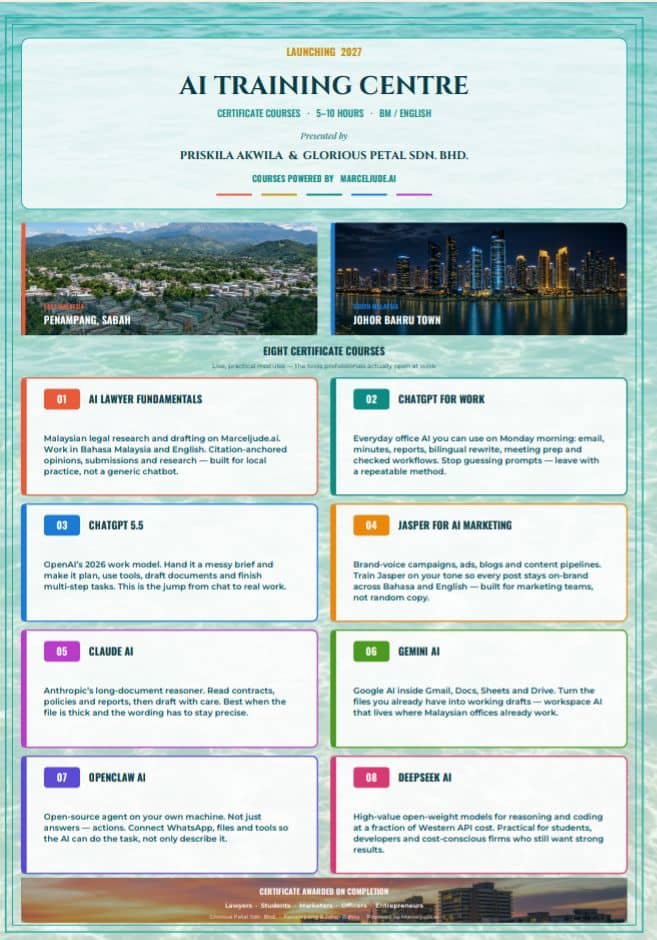
East Meets South: Priskila Akwila and Glorious Petal to Open AI Training Centres in Penampang, Johor Bahru and Singapore
Certificate courses powered by Marceljude.ai are slated for 2027, spanning legal AI and eight practical tools from ChatGPT to OpenClaw.
Lawyer Priskila Akwila and Sabah-registered firm Glorious Petal Sdn. Bhd. are preparing to open AI training centres in Penampang, Sabah; Johor Bahru; and Singapore, with a planned 2027 launch. The programmes will be powered by Marceljude.ai and framed as short certificate courses of five to ten hours — compact enough for working professionals, long enough to leave with a usable workflow rather than a slide deck of slogans.
The pairing is not accidental. Glorious Petal, incorporated in Sabah in 2013, already lists educational support and business consultancy among its activities. Akwila, a Sabahan lawyer who has also been active in public life, has been the legal face of Marceljude.ai’s homegrown legal tools. Together they have already promoted LEA (Legal Ecosystem AI) and an “AI Lawyer” platform aimed at Malaysian statutes, bilingual drafting and courtroom-ready research — work they present as a local alternative to generic chatbots that invent case citations.
The new centres extend that legal-tech story into a broader skills offering: not only how to use a Malaysian legal assistant, but how to work across the main commercial AI systems that offices actually open every morning. Adding Singapore gives the same syllabus a third audience — cross-border practices, regional headquarters, and professionals who move daily between Johor and the Republic. Three addresses, one syllabus
Penampang sits on Kota Kinabalu’s doorstep. Donggongon, the district’s commercial heart, is already a training corridor for Sabah’s digital push. Putting a centre there is a signal that East Malaysia is not an afterthought in the national AI conversation. It is also Sabah’s gateway for a Native and Culture Experience — a reminder that digital skills can be taught without erasing place.
The southern Malaysian node is Johor Bahru, close to the city centre, JB Sentral and the crossing to Singapore. Glorious Petal and Marceljude.ai already list a Johor presence around Stulang Laut and the Straits of Johor. A venue in that corridor makes the courses reachable for JB firms, Singapore-facing practices and anyone who can spare a day rather than a semester.
Singapore is the third classroom. A short hop from Johor, it places the same five-to-ten-hour certificates in front of regional counsel, compliance teams, agencies and operators who already live inside ChatGPT, Claude, Gemini and Google Workspace. The legal module remains Malaysia-first; the other seven tools are the same stack used in both countries. The point is not to export a Malaysian diploma into Singapore, but to offer a compact, bilingual, practice-oriented workshop that a professional can finish between Monday and Wednesday — then take back across the Causeway.
The format is deliberately short. Each course is designed as a five-to-ten-hour certificate module: enough time to log in, run live tasks, and leave with a checklist. That is closer to a professional workshop than a diploma — and that is the point.
The eight courses, and the AI behind each one
1. AI Lawyer Fundamentals
This is the house speciality. Marceljude.ai’s legal stack — marketed under names such as AI Lawyer and LEA — is built for Malaysian practice: bilingual Bahasa Malaysia and English, local citation style, and a claim of research anchored in curated textbooks and statutes rather than the open web. The fundamentals course is aimed at students, pupils, sole practitioners and in-house counsel who need to draft faster without surrendering professional judgement. Participants should expect research, IRAC-style issue mapping, opinions and submissions — plus a hard reminder that the human lawyer still signs the document. In Singapore the same module still matters for counsel who handle Malaysian matters, Sabah land and statutory work, or bilingual files that generic models mishandle.
2. ChatGPT for Work
OpenAI’s ChatGPT is the default workplace assistant for millions of people. The work module treats it as an office colleague, not a novelty: emails, minutes, spreadsheets, meeting prep, bilingual rewriting, and the habit of checking what the model invents. It is the entry ticket for staff who have “tried ChatGPT once” and never built a repeatable process.
3. ChatGPT 5.5
GPT-5.5, released by OpenAI in April 2026, is the current heavy-duty model in that family. OpenAI positions it as a “new class of intelligence for real work”: stronger at multi-step tasks, coding, research, documents and tool use, with less hand-holding than earlier versions. A dedicated 5.5 course is about the jump from chat to agent-style work — handing the model a messy brief and making it plan, use tools, and finish. That is a different skill from writing a clever prompt.
4. Jasper for AI Marketing
Jasper is not a general chatbot. It is a marketing platform that stores brand voice, audiences, style guides and product knowledge, then uses agents to draft ads, blogs, campaigns and multi-channel copy that stays on-brand. For SMEs and agencies in Sabah, Johor and Singapore, the value is consistency: one voice across Bahasa, English and platforms, without a 20-person content team. The course should cover Brand Voice / Jasper IQ, campaign workflows, and when Jasper is better than a raw ChatGPT window.
5. Claude AI
Claude, from Anthropic, is the model many lawyers, analysts and writers prefer when the job is long documents, careful reasoning and a calmer tone. It is strong at reading contracts, policies and reports, and at refusing sloppy instructions. A Claude module typically teaches long-context reading, structured drafting, and the difference between a helpful rewrite and an overconfident one.
6. Gemini AI
Google’s Gemini sits inside Gmail, Docs, Sheets, Drive and Search. For offices already living in Google Workspace — common in both Malaysia and Singapore — that integration is the product. The course is less about “another chatbot” and more about turning existing files, inboxes and slides into working drafts — with the usual caveats about what should never be pasted into a public model.
7. OpenClaw AI
OpenClaw is the odd one out — and the most future-facing. It is an open-source autonomous agent, created by Peter Steinberger, that runs on the user’s own machine and talks through WhatsApp, Telegram, Slack or similar. It does not only answer. It can read files, run commands, browse, draft mail and keep local memory. The model underneath can be Claude, GPT, Gemini, DeepSeek or a local model. A short course cannot make anyone an agent engineer, but it can show what “AI that does things” looks like, and why running an agent on your own hardware is a different risk profile from a website chatbot.
8. DeepSeek AI
DeepSeek, the Hangzhou lab that shook the market in 2025 with cheap, strong open-weight models, is now on its V4 / V4.1-Flash generation: long context, competitive coding and reasoning, and prices that undercut Western APIs. For cost-conscious firms, students and developers who want to experiment without a US-dollar invoice, DeepSeek is the practical alternative. A responsible course will also cover data-residency and policy questions that come with using a China-based service in a Malaysian or Singapore office.
Why a five-to-ten-hour certificate still matters
Malaysia and Singapore do not lack AI talk. They lack short, local, tool-specific training that a lawyer in Penampang, a marketer in Johor Bahru, or a counsel in Singapore can finish between Monday and Wednesday. Sabah has a dearth of AI training; the west coast of Johor has no shortage of half-day seminars; Singapore has no shortage of expensive conferences. What Akwila and Glorious Petal are proposing is a three-city storefront for Marceljude.ai’s legal stack plus the eight tools people actually ask about by name.
The certificate is the wrapper. The real product is bilingual, Malaysia-first legal AI sitting beside the global models — so a participant can leave knowing when to use AI Lawyer on a Sabah land dispute, when to use Claude on an 80-page bundle, when Jasper should write the campaign, and when OpenClaw is a research experiment rather than a production system.
Penampang, Johor Bahru and Singapore will be three of the more distinctive AI classrooms in the region: one in Kadazan-Dusun country, one looking across the water at Singapore, and one on the Singapore side of that same water — all teaching the same short list of machines that now sit on every professional desk.
Kota Kinabalu’s waterfront, a short drive from Penampang, is the other half of that East Malaysian story — a city that wants digital work to stay in Sabah rather than drain south. Johor Bahru and Singapore complete the southern arc: two cities, one crossing, one syllabus. Anyone tracking the launch should watch Marceljude.ai, askmelaws.com, and Glorious Petal’s Penampang, Johor and Singapore offices for the first certificate calendar.
- MALAYSIA'S 1ST AI LAWYER - CLICK HERE
- ISMAIL – INTEGRATED SINGAPORE/MALAYSIA AI & LAW (Library)
- OPENING OF SINGAPORE MALAYSIA AI CENTRE AND LAW LIBRARY
- LIFT - LAW INSTRUMENTS FORMS & TEMPLATES
- LAWS OF MALAYSIA FOR SINGAPOREAN DUMMIES
- HANNAH YEOH'S ARTIFICIAL INTELLIGENCE LAW ENCYCLOPEDIA
- LEAD CR - Law Ecosystem Archive Databases on CD-ROM
- BREAKING NEWS FROM MJN
- CLICK HERE CO. PROFILE
- EXCITING NEW SERIES - THE ADVENTURES OF BOBBY TAN -ADVOCATE & SOLICITOR IN THE HIGH COURT OF NORTH BORNEO by marceljude.ai
- MEDICO LEGAL - BY PRISKILA AKWILA & GLORIOUS PETAL SDN BHD - powered by marceljude.ai
- MISCELLANOUS
- ANNOTATED STATUTES OF SABAH - A NEW SERIES
- e-library - marceljude.ai
- DRAFT - DOCUMENT RESEARCH & AUTOMATED FILING TECHNOLOGY
- CLARA – Case Law Analysis & Retrieval AI
- FOR RESEARCH REQUEST CLICK HERE
- CLICK HERE TO ASK ANYTHING
- RAMBO'S LAW - THE LAW OF THE LAW JUNGLE - EXCITING NEW SERIES - CASE ANALYSIS BY JOHN RAMBO @ +60138646786
- PRISKILA AKWILA ADVOCATES - High Court of Sabah & Sarawak @ Kota Kinabalu
- COLA - COMMONWEALTH ONLINE LAWCASES AI -marceljude.ai
- THE LAW LIBRARY THAT COMES TO YOU ANYWHERE AND ANYTIME
- marceljude.ai training academy
