
LOCAL GOVERNMENT REPORTS - marceljude.ai
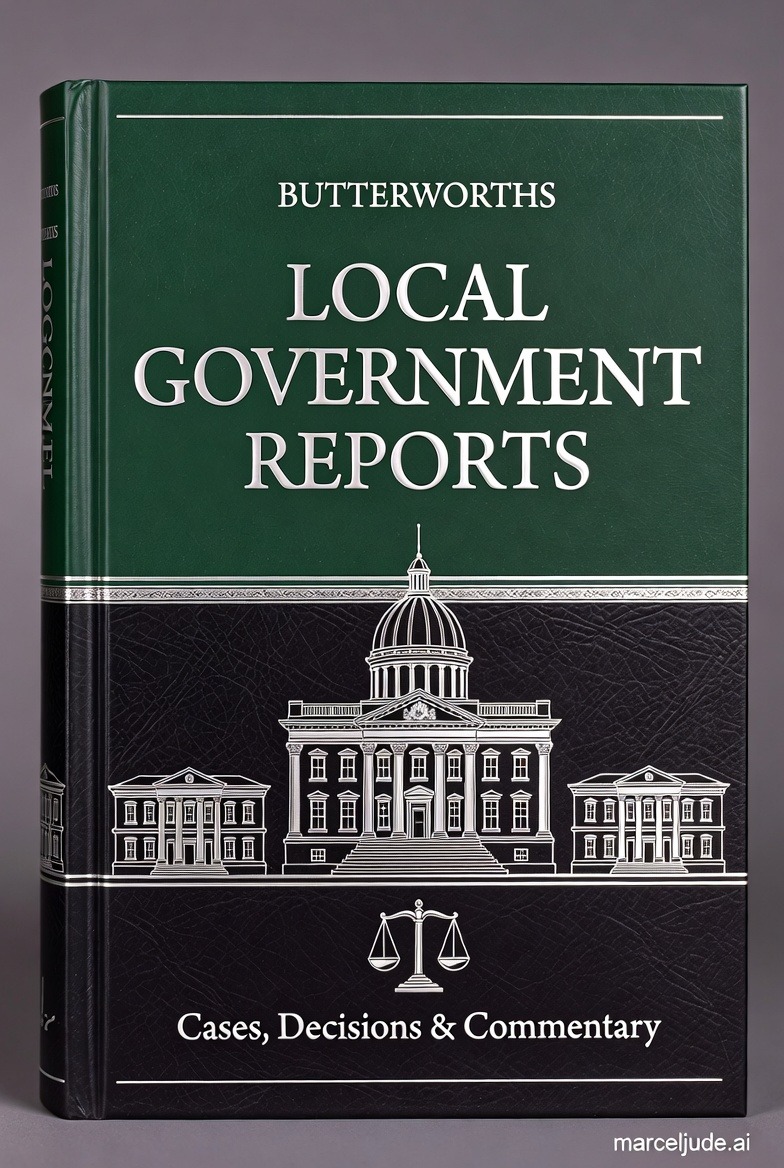
A REVIEW OF BUTTERWORTHS LOCAL GOVERNMENT REPORTS
Introduction
Butterworths Local Government Reports, usually known simply as the Local Government Reports and cited as “LGR”, is a specialist series reporting judicial decisions of particular importance to local authorities, public bodies, public-law practitioners and senior local-government administrators in England and Wales.
The publication is sometimes informally described as Butterworths Local Government Cases. Its proper title, however, is Butterworths Local Government Reports.
LGR occupies an important place in English public-law literature because local-government law does not exist within one comprehensive legislative code. The powers and responsibilities of local authorities are distributed across statutes dealing with planning, housing, public health, social services, education, licensing, procurement, finance, employment, environmental regulation and local taxation. Many of the legal principles controlling those powers are found in judicial decisions rather than in the statutory text alone.
The series collects significant decisions affecting local government and presents them through professionally prepared headnotes, editorial introductions and full judgments. It is particularly valuable because it reports some decisions that do not appear in the principal general law reports.
Publication Details
Title: Butterworths Local Government Reports
Common title: Local Government Reports
Abbreviation: LGR
Publisher: LexisNexis Butterworths
Jurisdiction: Principally England and Wales
Subject: Local government, administrative law and public law
ISSN: 1474-8657
Format: Printed parts, annual bound volumes and online reports
Online coverage: Full text generally available from 1997 onwards
Standard citation: [Year] LGR Page
The ISSN record confirms the title Butterworths Local Government Reports and its print ISSN of 1474-8657. ISSN International Centre.
Historical Development
The broader Local Government Reports series has a history extending considerably further back than the appearance of the Butterworths title.
Legal database records identify LGR coverage from 1951 onwards. For a substantial period, the reports were published as Knight’s Local Government Reports. The bibliographical record for that publication shows that it covered volumes issued between 1974 and 1998 and contained reports, orders, statutes and statutory instruments.
Butterworths became involved as publisher during the later part of that series. The succeeding publication, Butterworths Local Government Reports, commenced under that title from the 1999 reporting year. CiNii bibliographical record.
There is therefore continuity between the historic Local Government Reports, Knight’s Local Government Reports and the modern Butterworths series. The change in publisher and title did not alter the fundamental purpose of the publication: to provide specialist reporting of decisions affecting local government.
This historical continuity makes LGR valuable not only for contemporary litigation but also for tracing the development of local-authority powers and public-law principles over several decades.
Why a Specialist Local-Government Report Is Necessary
Local government is one of the most legally diverse areas of public administration. A local authority may act simultaneously as:
a planning authority; a housing authority; a licensing authority; an employer; a landowner; a contracting body; a social-services provider; an education authority; an environmental regulator; a rating and taxation authority; a highway authority; and a democratically elected public institution.
Each function may be governed by different legislation, procedures and standards of judicial review.
A general administrative-law report may record the broad public-law principle established by a case but give relatively little attention to its consequences for local authorities. LGR approaches the case from a local-government perspective. Its editorial materials identify the aspects of the decision that matter to councils, officers, councillors, public-law advocates and persons affected by municipal decisions.
Courts Covered
The series reports important local-government decisions from superior courts and relevant specialist tribunals. Its coverage has included decisions from:
the Supreme Court of the United Kingdom; formerly, the House of Lords; the Court of Appeal; the High Court; the Administrative Court; specialist divisions of the High Court; and the Employment Appeal Tribunal.
The inclusion of the Employment Appeal Tribunal is significant because local authorities are major public-sector employers. Employment decisions may affect not only an individual council but also the management practices of public authorities throughout the country.
LexisNexis describes LGR as covering cases heard in the House of Lords, Court of Appeal, High Court and Employment Appeal Tribunal, with full-text online coverage from 1997 onwards. LexisNexis international-content guide.
Editorial Method
LGR does not merely reproduce every judgment in which a local council happens to be named. Cases are selected for their legal significance to local government.
At least during its documented modern editorial period, the reports were edited by Daniel Stilitz KC and members of 11KBW, a leading English public-law chambers. The editorial board selected cases for publication, and each issue included an introductory note explaining the facts and highlighting the points of particular importance to local authorities.
The judgments were reported in full and accompanied by headnotes emphasising their local-government implications. The series was issued in eleven parts annually and subsequently compiled into a bound volume. 11KBW description of the series.
This editorial structure is one of LGR’s principal strengths. The introductory note gives the reader an overview of the entire issue, while the individual headnote identifies the facts, statutory provisions and legal principles relevant to each decision.
Structure of an LGR Report
A typical LGR report contains:
the names of the parties; the deciding court; the judges; the date of hearing and judgment; subject-matter catchwords; the material statutory provisions; a headnote summarising the facts and decision; the cases and authorities cited; the representation of the parties; the full or substantially complete judgment; and the court’s final order.
The introductory editorial note may also explain why the case matters to local authorities and how it relates to other decisions reported in the same issue.
Citation
The usual citation takes the following form:
[2015] LGR 675
The elements are:
[2015] — the reporting year; LGR — Local Government Reports; and 675 — the page upon which the report begins.
A pinpoint citation may be given by adding the relevant page:
[2015] LGR 675 at 689
Where the judgment contains numbered paragraphs, counsel should ordinarily identify the relevant paragraph:
[2015] LGR 675 at [42]
A case may also have a neutral citation, such as:
[2015] EWCA Civ 780
In court documents, it is useful to provide both the neutral citation and LGR citation where available, subject to the applicable citation practice.
LGR is recognised as an authoritative specialist report. Where a case has also been published in the official Law Reports, the Weekly Law Reports or another report possessing citation priority, the preferred report should be used in accordance with the governing court practice. LGR remains valuable for its specialised headnote and local-government focus.
Principal Areas Covered Judicial review of local authorities
Judicial review lies at the centre of local-government litigation. Councils exercise statutory powers affecting individuals, businesses, property owners and communities. Those powers must be exercised lawfully.
LGR reports cases involving:
acting outside statutory powers; unlawful delegation; irrelevant considerations; failure to consider relevant matters; improper purposes; irrationality; procedural unfairness; bias; consultation; legitimate expectation; proportionality; reasons for decisions; and remedies.
The reports are particularly valuable because they show how general administrative-law principles apply to specific municipal functions.
A court does not ordinarily decide whether it agrees with the local authority’s policy. It examines whether the decision was made within lawful powers, through a fair process and according to the correct legal principles.
Statutory powers and ultra vires
A local authority is a statutory body. It possesses the powers conferred upon it by Parliament, together with powers necessarily incidental to its statutory functions.
Cases may involve questions such as:
whether the authority possessed the power it claimed to exercise; whether statutory preconditions were satisfied; whether a power was exercised for its intended purpose; whether the council unlawfully fettered its discretion; whether an officer had delegated authority; whether a by-law was valid; and whether a decision was procedurally defective.
The doctrine of ultra vires remains fundamental to local-government law. Even a decision adopted for an apparently beneficial purpose may be unlawful if the authority lacks the statutory power to make it.
Planning and development control
Planning decisions directly affect land values, economic development, housing and the physical character of communities. LGR consequently contains substantial material relating to:
planning permission; development plans; enforcement notices; planning conditions; material considerations; environmental assessment; heritage protection; compulsory acquisition; developer contributions; affordable housing; consultation; and ministerial intervention.
Planning cases frequently turn upon the proper interpretation of legislation, planning policy and the reasons given by the decision-maker.
The reports help distinguish between an error of law, which the court may correct, and a matter of planning judgment entrusted to the relevant authority.
Housing and homelessness
Local authorities exercise important statutory responsibilities relating to public housing and homelessness. The reported cases may concern:
eligibility for housing assistance; priority need; intentional homelessness; suitability of accommodation; allocation schemes; temporary accommodation; out-of-area placement; possession proceedings; duties to vulnerable persons; review procedures; and equality obligations.
Housing disputes demonstrate the practical importance of procedural fairness. A decision may profoundly affect a person or family, yet it is often made through an administrative process rather than a conventional trial.
LGR provides access to appellate and judicial-review decisions explaining the content of local-authority housing duties.
Social services and community care
Local councils may be responsible for assessing and meeting the needs of children, older persons, persons with disabilities and vulnerable families.
Cases in this field may address:
assessment duties; care plans; safeguarding; residential accommodation; community support; services for children; support for persons without immigration status; financial assessments; carers’ needs; and the division of responsibility between public bodies.
The legal questions frequently involve limited public resources. The court must distinguish between a lawful allocation of resources and a failure to perform a mandatory statutory duty.
Education
Local-government cases may involve:
school admissions; special educational needs; school transport; exclusions; disciplinary procedures; school reorganisation; funding; religious education; disability discrimination; and consultation with parents and communities.
Although education administration has changed considerably over time, many principles concerning fairness, statutory duty and rational decision-making remain relevant.
Licensing
Local authorities administer numerous licensing systems, including licences relating to:
alcohol; entertainment; taxis and private-hire vehicles; street trading; markets; gambling premises; sex establishments; food premises; animals; and commercial activities.
Licensing cases may examine:
the scope of the licensing power; procedural fairness; the adequacy of reasons; the relevance of objections; licence conditions; suspension or revocation; legitimate fees; enforcement; and rights of appeal.
The reports show that a licensing authority must comply with both the governing statute and general public-law standards.
Local taxation and council finance
LGR includes cases concerning:
council tax; non-domestic rates; valuation; exemptions; recovery proceedings; local-authority budgets; revenue raising; expenditure; grants; financial consultation; and the legality of charging schemes.
Local-government finance is highly technical. A seemingly minor issue of statutory construction may have significant consequences for thousands of ratepayers or for the authority’s annual budget.
Public procurement and contracts
Local authorities purchase goods, services and construction works on a large scale. Procurement disputes may involve:
tender procedures; equal treatment of bidders; transparency; evaluation criteria; disclosure; conflicts of interest; exclusion of bidders; standstill periods; interim injunctions; damages; and remedies following an unlawful award.
LGR’s inclusion of procurement cases is important because such disputes combine public-law duties with commercial principles. A council must secure services efficiently while complying with statutory procurement requirements and standards of fairness.
Employment
As major employers, local authorities encounter legal disputes concerning:
dismissal; redundancy; discrimination; whistleblowing; pensions; disciplinary proceedings; transfer of undertakings; collective consultation; political restrictions; and public-sector employment terms.
The Employment Appeal Tribunal’s inclusion within LGR’s coverage permits the series to address legal issues affecting the internal administration of councils as well as their external statutory functions.
Data protection and freedom of information
Local authorities hold extensive personal and public information, including records relating to:
housing; social services; children; planning; taxation; licensing; employees; complaints; and enforcement.
Cases may concern data protection, confidentiality, disclosure, privacy and access to information. The challenge is to reconcile public accountability with the protection of personal or legally privileged information.
Public health and environmental regulation
Local authorities perform important functions relating to:
sanitation; waste disposal; pollution; food safety; public nuisances; contaminated land; infectious disease control; animal welfare; environmental licensing; and neighbourhood conditions.
The cases illustrate the tension between individual property or commercial interests and the council’s responsibility to protect public health and the environment.
By-laws and delegated legislation
Local authorities may be empowered to make by-laws governing particular local activities. Such by-laws must remain within the authority conferred by the parent legislation.
LGR cases may consider whether a by-law:
falls within the statutory power; is sufficiently certain; was made according to the required procedure; is unreasonable; improperly interferes with a protected right; or conflicts with national legislation.
This area is particularly relevant to Malaysian local government, where councils also operate through extensive subsidiary legislation and local by-laws.
The Importance of Full Judgments
A headnote provides an efficient summary, but it is not part of the judgment and does not create the legal rule.
Local-government cases are frequently fact-sensitive. The result may depend upon:
the wording of the statutory power; the identity of the decision-maker; the scope of delegated authority; the form of consultation undertaken; the documents placed before the council; the reasons recorded in the minutes; the policy in force at the time; or the remedy sought by the applicant.
A lawyer must therefore read the entire judgment before citing it. A general proposition appearing in the headnote may be qualified by the court’s reasoning or restricted to a particular statutory scheme.
Editorial Strengths 1. Specialist selection
LGR identifies cases according to their importance to local government. This is more useful to municipal practitioners than a general search for every case in which a council appeared as a party.
2. Reporting of otherwise unavailable cases
The publication includes important local-government decisions that may not be reported elsewhere. This is one of its most significant contributions.
3. Full-text judgments
The full judgment allows the researcher to examine the court’s reasoning and factual context rather than relying on a short digest.
4. Local-government-focused headnotes
The headnote draws attention to the consequences of the case for councils, officers and public-law practitioners.
5. Introductory notes
The editorial introduction summarises the cases in each issue and identifies their broader legal significance.
6. Breadth of coverage
The series extends beyond traditional municipal powers to planning, housing, procurement, employment, data protection and human rights.
7. Historical continuity
Coverage extending back to the earlier Local Government Reports gives researchers access to the development of local-authority law over many decades.
8. Digital availability
Online access permits searching by authority, statutory provision, subject, case name or legal principle.
Limitations 1. It is principally an English report
The series is centred upon England and Wales. It is not a comprehensive report of Scottish, Northern Irish, Commonwealth or international local-government cases.
2. English local-government legislation changes frequently
Local authorities have undergone repeated statutory reorganisation. A case decided under repealed legislation may no longer state the current law.
3. It is selective
Not every decision affecting a local authority is included. Researchers must also search general reports, official judgment databases and specialist reports dealing with planning, housing or employment.
4. It is not a textbook
LGR reports cases. It does not provide a complete narrative account of local-government law. A practitioner may still require a specialist textbook, statutory service or loose-leaf commentary.
5. Headnotes may be overused
The editor’s summary is a research aid. It is not a substitute for the judgment.
6. Older digital coverage is incomplete
LexisNexis states that the online collection contains full-text LGR cases from 1997 onwards. References to earlier LGR citations may not provide the corresponding full judgment online.
7. Different statutory systems limit comparative use
An English decision may be based on a statutory scheme with no equivalent in another jurisdiction. General administrative-law reasoning may remain persuasive, but the statutory conclusion may not travel.
Value to English Practitioners
For an English public-law or local-government practitioner, LGR is an essential first-reference series.
It is useful when advising:
local councils; public-sector officers; councillors; public contractors; housing applicants; developers; ratepayers; licence holders; employees; community organisations; and persons challenging municipal decisions.
The reports help counsel identify both the applicable legal principle and the practical context in which courts have applied it.
Value to Local-Authority Officers
The publication is not intended solely for courtroom lawyers. Senior officers and legal departments can use it to understand the consequences of judicial decisions for daily administration.
The cases can inform:
delegated-authority schemes; committee procedures; consultation exercises; procurement processes; licensing hearings; recording of reasons; policy preparation; information management; and statutory compliance.
Many judicial-review disputes can be avoided if the authority identifies the legal requirements before making the decision.
Value to Judges
For judges, a specialist report provides reliable access to authorities that might otherwise be difficult to locate. The focused headnotes identify the local-government implications of decisions that may involve several overlapping areas of law.
LGR can also assist in distinguishing between:
policy and law; merits review and judicial review; discretionary and mandatory duties; procedural and substantive illegality; and an individual error and a systemic administrative failure. Value to Law Students
For students, LGR demonstrates administrative law in its practical setting.
Principles such as ultra vires, natural justice, legitimate expectation and proportionality can appear abstract in a textbook. Local-government cases show how those principles affect housing, planning, licences, budgets and public services.
The series is particularly useful for studies in:
constitutional law; administrative law; planning law; environmental law; public procurement; housing law; local-government law; and judicial review. Value to Professors and Researchers
For academic researchers, LGR supplies a detailed record of the changing relationship between central government, local government, courts and citizens.
The series can support research into:
decentralisation; statutory interpretation; democratic accountability; public-sector finance; local autonomy; administrative justice; consultation; public participation; judicial remedies; and the effect of human rights upon municipal administration.
Its historical volumes permit researchers to trace the movement from traditional ultra vires review towards more developed principles of fairness, legitimate expectation and proportionality.
Relevance to Malaysian Local-Government Law
LGR can be useful to Malaysian practitioners because Malaysian administrative law shares part of its historical foundation with English public law. Principles concerning statutory power, procedural fairness, improper purpose, relevant considerations and legitimate expectation may therefore be instructive.
However, Malaysian local-government law is governed by distinct constitutional and statutory arrangements.
In Peninsular Malaysia, the principal legislation includes the Local Government Act 1976, together with the Town and Country Planning Act 1976, the Street, Drainage and Building Act 1974 and numerous state and local by-laws.
Sabah and Sarawak retain their own local-government regimes. In Sabah, the principal legislation is the Local Government Ordinance 1961. The Sabah State Attorney-General’s Chambers records that the Ordinance came into force on 1 January 1962 and lists the instruments and by-laws made under it. Sabah State Attorney-General’s Chambers.
Sarawak operates under the Local Authorities Ordinance 1996 (Cap. 20) and its subsidiary legislation. Sarawak LawNet.
These regional differences are important. An authority useful in Kuala Lumpur may not necessarily resolve a dispute involving Kota Kinabalu, Ranau, Kuching or another local authority operating under state-specific legislation.
Particular Value to Sabah Practitioners
For lawyers practising in Sabah, LGR may provide comparative guidance in disputes involving:
district and municipal councils; licensing decisions; assessment rates; local by-laws; markets and tamu regulation; building control; sanitation and waste; public health; planning and development; enforcement notices; council land; delegated authority; and judicial review of local-authority decisions.
The Sabah State Attorney-General’s Chambers identifies numerous council instruments and local by-laws made under the Local Government Ordinance 1961. These include uniform by-laws relating to anti-littering, food establishments, business premises, waste disposal and the compounding of offences. Sabah local-authority by-laws.
English LGR decisions cannot determine the meaning of these Sabah provisions. They may nevertheless assist with general questions such as:
whether a council acted within its statutory power; whether it afforded a fair hearing; whether it considered relevant matters; whether it imposed an unreasonable condition; whether the decision was made for a proper purpose; whether the council unlawfully fettered its discretion; and what remedy should follow from an unlawful decision. Particular Value to Sarawak Practitioners
Sarawak’s Local Authorities Ordinance 1996 and the subsidiary legislation made under it form an extensive municipal framework. Sarawak LawNet records local-government notifications and subsidiary legislation made by Kuching North City Hall, other local authorities and the Bintulu Development Authority. Sarawak LawNet publication system.
LGR may assist Sarawak practitioners researching comparative approaches to:
municipal powers; rating; licensing; planning; public health; environmental regulation; by-law validity; council procedure; and judicial review.
Again, the English decision is persuasive only to the extent that its underlying principle is compatible with Sarawak legislation and binding Malaysian authority.
Proper Use in Malaysian Courts
A Malaysian advocate relying on an LGR case should:
identify the Malaysian constitutional and statutory framework; cite binding Malaysian authority first; identify the statutory provision considered in the English case; compare it with the Malaysian, Sabah or Sarawak provision; separate general public-law reasoning from conclusions dependent upon English legislation; verify whether the English decision remains good law; and present the case as persuasive rather than binding authority.
The strongest use of LGR is not to claim that English local-government legislation applies in Malaysia. It is to demonstrate a carefully reasoned approach to a general question of administrative legality.
Use in Judicial-Review Proceedings
LGR is particularly valuable in judicial-review applications involving local authorities.
A properly prepared Malaysian submission may use an LGR decision to support a proposition concerning:
jurisdictional error; procedural fairness; adequate consultation; improper purpose; relevant considerations; unlawful delegation; fettering of discretion; legitimate expectation; proportionality; or the appropriate public-law remedy.
The foreign case should be connected directly to Malaysian principles and the language of the local statute. Merely presenting a lengthy collection of English authorities without analysing statutory differences will add little to the submission.
Research Method
A sound research method is as follows:
identify the precise local-authority decision under challenge; identify the statutory source of the authority’s power; examine all procedural requirements; locate binding Malaysian decisions; search LGR for comparable functions and public-law issues; read the headnote to assess relevance; read the full judgment; identify the precise ratio; check subsequent treatment; compare the English and Malaysian statutory schemes; and cite only the passages that genuinely assist the court.
This prevents the researcher from confusing a factually similar case with a legally analogous one.
Digital Research and Artificial Intelligence
Digital access permits LGR cases to be searched by:
council name; statutory provision; public function; type of decision; judicial-review ground; remedy; and factual expression.
Artificial intelligence can assist in identifying potentially relevant cases, organising them by subject and extracting passages. However, the results must be verified against the full report.
An AI system may fail to recognise that:
the statutory provision has been repealed; the quoted passage records counsel’s argument rather than the court’s conclusion; the case was reversed on appeal; the decisive fact was a particular delegation instrument; or a general public-law statement was qualified elsewhere in the judgment.
The specialist report remains the authoritative research source. Technology assists in locating and analysing it.
Overall Assessment
Butterworths Local Government Reports is a valuable specialist reporting series covering one of the most complex areas of public administration. Its chief strength is its ability to identify and explain decisions of particular importance to local authorities, including cases that may not be reported elsewhere.
The combination of full judgments, specialist headnotes, editorial introductions and long historical coverage makes LGR useful to practitioners, judges, council officers, academics and students.
Its limitations arise principally from its English focus and the changing nature of local-government legislation. Older cases and foreign decisions must be used with careful attention to the statutory context. It is a case-reporting series, not a substitute for current legislation or a comprehensive textbook.
Value to Malaysian Lawyers, Law Students, Professors and the General Public
For Malaysian lawyers, LGR provides a substantial source of comparative administrative-law reasoning, especially in judicial-review proceedings against local authorities.
For lawyers in Sabah and Sarawak, it is potentially useful in analysing municipal powers under the distinct state ordinances, provided that English decisions are not mistaken for binding local law.
For law students, it demonstrates how administrative-law principles operate in practical disputes involving housing, planning, licences, taxation and public services.
For professors, it offers material for comparative study of decentralisation, local democracy and judicial control of administrative power.
For the general public, the cases illustrate an essential principle of the rule of law: a local authority may possess extensive powers, but those powers must be exercised lawfully, fairly and for the purpose for which they were granted.
Conclusion
Butterworths Local Government Reports is an important specialist archive of decisions concerning the powers, duties and accountability of local authorities. Its roots extend through the earlier Local Government Reports and Knight’s Local Government Reports, while the modern Butterworths series continues the tradition of focused reporting.
Its coverage extends far beyond municipal administration in a narrow sense. It encompasses judicial review, housing, planning, social services, procurement, employment, licensing, taxation, data protection, public health and environmental regulation.
For English practitioners, it is a core specialist reference. For Malaysian practitioners, particularly those dealing with local authorities in Sabah and Sarawak, it provides persuasive comparative material on statutory power and administrative fairness.
The series ultimately records the legal boundaries of local government. It demonstrates that municipal administration is not simply the exercise of power close to the community; it is the exercise of legally limited power, subject to procedural fairness, judicial supervision and public accountability.
- MALAYSIA'S 1ST AI LAWYER - CLICK HERE
- ISMAIL – INTEGRATED SINGAPORE/MALAYSIA AI & LAW (Library)
- OPENING OF SINGAPORE MALAYSIA AI CENTRE AND LAW LIBRARY
- LIFT - LAW INSTRUMENTS FORMS & TEMPLATES
- LAWS OF MALAYSIA FOR SINGAPOREAN DUMMIES
- HANNAH YEOH'S ARTIFICIAL INTELLIGENCE LAW ENCYCLOPEDIA
- LEAD CR - Law Ecosystem Archive Databases on CD-ROM
- BREAKING NEWS FROM MJN
- CLICK HERE CO. PROFILE
- EXCITING NEW SERIES - THE ADVENTURES OF BOBBY TAN -ADVOCATE & SOLICITOR IN THE HIGH COURT OF NORTH BORNEO by marceljude.ai
- MEDICO LEGAL - BY PRISKILA AKWILA & GLORIOUS PETAL SDN BHD - powered by marceljude.ai
- MISCELLANOUS
- ANNOTATED STATUTES OF SABAH - A NEW SERIES
- e-library - marceljude.ai
- DRAFT - DOCUMENT RESEARCH & AUTOMATED FILING TECHNOLOGY
- CLARA – Case Law Analysis & Retrieval AI
- FOR RESEARCH REQUEST CLICK HERE
- CLICK HERE TO ASK ANYTHING
- RAMBO'S LAW - THE LAW OF THE LAW JUNGLE - EXCITING NEW SERIES - CASE ANALYSIS BY JOHN RAMBO @ +60138646786
- PRISKILA AKWILA ADVOCATES - High Court of Sabah & Sarawak @ Kota Kinabalu
- COLA - COMMONWEALTH ONLINE LAWCASES AI -marceljude.ai
- THE LAW LIBRARY THAT COMES TO YOU ANYWHERE AND ANYTIME
- marceljude.ai training academy
