
A law professor’s review of Administration of Estates in Malaysia - AKMAL HIDAYAH HALIM
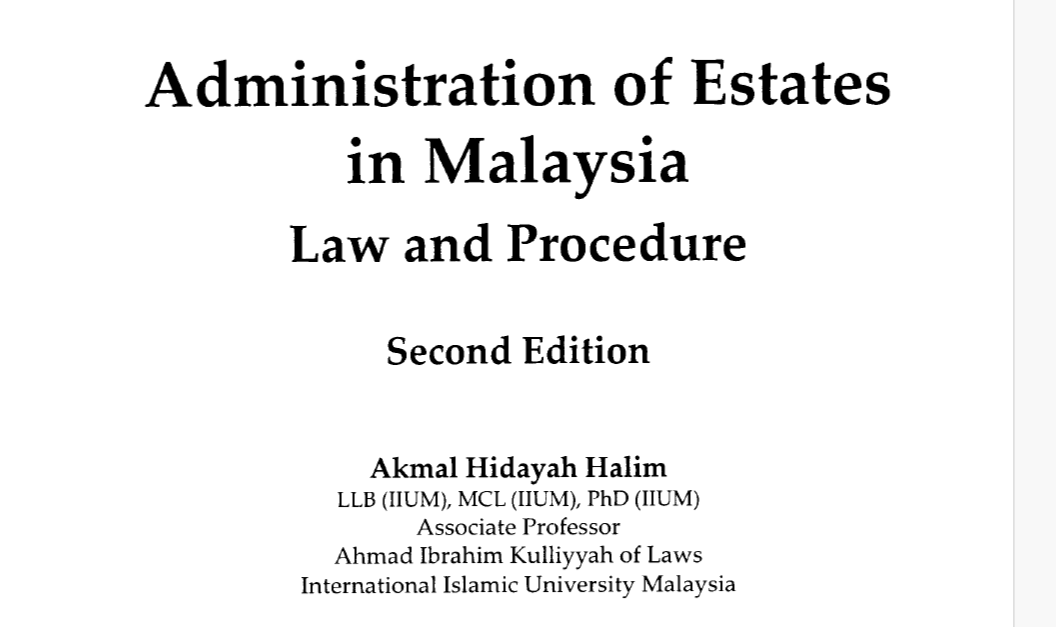


Description
A law professor’s review of Administration of Estates in Malaysia
This is a serious, useful, and unexpectedly ambitious legal work. On the surface, it is about probate, administration, grants, trustees, bonds, caveats, Land Administrators, Amanah Raya, and distribution orders. In lesser hands, that would become a swamp of forms and statutory cross-references. Here, the book does something better: it turns estate administration into a legal architecture. It shows that the subject is not merely about “who gets what,” but about which forum acts, under which statute, through which procedural route, with what legal consequences if something goes wrong. That is the real pulse of the book, and it is why it matters. The author’s own framing is clear: the work is meant to examine estate administration across the High Court, the Estate Distribution Division, and the Public Trust Corporation, while also addressing trusts, wills, wasiyyah, hibah, and the practical mechanics that move an estate from death to lawful distribution.
The book is also impressively well-designed as a teaching instrument. The contents show an eight-chapter structure that moves from concepts, to institutions, to trust and testamentary doctrine, and then into the procedural engines of the three main administrative bodies. The preface also emphasizes visual flow charts, forms, and practical aids, which is exactly right for a subject where procedural missteps can destroy substantive rights.
Chapter 1: Introduction
The first chapter performs the indispensable work of orientation. It defines the estate, explains why proof of death matters, distinguishes testate, intestate, partial intestate, small, movable, immovable, nominated, and insolvent estates, and identifies the central statutes governing administration. The chapter’s quiet achievement is that it prevents the reader from making the classic beginner’s mistake: assuming estate law begins with beneficiaries. The book insists that administration begins earlier, at the level of classification, proof, jurisdiction, and procedural choice. That is exactly correct.
As a professor, I would say this chapter is not dazzling, but it is disciplined. It creates a vocabulary before it creates argument. That may sound pedestrian, but in estate administration it is the difference between analysis and confusion. The strongest sentence in the chapter, conceptually speaking, is its closing point: different substantive rules may apply to Muslims and non-Muslims on succession, but the procedural route to administration still turns heavily on the type of estate. That is the spine of the whole book.
My only criticism is that the chapter is more map than thesis. It tells the reader where the roads are, but not yet why certain roads are normatively better or more just than others. Still, as an opening chapter, it does its job well.
Chapter 2: Administrative Bodies
This is the chapter where the book starts to show real force. It explains the jurisdiction of the High Court, the Estate Distribution Division, the Public Trust Corporation, and the Syariah Court, and it extends the analysis to Sabah and Sarawak. In other words, it treats administration of estates not as one smooth field, but as a legally segmented terrain. That is a sophisticated move, because Malaysian estate administration is inseparable from institutional design.
What makes this chapter especially strong is that it does not simply list bodies and powers. It identifies jurisdictional tension. The conclusion points out anomalies in estate-value thresholds and the curious mismatch between the Registrar’s monetary jurisdiction and the broader statutory thresholds for small estates and the Corporation. That is the kind of observation that lifts a book above being a manual. Manuals tell you the rule. Scholars notice where the rules do not sit comfortably together.
Pedagogically, this chapter is excellent. Practically, it is even better. If a young lawyer, judicial officer, or estate officer reads only one chapter before advising a client where to begin, this may be the one to read first.
Chapter 3: Trusts
This is, to my mind, one of the book’s intellectually richest chapters. It explains why trusts matter to estate administration at all: trust property is excluded from the estate-value calculation that determines jurisdiction. That means trust doctrine is not an ornamental detour; it is jurisdictionally consequential. From there, the chapter moves through express, resulting, constructive, and statutory trusts; the three certainties; formalities; constitution of trusts; bare trusts; imperfect gifts; hibah; charged property; and al-rahn.
What I admire here is the refusal to let estate administration become mechanically bureaucratic. The chapter reminds the reader that before land, money, or rights can be “administered,” one must know whose beneficial property it really is. That is classic equity thinking, and the book wears it well. The discussion of bare trust and imperfect gift inter vivos is particularly valuable, because it shows how formal title and equitable entitlement may part company. The inclusion of hibah and al-rahn also prevents the chapter from becoming a purely Anglo-equity transplant; it roots the discussion in Malaysian legal reality.
As a law professor, I would praise this chapter for conceptual ambition. As a teacher, I would warn students that it is dense. But it is dense for a reason: it explains that estate administration often turns on hidden proprietary structures that are easy to miss and fatal to ignore.
Chapter 4: Wills and Wasiyyah
This chapter brings together non-Muslim and Muslim testamentary law under one analytical roof. On the non-Muslim side, it deals with age, testamentary capacity, burden of proof, suspicious circumstances, formalities of execution, witnesses, alteration, and revocation under the Wills Act. On the Muslim side, it turns to wasiyyah, including the testator, beneficiary, subject-matter, and the one-third rule, as well as offer and acceptance.
This is an excellent chapter because it treats validity not as a ceremonial matter but as a litigation problem. Testamentary capacity is not simply defined; it is tied to proof. Suspicious circumstances are not abstractly mentioned; they are linked to the forensic burden borne by the propounder of a will. That is how a serious law teacher would present the subject. A will is not just written; it must survive challenge.
The chapter also deserves credit for refusing to push wasiyyah to the margins. Too many texts on succession in mixed legal systems treat Islamic testamentary rules as an appendix. Here, wasiyyah is part of the central structure. That gives the chapter comparative vitality.
If I have a reservation, it is this: the chapter seems stronger on doctrinal requirements than on normative comparison. I would have welcomed an even sharper analytical contrast between the liberal testamentary freedom of the Wills Act framework and the constraint-sensitive structure of wasiyyah. But as doctrinal exposition, it is very good.
Chapter 5: Personal Representatives
This is the engine-room chapter, and perhaps the most practically important in the book. The preface itself signals that the law relating to appointment, powers, duties, rights of action, and removal of personal representatives was assembled as a distinct chapter, and that decision was absolutely justified. This is where estate administration stops being institutional and becomes fiduciary.
The chapter examines executors and administrators, probate, chain of executorship, administration with will annexed, de bonis non, resealing, rights of action, proceedings against estates, and then the real work: transmission, conversion, payment of debts and liabilities, distribution, commission, and revocation or removal. It also contrasts High Court appointment with appointment by the Estate Distribution Division.
Its central doctrinal insight is stated plainly in the conclusion: the executor enjoys substantial advantages over the administrator. The executor derives authority from the will and takes earlier, broader operational control; the administrator depends much more heavily on the court, is burdened by bond requirements, and must seek prior approval in situations where the executor may proceed more freely. That is not just a procedural footnote; it is one of the book’s major lessons.
I also like the chapter’s sensitivity to the double identity of personal representatives. They are not merely office-holders; in the course of management they also take on trust-like obligations toward beneficiaries. That point has both doctrinal elegance and practical bite. This is the chapter I would most strongly recommend to a practicing lawyer handling an estate for the first time.
Chapter 6: Procedures in the High Court
This chapter is the book’s litigation manual, but it is more than a checklist. It divides proceedings into non-contentious and contentious probate and walks the reader through grant of probate, letters of administration, cause papers, hearings, administration bonds, guardians ad litem, caveats, citations, revocation of grants, and actions pronouncing for or against the validity of a will.
The author’s great strength here is procedural sequencing. The reader sees not just legal requirements, but timing, escalation, and procedural branching. Caveat becomes contentious business. Citation becomes a device to force movement. A grant of probate is shown to be procedurally leaner than letters of administration. That last point is made explicitly in the chapter’s conclusion, which notes the obvious strategic advantage of probate over administration, especially because of the administration bond and the additional hurdles the latter attracts.
As scholarship, the chapter is narrower than Chapter 3 or Chapter 5. As professional writing, it is first-rate. If one wants a chapter that converts “dead procedure” into a sequence of intelligible legal actions, this is it.
Chapter 7: Procedures in the Estate Distribution Division
This chapter is one of the book’s most valuable contributions because small-estate administration is often treated as administratively obvious when in truth it is full of hidden technicalities. The chapter covers petition for distribution, notice, hearing, evidentiary powers of the Land Administrator, collateral disputes, direct transmission, grants of letters of administration, orders for sale, appeals, subsequent applications, and special provisions for Negeri Sembilan.
What stands out is the book’s respect for the Land Administrator as a true decision-maker rather than a clerical funnel. The chapter makes clear that the office has evidentiary powers, jurisdiction over collateral disputes in many situations, and exclusive authority in the small-estate sphere unless matters properly spill into the court’s domain. Its conclusion emphasizes both efficiency and exclusivity: the procedure is designed to be simpler and cheaper, and the Land Administrator may resolve disputes without constantly sending parties off to separate court proceedings.
That is important, because it rescues the subject from the false belief that “small estate” means “simple law.” It often means administratively streamlined law, which is different. This chapter teaches that distinction well.
Chapter 8: Procedures in Public Trust Corporation (Amanah Raya Berhad)
The final substantive chapter deals with Amanah Raya Berhad and summary administration. It explains the Corporation’s role in summary administration of movable estates, estates of small value, exemption from notice of distribution, its capacity to act as a personal representative, and its custodial role over undistributed funds.
This chapter is especially useful because Amanah Raya is often mentioned in practice but not fully understood in doctrinal writing. The book gives it legal shape. It shows when the Corporation may step in, when it may be appointed by the court, when it may displace inertia, and how it serves as trustee for undistributed funds that cannot yet be safely paid out. That makes the chapter function as a bridge between formal probate doctrine and the administrative reality of unclaimed or difficult estates.
The conclusion is candid and sensible: Amanah Raya is important, but its direct administrative jurisdiction is comparatively narrow because it is mainly confined to movable property. That honesty strengthens the book. It does not exaggerate the institution; it locates it precisely.
Review of the entire book
Taken as a whole, this is a strong doctrinal-practical hybrid. Its greatest strength is structural intelligence. It knows that estate administration in Malaysia cannot be taught as a single stream of “succession law.” It must be taught through institutions, procedural gateways, fiduciary roles, and the interaction between civil and Islamic legal concepts. The book understands this and builds its chapters accordingly.
Its second great strength is that it does not separate theory from paperwork. Many legal texts either soar over doctrine or drown in forms. This one does both jobs: it explains the law and then gives the reader flow charts, sample forms, and procedural routes. For an area where one wrong filing, one missing bond, one misunderstanding about forum, or one mistaken assumption about title can derail an estate, that is not an accessory; it is a virtue.
Its third strength is its Malaysianity. The book does not lazily transplant English probate doctrine and stop there. It integrates Syariah jurisdiction, wasiyyah, hibah, faraid, Amanah Raya, the Estate Distribution Division, and regional distinctions involving Sabah and Sarawak. That makes it not just legally informative, but jurisdictionally honest.
Now the criticisms.
First, the prose is clear but rarely vivid. The book is excellent at telling you what the law is and how the process works, but less interested in dramatizing the human stakes behind delay, exclusion, family conflict, or administrative failure. A little more narrative energy—actual estate problems used as recurring examples—would have made the book even more memorable.
Second, it is at its best when exposing legal tension, but it does not always press hard enough into reform. The chapter on administrative bodies notices anomalies. The chapters on procedure expose bottlenecks. The chapter on personal representatives shows the operational superiority of executors over administrators. But the book is more diagnostician than reformer. I would have welcomed a final reform chapter drawing these concerns together.
Third, some chapters are denser than others. Chapter 3 and Chapter 5 are rewarding, but a student without prior grounding in equity or succession could feel the weight of detail. That is the cost of seriousness, but it is still a cost.
Even so, my judgment is firmly positive. This is not a glamorous book, but it is an authoritative one. It does what the best legal writing does: it clarifies a field that practitioners often know in fragments, and it shows that what seems merely procedural is actually deeply connected to property theory, institutional competence, and legal pluralism. In classroom terms, it is a book I would assign selectively by chapter. In practice terms, it is a book I would want within arm’s reach of any lawyer handling estates in Malaysia. In scholarly terms, it succeeds because it takes a supposedly dull subject and reveals that it is really about power, title, duty, delay, and lawful transition after death.
So my final verdict is this: the book is not exciting because the author tries to perform excitement. It is exciting because it reveals the hidden drama inside administrative law of succession. Estates do not move by sentiment. They move by jurisdiction, representation, proof, title, and procedure. This book understands that, and teaches it well.
- MALAYSIA'S 1ST AI LAWYER - CLICK HERE
- ISMAIL – INTEGRATED SINGAPORE/MALAYSIA AI & LAW (Library)
- OPENING OF SINGAPORE MALAYSIA AI CENTRE AND LAW LIBRARY
- LIFT - LAW INSTRUMENTS FORMS & TEMPLATES
- LAWS OF MALAYSIA FOR SINGAPOREAN DUMMIES
- HANNAH YEOH'S ARTIFICIAL INTELLIGENCE LAW ENCYCLOPEDIA
- LEAD CR - Law Ecosystem Archive Databases on CD-ROM
- BREAKING NEWS FROM MJN
- CLICK HERE CO. PROFILE
- EXCITING NEW SERIES - THE ADVENTURES OF BOBBY TAN -ADVOCATE & SOLICITOR IN THE HIGH COURT OF NORTH BORNEO by marceljude.ai
- MEDICO LEGAL - BY PRISKILA AKWILA & GLORIOUS PETAL SDN BHD - powered by marceljude.ai
- MISCELLANOUS
- ANNOTATED STATUTES OF SABAH - A NEW SERIES
- e-library - marceljude.ai
- DRAFT - DOCUMENT RESEARCH & AUTOMATED FILING TECHNOLOGY
- CLARA – Case Law Analysis & Retrieval AI
- FOR RESEARCH REQUEST CLICK HERE
- CLICK HERE TO ASK ANYTHING
- RAMBO'S LAW - THE LAW OF THE LAW JUNGLE - EXCITING NEW SERIES - CASE ANALYSIS BY JOHN RAMBO @ +60138646786
- PRISKILA AKWILA ADVOCATES - High Court of Sabah & Sarawak @ Kota Kinabalu
- COLA - COMMONWEALTH ONLINE LAWCASES AI -marceljude.ai
- THE LAW LIBRARY THAT COMES TO YOU ANYWHERE AND ANYTIME
- marceljude.ai training academy
