
Laws Governing Clinical Practice in Malaysia by Kulenthran Arumugam
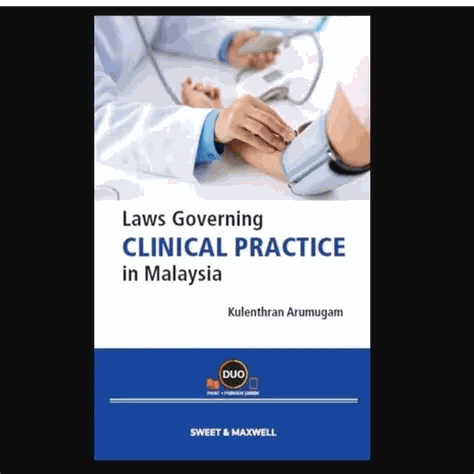


Description
Book Review
Title reviewed: Laws Governing Clinical Practice in Malaysia
Book author: Kulenthran Arumugam MBBS (Spore); MRCOG (Lond); MD (Mai); PhD (Mai); Dip Epid (Lond); LLB (Hons) (Lond)
Author of this review: marceljude.ai
I read the book and reviewed it as a medico-legal text directed mainly at doctors, but also useful to lawyers, judges, regulators, hospital administrators, and students of medical law.
List of Contents
The book is organised as follows:
Foreword
Preface
Acknowledgements
About the Author
Table of Cases
Table of Statutes
Chapter 1: The Malaysian Legal System in a Nutshell
Chapter 2: The Legal Right to Practise and the Laws Which Deny You That Right
Chapter 3: Professional Misconduct
Chapter 4: Confidentiality and the Legal Consequences of Its Breach
Chapter 5: Professional Liability in Tort
Chapter 6: Criminal Liability in Medical Practice
Chapter 7: Consent
Chapter 8: Refusal of Consent to “Necessary” Treatment
Chapter 9: Organ Donation and Organ Transplant
Chapter 10: Medical Reports and Expert Opinions
Chapter 11: Certifying Death
Index
Overall Review of the Book
Laws Governing Clinical Practice in Malaysia is a serious, practice-facing medico-legal work. Its central achievement is that it translates legal doctrine into the lived realities of clinical practice. It does not read like a purely academic treatise written for lawyers alone. Instead, it is structured as a professional survival guide for doctors who must practise medicine under the shadow of legal accountability.
From a law professor’s standpoint, the strength of the book lies in its integration of four overlapping legal domains: statutory regulation, professional discipline, civil negligence, and criminal liability. Many medical-law books treat these areas separately, but this book repeatedly shows that a single clinical incident may trigger several consequences at once: a civil claim, a disciplinary complaint, a criminal investigation, hospital inquiry, professional embarrassment, reputational damage, and emotional distress. That layered approach is one of the book’s most valuable features.
The author’s medical background is visible throughout the book. He understands the pressures of wards, clinics, emergency rooms, consent-taking, poor documentation, relatives demanding answers, patients refusing advice, and doctors making decisions under time pressure. At the same time, his legal training allows him to frame those clinical problems in terms of duty of care, breach, causation, consent, confidentiality, natural justice, disciplinary jurisdiction, and statutory obligation. The result is a hybrid text: part legal commentary, part clinical warning, part professional ethics manual.
The book is especially useful because it is Malaysian in orientation. It does not merely import English or Australian medical-law principles without adjustment. It places Malaysian legislation, Malaysian Medical Council processes, Malaysian cases, and Malaysian hospital realities at the centre of the discussion. Comparative cases from England, Australia, Canada, and elsewhere are used not as decorations, but as tools to illuminate principles that Malaysian courts may apply, adapt, or reject.
Its greatest pedagogical value is clarity. The book explains legal concepts in a way that non-lawyers can understand without oversimplifying the consequences. For doctors, it gives practical caution: keep good notes, obtain real consent, understand when confidentiality can be breached, avoid casual medical reports, do not treat guidelines lightly, and know that disciplinary bodies are not the same as courts. For lawyers, it supplies a structured map of how clinical facts become legal issues.
As a law professor, I would describe the book as doctrinally grounded, practically alert, and ethically serious. It is not merely about avoiding lawsuits. Its deeper message is that lawful clinical practice is inseparable from good clinical practice. Law, ethics, communication, and documentation are presented as mutually reinforcing. The book repeatedly implies that most medico-legal trouble begins not only from bad medicine, but from poor explanation, poor records, poor respect for patient autonomy, or poor professional judgment.
The book is not without limitations. Because it is heavily practical, some theoretical debates are necessarily compressed. For example, issues such as the philosophical basis of patient autonomy, the boundaries of therapeutic privilege, the relationship between public health and privacy, and the constitutional implications of medical decision-making could be developed further in a more academic text. But that is not really the author’s mission. His mission is to guide practitioners through the law that matters at the bedside, in the clinic, before the Malaysian Medical Council, and in court.
The book’s overall tone is cautionary but not hostile to doctors. It does not portray law as the enemy of medicine. Rather, it portrays law as an ever-present condition of professional practice. The best doctor, in the world of this book, is not merely clinically competent but legally literate, ethically aware, communicatively careful, and humble enough to document, consult, disclose, and refer when necessary.
Chapter-by-Chapter Review
Chapter 1: The Malaysian Legal System in a Nutshell
The opening chapter performs an important foundational function. It recognises that many doctors fear the law partly because they do not understand its structure. Before discussing negligence, misconduct, consent, or confidentiality, the book first explains what kind of legal system Malaysian doctors operate within.
The chapter introduces the broad categories of law: public law, private law, international law, statutory law, common law, and Syariah law. This is a sensible starting point because medical practice is not governed by one single legal source. A doctor may be regulated by statutes such as the Medical Act, sued under tort law, investigated under criminal law, disciplined by the Malaysian Medical Council, and affected by administrative or regulatory guidelines. The chapter therefore teaches the reader that law is not a single command but a system of overlapping authorities.
The discussion of legislation and common law is particularly helpful. Doctors often assume that law means only statutes. The book corrects that assumption by explaining that judicial decisions also shape legal obligations. In medical negligence, this is especially important because principles such as duty of care, standard of care, causation, informed consent, vicarious liability, and damages are largely developed through case law. The explanation of precedent, ratio decidendi, and obiter dictum gives the non-lawyer reader a usable introduction to how court decisions operate.
The treatment of statutory interpretation is also significant. Doctors reading statutes may think that words always carry obvious meanings. The chapter explains that interpretation can involve literal and purposive approaches. This is essential in medical law because statutory words such as “consent,” “good faith,” “professional misconduct,” “mental disorder,” “guardian,” or “public interest” can become contested in real cases.
The explanation of the Malaysian court hierarchy is practical and necessary. The book identifies the Federal Court, Court of Appeal, High Courts, Sessions Courts, and Magistrates’ Courts, and explains their roles. For a doctor who receives legal papers, this knowledge matters. A claim in negligence, a criminal charge, a judicial review, or an appeal from a disciplinary decision will not all proceed in the same forum.
One of the strongest parts of the chapter is its explanation of civil procedure using a medical negligence suit as the model. The book outlines how a writ begins an action, how pleadings identify the issues, how a defence responds, how documents and expert opinions become important, and how trial proceeds through evidence-in-chief, cross-examination, re-examination, submissions, and judgment. This demystifies litigation. It also shows doctors why early documentation is vital: by the time the case reaches court, the contemporaneous record may matter more than memory.
The chapter also distinguishes civil wrongs from criminal offences and disciplinary proceedings. This is a crucial lesson. A doctor may be cleared in one forum yet still face another process elsewhere. The legal consequences, standards of proof, language, procedure, and available sanctions differ. A civil claim may lead to damages. A disciplinary complaint may lead to reprimand, suspension, or removal from the register. A criminal case may lead to punishment by the state.
As a first chapter, it succeeds because it does not overload the reader with legal theory. It provides enough legal architecture for the later chapters to make sense. Its value is introductory, but its importance is substantial. Without this chapter, later discussions of tort, criminal liability, MMC proceedings, and court process would be harder for doctors to follow.
Chapter 2: The Legal Right to Practise and the Laws Which Deny You That Right
Chapter 2 moves from the general legal system to the specific legal status of the medical practitioner. It asks a basic but legally fundamental question: what gives a person the right to practise medicine, and how can that right be lost?
The chapter begins with registration. The book makes clear that medical practice is not merely a matter of qualification or skill. It is a legally controlled privilege. To practise independently, a doctor must be properly registered under the governing statutory framework. This immediately frames medicine as a regulated profession, not an ordinary occupation. The doctor’s legal identity depends on the register.
The discussion of the Annual Practising Certificate is especially important. The chapter explains that full registration alone is not enough; a practitioner also needs a valid practising certificate. This distinction is practically vital because doctors may mistakenly believe that once registered, they are permanently entitled to practise. The book warns that practising without the necessary certificate may carry serious consequences, including consequences relating to fees and professional liability.
The chapter then discusses specialist registration. This section is important because modern medical practice increasingly depends on specialist claims. A person who holds himself or herself out as a specialist assumes not only professional status but legal responsibility. The chapter’s focus on recognised training, recognised qualification, fitness, good character, and specialist registration numbers shows how law polices professional identity.
The treatment of complementary and traditional medicine is brief but useful. It shows that medical regulation does not operate in isolation from other healing systems. A registered doctor who wishes to practise traditional or complementary medicine may also need to consider separate regulatory requirements. This matters because some doctors may assume that a medical degree gives them unrestricted authority to engage in all health-related interventions. The book properly resists that assumption.
The discussion of aesthetic medical practice is also timely in principle. Aesthetic practice raises distinctive medico-legal risks because it often involves patient expectations, commercial pressures, advertising, elective procedures, and blurred boundaries between therapy and enhancement. The chapter’s emphasis on guidelines and registry requirements shows that aesthetic medicine is not a legal free zone simply because the patient desires the intervention.
The most important part of Chapter 2 is its treatment of grounds for forfeiting the right to practise. Here the book identifies the Malaysian Medical Council’s disciplinary jurisdiction. The grounds include conviction, withdrawal of qualification, serious professional misconduct, fraudulent registration, and removal from another register. This section teaches doctors that the right to practise can be lost not only through clinical incompetence but also through dishonesty, criminality, and misconduct that affects professional standing.
The discussion of interim suspension is especially valuable. It explains that the law may intervene before final guilt is established where public protection, public interest, or the practitioner’s own interest requires temporary restriction. This is a powerful regulatory tool. From a law professor’s standpoint, it also raises important natural justice questions: how does one balance public safety with fairness to the practitioner before final determination? The chapter introduces that tension effectively.
The section on disciplinary mechanisms is one of the chapter’s strongest contributions. The movement from complaint to Preliminary Investigation Committee, then to the Disciplinary Board, and finally to the Council gives doctors a procedural roadmap. It explains notice, reply, document review, inquiry, recommendation, decision, sanction, publication, and appeal. This is exactly the kind of practical legal knowledge doctors need but often lack.
The chapter’s final discussion of natural justice is excellent. It explains that disciplinary bodies must be fair, but they are not courts and need not copy full courtroom procedure. That distinction is central to administrative law. The book properly recognises that professional disciplinary bodies require flexibility, but also must give notice, allow response, avoid bias, and act fairly.
Overall, Chapter 2 is one of the book’s most practically important chapters. It tells doctors that their licence to practise is conditional, regulated, and procedurally vulnerable. It also teaches that professional legality begins before any patient is treated: it begins with registration, certification, lawful status, and compliance with regulatory obligations.
Chapter 3: Professional Misconduct
Chapter 3 deepens the regulatory discussion by focusing on professional misconduct. This chapter is essential because many doctors think of legal risk mainly in terms of negligence lawsuits. The book corrects that narrow view by explaining that disciplinary liability is a separate and serious form of professional accountability.
The chapter begins by locating the Malaysian Medical Council’s powers in statute. The Council regulates both standards of practice and professional conduct. That distinction is important. A doctor may be clinically competent but professionally unethical; conversely, clinical mistakes may become misconduct if they show disregard of professional responsibility. The chapter makes clear that the MMC is not merely concerned with bad outcomes but with professional behaviour.
The definition of serious professional misconduct is presented through the classic professional standard: conduct regarded by reputable professional peers as disgraceful or dishonourable. This is a useful definition because professional misconduct often cannot be exhaustively listed. The profession itself has ethical expectations that exceed ordinary legal compliance. A doctor may avoid civil liability yet still behave in a way that brings the profession into disrepute.
The chapter’s discussion of natural justice continues the theme from Chapter 2. It explains that the doctor facing disciplinary proceedings must know the accusation, have an opportunity to respond, and face a decision reached fairly. This is important because professional discipline can destroy reputation and livelihood. The book balances public protection with procedural fairness.
A particularly valuable section distinguishes court proceedings from MMC proceedings. The book explains that the same facts may be examined by a court and by the professional regulator, but the processes and purposes differ. A criminal acquittal does not necessarily prevent disciplinary inquiry, because acquittal may result from evidential or technical reasons, whereas the regulator is concerned with professional standards and public confidence. Conversely, dismissal of a disciplinary complaint does not necessarily bar a civil claim. This is a sophisticated and important point.
The chapter then analyses the Code of Professional Conduct. It groups misconduct into four main categories: neglect or disregard of professional responsibilities, abuse of professional privileges and skills, conduct derogatory to the profession’s reputation, and advertising or canvassing-related offences. This structure is helpful because it shows that misconduct is not limited to dramatic clinical errors. It includes poor documentation, false certification, improper delegation, conflict of interest, improper prescribing, unethical financial arrangements, inappropriate personal conduct, and misleading professional promotion.
The discussion of abuse of professional privileges is especially useful. Doctors occupy positions of trust. They may issue certificates, prescribe controlled substances, access confidential information, influence patients, and provide reports for legal or administrative use. The law therefore treats abuse of those privileges seriously. The book’s warning about false or misleading documents is particularly important because medical certificates and reports can affect employment, insurance, litigation, and liberty.
The section on conduct derogatory to the reputation of the profession shows that professional identity follows the doctor beyond the consultation room. Dishonesty, indecency, improper financial arrangements, or unethical associations can trigger disciplinary concern. This reflects the idea that medicine is a public profession sustained by trust.
The discussion of advertising and canvassing is also significant. Medical practice increasingly operates in a commercial environment, especially in private care and aesthetic medicine. The chapter reminds doctors that professional self-promotion is not simply a business choice. It is constrained by ethical rules designed to protect patients from misleading claims, pressure, or exploitation.
The chapter closes with whistleblowing. This is one of the most nuanced sections in the book. It recognises the moral difficulty faced by doctors who become aware of a colleague’s incompetence. Reporting may protect patients, but it may also expose the whistleblower to retaliation, defamation risk, professional isolation, or counter-complaint. The book does not romanticise whistleblowing. It treats it as ethically necessary in some circumstances but personally costly.
As a law professor, I would say Chapter 3 is strong because it presents professional misconduct not as a list of punishments but as a theory of professional trust. Doctors are trusted because they are licensed, skilled, honest, discreet, and ethically restrained. Misconduct is therefore conduct that damages the foundations of that trust.
Chapter 4: Confidentiality and the Legal Consequences of Its Breach
Chapter 4 is one of the book’s most doctrinally rich chapters. It examines confidentiality as ethical duty, professional obligation, contractual expectation, tortious interest, privacy concern, and statutory data issue.
The chapter begins with the nature of confidentiality in the doctor-patient relationship. The author correctly treats confidentiality as foundational rather than incidental. Patients disclose intimate, embarrassing, frightening, and socially sensitive information because they trust doctors. Without confidentiality, diagnosis and treatment may be compromised because patients may withhold information. Thus confidentiality protects both dignity and clinical accuracy.
The book explains that confidentiality continues even after death. This is important because some doctors may assume that death ends the duty. The chapter’s position reflects the deeper principle that medical information is not simply the doctor’s to use, nor merely the hospital’s administrative data. It is information received under a relationship of trust.
The chapter then discusses legal consequences of breach. First, a patient may complain to the Malaysian Medical Council. The book links confidentiality to professional misconduct, especially improper disclosure of information obtained in confidence. This is practical because many confidentiality breaches may never become major lawsuits but may still lead to disciplinary proceedings.
The book’s treatment of medical reports to third parties is especially important. Doctors often prepare reports for insurers, employers, managed-care organisations, or other institutions. The chapter warns that the doctor should obtain patient consent, explain the purpose and scope of disclosure, and be careful about releasing identifiable information. This is not merely bureaucratic caution. A report may affect employment, insurance, legal rights, or social standing.
The chapter then turns to court-based remedies. It discusses breach of contract, tort of breach of confidentiality, tort of invasion of privacy, and negligence. This is analytically useful because confidentiality breaches do not fit neatly into one legal category. A patient may claim that a doctor broke an implied contractual term, breached equitable confidence, invaded privacy, or failed to take reasonable care. The book helps readers see how one disclosure can generate several possible legal theories.
The discussion of invasion of privacy is particularly interesting in the Malaysian context. The chapter uses medical photography and intimate clinical information to show how privacy, dignity, modesty, and confidentiality overlap. It also shows that publication need not always mean wide public dissemination. Even limited unauthorised disclosure may be legally significant.
The chapter wisely addresses limitations of confidentiality. Confidentiality is powerful but not absolute. Disclosure may be required by law, justified by public interest, or necessary to prevent serious harm. This is one of the most difficult areas of medical law because doctors must balance patient trust against third-party protection and statutory duty. The book’s treatment is measured: it does not invite casual disclosure but recognises circumstances where silence may be legally or ethically indefensible.
The section on medical records is especially valuable. The book distinguishes ownership, custody, access, confidentiality, and court discovery. It explains that medical records may belong to the healthcare facility, but patients have important access rights. This is a crucial distinction. Ownership does not mean absolute control. A hospital may own the physical or institutional record, but the patient has a legitimate interest in the information contained in it.
The chapter’s discussion of patient access to medical records is one of its most practical contributions. Patients may need records for second opinions, continuing care, complaints, or litigation. The book warns against the mistaken belief that a patient always needs a court order before gaining access. This is important because refusal to provide records can itself inflame disputes and create suspicion.
The discussion of internal inquiry reports is also legally significant. Hospitals may assume that internal investigations are confidential, but litigation may require disclosure if the documents are relevant and not protected by a recognised privilege. The chapter shows how evidential principles can override institutional secrecy.
The final part of the chapter discusses personal data protection. This is a necessary modern addition. Medical information is not only confidential; it is sensitive personal data. The book connects medical records with data processing, commercial transactions, registration obligations, consent, disclosure, security, retention, and access principles. This section is complex but important because healthcare increasingly involves electronic systems, insurers, corporate providers, and third-party administrators.
Overall, Chapter 4 is one of the strongest chapters in the book. It teaches that confidentiality is not simply “do not gossip.” It is a dense legal obligation involving ethics, professional discipline, private law, evidence, privacy, data protection, and institutional governance.
Chapter 5: Professional Liability in Tort
Chapter 5 is the longest and most substantial chapter, and rightly so. Medical negligence is the central civil liability risk for doctors. The chapter gives a broad and detailed account of duty of care, standard of care, causation, guidelines, documentation, equipment, patient conduct, off-label use, vicarious liability, non-delegable duty, and damages.
The chapter begins by explaining why negligence, rather than contract, is usually the preferred legal route in medical injury claims. Although doctor-patient relationships may have contractual features, the terms are often unclear and the patient’s claim is usually better framed as breach of duty of care. This is doctrinally accurate and practically sensible.
The discussion of duty of care begins with the neighbour principle and then adapts it to clinical relationships. In most doctor-patient cases, duty of care is not controversial once the treatment relationship exists. The more difficult questions arise at the margins: before the doctor sees the patient, after discharge, where third parties are affected, where students or interns are involved, where emergencies occur, or where psychiatric harm is claimed by relatives.
The section on medical students and interns is especially useful. It warns that inexperience is not a complete defence. The law does not generally excuse poor care merely because the person is junior. At the same time, the book recognises that junior practitioners are expected to seek supervision. This reflects the legal expectation that competence includes knowing one’s limits.
The chapter’s discussion of duty before actual consultation is important. Hospitals and emergency departments cannot always avoid responsibility by saying the doctor never personally examined the patient. Once a patient presents for care and staff act or fail to act, a duty may arise. This is particularly relevant in triage, emergency medicine, and referral settings.
The section on post-discharge duty is equally important. A doctor’s responsibility may continue where follow-up advice, warning signs, referrals, or monitoring are necessary to prevent foreseeable harm. This shows that care is not confined to the moment of treatment.
The chapter then addresses duties to third parties. This is a complex area because negligence law generally protects the patient, but third parties may sometimes be foreseeably affected. Failed sterilisation, infectious disease, psychiatric patients, and family members are examples where courts may consider proximity, foreseeability, and fairness. The book does not overstate liability but shows that doctors must think beyond the immediate patient in certain cases.
The section on the Good Samaritan doctor is useful because it distinguishes legal duty from ethical expectation. The book notes that Malaysia does not have the same clear statutory protection found in some jurisdictions. For doctors, the practical lesson is that emergency assistance is ethically expected, but legal exposure depends on circumstances, consent, good faith, and negligence principles.
The chapter’s discussion of standard of care is central. It explains the Bolam test, which asks whether the doctor acted in accordance with a responsible body of medical opinion. It then explains the Bolitho qualification, which allows courts to reject expert opinion that cannot withstand logical analysis. This is crucial because medical opinion is influential but not absolute. Courts do not blindly surrender judgment to experts.
The book’s treatment of the Malaysian movement from Bolam through Foo Fio Na and later clarification in Zulhasnimar is one of its major doctrinal contributions. It explains the distinction between diagnosis and treatment on one hand, and advice about risks on the other. For diagnosis and treatment, Bolam as qualified by Bolitho remains important. For advice and informed consent, the patient-centred approach becomes central. This is one of the most important lessons in modern medical law.
The chapter then explores practical standard-of-care problems. What if the required treatment is unavailable? What if equipment is lacking? What if guidelines exist but are not followed? What if the patient leaves against medical advice? What if the patient contributes to the harm? What if the doctor uses a drug for an unregistered indication? What if the doctor makes an honest error of judgment? These are the situations doctors actually face.
The discussion of unavailable treatment and equipment is valuable because negligence is judged in context, but lack of resources is not always a complete excuse. If a hospital holds itself out as providing certain services, it may be expected to have necessary equipment or proper referral systems. This is important for institutional liability.
The section on guidelines is balanced. The book does not treat guidelines as absolute law, but it recognises their evidential importance. Guidelines may help establish accepted practice, but clinical judgment may justify departure if properly reasoned. The practical message is clear: follow guidelines where appropriate, and if departing from them, document the clinical reason.
The discussion of “at own risk” discharge is another practical highlight. The book warns that a patient’s desire to leave does not release the doctor from giving proper advice. The patient must understand the risk. A signed discharge form is not magic. The substance of counselling matters.
The section on contributory negligence and intervening acts is useful because patients sometimes worsen their own outcome. The law may reduce damages where the patient contributed to harm, but doctors cannot simply assume that patient fault erases professional responsibility. Causation remains fact-sensitive.
The off-label drug discussion is particularly relevant in clinical practice. The book recognises that doctors may use registered drugs for unregistered indications where supported by responsible medical practice. But the legal risk increases where the patient is not informed of material risks, uncertainties, or alternatives. The key is evidence-based justification and proper consent.
The section on error of judgment is fair to doctors. Not every bad outcome is negligence. Medicine involves uncertainty. But an “error of judgment” is not a complete defence if the judgment falls below accepted professional standards. This is a subtle but important distinction.
The discussion of incomplete notes is one of the most practically important warnings in the book. Poor notes weaken defence, invite adverse inference, and create evidential gaps. From a litigation perspective, the record is often the doctor’s strongest or weakest witness.
The causation section is doctrinally demanding but well handled. The book explains the “but for” test, competing causes, res ipsa loquitur, failure to warn, missing evidence, and adverse inference. It shows that even where breach is proved, the plaintiff must still prove that the breach caused the harm. Conversely, where documentation is missing or risk disclosure is absent, courts may draw inferences adverse to the doctor.
The final discussion of vicarious liability and non-delegable duty is essential for private hospitals. The book explains that hospitals may be liable for doctors depending on the relationship, representation, control, and circumstances. It rejects simplistic assumptions that independent contractors always protect hospitals from liability. This is an important modern development in healthcare law.
Chapter 5 is the intellectual centre of the book. It is detailed, case-rich, practical, and doctrinally significant. For teaching medical negligence, it would be the chapter I assign most heavily.
Chapter 6: Criminal Liability in Medical Practice
Chapter 6 addresses the most serious form of legal exposure: criminal liability. It is careful to show that criminal prosecution in clinical practice is uncommon, but possible.
The chapter begins with the basic criminal-law elements of actus reus and mens rea. This is important because doctors may confuse civil negligence with criminal wrongdoing. A bad outcome, even a negligent one, does not automatically become a crime. Criminal liability generally requires a prohibited act plus a culpable mental state, or at least a level of recklessness or gross negligence sufficient to justify punishment.
The book explains that criminal proof requires a much higher standard than civil proof. This distinction is crucial. In civil negligence, liability may be established on the balance of probabilities. In criminal cases, the prosecution must prove guilt beyond reasonable doubt. This higher threshold reflects the seriousness of criminal punishment.
The chapter identifies areas where criminal issues may arise in medical practice: assault-like conduct, unauthorised touching, privacy violations, unnecessary procedures, gross negligence causing death, pregnancy-related offences, child protection duties, and assisted-dying-related prohibitions. The chapter’s purpose is not to frighten doctors but to identify boundaries that clinical authority must not cross.
The discussion of criminal force, assault, battery, and privacy is important because consent is the legal foundation of bodily intervention. A medical examination or procedure without valid consent may be treated as wrongful. In most clinical disputes, patients sue in tort rather than pursue criminal charges, but the chapter reminds doctors that bodily autonomy is protected by both private and public law.
The section on unnecessary surgeries is particularly powerful. It shows that where surgery is not medically justified and is performed for improper reasons, the matter may move beyond negligence into criminal wrongdoing. This is a profound warning: a doctor’s scalpel is lawful only when used for proper therapeutic purposes with valid consent.
The discussion of controversial medical treatment raises difficult ethical and legal questions. Sterilisation of mentally disabled persons, invasive treatment for vulnerable patients, and procedures requested by relatives require extreme caution. The chapter correctly emphasises that parental or family consent does not automatically make every intervention lawful. The patient’s best interests remain central.
The chapter’s discussion of withdrawal of futile treatment distinguishes passive non-continuation of treatment from active life-ending conduct. This is a sensitive area, and the book’s approach is cautious. It stresses that doctors should not treat difficult end-of-life decisions casually and should seek guidance where the legal position is uncertain.
The section on modesty and privacy reinforces a recurring theme: clinical vulnerability requires professional restraint. Patients in medical settings may be physically exposed, sedated, anxious, or dependent. Abuse of that vulnerability is not merely unprofessional; it may carry serious legal consequences.
The discussion of causing death by gross negligence is one of the most important sections in the chapter. The book uses case law to show that criminal liability may arise where the conduct is not merely mistaken or careless but exceptionally bad. The distinction between ordinary negligence and gross negligence is essential. Criminal law does not punish every clinical error, but it may punish a grave departure from basic standards where death results.
The section on child abuse reporting is practically important. Doctors may fear defamation or confidentiality consequences if they report suspected abuse. The chapter explains that the law may impose a duty to act and may protect those who report on reasonable grounds. This is a good example of confidentiality yielding to child protection.
The final section discusses assisted dying and related criminal prohibitions in the legal framework presented by the book. Given the sensitivity of the subject, the chapter’s main practical message is that doctors must not assume compassion alone makes an act lawful. End-of-life care must be handled within legal boundaries.
As a whole, Chapter 6 is strong because it differentiates ordinary clinical error from criminal culpability. It warns doctors without sensationalising criminal law. Its deeper message is that professional intention, consent, good faith, and adherence to accepted standards are vital safeguards.
Chapter 7: Consent
Chapter 7 is one of the book’s most important chapters because consent is the legal expression of patient autonomy. Modern medical law increasingly turns on whether the patient was properly informed and genuinely allowed to decide.
The chapter begins from the basic principle that a competent adult has the right to decide what happens to his or her body. This is the foundation of consent law. Treatment without consent may amount to battery, negligence, professional misconduct, or even criminal concern depending on the circumstances. The book therefore treats consent not as paperwork but as a legal and ethical process.
The chapter identifies three central questions: does the patient have legal capacity, what mode of consent is required, and was the consent informed? This structure is excellent. Many doctors focus only on the signed form. The book shows that a signature is only one part of valid consent.
The discussion of minors is practically important. The book explains that persons below the age of majority are generally treated as lacking full legal capacity, so parental or guardian consent is usually required. But the chapter also introduces the more nuanced concept of the mature minor through the Gillick principle. This reflects the tension between legal age rules and the reality that some minors may understand medical decisions deeply. The book correctly notes that the Malaysian position requires caution.
The discussion of parental rights is valuable because it shows that parents are not absolute rulers over children’s medical treatment. Where parental refusal endangers a child’s welfare, legal mechanisms may be available. This is an important expression of the parens patriae principle: the state may intervene to protect those unable to protect themselves.
The section on children in custody under child-protection law is practical. It explains how protectors, police officers, and medical officers may interact when a child needs care. The chapter recognises that child protection creates special consent pathways, but also that doctors remain subject to professional standards.
The discussion of mentally disabled patients is another important section. It explains that capacity is decision-specific and may require psychiatric assessment. The book distinguishes general mental disorder from capacity to consent to a particular treatment. This is essential because not every mental condition removes decision-making ability.
The chapter’s discussion of emergencies is especially useful. It explains when consent may be dispensed with because delay would endanger life or serious health interests. The book also stresses safeguards: another practitioner’s view, written statements, and documentation. This prevents emergency exception from becoming a convenient shortcut.
The section on implied consent is practical and clear. A patient who voluntarily presents an arm for a routine injection or climbs onto an examination couch may imply consent to ordinary examination. But implied consent has limits. It does not justify major procedures, unexpected interventions of convenience, or additional surgery unrelated to necessity.
The discussion of express consent emphasises the importance of written consent for procedures and surgery. However, the book correctly warns that written consent is not enough. A form stating that risks were explained is weak if no real explanation occurred. This is one of the book’s strongest practical lessons: consent must be in substance, not merely in form.
The doctrine of informed consent is the heart of the chapter. The book traces the movement from doctor-centred disclosure to patient-centred disclosure. The modern position requires doctors to disclose material risks, reasonable alternatives, and information that a reasonable patient in that position would consider significant, as well as information the particular patient would likely consider important if the doctor knows or should know it.
This section is doctrinally important because it explains the role of Foo Fio Na, Rogers v Whitaker, Montgomery, and Zulhasnimar. The central lesson is that advice about risk is not governed purely by what doctors customarily disclose. Patient autonomy requires attention to what matters to the patient.
The discussion of therapeutic privilege is cautious. The book recognises that in rare situations disclosure may seriously harm the patient, but it warns against using therapeutic privilege too broadly. This is appropriate. If doctors could withhold information merely because disclosure is uncomfortable, informed consent would be hollow.
The chapter’s discussion of who should take consent is highly practical. The best person to take consent is usually the person performing the procedure because that person knows the procedure, risks, alternatives, and personal limitations. Where another doctor takes consent, the operating doctor should confirm that the patient understood the material information.
The section on witnesses is also important. Witnesses do not merely decorate the form. In disputed cases, the witness may become critical evidence that the explanation and signing occurred properly. Failure to call a relevant witness may damage the defence.
Overall, Chapter 7 is one of the book’s best chapters. It teaches that consent is communication, comprehension, voluntariness, capacity, disclosure, and documentation. A signature alone is not consent. A patient who does not understand has not meaningfully chosen.
Chapter 8: Refusal of Consent to “Necessary” Treatment
Chapter 8 is a natural continuation of Chapter 7. If consent protects autonomy, then refusal of treatment is its hardest test. It is easy to respect patient autonomy when the patient agrees with the doctor. It is much harder when the patient refuses treatment the doctor considers necessary.
The chapter begins from the principle that a competent patient may refuse treatment, even if refusal appears medically unwise. This is central to medical law. Competence, not wisdom, is the legal threshold. A patient does not lose autonomy merely because the doctor thinks the decision is wrong.
The chapter then considers advance directives. This is a difficult area because an advance directive attempts to project present autonomy into future incapacity. The book explains that such directives must be clear, specific, voluntary, and applicable to the clinical circumstances. This is crucial. A vague statement made years earlier may not safely govern a new medical situation.
The chapter treats advance directives cautiously in the Malaysian context. It recognises their ethical force but warns that the legal position may be uncertain. The practical advice is sound: scrutinise the directive, consider whether circumstances match, discuss with next of kin where appropriate, document carefully, and seek legal advice where doubt exists.
The section on Gillick-competent children refusing treatment raises one of the most difficult problems in medical law. The book explains that even if a child is mature enough to understand some medical decisions, refusal of life-preserving treatment may not be treated the same as consent to ordinary treatment. Courts may intervene to protect the child’s welfare. The chapter therefore distinguishes capacity to understand from legal authority to refuse grave treatment.
The discussion of disagreements between parents and doctors is important. Parents usually make medical decisions for children, but their authority is not unlimited. If parental refusal places a child at serious risk, doctors may seek legal intervention. The chapter shows that the child’s best interests remain the central legal standard.
The book also discusses disagreement between parents. This is often overlooked but clinically common. One parent may agree to treatment while the other objects. The chapter shows that doctors should not resolve such disputes casually by choosing the more convenient parent. Legal guidance may be necessary where the disagreement concerns serious treatment.
The section on “do not resuscitate” orders is one of the most practically significant discussions in the chapter. The book warns that such orders should not be made casually, silently, or as mere ward shorthand. They may be misunderstood by doctors, nurses, patients, and relatives. They may also raise fears that treatment is being abandoned. The chapter recommends discussion, documentation, and careful attention to the patient’s condition and family understanding.
A strong feature of this chapter is its moral seriousness. It recognises that refusal cases place doctors under emotional pressure. Doctors are trained to save, treat, and prevent harm. But law sometimes requires respect for refusal. At other times, especially with children or incapacity, law may permit intervention. The chapter therefore teaches doctors not to rely on instinct alone. They must analyse capacity, best interests, urgency, statutory powers, family authority, and court involvement.
Chapter 8 is valuable because it addresses the hardest side of autonomy. Consent law is not merely about getting permission; it is about respecting choice, including refusal, within legally recognised limits.
Chapter 9: Organ Donation and Organ Transplant
Chapter 9 addresses a specialised but ethically rich area: organ donation and transplantation. It is shorter than some earlier chapters, but it raises major questions about consent, death, bodily integrity, altruism, exploitation, and public trust.
The chapter begins by explaining the statutory framework for use of human tissue from deceased persons. The Human Tissues Act provides the legal basis for removal of body parts for therapeutic, educational, or research purposes. The book notes that the statute is limited and leaves several issues insufficiently defined. This is an important critique. Organ donation law requires clarity because it deals with death, grieving families, and irreversible decisions.
The chapter explains that removal of tissue requires attention to the deceased’s expressed request, the purpose of removal, and authorisation by the person lawfully in possession of the body. The difficulty is that family objection may still matter. This reflects the practical reality of transplantation: even when the deceased expressed a wish to donate, family cooperation is often central.
The discussion of determining that life is extinct is crucial. Organ retrieval depends on confidence that death has been properly certified. Public trust in transplantation would collapse if people feared that organs were removed prematurely or without proper certification. The book therefore rightly connects transplantation law with death certification and professional safeguards.
The chapter then turns to Malaysian Medical Council guidelines on organ donation and transplantation. This is important because the statutory framework may not cover every ethical and procedural issue. Guidelines fill gaps by articulating professional expectations.
The book grounds organ donation in four ethical principles: autonomy, non-maleficence, beneficence, and justice. This is an excellent framework. Autonomy requires voluntary consent. Non-maleficence requires avoiding undue harm to donors. Beneficence requires meaningful benefit to recipients. Justice requires fairness and avoidance of exploitation.
The discussion of living donors is particularly important. Living donation is ethically more complex than deceased donation because the donor undergoes medical risk without direct physical therapeutic benefit in the ordinary sense. The chapter therefore emphasises evaluation, competence, absence of coercion, understanding of risk, and freedom to withdraw.
The book’s distinction between related donors, emotionally related donors, and unrelated donors is useful. It recognises that the risk of coercion or improper inducement may vary depending on the relationship. Unrelated donation requires especially careful scrutiny because of concerns about organ trading, pressure, or hidden payment.
The chapter’s attention to information disclosure is also important. A donor must understand alternatives, tests, risks, success rates, follow-up, and the right to withdraw. Consent in transplantation is not a simple form; it is a process of ensuring that the donor’s decision is informed and voluntary.
The brief discussion of criminal-law protection for acts done in good faith is interesting but properly cautious. Transplantation involves risk, and the law must distinguish legitimate therapeutic transplantation from unlawful harm. The book does not overstate the protection; it encourages careful compliance with guidelines.
Overall, Chapter 9 is a concise but important chapter. It shows that transplantation law depends not only on technical medical ability but on trust, consent, death determination, donor protection, and ethical governance.
Chapter 10: Medical Reports and Expert Opinions
Chapter 10 is highly practical and should be required reading for doctors who write reports or appear as expert witnesses. It distinguishes two things doctors often confuse: medical reports and expert opinions.
The chapter explains that a medical report is primarily a factual account. It should identify the doctor, patient, dates, history, findings, investigations, diagnosis, treatment, and plan. It should be accurate, signed, and properly identified. The book warns doctors not to turn a medical report into an argumentative opinion unless asked and qualified to do so.
This warning is extremely important. Medical reports may later be used in litigation. If a doctor casually inserts opinions, excuses, defensive remarks, or conclusions about standard of care, those statements may be scrutinised in court. A report that appears self-serving may harm credibility. The chapter therefore teaches restraint: record facts, avoid unnecessary commentary, and be truthful.
The discussion of reports for third parties links back to confidentiality. Where reports are prepared for employers, insurers, or managed-care organisations, patient consent and disclosure scope matter. The doctor must not assume that a third party’s request overrides the patient’s confidentiality interest. This is a recurring theme in the book: convenience does not defeat legal duty.
The chapter also addresses time frames and fees. It notes that delay in medical reports may be unethical, especially where the patient needs the report for legal, insurance, employment, or continuing-care purposes. The practical message is that medical reporting is part of professional responsibility, not an optional administrative favour.
The second half of the chapter discusses expert opinions. This is one of the book’s most valuable contributions for litigation practice. An expert is not an advocate. The expert’s overriding duty is to assist the court. That duty overrides loyalty to the party who pays or instructs the expert.
The chapter explains who may be an expert: someone with relevant knowledge or experience whose opinion is admissible. It also warns that opposing counsel may challenge expertise. This is important because doctors sometimes assume that seniority alone makes them experts. True expertise must match the issue in dispute.
The discussion of expert duties under court rules is useful. An expert report should state qualifications, materials relied upon, issues considered, basis of opinion, range of opinion, reasons, conclusions, belief in correctness, and understanding of duty to the court. This structure promotes transparency and fairness.
The chapter’s practical account of how lawyers instruct experts is especially helpful. The expert may receive pleadings, medical records, reports, and specific questions. The expert must then assess whether the doctor acted in accordance with accepted practice, whether breach caused harm, and whether harm was reasonably foreseeable. This gives doctors a realistic picture of medico-legal litigation.
The book also warns experts not to go beyond their field. This is a key evidential principle. A brilliant obstetrician should not give handwriting evidence. A surgeon should not casually opine on psychiatric capacity unless qualified. Expert evidence must remain within expertise or it risks exclusion and reputational damage.
The discussion of expert fees is practical, but its deeper significance is ethical. Experts may be paid, but payment must not purchase opinion. The expert’s independence is the core of admissibility and credibility.
Chapter 10 is excellent because it teaches doctors that writing is legal conduct. A medical report, certificate, or expert opinion is not casual paperwork. It may affect litigation, rights, reputation, and justice.
Chapter 11: Certifying Death
Chapter 11 closes the book with a subject that is medically routine but legally serious: death certification. The chapter shows that certifying death is not merely administrative; it has legal, criminal, insurance, public health, and family consequences.
The chapter begins with the requirement that deaths be registered. The doctor’s role in certifying death is legally significant because the certificate becomes an official record. Errors or false statements may have consequences. This immediately frames death certification as a professional legal act.
The chapter discusses when a case may become a coroner’s or police case. This is important because not every death can be certified in the ordinary way. Sudden, suspicious, violent, accidental, unexplained, or potentially unlawful deaths may require notification and investigation. Doctors must know when not to issue an ordinary certificate prematurely.
The chapter’s discussion of mandatory post-mortem situations is practical. It explains that where legal criteria are met, the matter must be reported to the appropriate authority. This protects doctors from inadvertently interfering with investigation and protects the public interest in determining cause of death.
The section on non-inquest death certification is also useful. It explains how doctors should identify the direct cause of death, antecedent causes, and other contributing conditions. This matters because death certificates are used for statistics, inheritance, insurance, public health, and sometimes litigation.
The book properly warns against listing only modes of dying, such as general cardiorespiratory failure, without identifying the disease, injury, or complication that caused death. This is a common error. A death certificate should explain why the person died, not merely describe the final physiological collapse.
The discussion of assessable death under private healthcare legislation is particularly important. Deaths related to anaesthesia, procedures, medical technology, surgery, or similar interventions may require notification to health authorities. This recognises that procedural deaths raise public safety and regulatory concerns beyond ordinary certification.
The chapter also discusses confidentiality of mortality assessment information. This is important because mortality review must encourage honest assessment while preserving appropriate legal boundaries. However, confidentiality may yield in criminal investigation or proceedings.
The final section addresses brain death. This is legally and ethically significant because brain death allows certification of death even where machines maintain cardiopulmonary function. The chapter explains that brain death must be diagnosed under strict criteria and by appropriate specialists. This protects public confidence and prevents misuse.
The brain death discussion also connects to organ donation. Accurate death certification is a precondition for ethically legitimate organ retrieval. The book therefore ends by linking death, law, professional judgment, and transplantation ethics.
Chapter 11 is a fitting conclusion because death certification is one of the points where medicine, law, family grief, public administration, and ethics converge. The chapter reminds doctors that even the final act of clinical documentation carries legal weight.
The Book’s Major Themes
The book has several recurring themes.
First, law is not external to medicine. It is part of clinical practice. Every consent form, medical note, certificate, report, referral, disclosure, and refusal discussion carries legal significance.
Second, documentation is protection. The book repeatedly shows that good notes, clear reports, recorded explanations, written consent, documented counselling, and preserved records are central to legal defence and ethical practice.
Third, patient autonomy has become central. The strongest expression of this appears in the chapters on consent and refusal. The doctor’s duty is no longer satisfied by clinical expertise alone. The patient must be informed and allowed to decide.
Fourth, professional regulation is independent of litigation. A doctor may face the Malaysian Medical Council even where a court process is absent or unsuccessful. Professional standards may exceed minimum legal liability.
Fifth, guidelines matter even when they are not statutes. Courts and disciplinary bodies may treat guidelines as persuasive evidence of accepted practice. Doctors ignore them at risk.
Sixth, confidentiality is broad but not absolute. The book recognises patient privacy but also statutory reporting, public interest, child protection, court orders, and regulatory access.
Seventh, clinical uncertainty does not excuse poor process. Medicine may be uncertain, but doctors must still communicate, document, consult, and act reasonably.
Strengths of the Book
The book’s main strength is its practical realism. It understands how doctors actually work. It does not speak only in abstract legal language. It discusses ward rounds, medical reports, missing X-rays, tired doctors, incomplete notes, expert witnesses, AOR discharge, consent forms, minors, family disagreements, and patient access to records.
Its second strength is its Malaysian focus. The book is not merely a transplantation of English medical law. It uses Malaysian statutes, Malaysian Medical Council guidelines, Malaysian cases, and Malaysian court procedure.
Its third strength is its interdisciplinary authorship. The author writes as someone who understands both clinical practice and law. This makes the commentary unusually grounded.
Its fourth strength is its use of cases. The cases are not merely cited; they are explained in terms of what doctors need to learn from them.
Its fifth strength is its ethical seriousness. The book is not just about avoiding liability. It repeatedly returns to professionalism, trust, patient welfare, honesty, and the dignity of the patient.
Weaknesses and Limitations
The book’s practical focus means that some theoretical issues are not explored as deeply as they might be in a university monograph. A reader looking for a full philosophical account of autonomy, privacy, distributive justice, or regulatory theory may want more.
Some chapters are necessarily brief because the book covers a wide field. Organ transplantation, data protection, and end-of-life decision-making could each be a full book on their own.
The book also places heavy reliance on guidelines in some areas. That is understandable because guidelines are important in clinical practice, but readers must remember that guidelines, statutes, and case law do not always have the same legal status.
Finally, because law changes, the book should be used as a doctrinal and practical guide rather than as a substitute for checking the current legal position before making a professional decision.
Final Evaluation
As a law professor, I would classify Laws Governing Clinical Practice in Malaysia as an excellent practical medico-legal text. It is especially strong for doctors, medical students, hospital administrators, expert witnesses, and lawyers entering medical negligence practice.
Its greatest contribution is not merely that it explains the law. Its greatest contribution is that it teaches doctors how law sees clinical behaviour. To the doctor, a note may be routine; to the court, it may be evidence. To the doctor, consent may be a form; to the law, it is patient autonomy. To the doctor, a disclosure may be harmless; to the patient, it may be a breach of trust. To the doctor, a bad outcome may be unfortunate; to the law, the question is whether duty, breach, causation, and damage are proved.
The book’s central lesson is that good medicine and lawful medicine are deeply connected. The careful doctor listens, explains, documents, respects confidentiality, seeks proper consent, follows accepted practice, knows when to refer, avoids conflicts of interest, and remains honest with patients, regulators, and courts.
For Malaysian clinical practice, this book is not merely informative. It is protective. It gives doctors the legal literacy needed to practise with confidence, humility, and professional discipline.
 marceljude.ai @ +60128285778 |
- MALAYSIA'S 1ST AI LAWYER - CLICK HERE
- ISMAIL – INTEGRATED SINGAPORE/MALAYSIA AI & LAW (Library)
- OPENING OF SINGAPORE MALAYSIA AI CENTRE AND LAW LIBRARY
- LIFT - LAW INSTRUMENTS FORMS & TEMPLATES
- LAWS OF MALAYSIA FOR SINGAPOREAN DUMMIES
- HANNAH YEOH'S ARTIFICIAL INTELLIGENCE LAW ENCYCLOPEDIA
- LEAD CR - Law Ecosystem Archive Databases on CD-ROM
- BREAKING NEWS FROM MJN
- CLICK HERE CO. PROFILE
- EXCITING NEW SERIES - THE ADVENTURES OF BOBBY TAN -ADVOCATE & SOLICITOR IN THE HIGH COURT OF NORTH BORNEO by marceljude.ai
- MEDICO LEGAL - BY PRISKILA AKWILA & GLORIOUS PETAL SDN BHD - powered by marceljude.ai
- MISCELLANOUS
- ANNOTATED STATUTES OF SABAH - A NEW SERIES
- e-library - marceljude.ai
- DRAFT - DOCUMENT RESEARCH & AUTOMATED FILING TECHNOLOGY
- CLARA – Case Law Analysis & Retrieval AI
- FOR RESEARCH REQUEST CLICK HERE
- CLICK HERE TO ASK ANYTHING
- RAMBO'S LAW - THE LAW OF THE LAW JUNGLE - EXCITING NEW SERIES - CASE ANALYSIS BY JOHN RAMBO @ +60138646786
- PRISKILA AKWILA ADVOCATES - High Court of Sabah & Sarawak @ Kota Kinabalu
- COLA - COMMONWEALTH ONLINE LAWCASES AI -marceljude.ai
- THE LAW LIBRARY THAT COMES TO YOU ANYWHERE AND ANYTIME
- marceljude.ai training academy
