
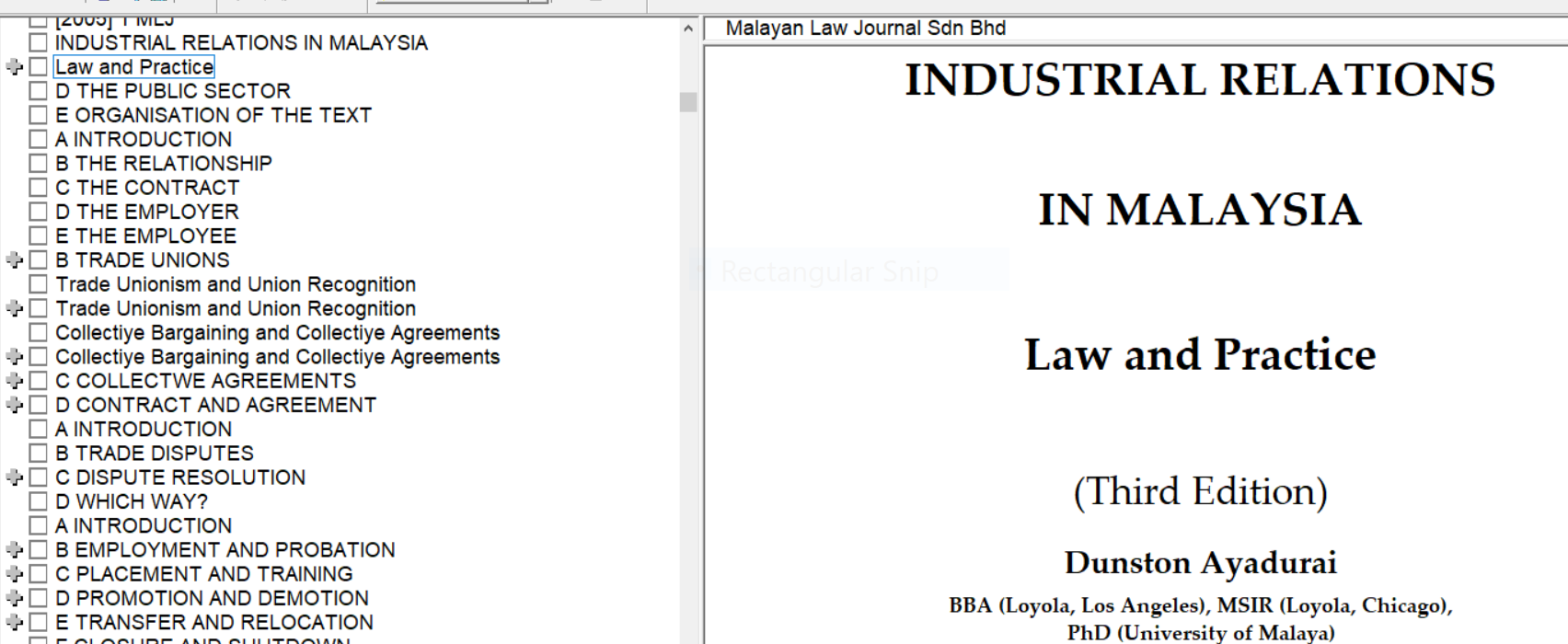
INDUSTRIAL RELATIONS IN MALAYSIA Law and Practice Dunston Ayadurai - with database


Description
INDUSTRIAL RELATIONS IN MALAYSIA
Law and Practice
Dunston Ayadurai BBA (Loyola, Los Angeles), MSIR (Loyola, Chicago), PhD (University of Malaya)
Book Review
Reviewed by: marceljude.ai
Book reviewed: Industrial Relations in Malaysia: Law and Practice
Scope of review:
Chapter-by-chapter,
subsection-by-subsection, plus whole-book assessment.
This is a review of the book’s legal treatment and scholarship, not an update of present Malaysian labour law.
Contents with printed book page numbers
Preface & Acknowledgments — page v List of Charts and Tables — page ix Table of Cases — page xi Table of Statutes — page xxxv
Chapter I — The Context — page 1 Introduction — page 3 Definition — page 3 Scope — page 3 The State and Industrial Relations — page 4 Industrial Relations and Human Resource Management — page 4 Employer-Employee Relations — page 5 Employer-Union Relations — page 5 The Framework — page 6 The Text — page 7 Relevant Legislation — page 8 The Employment Act 1955 — page 8 The Industrial Relations Act 1967 — page 9 The Trade Unions Act 1959 — page 9 The EA and the IRA — page 10 The EA, the IRA and the TUA — page 10 Courts and Tribunals — page 11 The “Labour Court” — page 11 The Industrial Court — page 11 The Law Courts — page 12 The Public Sector — page 13 Organisation of the Text — page 13
Chapter II — The Employment Relationship — page 15 Introduction — page 17 The Employment Act 1955 — page 18 The Industrial Relations Act 1967 — page 20 The Employment Act 1955 and the Industrial Relations Act 1967 — page 21 The Relationship — page 22 The Contract — page 25 The Employer — page 36 The Employee — page 49 Female Employees — page 52 Disabled Employees — page 55 Foreign Employees — page 56 Box: Employment Contract — Implied Terms — page 59
Chapter III — Trade Unions & Union Federations — page 63 Introduction — page 65 Trade Unions — page 66 Definition — page 66 Registration — page 68 Composition — page 70 Membership — page 71 Rights and Powers — page 74 Duties and Responsibilities — page 77 Union Federations — page 80 Box: First Schedule, TUA 1959 — page 84 Box: The Checkoff Provision — page 86
Chapter IV — Trade Unionism & Union Recognition — page 97 Introduction — page 99 Trade Unionism — page 101 The Rights — page 101 The Responsibilities — page 102 The Remedy — page 103 Union Recognition — page 111 The Scope of Representation — page 113 The Conditions for Recognition — page 117 The Recognition Process — page 118 The Effect of Recognition — page 121
Chapter V — Collective Bargaining & Collective Agreements — page 127 Introduction — page 129 Collective Bargaining — page 133 Process — page 133 Content — page 137 Collective Agreements — page 138 Scope — page 139 Content — page 146 Cognisance — page 148 Interpretation — page 149 Enforcement — page 152 Variation — page 158 Effect — page 159 Duration — page 162 Contract and Agreement — page 166
Chapter VI — Dispute Resolution: Techniques & Agencies — page 167 Introduction — page 169 Trade Disputes — page 170 Dispute Resolution — page 177 Negotiation — page 177 Conciliation — page 179 Arbitration — page 180 The Industrial Court — page 180 Statutory Provisions — page 180 Composition — page 180 Jurisdiction — page 180 Powers — page 181 Awards — page 181 Limitations — page 182 Representation — page 182 Court Decisions — page 183 Jurisdiction — page 191 Powers — page 193 Industrial Action — page 202 Picketing — page 202 Strike and Lockout — page 203 Statutory Provisions — page 203 Court Decisions — page 206 Which Way? — page 213
Chapter VII — The Managerial Prerogatives — page 219 Introduction — page 221 Employment and Probation — page 224 Employment — page 225 Probation — page 226 Placement and Training — page 235 Placement — page 236 Training — page 238 Promotion and Demotion — page 239 Promotion — page 239 Demotion — page 240 Transfer and Relocation — page 242 Transfer — page 243 Relocation — page 248 Closure and Shutdown — page 250 Closure and Termination — page 250 Shutdown and Layoff — page 252 Reorganisation and Retrenchment — page 255 Redundancy and Retrenchment — page 255 Retrenchment Principles — page 259 Retirement and Resignation — page 265 Retirement — page 265 Resignation — page 269 Termination and Dismissal — page 276 Statutory Provisions — page 277 Termination and Dismissal — page 279 Termination — page 281 Dismissal — page 285 Section 20 Representations — page 286 Constructive/Indirect Dismissal — page 296 Reinstatement and Re-employment — page 301 Discipline and Sanction — page 317
Chapter VIII — Misconduct, Due Inquiry & Incompetence — page 321 Introduction — page 323 Misconduct — page 324 What is Misconduct? — page 325 Burden and Standard of Proof — page 325 Aspects of Misconduct — page 331 Single Act of Misconduct — page 331 Past Misconduct — page 331 Subsequently Discovered Misconduct — page 333 Criminal Misconduct — page 335 Misconduct Outside Employment — page 338 Provocation of Misconduct — page 339 Condonation of Misconduct — page 340 Punishment for Misconduct — page 343 Kinds of Misconduct — page 347 Absence from Work — page 347 Breach of Implied Duties — page 352 Due Inquiry — page 359 The Domestic Inquiry — page 362 The Rules of Natural Justice — page 371 Incompetence — page 376
Chapter IX — Terms & Conditions of Employment — page 383 Introduction — page 385 Hours of Work — page 394 Statutory Provisions — page 394 Court Decisions — page 396 Wages and Salaries — page 401 Statutory Provisions — page 401 The Wage Period — page 402 The Payment of Wages — page 402 Advances on Wages — page 403 Deductions from Wages — page 404 Priority of Wages over other Debts — page 406 Liability to Pay Wages — page 406 Court Decisions — page 406 Definition of Wages — page 406 Determination of Wages and Salaries — page 410 Other Aspects of Wages and Salaries — page 418 The Rest Day — page 420 Public Holidays — page 422 Leave Benefits — page 427 Annual Leave — page 428 Sick Leave — page 432 Maternity Leave — page 437 Union Leave — page 437 Pecuniary Benefits — page 441 Maternity Benefit — page 443 Termination and Layoff Benefits — page 446 Retrenchment Benefit — page 449 Retirement Benefit — page 452 Resignation Benefit — page 459 Hospitalisation and Insurance Benefits — page 460 Conclusion — page 463 Box: The Productivity-Linked Wage System — page 419 Box: Implementation of Statutory Benefits — page 441
Chapter X — The Federal Government & Industrial Relations — page 465 Introduction — page 467 Legislator — page 468 Legislation on Employment — page 468 Legislation on Training — page 469 Legislation on Wages — page 471 Legislation on Trade Unions — page 471 Legislation on Industrial Relations — page 471 Safety and Health Legislation — page 472 Social Security Legislation — page 473 Administrator — page 475 Objectives of the Ministry — page 475 Departments in the Ministry — page 476 Participant — page 479 The National Labour Advisory Council — page 479 The Code of Conduct for Industrial Harmony 1975 — page 480 Employer — page 481 Salaries Committees — page 483 The Public Service Department — page 486 The Joint Councils — page 486
Appendix A — The “Labour Court” — page 493 Appendix B — A Sample Collective Agreement / Award in Lieu — page 500 Appendix C — The “Areas for Cooperation and Agreed Industrial Relations Practices” under the Code of Conduct for Industrial Harmony — page 531 Appendix D — The Industrial Court & the Law Courts — page 547 Index — page 565
The printed contents and internal chapter headings support the chapter and subsection structure above.
Overall review of the book
As a law professor, I would describe this book as a doctrinally rich, institutionally grounded, case-driven account of Malaysian industrial relations. Its central achievement is that it does not treat industrial relations as merely “labour management” or “human resources.” It treats it as a legal system: a structured framework of statutes, courts, tribunals, administrative agencies, trade unions, employer powers, employee protections, collective bargaining, and dispute-resolution mechanisms.
The book’s organizing thesis is that Malaysian industrial relations is best understood through regulation. The core actors are employers, employees, and trade unions; the core legal instruments are the employment contract, the Employment Act, the Industrial Relations Act, and the Trade Unions Act; the core institutions are the Labour Department, the Department of Industrial Relations, the Industrial Court, and the law courts. This framework approach is the book’s great strength. It gives the reader an architecture before giving detail. It tells the student or practitioner not only what the rules are, but where each rule sits in the system.
The book is particularly strong in its treatment of the Industrial Court. It repeatedly demonstrates that Malaysian industrial relations law is not built only from statutory text. It is also built from awards, arbitral practice, judicial review, and the continuing tension between legal formalism and industrial equity. The text’s repeated reliance on Industrial Court awards makes it highly practical. It shows how disputes actually arise: recognition disputes, retrenchment disputes, dismissal claims, wage claims, domestic inquiry challenges, collective agreement interpretation, and noncompliance applications.
Its limitation is also connected to its strength. Because the book is highly doctrinal and anchored in the law as presented in the book, it is not written as a socio-economic critique of Malaysian labour policy. It does not deeply theorize inequality, political economy, precarious work, migrant labour vulnerability, or comparative labour rights. It is a lawyer’s book rather than a labour sociologist’s book. That is not a defect, but it matters. The reader should understand that this is a legal map of an industrial relations system, not a complete social history of work.
The best way to use the book is as a foundation text. It is especially useful for law students, industrial relations practitioners, trade union officers, human resource professionals, and lawyers needing to understand the statutory and case-law logic of Malaysian industrial relations. Its enduring value lies in structure: employer-employee relationship first, unions next, recognition next, bargaining next, dispute settlement next, managerial power next, discipline next, statutory terms next, and finally the federal government’s role.
Chapter I — The Context, page 1
Chapter I performs the work every serious legal text should do: it defines the field before discussing the rules. The chapter begins with a disciplined definition of industrial relations as the study of regulation of relations between employers, employees, and their trade unions. This is a deliberately narrow definition. From a law professor’s standpoint, that narrowness is useful because it prevents the field from becoming vague “workplace studies.” It makes the subject juridical: who regulates, by what authority, through what procedures, and with what consequences.
The subsection on Definition at page 3 is foundational. It frames industrial relations not as casual workplace interaction but as a regulated relationship. This allows the rest of the book to treat statutes, administrative agencies, courts, and trade unions as parts of one system.
The subsection on Scope at page 3 distinguishes employer-employee relations from employer-union relations. The author’s argument is that industrial relations focuses more heavily on employer-union relations because unions alter the balance of power and introduce wider social, political, economic, and even security implications. That point is important because it explains why the state regulates trade unions more closely than individual employment contracts.
The subsection on The State and Industrial Relations at page 4 is one of the chapter’s most important conceptual contributions. The author explains that the state establishes the legal framework, but the parties themselves often regulate their own relations within that framework. This is an elegant description of Malaysian industrial relations as a hybrid system: partly statutory, partly contractual, partly arbitral, and partly negotiated.
The subsection on Industrial Relations and Human Resource Management at page 4 is pedagogically valuable. It explains that human resource management deals with employees generally, while industrial relations assumes unionisation. That difference is crucial. HRM may ask how to manage workers efficiently; industrial relations asks how management power is legally and collectively constrained when workers are organized.
The subsection on Employer-Employee Relations at page 5 explains the individual axis of the employment relationship. The book presents employees as valuable but volatile resources, and it suggests that the employer’s task becomes more complex when employees are unionised. A modern reader may find the management vocabulary somewhat employer-centered, but legally the point is sound: unionisation changes the governance structure of the workplace.
The subsection on Employer-Union Relations at page 5 is more balanced. It insists that unions exist to protect and promote employee interests, not merely to obstruct employers. The author’s important insight is that employer-union relations need not always be conflictual; they can be cooperative where interests converge, such as safety and health.
The subsection on The Framework at page 6 is the intellectual key to the book. The author argues that whether employer-union relations become confrontational or consensual depends significantly on the legal framework established by the state. As a law professor, I would call this the book’s jurisprudential thesis: law does not simply resolve labour conflict after it happens; law structures the conditions under which conflict or cooperation becomes likely.
The subsection on The Text at page 7 explains that the book will focus on relevant laws and significant decisions. That is exactly what the book does. It is statute-led but case-enriched.
The section on Relevant Legislation at page 8 identifies the Employment Act, the Industrial Relations Act, and the Trade Unions Act as the central statutory instruments. The book’s explanation of the Employment Act as governing employer-employee relations, the Industrial Relations Act as governing employer-union relations, and the Trade Unions Act as governing trade unions themselves is one of the clearest structural distinctions in the book.
The section on Courts and Tribunals at page 11 introduces the “Labour Court,” the Industrial Court, and the law courts. The distinction matters because Malaysian industrial relations is administered by multiple institutions, not one court. The Labour Court deals with specific employment payment and disciplinary matters; the Industrial Court is an arbitral tribunal central to trade disputes and unjust dismissal; and the law courts exercise supervisory and interpretive jurisdiction.
The section on The Public Sector at page 13 draws an important boundary. The book shows that Malaysia has not one perfectly uniform industrial relations system but two related systems: private sector and public sector. This observation prepares the reader for Chapter X.
The section on Organisation of the Text at page 13 is useful because it tells readers how the book will move: first the framework, then the private-sector system, and finally the public-sector and federal-government roles.
Evaluation of Chapter I: This is an excellent introductory chapter. It avoids abstraction for its own sake. Its main virtue is clarity of legal architecture. Its main limitation is that it adopts the state’s framework largely as given; it does not yet ask whether that framework distributes power fairly. But as an opening chapter, it succeeds.
Chapter II — The Employment Relationship, page 15
Chapter II turns from system to relationship. It asks: who counts as employer, who counts as employee, and what legal relationship connects them? This is essential because industrial relations law cannot operate unless the law first identifies the parties.
The Introduction at page 17 explains that the book must begin by defining employer and employee before moving to trade unions. This is doctrinally correct. Trade union rights, dismissal remedies, collective bargaining, and statutory benefits all depend on the existence of an employment relationship.
The subsection on The Employment Act 1955 at page 18 explains the “contract of service,” employer, and employee under that Act. The book stresses that the Employment Act’s coverage is not universal; it applies to defined categories. This is important because statutory protection depends on classification.
The subsection on The Industrial Relations Act 1967 at page 20 introduces the “contract of employment,” employer, and workman. The book shows that the Industrial Relations Act uses broader concepts than the Employment Act. This matters because a person may fall outside some Employment Act protections but still be relevant under industrial relations law.
The subsection on The Employment Act 1955 and the Industrial Relations Act 1967 at page 21 compares the two statutes. The chapter shows that the “contract of service” and “contract of employment” are substantially similar in nature but not identical in scope. This is a subtle but important distinction.
The section on The Relationship at page 22 treats employment as fundamentally contractual. But the book also shows that employment is not an ordinary commercial contract. Security of tenure, statutory protection, Industrial Court oversight, and equity modify strict contractual freedom. That is one of the chapter’s best legal insights.
The section on The Contract at page 25 is crucial. It distinguishes a contract of service or employment from a contract for services. That distinction separates employees from independent contractors. The chapter discusses tests such as control, integration, organization, and the mixed or multiple test. As a law professor, I would stress that this is not mechanical classification. The court must look at the real substance of the relationship, not merely the label chosen by the parties.
The section on The Employer at page 36 considers difficult problems of corporate identity, group companies, transfer of undertakings, agency, and the question of who truly controls the employment relationship. This is one of the most practically useful parts of the chapter. In modern corporate structures, the nominal employer may not always be the real economic decision-maker.
The section on The Employee at page 49 deals with the employee/workman distinction and the employee/independent contractor distinction. The book emphasizes that the question is one of mixed law and fact, requiring attention to contract terms, control, conduct, and economic reality.
The subsection on Female Employees at page 52 reflects the book’s discussion of equality, marriage clauses, pregnancy, retirement age, and sexual harassment. Some of the older case reasoning discussed in this area will feel dated to a modern equality-law reader, but the chapter is valuable because it records how industrial jurisprudence dealt with gendered employment disputes.
The subsection on Disabled Employees at page 55 is significant because it links disability, continued employment, suitable work, and the employer’s social obligation. The chapter recognizes that termination for incapacity is not purely contractual; it carries fairness and rehabilitation considerations.
The subsection on Foreign Employees at page 56 is especially important in Malaysia’s labour context. The book’s treatment indicates that foreign employees are not outside the law simply because they are foreign. It highlights equal treatment concerns in relation to wages and collective agreements.
The Box on Implied Terms at page 59 is doctrinally valuable. It explains implied contractual terms, including duties of fidelity, safe systems of work, and business efficacy. This helps connect common-law contract doctrine with industrial-relations fairness.
Evaluation of Chapter II: This is a strong and necessary chapter. Its great strength is classification. It teaches that labour protection depends on legal status, but that legal status depends on substance rather than labels. Its limitation is that it remains largely doctrinal; it does not deeply explore modern precarious work, gig work, or structural dependency. Still, as a foundation in employment status and contract, it is excellent.
Chapter III — Trade Unions & Union Federations, page 63
Chapter III introduces the institutional actors that distinguish industrial relations from ordinary employment law: trade unions and federations. The chapter is legalistic in the best sense. It explains how unions are defined, registered, controlled, empowered, and limited.
The Introduction at page 65 states that trade unions are essential to industrial relations and distinguish the discipline from human resource management. That is exactly right. Without collective organization, the field would collapse into individual employment law.
The section on Trade Unions at page 66 begins with definition. The book explains that a trade union is legally defined by composition, geographical scope, sectoral scope, industrial or occupational connection, and statutory objects. This matters because an organization may legally be a trade union even if it does not wish to be one.
The subsection on Definition at page 66 is one of the chapter’s most important parts. The statutory definition imposes boundaries: employer unions and employee unions are separate; unions are geographically limited; and employee unions may be establishment-based, industry-based, trade-based, or occupation-based.
The subsection on Registration at page 68 explains that unions must register before functioning lawfully. This reveals the state’s strong supervisory role. Registration is not a mere administrative detail; it is the gateway to legal capacity.
The subsection on Composition at page 70 shows how statutory definition shapes union structure. The book explains how legal categories contribute to multiplicity and fragmentation of unions. This is a valuable critical insight. The law does not merely recognize unions; it shapes the kind of union movement that can exist.
The subsection on Membership at page 71 explains restrictions on who may join unions, especially in the public sector. The book’s treatment of public officers, confidential or security capacity, and management/professional categories shows that union rights are strongly qualified.
The subsection on Rights and Powers at page 74 explains the legal privileges of registered unions, including immunities, capacity to sue, power to hold property, collect funds, and participate in industrial disputes. These rights show why registration matters.
The subsection on Duties and Responsibilities at page 77 balances the previous subsection. Unions must maintain rules, offices, accounts, records, ballots, and lawful procedures. This prevents a romantic view of unions. The book shows unions as legal persons with rights but also compliance burdens.
The section on Union Federations at page 80 explains the higher organizational layer: federations of unions. The book notes differences between unions, federations, and confederations, and it explains why some bodies function like federations even if registered differently.
The First Schedule box at page 84 is practical because it identifies matters that union rules must address. The Checkoff Provision box at page 86 is equally useful because checkoff is a recurring practical issue in union finance and collective relations.
Evaluation of Chapter III: This chapter is excellent on institutional legality. It shows how the state both enables and disciplines unionism. Its most important contribution is showing that union fragmentation is not accidental; it is partly produced by legal design. Its limitation is that it could do more normative evaluation of whether such fragmentation weakens collective bargaining power.
Chapter IV — Trade Unionism & Union Recognition, page 97
Chapter IV is about the bridge between union existence and collective bargaining power. A union may exist, but that does not automatically mean it can bargain. Recognition is the legal gate.
The Introduction at page 99 explains that the Industrial Relations Act becomes central here. The chapter describes the rights to form, join, and participate in trade union activities, then moves to union recognition as a prerequisite for collective bargaining.
The section on Trade Unionism at page 101 explains the basic trade union rights of employees and employers. The subsection on The Rights at page 101 emphasizes that these rights are conferred but qualified. That is important: the book does not present union rights as absolute civil liberties. They operate within statutory limits.
The subsection on The Responsibilities at page 102 explains the corresponding obligations imposed on employers, employees, and unions. Employers may not improperly interfere with union membership or activity, but employees and unions are also constrained.
The subsection on The Remedy at page 103 deals with unfair labour practice. The chapter shows that rights without remedies are inadequate. The complaint process through the Director General and possible reference to the Industrial Court gives legal teeth to trade unionism.
The section on Union Recognition at page 111 is the heart of the chapter. The book explains recognition as the employer’s acceptance of the union as proper representative of employees for collective bargaining purposes. That limitation is crucial. Recognition is not necessary for every union activity, but it is necessary for collective bargaining.
The subsection on The Scope of Representation at page 113 is one of the most critical and controversial parts of the book. It explains that recognition is tied to categories of employees and union competence. The distinction between “blue-collar” and “white-collar” representation, as treated in the book, has major consequences for bargaining power.
The subsection on The Conditions for Recognition at page 117 sets out the practical requirements: registration, competence, and representativeness. The book notes that some conditions were developed through case law rather than fully spelled out in the statute.
The subsection on The Recognition Process at page 118 explains claims for recognition, employer response, Director General involvement, membership verification, and secret ballot. This is highly practical for union officers and employer advisers.
The subsection on The Effect of Recognition at page 121 explains that recognition allows collective bargaining and restricts competing recognition claims. The book also discusses whether recognition can be unilaterally withdrawn, emphasizing the legal stability of recognition once granted.
Evaluation of Chapter IV: This is one of the book’s most important chapters. It explains why union law is not the same as bargaining law. A union’s existence does not automatically produce bargaining authority. The chapter’s strength is procedural clarity. Its weakness, from a modern labour-rights perspective, is that it reveals a restrictive system but does not fully critique the power imbalance created by recognition barriers.
Chapter V — Collective Bargaining & Collective Agreements, page 127
Chapter V is the book’s doctrinal center. Collective bargaining is presented as the principal means of improving employment terms and stabilizing industrial relations. The chapter links rights, recognition, negotiation, agreements, and enforceability.
The Introduction at page 129 states that collective bargaining improves employment terms and regulates employer-union relations. The book also treats the collective agreement as a legal instrument that stabilizes relations for a specified period. This is a mature view of collective bargaining: it is not merely confrontation; it is institutionalized peace through negotiated rules.
The section on Collective Bargaining at page 133 explains process and content. The subsection on Process at page 133 shows that bargaining begins with an invitation and proposals, but the machinery also contemplates refusal, complaint, and the possibility of a deemed trade dispute. This shows that Malaysian collective bargaining is procedural, not merely voluntary conversation.
The subsection on Content at page 137 explains what may or may not be bargained. It discusses managerial prerogatives and the extent to which some matters are excluded from union proposals unless the employer is prepared to bargain on them. This anticipates Chapter VII.
The section on Collective Agreements at page 138 is sophisticated. It treats agreements not as private contracts alone but as legal instruments requiring cognisance by the Industrial Court.
The subsection on Scope at page 139 asks who is bound. The book explains that collective agreements apply within defined limits: particular employers, unions, covered employees, and job categories. This is important because collective agreements are not simply general workplace codes.
The subsection on Content at page 146 explains that agreements may contain terms and conditions of employment and provisions regulating employer-union relations, but they must not undercut statutory minimums.
The subsection on Cognisance at page 148 is central. The Industrial Court’s cognisance gives the agreement legal force comparable to an award. Without cognisance, an agreement lacks the same legal enforceability.
The subsection on Interpretation at page 149 explains how disputes about meaning are dealt with. The book emphasizes that interpretation of collective agreements is not identical to ordinary commercial contract interpretation. Labour documents are often negotiated by non-lawyers and should be read pragmatically.
The subsection on Enforcement at page 152 explains noncompliance. This is one of the most useful parts for practitioners because it distinguishes interpretation from enforcement. A court enforcing an agreement must first determine whether a term has been breached; it should not casually convert enforcement into interpretation.
The subsection on Variation at page 158 explains that collective agreements and awards are not easily altered. Legal stability is a value in industrial relations.
The subsection on Effect at page 159 explains that a collective agreement, once properly recognized by law, binds parties and affects individual employment contracts.
The subsection on Duration at page 162 explains the temporal effect of agreements, including retrospective operation, termination clauses, and continuation clauses.
The section on Contract and Agreement at page 166 is doctrinally elegant. It explains that a collective agreement is not the same as an individual employment contract. It supersedes inconsistent individual terms but does not extinguish the individual contract.
Evaluation of Chapter V: This is perhaps the book’s best doctrinal chapter. It teaches the collective agreement as a hybrid instrument: negotiated like a contract, approved like a statutory-industrial instrument, and enforced through the Industrial Court. Its weakness is that the treatment remains technical; it does not deeply explore bargaining inequality. But as legal doctrine, it is strong.
Chapter VI — Dispute Resolution: Techniques & Agencies, page 167
Chapter VI explains how the system deals with conflict. The book treats dispute resolution as the second major pillar of industrial relations after collective bargaining.
The Introduction at page 169 explains that industrial relations law must both regulate relationships and prevent or settle disputes. The chapter identifies negotiation, fact-finding, conciliation, arbitration, and industrial action as recognized techniques, while noting that the system regulates confrontational methods carefully.
The section on Trade Disputes at page 170 defines the gateway concept. A trade dispute is not any workplace disagreement. It must involve the legally relevant parties and concern employment, non-employment, terms of employment, or conditions of work. This definition determines whether the Industrial Relations Act machinery can be invoked.
The section on Dispute Resolution at page 177 begins with Negotiation. The book rightly treats negotiation as the best and most natural first method. As a law professor, I agree with this ordering even where the statute does not fully rank the methods. Negotiated settlement usually preserves relationships better than adjudicated defeat.
The subsection on Conciliation at page 179 explains the role of the Department of Industrial Relations and the Director General. Conciliation is important because it adds a state-assisted settlement stage before arbitration.
The subsection on Arbitration at page 180 introduces the Industrial Court. The sub-subsection on Statutory Provisions explains composition, jurisdiction, powers, awards, limitations, and representation. This is valuable because students often misunderstand the Industrial Court as an ordinary court. It is not. It is an arbitral tribunal with statutory authority and a social justice function.
The sub-subsection on Court Decisions at page 183 develops the Industrial Court’s role through case law. The book shows that the Industrial Court acts according to equity, good conscience, and substantial merits, but is still bounded by jurisdiction, statute, and supervisory control by the law courts.
The subsection on Jurisdiction at page 191 explains that jurisdiction is conferred by statutory reference and that challenges to ministerial reference must be made in the proper forum. This is procedurally important.
The subsection on Powers at page 193 explains joinder, substitution, evidence, and the court’s ability to craft effective awards.
The subsection on Industrial Action at page 202 covers picketing, strike, and lockout. The book recognizes industrial action as part of dispute resolution but carefully notes statutory regulation. This reflects the Malaysian model: industrial peace is preferred, and industrial action is legally constrained.
The subsection on Picketing at page 202 treats picketing separately from strikes and lockouts. This is useful because picketing may be expressive and pressure-based without necessarily amounting to a strike.
The subsection on Strike and Lockout at page 203 explains statutory conditions and judicial treatment. The book’s treatment is practical: legality, justification, penalties, and consequences are all considered.
The final section, Which Way? at page 213, asks which method should be used. The implicit answer is that negotiation should come first, conciliation second, arbitration where necessary, and industrial action only within careful limits.
Evaluation of Chapter VI: This is a strong procedural chapter. It is excellent for understanding how disputes move through the system. Its main limitation is that it is institution-focused rather than worker-experience-focused. It explains how disputes are processed, but less about how cost, delay, and power affect access to justice.
Chapter VII — The Managerial Prerogatives, page 219
Chapter VII is the longest and one of the most practically important chapters. It deals with employer power: hiring, probation, promotion, transfer, closure, retrenchment, retirement, dismissal, reinstatement, and discipline. The chapter’s central thesis is that managerial prerogatives exist, but they are not absolute. They are qualified by bona fides, fairness, statutory limits, Industrial Court supervision, and the prohibition of victimisation or unfair labour practice.
The Introduction at page 221 frames the controversy. Employers claim prerogatives are necessary for efficient management; unions argue that matters affecting employees should be negotiable. The book’s balanced position is that managerial powers exist but may be reviewed for abuse.
The section on Employment and Probation at page 224 begins with Employment at page 225. The employer has discretion to hire, but that discretion cannot be used unlawfully or in bad faith. The subsection on Probation at page 226 explains that probationers occupy a vulnerable but not rightless position. A probationer may be assessed, but termination must still be justified in industrial law terms where statutory remedies apply.
The section on Placement and Training at page 235 begins with Placement at page 236. Placement concerns assignment of employees to suitable jobs. The subsection on Training at page 238 connects management needs with employee development. The employer may control training, but the Industrial Court may examine whether training-related decisions are fair.
The section on Promotion and Demotion at page 239 addresses vertical movement. Promotion at page 239 is generally a management matter, but procedures may be discussed and discrimination or bad faith may be challenged. Demotion at page 240 is more serious because it affects status, wages, dignity, and future prospects. Demotion may also operate as discipline, requiring fairness.
The section on Transfer and Relocation at page 242 is highly practical. Transfer at page 243 is usually recognized as managerial, but it must not be punitive, mala fide, or detrimental beyond contractual permission. Relocation at page 248 raises hardship and reasonableness issues. The book’s treatment is particularly useful because transfer disputes are common in industrial practice.
The section on Closure and Shutdown at page 250 distinguishes Closure and Termination from Shutdown and Layoff. Closure is a business decision that may end employment; shutdown may temporarily suspend work. The chapter recognizes that employer business autonomy exists, but employee consequences must be addressed through termination, layoff, or compensation principles.
The section on Reorganisation and Retrenchment at page 255 is one of the strongest parts of the chapter. Redundancy and Retrenchment at page 255 explains that redundancy may justify termination, but the employer must prove genuine redundancy. Retrenchment Principles at page 259 include fair selection, consultation, warning, possible transfer or retraining, and the LIFO principle where appropriate. The book’s treatment of retrenchment is commendable because it refuses to treat “business necessity” as a magic phrase.
The section on Retirement and Resignation at page 265 distinguishes employer-triggered retirement from employee-triggered resignation. Retirement at page 265 may be based on age, illness, or contract. Resignation at page 269 is formally an employee option, but the book rightly notes that some resignations are not voluntary; they may be forced dismissals in substance.
The section on Termination and Dismissal at page 276 is central to Malaysian industrial law. Statutory Provisions at page 277 sets out the legal framework. Termination and Dismissal at page 279 explains that termination by notice and dismissal may have the same practical effect, especially when statutory unjust dismissal remedies are engaged. Termination at page 281 concerns ending the contract through notice, expiry, or other mechanisms. Dismissal at page 285 concerns employer-initiated removal, often for misconduct or alleged cause.
The subsection on Section 20 Representations at page 286 is essential. It explains the mechanism by which an employee challenges dismissal and seeks reinstatement. The Industrial Court must ask whether there was a dismissal and whether it was with just cause or excuse.
The subsection on Constructive/Indirect Dismissal at page 296 is especially strong. Constructive dismissal is treated as employer conduct that so fundamentally breaches the contract that the employee is entitled to treat the contract as ended. The chapter correctly places the burden on the employee to establish constructive dismissal, while still requiring the employer’s justification to be assessed.
The section on Reinstatement and Re-employment at page 301 addresses remedies. The book shows that reinstatement is conceptually primary in unjust dismissal, but compensation may be awarded where reinstatement is impractical. This is an important remedial distinction.
The section on Discipline and Sanction at page 317 introduces the proportionality principle. Employers may discipline, but the penalty must fit the misconduct. Excessive punishment may become unfair labour practice or unjust dismissal.
Evaluation of Chapter VII: This is the book’s most practically valuable chapter for HR professionals, union officers, and litigators. It demonstrates that employer power is lawful but reviewable. Its strength is its insistence that management rights are qualified. Its limitation is that the breadth of the chapter makes some topics necessarily compressed, but the overall treatment is excellent.
Chapter VIII — Misconduct, Due Inquiry & Incompetence, page 321
Chapter VIII is a disciplinary-law chapter. It explains when employee conduct justifies sanction, how misconduct must be proved, what procedural fairness requires, and how incompetence differs from misconduct.
The Introduction at page 323 begins with statutory discipline. It explains that an employer may dismiss, downgrade, or impose lesser punishment for misconduct, but only after due inquiry. This establishes the central balance: discipline is permitted, but arbitrary discipline is not.
The section on Misconduct at page 324 begins with What is Misconduct? at page 325. The book defines misconduct as conduct inconsistent with the express or implied obligations of service, unless trivial. This connects misconduct to contract, trust, loyalty, care, skill, and workplace order.
The subsection on Burden and Standard of Proof at page 325 is essential. The book emphasizes that the employer bears the burden of proving misconduct. The standard is generally balance of probabilities, although criminal-type misconduct raises difficult questions about evidential seriousness. This is one of the most useful doctrinal discussions in the chapter.
The subsection on Aspects of Misconduct at page 331 examines multiple doctrinal problems. Single Act of Misconduct at page 331 considers whether one incident can justify dismissal. Past Misconduct at page 331 considers whether prior conduct may be considered. Subsequently Discovered Misconduct at page 333 asks whether misconduct discovered after dismissal can justify the employer’s action. Criminal Misconduct at page 335 distinguishes internal discipline from criminal prosecution. Misconduct Outside Employment at page 338 addresses conduct away from work that may affect trust or reputation. Provocation of Misconduct at page 339 recognizes contextual mitigation. Condonation of Misconduct at page 340 explains that an employer who forgives or ignores misconduct may lose the right to rely on it later. Punishment for Misconduct at page 343 introduces proportionality.
The subsection on Kinds of Misconduct at page 347 narrows the discussion to examples. Absence from Work at page 347 is a recurring industrial problem. The book treats absence not merely as non-attendance, but as a legal question involving permission, justification, notice, and statutory provisions. Breach of Implied Duties at page 352 includes loyalty, honesty, trust and confidence, care, and skill.
The section on Due Inquiry at page 359 is the procedural heart of the chapter. It explains that discipline must be preceded by a proper inquiry where required. The book’s treatment of due inquiry is important because procedure and substance are intertwined: a correct outcome may still be legally vulnerable if reached unfairly.
The subsection on The Domestic Inquiry at page 362 explains internal disciplinary hearings. The book discusses defective inquiries, absence of inquiry, and whether defects may be cured before the Industrial Court.
The subsection on The Rules of Natural Justice at page 371 is one of the chapter’s best parts. It explains the right to know the case, the right to be heard, and the rule against bias. It also recognizes practical realities, especially in small organizations, where perfect separation between complainant, witness, prosecutor, and decision-maker may be difficult.
The section on Incompetence at page 376 distinguishes poor performance from misconduct. Incompetence usually requires warning, opportunity to improve, evaluation, and fairness. The book recognizes exceptional cases where the nature of the job or the severity of incapability may justify faster action.
Evaluation of Chapter VIII: This is an excellent disciplinary chapter. It balances employer authority, procedural fairness, and evidential discipline. Its strongest contribution is that it treats misconduct not as moral outrage, but as a legal category requiring proof, process, proportionality, and connection to employment.
Chapter IX — Terms & Conditions of Employment, page 383
Chapter IX is the statutory-benefits and employment-terms chapter. It explains how the Employment Act establishes minimum conditions while contracts and collective agreements may improve upon them. This chapter is especially useful for understanding how statutory terms, individual contracts, and collective agreements interact.
The Introduction at page 385 explains that the Employment Act legislates basic and minimum terms. The chapter rightly emphasizes that employment terms may come from three sources: the individual employment contract, the collective agreement or award, and statute. This layered approach is doctrinally important.
The section on Hours of Work at page 394 covers Statutory Provisions and Court Decisions. It deals with ordinary hours, overtime, spread-over limits, and judicial interpretation. The value here is practical: working time rules are a major source of disputes.
The section on Wages and Salaries at page 401 is one of the most technical sections. Under Statutory Provisions, it covers The Wage Period at page 402, The Payment of Wages at page 402, Advances on Wages at page 403, Deductions from Wages at page 404, Priority of Wages over other Debts at page 406, and Liability to Pay Wages at page 406. The statutory rules protect employees against delay, improper payment methods, unlawful deductions, and evasion through contractors.
The Court Decisions subsection at page 406 begins with Definition of Wages. This is doctrinally important because “wages,” “salary,” “basic wages,” allowances, bonus, commission, and overtime may have different meanings depending on statutory or contractual context. The book’s treatment shows that labels are not always conclusive.
The subsection on Determination of Wages and Salaries at page 410 considers how wage increases are assessed. The book discusses cost of living, comparable establishments, internal wage structures, and employer capacity to pay. This is an excellent example of industrial adjudication balancing labour and capital.
The subsection on Other Aspects of Wages and Salaries at page 418 covers wage structures, increments, conversions, arrears, and productivity-linked wages. The box on Productivity-Linked Wage System at page 419 is significant because it connects wage policy with productivity and industrial competitiveness.
The section on The Rest Day at page 420 deals with weekly rest day entitlements. The section on Public Holidays at page 422 deals with holiday entitlement, payment, substitution, and work performed on holidays.
The section on Leave Benefits at page 427 covers Annual Leave at page 428, Sick Leave at page 432, Maternity Leave at page 437, and Union Leave at page 437. The inclusion of union leave is important because it connects individual time off with collective representation rights.
The section on Pecuniary Benefits at page 441 covers financial benefits beyond ordinary wages. Maternity Benefit at page 443 addresses payment and statutory entitlement. Termination and Layoff Benefits at page 446 explains benefits upon termination or layoff under relevant regulations. Retrenchment Benefit at page 449 addresses compensation for loss of employment due to surplus labour or business restructuring. Retirement Benefit at page 452 addresses benefits beyond statutory provident fund arrangements. Resignation Benefit at page 459 explains why such benefits are less favored unless already entrenched. Hospitalisation and Insurance Benefits at page 460 explores medical and insurance benefits under collective bargaining and awards.
The Implementation of Statutory Benefits box at page 441 is important because it clarifies that some statutory-benefit complaints belong in statutory enforcement channels, not necessarily the Industrial Court.
The Conclusion at page 463 candidly notes that the chapter cannot cover every possible term, allowance, benefit, or condition. That is fair. The chapter is already broad.
Evaluation of Chapter IX: This is a dense but essential chapter. Its strength is the layered model of employment terms. Its limitation is that it cannot cover every benefit in detail, but it succeeds in explaining the major statutory and arbitral categories.
Chapter X — The Federal Government & Industrial Relations, page 465
Chapter X returns to the state. It shows that the federal government is not merely a background lawmaker. It is legislator, administrator, participant, and employer. This chapter completes the conceptual arc begun in Chapter I.
The Introduction at page 467 explains that industrial relations is constitutionally federal and that the federal government is deeply involved in lawmaking, administration, policy formation, promotion of industrial harmony, and public-sector employment.
The section on Legislator at page 468 divides legislation into categories. Legislation on Employment at page 468 covers employment laws regulating employer-employee relations and minimum terms. Legislation on Training at page 469 addresses human resource development and training levies. Legislation on Wages at page 471 covers wage regulation. Legislation on Trade Unions at page 471 concerns union governance. Legislation on Industrial Relations at page 471 concerns employer-union relations and disputes. Safety and Health Legislation at page 472 covers occupational safety. Social Security Legislation at page 473 covers statutory employee protection.
The section on Administrator at page 475 explains the Ministry of Human Resources. The subsection on Objectives of the Ministry at page 475 addresses institutional purpose, while Departments in the Ministry at page 476 explains the administrative machinery.
The section on Participant at page 479 is normatively important. Through the National Labour Advisory Council at page 479 and the Code of Conduct for Industrial Harmony at page 480, the government participates in tripartite industrial-relations policy. The Code is especially important because courts and parties use it as a guide to fair industrial practice.
The section on Employer at page 481 recognizes that the federal government is itself a major employer. The subsection on Salaries Committees at page 483 addresses public-sector remuneration structures. The Public Service Department at page 486 is treated as the public sector’s central human resource institution. The Joint Councils at page 486 are consultative rather than negotiative, which is crucial: public-sector industrial relations is not the same as private-sector collective bargaining.
Evaluation of Chapter X: This chapter is indispensable because it prevents the reader from seeing the state as neutral background. The federal government is architect, enforcer, conciliator, policy participant, and employer. The chapter’s strength is institutional clarity. Its limitation is that it could more sharply critique the asymmetry between private-sector bargaining and public-sector consultation.
Appendices review
Appendix A — The “Labour Court,” page 493. This appendix is useful because the Labour Court is easily misunderstood. It is not the same as the Industrial Court. It is an administrative tribunal dealing primarily with wage/payment disputes and certain disciplinary matters. As a teaching tool, Appendix A helps clarify institutional boundaries.
Appendix B — A Sample Collective Agreement / Award in Lieu, page 500. This is one of the book’s most practically valuable additions. Students can read doctrine in Chapter V, then see how that doctrine appears in agreement form. The sample provisions on grievance procedure, conciliation, arbitration, union recognition, management rights, and scope of agreement show how industrial law becomes workplace governance.
Appendix C — Areas for Cooperation and Agreed Industrial Relations Practices under the Code of Conduct for Industrial Harmony, page 531. This appendix is valuable because it connects hard law with soft industrial norms. Retrenchment, consultation, cooperation, grievance handling, and fair labour practice cannot be understood only through statutes. Appendix C shows the normative layer of Malaysian industrial relations.
Appendix D — The Industrial Court & the Law Courts, page 547. This appendix is doctrinally significant. It explains the relationship between arbitral justice and judicial supervision. The Industrial Court acts with industrial equity, but the law courts retain a supervisory role. This is crucial for understanding certiorari, jurisdictional error, legal questions, and the boundary between industrial merits and legal legality.
Final law-professor assessment
The book’s greatest achievement is structure. It takes a complex field and makes it teachable. It begins with context, identifies the employment relationship, introduces unions, explains union rights and recognition, moves to bargaining and agreements, then dispute resolution, then employer prerogatives, discipline, statutory terms, and finally the state. That order is excellent. It mirrors the life of an industrial relations system.
Its second great achievement is case integration. Many labour-law books recite statutes. This book shows how statutory provisions live through Industrial Court awards and superior court decisions. That is especially important in industrial relations, where equity, good conscience, substantial merits, and workplace realities often shape outcomes.
Its third achievement is balance. The book does not pretend that employers have no managerial powers. Nor does it pretend those powers are absolute. It recognizes trade union rights but also union responsibilities. It recognizes collective bargaining but also legal limits. It recognizes industrial action but prefers peaceful dispute resolution. It recognizes contract but refuses to reduce employment to ordinary contract law.
The book’s most valuable chapters for legal doctrine are Chapter V on collective bargaining and agreements, Chapter VII on managerial prerogatives, and Chapter VIII on misconduct and due inquiry. Chapter V explains the legal force of collective agreements. Chapter VII explains how employer power is qualified. Chapter VIII explains the evidential and procedural discipline necessary before punishment. Together, those three chapters form the practical core of Malaysian industrial relations law.
The book’s most valuable chapters for institutional understanding are Chapter I, Chapter VI, and Chapter X. Chapter I gives the legal framework; Chapter VI explains dispute processing; Chapter X explains the federal government’s many roles.
The book’s weakest area is modern normative critique. It does not deeply interrogate whether the system sufficiently empowers workers, whether union fragmentation weakens bargaining, whether foreign employees face structural vulnerability, or whether public-sector consultation is an adequate substitute for bargaining. Those questions are beyond the book’s main purpose, but they are natural questions for a contemporary law classroom.
My final judgment: this is a serious, careful, highly useful doctrinal work. It is best read as a legal map of Malaysian industrial relations: statutes form the roads, the Industrial Court supplies much of the traffic law, the law courts supervise the route, and employers, employees, and unions move within the system. As a law professor, I would assign it not because it is light reading, but because it teaches students how an industrial relations system is built.
- MALAYSIA'S 1ST AI LAWYER - CLICK HERE
- ISMAIL – INTEGRATED SINGAPORE/MALAYSIA AI & LAW (Library)
- OPENING OF SINGAPORE MALAYSIA AI CENTRE AND LAW LIBRARY
- LIFT - LAW INSTRUMENTS FORMS & TEMPLATES
- LAWS OF MALAYSIA FOR SINGAPOREAN DUMMIES
- HANNAH YEOH'S ARTIFICIAL INTELLIGENCE LAW ENCYCLOPEDIA
- LEAD CR - Law Ecosystem Archive Databases on CD-ROM
- BREAKING NEWS FROM MJN
- CLICK HERE CO. PROFILE
- EXCITING NEW SERIES - THE ADVENTURES OF BOBBY TAN -ADVOCATE & SOLICITOR IN THE HIGH COURT OF NORTH BORNEO by marceljude.ai
- MEDICO LEGAL - BY PRISKILA AKWILA & GLORIOUS PETAL SDN BHD - powered by marceljude.ai
- MISCELLANOUS
- ANNOTATED STATUTES OF SABAH - A NEW SERIES
- e-library - marceljude.ai
- DRAFT - DOCUMENT RESEARCH & AUTOMATED FILING TECHNOLOGY
- CLARA – Case Law Analysis & Retrieval AI
- FOR RESEARCH REQUEST CLICK HERE
- CLICK HERE TO ASK ANYTHING
- RAMBO'S LAW - THE LAW OF THE LAW JUNGLE - EXCITING NEW SERIES - CASE ANALYSIS BY JOHN RAMBO @ +60138646786
- PRISKILA AKWILA ADVOCATES - High Court of Sabah & Sarawak @ Kota Kinabalu
- COLA - COMMONWEALTH ONLINE LAWCASES AI -marceljude.ai
- THE LAW LIBRARY THAT COMES TO YOU ANYWHERE AND ANYTIME
- marceljude.ai training academy
