
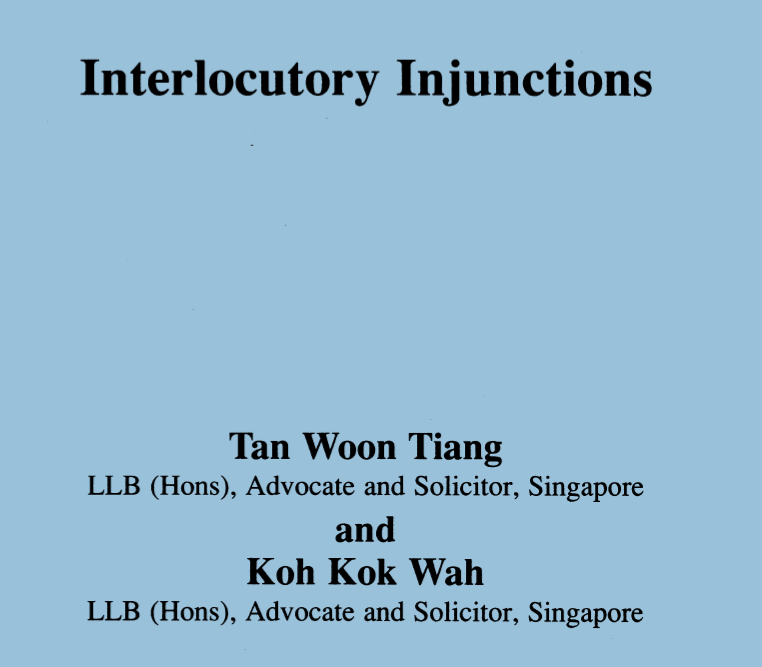
Interlocutory Injunctions by Tan Woon Tiang & Koh Kok Wah


Description
MarcelJude.ai review of Interlocutory Injunctions
This is not a grand abstract treatise on equity. It is a working lawyer’s book, and it knows that from the first page. The foreword and preface make its purpose unmistakable: interlocutory injunctions matter because they are urgent, often decisive, and frequently sought on short notice; the book is meant to give practitioners a compact but reliable guide to principles, procedure, local authority, and drafting. It also deliberately distinguishes itself by rooting the subject in Singapore and Malaysian practice while still drawing heavily on English authority, and by adding both a subject-indexed case digest and a precedents section for actual use in litigation.
That practical self-awareness is the key to reading the book properly. The authors are not trying to build a philosophical theory of injunctions. They are trying to answer a harder courtroom question: when a client turns up needing urgent interim protection, what exactly must counsel know, prove, file, draft, and anticipate? Once you read it that way, the whole architecture becomes very coherent. The book moves from foundations, to grant criteria, to practice, to special forms of injunction, to special subject areas, and then ends with case digests and precedents. It is a manual, but a very intelligent manual.
Chapter One: Introduction
This chapter does far more than define terms. It tells you what kind of legal animal an injunction is. The authors begin by stressing that an injunction is a judicial remedy commanding or forbidding conduct, but not every court order is an injunction. That sounds elementary, yet it is a very important starting point, because it keeps the reader from treating injunctions as just any command of the court. They are a specific equitable remedy with a distinct history and logic. The chapter then places injunctions in their proper lineage: they are a Chancery creation, designed to supplement the common law, so equitable principles are built into their structure, not added afterward as decoration.
The chapter’s treatment of classification is also better than it first appears. The authors acknowledge the usual distinction between interlocutory and final injunctions, but they do not stop there. They prefer classifying by the object of the order rather than merely its duration. That is a sharp choice. It means the essence of an interlocutory injunction lies in its function of preserving matters pending determination, even though the courts may, where appropriate, alter rather than simply preserve the status quo. This is a subtle but important point: the chapter is already warning the reader not to think mechanically about “status quo.” Interlocutory relief is protective, but sometimes protection requires temporary intervention, not passive freezing.
The second half of the chapter is jurisdictional, but again the discussion is more than a list of powers. It maps the legal source of authority for granting interlocutory injunctions in Singapore, identifies the broader “just and convenient” power of the High Court, notes the inherent jurisdiction to prevent injustice or abuse of process, and then turns to the subordinate courts, explaining both their position in Singapore and the absence of equivalent injunctive jurisdiction in Malaysian subordinate courts. That gives the reader an immediate sense that this book is not writing in an abstract Commonwealth vacuum: it is attentive to actual institutional structure. For a lecturer, that is one of the chapter’s major virtues. It teaches students that remedies live inside courts and statutes, not only inside doctrine.
My judgment on Chapter One is that it is concise but very well judged. It establishes three ideas that govern the rest of the book: injunctions are equitable, interlocutory relief is functionally distinctive, and jurisdiction matters at the threshold.
Chapter Two: Basic Requirements
This is the doctrinal centre of the whole book. If Chapter One tells you what an interlocutory injunction is, Chapter Two tells you when the court should grant one. The authors open with a strong and memorable premise: interlocutory relief exists because legal delay can destroy the fruits of litigation. That framing is excellent, because it reminds the reader that an interim injunction is not a side issue. It is the law’s answer to the problem that rights may be worthless if vindicated too late. The chapter then treats the remedy as discretionary but disciplined, explicitly rejecting any idea that equitable discretion means personal whim. The court’s discretion is structured by principle and precedent, and from there the authors turn to the great organising influence of American Cyanamid and its reception in Singapore and Malaysia.
The section on the serious question to be tried is one of the chapter’s strongest parts. The authors insist, correctly, that an injunction is a remedy and not a cause of action. That proposition has enormous importance. It means the applicant must first have a recognisable legal claim. Only then does the question of interim protection arise. They then explain the shift away from older formulae such as “strong prima facie case” and “probability of success” toward the American Cyanamid threshold. But they do not treat that shift as a slogan. They show that the serious-question standard is not emptiness; it still excludes claims that are frivolous, vexatious, misconceived, or structurally defective, including cases where proper parties are not before the court. In other words, the chapter teaches that Cyanamid lowered the merits threshold, but did not abolish legal seriousness.
The inadequacy of damages discussion is equally effective because it is treated symmetrically. The court must ask not only whether damages would adequately protect the claimant if relief is refused, but also whether the defendant would be adequately protected by the claimant’s undertaking if relief is wrongly granted. That two-sidedness is one of the deepest truths of injunction law, and the authors explain it well. They also give concrete illustrations of irreparable or hard-to-quantify harm: voting rights, business disruption, loss of credit and credibility, and situations where the defendant’s ability to satisfy a damages award is doubtful. The effect is to move the reader away from lazy thinking. “Damages” is not a magic answer; adequacy depends on the nature of the right and the practical realities of loss.
The balance of convenience discussion is perhaps the most mature part of the chapter. The authors note the criticism that “balance of convenience” is a misleading expression, because courts are really balancing justice and the risk of error. That is exactly right. The court is making a provisional choice under uncertainty. The question is which course carries the lower risk of serious injustice. From there, the book brings in the familiar factors: irreparable harm, alternative courses open to the defendant, and preservation of the status quo. What is especially good here is that “status quo” is not treated as a fetish. The authors recognise that it can be controversial, dynamic, and sometimes manipulable. That gives the treatment a welcome realism.
The chapter’s section on special cases is also very valuable. It explains that American Cyanamid is not a rigid algorithm. Where granting or refusing relief will effectively decide the action, where there is no real factual dispute, where proceedings themselves are said to be abusive, or where a public authority’s duties to the public are involved, the ordinary sequence of analysis may need adjustment. This is one of the places where the book becomes more than a student summary: it shows that interlocutory injunction law is flexible because it must respond to procedural reality, not because it is incoherent.
Finally, the discussion of the undertaking as to damages is excellent and central. The authors explain its rationale with clarity: because interim relief is granted before rights are finally established, the undertaking gives the court a mechanism to compensate a party wrongly enjoined. They also treat fortification sensibly, showing why the applicant’s means matter without collapsing the whole jurisdiction into a wealth test. That is exactly the right balance. The undertaking is both moral counterweight and procedural safeguard.
As a lecturer, I would say Chapter Two is the chapter one must master if one wants to understand the book. It captures the whole tension of interlocutory relief: urgency without finality, discretion without arbitrariness, and protection without pre-judgment.
Chapter Three: Practice and Procedure
This chapter is where doctrine turns into litigation craft. If Chapter Two answers “on what principles?”, Chapter Three answers “by what process?” The book’s practical identity is most visible here. The authors work through ex parte applications, inter partes hearings, originating process, affidavits, orders, costs, discharge, variation, suspension, and appeals. What is striking is that they never treat procedure as clerical routine. In injunction work, procedure is part of justice itself, because interim orders are often granted on incomplete evidence and sometimes without the other side being present.
The treatment of ex parte applications is particularly strong. The chapter insists that they are exceptional and belong to cases of urgency or genuine need for secrecy, such as Mareva or Anton Piller situations. Delay can be fatal; self-created urgency is unacceptable. That is an important lesson, especially for younger lawyers: urgency is not merely asserted, it must be earned by facts. The chapter then moves from doctrine to mechanics: the documents to be filed, the possibility of unsworn affidavits or telephone applications in true emergencies, the role of the duty registrar, and the defendant’s unusual but important position if he appears at an ex parte hearing. All this is very practical, yet it also reinforces procedural fairness. The absent side has no voice, so the applicant’s duty to the court becomes exceptionally demanding. That leads to one of the most important themes in the chapter: full and frank disclosure. The authors plainly regard this as fundamental. All material facts, including adverse ones, must be disclosed. The book also warns against evidential gamesmanship: an applicant should not rely on material in an ex parte setting that he is unwilling to reveal in the defendant’s presence. This is not just ethics; it is part of the legitimacy of the remedy. Ex parte relief without candour is intolerable because it weaponises the court’s trust.
The inter partes discussion is equally useful. Notice requirements, short service, response evidence, cross-applications to discharge or vary, and the admissibility of fresh affidavit evidence are handled clearly. The chapter shows how ex parte and inter partes stages connect: the ex parte order is not the end of the matter but the beginning of an urgent procedural sequence. That is a strong pedagogic point.
The sections on writs and affidavits are especially valuable because many books glide too quickly over them. Here the authors slow down and insist on form. The writ need not claim a final injunction merely to support an interim application, but if permanent relief is ultimately sought it must be pleaded. Affidavits must contain facts, not submissions; statements based on information and belief must disclose source and grounds; and failure to do so may be fatal, not just irregular. That is a very practitioner-minded warning. The book understands that in injunction litigation the affidavit is not background material; it is often the case itself in compressed form.
The section on the order itself is also excellent. It stresses return dates, undertakings, penal notices, service, and above all precision. The defendant and any affected third party must know exactly what is forbidden or required. That insistence on clarity runs through the whole work, but it becomes especially concrete here. The chapter knows that vague injunctions are dangerous: they are hard to obey, hard to enforce, and unfairly expose parties to contempt.
The later sections on costs, discharge, variation, suspension, and appeals round the chapter out well. Costs are treated as strategically significant. Discharge is tied to defects such as lack of urgency, non-disclosure, or absence of an underlying cause of action. Variation addresses overbreadth and change of circumstances. Suspension is acknowledged as exceptional. Appeals are handled with sensitivity to institutional hierarchy and the specific impropriety of treating an ex parte injunction as if it should go straight to appellate determination. The chapter ends by showing that injunction practice does not stop once an order is made; it immediately generates further remedial and procedural questions.
In short, Chapter Three is one of the book’s greatest strengths. It is the chapter that makes the book genuinely useful, not merely informative.
Chapter Four: Mandatory Injunction
This is a short chapter, but it is an important one because it deals with a form of interlocutory relief that courts traditionally approach with caution. The authors begin historically, noting the old practice of expressing mandatory relief in awkward negative form. They then show the move to direct language: if the court means “pull the wall down,” it should say so plainly. That is more than a stylistic point. It goes to the heart of mandatory relief, where the defendant must know exactly what positive act is required.
The chapter’s central insight is that mandatory interlocutory injunctions are generally more serious than prohibitory ones. They require action, expense, and sometimes irreversible change. Because they often alter rather than preserve the status quo, courts are slower to grant them. The authors emphasise this reluctance and tie it to the need for special circumstances, urgency, inadequacy of damages, and precision in the formulation of the order. They are especially good on the drafting point: if the court cannot define the obligation with workable exactness, relief may be refused regardless of sympathy on the merits. That is exactly right. A badly drawn mandatory order is not merely inelegant; it may be impossible to supervise or unfair to enforce.
The chapter is therefore less about multiplicity of doctrine than about judicial caution. It teaches that the more demanding the order, the more exacting the court becomes.
Chapter Five: Class Injunction
This is one of the most interesting chapters in the book because it deals with a problem ordinary procedure handles badly: what if the threat comes not from one named defendant but from a shifting body of anonymous or numerous persons? The authors explain that ordinary interlocutory procedure presupposes identifiable defendants. But in situations such as street-level piracy or counterfeit trading, that assumption can defeat justice. Chapter Five is the book’s answer to that problem.
The chapter traces the development of the class injunction through representative procedure rather than through any separate freestanding jurisdiction. That is a smart move doctrinally. The remedy is innovative, but the authors show that it grows out of existing procedural ideas rather than pure invention. They also bring in the “John Doe” practice from North America, which helps the reader see the broader remedial challenge without pretending the local solution is identical.
The procedural discussion is careful. The writ must make clear that the nominal defendant is sued in a representative capacity. The affidavit must establish some link and common interest among the members of the class, and explain why identifying all defendants individually is impracticable. The class must also be defined with real precision. This matters greatly. A class injunction that is too vague becomes a fantasy rather than a remedy.
The most impressive part of the chapter, however, is its honesty about enforcement difficulty. Serving a defined class is one thing; enforcing against individual wrongdoers is another. The plaintiff may need names, addresses, photographs, and other means of later identification if committal is to be realistic. The chapter recognises that an injunction against nameless defendants can easily become more symbolic than practical. Yet it does not dismiss the remedy. The deterrent force of a court order may itself matter, especially in mass or repeated infringement contexts. That balance between ingenuity and realism is one of the book’s better qualities. I would describe Chapter Five as a chapter about procedural adaptation. It shows equity stretching to meet modern wrongdoing without pretending that every practical difficulty has been solved.
Chapter Six: Mareva Injunction
This is one of the major chapters in the book, and rightly so. The Mareva injunction is presented as a dramatic but necessary departure from the older common law view that a creditor could not restrain a debtor from dealing with his property before judgment. The authors define the remedy in crisp terms: it is designed to stop a defendant from frustrating a future judgment by dissipating assets, but it gives the claimant no security interest or proprietary priority. That last point is crucial and the chapter handles it properly. A Mareva injunction is a protective restraint, not a shortcut to execution.
The chapter begins with jurisdiction, and this is where the book’s local value is strongest. It explains how Singapore and Malaysian courts grounded the Mareva remedy in their own statutory framework, rather than merely importing English practice by instinct. The authors clearly want the practitioner to know that this remedy is not floating free of legal source. That is good lawyering and good teaching.
The section on scope is also strong. Mareva relief is shown to be available not only before judgment but in aid of execution, even for costs, and not only where assets are about to leave the jurisdiction but also where they may be dissipated within it. The remedy also reaches defendants within the jurisdiction, and may support arbitration-related claims. But the authors are careful to keep the central warning in view: the jurisdiction must not be abused simply to obtain security. This chapter repeatedly resists the temptation to treat the Mareva injunction as an instrument of commercial pressure rather than necessity.
The procedure section reinforces the same caution. Because the fear is dissipation, applications are usually ex parte. The affidavit must identify reasonable grounds for believing the defendant has assets and that there is real risk of disposal. Full and frank disclosure is especially important because the remedy is draconian. The draft order must be precise and contain sensible provisos. Again, the book’s practical emphasis is one of its great strengths: it knows that a Mareva order can be lost or limited through sloppy preparation just as easily as through weak law.
The core doctrinal discussion is in what the plaintiff must show. Here the authors gather the case law into a usable formula: a substantive claim within jurisdiction, a good arguable case, assets within the jurisdiction, and a real risk of disposal or dissipation, all under the broader umbrella that it be just and convenient to grant relief. This is very well done. The chapter does not treat Mareva as mystical exceptionalism; it presents it as interlocutory injunction law with additional conditions driven by the particular mischief of asset dissipation.
The chapter’s treatment of ancillary orders and third parties is especially valuable. Discovery of assets, interrogatories, possible delivery-up, and even third-party disclosure are all shown as tools that may be needed if Mareva relief is to be effective. Equally, the chapter explains the role of banks and other third parties who, once on notice, risk contempt if they knowingly assist a breach. This makes clear that Mareva litigation is rarely just two-party litigation; it often radiates outward into the commercial environment surrounding the defendant.
Finally, the chapter deals with variation and discharge in a very practical way. Orders may be narrowed, assets released for living or business expenses, debts to bona fide third parties allowed to be paid, and set-off issues accommodated. Non-disclosure, failure to pursue the main action, and breach of undertakings may all justify discharge. In other words, the chapter understands Mareva as a living interlocutory order that must often be adjusted after its dramatic birth.
This is one of the best chapters in the book. It combines doctrinal clarity, procedural realism, and commercial awareness.
Chapter Seven: Anton Piller Order
If the Mareva injunction is the chapter on asset preservation, this is the chapter on evidence preservation. The authors explain the Anton Piller order as an ex parte mandatory order allowing entry to premises for inspection and removal of documents or things relevant to litigation. They are careful to say what it is for: preventing destruction or concealment of evidence. They are equally careful to say what it is not: it is not a criminal search warrant, even though it is often described as resembling one. That distinction matters very much in both law and tone.
The chapter’s opening strength is its candour about harshness. This is a severe remedy, originally developed in intellectual property piracy and counterfeiting cases, but not confined to them. By putting that warning up front, the authors stop the reader from romanticising the order. It exists because ordinary notice can defeat justice, but its intrusiveness means the court must keep very close control. The procedure section is excellent. The application is almost always ex parte. The affidavit must establish the preconditions with great care. Full and frank disclosure is described in especially strict terms. The order must identify the premises and material with precision and must be framed as an obligation on the defendant to permit entry, not as a public-law authorisation to force entry. That is a crucial distinction and the chapter handles it well. It also attends to the often-overlooked detail that the defendant should be informed of rights, including legal advice, and that execution should be supervised by the plaintiff’s solicitors. These are not minor refinements; they are the safeguards that keep the remedy lawful rather than abusive.
The chapter’s doctrinal core is the fourfold test: extremely strong prima facie case, very serious damage, possession of incriminating material, and real risk of destruction before an inter partes hearing can be held. This is significantly more demanding than ordinary American Cyanamid analysis, and the authors explain why. The order is invasive, compulsory, and often sudden. That is why the threshold is higher. The discussion is properly functional: the strength of the case matters more here because the cost of being wrong is greater.
The execution section is one of the best in the whole book. It emphasises that even when an order is granted, neither claimant nor solicitor may behave like a raiding party. No forcible entry. No improvisation outside the terms of the order. No contemptuous disregard of the defendant’s rights. That focus on controlled execution is one of the marks of a serious remedies book.
The sections on privilege against self-incrimination and use of evidence obtained add real depth. The authors explain that the order’s information-gathering power collides with the privilege in difficult ways, and they also handle the implied undertaking governing discovered material. Most usefully, they show why Anton Piller material can sometimes be used to identify and pursue related third-party wrongdoers. That is a practical insight of real litigation importance.
As a lecturer, I would say Chapter Seven is the book at its most vivid: it teaches not only law, but judicial temperament. Powerful relief requires disciplined supervision.
Chapter Eight: Injunction in Particular Areas
This chapter is valuable because it shows that interlocutory injunction law is not merely one body of doctrine applied uniformly everywhere. Different fields place different weights on different values. The chapter begins with intellectual property, and that makes perfect sense, because the book itself earlier noted how central urgent relief is in the electronic age and in piracy or counterfeiting contexts. The authors explain that the usual interlocutory principles generally apply, but may take on a sharper commercial edge because of goodwill, confusion, market entry, and evidential concealment.
In passing-off and trademark cases, the discussion turns on the relation between special commercial sensitivity and the general American Cyanamid framework. The authors’ approach is sensible: even if some judges speak as though passing-off is different, the better view is that the ordinary principles apply, though the strength of the claimant’s case may weigh especially heavily where interlocutory relief is close to final relief. That is a mature synthesis rather than a mechanical repetition of authority.
In copyright, the chapter shows that the general interim principles apply, but that certain defences, especially fair dealing, may make interim restraint inappropriate. The Malaysian case discussion is especially useful because it shows how copyright injunction practice intersects with statutory arguments and equitable clean-hands objections without collapsing into them.
In patents, the chapter rightly returns to American Cyanamid’s own factual origin. This allows the authors to make a larger point: in patent cases, damages are often hard to treat as adequate because market entry, goodwill, research investment, and “head-start” effects can alter the competitive landscape in ways money may not cleanly repair. That is a strong practical insight and one of the chapter’s better analytical moments.
The employment section is concise but sharp. The authors emphasise the refusal of courts to use injunctions as indirect specific performance of contracts of employment, especially where trust and confidence have broken down. Yet they also explain the enforceability of negative covenants and restraints on misuse of genuine trade secrets. That is exactly the right balance. The chapter does not confuse protection of confidential business interests with forced continuation of personal service relationships.
The defamation section is, in my view, especially strong. The authors present the classic judicial reluctance to restrain allegedly defamatory publication before trial with proper seriousness.
Freedom of speech, truth, fair comment, and privilege all weigh against premature restraint. The chapter makes clear that libel injunctions are exceptional because granting them too readily means deciding the substance before the trial has really happened. This is one of the best parts of the chapter because it captures how interlocutory law changes when it enters the territory of speech and public interest.
The final section on confidential information is also well handled. The authors reduce the subject to a workable set of requirements: confidentiality, duty, breach or threatened breach, and the claimant’s standing. But they do not oversimplify. Prior publication, the claimant’s own publicity-seeking conduct, and the possibility of further publication after partial publication are all shown to matter. That is an appropriately nuanced ending to the substantive chapters.
Chapter Eight is therefore the book’s demonstration chapter. It shows the reader how one body of interim remedial law adapts itself to different substantive contexts without losing its basic form. The cases digest and the precedents
These are not ornaments. They are part of the book’s identity. The cases section is arranged by subject and gives short statements of what individual cases decided. That turns the book into a rapid-reference tool as well as a teaching text. A busy lawyer can move from “balance of convenience” or “full relief” or “form of order” to an immediate cluster of authorities and propositions. This is extremely useful and entirely consistent with the book’s self-description as a practical guide.
The precedents section is equally important. It contains forms for ex parte summonses, interlocutory orders, inter partes notices, mandatory injunctions, class injunctions, Anton Piller affidavits and orders, explanatory letters, and Mareva affidavits and orders. This tells you something profound about the authors’ conception of legal knowledge: to know injunction law is not only to know tests and cases, but to know how an application is physically put before the court. That is one of the book’s greatest strengths.
Overall assessment
The best way to describe this book is as a disciplined practitioner’s handbook with real doctrinal intelligence. Its chief strength lies in the way it joins legal principle to procedural method. It does not pretend that interlocutory injunctions can be understood only through abstract theory, nor does it collapse the subject into forms and filing habits. Instead, it shows the reader that interim injunction law is a field where principle and procedure are inseparable.
Its biggest achievement is probably Chapter Two and Chapter Three taken together. Those chapters teach that the law of interlocutory injunctions is built around a basic tension: the court must act quickly enough to prevent litigation from becoming futile, but carefully enough to avoid inflicting provisional injustice. Everything else in the book grows from that tension. Mandatory injunctions, class injunctions, Mareva orders, Anton Piller orders, and injunctions in defamation or employment all appear as different answers to the same structural problem.
Its other major strength is local grounding. By weaving Singaporean and Malaysian authority together with English case law, the authors avoid producing either a purely English transplant or a thin local digest. They create something better: a regional working text with comparative awareness.
The book’s limitation is also clear, and it is not really a defect so much as a choice. Because it is written as a compact guide for practitioners, it does not dwell for long on broader jurisprudential questions about equity, rights theory, or comparative remedies. Someone looking for a philosophical study of injunctions will not find that here. Someone looking for a lawyer’s map of interlocutory injunctive relief absolutely will.
My final judgment is simple. This is a very good book on exactly the subject it set out to cover. It teaches that interlocutory injunctions are powerful because they are provisional, dangerous because they are coercive, and useful only when courts insist on seriousness of claim, inadequacy of ordinary relief, careful procedural fairness, full disclosure, and precise drafting. It is a book written by people who understand that in injunction work, haste without structure is abuse, but structure without urgency is useless. That is why it still reads like a serious lawyer’s book rather than a mere handbook.
- MALAYSIA'S 1ST AI LAWYER - CLICK HERE
- ISMAIL – INTEGRATED SINGAPORE/MALAYSIA AI & LAW (Library)
- OPENING OF SINGAPORE MALAYSIA AI CENTRE AND LAW LIBRARY
- LIFT - LAW INSTRUMENTS FORMS & TEMPLATES
- LAWS OF MALAYSIA FOR SINGAPOREAN DUMMIES
- HANNAH YEOH'S ARTIFICIAL INTELLIGENCE LAW ENCYCLOPEDIA
- LEAD CR - Law Ecosystem Archive Databases on CD-ROM
- BREAKING NEWS FROM MJN
- CLICK HERE CO. PROFILE
- EXCITING NEW SERIES - THE ADVENTURES OF BOBBY TAN -ADVOCATE & SOLICITOR IN THE HIGH COURT OF NORTH BORNEO by marceljude.ai
- MEDICO LEGAL - BY PRISKILA AKWILA & GLORIOUS PETAL SDN BHD - powered by marceljude.ai
- MISCELLANOUS
- ANNOTATED STATUTES OF SABAH - A NEW SERIES
- e-library - marceljude.ai
- DRAFT - DOCUMENT RESEARCH & AUTOMATED FILING TECHNOLOGY
- CLARA – Case Law Analysis & Retrieval AI
- FOR RESEARCH REQUEST CLICK HERE
- CLICK HERE TO ASK ANYTHING
- RAMBO'S LAW - THE LAW OF THE LAW JUNGLE - EXCITING NEW SERIES - CASE ANALYSIS BY JOHN RAMBO @ +60138646786
- PRISKILA AKWILA ADVOCATES - High Court of Sabah & Sarawak @ Kota Kinabalu
- COLA - COMMONWEALTH ONLINE LAWCASES AI -marceljude.ai
- THE LAW LIBRARY THAT COMES TO YOU ANYWHERE AND ANYTIME
- marceljude.ai training academy
