
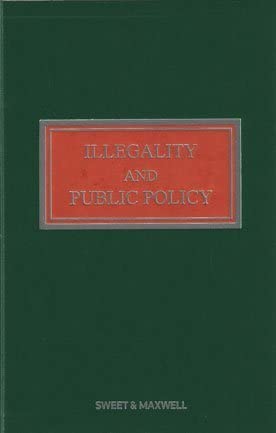
ILLEGALITY AND PUBLIC POLICY By R. A. Buckley


Description
THE CONTRACT LAW LIBRARY
ILLEGALITY AND PUBLIC POLICY
By R. A. Buckley MA., D.Phil., of Lincoln's Inn, Barrister, Professor of Law in The University of Reading
Review by marceljude.ai
This review is based on R. A. Buckley’s Illegality and Public Policy, a doctrinal study of illegality and public policy in contract law.
Overall Academic Assessment
This is a serious, dense, and highly analytical contract-law monograph. It is not merely a catalogue of cases. Its deeper project is to expose the instability of the illegality doctrine: courts often say they are applying rules, but in practice they are balancing blameworthiness, public harm, deterrence, proportionality, and fairness. Buckley’s central strength is his insistence that the law of illegality cannot be reduced to slogans such as “no one may benefit from a wrong” or “no action arises from an illegal act.” Those maxims sound authoritative, but the book shows that they often conceal the real question: whether refusing relief actually serves the public interest in the circumstances.
The book is divided into five broad parts: contravening the law, public policy, restraint of trade, relief from illegality’s consequences, and reform. Buckley expressly frames the work around the distinction between statutory illegality and common-law illegality, the need to distinguish the agreement itself from surrounding unlawful conduct, the special doctrine of restraint of trade, and the availability of relief such as restitution, severance, or statutory discretion.
As a law professor, I would describe the book as an anatomy of a troubled doctrine. It is excellent on taxonomy. It separates concepts that courts too often blur: illegality in formation, illegality in performance, statutory prohibition, participation, mere knowledge, fraud, corruption, public morality, restraint of trade, proprietary consequences, restitution, repentance, and reform. Its principal intellectual contribution is that it treats illegality not as a single rule but as a family of policy problems.
The book’s recurring criticism is that English law has historically tried to solve these problems through technical categories rather than open judicial reasoning. Buckley repeatedly argues that the courts should confront policy directly, especially where the blunt denial of contractual relief produces arbitrary windfalls or disproportionate penalties.
Introduction
The Introduction establishes the book’s central jurisprudential problem: illegality is exceptional within contract law because it is not primarily concerned with enforcing the parties’ bargain. Ordinary contract law asks what the parties promised, whether they breached, and what remedy follows. Illegality asks a different question: whether the court should withhold its ordinary assistance because enforcing the contract would harm society, undermine the law, or compromise public policy.
Buckley begins by emphasizing complexity. The law of illegality is obscure because it sits at the intersection of private law and public law. It uses contract remedies to pursue public goals. That is inherently awkward. Refusing enforcement may punish one party far more severely than the criminal law would have done, while giving the other party a windfall. The Introduction therefore identifies illegality as a “blunt instrument”: useful in grave cases, dangerous in marginal ones.
The Introduction also anticipates the book’s reformist thesis. Buckley is not content to describe the law. He wants to show that the law’s rigidity and unpredictability call for a more principled, discretionary system. This sets up the final chapters, where statutory reform and judicial discretion become the natural endpoint of the analysis.
A particularly important introductory theme is proportionality. Buckley argues that illegality rules must avoid arbitrary and excessive outcomes. A trivial regulatory breach should not automatically destroy valuable contractual rights unless that consequence is justified by the statute’s purpose or by a genuine public-policy need. This proportionality theme runs through the whole book.
Part One: Contravening the Law
Chapter 1 — Crime, Tort and Statutory Illegality
Chapter 1 opens the substantive analysis by distinguishing contracts that involve criminal or tortious conduct from contracts affected by statutory prohibition. This distinction is fundamental. A contract to commit a serious wrong will plainly not be enforced. But many cases are harder: a contract may be lawful in its main purpose but involve some regulatory breach, minor offence, or unlawful method of performance. Buckley’s key move is to resist the lazy label “illegal contract.” He argues that not every contract touched by illegality should be treated as wholly void or unenforceable by both parties. The real questions are more precise. What law was contravened? Was the contravention central or incidental? Did the claimant know? Did the claimant participate? Was the statute aimed at invalidating the contract or merely penalising conduct?
The chapter’s treatment of statutory illegality is especially important. Buckley distinguishes express statutory prohibition, implied statutory prohibition, and common-law illegality arising in a statutory setting. This matters because courts have often assumed that if a statute is involved, the statute itself must determine contractual unenforceability. Buckley rejects that simplification. A statute may impose a penalty without intending to invalidate contracts. Conversely, common-law public policy may sometimes refuse enforcement even where the statute is silent.
The chapter’s deeper value lies in its insistence on seriousness. Buckley shows that some judicial reasoning becomes absurd if every unlawful act, however minor, automatically bars contractual recovery. The law must be able to distinguish deliberate serious wrongdoing from technical or incidental illegality. In that respect, Chapter 1 lays down the book’s governing intellectual discipline: categorise carefully before moralising.
Chapter 2 — Implied Prohibition of Contracts
Chapter 2 develops the doctrine of implied statutory prohibition. This is one of the most technical but important chapters in the book. The problem arises when a statute penalises certain conduct but does not expressly state whether contracts made in breach of the statute are unenforceable.
Buckley’s analysis is careful and practical. Courts must ask whether the statute is directed at contracts themselves or merely at conduct that may happen to occur in a contractual setting. A statute requiring a licence, for example, may have different contractual consequences depending on whether its purpose is consumer protection, public safety, revenue collection, professional regulation, or market control.
The chapter criticises mechanical reasoning. Buckley is wary of decisions that infer contractual invalidity simply because a statutory requirement was breached. He argues that courts should look at the purpose of the statute, the gravity of the penalty, the class of persons protected, and whether invalidating the contract would advance or defeat the legislative policy.
The chapter also handles conditional agreements. Parties may contract on the assumption that a licence or regulatory approval will be obtained before performance. Buckley treats this as different from contracting to break the law. This distinction is important in commercial life, where contracts often precede final regulatory approval.
One of the chapter’s strongest insights is that contractual illegality must not become a hidden extra penalty. If Parliament imposes a small fine for non-compliance, courts should be cautious before adding the much harsher consequence of total contractual forfeiture. This is one of the clearest examples of Buckley’s proportionality-based thinking.
Chapter 3 — Unlawful Performance
Chapter 3 examines contracts that are lawful in formation but are performed unlawfully. This is a difficult area because the illegality does not necessarily infect the bargain at the outset. The question is whether unlawful performance later disables one or both parties from enforcing rights under the contract.
Buckley separates several ideas that courts sometimes confuse. A party may intend unlawful performance through ignorance. A party may perform unlawfully without intending to. A contract may become impossible to perform lawfully. Or a party may deliberately choose an unlawful method of performance to save money or gain advantage.
The chapter’s central lesson is that unlawful performance should not automatically destroy contractual rights. The court must ask who was responsible, whether the illegality was deliberate, whether the claimant participated, and whether denying enforcement would serve the relevant policy. A guilty party may be barred; an innocent party should not normally lose rights merely because the other party performed unlawfully.
Buckley is especially critical of cases where illegality is confused with mistake or failure of consideration. Sometimes the true problem is not that the contract is morally or legally tainted, but that the parties misunderstood the law or the factual circumstances. In those cases, doctrines such as mistake, frustration, or failure of consideration may be more appropriate than illegality.
This chapter is valuable because it resists all-or-nothing thinking. A contract is not a physical object that becomes contaminated once unlawful performance occurs. Rights and remedies must be analysed party by party and obligation by obligation.
Chapter 4 — Knowledge and Participation
Chapter 4 is one of the book’s most sophisticated chapters. It asks when a claimant who did not originate the unlawful scheme nevertheless becomes sufficiently implicated to lose contractual relief.
Buckley draws the crucial distinction between mere knowledge and participation. Mere awareness that the other party has an unlawful purpose should not always bar recovery. Participation is different. A claimant participates where he assists, profits from, facilitates, or structures the transaction in a way that advances the unlawful purpose.
The chapter explores several forms of participation. A claimant may participate by saving money through another party’s unlawful performance. He may provide documentation or physical assistance that facilitates illegality. He may enter into a related transaction designed to support the illegal scheme. Or he may knowingly help the other party evade a legal obligation.
Buckley’s position is nuanced. He does not say knowledge is always irrelevant. If the other party’s scheme is especially grave, mere knowledge may become enough because proceeding with the contract would itself be intolerable. But in ordinary commercial cases, he argues that knowledge alone is too blunt a test. The chapter also discusses contracts unlawful from the outset because of facts known to one party but not the other. Buckley’s approach is protective of innocent parties. If one party knows performance is unlawful and the other does not, the innocent party should not automatically be deprived of relief. Again, the book refuses to treat “the contract” as uniformly illegal for all purposes.
The distinction between promises and warranties also becomes important. Not every contractual term requires performance. Some terms merely state a fact. Buckley uses this distinction to show why illegality analysis must be precise at the level of contractual obligation.
Chapter 5 — Indemnity and Forfeiture
Chapter 5 shifts from ordinary enforcement to indemnity, insurance, criminal penalties, civil damages, succession, and forfeiture. The connecting theme is whether a person should be allowed to avoid the legal consequences of his own wrongdoing.
Buckley begins with recovery of criminal penalties. The general position is that a person should not recover a criminal fine from someone else because doing so would undermine the punitive purpose of the criminal law. Yet Buckley shows that hard cases arise where the claimant was not morally at fault and was penalised under strict liability. The chapter therefore examines whether civil recovery may sometimes be justified where the claimant’s liability was technical or innocent.
The discussion of civil damages is more flexible. A person liable in damages may sometimes recover under an indemnity or insurance policy, especially where refusing recovery would leave the original victim uncompensated. Buckley is attentive to the interests of third-party victims. He questions whether denying indemnity always serves public policy, especially where deterrence is speculative and the practical result is non-compensation.
The chapter also examines life insurance and succession in cases involving self-inflicted death or unlawful killing, but its analysis remains legal rather than sensational. The doctrinal point is whether public policy should prevent an estate, assignee, beneficiary, or wrongdoer from receiving a benefit. Buckley treats the familiar “no benefit from crime” formula with suspicion. It may be useful in some succession cases, but in contract law it is often too vague to do serious analytical work.
This chapter is a strong example of Buckley’s larger method. He does not reject public policy. He rejects slogans masquerading as reasoning. The law must ask what purpose forfeiture serves, who is harmed, who benefits, and whether the outcome is proportionate.
Part Two: Public Policy
Chapter 6 — Policy and Morality
Chapter 6 directly addresses public policy as a judicial doctrine. It asks how courts can legitimately refuse enforcement on grounds of morality, public welfare, or institutional integrity.
Buckley begins from the classic anxiety: public policy can be an “unruly” concept. Judges must be cautious because they are not legislators. Yet courts cannot avoid public policy altogether. Contract law has long refused enforcement to certain bargains, not because of defects in consent, but because enforcement would be socially unacceptable.
The chapter distinguishes between public policy as a fixed rule and public policy as a flexible standard. Some doctrines harden into relatively settled rules; others remain open to reassessment as society changes. Buckley is especially interested in whether courts can update public policy without pretending that nothing has changed.
The chapter’s treatment of marriage and sexual morality shows the difficulty. Older cases often reflected moral assumptions that modern courts may no longer share. Buckley presents the judiciary as increasingly reluctant to impose private moral judgment without evidence of a real public consensus or public harm. The discussion of sexual morality is not merely about social attitudes; it is about the legitimacy of judicial lawmaking.
The best part of the chapter is its insistence that public policy must be historically conscious. A doctrine that once served a real social purpose may become obsolete. Maintenance and champerty later become Buckley’s major example of such transformation.
Chapter 7 — Fraud and Corruption
Chapter 7 deals with contracts affected by fraud, corruption, tax evasion, deceptive documentation, improper influence, and confidentiality agreements. It is one of the book’s most practically important chapters.
Buckley begins with fraudulent contracts in the strict sense: agreements whose purpose is to deceive third parties or public authorities. Such agreements are obvious candidates for unenforceability. But the hard cases are those where the main transaction is legitimate and the fraud is collateral, subordinate, or documentary.
The chapter’s discussion of revenue fraud is especially nuanced. Tax evasion cases often tempt courts into harsh outcomes because public revenue is involved. Buckley does not deny the seriousness of tax evasion, but he resists automatic forfeiture. He considers degrees of blameworthiness, the parties’ relative culpability, and whether the unlawful feature is central or incidental.
Corrupt bargains receive separate treatment. Contracts to buy influence, honours, official favour, or improper access undermine public institutions. Here public policy has a powerful role because the corruption is not merely private wrongdoing; it attacks the integrity of decision-making systems.
The chapter’s discussion of confidentiality agreements is particularly modern in spirit. Confidentiality may be legitimate, but agreements to suppress criminality, conceal wrongdoing, or prevent disclosure of matters of public interest raise distinct problems. Buckley’s treatment anticipates the tension between private settlement and public transparency. The chapter therefore connects fraud doctrine to wider concerns about accountability.
Chapter 8 — Compromising the Legal Process
Chapter 8 examines contracts that interfere with the legal process, especially agreements to stifle prosecutions. The central policy is the integrity of criminal justice. Private parties must not bargain away the public interest in prosecution.
Buckley distinguishes legitimate compromise from unlawful suppression. Civil disputes can be settled. Even some matters involving potential criminal conduct may have civil aspects that are properly compromised. But a bargain whose true object is to prevent prosecution or conceal an offence can be illegal.
The chapter carefully considers offences of different gravity. This is important because older law drew distinctions between public and private offences, felonies and misdemeanours, and various categories of prosecutorial seriousness. Buckley’s underlying concern is that the law should not collapse all settlements into suspicion. The relevant question is whether the agreement compromises public justice.
The discussion of existing liabilities is valuable. A person may owe a genuine civil debt even where criminal proceedings are possible. A settlement of that debt is not necessarily illegal. But if the payment is extracted or made as the price of suppressing prosecution, illegality may arise.
Buckley also examines duress. Agreements made under pressure connected to threatened prosecution sit at the border of illegality and duress. The chapter’s strength lies in showing that the same facts may raise different doctrinal concerns: public justice, coercion, unjust enrichment, and restitution.
Chapter 9 — Maintenance and Champerty
Chapter 9 is one of the book’s best illustrations of changing public policy. Maintenance and champerty historically condemned third-party support for litigation, especially where the supporter had no legitimate interest or took a share of the proceeds. Buckley explains that the doctrine arose from fears about abuse of litigation, influence, and corruption of justice.
The modern picture is different. Litigation funding, trade-union support, insurance-backed defence, legal aid, and conditional fee arrangements changed the social meaning of third-party support. Buckley notes that modern legal systems may view support for litigation not as a threat but as a means of access to justice. The book’s discussion recognises that champerty is no longer automatically condemned in the same moral atmosphere as before.
The chapter distinguishes maintenance from champerty, lawful support from unlawful trafficking, and genuine commercial interest from bare speculation in lawsuits. It also examines assignment of choses in action, where the law must distinguish legitimate commercial assignment from the sale of naked litigation. The legal-profession section is especially important. Lawyers’ funding arrangements raise special concerns because lawyers owe duties to the court and client. Buckley recognises the modern need for flexible funding but also the continuing need to guard against conflicts, inflated claims, and improper control of litigation.
The chapter’s broader contribution is methodological. It shows that public policy is not frozen. A rule born in one social world may become irrational in another. The law should adapt openly rather than preserve obsolete distinctions through technical language.
Chapter 10 — Peace and War
Chapter 10 takes public policy into international territory. It examines contracts with foreign elements, international comity, foreign illegality, and trading with the enemy.
The first part concerns contracts governed by English law but performed abroad. Buckley explains that English courts may refuse enforcement where performance would violate the law of a friendly foreign state. The policy is comity: courts should not encourage parties to break another country’s law.
The second part concerns contracts governed by foreign law but litigated in England. Here the question is whether English public policy should override the otherwise applicable foreign law. Buckley treats this as a conflict-of-laws problem, not merely an illegality problem.
The chapter then turns to wartime doctrine: trading with the enemy. This is a dramatic context in which private contractual obligations collide with national public policy. Buckley uses these cases not simply for their historical interest but because they reveal how courts reason when the public interest is overwhelming.
The chapter’s deeper point is that international public policy demands both principle and caution. Courts must respect foreign legal systems, protect domestic public policy, and avoid casually converting every foreign regulatory breach into a domestic defence.
Part Three: Restraint of Trade
Chapter 11 — Nature of the Doctrine
Chapter 11 begins the book’s major treatment of restraint of trade. This doctrine is special because courts openly review the reasonableness of certain contractual restrictions. Unlike ordinary contract law, which usually enforces bargains, restraint of trade law asks whether a restriction is justified in the interests of the parties and the public.
Buckley traces the doctrine’s origins and shows its continuing importance. A restraint is presumptively suspect unless justified. The classic justification is protection of a legitimate interest: goodwill, trade secrets, confidential information, customer connections, or similar interests. A bare covenant not to compete is usually objectionable.
The chapter explains the dual test: reasonableness between the parties and reasonableness in the public interest. Buckley resists collapsing those two limbs into one. The parties’ interests matter, but so does the public interest in competition, labour mobility, and economic freedom.
The chapter also considers sanctions and benefits. A restraint may take the form of an injunction, a liquidated damages clause, loss of benefits, or conditional entitlement. Buckley shows that substance matters more than form: a clause can restrain trade even if drafted as a condition rather than a prohibition. The discussion of continuing relationships is subtle. Not every exclusive service contract is a restraint of trade. But long-term arrangements that sterilise a person’s ability to work or trade may fall within the doctrine. Buckley recognises the difficulty of drawing the line.
Finally, the chapter situates common-law restraint of trade alongside statutory competition law. This is important because modern competition statutes address some of the same concerns, but not always in the same way. Chapter 11 therefore frames restraint of trade as both ancient and modern: a doctrine with old roots but continuing commercial relevance.
Chapter 12 — Frontiers of Protection
Chapter 12 asks what interests a restraint may legitimately protect. It focuses on confidentiality, secrecy, trade secrets, public interest, vendor-purchaser covenants, and exclusive supply contracts.
The chapter’s first distinction is between an employee’s own skill and experience and the employer’s protectable confidential information. Buckley explains that employees cannot be prevented from using their general skill, knowledge, and experience. That belongs to them. But trade secrets and genuinely confidential information may be protected.
This distinction is foundational in employment law. Employers often frame ordinary experience as confidential know-how. Buckley’s analysis warns against that overreach. The law protects legitimate interests; it does not allow employers to suppress competition merely because competition is inconvenient. The chapter also discusses the relationship between restrictive covenants and breach of confidence. A covenant may extend or clarify obligations, but the equitable doctrine of confidence may operate even without express covenant. Buckley treats this as an overlapping but distinct protective regime.
The public-interest section examines whether a restraint reasonable between the parties may still be invalid because of wider social harm. Buckley argues that public interest should remain a real limb of the test, not merely decorative language.
Vendor-purchaser covenants receive more favourable treatment than employment covenants because the buyer of a business is purchasing goodwill. A seller who immediately competes may destroy what he sold. But even here, the restriction must be tied to the business sold and no wider than necessary.
Exclusive supply contracts create special difficulty. They may restrict trade but also serve legitimate commercial planning. Buckley’s analysis resists simplistic condemnation, especially where the restraint is part of a broader commercial structure.
Chapter 13 — Construction and Scope of Covenants
Chapter 13 deals with interpretation. How should courts read restrictive covenants? Literally, contextually, strictly, or commercially?
Buckley identifies a tension. Modern contract law generally favours contextual interpretation. But restraint of trade cases have historically used strict construction to discourage employers from drafting excessively wide covenants. The law does not want employers to write broad restrictions and rely on litigation pressure to secure practical compliance.
The chapter examines area covenants, duration, and statutory modification in other jurisdictions. Area covenants can be especially problematic because they restrain activity across geographic space. Their validity depends on the nature of the business, the employee’s role, the customer base, and the legitimate interest needing protection.
Duration is equally important. A restraint lasting months may be reasonable; one lasting years may be oppressive unless justified by special circumstances. Buckley notes that commercial conditions change quickly, especially in employment contexts. Courts must be realistic about how long confidential information or customer influence remains valuable.
The chapter’s discussion of “imaginary breaches” is particularly useful. Older courts sometimes invalidated covenants because they could imagine unreasonable applications, even if the actual conduct complained of was plainly within a reasonable core. Buckley shows that modern approaches have moved away from excessive artificiality.
New Zealand and New South Wales statutory approaches are used as comparative examples. These jurisdictions permit modification or reading down in ways that soften the harshness of the old common-law blue-pencil rule. Buckley treats these reforms as evidence that rigid invalidation is not the only possible model.
Chapter 14 — Customers, Rivals and the Professions
Chapter 14 applies restraint doctrine to customer solicitation, rival employers, poaching, medical practitioners, and solicitors.
Non-solicitation covenants are generally more acceptable than broad non-compete clauses because they target a specific legitimate interest: customer connection. But they still require justification. A covenant that covers too many customers, future customers, or persons with whom the employee had no dealings may be too wide.
Covenants against joining rivals are more severe. They prevent employment itself, not merely solicitation. Buckley treats them with caution because they can operate as broad suppression of labour mobility. The employer must show a strong legitimate interest, such as protection of confidential information.
Poaching covenants, which restrict a former employee from recruiting colleagues, are treated as another kind of legitimate-interest claim. Employers may have an interest in workforce stability, but the restraint must be proportionate.
The professional sections are especially interesting. Medical and legal practices rely heavily on personal relationships, trust, and goodwill. A covenant restraining a doctor or solicitor may protect the goodwill of a practice, but it may also limit patient or client choice. Buckley’s analysis balances business protection against professional autonomy and public access to professional services.
The chapter’s value lies in showing that reasonableness is context-specific. A covenant acceptable in the sale of a professional practice may be unacceptable in an ordinary employment contract. The doctrine cannot be applied by formula.
Chapter 15 — Oppression, Repudiation and Interim Injunctions
Chapter 15 examines three situations in which a claimant seeking to enforce a restraint may be denied relief: oppression, repudiation, and interim injunction problems.
The oppression discussion addresses contracts that restrain activity during a continuing relationship, not merely after termination. Buckley is cautious about expanding restraint of trade into a general fairness jurisdiction over all service contracts. Yet he recognises that some exclusive arrangements may become so one-sided or sterilising that judicial intervention is justified.
Repudiation raises another issue: can an employer who has wrongfully repudiated the employment contract still enforce a restrictive covenant contained in it? Buckley examines the tension between contractual doctrine and restraint policy. If an employer has destroyed the employment relationship, it may be unjust to allow that employer to preserve post-termination restraints for its own benefit.
The interim injunction section is highly practical. Many restraint cases are effectively decided at the interim stage. If a court grants an interim injunction preventing a former employee from working, the employee may suffer the full practical burden of the covenant before trial. Buckley is alert to this procedural reality. Interim relief can coerce settlement and prevent a proper merits hearing.
This chapter therefore connects substantive contract doctrine with civil procedure. The form of remedy matters. A restraint may look contestable in theory but become decisive in practice once an interim injunction is granted.
Part Four: Relief from the Consequences
Chapter 16 — The Enforceability of Proprietary Interests
Chapter 16 considers whether property rights can pass under an illegal transaction. This is one of the most intellectually difficult parts of illegality law because contract and property do not always move together. At common law, property may pass even though the underlying contract is illegal. This creates difficult consequences. A party may be unable to sue on the contract but may still hold property transferred under it. Buckley shows that this can produce arbitrary outcomes, especially where the distinction between personal and proprietary rights becomes decisive.
The chapter examines the “no-reliance” doctrine, especially in common law and equity. A claimant may sometimes succeed if he can establish his property claim without relying on the illegal transaction. Buckley is critical of this doctrine because it can make outcomes depend on pleading technique rather than moral culpability or policy.
Equity complicates the matter further. Resulting trusts, presumptions of advancement, and equitable title may allow recovery or deny it depending on whether the claimant must rely on illegality. Buckley treats these rules as conceptually fragile.
The chapter’s conclusion is reformist. Buckley regards the existing property position as unsatisfactory because it protects proprietary transfers in ways that may be out of step with the policy that made the contract unenforceable. Yet he is also aware that property law requires certainty. This tension sets up the later discussion of statutory reform.
Chapter 17 — Illegality and Restitution
Chapter 17 explores whether a party to an illegal transaction may recover money, property, or value transferred under it. This is central to the book’s concern with avoiding disproportionate forfeiture. The traditional rule is that restitution is often denied where the claimant must rely on an illegal transaction. But Buckley shows that the law contains exceptions: mistake, failure of consideration, oppression, protected classes, and sometimes withdrawal from the transaction.
The chapter’s most important theme is that restitution is not the same as enforcement. Enforcing an illegal contract gives effect to the bargain. Restitution may merely reverse unjust enrichment. That distinction matters. A court may refuse to enforce an unlawful fee-sharing agreement but still award reasonable value for services where denying all recovery would unjustly enrich the defendant and would not further the statutory policy.
Buckley discusses the expanding role of restitution and welcomes greater willingness to examine culpability. The uploaded text specifically notes a modern development allowing a quantum meruit claim to proceed despite the underlying agreement’s illegality, signalling a broader restitutionary approach.
The chapter also examines fraud and negligence. An innocent party deceived into an illegal transaction may sometimes recover through tort or restitution. Buckley’s view is again policy-sensitive: the law should not allow illegality doctrine to become a shield for fraud.
This chapter is one of the book’s strongest because it shows how restitution can soften illegality’s harshness without collapsing into full enforcement.
Chapter 18 — Repentance and Protection
Chapter 18 considers the doctrine of locus poenitentiae: the opportunity to withdraw from an illegal transaction and recover what has been transferred before the illegal purpose is completed.
The traditional doctrine is sometimes framed in terms of repentance. Buckley questions whether genuine moral repentance should be required. A party may withdraw for selfish reasons, fear, or practical reconsideration. If withdrawal reduces the likelihood of illegal performance, the law may have reason to encourage it regardless of inner remorse.
The chapter examines partial fulfilment. If the illegal purpose has already been partly carried out, recovery becomes harder. But Buckley resists rigid lines. The real question is whether allowing recovery would discourage completion of the illegal scheme or undermine public policy.
The protection principle is also important. Sometimes illegality rules exist to protect one class of persons, such as consumers, tenants, employees, or debtors. If a protected person participates in a technically illegal transaction, denying relief may defeat the very policy the law was meant to serve. Buckley treats this as a major exception to crude illegality reasoning.
Chapter 18 therefore combines deterrence and protection. Restitution may be justified not because the claimant is morally pure, but because granting relief supports the law’s protective purpose.
Chapter 19 — The Doctrine of Severance
Chapter 19 examines whether an illegal part of a contract can be cut out, leaving the rest enforceable. Severance is especially important in restraint of trade but also applies more widely.
Buckley begins with the “blue pencil” idea: can the offending words be removed without rewriting the contract? But he shows that this formal test is insufficient. Severance also depends on consideration, the character of the contract, and policy factors.
The chapter distinguishes between excessive restraint clauses and contracts tainted by illegality. In restraint cases, severance may prevent an otherwise legitimate bargain from failing because of an overbroad phrase. But there is a policy danger: if employers know courts will sever excessive clauses, they may draft too broadly. Buckley therefore treats severance as both remedial and regulatory.
In tainted-contract cases, severance becomes more delicate. If the illegal term is central to the bargain, cutting it out may create a different contract. If the illegal feature is collateral, severance may be justified. Buckley’s discussion shows that severance is never merely mechanical; it is a policy judgment disguised as textual surgery.
The chapter’s conclusion criticises judicial reticence. Courts often manipulate formal severance tests to reach desired outcomes without openly discussing policy. Buckley wants greater candour. The uploaded text records his view that judicial reluctance to discuss policy openly produces avoidable uncertainty in severance doctrine.
Part Five: Reform Chapter 20 — The New Zealand Illegal Contracts Act
Chapter 20 turns to comprehensive statutory reform. New Zealand is treated as the leading Commonwealth example of legislative intervention across the field of illegal contracts. The chapter explains the statute’s definition, scope, validation powers, treatment of property, and judicial discretion.
The Act preserves the common-law concept of illegality as its starting point, but gives courts broad power to grant relief. Buckley recognises both the strength and weakness of this approach. The strength is flexibility. The weakness is that if the common law is uncertain, using it as the statutory trigger may reproduce uncertainty.
The Act’s approach to property is particularly radical. The uploaded text notes that the Act abrogates the common-law principle that property may pass under an illegal contract, while giving the court power to regulate property consequences.
Buckley also considers the statutory discretion. Relevant factors include the parties’ conduct, the purpose of the breached enactment, the gravity of the penalty, and the public interest. This is precisely the kind of overt balancing that Buckley generally favours.
Yet the chapter is not naïve. Broad discretion may produce unpredictability. It may also allow courts to override legislative policy too readily. Buckley presents New Zealand as a serious experiment: not perfect, but a valuable model because it confronts openly what common law often conceals.
Chapter 21 — Reform Proposals in Commonwealth Jurisdictions
Chapter 21 is the book’s culminating chapter. It surveys reform proposals in British Columbia, Ontario, South Australia, England, Canada, and Australia. Its central concern is whether illegality law should remain rule-based or move toward statutory discretion.
The chapter begins with British Columbia, whose law reform body saw the common law as complex and disordered. The proposed solution was a discretionary power to relieve against illegality, replacing many technical exceptions. The uploaded text notes that the British Columbia model preserved a general rule of unenforceability but proposed discretionary relief against harsh consequences.
Ontario’s approach was similar but more cautious, especially regarding property transfers and the danger of courts validating contracts that legislation intended to suppress. South Australia also contributed to the reform debate.
The English Law Commission proposals receive detailed treatment. Buckley discusses proposed factors for judicial discretion: seriousness of illegality, claimant knowledge, deterrence, the purpose of the rule violated, and proportionality. The uploaded text identifies these factors as central to the proposed discretionary model.
The chapter also discusses judicial reform in Canada and Australia. Canadian cases are presented as more willing to adopt a modern, purposive approach, considering good faith, statutory purpose, and proportionality. The uploaded text contrasts the “classical model” of illegality with a “modern approach” that weighs good faith and disproportionate penalty.
The final conclusion is forceful. Buckley regards the existing English law as chaotic and badly in need of reform. He argues that the variety of illegality problems cannot be compressed into fixed rules without artificiality. A structured judicial discretion, in his view, is the best available route.
Entire Book Review
The Book’s Central Thesis
The book’s central thesis is that illegality in contract law is not one doctrine but many. Courts have historically tried to manage these many problems through maxims, categories, and technical distinctions. Buckley argues that this has produced uncertainty, harshness, and conceptual confusion.
The book’s deeper claim is that illegality requires open policy reasoning. Courts should ask what public policy is being protected, whether denial of enforcement advances that policy, how culpable the claimant is, whether the defendant would receive an undeserved windfall, and whether a lesser remedy such as restitution or severance would better serve justice.
Strengths
The first major strength is conceptual precision. Buckley constantly distinguishes categories that courts often merge. Statutory illegality is not the same as common-law illegality. Illegal formation is not the same as illegal performance. Knowledge is not the same as participation. Restitution is not the same as enforcement. Property transfer is not the same as contractual validity.
The second strength is case analysis. The book is deeply case-driven, but not in a mechanical way. Buckley uses cases to reveal doctrinal instability. He is especially good at showing how courts sometimes reach sensible results through questionable reasoning.
The third strength is the comparative reform perspective. The final chapters do not feel like an afterthought. They are the natural conclusion of the book’s argument. After hundreds of pages showing doctrinal complexity, the case for reform becomes powerful.
The fourth strength is the treatment of proportionality. Buckley repeatedly asks whether total denial of relief is too severe. This gives the book a modern sensibility. It recognises that illegality doctrine can punish, deter, protect, compensate, or unjustly enrich, depending on how it is applied.
The fifth strength is its treatment of restraint of trade. The restraint chapters are not merely inserted because restraint is traditionally part of public policy. They show a distinctive area where courts openly balance private liberty, commercial protection, and public competition. That makes restraint of trade a model for broader illegality reasoning.
Weaknesses
The book’s main weakness is density. It is not an introductory student text. It assumes familiarity with contract law, equity, restitution, statutory interpretation, tort, conflict of laws, and civil procedure. A reader without that background may find the distinctions difficult.
The second weakness is that the book’s commitment to doctrinal classification sometimes makes the reading demanding. Buckley is trying to clean up a chaotic area, but the very act of classification can become intricate.
The third weakness is that the proposed turn toward discretion, while attractive, has risks. A structured discretion may produce fairer outcomes, but it can also reduce predictability. Commercial lawyers value certainty. Buckley recognises this objection, but his sympathies are plainly with flexibility.
The fourth weakness is that the book is primarily common-law and Commonwealth focused. That is appropriate for its subject, but readers seeking a broader comparative or theoretical treatment of illegality across civil-law systems will find the scope narrower.
The Book’s Jurisprudential Importance
The book matters because illegality is where private law reveals its public foundations. Contract law often presents itself as neutral enforcement of private bargains. Illegality exposes the limits of that neutrality. Courts will not always enforce bargains. Sometimes they refuse because enforcement would harm the legal system, public institutions, morality, competition, revenue, foreign relations, or statutory policy. Buckley’s contribution is to insist that these refusals must be reasoned, not merely announced. “Public policy” must not become a judicial incantation. It must be tied to identifiable purposes and proportionate consequences.
Best Audience
The book is best suited for advanced contract-law students, postgraduate researchers, law reformers, judges, and practitioners dealing with difficult illegality issues. It is especially useful for anyone working on restitution, restraint of trade, statutory illegality, commercial contracts affected by regulation, or equitable claims involving illegal purposes.
For classroom use, I would assign selected chapters rather than the whole book. Chapters 1, 4, 11, 16, 17, 19, and 21 are especially valuable for advanced discussion. For law reform, Chapters 20 and 21 are essential.
Final Verdict This is an excellent doctrinal monograph. Its greatest achievement is that it refuses to let illegality remain a fog of Latin maxims, moral intuitions, and technical evasions. It shows that illegality is really a set of hard policy choices about when the court should help, when it should refuse help, and when refusal itself becomes unjust.
As a law professor, my final judgment is that Buckley’s book is both descriptive and reformist. It maps the law with care, but it also indicts the law for incoherence. Its ultimate message is that illegality doctrine must become more candid, more proportional, and more openly discretionary if it is to avoid arbitrary results.
Overall rating: highly authoritative, analytically rigorous, reform-minded, and indispensable for serious study of illegality and public policy in contract law.
- MALAYSIA'S 1ST AI LAWYER - CLICK HERE
- ISMAIL – INTEGRATED SINGAPORE/MALAYSIA AI & LAW (Library)
- OPENING OF SINGAPORE MALAYSIA AI CENTRE AND LAW LIBRARY
- LIFT - LAW INSTRUMENTS FORMS & TEMPLATES
- LAWS OF MALAYSIA FOR SINGAPOREAN DUMMIES
- HANNAH YEOH'S ARTIFICIAL INTELLIGENCE LAW ENCYCLOPEDIA
- LEAD CR - Law Ecosystem Archive Databases on CD-ROM
- BREAKING NEWS FROM MJN
- CLICK HERE CO. PROFILE
- EXCITING NEW SERIES - THE ADVENTURES OF BOBBY TAN -ADVOCATE & SOLICITOR IN THE HIGH COURT OF NORTH BORNEO by marceljude.ai
- MEDICO LEGAL - BY PRISKILA AKWILA & GLORIOUS PETAL SDN BHD - powered by marceljude.ai
- MISCELLANOUS
- ANNOTATED STATUTES OF SABAH - A NEW SERIES
- e-library - marceljude.ai
- DRAFT - DOCUMENT RESEARCH & AUTOMATED FILING TECHNOLOGY
- CLARA – Case Law Analysis & Retrieval AI
- FOR RESEARCH REQUEST CLICK HERE
- CLICK HERE TO ASK ANYTHING
- RAMBO'S LAW - THE LAW OF THE LAW JUNGLE - EXCITING NEW SERIES - CASE ANALYSIS BY JOHN RAMBO @ +60138646786
- PRISKILA AKWILA ADVOCATES - High Court of Sabah & Sarawak @ Kota Kinabalu
- COLA - COMMONWEALTH ONLINE LAWCASES AI -marceljude.ai
- THE LAW LIBRARY THAT COMES TO YOU ANYWHERE AND ANYTIME
- marceljude.ai training academy
