
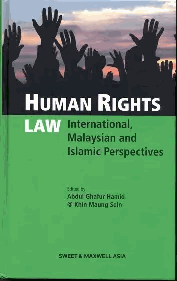
Human Rights Law: International, Malaysian and Islamic Perspectives Edited by Abdul Ghafur Hamid @ Khin Maung Sein - marceljude.ai


Description
Book Review Author: MarcelJude.ai
This review is on Human Rights Law: International, Malaysian and Islamic Perspectives, an edited legal work that is structured into three major perspectives: the international framework, the Malaysian constitutional and legal position, and the Islamic law perspective. The editor’s introduction itself states that the work is divided into three parts and 24 chapters, beginning with international human-rights law, moving to Malaysia, and ending with the Shari‘ah or Islamic-law perspective.
List of Contents
Part I: Human Rights Law: The International Framework
Chapter 1: Human Rights: Genesis and Perspectives
Chapter 2: International Human Rights Instruments: Hard and Soft Law
Chapter 3: Enforcement: The Key Human Rights Challenge
Chapter 4: The Right to Life and Freedom from Torture
Chapter 5: The Right to Liberty: A Pillar of Freedom in a Democratic Society
Chapter 6: The Right to a Fair Trial: The Perspective of International Law and the Malaysian Experience
Chapter 7: The Right to Equality and Non-Discrimination
Chapter 8: Freedom of Expression and Freedom of Religion
Chapter 9: The Right to Work and the Right to Education
Chapter 10: Women’s Rights and the Impact of CEDAW
Chapter 11: Protection of Children’s Rights
Chapter 12: Rights of “Refugees” and “Migrant Workers”
Chapter 13: Right to Self-Determination, and Rights of Indigenous Peoples and Minorities
Part II: Malaysia and Human Rights: Traditions versus Universality
Chapter 14: Application of International Human Rights Law in Malaysia
Chapter 15: Fundamental Liberties under the Federal Constitution: A Critical Analysis
Chapter 16: Contemporary Human Rights Issues in Malaysia
Part III: Human Rights: Islamic Perspective
Chapter 17: Islamic Concept of Human Rights
Chapter 18: Islamic Human Rights versus International Human Rights Instruments
Chapter 19: Basic Human Rights in Islam
Chapter 20: Mechanisms for Protection and Enforcement of Human Rights in Islam
Chapter 21: Islamic Criminal Law and Human Rights
Chapter 22: Terrorism, Jihad and Human Rights in Islam
Chapter 23: Women’s Rights in Islam
Chapter 24: Freedom of Religion, Apostasy and Blasphemy in Islam
Overall Review
This book is ambitious, doctrinal, comparative, and consciously pluralist. It does not merely introduce human rights as a set of international declarations and treaties. It places human rights inside three overlapping legal universes: public international law, Malaysian constitutional law, and Islamic jurisprudence. That tripartite structure is the book’s strongest academic contribution. Many human-rights texts treat the international framework as the master narrative and local or religious systems as secondary complications. This work does something more interesting: it allows the international framework, Malaysian constitutionalism, and Islamic legal theory to speak to one another, sometimes harmoniously and sometimes in tension.
As a law professor, I would describe the book as both a teaching text and a debate text. It is useful for students because it explains foundational rights such as life, liberty, fair trial, equality, expression, religion, work, education, women’s rights, children’s rights, refugee rights, and collective rights. It is useful for scholars because it raises the harder jurisprudential question: are human rights universal, culturally mediated, religiously grounded, State-created, or morally prior to the State? The book never fully escapes that tension, but it is precisely that tension that makes the work legally valuable.
Its principal strength lies in its range. The editor’s introduction explains that Part I evaluates the international legal framework, Part II considers Malaysia and human rights under the tension between tradition and universality, and Part III examines the Islamic or Shari‘ah perspective. This allows the book to move from abstract theory to concrete Malaysian doctrine and then to Islamic legal philosophy. The result is not a single-author thesis but a collection of scholarly chapters, each with its own method and tone. Its weakness is also connected to that strength. Because the chapters are written by different contributors, the book sometimes reads as a series of strong self-contained essays rather than a fully unified monograph. Some chapters are more descriptive, some more critical, and some more apologetic toward particular legal traditions. Yet this is not fatal. In fact, for a field as contested as human rights law, such plurality may be more honest than an artificially unified voice.
The book is especially valuable in Malaysia because it refuses to separate human rights from constitutional reality. It recognizes that Malaysian law does not simply absorb international human-rights norms automatically. Instead, international treaties, customary international law, constitutional provisions, judicial interpretation, and religious considerations interact in complex ways. Chapter 14’s discussion of Malaysia’s reception of international human-rights law and the role of SUHAKAM is central to this point.
The Islamic part of the book is intellectually important because it does not present Islam merely as an obstacle to human rights. Rather, it argues that Islamic law has its own rights tradition, its own enforcement mechanisms, and its own moral grammar. That said, the Islamic chapters also expose the most difficult areas of divergence between international human-rights law and Islamic law: criminal punishment, gender equality, freedom of religion, apostasy, blasphemy, and sexuality. Chapter 18 expressly identifies convergence on matters such as basic individual rights, education, thought, environmental rights, work, and presumption of innocence, while also identifying divergence on abortion, gay marriage, freedom of religion, and gender equality or equity.
My overall judgment is that this is a serious, useful, and intellectually challenging work. It is not a neutral encyclopedia. It has normative commitments, especially toward the legitimacy of Malaysian constitutional structure and Islamic legal reasoning. But it also gives readers enough doctrinal material to evaluate those commitments critically. For advanced undergraduates, law students, postgraduate researchers, and legal practitioners interested in Malaysia, international human rights, or Islamic legal thought, it is a valuable reference.
Chapter-by-Chapter Review
Chapter 1: Human Rights: Genesis and Perspectives
The opening chapter performs the essential jurisprudential work of locating modern human rights within a longer intellectual history. It begins from the idea that human rights are not merely technical legal rules but moral and philosophical claims about the worth of human beings. The chapter’s discussion of early liberal philosophers such as Hobbes, Locke, and Rousseau is important because it shows how modern rights discourse emerged through debates about liberty, sovereignty, social contract, and the limits of State power.
From a legal-theoretical perspective, the chapter is especially useful because it explains how human-rights law challenged traditional international law. Classical international law was State-centered: States were the main subjects, and individuals were largely objects of protection rather than rights-bearing actors. Human rights disrupted that model by making the individual a direct concern of international legal order. That shift is one of the most important developments in modern public international law.
The chapter also introduces the familiar classification of rights into first-generation civil and political rights, second-generation economic, social and cultural rights, and third-generation collective or solidarity rights. This classification is pedagogically helpful, though it can be criticized for implying a hierarchy or historical sequence that may oversimplify rights development. The chapter’s treatment of universalism and cultural relativism sets up one of the book’s recurring themes: whether human rights are universally binding moral-legal norms or whether they must be mediated by culture, religion, and local tradition.
As an opening chapter, it succeeds. It gives the reader the conceptual vocabulary needed for the rest of the book. Its strongest point is that it refuses to treat human rights as self-evident. Instead, it shows that rights are contested, historical, philosophical, and political.
Chapter 2: International Human Rights Instruments: Hard and Soft Law
Chapter 2 is a doctrinally important chapter because it explains the sources of international human-rights law. The distinction between hard law and soft law is crucial for students. Hard law, especially treaties, creates binding legal obligations for States that accept them. Soft law, such as declarations and resolutions, may not be formally binding but can shape interpretation, guide State behavior, and contribute to the formation of customary international law.
The chapter’s discussion of the UN Charter, the Universal Declaration of Human Rights, the ICCPR, and the ICESCR gives readers the basic architecture of the international human-rights system. It rightly emphasizes that the UDHR, although not a treaty, has become foundational. The chapter explains that the UDHR influenced later binding treaties and many national constitutions. This is especially relevant in Malaysia, where constitutional fundamental liberties bear the imprint of post-war human-rights thinking. The chapter also highlights the legal complexity of custom. A treaty binds only its parties, but customary international law may bind States more generally if supported by State practice and opinio juris. The chapter’s treatment of “modern custom” is useful because human-rights law often relies less on repeated physical State practice and more on normative declarations, institutional practice, and widespread acceptance of legal standards.
As a law professor, I would praise this chapter for making a difficult subject accessible. It helps readers understand why international human-rights norms may matter even when a State has not ratified every treaty. However, the chapter also correctly resists overstating the binding force of soft law. That restraint gives the analysis credibility.
Chapter 3: Enforcement: The Key Human Rights Challenge
Chapter 3 addresses perhaps the central weakness of international human-rights law: enforcement. Rights without remedies risk becoming moral aspirations rather than legal protections. The chapter begins from that problem and examines domestic enforcement, UN mechanisms, treaty bodies, regional courts, sanctions, humanitarian intervention, and corporate accountability.
The chapter’s most important insight is that domestic enforcement remains primary. International human-rights law usually depends on national courts, national legislation, and administrative mechanisms for real-world effect. International monitoring bodies can criticize, recommend, and pressure, but they often lack strong coercive power. This is a realistic and legally sound assessment.
The chapter is also valuable because it does not confine enforcement to States alone. Its discussion of multinational corporations is forward-looking. Modern human-rights violations may occur through private economic power, not only through public authority. The chapter’s consideration of corporate accountability recognizes that global capitalism complicates the older State-centered enforcement model.
Its discussion of humanitarian intervention and sanctions is also important, though necessarily controversial. Coercive enforcement of human rights may protect victims, but it may also be abused by powerful States. The chapter therefore raises the hard question whether human-rights enforcement can be made effective without becoming a tool of geopolitical domination.
This is one of the strongest chapters in the book. It teaches that human-rights law is not only about defining rights; it is about building institutions capable of protecting them.
Chapter 4: The Right to Life and Freedom from Torture
Chapter 4 examines two of the most fundamental rights in any legal system: the right to life and freedom from torture. The chapter correctly treats the right to life as foundational because all other rights depend on the continued existence and bodily security of the person. Its discussion includes international human-rights law, Malaysian constitutional law, death penalty issues, abortion, unborn life, euthanasia, and State obligations.
The chapter’s strength is its breadth. It explains that the right to life is not merely a negative duty requiring the State not to kill unlawfully. It also creates positive obligations: the State must protect life, investigate unlawful deaths, regulate dangerous practices, and provide remedies where life is wrongfully taken. That modern understanding is essential.
The Malaysian constitutional discussion is especially useful. The chapter connects Article 5 of the Federal Constitution with judicial interpretations that have expanded “life” beyond mere physical existence to include livelihood, health, and environmental conditions. That broader reading shows how constitutional rights can evolve through judicial interpretation.
The second half of the chapter, on torture and cruel, inhuman or degrading treatment, is doctrinally strong. It links international human-rights law with international humanitarian law and discusses the absolute moral and legal rejection of torture. The chapter’s treatment of extraordinary rendition is also significant because it shows how post-security-crisis policies can test human-rights commitments.
As a whole, Chapter 4 demonstrates that the right to life and freedom from torture are not abstract ideals. They are practical limits on police power, criminal punishment, military action, detention, interrogation, and State violence.
Chapter 5: The Right to Liberty: A Pillar of Freedom in a Democratic Society
Chapter 5 focuses on liberty, especially arrest, detention, preventive detention, habeas corpus, and compensation for unlawful detention. The chapter is doctrinally precise and especially relevant to Malaysia because preventive detention has historically been one of the most controversial areas of Malaysian public law.
The chapter’s treatment of Article 9 of the ICCPR gives readers a structured framework: liberty, security of person, freedom from arbitrary arrest, lawful grounds for detention, prompt judicial supervision, habeas corpus, and compensation. The discussion rightly distinguishes between “lawful” detention and “non-arbitrary” detention. A detention may be authorized by domestic law and still be objectionable under international human-rights principles if it is unreasonable, disproportionate, or procedurally unfair. The Malaysian material is central. The chapter discusses preventive detention legislation and the tension between national security and individual liberty. From a constitutional-law perspective, this is a classic conflict between executive discretion and judicial protection of rights. The chapter correctly treats habeas corpus as a vital safeguard, not a technical procedural device.
The chapter’s deeper legal message is that liberty is not secured simply by saying that the State may detain “according to law.” The quality of the law matters. A legal system must ask whether the law itself provides fair grounds, independent review, access to counsel, and meaningful remedies. That is the difference between formal legality and constitutional legality.
Chapter 6: The Right to a Fair Trial: The Perspective of International Law and the Malaysian Experience
Chapter 6 is one of the most practically important chapters because fair-trial rights are the daily operating system of criminal justice. It examines equality before courts, public hearings, independent and impartial tribunals, presumption of innocence, right to silence, timely trial, right to counsel, trial in the accused’s presence, double jeopardy, legality, and preventive detention.
The chapter’s strength lies in its connection between international standards and Malaysian criminal procedure. It shows that fair trial is not a single right but a bundle of procedural guarantees. These guarantees exist to prevent wrongful conviction, arbitrary punishment, political prosecution, and coercive abuse.
The discussion of judicial independence and impartiality is especially important. A fair trial is impossible if courts are structurally dependent on the executive or if judges are biased. Likewise, the presumption of innocence and burden of proof are not merely evidentiary rules; they are constitutional protections against State power.
The chapter’s treatment of preventive detention as a possible violation of fair-trial rights is important. Detention without trial may be justified by governments on grounds of security, but it bypasses ordinary adjudication. The chapter’s legal concern is therefore sound: where liberty is removed without trial, the core structure of criminal justice is weakened.
As a professor, I would assign this chapter in a criminal procedure or constitutional law class because it shows how fair-trial rights connect legal doctrine, courtroom practice, and constitutional morality.
Chapter 7: The Right to Equality and Non-Discrimination
Chapter 7 examines equality and non-discrimination through the ICCPR, ICESCR, ICERD, CEDAW, affirmative action, private-sector discrimination, and Islam. The chapter is doctrinally sophisticated because equality is one of the most difficult rights to define. Equal treatment may sometimes require identical treatment, but sometimes it requires differential treatment to correct disadvantage.
The chapter correctly explains that non-discrimination is both an independent right and a principle that supports other rights. It is not confined to race or gender; it can operate across religion, language, political opinion, social origin, property, birth, and other statuses. The chapter’s treatment of affirmative action is especially relevant in Malaysia because constitutional arrangements concerning Malays and natives of Sabah and Sarawak raise questions about equality, historical disadvantage, and social justice.
Its discussion of private-sector discrimination is valuable because discrimination does not occur only through State action. Employers, corporations, landlords, schools, and private institutions can also reproduce inequality. The chapter recognizes the difficulty of applying human-rights obligations horizontally between private parties.
The Islamic discussion is one of the chapter’s most interesting parts. It explores whether equality in Islam should be understood as identical treatment or as justice based on function, obligation, and moral status before God. This is where the book’s comparative method becomes evident: it does not simply impose international doctrine on Islamic law but asks how different legal traditions conceptualize equality. The chapter is strong because it treats equality as a living problem rather than a slogan.
Chapter 8: Freedom of Expression and Freedom of Religion
Chapter 8 combines two freedoms that are often mutually reinforcing but sometimes in conflict: expression and religion. The first part examines expression under the UDHR, ICCPR, and modern communication technologies. The second part examines religious freedom, including the difficult issue of changing religion. The expression section is strong in its treatment of new communication technologies. It recognizes that the internet expands the practical reach of expression, information, and public participation. At the same time, it notes that States often restrict expression on grounds such as national security, public order, morality, and protection of others’ rights. The chapter’s use of limitation analysis is important: freedom of expression is not absolute, but restrictions must be legally prescribed, legitimate, necessary, and proportionate. The religion section is more controversial and more jurisdictionally sensitive. It explains freedom of religion under international instruments and then contrasts that with the approach of Muslim States and Islamic law regarding conversion, apostasy, and religious identity. The chapter argues that State practice is not uniform on freedom to change religion, especially in Muslim-majority contexts.
As a legal review, I would say this chapter is valuable because it confronts the collision between liberal international human-rights doctrine and religious-legal commitments. It may not persuade all readers, especially those committed to a broad international right to change religion, but it clearly identifies the legal and philosophical dispute.
Chapter 9: The Right to Work and the Right to Education
Chapter 9 turns to economic, social, and cultural rights. Its focus on work and education is important because human dignity is not protected only by freedom from State interference. It also depends on access to livelihood, knowledge, training, and meaningful participation in society.
The right-to-work section correctly avoids an unrealistic claim that the State must guarantee employment to every person immediately. Instead, it treats the right as a progressive obligation: States must create conditions for access to employment, vocational training, free choice of work, and protection from arbitrary dismissal. This is doctrinally consistent with the nature of economic and social rights.
The right-to-education section is one of the more humane parts of the book. It explains education as both a right in itself and a precondition for the exercise of other rights. A person who lacks education may be formally free but practically unable to participate in law, politics, employment, and culture. The chapter’s discussion of human-rights education is especially important because rights are difficult to claim if people do not know they possess them.
The chapter also addresses academic freedom, which is essential in universities. From a law-professor perspective, this is crucial. Legal education cannot function properly if scholars and students cannot examine State power, rights, religion, and social policy critically.
Chapter 9 therefore broadens the book’s focus from civil liberty to social capability.
Chapter 10: Women’s Rights and the Impact of CEDAW
Chapter 10 examines women’s rights through CEDAW, focusing on employment, workplace discrimination, marriage and family, violence against women, trafficking, reservations, and enforcement. The chapter explains that earlier general human-rights treaties did not sufficiently address de facto discrimination against women because they focused more on formal legal equality than on practices, customs, and social structures that produce inequality.
The chapter’s strongest point is its recognition that women’s rights require more than neutral legal language. A law may declare equality, but women may still face unequal employment conditions, discriminatory family norms, domestic violence, trafficking, and weak enforcement. CEDAW is presented as a treaty designed to move beyond general rights language toward targeted obligations.
The discussion of reservations is important, especially in Muslim-majority States. Reservations to CEDAW often reflect tensions between international gender-equality norms and religious or family-law systems. The chapter fairly shows that reservations can preserve domestic legal identity, but they may also weaken the treaty’s effectiveness.
The chapter’s treatment of trafficking and violence against women demonstrates the practical stakes of women’s rights. The book notes governmental and community awareness measures in Malaysia, including initiatives directed toward gender equality and women’s legal rights.
As a review, I would say Chapter 10 is effective because it does not reduce women’s rights to abstract equality. It places equality in the realities of family, work, violence, vulnerability, and enforcement.
Chapter 11: Protection of Children’s Rights
Chapter 11 explains children’s rights through theory, international law, the Convention on the Rights of the Child, enforcement, violence, juvenile justice, armed conflict, and Malaysian law. The chapter is useful because children occupy a distinctive legal position: they are rights-holders, but they are also dependent persons requiring protection and development.
The chapter’s use of the “4 Ps” framework — prevention, protection, provision, and participation — is pedagogically strong. It allows students to understand children’s rights as more than welfare. Children must be protected from harm, provided with conditions for development, protected against discrimination and exploitation, and allowed meaningful participation appropriate to age and maturity.
The chapter’s discussion of the CRC is central. It shows how children’s rights became consolidated in a single international instrument and how ratification creates pressure for domestic legal reform. However, the chapter also recognizes the gap between law and practice. Children may be legally protected but still fall through institutional cracks.
The Malaysian section is valuable because it considers local legal frameworks and concerns. Issues such as child abuse, juvenile justice, and children affected by conflict require more than formal ratification. They require enforcement agencies, trained judges, welfare institutions, and social awareness.
As a law professor, I would regard this chapter as important because it challenges the older idea that children are merely objects of adult protection. It presents them as legal persons with dignity, interests, and claims.
Chapter 12: Rights of “Refugees” and “Migrant Workers”
Chapter 12 deals with two vulnerable groups often marginalized in domestic legal systems: refugees and migrant workers. The chapter begins by distinguishing refugees, asylum seekers, and internally displaced persons, then discusses the Refugee Convention, refugee definition, refugee rights, UNHCR, migrant workers, causes of migration, problems faced by migrant workers, their rights, and Malaysia’s position. The chapter’s value lies in its careful classification. Refugees, asylum seekers, internally displaced persons, and migrant workers are often treated as one category in public debate, but legally they are different. A refugee claim usually turns on persecution and inability or unwillingness to obtain protection from the home State. Migrant workers may move primarily for economic reasons but still require rights protection.
The chapter is particularly relevant in Malaysia because Malaysia has long been a destination for migrant labor and a place of transit or residence for displaced persons. The rights issues include documentation, detention, labor exploitation, access to justice, health care, wages, and vulnerability to abuse. The chapter also reveals a major weakness in international law: protection depends heavily on ratification, domestic incorporation, administrative willingness, and enforcement capacity. Refugees and migrant workers often exist at the edge of law, where sovereignty, border control, labor markets, and humanitarian obligation collide.
This is a necessary chapter because it shifts attention from citizens to non-citizens, where human-rights commitments are often most severely tested.
Chapter 13: Right to Self-Determination, and Rights of Indigenous Peoples and Minorities
Chapter 13 examines collective rights: self-determination, minorities, and indigenous peoples. This is an important expansion beyond individual rights. Human rights law often focuses on the individual, but peoples and communities may suffer collective domination, cultural erasure, dispossession, or political exclusion.
The chapter’s discussion of self-determination traces its historical connection to decolonization and then considers its modern relevance. It distinguishes between external self-determination, such as independence or secession, and internal self-determination, such as autonomy, participation, and cultural protection within an existing State.
The chapter’s treatment of indigenous peoples is especially significant. It identifies rights to ancestral lands, economic and social rights, political participation, cultural heritage, and forms of self-determination. The text notes that the rights of indigenous peoples have increasingly influenced domestic laws and judicial reasoning in different jurisdictions.
As a legal review, I would say this chapter’s strength is its recognition that human rights cannot be fully understood without land, identity, culture, and political status. For indigenous communities, rights are not merely about individual liberty. They are about survival as a people.
The chapter also raises a difficult constitutional question: how can a State protect national unity while also recognizing the deep legal claims of minorities and indigenous peoples? The chapter does not solve that tension, but it frames it well.
Chapter 14: Application of International Human Rights Law in Malaysia
Chapter 14 is the bridge between the international and Malaysian parts of the book. It discusses Malaysia’s approach to receiving international law, obligations under treaties, obligations under customary international law, and the role of SUHAKAM. The chapter is essential because international human-rights law does not automatically operate in every domestic system in the same way.
The chapter’s core point is that Malaysia’s constitutional structure matters. Malaysia is a federation, the Federal Constitution is supreme, Islam is constitutionally recognized, and legislative powers are divided between the Federation and the States. This means that international human-rights law must be understood through constitutional allocation, domestic legislation, and religious-legal context.
The chapter also discusses Malaysia’s treaty obligations and reservations. Its treatment of CEDAW reservations is especially important because it shows how Malaysia negotiates between international obligations and domestic religious-family law.
The SUHAKAM discussion gives the chapter practical relevance. National human-rights institutions often operate between civil society, government, courts, and international bodies. They may not possess the same coercive power as courts, but they can investigate, educate, report, and influence reform. As a law professor, I would consider Chapter 14 indispensable. Without it, the reader might wrongly assume that international norms enter Malaysian law automatically. The chapter corrects that assumption. Chapter 15: Fundamental Liberties under the Federal Constitution: A Critical Analysis Chapter 15 critically examines fundamental liberties under the Malaysian Federal Constitution. It discusses their origins, judicial interpretation, comparison with international instruments, and justiciability. This is one of the most constitutionally important chapters in the book.
The chapter’s central criticism is that judicial interpretation of fundamental liberties in Malaysia has often been cautious, especially in matters involving security and public order. The text notes that courts have sometimes deferred to government assessments in security matters, while showing more willingness to review executive or legislative action outside those contexts.
The chapter’s discussion of Article 153 and the special position of Malays and natives of Sabah and Sarawak also shows that Malaysian equality discourse cannot be separated from history, colonialism, ethnicity, and constitutional compromise.
The chapter is valuable because it treats constitutional rights not merely as written clauses but as judicially mediated protections. A right’s real force depends on how courts interpret “life,” “liberty,” “law,” “equality,” “speech,” “religion,” and “property.” If interpretation is narrow, rights shrink. If interpretation is generous, rights expand.
This chapter’s critical tone is welcome. It does not simply celebrate constitutional rights; it asks whether they are sufficiently protected in practice.
Chapter 16: Contemporary Human Rights Issues in Malaysia
Chapter 16 narrows the Malaysian discussion to selected contemporary issues: gender equality, detention without trial, and freedom of speech. Its value lies in bringing abstract doctrine into concrete Malaysian controversies.
The gender-equality discussion connects constitutional equality with women’s lived experiences. This is especially important because formal equality provisions do not necessarily eliminate discrimination in employment, family law, or public life. The chapter likely works alongside Chapter 10’s CEDAW analysis and Chapter 23’s Islamic-law discussion of women’s rights.
The detention-without-trial discussion continues the themes of Chapters 5 and 6. Preventive detention is one of the recurring pressure points in Malaysian human-rights law. It raises the question whether liberty can be meaningfully protected where the executive has broad powers to detain on security grounds. The freedom-of-speech discussion is also central to constitutional democracy. Speech restrictions often arise through laws concerning public order, sedition, printing, publication, communications, and national security. The chapter’s placement after the broader constitutional chapter is effective because it shows how constitutional interpretation affects real political freedoms.
As a review, I would say Chapter 16 is short but strategically important. It demonstrates that Malaysia’s human-rights challenges are not merely theoretical; they involve live tensions between governance, security, morality, political control, and individual rights.
Chapter 17: Islamic Concept of Human Rights
Chapter 17 begins the Islamic perspective section by explaining human rights through Islam, human nature, objectives, sources, and a duty-based concept. This chapter is foundational because the Islamic part of the book cannot be understood through international-law categories alone.
The chapter’s most important contribution is its emphasis on duties. Liberal human-rights discourse often begins with the autonomous rights-bearing individual. Islamic legal thought often begins with the human being as a servant of God, a moral actor, and a member of a community. Rights exist, but they are connected to obligations, divine command, justice, and the purposes of Shari‘ah.
The chapter also appears to frame human rights through the objectives of Islamic law. This is significant because maqasid analysis allows Islamic jurisprudence to discuss protection of religion, life, intellect, lineage, property, justice, dignity, and social order. In that framework, rights are not merely claims against the State; they are moral-legal protections rooted in divine purpose.
As a professor, I would say the chapter is useful but also raises questions. A duty-based conception can enrich rights discourse by emphasizing responsibility and community. However, it may also limit individual claims where authority defines duties narrowly. The chapter therefore opens a serious comparative inquiry: can rights be both universal and theologically grounded?
Chapter 18: Islamic Human Rights versus International Human Rights Instruments
Chapter 18 is one of the book’s most analytically important chapters. It directly compares Islamic human-rights thought with international human-rights instruments. It considers underlying philosophy, value-based rights, the Muslim ummah, convergence, divergence, and the contemporary practice of Muslim-majority countries.
The chapter’s structure is commendable. It does not simply assert compatibility or incompatibility. It identifies areas of convergence, such as basic individual rights, equality, education, freedom of thought, environmental rights, work, and presumption of innocence. It then identifies divergence on contested issues such as abortion, same-sex marriage, freedom of religion, and gender equality versus gender equity.
The chapter’s discussion of philosophical difference is crucial. Two legal systems may use similar words — dignity, life, liberty, equality — but attach different meanings to them. International human-rights law often proceeds from individual autonomy and secular universality. Islamic human-rights theory may proceed from divine command, moral order, and communal responsibility.
The chapter’s critique of normative hegemony is also important. It questions whether international human-rights law is truly universal or partly shaped by Western political and cultural dominance. Whether one agrees or not, the critique is jurisprudentially serious.
This chapter is one of the book’s intellectual anchors because it directly addresses the central comparative problem.
Chapter 19: Basic Human Rights in Islam
Chapter 19 identifies basic rights in Islam, including freedom of religion, right to life, right to justice, and right to freedom. Its role is to move from broad Islamic theory to specific rights categories.
The chapter’s treatment of the right to life is important because Islamic law, like international human-rights law, treats life as a foundational protection. But Islamic law frames life within divine trust and moral responsibility, not merely individual entitlement. This affects debates on abortion, punishment, and the limits of autonomy.
The discussion of justice is also central. In Islamic legal thought, justice is not merely procedural fairness; it is a moral purpose of law. Rights must therefore be evaluated not only by formal equality but by whether they produce justice according to Shari‘ah principles.
The freedom discussion is useful because it challenges simplistic claims that Islamic law has no concept of liberty. Islamic law recognizes forms of freedom, but those freedoms are structured by divine obligation and social order. That makes the chapter important for comparative legal theory.
This chapter is concise in scope but conceptually important. It functions as a doctrinal map of rights within Islamic law before the later chapters examine enforcement, criminal law, terrorism, women, and religion.
Chapter 20: Mechanisms for Protection and Enforcement of Human Rights in Islam
Chapter 20 focuses on Islamic mechanisms for protecting rights: judiciary, judicial independence, wali al-mazalim, hisbah, modern hisbah institutions, functions, powers, and the muhtasib. The chapter is valuable because it shows that Islamic law is not merely a set of substantive rules; it also has institutional mechanisms.
The judiciary is presented as a rights-protection mechanism. This is important because rights require adjudication. If a legal system recognizes rights but lacks independent judges, remedies, or accountability institutions, the rights remain weak.
The discussion of wali al-mazalim is particularly interesting. Historically, mazalim jurisdiction addressed grievances against rulers, officials, and abuses of power. In modern constitutional vocabulary, it resembles administrative justice, ombudsman functions, or public-law review. This connection is valuable for comparative constitutional law.
The hisbah discussion is more complex. Hisbah is associated with commanding right and preventing wrong, market regulation, public morality, and social accountability. In rights terms, it can be protective, but it can also raise concerns about over-policing morality if not properly limited. The chapter’s inclusion of modern hisbah institutions makes the discussion contemporary.
As a professor, I would say this chapter is significant because it rebuts the assumption that only modern Western institutions can protect rights. But it also invites scrutiny: the legitimacy of enforcement depends on independence, legality, proportionality, and safeguards against abuse.
Chapter 21: Islamic Criminal Law and Human Rights
Chapter 21 examines Shari‘ah, fiqh, crimes and punishment, objectives of Islamic punishment, and hudud in relation to human rights. This is one of the most sensitive chapters because Islamic criminal law is often where international critics identify the sharpest human-rights tensions.
The chapter distinguishes categories such as hudud, qisas, and ta‘zir. It notes that hudud crimes, according to majority scholarship, include offences such as hirabah, theft, zina, false accusation, drinking liquor, apostasy, and rebellion. It also explains qisas as retaliation for violations of life and body, and ta‘zir as discretionary punishment.
The chapter’s strongest academic contribution is its explanation of objectives: deterrence, protection of society, moral order, and the protection of rights. It presents Islamic punishment not as arbitrary harshness but as part of a theory of social protection and divine justice.
However, as a law professor, I would also identify the chapter as a point where deeper critical engagement is needed. International human-rights law will ask about proportionality, bodily integrity, equality, fair-trial safeguards, evidentiary standards, and cruel or degrading punishment. The chapter’s defense of Islamic criminal law must therefore be read alongside Chapters 4, 6, and 7.
The chapter is important precisely because it does not avoid controversy. It forces readers to confront whether human-rights analysis can accommodate religious criminal law and, if so, under what safeguards.
Chapter 22: Terrorism, Jihad and Human Rights in Islam
Chapter 22 addresses Islam, peace, jihad, terrorism, and human rights. Its central aim is to distinguish jihad from terrorism and to frame jihad as defensive rather than aggressive. This chapter is important because misunderstandings of jihad have significant legal, political, and social consequences.
The chapter’s insistence that Islam is a peaceful religion and that jihad is defensive functions as a corrective to both extremist misuse and external stereotyping. From a human-rights standpoint, the key issue is whether force is used to protect rights and community survival or to terrorize civilians and destroy legal order.
The chapter’s discussion of jihad in defense of human rights is particularly interesting. It suggests that Islamic legal thought can conceptualize resistance to oppression within a rights framework. However, the chapter must also be read carefully: any legal theory of armed defense must be bounded by strict rules protecting civilians, prisoners, non-combatants, and proportionality.
The terrorism section is necessary because terrorism violates fundamental rights, especially life, security, liberty, and public peace. By separating terrorism from legitimate defense, the chapter contributes to both Islamic jurisprudence and international legal discourse.
This is a timely and pedagogically useful chapter. Its strength is clarification. Its challenge is ensuring that the boundary between lawful defense and unlawful violence remains institutionally enforceable, not merely theoretically asserted.
Chapter 23: Women’s Rights in Islam
Chapter 23 examines women’s rights under Islamic law, including equality between sexes, basic rights, marriage, financial rights, divorce, custody, property ownership, inheritance, and political rights. This chapter is a counterpart to Chapter 10 on CEDAW.
The chapter’s main argument is that Islam gives women significant rights and that many negative practices in Muslim societies arise from culture, misinterpretation, or rigid application rather than from the true principles of Islamic law. The text emphasizes that Islamic sources recognize women’s rights, but modern application is complicated by social traditions and interpretive disputes.
The chapter is strongest when it discusses specific legal rights: the right to marry and choose a spouse, financial rights during marriage and after divorce, custody, property ownership, inheritance, and political participation. These topics show that women in Islamic law are not legally invisible. They possess defined claims and protections.
The political-rights discussion is especially interesting because it considers debates about women in leadership. The chapter notes arguments based on hadith but also refers to contextual interpretation and historical examples of women’s public roles.
As a law professor, I would say this chapter is valuable but should be read critically with Chapter 10. Chapter 10 asks whether international equality norms are satisfied; Chapter 23 asks whether Islamic law, properly understood, protects women’s dignity and rights. The tension between those two questions is one of the book’s most important themes.
Chapter 24: Freedom of Religion, Apostasy and Blasphemy in Islam
Chapter 24 is the final and perhaps most controversial chapter. It examines freedom of religion, apostasy, and blasphemy from the Islamic-law perspective, relying on the Qur’an and Sunnah as primary sources. The chapter states that Islamic law prohibits forcing non-Muslims to embrace Islam, but also prohibits apostasy from Islam and blasphemy against Islam and non-Islamic religions.
The chapter is important because it confronts one of the sharpest divergences between international human-rights law and many traditional Islamic-law positions. International human-rights instruments commonly protect freedom of thought, conscience, and religion, including debates over changing religion. The Islamic-law analysis in this chapter distinguishes freedom from coercion into Islam from freedom to leave Islam.
The blasphemy discussion raises another difficult rights conflict: freedom of expression versus protection of religion and public order. In liberal human-rights systems, blasphemy laws are often criticized as suppressing expression. In religious legal systems, blasphemy may be treated as an attack on sacred order and communal peace.
As a closing chapter, it is thematically appropriate because it leaves the reader with the book’s core unresolved question: can international human-rights law and Islamic law be harmonized, or must they remain partly divergent on foundational issues?
The chapter is legally useful because it states the Islamic position clearly. Its persuasiveness will depend on the reader’s jurisprudential starting point.
Final Academic Assessment
This book is not merely a human-rights manual. It is a comparative legal conversation. Its doctrinal coverage is broad, its Malaysian focus is valuable, and its Islamic-law section gives it a distinctive identity. The book’s deepest contribution is its refusal to flatten human rights into one legal culture. It recognizes that human rights operate in international institutions, domestic constitutions, courts, religious traditions, and social practice.
Its best chapters are those that connect doctrine with enforcement: liberty, fair trial, equality, Malaysian application of international law, and Islamic enforcement mechanisms. Its most contested chapters are those on women’s rights, Islamic criminal law, apostasy, blasphemy, and freedom of religion. But those contested chapters are also among the most important because they expose the real fault lines in global human-rights discourse.
As a law professor, my final view is this: the book is a strong scholarly resource for understanding human rights in a plural legal environment. It is especially useful for Malaysian and Muslim-world legal education because it does not treat international law, constitutional law, and Islamic law as separate islands. It places them in conversation. That conversation is sometimes uneasy, but it is necessary.
 marceljude.ai @ 0128285778 |
- MALAYSIA'S 1ST AI LAWYER - CLICK HERE
- ISMAIL – INTEGRATED SINGAPORE/MALAYSIA AI & LAW (Library)
- OPENING OF SINGAPORE MALAYSIA AI CENTRE AND LAW LIBRARY
- LIFT - LAW INSTRUMENTS FORMS & TEMPLATES
- LAWS OF MALAYSIA FOR SINGAPOREAN DUMMIES
- HANNAH YEOH'S ARTIFICIAL INTELLIGENCE LAW ENCYCLOPEDIA
- LEAD CR - Law Ecosystem Archive Databases on CD-ROM
- BREAKING NEWS FROM MJN
- CLICK HERE CO. PROFILE
- EXCITING NEW SERIES - THE ADVENTURES OF BOBBY TAN -ADVOCATE & SOLICITOR IN THE HIGH COURT OF NORTH BORNEO by marceljude.ai
- MEDICO LEGAL - BY PRISKILA AKWILA & GLORIOUS PETAL SDN BHD - powered by marceljude.ai
- MISCELLANOUS
- ANNOTATED STATUTES OF SABAH - A NEW SERIES
- e-library - marceljude.ai
- DRAFT - DOCUMENT RESEARCH & AUTOMATED FILING TECHNOLOGY
- CLARA – Case Law Analysis & Retrieval AI
- FOR RESEARCH REQUEST CLICK HERE
- CLICK HERE TO ASK ANYTHING
- RAMBO'S LAW - THE LAW OF THE LAW JUNGLE - EXCITING NEW SERIES - CASE ANALYSIS BY JOHN RAMBO @ +60138646786
- PRISKILA AKWILA ADVOCATES - High Court of Sabah & Sarawak @ Kota Kinabalu
- COLA - COMMONWEALTH ONLINE LAWCASES AI -marceljude.ai
- THE LAW LIBRARY THAT COMES TO YOU ANYWHERE AND ANYTIME
- marceljude.ai training academy
