
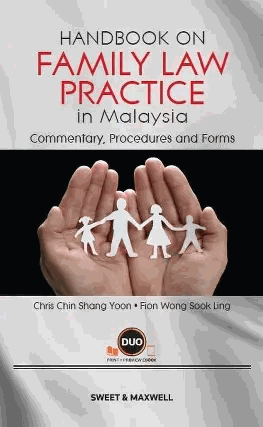
Handbook on Family Law Practice in Malaysia Commentary, Procedures and Forms Chris Chin Shang Yoon & Fion Wong Sook Ling - marceljude.ai


Description
Book Review
Book: Handbook on Family Law Practice in Malaysia: Commentary, Procedures and Forms
Chris Chin Shang Yoon
LLB (Hons) (London), CLP, LLM (Malaya) Advocate & Solicitor, High Court of Malaya
Fion Wong Sook Ling
LLB (Hons) (London), CLP Advocate & Solicitor, High Court of Malaya
Review Author: marceljude.ai
List of Contents
The book is organized around the core areas of Malaysian non-Muslim family law practice:
Preface
About the Authors
Table of Cases
Table of Statutes
Chapter 1: Introduction
Chapter 2: Divorce
Chapter 3: Judicial Separation
Chapter 4: Decree of Nullity
Chapter 5: Ancillary Relief
Chapter 6: Custody of Children
Chapter 7: Injunction Against Molestation
Index
Overall Review of the Book
This book is a practitioner-centered yet doctrinally serious handbook on Malaysian family law for non-Muslims. Its central strength is that it does not merely explain the Law Reform (Marriage and Divorce) Act 1976 in a mechanical, section-by-section fashion. Instead, it arranges the law according to the actual problems faced in practice: divorce, separation, nullity, maintenance, property division, custody, and protective injunctions.
From a law professor’s perspective, the book’s greatest value lies in its fusion of three things: legal doctrine, litigation procedure, and drafting practice. Many family law books explain principles but do not show how those principles are translated into originating summonses, petitions, affidavits, orders, and procedural steps. This book does that. It therefore operates as both a legal commentary and a procedural manual.
The book is especially useful because Malaysian family law is not purely theoretical. A lawyer handling a matrimonial matter must know the statute, the cases, the procedural rules, the court forms, the timing requirements, and the evidential burden. The book recognizes this reality. It treats family law as a living litigation system rather than as a collection of abstract rights.
Its doctrinal backbone is the Law Reform (Marriage and Divorce) Act 1976, supported by the Divorce and Matrimonial Proceedings Rules 1980 and a wide range of Malaysian, Singaporean, and English authorities. The authors also emphasize the effect of statutory amendments, particularly where conversion to Islam, child maintenance, and matrimonial asset division are concerned. This is important because Malaysian family law is shaped not only by private marital breakdown but also by constitutional, religious, and jurisdictional tensions.
The book’s style is highly practical. It gives the reader not only the answer to “what is the law?” but also “how does one apply for relief?”, “what must be pleaded?”, “what evidence is needed?”, “what documents are filed?”, and “what order should the court grant?” That makes it particularly valuable for junior lawyers, pupils in chambers, court officers, and law students who want to understand how family law operates in actual litigation.
Its limitation is also connected to its strength. Because the book is practice-oriented, some areas could benefit from deeper theoretical critique: gender equality, access to justice, the sociology of divorce, the emotional realities of custody litigation, and the constitutional consequences of Malaysia’s dual legal system. However, the book does not pretend to be a purely theoretical treatise. It is a handbook, and judged as a handbook, it is strong.
Chapter 1: Introduction
Chapter 1 establishes the architecture of Malaysian family law. Its main concern is jurisdictional and structural: Malaysia has a dual family law system. Muslim family matters are governed by Shariah law, while non-Muslim family matters fall under civil legislation, especially the Law Reform (Marriage and Divorce) Act 1976 and the Divorce and Matrimonial Proceedings Rules 1980.
This introductory chapter is short, but it performs an important function. It tells the reader that the book is concerned with civil family litigation involving non-Muslims. That distinction is fundamental. Without it, a reader might misunderstand the scope of the remedies discussed later, especially divorce, nullity, custody, maintenance, and injunctions.
The chapter also explains that family litigation in the civil courts follows ordinary civil litigation logic: pleadings, affidavits, timelines, service, hearings, and orders. This point is important because family law is often emotionally charged, but the court process remains procedural. A spouse may have a morally sympathetic claim, but that claim still needs proper jurisdiction, pleadings, evidence, and relief.
From a law professor’s viewpoint, Chapter 1 is an effective conceptual gateway. It properly situates the book within the Malaysian legal system. It also explains the authors’ methodology: the book is arranged by topic rather than by statutory sequence. This is pedagogically sound. Students and practitioners often think in terms of legal problems, not statutory numbering. A client does not walk into a lawyer’s office asking about “section 76”; the client asks, “Can I claim the house?” or “Who gets custody?” The book’s structure mirrors that practical reality.
The chapter also introduces the book’s distinctive format. Each major area of family law is treated through commentary, procedure, and forms. This is more than convenience. It reflects the truth that family law is both substantive and procedural. A right without a correct procedure is often useless in court. The chapter’s weakness is that it could have offered a richer constitutional introduction to the relationship between civil and Shariah jurisdiction, especially because later chapters discuss conversion to Islam. Still, as an introduction, it is focused and functional.
Chapter 2: Divorce
Chapter 2 is one of the book’s most substantial chapters. It covers both mutual and non-mutual divorce, jurisdiction, domicile, reconciliation requirements, divorce within two years of marriage, grounds for breakdown, conversion to Islam, procedural steps, and sample court documents.
The chapter begins with the decree of divorce. It explains that the court may only dissolve a marriage if the legal prerequisites are met. These include registration or deemed registration of the marriage, monogamous character of the marriage, and the domicile requirement. This is an excellent starting point because divorce is not merely about marital failure. It is about the court’s power to act.
The discussion of domicile is particularly important. The book explains domicile of origin, domicile of choice, and domicile of dependence. It also addresses the controversial position that a wife’s domicile may still be treated as dependent on her husband’s domicile under Malaysian common law principles unless legislation changes that position. This is one of the more intellectually provocative parts of the chapter. From a law professor’s perspective, this reveals a tension between older common law assumptions and modern principles of gender equality. The authors rightly show that the courts may be constrained by the existing legal framework, even where the social logic of the rule seems outdated.
The chapter then discusses the restriction on presenting a divorce petition within two years of marriage. The book explains that the law discourages hasty divorce but permits exceptions where exceptional circumstances or hardship can be shown. The analysis is careful because it does not treat every marital wrong as sufficient. For example, ordinary allegations of unhappiness or even certain forms of misconduct may not automatically meet the threshold. The hardship must be exceptional and, in many cases, present or continuing. This section is useful for practitioners because applications within two years are common enough to matter but difficult enough to require careful evidence.
The treatment of the conciliatory body requirement is also strong. The book explains that parties must generally refer matrimonial difficulties to a conciliatory body before filing a contested divorce, unless an exception applies. It distinguishes mutual divorce and conversion cases, where that requirement does not apply in the same way. It also explains the practical problem where one spouse refuses to attend conciliation, requiring an exemption application. This reflects the practical frustrations of family litigation: procedure may be intended to encourage reconciliation, but it may also delay relief where reconciliation is not realistic.
The section on divorce by mutual consent is concise and useful. It stresses that both parties must freely consent and that proper provision must be made for the spouse and children. The book rightly shows that even mutual divorce is not merely a private agreement; the court retains supervisory power, especially where children and financial arrangements are concerned.
The section on non-mutual divorce is doctrinally rich. The book discusses the statutory idea that a marriage has irretrievably broken down and explains the recognized factual bases: adultery, unreasonable behaviour, desertion, and two years’ separation. The treatment of adultery is technical, emphasizing proof, parties, burden, and damages. The book’s insistence that adultery must have caused or contributed to the breakdown is important. It prevents adultery from being treated as a purely punitive allegation disconnected from the breakdown of the marriage.
The discussion of unreasonable behaviour is also practical. The book does not reduce unreasonable behaviour to a checklist. Instead, it emphasizes cumulative effect and context. A single minor act may not suffice, but repeated conduct may make continued cohabitation unreasonable. This approach aligns well with the lived reality of matrimonial disputes, where the breakdown is often not one dramatic event but an accumulation of conduct.
The discussion of desertion and two years’ separation is clearer and more technical. Desertion requires more than physical separation; it involves intention. Two years’ separation, by contrast, focuses on living apart for the required period. These distinctions matter because pleadings must be accurate. One of the chapter’s most significant sections concerns dissolution on the ground of conversion to Islam. The book explains the earlier difficulties under section 51, where the converted spouse could not petition and the non-converted spouse was limited in how the divorce could be framed. It then explains the effect of amendments allowing either party to petition. This is one of the book’s strongest contributions because it shows family law at the intersection of religion, civil jurisdiction, and fairness. It also highlights the importance of ensuring that conversion is not used to avoid civil matrimonial obligations.
Overall, Chapter 2 is excellent. It is doctrinally detailed, procedurally useful, and sensitive to the practical realities of divorce litigation.
Chapter 3: Judicial Separation
Chapter 3 explains judicial separation as distinct from divorce. This distinction is essential. Judicial separation allows spouses to live apart without dissolving the marriage. The marriage remains legally valid, but the obligation to cohabit is removed.
The chapter explains why judicial separation may be chosen. Some parties may have religious or personal objections to divorce. Others may need legal relief but cannot yet petition for divorce because the marriage has not lasted long enough or because the legal threshold for early divorce is not met. This practical explanation is one of the chapter’s strengths. It shows judicial separation not as an obscure remedy but as a strategic and principled alternative.
The chapter explains that judicial separation is based on grounds similar to divorce: adultery, unreasonable behaviour, desertion, or living apart. However, the jurisdictional requirement differs. For judicial separation, the focus is residence in Malaysia at the commencement of proceedings, rather than domicile in the same way as divorce. This is an important procedural distinction that practitioners must not overlook. The chapter also explains the effects of judicial separation. The parties remain married. They cannot remarry. A decree of judicial separation does not bar a later divorce. In fact, the decree may later serve as proof of the relevant ground, though evidence is still required before divorce is granted. The discussion of property consequences is especially interesting. The chapter explains the effect on a wife’s property where she dies intestate after judicial separation. This is a narrow but important point, showing that judicial separation may have consequences beyond residence and cohabitation. The chapter’s discussion of damages for adultery is also useful. It explains that damages for adultery are tied to divorce proceedings and cannot simply be imported into judicial separation proceedings. This is a good example of the book’s technical precision. A lawyer who misunderstands this point could plead a remedy that the court has no power to grant.
From a law professor’s perspective, Chapter 3 is valuable because it rescues judicial separation from being treated as a lesser divorce. It is not divorce. It is a different legal status with different consequences. The book explains this distinction clearly.
Chapter 4: Decree of Nullity
Chapter 4 deals with annulment, or nullity of marriage. This chapter is doctrinally important because nullity is conceptually different from divorce. Divorce ends a valid marriage. Nullity declares that the marriage is void or voidable.
The chapter begins by explaining the requirements for a decree of nullity: the marriage must be registered or deemed registered, or must be a monogamous marriage under relevant law, and the parties must reside in Malaysia at the commencement of proceedings. The residence requirement is emphasized because failure to plead or prove it may be fatal.
The chapter then distinguishes void and voidable marriages. This distinction is central. A void marriage is treated as never having legally existed. A voidable marriage remains valid unless and until annulled by a court. The legal consequences are very different, especially for legitimacy of children, property, and the parties’ legal status.
The discussion of void marriages includes situations such as a prior existing marriage, minority without required approval, prohibited degrees of relationship, and parties not being respectively male and female under the statutory framework discussed in the book. The analysis is technical but necessary. Nullity law is highly rule-bound.
The discussion of voidable marriages is more complex. It includes non-consummation due to incapacity, refusal to consummate, lack of valid consent, mental disorder, communicable venereal disease, and pregnancy by another person at the time of marriage. The book’s treatment of these topics is legal rather than sensational. It focuses on proof, statutory language, and bars to relief. The chapter also discusses bars to relief in voidable marriages. This is important because a petitioner cannot always rely on a defect if their conduct led the respondent reasonably to believe the marriage would not be challenged, or if it would be unjust to grant the decree. This prevents nullity from becoming an opportunistic remedy.
A particularly useful part of the chapter concerns medical inspection in nullity suits. This is a procedural area many students would never understand from statutory reading alone. The book explains who applies, when the application is made, how medical inspectors are appointed, how examination is conducted, and how reports are used. The procedural guidance is one of the chapter’s strongest features. From a law professor’s perspective, Chapter 4 is strong because it teaches students that nullity is not “divorce by another name.” It has its own conceptual structure, evidential requirements, procedural mechanisms, and consequences.
Chapter 5: Ancillary Relief
Chapter 5 is one of the most practically important chapters in the book. It deals with the financial and property consequences of matrimonial proceedings. The chapter defines ancillary relief to include avoidance of disposition orders, financial provision orders, maintenance pending suit, property adjustment orders, and variation orders. It also correctly separates custody of children from ancillary relief, leaving custody to Chapter 6.
The chapter begins by explaining how ancillary relief should be claimed. It emphasizes that certain reliefs should be included in the petition or answer, though later applications may be possible with leave or by notice where parties agree. This procedural point is vital. A party may have a strong claim but still face difficulty if the claim is not properly pleaded.
The discussion of avoidance of disposition orders is highly useful. It addresses the problem of a spouse disposing of property to defeat maintenance or property claims. The book explains that the court may set aside certain dispositions or prevent intended dispositions where the statutory conditions are satisfied. This is important because matrimonial litigation often involves attempts to hide, transfer, or encumber assets. The treatment of injunction principles is also strong. The book explains that applications to restrain disposition may involve interlocutory or ex parte injunctions, and it discusses the need for full and frank disclosure, undertaking as to damages, urgency, and the balance of convenience. This elevates the chapter beyond family law into civil procedure and equitable remedies. That is precisely how family litigation often works in practice: matrimonial rights are enforced through procedural tools familiar to civil litigators.
The chapter’s treatment of spouse maintenance is doctrinally and practically significant. It explains that maintenance is not merely bare survival. It includes the means to live according to the relevant standard, taking into account the parties’ needs, means, and responsibility for the breakdown. The chapter also discusses maintenance during matrimonial proceedings, maintenance after divorce or judicial separation, and lump sum maintenance. Its analysis of lump sum maintenance is especially important because it supports the “clean break” idea in appropriate cases.
The discussion of child maintenance is also substantial. The book explains parental responsibility, the father’s primary obligation as traditionally framed in the cases, and the possibility that a mother may also be directed to contribute where she has means. The chapter also explains the modern extension of maintenance where a child is pursuing further or higher education or training. That is an important reform because it aligns legal responsibility more closely with modern educational realities.
The section on maintenance pending suit is particularly useful. It recognizes that a spouse and children may need support before the final divorce is resolved. The book correctly treats interim maintenance as a protection against hardship during litigation, not as a premature final order.
The property adjustment section is one of the chapter’s strongest areas. It addresses matrimonial assets, the matrimonial home, businesses and shares, gifts and inheritances, substantially improved assets, direct and indirect contribution, and the move toward equality in division. The book’s discussion of indirect contribution is important. Family wealth is often built not only by salary or capital investment but also by unpaid domestic work, childcare, emotional support, and management of the household. A modern family law system must recognize those contributions.
The chapter also discusses the amendment to section 76 and the removal of the older “joint effort” and “sole effort” distinction. This is legally significant because it moves the law toward a more equal and holistic assessment of matrimonial assets. From a law professor’s perspective, this is one of the most important policy developments discussed in the book. It shows the law moving away from formal ownership and toward substantive fairness.
The chapter’s treatment of property after conversion to Islam is also important. It addresses the distribution of matrimonial assets where a spouse converts and dies before the civil marriage is dissolved. This shows the book’s awareness of Malaysia’s dual legal system and the practical injustices that can arise if civil matrimonial property rights are not protected.
Finally, the chapter discusses variation of maintenance, custody, and maintenance agreements. It emphasizes that variation requires misrepresentation, mistake of fact, or material change in circumstances. This is essential because parties often seek to reopen orders merely because they are dissatisfied. The law requires more. There must be a legally relevant change.
Chapter 5 is perhaps the most practice-heavy chapter in the book, but it is also one of the most intellectually important. It shows that family law is not only about status; it is about money, property, survival, fairness, and enforcement.
Chapter 6: Custody of Children
Chapter 6 deals with custody, care and control, access, welfare, and related procedural applications. The chapter correctly treats custody separately from ancillary relief. This is important because custody is not merely another financial consequence of divorce. It concerns the welfare and future of the child.
The chapter begins by defining “child” in the context of the Law Reform (Marriage and Divorce) Act 1976. It emphasizes that the court’s power concerns a child of the marriage. This is a necessary jurisdictional point. The chapter then discusses the court’s power to place a child in the custody of either parent, or in exceptional circumstances, another relative, organization, or suitable person. This shows that parental claims are important but not absolute. The welfare of the child remains central.
The discussion of joint custody, sole custody, and split orders is one of the chapter’s key strengths. In practice, the language of custody can be confusing. “Custody” may refer to broader decision-making authority, while “care and control” may refer to the parent with whom the child lives day to day. The book’s explanation helps clarify these distinctions.
The chapter’s comparative references to Singapore and the United Kingdom are useful because Malaysian family law often develops in conversation with other common law jurisdictions. However, the book does not simply import foreign law. It uses comparative law to illuminate local practice.
The central principle in the chapter is welfare of the child. The book treats welfare as paramount. This means custody disputes are not decided by parental entitlement, punishment, or moral victory. They are decided by what best serves the child’s interests. This is the correct doctrinal emphasis.
The chapter also explains the factors relevant to welfare: moral and physical well-being, stability, the advice of welfare officers, the wishes of the parents, and the wishes of the child where appropriate. The discussion is valuable because it resists a simplistic formula. Custody cannot be decided by arithmetic. It requires judicial evaluation of family circumstances.
The section on the rebuttable presumption for children below seven being with the mother is especially important. The book explains that the presumption exists but can be rebutted. It also explains factors that may or may not rebut it. For example, some allegations may not automatically displace the presumption, while serious concerns about abuse or mental illness may do so. This is a nuanced approach. It avoids both rigid maternal preference and careless disregard of young children’s needs.
The chapter also stresses that the welfare of each child must be considered independently. This is important in cases involving siblings. The law may prefer keeping siblings together where appropriate, but it cannot assume that the same order is automatically best for every child.
The discussion of access is also strong. The book explains that access is not merely a privilege of the non-custodial parent. It is also for the child’s benefit. A child may need continuing emotional connection with both parents, unless access would harm the child. The book also discusses exclusion of access, recognizing that in some circumstances access may need to be restricted or denied.
From a law professor’s viewpoint, Chapter 6 is doctrinally sound and practically valuable. Its best feature is that it places child welfare above parental rivalry. Its limitation is that it could perhaps say more about child psychology, parental alienation, supervised access mechanisms, and enforcement difficulties. But as a legal handbook, it is strong.
Chapter 7: Injunction Against Molestation
Chapter 7 is the shortest substantive chapter, but it addresses an important protective remedy. It explains the court’s power to restrain a person from forcing their society on a spouse or former spouse, or from other acts of molestation, during matrimonial proceedings or after a decree of divorce, judicial separation, or annulment.
The chapter begins by noting that “molestation” is not defined in the statute and must be understood through case law. The book explains that molestation can include troubling, vexing, annoying, or causing inconvenience, and that the courts may recognize fear of violence even before physical abuse occurs. This is significant because protective law should not require harm to occur before intervention is possible. The chapter’s main doctrinal point is jurisdictional: the injunction must be connected to pending matrimonial proceedings or to a decree already granted. The phrase “during the pendency of matrimonial proceedings” is therefore crucial. The book explains that steps such as applying to a conciliatory body may be sufficient to trigger the statutory framework. This is practically important because a spouse may need protection before the divorce petition itself is filed.
The procedural forms in this chapter are also useful. They show how an ex parte originating summons, notice of application, injunction order, and continuation or discharge order may be framed. This is important because protective injunctions often require urgency.
From a law professor’s perspective, Chapter 7 is valuable because it shows the protective function of family law. Family law is not only about dissolving marriage or dividing property. It is also about safety, dignity, and preventing harassment or intimidation during the breakdown of a relationship. The chapter could have been expanded further. A broader discussion of evidential standards, enforcement, contempt, police involvement, and interaction with domestic violence legislation would have made it stronger. Still, the chapter succeeds within its chosen scope.
Major Strengths of the Book
The first major strength is its practical structure. The book is organized around real legal problems rather than merely following statutory sequence. This makes it easier for practitioners to use.
The second strength is its integration of commentary, procedure, and forms. Many books explain doctrine; fewer show how doctrine is translated into litigation documents.
The third strength is its careful attention to jurisdiction. The book repeatedly reminds the reader that relief depends on domicile, residence, commencement of proceedings, proper parties, and statutory preconditions.
The fourth strength is its use of case law. The book does not merely cite cases decoratively. It uses cases to explain how courts apply statutory language in real disputes.
The fifth strength is its treatment of amendments and reform. The discussions on conversion to Islam, child maintenance beyond 18 in educational circumstances, and matrimonial asset division are especially valuable.
The sixth strength is its recognition that family litigation is procedurally demanding. Service, pleadings, affidavits, directions for trial, decree nisi, decree absolute, substituted service, and ex parte applications are all treated as essential parts of practice.
Critical Observations
The book’s practical orientation is its virtue, but it also means that some deeper theoretical questions receive less sustained attention. For example, the continuing relevance of dependent domicile for wives deserves stronger normative criticism. A modern law professor would ask whether such a doctrine remains compatible with equality, autonomy, and contemporary constitutional values.
The book could also go further in discussing access to justice. Family litigation can be expensive and emotionally exhausting. A handbook of practice might usefully include more reflection on self-represented litigants, mediation, settlement ethics, and the risk of procedural complexity excluding vulnerable parties. The custody chapter is strong doctrinally, but a deeper interdisciplinary discussion would improve it. Child welfare is a legal standard, but it is also psychological, developmental, and social. Courts depend heavily on evidence, welfare officers, and judicial interviews. More discussion of how such evidence should be assessed would strengthen the chapter.
The injunction chapter is useful but relatively brief. Given the seriousness of harassment and intimidation in family breakdown, more extensive discussion of protective remedies would be welcome.
Final Evaluation
As a law professor, I would describe this book as a highly useful and practice-driven family law handbook. It is not merely a textbook, and it is not merely a form book. Its value lies in combining both. It teaches the reader what the law is, how courts have interpreted it, and how a lawyer should move procedurally from legal right to court order.
The book is especially strong for Malaysian non-Muslim matrimonial practice. It is valuable for lawyers, pupils, law students, court officers, and anyone who needs to understand the machinery of family litigation. Its chapter-by-chapter arrangement reflects the way family law problems actually arise in practice. The book’s best chapters are Divorce, Ancillary Relief, and Custody of Children. These are the areas where the legal doctrine, practical procedure, and human consequences are most fully developed. The chapters on Judicial Separation, Nullity, and Injunction Against Molestation are also useful, especially because they explain remedies that are sometimes misunderstood or under-discussed.
Overall, the book succeeds as a professional guide. It is clear, structured, procedurally attentive, and grounded in Malaysian law. Its strongest contribution is that it makes family law usable. It does not treat matrimonial law as abstract doctrine alone; it treats it as a working legal system in which pleadings, evidence, procedure, and relief must all align. For that reason, it is a valuable contribution to Malaysian family law practice.
 marceljude.ai @ +60128285778 |
- MALAYSIA'S 1ST AI LAWYER - CLICK HERE
- ISMAIL – INTEGRATED SINGAPORE/MALAYSIA AI & LAW (Library)
- OPENING OF SINGAPORE MALAYSIA AI CENTRE AND LAW LIBRARY
- LIFT - LAW INSTRUMENTS FORMS & TEMPLATES
- LAWS OF MALAYSIA FOR SINGAPOREAN DUMMIES
- HANNAH YEOH'S ARTIFICIAL INTELLIGENCE LAW ENCYCLOPEDIA
- LEAD CR - Law Ecosystem Archive Databases on CD-ROM
- BREAKING NEWS FROM MJN
- CLICK HERE CO. PROFILE
- EXCITING NEW SERIES - THE ADVENTURES OF BOBBY TAN -ADVOCATE & SOLICITOR IN THE HIGH COURT OF NORTH BORNEO by marceljude.ai
- MEDICO LEGAL - BY PRISKILA AKWILA & GLORIOUS PETAL SDN BHD - powered by marceljude.ai
- MISCELLANOUS
- ANNOTATED STATUTES OF SABAH - A NEW SERIES
- e-library - marceljude.ai
- DRAFT - DOCUMENT RESEARCH & AUTOMATED FILING TECHNOLOGY
- CLARA – Case Law Analysis & Retrieval AI
- FOR RESEARCH REQUEST CLICK HERE
- CLICK HERE TO ASK ANYTHING
- RAMBO'S LAW - THE LAW OF THE LAW JUNGLE - EXCITING NEW SERIES - CASE ANALYSIS BY JOHN RAMBO @ +60138646786
- PRISKILA AKWILA ADVOCATES - High Court of Sabah & Sarawak @ Kota Kinabalu
- COLA - COMMONWEALTH ONLINE LAWCASES AI -marceljude.ai
- THE LAW LIBRARY THAT COMES TO YOU ANYWHERE AND ANYTIME
- marceljude.ai training academy
