
HALSBURY’S LAWS OF MALAYSIA — REVENUE & TAX LAW - Review By marceljude.ai
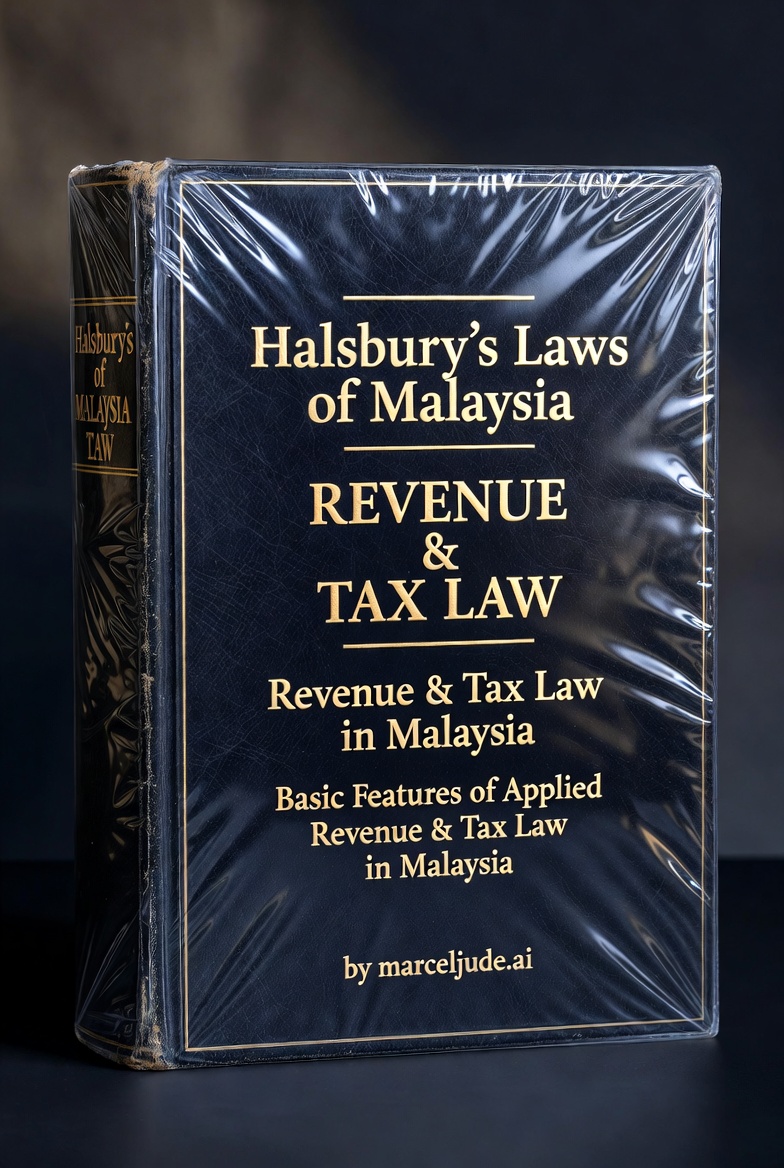


Description
HALSBURY’S LAWS OF MALAYSIA — REVENUE
An Extensive Chapter-by-Chapter Review
By marceljude.ai
I have read the book in full.
LIST OF CONTENTS Chapter 1 — Introduction Overview Historical outline Historical development of income tax Historical development of stamp and estate duties Historical position in Sabah and Sarawak
Paragraphs [480.001]–[480.013]
Chapter 2 — Income Classes of income Manner in which chargeable income is ascertained Current year of assessment and basis periods Transitional provisions concerning the year of assessment Exemptions, remission and related matters Derived and remittance basis Other taxable income
Paragraphs [480.014]–[480.033]
Chapter 3 — Gains or Profits from a Business Meaning and existence of a business Income and source of income Banking Sea and air transport businesses Taxation of companies Insurance and reinsurance businesses Takaful business Partnerships Labuan business activities Leasing
Paragraphs [480.034]–[480.100]
Chapter 4 — Adjusted Income and Deductions General principles Meaning of outgoings and expenses Capital and revenue expenditure Permitted business deductions Prohibited expenditure
Paragraphs [480.101]–[480.124]
Chapter 5 — Capital Allowances and Charges Machinery and plant Industrial buildings Agricultural allowances Forest allowances Capital expenditure on mines Prospecting operations Pre-operational business expenditure
Paragraphs [480.125]–[480.178]
Chapter 6 — Investment Incentives Introduction Pioneer status Losses and capital allowances Total income of pioneer companies Exemption from income tax Investment tax allowance Infrastructure allowance Industrial adjustment allowance Other deductions Incentives under the Income Tax Act 1967
Paragraphs [480.179]–[480.216]
Chapter 7 — Taxation of Gains or Profits from Employment Liability to tax Meaning of employment income Benefits and allowances Exemptions generally Specific exemptions
Paragraphs [480.217]–[480.252]
Chapter 8 — Personal Relief and Exemptions Different forms of personal relief Tax rebates Non-resident relief Company-related exemptions Fund management companies Closed-end companies special-purpose vehicles Investment holding companies Unit trusts Co-operative societies Trade associations and clubs Trade unions
Paragraphs [480.253]–[480.278]
Chapter 9 — Returns, Assessments, Appeals, Collection and Recovery Returns Assessments Special Commissioners of Income Tax Appeal procedures Hearing before the Special Commissioners Appeal to the High Court Judicial review Further appeals Payment of tax Withholding tax Collection and recovery
Paragraphs [480.279]–[480.326]
Chapter 10 — Tax Avoidance Statutory anti-avoidance powers Transactions capable of adjustment
Paragraphs [480.327]–[480.328]
Chapter 11 — Taxation of Other Entities Settlements and tax avoidance Meaning and effect of a settlement Estates Trust bodies Beneficiaries Discretionary and mixed trusts Trust annuities Foreign tax
Paragraphs [480.329]–[480.353]
Chapter 12 — Real Property Gains Tax General principles Chargeability Allowable losses Acquisition and disposal dates Acquisition and disposal prices Transfers to controlled companies Transfers within corporate groups Rates Partnerships Other disposals Real property companies Returns, assessments and appeals Payment, recovery and refunds Exemptions Tax avoidance Remission Investigatory powers Offences and penalties Administration
Paragraphs [480.354]–[480.424]
Chapter 13 — Stamp Duty Introduction and application Instruments General rules Time and mode of stamping Valuation Scope of charge Recovery from third parties Allowances Corporate reconstruction and associated-company relief Principal security instruments Adjudication and appeals Offences and penalties
Paragraphs [480.425]–[480.506]
Chapter 14 — Sales Tax Statutory foundation Assessment Licensing Invoices and records Collection and recovery Inspection, search, seizure and arrest
Paragraphs [480.507]–[480.558]
Chapter 15 — Service Tax Statutory foundation Assessment Licensing Collection and recovery Prescribed establishments and services Inspection, search, seizure and arrest
Paragraphs [480.559]–[480.594]
Chapter 16 — Petroleum Income Tax Scope of petroleum taxation Computation of chargeable income Capital allowances Administration Appeals Collection and recovery Offences and penalties
Paragraphs [480.595]–[480.696]
Chapter 17 — Customs Duty Charge and valuation Import and export duties Warehousing Drawback Exemptions Import and export procedures Search, seizure and enforcement Offences and penalties
Paragraphs [480.697]–[480.745]
Chapter 18 — Excise Duty Levying of excise duties Licensing Vessels in territorial waters Declaration of goods Denaturing of dutiable goods Corporate responsibility Inspection, investigation, search, seizure and arrest Offences and penalties
Paragraphs [480.746]–[480.798]
GENERAL REVIEW OF THE BOOK
Revenue law is sometimes presented as an assortment of rates, schedules, exemptions and administrative forms. This book demonstrates that Malaysian revenue law is considerably more coherent—and more constitutionally significant—than that description suggests.
Its central subject is the legal relationship between the State and the taxpayer. Every tax begins with legislative authority. Every assessment depends upon the identification of a taxable person, source, transaction, instrument or activity. Every collection mechanism must operate within the limits prescribed by statute. Every enforcement power must be reconciled with procedural fairness and access to the courts.
The book’s great strength is its comprehensiveness. It does not confine revenue law to income tax. It moves through business income, employment income, deductions, capital allowances, investment incentives, real property gains tax, stamp duty, sales tax, service tax, petroleum taxation, customs and excise. It therefore reveals the architecture of the Malaysian revenue system as a whole.
A second strength is the integration of substantive and procedural law. The work explains not merely when liability arises, but how returns are made, assessments issued, appeals commenced, tax collected and offences prosecuted. For practising lawyers, that procedural dimension is indispensable.
Its limitation is inherent in the subject. Tax law changes rapidly. Rates, exemptions, statutory names and particular fiscal schemes can be replaced by later legislation. The enduring value of the book therefore lies less in any isolated historical rate than in its explanation of legal concepts: source, income, capital, deductibility, residence, assessment, appeal, statutory construction and enforcement.
CHAPTER-BY-CHAPTER REVIEW CHAPTER 1 — INTRODUCTION Paragraphs [480.001]–[480.013]
The introductory chapter establishes the breadth of the title. It distinguishes direct taxation—such as income tax, petroleum income tax, real property gains tax and stamp duty—from indirect taxation administered principally through customs legislation.
Scope of the title — [480.001]
The opening proposition identifies the book as a treatment of federal revenue derived from taxes and duties. It covers substantive liability, the relevant authorities, administrative procedures and procedural forms.
The exclusion of repealed or expired taxes is conceptually important. Revenue law is a field in which historical liabilities may survive even after a tax has ceased to operate, but a contemporary exposition must distinguish active fiscal law from obsolete schemes.
Revenue authorities — [480.002]–[480.004]
These subsections explain the respective institutional functions of the Inland Revenue Board and the customs administration.
The discussion correctly distinguishes the Board as a statutory body and government agent from the Director General as the holder of particular statutory powers. That distinction matters in litigation. A claim, appeal or judicial-review application may fail if brought against the wrong legal entity.
The chapter also deals with delegation, appointment of officers, public rulings, advance rulings and advance-pricing arrangements. These provisions demonstrate the movement of tax administration from purely retrospective assessment towards prospective regulatory guidance.
Historical development of income tax — [480.005]–[480.010]
The historical account shows that Malaysian income tax law developed through separate territorial systems before consolidation.
This is not merely background. Historical development assists in interpreting statutory language inherited from earlier legislation and Commonwealth tax jurisprudence. It also explains why English, Australian and other Commonwealth authorities have sometimes influenced Malaysian revenue law.
Stamp and estate duties — [480.011]–[480.013]
The book traces the development of stamp and estate duties in the Federated and Unfederated Malay States and separately addresses Sabah and Sarawak.
The Sabah and Sarawak discussion is especially valuable. Sarawak introduced estate duty and a comprehensive stamp regime through its own ordinances, while Sabah developed its corresponding statutory arrangements separately. The later extension of federal legislation did not erase this distinct legislative history.
Assessment of Chapter 1
This is a successful conceptual opening. It places revenue law in its constitutional, historical and administrative setting before undertaking detailed statutory analysis.
Its particular value to lawyers in Sabah and Sarawak is that it does not portray Malaysian fiscal law as having originated solely in Peninsular institutions. It recognises the pre-federal revenue histories of both territories.
CHAPTER 2 — INCOME Paragraphs [480.014]–[480.033]
Chapter 2 develops the conceptual foundation of income taxation.
Classes of income — [480.014]–[480.015]
The book identifies the principal statutory classes:
Business gains or profits; Employment gains or profits; Dividends, interest or discounts; Rent, royalties or premiums; Pensions, annuities and other periodical payments; and Residual gains or profits.
These categories are not necessarily mutually exclusive. Their overlap allows the revenue authority to characterise receipts according to their true legal and commercial nature.
Special classes of income paid to non-residents are treated separately. Technical services, assistance, machinery-related services and payments for the use of movable property may attract Malaysian taxation where the statutory source requirements are satisfied.
Ascertainment of chargeable income — [480.016]
This subsection explains the tax computation as a series of legal stages:
Gross income is identified by source. Permitted deductions produce adjusted income. Capital allowances may then be deducted from business income to produce statutory income. Statutory incomes are aggregated, applicable losses and donations are considered, and personal reliefs are deducted to determine chargeable income.
This is one of the book’s clearest analytical passages. It prevents the common error of treating accounting profit, adjusted income, statutory income, aggregate income, total income and chargeable income as interchangeable concepts.
Basis periods and years of assessment — [480.017]–[480.026]
The provisions concerning basis periods connect an economic activity to a particular year of assessment. Special rules are examined for companies, newly commenced businesses, changes of accounting date and cessation.
These rules are essential because income does not become taxable in the abstract. It must be allocated to a legally recognised assessment period.
Exemptions and remission — [480.027]–[480.029]
The work distinguishes an exemption created by law from a remission granted pursuant to statutory authority. An exemption prevents or limits liability; remission may relieve a liability which would otherwise arise.
That distinction affects pleading, evidential burdens and the identification of the correct decision-maker.
Territorial source and remittance — [480.030]
The source of income is treated as a factual and legal inquiry. Residence of the taxpayer, location of payment and source of the income are distinct questions.
Other taxable income — [480.031]–[480.033]
The residual provisions prevent taxable gains from escaping merely because they do not fit comfortably within conventional categories.
Assessment of Chapter 2
The chapter is doctrinally strong because it supplies the vocabulary required for all later discussion. It shows that income-tax liability is built through classification, source, timing and computation—not simply through the receipt of money.
CHAPTER 3 — GAINS OR PROFITS FROM A BUSINESS Paragraphs [480.034]–[480.100]
This is one of the most substantial parts of the work.
Meaning of business — [480.034]–[480.038]
“Business” is treated broadly and may include a profession, vocation, trade, manufacture, adventure or concern in the nature of trade.
The book discusses the badges of trade: the nature of the property, length of ownership, frequency of transactions, supplementary work, circumstances of realisation, financing and the taxpayer’s intention. No single badge is conclusive. The court must examine the transaction as a whole.
Income and source — [480.039]–[480.047]
The chapter distinguishes capital gains from revenue gains. A profit arising from the ordinary circulation of business capital is generally revenue; a gain arising from the realisation of the business’s permanent structure may be capital.
It also considers:
Identification of a source; Commencement and cessation of a source; Isolated transactions; Compensation receipts; Illegal businesses and expenses; and Mutual trading.
The inclusion of unlawful business income illustrates the neutrality of taxation. Tax law generally asks whether income exists, not whether the activity producing it was lawful. Deductibility of an unlawful payment is a separate question.
Banking — [480.048]
Banking requires special treatment because money is both the bank’s medium of trade and its stock. Interest, securities and funding costs therefore cannot always be analysed through rules designed for an ordinary trader.
Sea and air transport — [480.049]–[480.052]
International transport raises questions of source, residence and treaty allocation. The book explains specialised computation and exemption mechanisms intended to prevent duplicative taxation.
Companies — [480.053]–[480.057]
Corporate residence, control and management, company income and dividend treatment are examined. The discussion recognises that a company is a distinct taxpayer even when its economic benefit ultimately passes to shareholders.
Insurance, reinsurance and takaful — [480.058]–[480.074]
The chapter separately treats:
General insurance; Life insurance; Inward reinsurance; Offshore insurance; Life reinsurance; Incidental income; and Takaful.
This separation is justified because insurance receipts include premiums, investment returns, reserves and actuarial liabilities. Ordinary profit-and-loss analysis cannot simply be applied without modification.
The inclusion of takaful is important. It recognises that Islamic risk-sharing structures require legal and fiscal treatment responsive to their form and substance.
Partnerships — [480.075]–[480.083]
A partnership is not treated in precisely the same way as a company. The book explains the computation of partnership income, divisible income, partners’ shares and the allocation of capital allowances.
The key principle is that the partnership computation is undertaken collectively, but tax consequences are attributed to the partners according to the statutory scheme.
Labuan business activities — [480.084]–[480.099]
The work addresses chargeability, elections, filing, payment, administration and offences in relation to Labuan business activities.
The distinction between trading and non-trading activities is central. The chapter also exposes the continuing legal importance of Labuan to Sabah-based practitioners, notwithstanding its status as a Federal Territory.
Leasing — [480.100]
Leasing creates difficult questions concerning ownership, capital allowances, financing substance and the character of lease payments. The discussion places leasing within the wider business-income framework.
Assessment of Chapter 3
This is a sophisticated chapter. Its principal accomplishment is to show that “business income” is not a single concept. The fiscal treatment changes according to the nature of the enterprise, the source of the receipt and the legal structure through which the activity is conducted.
CHAPTER 4 — ADJUSTED INCOME AND DEDUCTIONS Paragraphs [480.101]–[480.124] General principle — [480.101]
A deduction is not available merely because an expense appears commercially reasonable. It must fall within the statutory deductibility rule and avoid the statutory prohibitions.
Outgoings and expenses — [480.102]–[480.105]
The work analyses the requirement that an expense be wholly and exclusively incurred in producing gross income. The necessary relationship is between the expense and income-producing operations.
The phrase “wholly and exclusively” does not invariably mean that the expense must produce immediate income. It requires an examination of purpose, connection and statutory character.
Capital and revenue expenditure — [480.106]
The distinction between capital and revenue is fundamental. Expenditure creating, acquiring or substantially improving the enduring structure of a business is generally capital. Recurring expenditure incurred in operating that structure is more likely to be revenue.
The distinction cannot be resolved by terminology used in accounts or contracts. The court must determine the real legal and commercial character of the expenditure.
Permitted deductions — [480.107]–[480.123]
The chapter addresses categories such as:
Interest and borrowing expenses; Rent; Repairs; Bad and doubtful debts; Employer contributions; Employee remuneration; Legal and professional expenses; Research expenditure; Promotional expenses; Insurance; and Specific statutory deductions.
Each expense must be tied to the relevant income source.
Prohibited expenditure — [480.124]
Private and domestic expenditure, capital expenditure, income-tax payments and expenses insufficiently connected to income production are among the principal prohibited categories.
Assessment of Chapter 4
This chapter is particularly useful in disputes arising from tax audits. Its central message is that deductibility is a legal conclusion based upon facts, not an automatic consequence of accounting treatment.
CHAPTER 5 — CAPITAL ALLOWANCES AND CHARGES Paragraphs [480.125]–[480.178] Plant and machinery — [480.125]–[480.144]
Capital allowances provide statutory relief for qualifying capital expenditure where an ordinary revenue deduction is unavailable.
The book examines ownership, use in business, qualifying expenditure, initial and annual allowances, disposals, balancing allowances and balancing charges.
A balancing charge prevents excessive relief where an asset is disposed of for an amount exceeding its tax written-down value. A balancing allowance supplies additional relief where the remaining expenditure has not been fully recognised.
Industrial buildings — [480.145]–[480.161]
The chapter distinguishes an industrial building from an ordinary commercial building. The statutory use of the structure is critical.
It examines buildings associated with manufacturing, mining, agriculture, storage, utilities, employee welfare and other specified activities, together with initial and annual allowances.
Agricultural allowances — [480.162]–[480.165]
Qualifying agricultural expenditure can include clearing and preparation of land, planting, roads, bridges, buildings and improvements used for agricultural purposes.
This section has obvious importance to Sabah and Sarawak, where plantations, rural infrastructure and agricultural development remain major economic activities.
Forest allowances — [480.166]–[480.169]
Forestry has long production cycles and substantial preliminary expenditure. Special allowances recognise that conventional annual accounting does not adequately reflect this commercial reality.
Mining expenditure — [480.170]–[480.174]
The work examines capital expenditure on mines, transfers and the treatment of unabsorbed expenditure.
Prospecting and pre-operational expenditure — [480.175]–[480.178]
These provisions recognise expenditure incurred before income production begins. Relief is statutory and therefore depends on compliance with the prescribed conditions.
Assessment of Chapter 5
The chapter successfully explains capital allowances as a self-contained statutory code rather than ordinary depreciation. It is especially relevant to industrial, agricultural, forestry, mining and infrastructure clients.
CHAPTER 6 — INVESTMENT INCENTIVES Paragraphs [480.179]–[480.216] Introduction and pioneer status — [480.179]–[480.186]
Pioneer status is presented as an instrument of economic policy delivered through tax law. Eligibility depends upon statutory approval, the promoted activity or product and compliance with the conditions imposed.
Losses and capital allowances — [480.187]–[480.188]
The chapter explains the treatment of losses and allowances during and after the tax-relief period. This is essential because an incentive may be undermined if losses or allowances are incorrectly allocated.
Total income and exemption — [480.189]–[480.193]
The book examines exempt and non-exempt income and the consequences of maintaining separate income streams or accounts.
Investment tax allowance — [480.194]–[480.206]
Investment tax allowance links relief to qualifying capital expenditure rather than simply exempting profits. The text covers manufacturing, agriculture, tourism and other promoted activities.
Infrastructure and industrial adjustment — [480.207]–[480.208]
Infrastructure allowance recognises investment in specified regions or facilities. Industrial adjustment incentives facilitate modernisation, reorganisation and restructuring.
Other incentives — [480.209]–[480.216]
Further deductions and Income Tax Act incentives are considered, demonstrating that fiscal encouragement is distributed across several statutory mechanisms rather than confined to one Act.
Assessment of Chapter 6
The chapter reveals tax incentives as conditional public-law benefits. Approval, representations, compliance, withdrawal and legitimate expectations may therefore become as important as numerical computation.
For Sabah and Sarawak, investment incentives have additional significance because geography, transport costs, infrastructure needs and regional-development policy may affect both eligibility and commercial value.
CHAPTER 7 — EMPLOYMENT INCOME Paragraphs [480.217]–[480.252] Liability — [480.217]–[480.227]
The chapter identifies employment income broadly. It may include wages, salary, remuneration, leave pay, fees, commissions, bonuses, gratuities, perquisites, benefits in kind, living accommodation, compensation and amounts received from an employee share scheme.
The decisive issue is whether the gain arises from the employment. A payment need not be made by the employer if its true source is the employment relationship.
The book also deals with commencement, termination, lump sums, compensation and the valuation of non-cash benefits.
General and specific exemptions — [480.228]–[480.252]
Exemptions include specified pensions, gratuities, allowances, diplomatic or public-service payments, approved funds, scholarships and other legislatively protected receipts.
The Merdeka bond provision illustrates how exemptions may be used to encourage particular public or financial policies.
Assessment of Chapter 7
This chapter is practical and well organised. It reminds the reader that employment income extends well beyond the employee’s monthly salary and that exemptions must be founded on statutory language.
CHAPTER 8 — PERSONAL RELIEF AND ENTITY EXEMPTIONS Paragraphs [480.253]–[480.278] Personal relief — [480.253]–[480.266]
The book considers residence, individual status, spouses, children, disability, medical expenditure, education, insurance and other forms of relief.
Child relief is treated in detail because entitlement may depend upon age, education, disability, maintenance and the allocation of relief between parents.
Rebates and non-resident relief — [480.267]–[480.270]
A rebate differs from a relief. Relief reduces chargeable income; a rebate operates against the tax otherwise payable. The distinction is computationally and legally significant.
Company and institutional exemptions — [480.271]–[480.278]
The work addresses:
Foreign fund management companies; Closed-end companies; Special-purpose vehicles; Investment holding companies; Unit trusts; Co-operative societies; Trade associations and clubs; and Trade unions.
The legal form of the entity does not alone determine exemption. Its purposes, activities, income and statutory qualification must be considered.
Assessment of Chapter 8
This chapter links tax law to family circumstances and institutional policy. It also shows how Parliament uses exemptions to support particular social and economic objectives.
CHAPTER 9 — RETURNS, ASSESSMENTS, APPEALS, COLLECTION AND RECOVERY Paragraphs [480.279]–[480.326]
This is the book’s principal procedural chapter.
Returns — [480.279]–[480.280]
Taxpayers must furnish prescribed information accurately and within time. Record-keeping obligations support the self-assessment system.
Assessments — [480.281]–[480.288]
The book examines self-assessment, additional assessments, estimated assessments, limitation periods, fraud, wilful default and the finality of assessments.
An assessment is a statutory act with immediate consequences. Its validity depends upon compliance with the statute, but mere disagreement over quantum ordinarily belongs within the appeal machinery.
Special Commissioners — [480.289]–[480.306]
The work covers appointment, jurisdiction, notices of appeal, transmission, review, agreement, hearing, evidence, burden of proof and deciding orders.
A taxpayer generally bears the burden of showing that an assessment is excessive or erroneous. That burden makes contemporaneous documents and expert accounting evidence crucial.
High Court appeal — [480.307]–[480.312]
An appeal from a deciding order is ordinarily concerned with a question of law. The distinction between fact, law and mixed fact and law is therefore central.
The High Court does not simply conduct a fresh assessment. It examines whether the Special Commissioners correctly directed themselves in law and whether their conclusion was legally sustainable.
Judicial review — [480.313]
Judicial review remains relevant where the complaint concerns jurisdiction, procedural unfairness, illegality or another public-law defect. It is not ordinarily a substitute for the statutory appeal merely because the taxpayer disputes the assessment.
Further appeals — [480.314]
Further appellate rights are governed by the applicable procedural and jurisdictional requirements.
Collection and withholding — [480.315]–[480.326]
The book addresses due dates, instalments, increases for late payment, civil recovery, certificates, withholding obligations and the payer’s statutory responsibilities.
The “pay first, dispute later” character of revenue collection is one of the system’s most powerful features. An appeal does not necessarily suspend collection.
Assessment of Chapter 9
For litigators, this is among the most important chapters. Tax disputes are frequently lost through procedural errors: wrong forum, late appeal, failure to preserve evidence, misunderstanding the burden of proof or an incorrect attempt to use judicial review.
CHAPTER 10 — TAX AVOIDANCE Paragraphs [480.327]–[480.328]
The chapter examines the Director General’s power to disregard or vary transactions whose direct or indirect effect is to alter the incidence of tax, relieve liability, evade or avoid duty, or hinder the operation of the taxing legislation.
The distinction between lawful tax planning and impermissible avoidance cannot be resolved by labels. The legal effect, commercial substance, sequence and purpose of the arrangement must be examined.
The chapter is short but conceptually significant. It supplies the bridge between ordinary statutory computation and the revenue authority’s power to reconstruct artificial arrangements.
CHAPTER 11 — TAXATION OF OTHER ENTITIES Paragraphs [480.329]–[480.353] Settlements — [480.329]–[480.336]
The settlement provisions are designed to prevent a taxpayer from diverting income while retaining control or benefit.
The meaning of settlement is examined broadly. The law looks beyond formal title to retained powers, revocability, beneficial enjoyment and the relationship between settlor and recipient.
Estates — [480.337]–[480.340]
The personal representative’s liability and the taxation of estate income are treated separately from the beneficiary’s position.
Trust bodies and beneficiaries — [480.341]–[480.348]
A trust body may be assessed on trust income, while beneficiaries may also have statutory consequences depending on entitlement and distribution. The analysis requires separation between legal ownership, beneficial entitlement and the statutory taxpayer.
Discretionary and mixed trusts — [480.349]–[480.351]
In a discretionary trust, no beneficiary has an automatic right to a specific part of the income until the discretion is exercised. Mixed trusts combine different forms of entitlement and require allocation.
Trust annuities and foreign tax — [480.352]–[480.353]
These subsections address periodic trust payments and relief for foreign taxation.
Assessment of Chapter 11
The chapter is valuable because it treats trusts as fiscal relationships rather than merely private-law arrangements. It should be read together with trust, probate and estate-administration law.
CHAPTER 12 — REAL PROPERTY GAINS TAX Paragraphs [480.354]–[480.424] General principles and chargeability — [480.354]–[480.358]
RPGT applies to gains arising from the disposal of chargeable assets. The book explains the requirements of a disposal, a chargeable asset and a chargeable gain.
Allowable losses — [480.359]
Loss relief is governed by the statute and cannot be assumed merely because a transaction produced an economic loss.
Acquisition and disposal dates — [480.360]–[480.365]
The date of acquisition and disposal may determine the applicable rate, exemption and assessment period. Conditional contracts, compulsory acquisition, gifts and other transactions require specialised rules.
Acquisition and disposal prices — [480.366]–[480.369]
The statutory computation adjusts the consideration by permitted incidental costs, enhancement expenditure, compensation, insurance receipts and other prescribed amounts.
Corporate transfers — [480.370]–[480.371]
Transfers to controlled companies and within groups receive special treatment. Relief is conditional and should not be mistaken for an unrestricted exemption.
Rates and partnerships — [480.372]–[480.373]
Rates depend on statutory classification and timing. Partnership disposals require attention to both partnership property and partners’ interests.
Other disposals and nominees — [480.374]–[480.379]
The chapter considers gifts, nominees, trustees, compulsory acquisitions and other non-standard transactions.
Real property companies — [480.380]–[480.383]
Shares in a real property company may themselves constitute chargeable assets. This prevents parties from avoiding RPGT merely by holding land through a company and selling shares instead of the land.
Returns, assessments and appeals — [480.384]–[480.391]
The procedural framework resembles income-tax administration but operates under its own statute and prescribed forms.
Payment, clearance, recovery and refunds — [480.392]–[480.399]
Retention and remittance obligations imposed upon acquirers are particularly important in conveyancing. The certificate-of-clearance machinery affects completion and release of retained sums.
Exemptions — [480.400]–[480.408]
The book considers gifts, private-residence relief, transfers between spouses and other statutory exemptions.
Avoidance, remission and investigation — [480.409]–[480.412]
Anti-avoidance and investigatory powers safeguard the tax base.
Offences, penalties and administration — [480.413]–[480.424]
Failures to notify, file, disclose or pay may produce civil increases and criminal liability.
Assessment of Chapter 12
This is essential reading for conveyancing and corporate practitioners. It demonstrates that RPGT consequences should be investigated before a transaction is documented, not after completion.
In Sabah and Sarawak, the chapter must be applied alongside the respective land-law systems. The federal tax consequences may be uniform, but the nature, registration and transfer of the underlying land interest are governed by the relevant territorial land legislation.
CHAPTER 13 — STAMP DUTY Paragraphs [480.425]–[480.506] Application and scope — [480.425]–[480.431]
Stamp duty is principally a duty upon instruments, not transactions in the abstract. The legal character of the document is therefore decisive.
Instruments — [480.432]–[480.435]
The work examines executed instruments, instruments comprising several matters and multiple instruments forming part of a single transaction.
General rules — [480.436]–[480.438]
The document must be classified according to its legal effect. Parties cannot avoid duty simply by giving it an inaccurate title.
Time and mode of stamping — [480.439]–[480.442]
The book explains when instruments executed within or outside Malaysia must be stamped, together with the modes of payment and consequences of delay.
An insufficiently stamped instrument may face restrictions on admissibility until duty and penalty are paid.
Valuation — [480.443]
Market value rules prevent understatement of consideration from defeating the statutory charge.
Scope of charge — [480.444]–[480.481]
The chapter gives individual treatment to:
Insurance and life policies; Workmen’s compensation instruments; Securities; Mortgages; Contract notes; Conveyances on sale; Transfers of shares; Voluntary inter vivos conveyances; Conveyances in consideration of debt; Foreclosure orders; Annuities; Exchanges; Transfers of undivided interests; Contracts treated as conveyances; Marketable securities; Overdraft securities; Bonds; Promissory notes; Leases; Agreements effected by correspondence; Duplicates and counterparts; Syariah financing; and Instruments reserving interest.
The inclusion of Syariah financing is significant because a financing arrangement involving several instruments might otherwise suffer a greater duty burden than an economically comparable conventional loan.
Recovery, allowance and relief — [480.482]–[480.487]
The book explains recovery from responsible persons, spoiled or unused instruments, associated-company relief and reconstruction or amalgamation relief.
These reliefs are conditional. Corporate association by itself does not guarantee exemption.
Principal securities — [480.488]
Where several instruments secure the same debt, the identification of the principal security affects the duty payable on collateral instruments.
Adjudication and appeal — [480.489]–[480.492]
Adjudication provides a mechanism for obtaining the Collector’s determination. An aggrieved party must follow the prescribed appeal process and time limits.
Offences and penalties — [480.493]–[480.506]
The chapter covers late stamping, fraudulent devices, false information, unauthorised dealing and related offences.
Assessment of Chapter 13
This is one of the work’s most practically valuable chapters. Stamp-duty liability depends on precise drafting. A document intended to implement one commercial bargain may accidentally create several chargeable instruments if poorly structured.
The discussion is directly relevant to Sabah and Sarawak. The Stamp Act’s historical application to both territories must be understood together with their distinctive land-registration documents and practices.
CHAPTER 14 — SALES TAX Paragraphs [480.507]–[480.558] Charge and assessment — [480.507]–[480.515]
The chapter explains the statutory charge on taxable goods, the identification of manufacturers and importers, valuation, exemptions and assessment.
Licensing — [480.516]–[480.520]
Licensing controls participation in taxable manufacturing activities. Obligations may attach even before an assessment is issued.
Invoices and records — [480.521]–[480.526]
Invoices, books and records are indispensable to tax verification. Failure to preserve them may create adverse assessments and separate offences.
Collection and recovery — [480.527]–[480.552]
The work addresses payment, demands, civil recovery, security, refunds, drawback, remission and other collection measures.
Inspection, search, seizure and arrest — [480.553]–[480.558]
These provisions confer coercive powers upon enforcement officers. Their exercise must remain within statutory conditions concerning authority, premises, goods, documents and suspected offences.
Assessment of Chapter 14
Although the specific fiscal regime discussed is historically situated, the chapter retains value for its explanation of indirect-tax administration: licensing, documentation, assessment, recovery and enforcement.
CHAPTER 15 — SERVICE TAX Paragraphs [480.559]–[480.594] Statutory charge — [480.559]–[480.563]
Service tax depends upon the provision of a taxable service by a taxable or licensed person within the statutory framework.
Licensing — [480.564]–[480.568]
The licensing regime determines who must register or obtain authority and what obligations follow.
Collection and recovery — [480.569]–[480.586]
The book treats invoices, accounting periods, payment, assessment, additional assessment, recovery, refunds, penalties and record keeping.
Prescribed establishments and services — [480.587]–[480.589]
The tax applies by reference to prescribed categories. Classification of the establishment and service is therefore critical.
Investigation and enforcement — [480.590]–[480.594]
Search, seizure and arrest powers support compliance but must be exercised in accordance with the legislation.
Assessment of Chapter 15
The chapter demonstrates that indirect taxation turns heavily upon statutory definitions. Commercial descriptions are not conclusive; the actual service and the statutory category must be compared.
CHAPTER 16 — PETROLEUM INCOME TAX Paragraphs [480.595]–[480.696] Scope — [480.595]–[480.603]
The petroleum tax regime is specialised because of the scale, risk, geography and contractual organisation of petroleum operations.
The book examines chargeability, petroleum operations, chargeable persons, residence, basis periods and the territorial scope of operations.
Computation — [480.604]–[480.629]
Gross income, permitted deductions, prohibited expenses, abandonment expenditure, interest, royalties, rent, losses and chargeable income are separately considered.
The ring-fencing of petroleum operations prevents unrelated expenditure from being used indiscriminately against petroleum profits.
Capital allowances — [480.630]–[480.658]
The First and Second Schedules govern qualifying expenditure, plant, machinery, industrial buildings, disposal adjustments and allowances.
Administration — [480.659]–[480.668]
Returns, information, assessments, additional assessments and the functions of the revenue authority are addressed.
Appeals — [480.669]–[480.680]
The appeal framework includes notices, review, commissioners, hearings, evidence and deciding orders.
Collection and recovery — [480.681]–[480.687]
The book examines payment, increases, recovery proceedings and related mechanisms.
Offences and penalties — [480.688]–[480.696]
False returns, failure to furnish information, obstruction and wilful evasion are treated separately.
Assessment of Chapter 16
This chapter has exceptional relevance to Sabah and Sarawak because a substantial part of Malaysia’s petroleum industry is associated with those territories and their adjacent waters.
The chapter is primarily a federal tax analysis. It does not, by itself, resolve constitutional questions concerning ownership, territorial entitlements, petroleum agreements or the distribution of federal revenue. Nevertheless, it supplies essential background for understanding the revenue generated from petroleum operations.
CHAPTER 17 — CUSTOMS DUTY Paragraphs [480.697]–[480.745]
The chapter deals with importation, exportation, valuation, declaration, warehousing, drawback, exemptions, prohibited goods, customs control and enforcement.
Customs liability depends upon the classification, origin, value, quantity and movement of goods. The point at which goods enter or leave the customs territory may be decisive.
Warehousing permits duty to be suspended while goods remain under customs control. Drawback allows repayment in specified circumstances, particularly where imported inputs are later exported.
The enforcement provisions cover searches, seizure, detention, forfeiture and offences. Customs forfeiture may operate against the goods independently of personal criminal liability, subject to the statutory scheme.
Assessment of Chapter 17
The chapter combines fiscal law with border regulation. Customs legislation is not limited to raising money; it also controls the movement of goods and protects regulated markets.
Its importance to Sabah and Sarawak is considerable because both territories have extensive coastlines, ports, cross-border trade and distinctive geographical enforcement conditions.
CHAPTER 18 — EXCISE DUTY Paragraphs [480.746]–[480.798] Levying of duty — [480.746]–[480.758]
Excise duty generally attaches to specified goods manufactured domestically or moved within the relevant statutory territory. The book examines rates, exemptions, drawback and movement of goods.
Licensing — [480.759]–[480.766]
Manufacture, storage and dealing in excisable goods may require licences. Conditions may regulate premises, equipment, quantities, records and security.
Vessels and territorial waters — [480.767]–[480.768]
Special provisions prevent vessels from being used to evade controls over excisable goods.
Declaration and denaturing — [480.769]–[480.771]
Declarations facilitate assessment and control. Denaturing changes goods so that they cannot ordinarily be used for the dutiable purpose and may consequently receive different treatment.
Companies — [480.772]–[480.773]
Corporate offences may extend liability to directors, managers or responsible officers where the statutory conditions are satisfied.
Inspection, investigation, search, seizure and arrest — [480.774]–[480.787]
The chapter explains access to premises and records, seizure of goods and conveyances, production of documents and arrest powers.
Offences and penalties — [480.788]–[480.798]
Offences include unlawful manufacture, possession, removal, concealment, false declarations, obstruction and evasion.
Assessment of Chapter 18
The final chapter completes the book’s movement from direct taxation to highly regulated commodity taxation. It shows how fiscal collection and criminal enforcement converge in customs and excise law.
THE BOOK’S TREATMENT OF SABAH AND SARAWAK
The book is important to Sabah and Sarawak for five principal reasons.
First, it recognises that both territories possessed distinct revenue histories before the application of uniform federal legislation. The account at [480.013] is therefore constitutionally and historically significant.
Second, federal revenue statutes operate upon transactions whose underlying private-law character may be determined by Sabah or Sarawak law. A land transfer may attract federal stamp duty or RPGT, but the nature and validity of the land interest must be determined under the applicable territorial land regime.
Third, petroleum income taxation has disproportionate practical importance to Sabah and Sarawak. The federal tax system cannot be considered in isolation from wider constitutional debates about petroleum resources and the distribution of revenue.
Fourth, customs and excise enforcement has particular significance because of the territories’ long coastlines, maritime trade and international borders.
Fifth, Labuan’s fiscal system has a close economic and geographical relationship with Sabah. Sabah practitioners advising corporations, financial businesses, trusts and cross-border enterprises must therefore understand both the general Malaysian system and the specialised Labuan regime.
The constitutional allocation of revenue must also be distinguished from tax liability. A federal statute may determine what a taxpayer owes, while the Federal Constitution determines how specified revenues, grants or assignments are distributed between the Federation and the States. The book supplies the taxation foundation, but constitutional fiscal disputes require an additional examination of the Federal Constitution and the relevant intergovernmental arrangements.
CRITICAL EVALUATION Strengths
The book is exceptionally comprehensive.
It integrates direct taxes, transactional duties, commodity taxes and enforcement law within one coherent title.
Its numbered propositions make legal research efficient and permit precise citation.
The treatment of assessments and appeals is especially valuable to advocates.
The work does not overlook Sabah and Sarawak’s separate historical development.
Its analysis repeatedly distinguishes legal substance from accounting or commercial labels.
Limitations
Revenue law changes faster than most fields. A reader must verify whether particular rates, exemptions, institutional descriptions or taxing statutes remain operative.
The book’s encyclopaedic style sometimes states rules more readily than it explores their constitutional implications.
The treatment of Sabah and Sarawak is valuable but comparatively brief when measured against the territories’ distinctive land, petroleum, customs and constitutional concerns.
The work could give greater prominence to taxpayer rights, proportionality in enforcement, legitimate expectation arising from public rulings and the relationship between statutory appeals and judicial review.
OVERALL VERDICT
Halsbury’s Laws of Malaysia — Revenue is a formidable exposition of Malaysian taxation and fiscal administration. Its greatest achievement is the presentation of revenue law as an interconnected legal system rather than a collection of unrelated taxes.
For students, it provides the conceptual vocabulary of income, source, residence, deductions, capital allowances and assessments.
For transactional lawyers, it supplies indispensable guidance on RPGT and stamp duty.
For litigators, its treatment of assessments, statutory appeals, judicial review, recovery and evidential burdens is of immediate practical value.
For corporate and commercial advisers, it explains the consequences of business structure, investment incentives, partnerships, insurance, Labuan activities and corporate reorganisations.
For Sabah and Sarawak lawyers, it provides both historical recognition and a federal fiscal framework that must be read alongside territorial land law, petroleum arrangements and constitutional revenue provisions.
The book deserves to be regarded as a foundational Malaysian revenue-law reference. Its rules must be checked against subsequent legislation, but its legal method remains compelling: identify the taxpayer, classify the receipt or instrument, establish territorial and temporal connection, calculate liability according to statute, and challenge administrative action through the correct procedure.
That method is the enduring intellectual contribution of the work.
Final Rating by marceljude.ai
Doctrinal coverage: Exceptional
Practical usefulness: Exceptional
Procedural treatment: Highly authoritative
Treatment of Sabah and Sarawak: Important but capable of further expansion
Value to practitioners and students: Indispensable
Overall assessment: A major and enduring work of Malaysian revenue law.
- MALAYSIA'S 1ST AI LAWYER - CLICK HERE
- ISMAIL – INTEGRATED SINGAPORE/MALAYSIA AI & LAW (Library)
- OPENING OF SINGAPORE MALAYSIA AI CENTRE AND LAW LIBRARY
- LIFT - LAW INSTRUMENTS FORMS & TEMPLATES
- LAWS OF MALAYSIA FOR SINGAPOREAN DUMMIES
- HANNAH YEOH'S ARTIFICIAL INTELLIGENCE LAW ENCYCLOPEDIA
- LEAD CR - Law Ecosystem Archive Databases on CD-ROM
- BREAKING NEWS FROM MJN
- CLICK HERE CO. PROFILE
- EXCITING NEW SERIES - THE ADVENTURES OF BOBBY TAN -ADVOCATE & SOLICITOR IN THE HIGH COURT OF NORTH BORNEO by marceljude.ai
- MEDICO LEGAL - BY PRISKILA AKWILA & GLORIOUS PETAL SDN BHD - powered by marceljude.ai
- MISCELLANOUS
- ANNOTATED STATUTES OF SABAH - A NEW SERIES
- e-library - marceljude.ai
- DRAFT - DOCUMENT RESEARCH & AUTOMATED FILING TECHNOLOGY
- CLARA – Case Law Analysis & Retrieval AI
- FOR RESEARCH REQUEST CLICK HERE
- CLICK HERE TO ASK ANYTHING
- RAMBO'S LAW - THE LAW OF THE LAW JUNGLE - EXCITING NEW SERIES - CASE ANALYSIS BY JOHN RAMBO @ +60138646786
- PRISKILA AKWILA ADVOCATES - High Court of Sabah & Sarawak @ Kota Kinabalu
- COLA - COMMONWEALTH ONLINE LAWCASES AI -marceljude.ai
- THE LAW LIBRARY THAT COMES TO YOU ANYWHERE AND ANYTIME
- marceljude.ai training academy
