
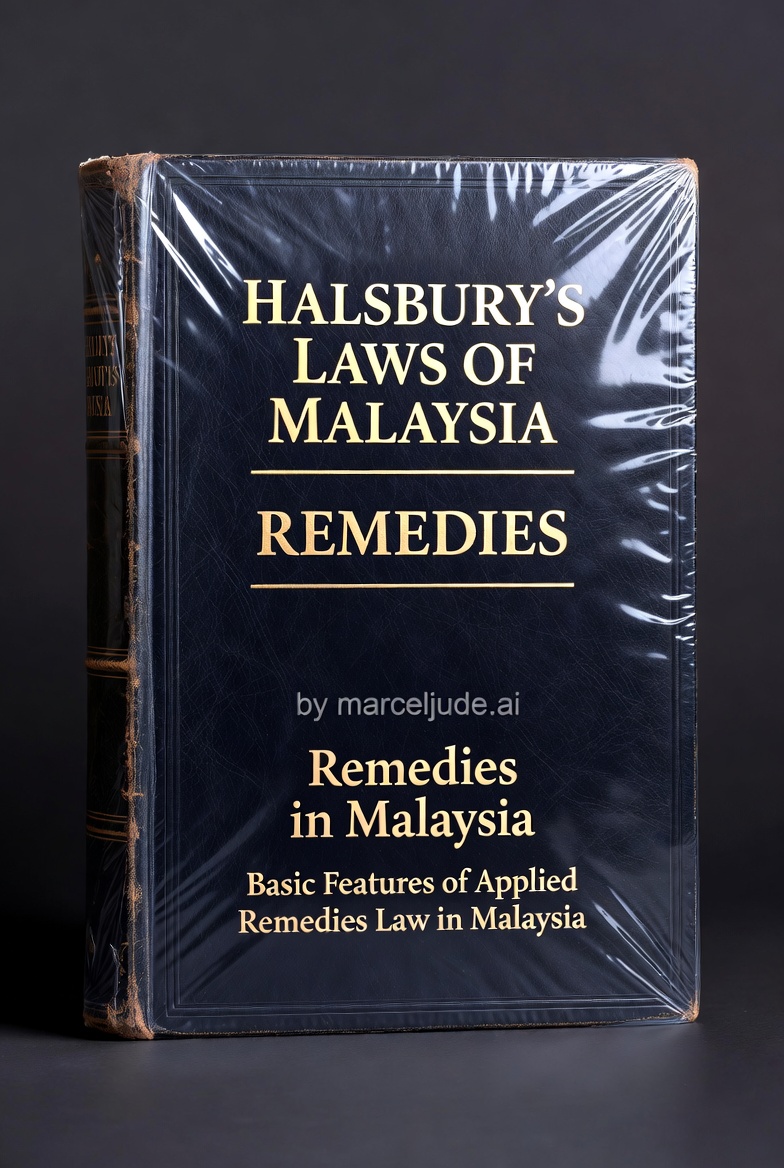
HALSBURY’S LAWS OF MALAYSIA — REMEDIES - Review by marceljude.ai


Description
HALSBURY’S LAWS OF MALAYSIA — REMEDIES
An Extensive Chapter-by-Chapter Review
Review by marceljude.ai
I have read the book in full.
The work is organised principally by numbered propositions running from [300.001] to [300.141],.
Accordingly, every part of this review is tied to the book’s own paragraph numbers, which provide a more precise reference than a general page citation. Any reported-law page numbers appearing in the book refer to the relevant law reports, not to pages of the book itself.
LIST OF CONTENTS Chapter One — Introduction
Paragraphs [300.001]–[300.010]
The law relating to remedies — [300.001]
The Civil Law Act 1956 — [300.002]
English common law and rules of equity — [300.003]
Ambit of English common law and equitable rules — [300.004]
Equitable remedies — [300.005]
Contractual remedies — [300.006]
Tortious remedies — [300.007]
Limitation of actions — [300.008]
Streamlining the obtaining of remedies — [300.009]
Relationship between common law and Malaysian legislation — [300.010]
Chapter Two — Contractual Remedies
Paragraphs [300.011]–[300.037]
Remedies under the common law
Common-law damages — [300.011]
Right to common-law damages — [300.012]
Privity and relief — [300.013]
Discharge of contract by breach — [300.014]
The rule in Hadley v Baxendale — [300.015]
Application of the rule — [300.016]
Developments in the application of the rule — [300.017]
Modern bases of damages — [300.018]
Effect of vitiating factors — [300.019]
Frustration — [300.020]
Assessment of damages
Avoidance of contracts
Quantum meruit
Remedies under the Contracts Act 1950
Development of Malaysian contract law — [300.022]
Formation of a contract in Malaysia — [300.023]
Avoidance on the basis of vitiating factors — [300.024]
The Contracts Act 1950 — [300.025]
General ambit of the Act — [300.026]
Provisions on remedies — [300.027]
When compensation may be awarded — [300.028]
Interpretation of compensation provisions — [300.029]
Compensation for loss caused by breach — [300.030]
Failure to discharge contract-like obligations — [300.031]
Illustrations of compensation — [300.032]
Reimbursement for necessaries — [300.033]
Reimbursement of an interested person — [300.034]
Compensation following rightful rescission — [300.035]
Assessment of compensation and reimbursement — [300.036]
Penalties and liquidated sums — [300.037]
Restitution under the Contracts Act 1950
Indemnities
Chapter Three — Equitable Remedies
Paragraphs [300.040]–[300.126]
General equitable remedies
Equitable principles — [300.040]
Equitable maxims — [300.041]
Discretionary bars to relief — [300.042]
Fraud — [300.043]
Equitable restitution — [300.044]
Nature of restitutionary relief — [300.045]
Unconscionable transactions
Estoppel
Fiduciary obligations — [300.047]
Effect upon the contract — [300.049]
Readiness and willingness — [300.050]
Inadequacy of damages — [300.051]
Supervision by the court — [300.052]
Whether a proprietary interest is necessary — [300.053]
Damages in addition to or instead of specific performance — [300.054]
Types of injunctions — [300.055]
Interlocutory injunctions — [300.056]
Exclusive equitable jurisdiction — [300.057]
Auxiliary jurisdiction — [300.058]
Negative covenants — [300.059]
Mareva injunctions — [300.060]
Rectification
Declarations
Delivery up and cancellation — [300.063]
Rescission — [300.064]
Tracing — [300.065]
Mixed funds — [300.066]
Property transferred to third parties — [300.067]
Account
Specific restitution — [300.069]
Remedies under the Specific Relief Act 1950
Statutory equitable remedies — [300.070]
Limits of equitable relief — [300.073]
No enforcement of penal laws — [300.074]
Recovery of immovable property — [300.075]
Recovery of movable property — [300.076]
Specific performance — [300.077]
Enforceable contracts — [300.078]
Partial destruction of the subject matter — [300.079]
Small unperformed part — [300.080]
Large unperformed part — [300.081]
Independent part of a contract — [300.082]
Other bars to partial performance — [300.083]
Purchaser’s rights against vendor with imperfect title — [300.084]
Compensation accompanying specific performance — [300.085]
Liquidated damages not a bar — [300.086]
Contracts not specifically enforceable — [300.087]
Judicial discretion — [300.088]
Persons entitled to specific performance — [300.089]
Personal bars — [300.090]
Vendors without title and voluntary settlements — [300.091]
Enforcement subject to variation — [300.092]
Enforcement against subsequent claimants — [300.093]
Persons who cannot be compelled to perform — [300.094]
Effect of dismissal — [300.095]
Awards and testamentary settlements — [300.096]
Rectification — [300.097]
When an instrument may be rectified — [300.098]
Real intention of the parties — [300.099]
Principles governing rectification — [300.100]
Enforcement of a rectified contract — [300.101]
Rescission — [300.103]
Rescission for mistake — [300.104]
Alternative prayer for rescission — [300.105]
Duty to do equity — [300.106]
Partial cancellation — [300.108]
Compensation following cancellation — [300.109]
Cancellation in place of other relief — [300.110]
Declaratory relief — [300.111]
Effect of a declaration — [300.112]
Receivers — [300.113]
Enforcement of public duties — [300.114]
Procedure — [300.115]
Peremptory order — [300.116]
Execution and appeal — [300.117]
Costs — [300.118]
Bar to mandamus — [300.119]
Temporary injunctions — [300.121]
General principles of injunctions — [300.122]
Perpetual injunctions — [300.123]
Mandatory injunctions — [300.124]
Refusal of injunctions — [300.125]
Enforcement of negative agreements — [300.126]
Chapter Four — Concurrent Rights in Contract and Tort
Paragraphs [300.128]–[300.135]
Contractual and tortious liability — [300.128]
Liability of a lawyer — [300.129]
Limitations — [300.130]
Solicitors and negligent misstatement — [300.131]
Heads of damage — [300.132]
Barriers to relief — [300.133]
Restrictions on concurrency — [300.134]
Concurrency in Malaysia — [300.135]
Chapter Five — Damages in Tort
Paragraphs [300.136]–[300.141]
Damages — [300.136]
Principles governing common-law tort remedies
Negligence in Malaysia — [300.139]
Donoghue v Stevenson — [300.140]
Representations and negligent statements — [300.141]
OVERALL REVIEW OF THE BOOK
The central achievement of Halsbury’s Laws of Malaysia — Remedies is that it treats remedies as a coherent field of law rather than as an assortment of orders appended to substantive causes of action.
That approach is jurisprudentially important. A right without an effective remedy may have little practical value. Conversely, the availability, scope and discretionary character of a remedy may determine whether litigation is worth commencing even before the final merits are considered. The book therefore asks not merely whether a claimant has a right, but what a Malaysian court may actually do after finding that the right has been infringed.
The work is built around three intersecting legal sources:
Malaysian legislation, particularly the Contracts Act 1950 and Specific Relief Act 1950; Malaysian judicial decisions applying and interpreting those enactments; and received principles of English common law and equity, subject to the Civil Law Act 1956, local written law and local circumstances.
Its architecture moves logically from foundations to application. It begins by identifying the sources of remedial law. It then considers contractual remedies, equitable remedies, concurrent liability and tortious damages. The result is an account of remedial law that crosses the artificial boundaries between contract, tort, restitution and equity.
The book is particularly strong in demonstrating that Malaysian remedial law is neither wholly codified nor simply imported English law. Malaysian statutes frequently embody older common-law or equitable propositions, sometimes accompanied by statutory illustrations. Those statutory provisions must be interpreted as Malaysian law. English decisions may illuminate their origins, but cannot automatically displace their language.
This is especially important in Sabah and Sarawak. The Civil Law Act supplies different historical reception dates:
West Malaysia: 7 April 1956; Sabah: 1 December 1951; Sarawak: 12 December 1949.
Those dates do not mean that Malaysian courts must mechanically freeze the law at a historical point. They do, however, require careful analysis of whether an asserted English doctrine is received law, persuasive development, or incompatible with Malaysian legislation and local circumstances.
The book’s greatest practical lesson is that counsel must formulate the remedy at the beginning of a case. Pleading a wrong without pleading the correct remedial foundation may produce an empty victory. A claimant seeking specific performance, rescission, rectification, restitution, an injunction and damages must appreciate that each remedy has distinct elements, defences and consequences.
CHAPTER ONE INTRODUCTION Paragraphs [300.001]–[300.010] 1. The law relating to remedies — [300.001]
The opening proposition explains that Malaysian remedial law has plural sources. Some remedies are statutory; others arise from common law or equity. This is the key to the entire book.
The statutory centre of the subject includes the Contracts Act 1950 and Specific Relief Act 1950. Yet these statutes do not operate in intellectual isolation. Their concepts—compensation, rescission, restitution, specific performance, injunction and rectification—were shaped by earlier common-law and equitable traditions.
The book correctly warns against treating remedies as belonging to a single source. Damages may arise under statute or common law. Specific performance has equitable origins but is also regulated by statute. Restitution may arise after the avoidance of a contract, from failure of consideration, under quasi-contractual statutory provisions, or through fiduciary and tracing principles.
A particularly valuable observation concerns statutory explanations and illustrations. These illustrations frequently preserve the reasoning of older cases. They are therefore not decorative examples. They help reveal the legislative structure and intended application of the provision.
The chapter introduces a continuing tension: when should a court follow the literal language of a Malaysian statute, and when may it develop the law through equitable or common-law principle? The book’s answer is that local written law is primary, while received law fills genuine gaps and assists interpretation where compatible.
2. The Civil Law Act 1956 — [300.002]
This section provides the constitutional and statutory gateway through which English common law and equity enter Malaysian law.
The Civil Law Act was extended to Sabah and Sarawak from 1 April 1972. Its importance is not that it makes English law automatically applicable, but that it defines the circumstances and limits of reception.
The book identifies several matters governed by the Act:
application of English common law and rules of equity; reception of statutes of general application in Sabah and Sarawak, subject to the prescribed dates; exclusion of English land tenure and conveyancing law; remedies following frustration; and certain principles concerning fatal accidents, contribution and civil liability.
The exclusion concerning land law is especially important. Malaysia employs statutory systems of registered title. In Sabah and Sarawak, the Sabah Land Ordinance and Sarawak Land Code provide their own regimes. English doctrines concerning land cannot be introduced if they conflict with those regimes.
This has direct remedial consequences. A claimant cannot assume that an English proprietary remedy, estate or conveyancing doctrine applies merely because an analogous English case exists. The court must first examine the local land legislation.
At the same time, the rejection of English land tenure does not necessarily eliminate all equitable doctrines affecting transactions concerning land. Estoppel, constructive trust, fiduciary obligation or specific performance may still be relevant where they do not contradict the governing statutory land code.
3. English common law and rules of equity — [300.003]
This subsection examines the reception dates and the debate over whether the law is static or capable of development.
The reception dates establish the historical law initially available for adoption. Nevertheless, later English, Australian, Singaporean and other Commonwealth authorities may remain persuasive, particularly where they explain an existing principle rather than introduce an incompatible statutory rule.
The governing limitations are:
there must be no controlling Malaysian written law; there must be a genuine gap in Malaysian law; the received rule must be suitable to local circumstances; and its application must not contradict Malaysian public policy.
The section is valuable because it rejects both extremes. Malaysian law is not merely English law under another name. Equally, Malaysian courts need not disregard later Commonwealth developments that logically elaborate an already received principle.
The preferable method is principled adaptation. A Malaysian court should identify the underlying doctrine, examine its statutory compatibility and decide whether contemporary application is suitable in local conditions.
For Sabah and Sarawak, the local-circumstances qualification is especially important. Land customs, native rights, regional legislation and distinctive historical institutions can make a rule suitable in Peninsular Malaysia inappropriate in East Malaysia.
4. Ambit of application — [300.004]
The book stresses that English law only operates to fill a lacuna. It is not available to rewrite an existing Malaysian statute merely because the English position appears more modern or convenient.
A proper judicial inquiry should therefore proceed in stages:
Identify the precise issue. Determine whether Malaysian written law governs it. Examine Malaysian authorities construing that written law. Decide whether a genuine gap remains. If a gap exists, consider the relevant received common-law or equitable rule. Modify or reject that rule if local circumstances require.
This section exposes one of the most frequent errors in Malaysian advocacy: citing an English authority before establishing that English law is legally receivable on the particular issue.
The book also recognises that the common law develops incrementally. Malaysian courts may develop Malaysian common law through precedent without pretending that every development is directly imported under the Civil Law Act.
5. Equitable remedies — [300.005]
Equitable remedies are distinguished by their discretionary character. A claimant may prove an underlying right yet still be refused relief because of delay, acquiescence, hardship, lack of clean hands, impossibility of supervision or inadequacy in the claimant’s own performance.
Equity is nevertheless not arbitrary. Judicial discretion is governed by settled principles. The court must give reasons and apply the relevant equitable considerations consistently.
The book treats equity as both corrective and preventive. Its remedies may:
restrain a threatened wrong; compel performance; reverse an unconscionable transaction; correct a written instrument; restore property; trace substitutes for property; require an account; or declare the parties’ rights before further injury occurs.
The subsection prepares the reader for the extensive treatment of specific performance, injunctions, rescission, rectification and tracing in Chapter Three.
6. Contractual remedies — [300.006]
Contractual remedies protect the performance interest created by agreement. The ordinary remedy is damages, but damages are not the only response.
Depending on the breach and the nature of the contract, relief may include:
compensation; termination or discharge; restitution; recovery on a quantum meruit; specific performance; injunction; rescission; and rectification.
The book correctly distinguishes liability from remedy. Proof of breach does not itself determine whether the claimant may terminate the agreement, claim damages while affirming it, obtain restitution, or compel performance.
The nature of the term breached matters. Breach of a warranty ordinarily sounds only in damages. Breach of a condition may permit termination. Breach of an innominate term depends upon the seriousness of its consequences.
7. Tortious remedies — [300.007]
Tortious damages generally seek to place the claimant in the position that would have existed had the tort not occurred. This differs from the contractual expectation measure, which ordinarily places the claimant in the position expected if the contract had been performed.
The distinction affects causation, remoteness, mitigation and quantification.
The book also prepares the reader for cases where identical facts support both contract and tort. Professional negligence is the clearest example. A lawyer may owe contractual duties arising from the retainer and a concurrent tortious duty of care.
8. Limitation of actions — [300.008]
Limitation is treated as an integral part of remedial law. A cause of action may be substantively valid but procedurally unenforceable after the limitation period expires.
The relevant legislation differs regionally. Sabah and Sarawak have their own limitation legislation. Practitioners must therefore avoid applying Peninsular limitation provisions indiscriminately to East Malaysian proceedings.
Limitation questions include:
when the cause of action accrued; whether damage is an essential element; latent damage; acknowledgment or part payment; fraud or concealment; disability; continuing wrongs; and the distinction between legal and equitable relief.
Equity also has doctrines such as laches and acquiescence. A claim may consequently fail for unreasonable delay even if a statutory limitation period has not technically expired.
9. Streamlining the obtaining of remedies — [300.009]
This section addresses procedural efficiency. Substantive and procedural law should operate together so that the court can determine all connected relief in one proceeding where appropriate.
The modern judicial preference is to avoid needless multiplicity of actions. Alternative and cumulative remedies may be pleaded, subject to rules against double recovery and inconsistent final elections.
A claimant may, for example, seek:
specific performance and alternatively damages; rectification followed by specific performance; rescission and consequential restitution; an injunction together with damages; or declarations supporting consequential orders.
Counsel should distinguish alternative relief from cumulative relief. A party may plead inconsistent remedies initially but cannot necessarily obtain final judgment on mutually destructive bases.
10. Relationship between common law and legislation — [300.010]
The final introductory subsection explains that legislation may codify, modify or displace common law.
The correct interpretive method begins with the statutory text. Historical common law may explain the mischief or conceptual background, but cannot override clear statutory language.
This principle is particularly important under the Contracts Act 1950 and Specific Relief Act 1950. English cases may be useful, but the court must ultimately apply the Malaysian enactment.
The chapter’s overall achievement is to establish a disciplined hierarchy:
Federal and State legislation; binding Malaysian precedent; applicable received common law and equity; persuasive Commonwealth developments; and discretionary remedial principles applied to the facts.
CHAPTER TWO CONTRACTUAL REMEDIES Paragraphs [300.011]–[300.037] 1. Common-law damages — [300.011]
Damages are presented as the conventional response to breach. They are compensatory, not ordinarily punitive. Their purpose is to protect the claimant’s expectation, reliance or, in appropriate cases, restitutionary interest.
The court must distinguish:
expectation loss; reliance expenditure; consequential loss; loss of profit; loss of opportunity; wasted expenditure; diminution in value; cost of cure; and non-pecuniary loss.
The claimant cannot recover twice for the same injury. Reliance damages cannot be used to escape the consequences of a bad bargain where the defendant proves that the expenditure would have been lost even upon full performance.
2. Right to damages — [300.012]
A breach normally gives rise to a right to damages even where no substantial financial loss is proved. Nominal damages may vindicate the right.
Substantial recovery requires proof of actual loss, causation and remoteness. The claimant must also mitigate avoidable loss.
The section usefully explains that damages follow from breach, whereas termination depends upon the quality and seriousness of the breach. A minor breach may produce damages without giving a right to terminate.
3. Privity and relief — [300.013]
The doctrine of privity limits contractual enforcement to parties to the agreement. A person who benefits from a contract but is not a party ordinarily cannot sue upon it.
The book recognises traditional exceptions and devices, including:
trusts; agency; assignment; restrictive covenants; negotiable instruments; collateral contracts; and statutory exceptions.
The section is critical because remedial standing precedes quantification. A person may have suffered real loss yet lack the contractual standing to recover it.
Malaysian law retains the doctrine subject to recognised exceptions. Counsel should therefore identify precisely whether the claimant sues as contracting party, assignee, beneficiary, principal, trustee or under an independent duty.
4. Discharge by breach — [300.014]
This is among the book’s most valuable conceptual sections.
It distinguishes:
breach of warranty; breach of condition; serious or non-serious breach of an innominate term; repudiatory breach; anticipatory breach; affirmation; termination; and rescission.
Breach of a warranty generally permits damages but not termination. Breach of a condition generally permits termination and damages. For an innominate term, the court examines whether the consequences substantially deprive the innocent party of the contractual benefit.
The innocent party must elect whether to accept a repudiation or affirm the contract. Affirmation keeps the contract alive for both parties and may expose the affirming party to continuing obligations.
The book rightly warns against describing termination for breach as “rescission.” True rescission ordinarily sets aside a transaction and seeks restoration. Termination for breach discharges future performance but does not erase accrued rights.
5. The rule in Hadley v Baxendale — [300.015]
The classical rule divides recoverable loss into two limbs:
loss arising naturally in the ordinary course from the breach; and unusual loss within the reasonable contemplation of both parties because special circumstances were communicated.
The rule is concerned with the scope of responsibility assumed through the contract. It prevents contractual liability from becoming unlimited.
The decisive question is not merely whether the loss was factually caused by the breach. It is whether the kind of loss was sufficiently foreseeable or contemplated when the contract was made.
6. Application of Hadley v Baxendale — [300.016]
The application of the rule requires attention to the contracting parties’ knowledge.
Ordinary knowledge is imputed from the transaction. Special knowledge depends upon communication. A claimant seeking unusual consequential loss must therefore prove that the defendant knew the special circumstances at the time of contracting.
The degree of probability required in contract is traditionally more restrictive than the reasonable foreseeability test in tort. The book shows, however, that modern authorities increasingly explain the result through assumed responsibility and contractual allocation of risk.
7. Developments in the rule — [300.017]
The subsection follows the evolution from rigid remoteness formulas toward a contextual examination of the contract.
Relevant matters include:
commercial purpose; parties’ knowledge; contractual allocation of risk; market practice; exclusion or limitation clauses; the price charged; and whether the loss was a type the defendant reasonably undertook to bear.
This development makes damages more sensitive to the bargain itself. It also reduces the temptation to treat every foreseeable consequence as recoverable.
8. Modern bases of damages — [300.018]
The work examines expectation, reliance and opportunity-based recovery.
Expectation damages protect the promised performance. Reliance damages reimburse expenditure reasonably incurred in reliance on the agreement. Loss-of-chance damages may be awarded where the breach destroyed a real and measurable opportunity, even though the ultimate outcome cannot be proved with certainty.
The distinction between uncertainty as to causation and uncertainty as to amount is important. A claimant must prove that the breach caused loss. Once some loss is established, difficulty in exact calculation should not automatically defeat recovery.
9. Vitiating factors — [300.019]
Mistake, misrepresentation, fraud, undue influence, duress and unconscionability may affect the existence or enforceability of contractual consent.
The remedial consequences differ:
a contract may be void; voidable at the election of one party; unenforceable; rectifiable; rescindable; or capable of supporting damages or restitution.
The book’s strength lies in resisting the assumption that all defective-consent cases produce the same result. The practitioner must identify the exact vitiating factor and its corresponding remedial consequences.
10. Frustration — [300.020]
Frustration discharges a contract when a supervening event, without the fault of either party, makes performance impossible, illegal or radically different.
The doctrine must be applied narrowly. Mere inconvenience, increased expense or a bad bargain is insufficient.
The Civil Law Act regulates the financial consequences. Questions may arise concerning:
money paid before frustration; expenses incurred; valuable benefits conferred; and adjustment between the parties.
Frustration differs from breach because neither party is necessarily at fault. Its remedies therefore focus on fair adjustment rather than compensation for wrongdoing.
11. Assessment of damages
This subsection develops the mechanics of valuation.
The court must determine:
the legally protected interest; the counterfactual position; factual causation; remoteness; mitigation; contributory conduct where applicable; certainty of proof; and the appropriate valuation date.
The section recognises that damages are an exercise in practical justice, not mathematical perfection. Nevertheless, a claimant must supply the best evidence reasonably available.
12. Avoidance of contracts
Avoidance brings together mistake, misrepresentation, duress, undue influence, illegality and other defects.
The distinction between void and voidable agreements is essential. A void agreement creates no enforceable contractual obligations. A voidable agreement remains operative until rescinded.
Bars to rescission may include:
affirmation; lapse of time; intervention of third-party rights; impossibility of substantial restoration; and conduct inconsistent with rescission. 13. Quantum meruit
Quantum meruit allows reasonable remuneration for services rendered in circumstances where contractual recovery is unavailable or incomplete.
Its operation may arise where:
no concluded contract exists; an agreement is void; work falls outside the contract; one party prevents completion; the contract is discharged; or the parties contemplated reasonable remuneration without fixing a price.
The claim should not be used simply to replace an unfavourable contractual price. Where a valid contract governs the remuneration, the contract usually controls.
14. Development of Malaysian contract law — [300.022]
The book explains the historical interaction between indigenous legislation and received English principles.
The Contracts Act 1950 is a Malaysian statute and must be applied as such. Its Indian origins and common-law background assist interpretation, but do not diminish its statutory authority.
15. Formation of contract — [300.023]
Before remedies can be awarded, the court must establish that a contract exists and identify its terms.
This requires examination of:
offer and acceptance; consideration; certainty; intention; capacity; representations and terms; implied terms; exclusion clauses; collateral agreements; and admissible evidence of the bargain.
A remedial claim may fail not because the defendant performed properly, but because the claimant cannot prove the promised obligation.
16. Avoidance based on vitiating factors — [300.024]
The Contracts Act regulates consent, coercion, undue influence, fraud, misrepresentation and mistake.
The book emphasises substance over labels. The facts must be matched to the statutory definition. A pleading merely alleging that an agreement was “unfair” or “unconscionable” may be inadequate unless the facts establish a recognised statutory or equitable ground.
17. The Contracts Act 1950 — [300.025]
The Act supplies the principal statutory framework for contractual relief.
Its provisions must be read together. Rules concerning validity, voidability, performance, discharge, compensation, restitution, indemnity and guarantee form an integrated scheme.
The illustrations are particularly useful because they show how broad statutory language is intended to operate in concrete cases.
18. General ambit — [300.026]
The Act does not necessarily exhaust the whole law of contract. Common-law and equitable principles may supplement it where they are compatible and where the statute leaves a genuine gap.
The danger lies in allowing external doctrine to contradict the Act. Supplementation is permissible; displacement is not.
19. Provisions on remedies — [300.027]
The remedial provisions include compensation for breach, compensation for failure to discharge obligations resembling contractual obligations, restoration of benefits and relief connected with rescission.
These provisions reveal that the Act spans both compensation and restitution.
20. When compensation may be awarded — [300.028]
Compensation requires breach or failure to discharge a legally recognised obligation. The claimant must prove loss sufficiently connected to that failure.
The provision does not make every consequence recoverable. Remoteness, causation and mitigation remain relevant.
21. Interpretation of compensation provisions — [300.029]
The statutory provisions resemble common-law damages rules but must be applied according to their own language.
English decisions may assist, particularly regarding remoteness and mitigation, but Malaysian courts must avoid treating the section as if it were merely a restatement of an English judgment.
22. Loss caused by breach — [300.030]
Compensation extends to loss naturally arising in the usual course or known to be likely when the contract was made. Remote and indirect loss is excluded.
This corresponds broadly to the two limbs of Hadley v Baxendale, while retaining a statutory form.
23. Contract-like obligations — [300.031]
The Act recognises obligations resembling those created by contract. These are sometimes described as quasi-contractual.
The obligation is imposed by law to prevent unjust retention of a benefit, even though the parties did not form an enforceable contract.
24. Illustrations of compensation — [300.032]
The statutory illustrations demonstrate the application of compensation principles to different factual patterns.
Their pedagogical value is substantial. They show how the legislature expected the abstract rule to operate and help distinguish direct loss from remote loss.
25. Necessaries — [300.033]
Where necessaries are supplied to a person incapable of contracting, reimbursement may be obtained from that person’s property.
This is restitutionary rather than contractual. Personal contractual liability does not arise because contractual capacity is absent.
26. Payment by an interested person — [300.034]
A person who pays money that another is legally bound to pay may recover where the payer has a legitimate interest in making the payment and the statutory requirements are satisfied.
The provision prevents unjust enrichment while excluding officious intervention by strangers.
27. Rightful rescission — [300.035]
A party who rightfully rescinds may claim compensation for damage sustained through non-fulfilment.
The right depends upon lawful rescission. A party who terminates without sufficient ground may itself commit a repudiatory breach.
28. Assessment of compensation — [300.036]
The subsection draws together causation, remoteness, proof, mitigation and valuation.
Compensation is neither automatic nor punitive. The claimant must establish the loss and cannot recover more than is necessary to place it in the legally protected position.
29. Penalties and liquidated sums — [300.037]
This is one of the most practically important sections.
A contractual sum payable upon breach does not automatically determine the award. Malaysian law traditionally requires reasonable compensation not exceeding the stipulated amount.
The issues include:
whether actual loss must be proved; whether proof is practically possible; whether the stipulated amount represents a genuine pre-estimate; proportionality between the sum and the legitimate interest protected; and whether the provision is compensatory or oppressive.
The stipulated figure ordinarily functions as a ceiling rather than an automatic entitlement.
30. Restitution under the Contracts Act
Restitution applies where an agreement is discovered to be void, becomes void, or where a person receives an advantage under circumstances requiring restoration.
The aim is reversal of unjust enrichment rather than compensation for expected contractual performance.
31. Indemnities
An indemnity shifts responsibility for specified loss from one party to another.
The scope depends on construction of the indemnity and the nature of the loss covered. Questions may arise regarding when liability accrues, whether actual payment is required and whether reasonable settlement or expenditure is recoverable.
CHAPTER THREE EQUITABLE REMEDIES Paragraphs [300.040]–[300.126] 1. Equitable principles and maxims — [300.040]–[300.041]
The book explains that equitable remedies are governed by conscience but administered through established doctrine.
Important maxims include:
equity will not suffer a wrong without a remedy; equity follows the law; one who seeks equity must do equity; one who comes to equity must come with clean hands; delay defeats equity; equity looks to intent rather than form; equity treats as done what ought to be done; and equality is equity.
These maxims are not independent causes of action. They organise judicial reasoning and guide discretion.
2. Discretionary bars — [300.042]
Relief may be refused because of:
delay; acquiescence; affirmation; hardship; impossibility; lack of mutuality; misconduct connected to the relief; inadequate consideration in an oppressive transaction; intervention of third-party rights; or impossibility of effective supervision.
The bar must relate rationally to the remedy. “Clean hands” is not a general moral examination of the claimant’s life.
3. Fraud — [300.043]
Equity’s jurisdiction over fraud is broad but legally disciplined.
Fraud may justify rescission, injunction, restitution, tracing, account, constructive trust or other relief. Yet fraud must be pleaded with particularity. General suspicion or conclusory accusations are insufficient.
The remedy depends upon what the fraud accomplished: inducing a contract, diverting property, abusing confidence, concealing information or defeating an existing right.
4. Equitable restitution — [300.044]–[300.045]
Equitable restitution aims to reverse benefits retained unconscionably.
It may operate through:
rescission; constructive trust; account of profits; equitable lien; subrogation; tracing; and restoration of specific property.
The claimant must distinguish restitution for unjust enrichment from compensation for loss. One focuses on the defendant’s gain; the other on the claimant’s injury.
5. Unconscionable transactions
Equity may intervene where one party exploits another’s serious disadvantage in circumstances making retention of the benefit unconscionable.
Mere inequality or a harsh bargain is not enough. The analysis requires identifiable disadvantage, knowledge and exploitative conduct.
6. Estoppel
Estoppel restrains a party from departing unconscionably from an assumption that the party induced or adopted and upon which another relied.
The section reflects Malaysian acceptance of a broader equitable conception founded upon unconscionability.
The usual elements are:
an assumption or representation; inducement or adoption; reliance; detriment or material alteration of position; and unconscionability in departure.
The relief should be proportionate. Estoppel does not always enforce the expectation in full; sometimes it merely prevents detriment.
7. Fiduciary obligations — [300.047]
A fiduciary must act loyally in matters within the scope of the relationship.
The principal duties include:
avoiding conflicts; not making unauthorised profits; not misusing confidential information; acting for proper purposes; and accounting for benefits obtained through the position.
The remedy may be strict. An account of profits may be ordered without proof that the beneficiary suffered equivalent loss.
The book properly treats the existence and scope of the fiduciary relationship as the first question. Not every relationship involving confidence is fiduciary for every purpose.
8. Specific performance — [300.049]–[300.054]
Specific performance compels contractual performance where damages are inadequate.
The claimant generally must show:
a valid and sufficiently certain contract; readiness and willingness to perform; inadequacy of damages; absence of a statutory or equitable bar; practical enforceability; and fairness of the order.
The court may refuse relief where continuous supervision would be required or where performance depends upon personal trust or personal services.
A proprietary interest is often important, particularly in land transactions, but the remedy is not conceptually confined to existing proprietary rights.
Damages may be awarded in addition to or instead of specific performance where justice requires.
9. Injunctions — [300.055]–[300.060]
The book distinguishes:
prohibitory and mandatory injunctions; interim and perpetual injunctions; quia timet injunctions; injunctions in exclusive jurisdiction; injunctions auxiliary to legal rights; negative-covenant injunctions; and Mareva or freezing injunctions.
For interlocutory relief, the court considers whether there is a serious issue, adequacy of damages, balance of convenience, preservation of the status quo and the claimant’s undertaking as to damages.
A mandatory interlocutory injunction ordinarily requires greater caution because it alters rather than preserves the existing position.
A freezing injunction is not security for judgment. Its purpose is to prevent dissipation that would frustrate enforcement. The applicant must show a good arguable case, assets within the court’s reach and a real risk of dissipation.
Full and frank disclosure is essential in ex parte applications.
10. Rectification
Rectification corrects an instrument that fails to record the parties’ actual common intention because of mistake or, in some cases, unilateral mistake accompanied by inequitable conduct.
It corrects the document, not the bargain. The court must be satisfied by convincing evidence that the written instrument departs from the parties’ true agreement.
11. Declarations
A declaration states the legal position without necessarily ordering coercive enforcement.
Declaratory relief is useful where parties require authoritative determination of status, rights or construction before further damage occurs.
The court will not ordinarily decide abstract, hypothetical or academic disputes.
12. Delivery up and cancellation — [300.063]
Equity may require documents to be surrendered and cancelled where their continued existence creates a serious risk of misuse or injury.
The remedy is particularly relevant to void, voidable, fraudulent or improperly obtained instruments.
13. Rescission — [300.064]
Rescission sets aside a voidable transaction and seeks substantial restoration.
Grounds include misrepresentation, fraud, undue influence and certain mistakes.
Bars include affirmation, delay, third-party rights and impossibility of substantial restitution. Exact restoration is not always necessary if practical adjustments can achieve justice.
14. Tracing — [300.065]–[300.067]
Tracing identifies property or its substitute as it changes form or passes through transactions.
It is a process supporting a proprietary or personal remedy, not itself an independent cause of action.
Where trust money is mixed, equity uses presumptions designed to prevent the wrongdoer from benefiting from the confusion. Claims against third parties depend upon whether they are volunteers, bona fide purchasers for value without notice, or knowing recipients.
Tracing can provide substantial advantages in insolvency because a proprietary claimant may recover identified property ahead of unsecured creditors.
15. Account
An account compels disclosure and surrender of gains obtained through fiduciary breach or other recognised equitable wrongdoing.
Its function is gain-stripping. It therefore differs from compensatory damages.
16. Specific restitution — [300.069]
Specific restitution restores the particular property rather than awarding its monetary value.
It is appropriate where the property is unique, damages are inadequate or the claimant retains a proprietary entitlement.
17. The Specific Relief Act 1950 — [300.070]–[300.074]
The Act gives statutory expression to many equitable remedies.
The book’s essential warning is that the Act must be applied as legislation. General equitable principles continue to inform discretion but cannot contradict express statutory limits.
Specific relief cannot be used to enforce foreign penal laws or to evade restrictions imposed by public law.
18. Recovery of property — [300.075]–[300.076]
The Act distinguishes recovery of immovable and movable property.
The claimant must establish an immediate right to possession. Title and possession are related but distinct. In some proceedings, prior possession may itself support recovery against a wrongdoer lacking a better right.
In Sabah and Sarawak, such remedies must be reconciled with local land legislation, registered title and native customary rights.
19. Specific performance under the Act — [300.077]–[300.096]
This is the longest and most detailed part of the book.
The Act addresses:
contracts ordinarily enforceable; partial destruction of subject matter; partial performance; defective title; compensation; liquidated damages clauses; non-enforceable contracts; discretion; persons entitled to sue; personal bars; enforcement against subsequent claimants; and awards and testamentary directions.
Specific performance is particularly suitable where the subject matter is unique or damages cannot adequately quantify the loss.
Contracts involving personal skill, determinable obligations, uncertainty or continuous supervision are generally unsuitable.
The claimant must remain ready and willing to perform. A party seeking enforcement cannot insist upon the other party’s obligations while refusing its own.
A stipulated damages clause does not necessarily exclude specific performance. The question is whether the sum was intended as an alternative performance or merely as security for the primary obligation.
Partial performance requires close attention to severability and fairness. The court may enforce the performable portion with compensation where statutory conditions are met, but it will not create a substantially different bargain.
Enforcement against subsequent transferees generally depends upon notice and the protection afforded to bona fide purchasers for value.
20. Rectification under the Act — [300.097]–[300.101]
The court may rectify a written instrument where fraud or mutual mistake causes it to fail to express the parties’ real intention.
The claimant must identify:
the actual prior intention; the continuing common intention; the departure in the instrument; and the precise correction required.
After rectification, the corrected contract may be specifically enforced if the remaining statutory requirements are satisfied.
21. Rescission under the Act — [300.103]–[300.106]
Rescission may be adjudged where the contract is voidable or terminable by the claimant, or where the contract is unlawful for reasons not apparent on its face and the defendant is more blameworthy.
Rescission may be pleaded alternatively to specific performance. This is sensible because a court may conclude that enforcement is unavailable but that the transaction should be set aside.
A party seeking rescission may be required to restore benefits or make compensation. This gives statutory form to the maxim that one who seeks equity must do equity.
22. Cancellation — [300.108]–[300.110]
Cancellation protects a person against an instrument that is void or voidable and capable of causing serious injury if left outstanding.
Partial cancellation is possible where the instrument contains distinct rights or obligations.
The court may impose compensation or restoration as a condition of relief.
23. Declarations — [300.111]–[300.112]
A person entitled to a legal character or right concerning property may seek a declaration against one who denies or is interested in denying that title.
The court may refuse a bare declaration where the claimant could seek consequential relief but deliberately omits it. This rule prevents fragmented litigation.
A declaration binds the parties and persons claiming through them, subject to the statutory limits.
24. Receivers — [300.113]
A receiver preserves, manages or realises property under the court’s control.
Appointment is discretionary and commonly justified where assets are endangered, management is paralysed or preservation pending trial is necessary.
Because appointment displaces ordinary control, it is a serious remedy and should not be granted merely for convenience.
25. Enforcement of public duties — [300.114]–[300.119]
The Act provides machinery resembling mandamus for compelling public officers, corporations or inferior tribunals to perform specific public duties.
The applicant must ordinarily establish:
a public duty; a corresponding legal right; failure or refusal to perform; absence of an adequate alternative remedy; and suitability of a coercive order.
The court cannot compel an authority to exercise discretion in a predetermined way, but may compel it to consider and decide lawfully.
The book covers application procedure, peremptory orders, execution, appeals and costs. It also identifies statutory circumstances in which mandamus-like relief is barred.
26. Injunctions under the Act — [300.121]–[300.126]
Temporary injunctions are governed by procedural law, while perpetual injunctions follow a final determination of rights.
A perpetual injunction may prevent breach of an obligation existing in the claimant’s favour. A mandatory injunction may compel positive action necessary to prevent or remedy a breach.
Injunctions may be refused where:
damages are adequate; the claimant acquiesced; the claimant’s conduct disentitles relief; the order would be futile; supervision is impracticable; the claim restrains legitimate public functions; or another equally effective remedy exists.
A negative agreement may be enforced by injunction even where the court cannot compel performance of the corresponding positive promise, provided the order does not indirectly amount to forced personal service.
CHAPTER FOUR CONCURRENT RIGHTS IN CONTRACT AND TORT Paragraphs [300.128]–[300.135] 1. Contractual and tortious liability — [300.128]
The same conduct may breach a contractual obligation and an independent duty of care.
The existence of a contract does not automatically exclude tort. The important question is whether the tortious duty exists independently and whether recognising it contradicts the parties’ contractual allocation of responsibility.
Concurrency gives a claimant alternative causes of action but not double recovery.
2. Liability of a lawyer — [300.129]
The solicitor-client relationship is the principal example.
A lawyer’s duties arise from:
the retainer; tortious duties of reasonable care; fiduciary loyalty; confidentiality; statutory and professional obligations; and duties to the court.
The contractual duty is defined by the scope of the retainer. The tortious duty may overlap but should not expand the engagement beyond reasonable limits.
The standard is that of a reasonably competent practitioner in the relevant field. Mere error of judgment does not necessarily establish negligence, but failure to research basic law, observe limitation periods, follow instructions or advise of material risks may do so.
3. Limitations — [300.130]
Contract and tort claims may accrue at different times.
A contractual claim generally accrues upon breach. A negligence claim generally accrues when actionable damage occurs. This difference can affect limitation.
The claimant cannot manipulate labels artificially. The court will examine the substance of the pleaded duty and loss.
4. Negligent misstatement — [300.131]
A solicitor may be liable for statements or advice reasonably relied upon where the relationship creates an assumption of responsibility.
The claimant must establish:
duty; breach; reasonable reliance; causation; actionable loss; and absence of an effective disclaimer or contractual limitation.
Liability to non-clients requires particular caution because it may create indeterminate exposure.
5. Heads of damage — [300.132]
Potential losses include:
loss of a claim or defence; loss of an opportunity; additional litigation costs; diminution in property value; unnecessary liabilities; lost transaction benefits; and consequential financial loss.
In a lost-litigation claim, the court may have to conduct a “trial within a trial” to determine what probably would have occurred with competent representation.
6. Barriers to relief — [300.133]
Barriers include causation, remoteness, mitigation, contributory negligence, limitation, illegality, exclusion clauses and failure to prove the underlying lost opportunity.
Even obvious professional negligence produces no substantial damages if the claimant would have suffered the same result in any event.
7. Restrictions on concurrency — [300.134]
Contractual terms may define or limit the duty of care. Tort should not be used to defeat a valid limitation, exclusion or agreed allocation of risk.
However, a contract does not necessarily eliminate all tortious obligations. The result depends upon construction and compatibility.
8. Malaysian position — [300.135]
Malaysian law recognises concurrent liability where the facts establish both causes of action and the contract does not exclude the tortious duty.
The chapter’s practical message is that counsel should plead the causes separately:
identify the contractual term; identify the independent tortious duty; plead breach of each; plead causation separately where necessary; and avoid duplicate recovery. CHAPTER FIVE DAMAGES IN TORT Paragraphs [300.136]–[300.141] 1. Damages — [300.136]
Tort damages ordinarily seek to restore the claimant to the position that would have existed without the tort.
Recoverable categories may include:
personal injury; property damage; financial loss; loss of earnings; medical and care expenses; pain and suffering; loss of amenities; loss of dependency; and aggravated or exemplary damages in limited cases.
The assessment requires causation, remoteness, mitigation and proof.
2. Principles of common-law tort remedies
Compensatory damages are divided broadly into general and special damages.
Special damages concern quantifiable pre-trial loss and must be specifically pleaded and proved. General damages include loss assessed by the court where exact calculation is impossible.
Nominal damages vindicate an infringed right without substantial loss. Aggravated damages compensate for additional injury to dignity or feelings caused by the manner of wrongdoing. Exemplary damages are exceptional and serve a punitive or deterrent purpose within recognised categories.
3. Negligence in Malaysia — [300.139]
Negligence requires:
duty of care; breach; factual causation; legal causation or remoteness; actionable damage; and absence of a complete defence.
The standard is objective but responsive to the circumstances. The court considers probability of harm, seriousness of potential injury, burden of precautions and social utility.
Causation ordinarily begins with the “but for” test but may require more refined analysis where several causes operate.
4. Donoghue v Stevenson — [300.140]
The famous neighbour principle supplies the conceptual foundation for modern negligence.
A person must take reasonable care to avoid acts or omissions reasonably foreseeable as likely to injure persons closely and directly affected.
Modern duty analysis is more controlled than unrestricted foreseeability. Courts also consider proximity, the nature of the relationship, assumption of responsibility, policy and whether imposing the duty is fair and consistent with existing law.
The book uses the case not merely as history, but as the bridge between physical injury cases and later liability for statements and financial loss.
5. Representations — [300.141]
A careless statement may cause financial loss without physical injury.
Liability depends upon a sufficiently proximate relationship, assumption of responsibility and reasonable reliance. Relevant considerations include:
purpose for which the statement was made; identity or class of persons expected to rely; knowledge of the transaction; presence of disclaimers; expertise of the maker; and reasonableness of reliance.
This subsection links tortious misstatement with contractual misrepresentation, fiduciary obligations and professional negligence.
CRITICAL EVALUATION Strengths
The work’s principal strength is its integration of doctrine. It does not isolate damages from specific performance, or contract from tort, or statute from equity. It shows how a single dispute may generate several remedial possibilities.
Its treatment of the Civil Law Act is particularly valuable. It correctly cautions against casual transplantation of English law and highlights the distinctive reception positions of Sabah and Sarawak.
The book is also strong in terminology. Its distinction between rescission and termination, compensation and restitution, tracing and remedy, or condition and innominate term prevents serious pleading errors.
The statutory treatment is detailed and practical. The long discussion of the Specific Relief Act is especially helpful to litigators seeking specific performance, rectification, cancellation, declarations or injunctions.
Limitations
The breadth of the work sometimes produces compression. Certain areas—particularly modern unjust enrichment, proprietary remedies, freezing orders and economic tort damages—could benefit from a more unified theoretical discussion.
The organisation around numerous numbered propositions assists research but can fragment sustained conceptual analysis. Readers should therefore read connected paragraph groups rather than isolated propositions.
Because remedies develop rapidly, especially interlocutory and asset-preservation remedies, practitioners must check later legislation, rules and binding authorities before relying upon any proposition in current litigation.
The terminology of equity also requires care. Concepts such as unconscionability, constructive trust and estoppel should not be treated as free-standing invitations to decide cases according to broad fairness.
PARTICULAR RELEVANCE TO SABAH AND SARAWAK
The book is exceptionally relevant to East Malaysian practice for four reasons.
First, it records the different Civil Law Act reception dates for Sabah and Sarawak. This affects the historical foundation for received common law, equity and statutes of general application.
Second, it recognises that local circumstances may qualify the application of English doctrine. This is crucial where customary rights, local institutions or regional legislation are involved.
Third, land remedies must be reconciled with the Sabah Land Ordinance and Sarawak Land Code. The National Land Code does not govern land tenure in those States. A West Malaysian land authority must therefore be used carefully.
Fourth, limitation legislation differs. The applicable Sabah or Sarawak statute must be examined rather than assuming that the Limitation Act applicable in Peninsular Malaysia controls.
In native customary rights litigation, remedial analysis should distinguish among:
declaration of customary rights; recovery of possession; injunction against interference; compensation; restitutionary relief; tracing or account where profits were obtained; judicial review of administrative decisions; and statutory land remedies.
A claimant may establish historical occupation yet fail if the relief is framed inconsistently with the local land regime. Conversely, the statutory land system does not necessarily eliminate compatible equitable principles.
FINAL ASSESSMENT
Halsbury’s Laws of Malaysia — Remedies is an authoritative, ambitious and highly practical account of the judicial responses available when legal rights are infringed.
Its underlying thesis is compelling: substantive liability and remedy must be analysed together. The nature of the remedy affects pleading, proof, interlocutory strategy, limitation, available defences and the final form of judgment.
For students, the book supplies an intellectual map of compensation, restitution, coercive relief and declarations.
For practitioners, it is a checklist against remedial error. It reminds counsel to ask:
What right has been infringed? What source of law creates the remedy? Is damages an adequate response? Is the relief legal, equitable or statutory? Is it discretionary? Are restoration, readiness and willingness, clean hands or an undertaking required? Does the remedy conflict with local written law? Is an English authority receivable or merely persuasive? Are Sabah or Sarawak legislation and local circumstances controlling? Has the correct relief been pleaded?
The book’s enduring contribution is its demonstration that remedies are not the final administrative step after liability. They are the practical expression of the law itself. A legal right becomes meaningful only when the court can recognise, protect, restore or compensate it.
For Malaysian litigation—and particularly for the distinctive legal environments of Sabah and Sarawak—this work remains a substantial guide to converting legal entitlement into effective judicial relief.
- MALAYSIA'S 1ST AI LAWYER - CLICK HERE
- ISMAIL – INTEGRATED SINGAPORE/MALAYSIA AI & LAW (Library)
- OPENING OF SINGAPORE MALAYSIA AI CENTRE AND LAW LIBRARY
- LIFT - LAW INSTRUMENTS FORMS & TEMPLATES
- LAWS OF MALAYSIA FOR SINGAPOREAN DUMMIES
- HANNAH YEOH'S ARTIFICIAL INTELLIGENCE LAW ENCYCLOPEDIA
- LEAD CR - Law Ecosystem Archive Databases on CD-ROM
- BREAKING NEWS FROM MJN
- CLICK HERE CO. PROFILE
- EXCITING NEW SERIES - THE ADVENTURES OF BOBBY TAN -ADVOCATE & SOLICITOR IN THE HIGH COURT OF NORTH BORNEO by marceljude.ai
- MEDICO LEGAL - BY PRISKILA AKWILA & GLORIOUS PETAL SDN BHD - powered by marceljude.ai
- MISCELLANOUS
- ANNOTATED STATUTES OF SABAH - A NEW SERIES
- e-library - marceljude.ai
- DRAFT - DOCUMENT RESEARCH & AUTOMATED FILING TECHNOLOGY
- CLARA – Case Law Analysis & Retrieval AI
- FOR RESEARCH REQUEST CLICK HERE
- CLICK HERE TO ASK ANYTHING
- RAMBO'S LAW - THE LAW OF THE LAW JUNGLE - EXCITING NEW SERIES - CASE ANALYSIS BY JOHN RAMBO @ +60138646786
- PRISKILA AKWILA ADVOCATES - High Court of Sabah & Sarawak @ Kota Kinabalu
- COLA - COMMONWEALTH ONLINE LAWCASES AI -marceljude.ai
- THE LAW LIBRARY THAT COMES TO YOU ANYWHERE AND ANYTIME
- marceljude.ai training academy
