
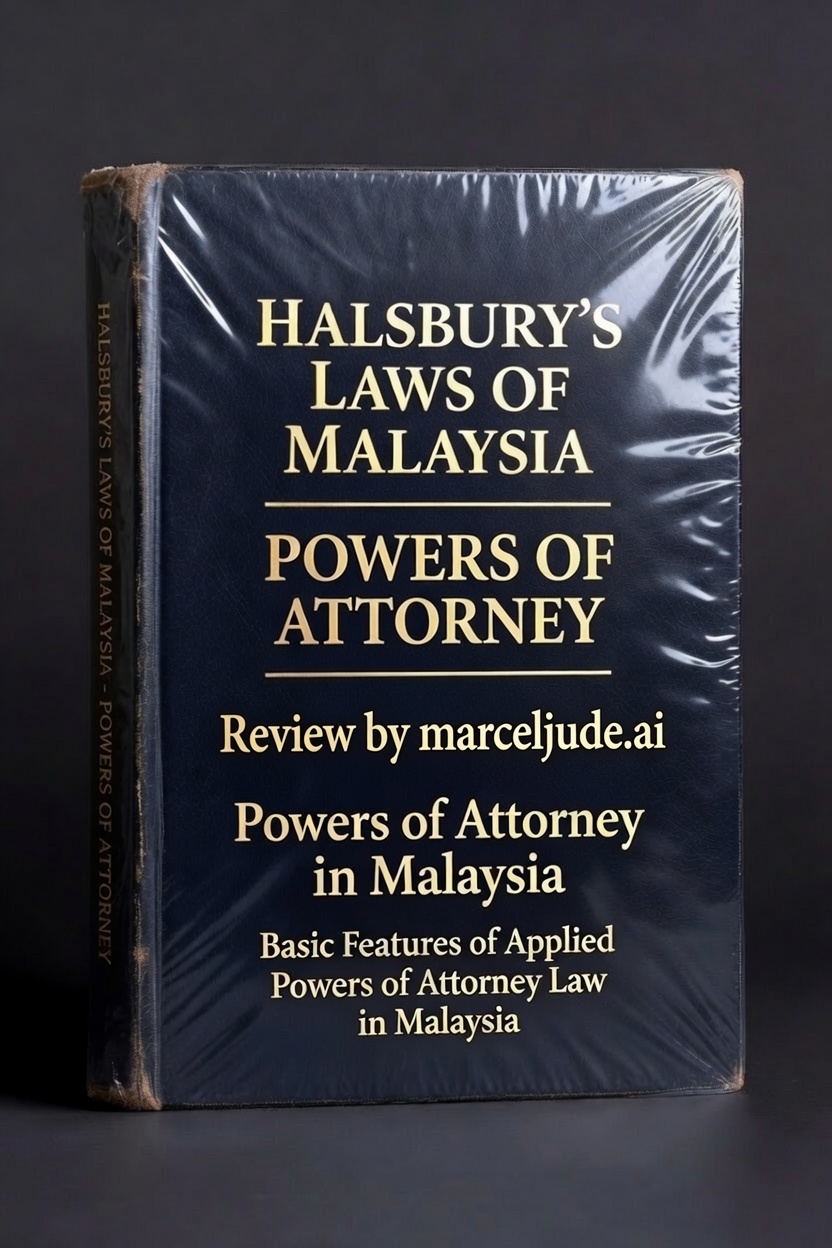
HALSBURY’S LAWS OF MALAYSIA: POWERS OF ATTORNEY- Review By marceljude.ai


Description
HALSBURY’S LAWS OF MALAYSIA: POWERS OF ATTORNEY
An Extensive Legal and Critical Review By marceljude.ai
I have read the entire work.
This title is organised principally through Halsbury’s numbered paragraphs, beginning at [320.001] and ending at [320.041,
LIST OF CONTENTS
Part I — Powers of Attorney in General
Chapter 1 — Nature and Effect of a Power of Attorney
Nature of a power of attorney — [320.001]
Effect of a power of attorney — [320.002]
Chapter 2 — Formalities
A. Execution of a Power of Attorney
Formalities governing execution — [320.003]
B. Deposit and Registration
Deposit of a power of attorney — [320.004]
Register of powers of attorney — [320.005]
Forwarding copies between registries — [320.006]
Filing the instrument in the High Court Registry — [320.007]
Inspection of powers of attorney — [320.008]
Office copies — [320.009]
Searches — [320.010]
Chapter 3 — Duration of a Power of Attorney
Revocation — [320.011]
Powers given for valuable consideration — [320.012]
Powers expressed to be irrevocable for a fixed time — [320.013]
Payments or acts undertaken without notice of death or revocation — [320.014]
Chapter 4 — Evidentiary Value
Proof of a power of attorney — [320.015]
Chapter 5 — Offences
Forging a power of attorney — [320.016]
Part II — Uses of Powers of Attorney
Chapter 6 — Companies and Corporations
Limited companies — [320.017]
Foreign companies — [320.018]
Religious corporations — [320.019]
Chapter 7 — Use as Authority
Power of attorney as authority — [320.020]
Chapter 8 — Probate and Administration
Grant of administration to an attorney — [320.021]
Chapter 9 — Trustees
A. Trustees Generally
Power of attorney given by a trustee — [320.022]
Exoneration of trustees acting in good faith — [320.023]
B. Labuan Trusts
Absence of a trustee and temporary delegation — [320.024]
Chapter 10 — Land Transactions
Application made by the donee of a power of attorney — [320.025]
Execution of instruments of dealing — [320.026]
Caveatable interests — [320.027]
Registration of instruments — [320.028]
Registrar’s inquiries — [320.029]
Execution by a non-citizen or foreign company — [320.030]
Exemption from attestation requirements concerning reservation land — [320.031]
Dealings involving reservation land — [320.032]
Part III — Incidents of Powers of Attorney
Chapter 11 — Effect of the Grant
Application of the law of agency — [320.033]
Attorney executing documents for the donor — [320.034]
Legal proceedings brought by a donee — [320.035]
Gratuitous powers of attorney — [320.036]
Chapter 12 — Construction and Extent
Acts exceeding the authority conferred — [320.037]
Delegation and substitution — [320.038]
Chapter 13 — Factors Vitiating a Power of Attorney
Illegality — [320.039]
Forgery and fraud — [320.040]
Duress and undue influence — [320.041]
GENERAL REVIEW OF THE ENTIRE WORK
This title is a compact but intellectually substantial treatment of the Malaysian law governing powers of attorney. Its great strength is that it refuses to treat a power of attorney as merely a document used for convenience. Instead, it exposes the instrument as a point of intersection among several bodies of law:
agency;
contract;
fiduciary obligations;
evidence;
civil procedure;
company law;
insolvency;
trusts;
probate and administration;
land registration;
statutory illegality; and
equitable doctrines such as fraud and undue influence.
The central idea running through the entire work is that a power of attorney confers authority, but does not normally transfer the donor’s underlying ownership or legal personality to the attorney.
The donee stands in the donor’s place only for the purposes authorised by the instrument. The donee does not become the donor, does not obtain powers greater than those possessed by the donor and does not automatically acquire the donor’s proprietary rights.
The work consequently insists upon four safeguards.
First, the power must be properly created.
Second, its terms must be strictly construed.
Third, the attorney must remain within the conferred authority.
Fourth, the transaction must not be illegal, fraudulent or inconsistent with the attorney’s fiduciary position.
The discussion is doctrinally valuable because it explains the distinction between:
an ordinary agency and a formal power of attorney;
authority and ownership;
revocable and irrevocable powers;
a power coupled with valuable consideration and a merely gratuitous appointment;
an attorney’s authority to act and the attorney’s standing to sue;
execution of a document and proof of that document;
statutory validity and land-registration validity; and
a genuine agency arrangement and a disguised transfer prohibited by law.
Its principal limitation is geographical. Much of the formal statutory treatment concerns the Powers of Attorney Act 1949, which applies only in Peninsular Malaysia. Sabah and Sarawak therefore cannot be treated as if the Act automatically governs instruments executed or used there.
Nevertheless, the work remains highly relevant to East Malaysian practice because its underlying common-law principles—strict construction, agency, fiduciary accountability, fraud, illegality, revocation and protection of innocent third parties—have broad application. It also expressly discusses significant Sabah and Sarawak authorities and their separate land regimes.
PART I — POWERS OF ATTORNEY IN GENERAL
CHAPTER 1 — NATURE AND EFFECT
1. Nature of a Power of Attorney — [320.001]
The opening subsection defines the power of attorney functionally. It is an instrument by which one person, the donor, formally authorises another, the donee or attorney, to act on the donor’s behalf.
The authority may be:
general, covering a broad range of the donor’s affairs; or special, confined to a particular transaction or class of transactions.
The distinction is fundamental. A general power is not necessarily unlimited. It remains subject to the wording, purposes and surrounding structure of the instrument. A special power is even more strictly confined to its specified object.
The work distinguishes a formal power of attorney from an ordinary agency. An agency may generally be created without elaborate formalities. A formal power of attorney, however, is ordinarily executed with the prescribed solemnity and derives its content from the written instrument.
This has an important consequence for third parties. Where a third party knows that the attorney is acting under a written power, the third party is expected to examine it. He cannot ordinarily rely upon a wider representation by the attorney when the written instrument discloses narrower authority.
In Lim Eng Chuan Sdn Bhd v United Malayan Banking Corporation Bhd [2005] 4 MLJ 172, the power was described as a formal written delegation empowering the donee to act for the donor within the limits stated in the instrument.
The subsection also illustrates the distinction between authority and standing. In Sin Chuan Aik Brothers Realty Sdn Bhd v Inti Higher Learning Centre Sdn Bhd [2008] 7 MLJ 633; [2008] 8 CLJ 587, authority to rent, manage and collect rent did not entitle the agent to commence proceedings in its own name. The registered proprietors remained the proper plaintiffs.
The lesson is exacting: authority to manage property is not necessarily authority to litigate, and authority to litigate for another does not necessarily confer a personal cause of action upon the attorney.
Critical assessment
This is a strong opening because it immediately rejects the lay assumption that a power of attorney gives the attorney an unrestricted entitlement to “do everything.” The instrument is an authority-conferring device, not a transfer of personality or ownership.
2. Effect of a Power of Attorney — [320.002]
The second subsection examines the legal relationship created by the instrument.
A power of attorney produces a relationship substantially governed by the law of principal and agent. The attorney consequently owes fiduciary obligations to the donor. These include duties:
to act within authority;
to act honestly and for the authorised purpose;
to keep proper accounts;
to disclose conflicts of interest;
not to make secret profits;
not to receive secret commissions or bribes; and
to account for money and property handled under the power.
The attorney’s authority cannot exceed the donor’s own legal capacity. A person cannot delegate an act which he himself has no legal power to perform.
The work also explains that an attorney should ordinarily act in the donor’s name. If litigation is authorised, proceedings should normally be brought in the donor’s name unless some independent rule gives the attorney standing.
Where an attorney contracts in his own name without adequately disclosing the principal, personal liability may arise. Depending upon the applicable law of agency, the undisclosed principal may also be liable, subject to the third party’s rights of election.
Most importantly, property described as being “vested” in an attorney is not necessarily beneficially transferred to him. The donor may retain the underlying title and interest, while the attorney holds authority to deal with the property for the stated purpose.
The fiduciary dimension is illustrated by Kuan Chit v Daro (M) Sdn Bhd [2009] 9 MLJ 661. The attorney used the granted authority in connection with land development to obtain an advantage for itself. The court treated the conduct as a breach of duty and the making of a secret profit.
Critical assessment
This subsection contains the moral core of the work. A power of attorney is not merely a technical mandate. It creates a relationship of trust, loyalty and accountability.
CHAPTER 2 — FORMALITIES
A. Execution 3. Formalities Governing Execution — [320.003]
This subsection deals with statutory execution and authentication under the Powers of Attorney Act 1949.
The work stresses that an instrument intended to create a valid power within Peninsular Malaysia must comply with the prescribed formalities.
Where execution occurs within Peninsular Malaysia, authentication may be undertaken by prescribed persons, including:
a magistrate;
a Justice of the Peace;
a Land Administrator;
a notary public;
a Commissioner for Oaths;
an advocate and solicitor; or
an authorised officer of a qualifying banking company.
Where the instrument is executed outside Peninsular Malaysia, a different list of authorised authenticating persons applies, including appropriate judicial, diplomatic, consular or notarial officers.
Authentication is more than witnessing a signature. It gives the instrument evidential reliability and provides a formal safeguard against impersonation, forgery and later denial.
The validity and authenticity of a power may ultimately be a question for the trial judge. Sum Phoon Mun v Mann Foong Realty Sdn Bhd [1998] 3 CLJ 919 is cited for that proposition.
The work also discusses the relationship with section 67 of the Evidence Act 1950. In Eon Bank Bhd v Hotel Flamingo [2005] 1 MLJ 712, the court held that section 67 did not govern the power in the ordinary way because the instrument was one required by law to be attested. The statutory authentication regime assumed central importance.
Sabah and Sarawak qualification
The Powers of Attorney Act 1949 expressly applies only to Peninsular Malaysia. Its execution provisions must therefore not be uncritically applied to Sabah or Sarawak.
In East Malaysia, practitioners must examine:
local legislation;
the Sabah Land Ordinance or Sarawak Land Code where land is concerned;
applicable court and registry requirements;
relevant company, probate or trust legislation; and
received English law where legally applicable.
This territorial qualification should be printed in red, metaphorically speaking, beside every Peninsular statutory proposition in the chapter.
B. Deposit and Registration
4. Deposit of a Power of Attorney — [320.004]
The work explains that, within Peninsular Malaysia, proper execution is not always sufficient. A true or office copy must ordinarily be deposited with the proper High Court registry before the instrument becomes effective to create the relevant power.
The deposit requirement performs several functions:
it provides public notice;
creates a record capable of inspection;
reduces the risk of concealed or fabricated authority;
facilitates proof of the attorney’s appointment; and
permits later revocation or determination to be recorded.
An important exception concerns instruments executed and used solely for specified land or mining transactions before the relevant administrative authority, provided the applicable attestation law has been followed.
Where the instrument is in a language other than Bahasa Malaysia or English, a properly certified or verified translation must accompany it.
The work rightly treats deposit as a substantive safeguard rather than a clerical inconvenience. United Malayan Banking Corporation Bhd v Official Receiver and Liquidator of Soon Hup Seng Sdn Bhd (In Liquidation) [1986] 1 MLJ 75 associates registration with public notice and the prevention of fraud.
Critical assessment
The distinction between execution and deposit is indispensable. A beautifully drafted and authentically signed power may still be legally ineffective for the intended purpose if the applicable deposit regime is ignored.
5. Register of Powers of Attorney — [320.005]
The registrar must maintain a separate file and register containing short particulars of deposited powers. Subsequent revocation or determination, where notified, should also be entered.
Members of the public may, upon payment of the prescribed fee:
search the register;
inspect deposited instruments; and
obtain office copies.
This subsection gives practical meaning to the doctrine of notice. A power of attorney may affect dealings with land, companies, securities and money. A searchable official record permits third parties to verify the existence, scope and continuing status of the power.
For conveyancing and banking practice, a search should not be treated as optional where the transaction depends materially upon the attorney’s authority.
6. Forwarding of Copies — [320.006]
Where the same power is to operate in more than one territorial or registry context, the administrative machinery allows relevant copies to be forwarded or lodged as required.
Although procedurally modest, this provision reflects the reality that a single attorney may be authorised to deal with property or transactions situated in different places. Proper filing must be established in each place where local law requires it.
A practitioner should never assume that deposit in one registry automatically satisfies every other registry or land office.
7. Filing in the High Court Registry — [320.007]
This subsection identifies the documents and supporting evidence required when the instrument is filed.
Depending upon the circumstances, filing may have to be accompanied by:
an affidavit;
a declaration;
a certificate;
other proof verifying execution; or
in the case of a trust, the required statutory declaration.
The formal evidential chain matters. The registry is not simply storing paper; it is recording an instrument through which one person may dispose of another’s property or assume control over significant legal affairs.
The distinction between attestation by a Commissioner for Oaths and other forms of verification is also relevant. Practitioners must examine which supporting document is required in the particular case.
8. Inspection — [320.008]
Inspection enables an interested party to ascertain:
who appointed the attorney;
the date and form of appointment;
the scope of authority;
whether the power is general or limited;
whether substitution is permitted;
whether the power is described as irrevocable;
whether a fixed duration applies; and
whether a revocation or determination has been recorded.
This is of special importance when the attorney proposes to sell, charge, lease or otherwise deal with valuable property.
A prudent lawyer should inspect the actual instrument rather than rely solely on a recital in a later agreement stating that the signatory is the donor’s lawful attorney.
9. Office Copies — [320.009]
A properly verified and marked office copy constitutes sufficient evidence of:
the contents of the deposited instrument; and the fact of its deposit.
This reduces the need to produce the original instrument in every later transaction or proceeding. It provides an official evidentiary substitute while preserving the original or deposited record.
However, an office copy proves the deposited contents. It does not necessarily establish that every act later performed by the attorney fell within the power, was undertaken honestly or complied with separate land or company legislation.
10. Searches — [320.010]
The search machinery complements inspection and office-copy provisions.
For professional practice, a proper search should be directed not merely to whether a power exists but also to:
its complete terms;
any limitations;
the date of commencement;
termination provisions;
revocations;
renunciations;
the death or incapacity of relevant parties;
substitutions; and
any other deposited determination.
This subsection is short, but commercially significant. Many disputes attributed to fraud could be prevented by elementary verification at the transactional stage.
CHAPTER 3 — DURATION
11. Revocation — [320.011]
The general law permits a donor to revoke an ordinary power of attorney. A power may also terminate through events such as:
death;
mental incapacity;
bankruptcy;
completion of the authorised transaction;
expiry of the stated period;
renunciation by the attorney; or
operation of the instrument’s terms.
The work emphasises that revocation must comply with statutory notice and deposit requirements where applicable. Private revocation communicated only between donor and donee may not adequately protect third parties who deal without notice.
Where a deposited power has been revoked, the notice or instrument of revocation should be deposited in each relevant office so that the register accurately reflects the change.
The subsection illustrates a wider principle: revocation has both an internal and external dimension. Internally, it terminates the attorney’s mandate. Externally, adequate notice is needed before innocent third parties can safely be treated as aware of that termination.
12. Powers Given for Valuable Consideration — [320.012]
This is one of the work’s most important subsections.
Where a power is given for valuable consideration and expressed to be irrevocable, statutory protection may prevent revocation by:
a unilateral act of the donor;
death;
marriage;
mental disorder or unsoundness of mind; or
bankruptcy.
Acts performed by the attorney pursuant to such a protected power may remain valid despite those events. Purchasers and donees may also be protected against prejudicial notice of later events.
However, the label “irrevocable” is not magical. Valuable consideration must exist and, according to the authorities discussed, should be specifically and expressly identified.
In Hj Fauzi Hj A Majid lwn Kenangan Erat Sdn Bhd [2005] 8 CLJ 230, valuable consideration was treated as essential to sustaining irrevocability under section 6 of the Powers of Attorney Act 1949.
The subsection also refers to Chon Ah Jee @ Chuan Teck Chun v Lim Tian Huat (as receiver and manager appointed for Bigraise Telipok Sdn Bhd) [2010] 4 MLJ 270, a Sabah authority of major importance. Although the Peninsular Act did not apply in Sabah, the court considered the equivalent United Kingdom principles through the Civil Law Act 1956. The power was expressed to be irrevocable and arose from unperformed contractual obligations under a joint-venture arrangement.
Critical assessment
The subsection shows that irrevocability is usually a means of protecting an underlying proprietary or contractual interest. It should not be confused with an ordinary gratuitous appointment which merely declares itself irrevocable.
13. Irrevocability for a Fixed Time — [320.013]
A power may be expressed to be irrevocable for a specified period whether or not valuable consideration is present, subject to the governing statute.
During that fixed period, the power may be protected against unilateral revocation and against events such as death, incapacity or bankruptcy. Acts properly performed during the protected period remain valid, and purchasers may receive statutory protection.
The distinction from [320.012] is conceptual:
paragraph [320.012] concerns a power secured by valuable consideration; whereas paragraph [320.013] concerns irrevocability for a defined period.
A careful drafter should therefore state:
the exact duration;
the commencement date;
the contractual or proprietary purpose;
whether consideration was provided;
what occurs upon expiry;
whether pending transactions survive expiry; and
what notices must be given.
Ambiguous drafting can generate disputes over whether the power is truly irrevocable, merely contractual, or revocable subject to a claim in damages.
14. Acts Without Notice of Death or Revocation — [320.014]
This subsection protects a person who, in good faith and without notice, makes a payment or performs an act under a power after the donor has:
died;
become mentally disordered or of unsound mind;
become bankrupt; or
revoked the authority.
The protection is based upon good faith and absence of knowledge. It prevents unfair liability where the actor reasonably relies on an apparently subsisting authority.
Nevertheless, the protection does not extinguish every proprietary claim. A person beneficially entitled to money may retain a remedy against the payee.
This produces an equitable allocation of loss:
the innocent payer or actor is protected;
but the ultimate recipient of money is not necessarily allowed to retain it against the true beneficiary.
CHAPTER 4 — EVIDENTIARY VALUE
15. Proof of a Power of Attorney — [320.015]
Under section 85 of the Evidence Act 1950, the court must presume due execution and authentication where the document purports to be a power of attorney executed before and authenticated by an authorised person.
The presumption assists proof but does not convert a forged or fraudulent instrument into a valid one. It is a rebuttable evidential presumption.
The work also recognises a corresponding rule in Syariah evidentiary legislation for instruments purporting to have been executed before and authenticated by the specified judicial or consular officers.
The principal practical points are:
the instrument must appear on its face to fall within the statutory category;
authentication must be by an authorised person;
the presumption concerns execution and authentication;
allegations of forgery, fraud or want of authority may still be investigated; and
the presumption does not enlarge the substantive powers stated in the document.
The subsection is especially relevant where the donor denies signing the instrument or challenges the identity or authority of the attesting person.
CHAPTER 5 — OFFENCES 16. Forging a Power of Attorney — [320.016]
Forgery of a power of attorney is treated as a serious criminal offence because the forged instrument can be used to:
transfer land;
create charges;
obtain loans;
operate bank accounts;
sell shares;
commence proceedings;
deal with estates; or
appropriate the donor’s assets.
The seriousness flows from the instrument’s capacity to impersonate lawful authority. A forged signature on an ordinary letter may misrepresent instructions; a forged power of attorney may create the appearance of a legally authenticated delegation.
This criminal provision complements the civil rule that a forged power is ordinarily a nullity.
PART II — USES OF POWERS OF ATTORNEY
CHAPTER 6 — COMPANIES AND CORPORATIONS
17. Limited Companies — [320.017]
A company may appoint an attorney to execute documents or conduct authorised affairs on its behalf. The appointment must comply with the company’s governing legislation, constitution and corporate-authorisation requirements.
The legal inquiry should include:
whether the company possessed the power to make the appointment;
whether the board validly authorised it;
whether the instrument was properly executed;
whether the attorney acted within its terms;
whether the company was in liquidation; and
whether the power was supported by valuable consideration or formed part of a security arrangement.
Corporate powers of attorney frequently appear in:
development agreements;
financing transactions;
debentures;
charges;
receiverships;
property sales; and
foreign commercial transactions.
The subsection usefully exposes the connection between company authority and the law of agency. A director’s office does not automatically confer every power purportedly exercised, and an attorney’s appointment does not cure a defective corporate decision.
18. Foreign Companies — [320.018]
Foreign companies may appoint attorneys to act in Malaysia, but the transaction may engage several overlapping requirements:
the law of incorporation;
Malaysian company legislation;
authentication abroad;
consular or notarial requirements;
translation;
registration as a foreign company;
landholding restrictions; and
local land-law provisions.
The governing law of the corporation determines internal capacity, while Malaysian law governs many questions concerning local execution, registration and dealings.
This subsection is highly relevant to Sabah and Sarawak because foreign corporations commonly participate in land development, timber, plantation, energy and infrastructure projects. Local land law must be separately satisfied even if the corporate appointment is valid under the company’s home law.
19. Religious Corporations — [320.019]
A religious corporation or statutory religious body may act through an attorney only within the powers conferred by its constituting legislation.
The apparent breadth of a power cannot override statutory limits on:
ownership;
disposition of religious property;
approval by governing bodies;
charitable purposes; or
public or religious trusts.
The broader lesson is that the attorney inherits the donor’s limitations. A statutory corporation cannot use a power of attorney to escape the restrictions imposed upon the corporation itself.
CHAPTER 7 — USE AS AUTHORITY 20. Power of Attorney as Authority — [320.020]
A power may be produced to demonstrate that the attorney has authority to sign or act for another.
But production of the instrument answers only the first question: whether authority was conferred. It does not automatically answer:
whether the power remained in force;
whether the proposed act fell within its terms;
whether a condition precedent was fulfilled;
whether the transaction was lawful;
whether local registration requirements were satisfied; or
whether the attorney was acting for a proper purpose.
Third parties must read the instrument as a whole. Particular clauses should not be separated from recitals, limitations or the agreement in connection with which the power was created.
CHAPTER 8 — PROBATE AND ADMINISTRATION
21. Grant of Administration to an Attorney — [320.021]
Where a person entitled to representation is outside the jurisdiction or otherwise unable to act personally, administration may in appropriate circumstances be granted to an attorney for the use and benefit of that person.
This is not an unrestricted substitution. Probate and administration involve duties owed to:
beneficiaries;
creditors;
the estate; and
the court.
The attorney must act within the scope of the grant and the power. Certain duties requiring personal knowledge or responsibility may not be freely delegated.
The subsection is practically important in Sabah and Sarawak, where estates frequently involve beneficiaries residing elsewhere, cross-border families and land governed by local statutory restrictions.
Where Native Title or customary interests are involved, the attorney’s appointment cannot enlarge the class of persons legally entitled to acquire or deal with those interests.
CHAPTER 9 — TRUSTEES
22. Power of Attorney Given by a Trustee — [320.022]
Trusteeship is fiduciary and ordinarily personal. A trustee cannot simply hand over every discretionary responsibility to another person.
The Trustee Act permits delegation in defined circumstances and subject to safeguards. The work examines:
the scope of permissible delegation;
its duration;
required notices;
duties that remain personal;
the trustee’s continuing responsibility; and
statutory declarations or registration requirements.
The key distinction is between delegating an administrative act and abandoning the office of trustee. A power of attorney must not become a device through which the trustee escapes responsibility for judgment entrusted personally to him.
23. Exoneration of Trustees Acting in Good Faith — [320.023]
A trustee who acts or pays money in good faith under a power is protected where he did not know that the donor:
was under disability;
was bankrupt;
had died; or
had done something terminating the power.
The protection does not necessarily prejudice the rights of the person truly entitled to the money. That person may pursue the recipient.
The subsection balances administrative practicality with beneficial ownership. Trustees must be able to act upon apparently valid authority, but recipients should not obtain an unjust windfall merely because the trustee is protected.
24. Absence of a Labuan Trustee — [320.024]
A trustee of a Labuan trust may, subject to the trust terms, delegate specified functions by power of attorney for a period not exceeding 12 months.
The trustee cannot delegate the power to issue further powers of attorney. The sole remaining co-trustee cannot ordinarily be appointed as donee.
Written notice must be given within seven days to:
any person empowered to appoint a new trustee;
every co-trustee; and
the relevant Labuan authority in the case of a registered trust.
The notice must specify:
commencement and duration;
the donee’s name and address;
the reason for delegation; and
the functions delegated.
Failure to give notice does not necessarily invalidate acts in favour of an outsider dealing with the donee. However, the donor trustee remains bound by and liable for the donee’s acts or defaults as if they were the donor’s own.
Critical assessment
This subsection illustrates a sophisticated statutory compromise: temporary operational delegation is permitted, but accountability remains with the trustee.
CHAPTER 10 — LAND TRANSACTIONS 25. Application by the Donee — [320.025]
The attorney may make applications concerning land where the power and applicable land law permit it.
However, a power of attorney does not itself transfer title. The donee acts for the registered proprietor and remains bound by:
the terms of the instrument;
statutory restrictions;
conditions and restrictions in interest;
requirements governing native or reservation land;
prohibitions affecting foreigners; and
the registration system.
This principle is of exceptional importance in Sabah and Sarawak, where the National Land Code does not govern the State land systems.
26. Execution of Instruments of Dealing — [320.026]
An attorney may execute an instrument of dealing for a proprietor if the governing land law recognises the authority and the instrument satisfies the relevant formalities.
For Sarawak, the work specifically refers to provisions of the Sarawak Land Code concerning execution under a power of attorney.
The land instrument and power must be examined together. The registrar must be able to identify:
the donor;
the attorney;
the land;
the authorised form of dealing; and
any relevant limitation.
A general authority to manage land may not authorise its sale or charge. The power to dispose of the donor’s proprietary interest should be expressed clearly.
27. Caveatable Interest — [320.027]
A mere power of attorney does not invariably create a proprietary interest capable of supporting a caveat.
However, an irrevocable power granted for valuable consideration in connection with a transaction concerning land may, depending upon its terms and the underlying agreement, evidence or protect a caveatable interest.
The court must distinguish:
bare authority to act;
contractual rights against the donor;
an equitable interest in the land; and
a proprietary security supported by valuable consideration.
The decision in Lian Lee Construction Sdn Bhd v Joyous Seasons Sdn Bhd [2008] 8 MLJ 387 illustrates how an irrevocable power connected with valuable consideration and authority to sell, assign or charge land may support a caveatable interest.
For Sabah and Sarawak, caveatability must be determined under the local land statute and local jurisprudence, not merely by reference to the National Land Code.
28. Registration of Instruments — [320.028]
The instrument of dealing must comply with land-registration requirements even if the power is otherwise valid.
The work refers to Pawa Ak Ajah v Chung Kok Chiang @ Chong Kok Kiong [2002] 6 MLJ 236, concerning registration under the Sarawak Land Code. Registration of the power was described as an administrative function, and the registrar was not necessarily required at that stage to adjudicate every question concerning its legality or validity.
That does not mean illegality becomes immune from challenge. It means registration and judicial determination of validity are distinct functions.
This distinction is crucial:
acceptance for registration is not always conclusive proof of substantive validity;
registration cannot necessarily cure forgery, fraud or want of authority; and
land legislation determines the effect of registration upon competing interests.
29. Registrar’s Inquiries — [320.029]
The registrar may undertake inquiries authorised by the governing land legislation, but the scope of that responsibility is statutory.
The registrar should not invent additional preconditions, yet must not ignore defects apparent on the face of the documents.
The subsection raises the difficult balance between:
efficient registration;
prevention of fraud;
administrative legality; and
the registrar’s limited adjudicative role.
For East Malaysian practice, the relevant powers must be found in the Sabah Land Ordinance or Sarawak Land Code and their subsidiary instruments.
30. Non-Citizens and Foreign Companies — [320.030]
Execution through an attorney does not permit a foreign person or company to circumvent statutory restrictions on land ownership.
The attorney is not treated as the beneficial purchaser merely because he signs the instrument. Conversely, a locally qualified attorney cannot be used as a mask to acquire land for a disqualified foreign principal.
The substantive identity of the acquirer remains relevant. A valid agency does not neutralise immigration, citizenship, corporate or landholding restrictions.
31. Exemption Concerning Reservation Land — [320.031]
The work considers statutory exemptions from ordinary attestation requirements in certain dealings involving Malay reservation land.
The purpose is not to free such land from statutory control. Rather, it recognises particular forms of execution or authentication within the reservation-land regime.
This subsection has no direct automatic application to Native Title land in Sabah or native-area or native-customary land in Sarawak. Those categories arise under different constitutional and statutory histories.
32. Dealings in Reservation Land — [320.032]
A power of attorney cannot be used to circumvent restrictions governing reservation land.
The law looks at the substance of the transaction. If the instrument merely disguises a prohibited transfer, charge or beneficial acquisition, it may be ineffective or illegal.
This proposition translates directly into Sabah and Sarawak practice:
a power cannot convert a non-native into a native;
it cannot make prohibited Native Title ownership lawful;
it cannot validate a disguised beneficial transfer;
and it cannot defeat restrictions imposed to protect native land.
PART III — INCIDENTS OF POWERS OF ATTORNEY
CHAPTER 11 — EFFECT OF THE GRANT
33. Law of Agency — [320.033]
The general relationship is one of principal and agent, but the instrument and any connected agreement must be construed together.
In T & TT Enterprise Sdn Bhd v Lembaga Pembangunan dan Lindungan Tanah [2009] 2 MLJ 205, the Court of Appeal examined a development agreement and power together. The arrangement was a joint venture, and the power existed to facilitate the developer’s contractual obligations. It did not necessarily create a principal-agent relationship for every contract made by the developer.
This decision is particularly relevant to Sarawak land-development arrangements. A power given to a developer does not automatically make the landowner liable for every contractor or supplier engaged by that developer.
The subsection also explains that appointment of one partner as attorney does not necessarily confer authority upon the entire firm. Liability depends upon the scope of the appointment and the relationship between the wrongful act and the firm’s business.
34. Execution of Documents for the Donor — [320.034]
The work considers three recurring contexts.
Affidavits
An attorney may affirm an affidavit only where:
the power is sufficiently wide; and
the evidence does not require the donor’s personal knowledge,
judgment or conscience.
A verifying affidavit requiring personal consideration of documents or facts cannot ordinarily be delegated merely by executing a power of attorney.
Re Azhar Azizan Harun (as absolute representative of Eleanor Dulcie Robinson) [1998] 7 MLJ 89; [1999] 2 AMR 1596 illustrates circumstances where official documents permitted verification without exclusively personal knowledge.
Bankruptcy petitions
An attorney may sign a bankruptcy petition on behalf of the petitioning creditor if the power expressly or sufficiently authorises that act.
Debentures and charges
An attorney may execute debentures and charge documents for the owner if the terms confer that authority. Because these instruments may expose the donor’s assets to enforcement, borrowing and charging powers should be express.
Critical assessment
This subsection is exceptionally useful to litigators. A power cannot manufacture personal knowledge. It can authorise a signature, but it cannot transfer the donor’s memory, belief or obligation of candour to the attorney.
35. Legal Proceedings by Donees — [320.035]
A power authorising litigation ordinarily enables the attorney to instruct lawyers and conduct proceedings in the donor’s name. It does not necessarily make the donee the substantive claimant.
The relevant questions are:
who owns the cause of action;
in whose name must proceedings be brought;
whether the attorney has express authority to commence or defend proceedings;
whether the attorney may compromise the claim;
whether the attorney can affirm supporting affidavits; and
whether the attorney has personal knowledge of the pleaded facts.
An action commenced in the attorney’s own name may be struck out for lack of locus standi where the cause of action remains vested in the donor.
36. Gratuitous Power — [320.036]
A power conferred without valuable consideration is generally revocable unless a statutory exception applies.
The gratuitous attorney has no proprietary entitlement merely because authority was conferred. The donor retains the right to terminate the appointment subject to:
contractual terms;
notice requirements;
protection of innocent third parties; and
acts already validly completed.
The distinction between a gratuitous power and a power coupled with an interest is central to the law of irrevocability.
CHAPTER 12 — CONSTRUCTION AND EXTENT
37. Exceeding the Granted Authority — [320.037]
Powers of attorney are construed strictly. General words are interpreted in light of the specific purposes stated in the instrument.
Authority to manage property does not necessarily include authority to:
sell it;
mortgage it;
borrow on the donor’s credit;
give third-party security;
compromise litigation;
make gifts;
transfer the property to the attorney; or
delegate the power.
Third parties dealing with a known attorney are expected to examine the instrument. They may be fixed with knowledge of its limitations.
A third party who advances money merely on the attorney’s assurance that borrowing is authorised takes a serious risk if the written power says otherwise.
The work nevertheless recognises incidental powers. Authority may include acts reasonably necessary to achieve the expressly authorised purpose. The challenge is to distinguish a genuinely incidental act from a new and substantial power.
Drafting lesson
Express clauses should address:
sale;
purchase;
lease;
borrowing;
charging;
receipt of money;
litigation;
settlement; delegation;
self-dealing;
gifts;
banking;
digital transactions; and
execution of statutory forms.
38. Delegation — [320.038]
The maxim delegatus non potest delegare applies: a delegate cannot further delegate unless the original power expressly or impliedly permits it.
An attorney cannot confer upon a substitute greater authority than the donor conferred upon the attorney.
The instrument may include a power of substitution. If successive substitution is contemplated, it should be stated expressly.
The authorities discussed include:
Pappa v Saminathan [1975] 1 MLJ 263; Saminathan v Pappa [1981] 1 MLJ 121; and S R M M Annamalai Chettiar v Lassam binti Veeramanawi [1953] MLJ 29.
The cases demonstrate that construction depends upon the precise wording and, in some circumstances, subsequent ratification.
For practice, a substitution instrument should identify:
the original donor;
the original power;
the clause authorising substitution;
the substitute attorney;
whether the full or a limited power is delegated;
the duration; and
whether the substitute may appoint another.
CHAPTER 13 — FACTORS VITIATING POWERS
39. Illegality — [320.039]
A power granted for an illegal purpose is invalid. Courts examine the true substance of the arrangement rather than its formal description.
This subsection is one of the title’s most important contributions to Sabah law.
In Sundang Timber Co Sdn Bhd v Kinabatangan Development Co Sdn Bhd [1977] 2 MLJ 200, a special timber licence was effectively assigned through an agreement and irrevocable power. The Federal Court held that the interconnected documents produced an illegal transfer contrary to the Forests Enactment 1968.
In Lo Su Tsoon Timber Depot v Southern Estate Sdn Bhd [1971] 2 MLJ 161, the power was characterised as a colourable device intended to make the operator appear to be merely an agent of the licensee.
In Director of Forestry, Sabah v Mau Kam Tong [2010] 3 CLJ 377, the Court of Appeal found that powers and related agreements were devices camouflaging prohibited transfers of personal forest licences.
The doctrine is clear: parties cannot achieve indirectly through agency what legislation prohibits directly.
This principle applies beyond forestry to:
Native Title land;
statutory licences;
permits;
government concessions;
development approvals;
fishing or extraction rights;
regulated shares; and
offices or functions which are legally personal.
40. Forgery and Fraud — [320.040]
A forged power is ordinarily a nullity. Transactions founded upon it may be set aside, subject to the operation of applicable land-registration principles and the rights of later parties.
The work examines several leading cases.
In Buang bin Mohamad v Awang Jimat bin Awang Nook [1999] 3 MLJ 239, oral evidence could be admitted to demonstrate that the power was procured by fraud or that consideration had failed.
In Public Bank Bhd v Ng Yoon Lin [2001] 5 MLJ 70, the evidence established that the signature on the power was not that of the purported donor.
In Teh Cheng Choo v Malayan Banking Bhd [2009] 5 CLJ 463, the claimant failed to establish that the bank participated in or had notice of the alleged fraud.
In Tan Ying Hong v Tan Sian San [2010] 2 MLJ 1, the Federal Court held that charges founded upon a forged power were liable to be set aside under section 340(2)(b) of the National Land Code.
The work’s discussion of the standard of proof reflects the authorities available to it, but the modern Malaysian position should be stated carefully: fraud in civil proceedings is proved on the balance of probabilities, although the inherent seriousness of the allegation affects the cogency of evidence required. The authoritative modern statement is found in Sinnaiyah & Sons Sdn Bhd v Damai Setia Sdn Bhd [2015] 1 MLJ 423, which post-dates the authorities discussed in this title.
For Sabah and Sarawak, the effect of forgery upon registered interests must be determined under the respective local land statutes and jurisprudence, not section 340 of the National Land Code.
41. Duress and Undue Influence — [320.041]
A power may be set aside where its execution was procured by duress or undue influence.
Duress historically concerns unlawful coercion or threats. Undue influence is broader and addresses relationships in which one party dominates the will of another and obtains an unfair advantage.
Section 16 of the Contracts Act 1950 gives statutory form to the doctrine of undue influence.
The court examines:
the relationship between donor and donee;
age and health;
dependence;
literacy and language;
urgency;
whether consideration was adequate;
whether the document was explained;
whether the donor appreciated its breadth;
whether the attorney received an unusual benefit; and
whether independent legal advice was obtained.
In T Nallapiravy v Mahadevan [1978] 2 MLJ 119, the evidence did not establish that the power had been executed under undue influence.
Independent legal advice is highly relevant, though not always conclusive. The advice must be genuine and directed to the actual nature and consequences of the transaction.
This subsection is particularly relevant where elderly landowners sign broad and irrevocable powers in favour of developers, relatives, moneylenders or persons upon whom they depend.
COMPARISON WITH SABAH AND SARAWAK\
1. Territorial Application
The first and most important difference is that the Powers of Attorney Act 1949 applies only in Peninsular Malaysia.
Therefore:
its deposit machinery does not automatically govern Sabah and Sarawak;
its statutory forms of authentication cannot simply be assumed to apply there;
its provisions on irrevocability require separate legal examination; and
East Malaysian land dealings must satisfy local land legislation.
The common-law and equitable principles discussed in the work remain persuasive and frequently applicable, but the statutory route differs.
2. Sabah
Sabah has no equivalent wholesale application of the Peninsular Powers of Attorney Act 1949.
In Chon Ah Jee @ Chuan Teck Chun v Lim Tian Huat [2010] 4 MLJ 270, the High Court considered the application of the United Kingdom Powers of Attorney Act 1971 through section 5 of the Civil Law Act 1956 in a commercial matter. This supported the continued operation of an irrevocable power given for valuable consideration despite the donor company’s winding up.
The Sabah practitioner must also examine the Sabah Land Ordinance whenever the power concerns land. The authority to sign does not dispense with:
restrictions governing Native Title;
consent requirements;
registration requirements;
prohibitions on non-native acquisition;
conditions in the title; or
the Director of Lands and Surveys’ statutory functions.
The Sabah forestry cases examined at [320.039] are especially valuable. They demonstrate that a power cannot be used to transfer a personal licence in disguise.
The same reasoning should apply whenever legislation makes a right personal or non-transferable.
3. Sarawak
Sarawak powers relating to land must be understood together with the Sarawak Land Code.
The work refers to Sarawak provisions governing:
execution by an attorney;
registration of powers;
production of the instrument; and
land dealings undertaken under the authority.
In Pawa Ak Ajah v Chung Kok Chiang @ Chong Kok Kiong [2002] 6 MLJ 236, registration of a power under the Sarawak Land Code was treated as an administrative function. The registrar’s acceptance did not necessarily amount to a judicial determination of substantive legality.
Pembinaan Masdamai Sdn Bhd v Me-Wong Builders Sdn Bhd [1994] 2 MLJ 64 is also noted in relation to execution under Sarawak land law.
A power concerning native customary land or other protected land cannot override statutory restrictions or validate a disguised transaction. The attorney possesses only the authority lawfully capable of being exercised by the donor.
4. Native Land and Native Customary Rights
The work’s discussion of Malay reservation land provides a useful analogy, but not an identical legal regime.
In Sabah and Sarawak, the essential questions include:
whether the donor holds registered title or only asserts customary rights;
whether the attorney is authorised to pursue recognition,
compensation or registration;
whether the proposed transaction is legally transferable;
whether native status is required;
whether governmental consent is necessary; and
whether the power disguises a beneficial disposition to a legally disqualified person.
A power may authorise the attorney to pursue an NCR claim. It does not itself prove that NCR exists. Nor does it automatically permit the attorney to acquire beneficial ownership of that right.
5. Litigation in the High Court of Sabah and Sarawak
The work is directly relevant to litigation concerning:
standing;
authority to instruct solicitors;
commencement of proceedings;
affirming affidavits;
settlement;
receipt of judgment money;
enforcement;
revocation; and
death or incapacity of the donor.
A lawyer acting for an attorney should obtain and examine:
the complete power;
evidence of execution and authentication;
applicable registration or deposit records;
proof that it remains in force;
the clause authorising litigation;
the clause authorising settlement or receipt of money; and
evidence showing whether the attorney possesses personal knowledge of affidavit facts.
WHY THIS WORK REMAINS RELEVANT
The title remains highly relevant for six principal reasons.
First, powers of attorney remain common in land development, banking, estate administration, corporate finance and family property management.
Second, Malaysia’s federal structure means practitioners must distinguish Peninsular law from the separate Sabah and Sarawak regimes.
Third, modern fraud frequently involves apparently authenticated instruments. The chapters on execution, proof, registration and forgery provide a coherent framework for challenging or defending such instruments.
Fourth, the distinction between authority and beneficial ownership is essential in land disputes.
Fifth, the work’s discussion of illegality is particularly important in Sabah, where statutory licences and native land restrictions cannot be circumvented through nominal agency.
Sixth, the treatment of affidavits and litigation authority is immediately useful in daily court practice. A power may authorise an attorney to conduct proceedings, but it cannot confer personal knowledge that the attorney does not possess.
FINAL EVALUATION
Halsbury’s treatment of powers of attorney is doctrinally disciplined, practically valuable and unusually rich for a relatively confined subject.
Its best feature is its insistence that every dispute be answered through a sequence of legal questions:
Was the power validly executed?
Was any required deposit or registration completed?
Does the power remain in force?
Is it revocable, irrevocable for consideration, or irrevocable for a fixed period?
What precisely does the instrument authorise?
Did the attorney act in the donor’s name and for the authorised purpose?
Did the attorney exceed, delegate or misuse the authority?
Does a separate statute prohibit the underlying transaction?
Was the power affected by fraud, forgery, duress or undue influence? What protection is available to an innocent third party?
For Peninsular Malaysia, it provides a clear account of the Powers of Attorney Act 1949 and its relationship with evidence, agency, land and company law.
For Sabah and Sarawak, it must be read selectively and territorially. Its general principles remain powerful, but the applicable statute, land system and rules of received law must be separately identified.
Its Sabah forestry authorities are among its strongest components. They demonstrate that courts will look through the form of a power of attorney and identify the true transaction. A document calling someone an “attorney” cannot legitimise a prohibited transfer.
Its Sarawak treatment is valuable in showing that registration is not synonymous with substantive validity and that the Sarawak Land Code has its own statutory structure.
The enduring message of the work is therefore simple but profound:
A power of attorney is an instrument of authority, not an instrument of legal escape. It facilitates lawful action for another person; it cannot confer ownership where none was transferred, create standing where none exists, supply personal knowledge, authorise self-dealing, cure forgery, or circumvent a statutory prohibition.
Reviewed by marceljude.ai
- MALAYSIA'S 1ST AI LAWYER - CLICK HERE
- ISMAIL – INTEGRATED SINGAPORE/MALAYSIA AI & LAW (Library)
- OPENING OF SINGAPORE MALAYSIA AI CENTRE AND LAW LIBRARY
- LIFT - LAW INSTRUMENTS FORMS & TEMPLATES
- LAWS OF MALAYSIA FOR SINGAPOREAN DUMMIES
- HANNAH YEOH'S ARTIFICIAL INTELLIGENCE LAW ENCYCLOPEDIA
- LEAD CR - Law Ecosystem Archive Databases on CD-ROM
- BREAKING NEWS FROM MJN
- CLICK HERE CO. PROFILE
- EXCITING NEW SERIES - THE ADVENTURES OF BOBBY TAN -ADVOCATE & SOLICITOR IN THE HIGH COURT OF NORTH BORNEO by marceljude.ai
- MEDICO LEGAL - BY PRISKILA AKWILA & GLORIOUS PETAL SDN BHD - powered by marceljude.ai
- MISCELLANOUS
- ANNOTATED STATUTES OF SABAH - A NEW SERIES
- e-library - marceljude.ai
- DRAFT - DOCUMENT RESEARCH & AUTOMATED FILING TECHNOLOGY
- CLARA – Case Law Analysis & Retrieval AI
- FOR RESEARCH REQUEST CLICK HERE
- CLICK HERE TO ASK ANYTHING
- RAMBO'S LAW - THE LAW OF THE LAW JUNGLE - EXCITING NEW SERIES - CASE ANALYSIS BY JOHN RAMBO @ +60138646786
- PRISKILA AKWILA ADVOCATES - High Court of Sabah & Sarawak @ Kota Kinabalu
- COLA - COMMONWEALTH ONLINE LAWCASES AI -marceljude.ai
- THE LAW LIBRARY THAT COMES TO YOU ANYWHERE AND ANYTIME
- marceljude.ai training academy
