
HALSBURY'S LAWS OF MALAYISA - EDUCATION - review by marceljude.ai
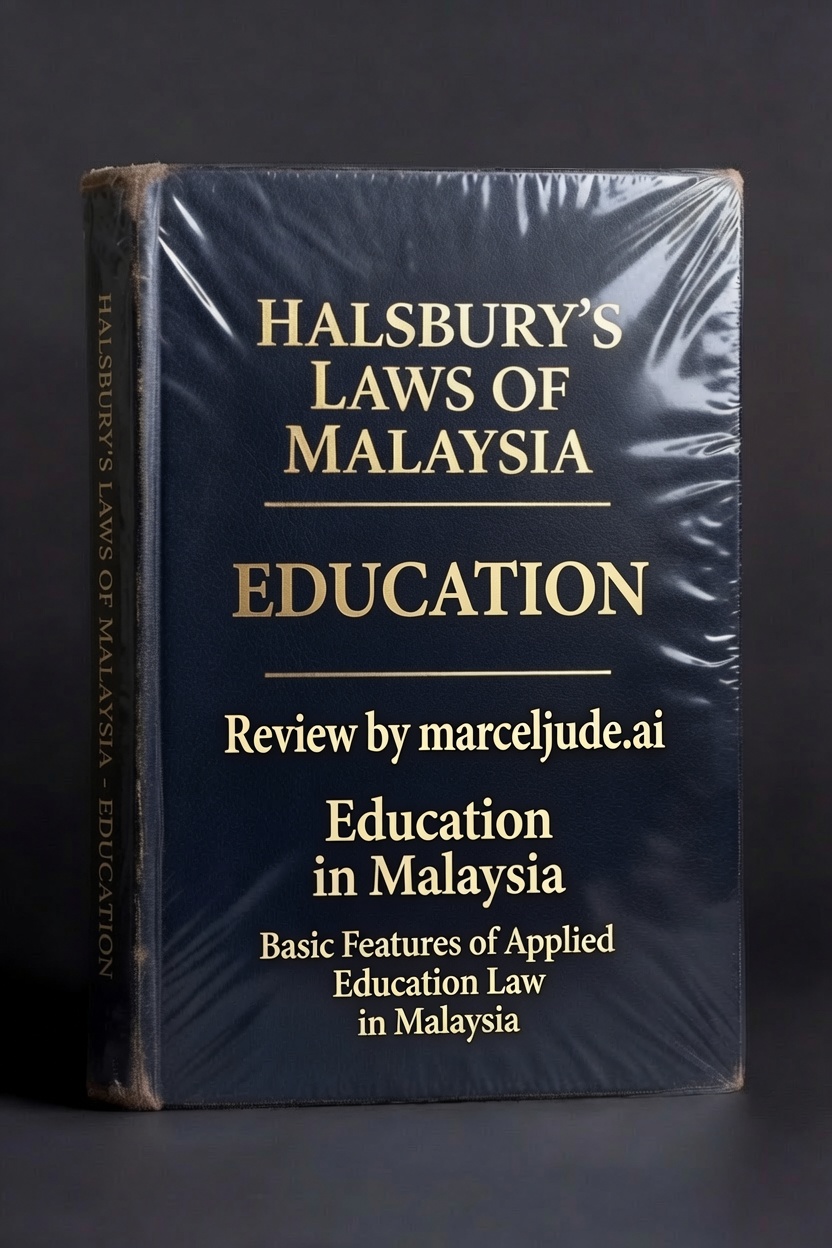


Description
HALSBURY’S LAWS OF MALAYSIA — EDUCATION
AN EXTENSIVE PROFESSORIAL BOOK REVIEW
By marceljude.ai
PRELIMINARY NOTE ON REFERENCES
I have read the book in full.
The work is organised as Title 530, “Education”, and uses authoritative paragraph references running from [530.001] to [530.427]
LIST OF CONTENTS
Introduction — [530.001]–[530.002]
Administration — [530.003]–[530.010]
National Education Advisory Council — [530.011]–[530.012]
National Education System — [530.013]–[530.243]
4.1 Introduction — [530.013]–[530.021]
4.2 General provisions relating to pupils — [530.022]–[530.027]
4.3 Pre-school education — [530.029]–[530.034]
4.4 Primary education — [530.035]–[530.038]
4.5 Secondary education — [530.039]–[530.040]
4.6 Post-secondary education — [530.043]
4.7 Other educational institutions — [530.043]
4.8 Technical education and polytechnics — [530.044]–[530.052]
4.9 Special education — [530.053]–[530.055]
4.10 Teacher education — [530.056]–[530.059]
4.11 Religious teaching — [530.062]
4.12 Private educational institutions — [530.063]–[530.084]
4.13 Higher education — [530.085]–[530.234]
4.14 National Council on Higher Education — [530.235]–[530.243]
Disciplinary Provisions under the Various Statutes — [530.244]–[530.277]
Registration — [530.278]–[530.293]
Offences and Penalties — [530.294]–[530.301]
Appeals — [530.303]
Management of Educational Institutions — [530.304]–[530.309]
Provision of Facilities and Services — [530.311]
Assessment and Examination — [530.313]–[530.325]
Accreditation of Certificates, Diplomas and Degrees — [530.326]–[530.380]
Education Funds — [530.381]–[530.427]
OVERALL REVIEW OF THE BOOK
This is not merely a summary of the Education Act 1996. It is a systematic account of the legal architecture through which Malaysia creates, regulates, finances, supervises and disciplines its educational institutions.
Its central intellectual achievement is to demonstrate that education law is a distinct field of public law. It combines:
constitutional law;
administrative law;
statutory regulation;
institutional governance;
disciplinary law;
criminal and regulatory enforcement;
public finance;
language policy;
quality assurance; and
the legal regulation of children, teachers, universities and private education providers.
The book moves from national educational philosophy to institutional detail. It begins with the political and social purposes of education, proceeds to the machinery of ministerial administration, and then examines the different stages and forms of education. It ultimately reaches enforcement, accreditation and financing.
The structure reveals an important jurisprudential proposition: education is simultaneously a public service, an instrument of national policy, a regulated sector and a means of individual development.
The student is consequently not treated solely as the beneficiary of a service. A student may also be the subject of admission rules, curriculum requirements, examinations, discipline, suspension and financial obligations. Similarly, the educational institution is not merely a place of learning; it is a statutory entity subject to registration, inspection, governance, curriculum, staffing and enforcement controls.
The work is strongest when explaining legal machinery. It carefully identifies:
who possesses a statutory power;
the conditions governing its exercise;
the persons affected;
the administrative procedure to be followed;
the consequences of non-compliance; and
whether an appeal, exemption or ministerial intervention is available.
Its principal limitation is inherent in its encyclopaedic method. It states the positive law comprehensively, but gives less sustained treatment to deeper constitutional questions such as equality of educational opportunity, the substantive content of a right to education, rural educational inequality, indigenous-language education, academic freedom and proportionality in student discipline.
Nevertheless, as a work of legal reference, it is exceptionally useful. It permits a practitioner to move from a general problem—registration, expulsion, accreditation, examination results or student loans—to the responsible authority and governing statutory provisions.
CHAPTER-BY-CHAPTER REVIEW
CHAPTER 1 — INTRODUCTION
References: [530.001]–[530.002]
Development of the educational system — [530.001]
The opening chapter identifies education as a central component of national development. The educational system is presented as serving four broad purposes:
national integration and unity;
the development of trained manpower;
the improvement of educational quality in a scientific and technological society; and improved capacity for research, planning and implementation.
This opening is important because it establishes the policy background against which all the later statutory provisions must be understood. Curriculum, language, examinations and institutional control are not portrayed as isolated administrative arrangements. They are mechanisms for achieving national objectives.
The chapter also recognises the international and commercial dimensions of education. Malaysia’s aspiration to become a regional educational centre explains the later importance attached to private higher education, foreign university programmes, branch campuses, accreditation and quality assurance.
From a public-law perspective, [530.001] exposes a recurring tension. Education is designed both to develop the individual and to satisfy collective national needs. The law must therefore mediate between personal educational choice and national standardisation.
Reorganisation of the Ministry — [530.002]
This subsection explains the administrative division between the Ministry responsible for school education and the Ministry responsible for higher education.
The division is functional rather than merely bureaucratic. Pre-school, primary, secondary and pre-university matters fall within one administrative stream, while universities, private higher educational institutions, community colleges, polytechnics, accreditation and higher-education finance fall within another.
The subsection is legally significant because the validity of an administrative decision may depend upon whether it was made by the correct Minister, department, registrar or delegated authority.
It also introduces the Malaysian Qualifications Agency and the National Higher Education Fund Corporation. These bodies later become central to the regulation of educational quality and student financing.
Critical assessment
The introductory chapter efficiently connects educational philosophy to institutional structure. Its weakness is that it does not fully interrogate whether administrative fragmentation may cause overlapping jurisdiction or inconsistent policy. Nevertheless, it provides the conceptual foundation for the entire title.
CHAPTER 2 — ADMINISTRATION
References: [530.003]–[530.010]
General statutory framework — [530.003]
This subsection presents the Education Act 1996 as the central statute governing school education while recognising the presence of separate legislation governing universities, private higher education, national higher-education planning, accreditation and educational finance.
It explains that the National Education Policy is not self-executing merely because it is expressed as government policy. Courts ordinarily enforce legal rights and duties embodied in legislation, not abstract political aspirations. This distinction is illustrated through the jurisprudence associated with Merdeka University Berhad v Government of Malaysia.
The subsection is one of the book’s most jurisprudentially valuable passages. It distinguishes between:
policy as an executive aspiration; and
policy translated into enforceable statutory law.
State Directors and education officers — [530.005]
The State Director of Education and other education officers form the regional administrative machinery through which federal educational policy is implemented.
The subsection demonstrates that Malaysian educational administration is centrally structured but operationally decentralised. State and district officers act as implementation, inspection and supervisory channels.
Their decisions remain public decisions. They must therefore be made within statutory authority, for proper purposes and according to procedural fairness.
Registrars — [530.006]
The law establishes registrars for educational institutions and teachers. Registration is not a mere clerical procedure. It is a regulatory gateway controlling lawful participation in the education system.
Registrars possess powers concerning:
institutional registration;
teacher registration;
conditions of registration;
inspection and compliance; and
cancellation or removal from a register.
Because registration determines whether an institution or teacher may operate lawfully, a refusal or cancellation may have severe legal and economic consequences.
Inspector of Schools — [530.008]
The Inspector of Schools performs an oversight function. Inspection protects educational standards by allowing authorised officers to enter institutions, inspect teaching arrangements, examine records and investigate compliance.
These powers are necessary, but they also raise questions concerning statutory limits, procedural propriety and the use of information obtained during inspections.
Director of Examinations — [530.009]
The Director of Examinations occupies a specialised position concerned with the administration and integrity of prescribed examinations.
This foreshadows the later chapter on assessment and examination. The legal importance of examinations arises from their effect upon admission, progression, employment and professional status.
Ministerial directions — [530.010]
The Minister may issue general or special directions within the statutory framework.
The breadth of this power reflects the centralised character of educational administration. However, a direction cannot lawfully contradict the statute, pursue an irrelevant purpose or exceed the power Parliament has conferred.
Critical assessment
This chapter is a strong account of the administrative chain of command. Its practical lesson is that every education dispute must begin by identifying the statutory decision-maker and the exact source of that decision-maker’s power.
CHAPTER 3 — NATIONAL EDUCATION ADVISORY COUNCIL
References: [530.011]–[530.012]
Constitution and function of the Council — [530.011]
The Council advises the Minister on educational matters. Its function is consultative rather than executive.
Its existence recognises that educational policy requires specialised and representative input. Yet the ultimate decision-making authority remains with the Minister.
The distinction between advice and decision is legally important. A recommendation by the Council is not necessarily binding unless the statute expressly gives it binding effect.
Right of attendance — [530.012]
The right of specified persons to attend Council proceedings facilitates administrative coordination and access to expert information.
Attendance does not necessarily confer membership, voting power or independent decision-making authority. The subsection therefore illustrates the importance of distinguishing participation from legal power.
Critical assessment
This brief chapter raises a larger governance question: whether an advisory body can meaningfully restrain or improve ministerial decision-making when its conclusions are not binding. The book accurately describes the mechanism but could have explored the consequences of a failure to consult the Council where consultation is legally required.
CHAPTER 4 — NATIONAL EDUCATION SYSTEM
PART 1: INTRODUCTION
References: [530.013]–[530.021]
Composition of the National Education System — [530.013]
The National Education System encompasses the successive levels and recognised forms of education regulated by national law.
The system is legally integrated through:
a common policy;
the national language;
a National Curriculum;
prescribed examinations;
regulated institutions; and
ministerial supervision.
The legal idea of a “system” is important. It permits diverse institutions to exist, but subjects them to common national requirements.
Administration of institutions — [530.014]
Educational institutions operate within a hierarchy of ministerial, departmental, state and institutional responsibility. Public, aided and private institutions may possess different degrees of autonomy, but none is wholly outside statutory supervision.
National Language — [530.015]
This is one of the most constitutionally important parts of the book.
The national language is the principal medium of instruction in institutions within the National Education System, subject to recognised exceptions. Where another language is used as the principal medium, the national language must ordinarily be taught as a compulsory subject.
The discussion connects the Education Act with Article 152 of the Federal Constitution and the National Language Acts.
The treatment of Merdeka University Berhad v Government of Malaysia and PP v Mark Koding demonstrates the legal distinction between:
teaching or learning another language; and using another language as the principal medium for teaching other subjects.
This distinction is fundamental. Constitutional protection for learning a language does not automatically create an unrestricted constitutional right to operate an entire educational institution through that language.
National Curriculum — [530.016]
All schools within the National Education System are generally required to use the National Curriculum.
The curriculum is not confined to academic subjects. It includes knowledge, skills, norms, values, cultural elements, beliefs and co-curricular activities directed towards the physical, spiritual, mental and emotional development of pupils.
The subsection therefore shows curriculum law as a form of nation-building. It prescribes both what pupils should know and the kind of citizens the system seeks to cultivate.
Core subjects and co-curricular activities — [530.017]
The book distinguishes core subjects, additional subjects and co-curricular activities. This ensures a common educational foundation while permitting a degree of institutional and pedagogical variation.
Co-curricular participation is legally part of education rather than a wholly optional appendage.
Syllabuses and timetables — [530.018]
Schools must retain prescribed syllabuses and timetables and make them available for inspection. The requirement creates documentary accountability: an institution must be able to demonstrate that its actual instruction corresponds with the approved curriculum.
Teacher’s record book — [530.019]
The teacher’s record book provides evidence of instructional planning and delivery. It enables supervisory authorities to compare prescribed curriculum with actual teaching.
Translation requirements — [530.020]
Where educational schedules, syllabuses or relevant materials are maintained in a language other than the national language, translations may be required. This supports regulatory supervision and the national-language framework.
Penalties — [530.021]
Non-compliance with curriculum and related statutory obligations may lead to penal consequences. The inclusion of offences illustrates that curriculum regulation is mandatory law, not merely pedagogical guidance.
Evaluation
This part is conceptually rich. It shows how language, curriculum, documentation and inspection combine to transform educational policy into enforceable administration.
PART 2: GENERAL PROVISIONS RELATING TO PUPILS References: [530.022]–[530.027] Admission and registers — [530.022]
Admission is governed by formal legal requirements rather than unrestricted institutional preference. The proper maintenance of pupil records ensures accountability and allows educational authorities to monitor enrolment and movement.
Citizen pupils — [530.023]
The admission of Malaysian citizens reflects the public character of the national system. The provision must be read together with compulsory primary education and the state’s obligation to provide educational infrastructure.
Non-citizen pupils — [530.024]
Non-citizens occupy a different statutory position. Their admission may be subject to permission, conditions, prescribed documentation or fees.
The distinction raises questions of equality, immigration status and access to education, particularly for children resident in Malaysia without secure documentation.
Register of admissions — [530.025]
The admissions register is an official institutional record. Incorrect, incomplete or false entries may have consequences extending beyond school administration, including proof of attendance and eligibility.
Transfer of school — [530.026]
Transfers are controlled to preserve continuity and proper recordkeeping. The power must be exercised with regard to the pupil’s welfare, educational needs and applicable administrative requirements.
Offence and penalty — [530.027]
The penal provision secures compliance with pupil-registration rules. It reinforces the proposition that educational records form part of the regulatory system.
PART 3: PRE-SCHOOL EDUCATION References: [530.029]–[530.034] National Pre-school Curriculum — [530.029]
All kindergartens are required to follow the National Pre-school Curriculum. The national regulatory project therefore begins before compulsory primary schooling.
Language of instruction — [530.030]
Language requirements apply at the pre-school level, subject to statutory qualifications. Early education is thus brought within national language policy while retaining space for permitted multilingual instruction.
Curriculum materials — [530.031]
Materials must conform to the prescribed curriculum and educational standards. This provision enables supervision of both content and teaching practice.
Minimum periods — [530.032]
The prescribed minimum allocation of teaching periods prevents a kindergarten from claiming compliance merely by nominally adopting the curriculum.
Teacher’s records — [530.033]
Teachers must document their instructional work. Such records facilitate inspection and assessment of compliance.
Pupil progress records — [530.034]
Progress records recognise that pre-school education involves structured development capable of observation and evaluation.
Evaluation
This part demonstrates the increasing juridification of early childhood education. The benefits are consistency and minimum standards; the corresponding risk is excessive uniformity in an area that often benefits from pedagogical flexibility.
PART 4: PRIMARY EDUCATION
References: [530.035]–[530.038]
Establishment and maintenance of schools — [530.035]
The Minister is responsible for providing primary education and for establishing and maintaining national and national-type schools.
The coexistence of these school types embodies Malaysia’s accommodation between national integration and linguistic diversity.
Duration — [530.036]
Primary education has a prescribed duration, subject to the statutory power to permit variations where appropriate.
Compulsory primary education — [530.037]
This is among the most important provisions in the book. It converts primary education from a policy aspiration into a legal obligation.
Parents bear responsibility for ensuring the enrolment and attendance of children of compulsory school age, subject to recognised exemptions.
The subsection reflects a triangular legal relationship:
the state must provide a functioning system;
the parent must secure attendance; and
the child is the intended beneficiary.
Core and compulsory subjects — [530.038]
Primary pupils must receive instruction in prescribed subjects. The provision protects the common educational foundation of the national system.
Evaluation
The chapter states the statutory obligation clearly. A fuller rights-based discussion could have examined whether compulsion must be matched by reasonable accessibility, particularly in remote regions.
PART 5: SECONDARY EDUCATION
References: [530.039]–[530.040]
Ministerial provision — [530.039]
The Minister may provide secondary education through appropriate institutions and programmes. Secondary education is differentiated by academic, technical, vocational and other pathways.
Establishment and maintenance — [530.040]
The legal authority to establish and maintain secondary schools supports national planning, resource allocation and curricular differentiation.
Evaluation
The concise treatment reflects the statutory framework, but issues of equitable transition from primary to secondary education deserve more analytical attention.
PARTS 6 AND 7: POST-SECONDARY AND OTHER EDUCATIONAL INSTITUTIONS
Reference: [530.043]
This subsection recognises colleges, special schools and other institutions outside the ordinary primary-secondary sequence.
Its importance lies in statutory flexibility. The education system can accommodate institutions serving specialised, transitional or advanced purposes without forcing every institution into the conventional school model.
PART 8: TECHNICAL EDUCATION AND POLYTECHNICS
References: [530.044]–[530.052]
Technical education — [530.044]
Technical education links schooling with occupational knowledge and national economic requirements.
Polytechnic courses and qualifications — [530.045]
Polytechnics may provide approved courses and confer certificates, diplomas or other qualifications within their statutory authority.
Institutional and industrial collaboration — [530.046]
Collaboration with educational institutions and industry allows programmes to remain connected with professional and technological needs.
Degree-related courses — [530.047]
Polytechnics may participate in programmes connected with degrees awarded by universities or other authorised bodies, provided the arrangements fall within the statutory framework.
Regulations — [530.048]
The Minister’s regulatory power covers administration, courses, examinations, awards and other aspects of polytechnic education.
Examinations and Awards Board — [530.049]–[530.050]
The Board secures consistency in examination standards and awards. It protects the public reliability of polytechnic qualifications.
Curriculum Board — [530.052]
The Curriculum Board supervises the academic content and relevance of courses.
Evaluation
This is a particularly useful section because it treats technical education as a complete legal and academic system, rather than as a secondary alternative to university education.
PART 9: SPECIAL EDUCATION
References: [530.053]–[530.055]
Duration and curriculum — [530.053]
Special education programmes may differ in duration and structure to respond to the needs of pupils requiring specialised provision.
Eligibility — [530.054]
Eligibility determines access to special programmes. Such decisions must be based on lawful and relevant criteria.
Special curriculum — [530.055]
The curriculum may be modified to serve pupils’ particular capacities and educational needs.
Evaluation
The chapter is legally important but too brief from a modern disability-rights perspective. It concentrates on programme structure and eligibility rather than reasonable accommodation, inclusive education, accessibility and the participation of parents and pupils in placement decisions.
PART 10: TEACHER EDUCATION
References: [530.056]–[530.059]
The Minister may establish teacher-education institutes, authorise them to award certificates, prescribe courses and training programmes, and provide instruments of government for their administration.
These provisions recognise that educational quality depends upon the professional preparation of teachers. Teacher education is therefore not external to the national system; it is one of its regulated foundations.
PART 11: RELIGIOUS TEACHING
Reference: [530.062]
Financial assistance may be given to Islamic educational institutions not established or maintained by the Minister or a State Government.
This provision reflects the relationship between education, religion and public funding. It should be read together with the constitutional arrangements concerning Islam, religious instruction and the limits upon compulsory participation.
PART 12: PRIVATE EDUCATIONAL INSTITUTIONS
References: [530.063]–[530.084]
General requirements — [530.063]–[530.067]
Private institutions remain subject to the National Curriculum, prescribed examinations and regulatory supervision.
They cannot claim absolute autonomy merely because they are privately owned. The law treats private education as a public-facing activity whose quality and representations affect pupils and parents.
Advertising — [530.068]–[530.070]
Advertisements must contain accurate particulars and use permitted language. The Registrar General may require an advertisement to cease, be modified or be removed.
An appeal mechanism provides a degree of procedural protection.
Premises and standards — [530.071]–[530.079]
The regulations address:
descriptions of premises;
notice boards;
maintenance and lighting;
classrooms and equipment;
sanitation and miscellaneous needs;
medical inspection;
renovation and use of premises; and
penalties.
These provisions show that educational quality includes physical safety and suitability, not merely academic content.
Discipline of pupils — [530.080]–[530.084]
A disciplinary officer possesses responsibility for institutional discipline. Notices must be issued, appeals may be made to the board, and serious cases may result in expulsion.
The prohibition against a guilty or expelled pupil entering the institution protects institutional order, but disciplinary powers must be used consistently with natural justice.
PART 13: HIGHER EDUCATION
References: [530.085]–[530.234]
General responsibility — [530.085]–[530.088]
The Minister is responsible for higher education. The establishment of higher educational institutions and universities is prohibited except under lawful authority.
This prevents unauthorised bodies from presenting themselves as universities and protects the credibility of qualifications.
Universities — [530.089]–[530.104]
The book examines:
incorporation;
corporate powers;
constitutions;
registered offices;
statutes and rules;
grants and accounts;
campuses;
land acquisition;
taxation;
student organisations;
collection of money;
student liability;
suspension and expulsion;
dissolution of student bodies; and
transitional matters.
The university is portrayed as a statutory corporation rather than an entirely autonomous scholarly community.
Particularly important are the provisions controlling student organisations and activities. They reveal a model in which institutional order and governmental supervision historically receive considerable emphasis.
University colleges — [530.105]–[530.108]
University colleges are separately regulated. Establishment and incorporation require lawful authority, and their constitutions define their governance.
Miscellaneous protections and prohibitions — [530.109]–[530.117]
The work examines offences involving unauthorised use of the terms “University” and “University College”, service of documents, public-authority protections, public-servant status, existing universities and exemptions.
These provisions protect the institutional identity and public credibility of higher education.
Universiti Teknologi MARA — [530.118]–[530.160]
This is an extensive institutional study.
Establishment and corporate powers — [530.118]–[530.130]
The Universiti is established as a statutory body corporate with powers concerning property, branches, schools, centres, collaborative study, business transactions and agents.
Board and Senate — [530.131]–[530.136]
The Board provides corporate governance, while the Senate exercises academic functions. This separation reflects the conventional distinction between administrative and academic authority.
Chancellor and principal officers — [530.137]–[530.143]
The provisions regulate the Chancellor, Pro-Chancellor, Vice-Chancellor, Deputy Vice-Chancellor, Registrar, Bursar and other staff.
Finance — [530.144]–[530.149]
The statutory scheme covers the fund, reserves, estimates, accounts, audit, gifts and surcharge.
Ministerial control and miscellaneous matters — [530.150]–[530.160]
The Minister may issue directions and delegate powers. The text also covers secrecy, civil proceedings, good-faith protection, service and rule-making.
This treatment offers a valuable institutional anatomy of a Malaysian public university.
Private higher educational institutions — [530.161]–[530.234]
This is one of the book’s longest and most practically useful divisions.
Administration — [530.161]–[530.162]
The Registrar General and subordinate officers administer the regulatory framework, subject to ministerial directions.
Establishment — [530.164]–[530.177]
Approval is required to establish and maintain a private higher educational institution. Applicants must disclose relevant interests and satisfy statutory requirements.
Special provisions govern institutions seeking university, university-college or branch-campus status.
Registration — [530.178]–[530.182]
Approval to establish an institution does not eliminate the need for registration. The Registrar General may refuse registration or impose and vary conditions.
Revocation and cancellation — [530.183]–[530.186]
The book identifies grounds for revoking approval or cancelling registration. Decisions may be based upon documents without an oral hearing where the statute so provides.
This raises an important natural-justice question: even where an oral hearing is excluded, the affected institution should ordinarily receive notice of the case and a meaningful opportunity to answer it in writing.
Management — [530.188]–[530.192]
The chief executive must be properly appointed and registered, supply information and satisfy eligibility requirements.
Courses of study — [530.193]–[530.198]
Prior approval may be needed for courses, affiliations and collaborative arrangements. The statutory framework also regulates:
the medium of instruction;
compulsory subjects; and
academic standards.
Permits to teach — [530.199]–[530.200]
Teaching requires a valid permit where prescribed. The Registrar General may refuse or revoke a permit according to law.
Closure — [530.201]–[530.203]
The Minister may issue directions to protect students when an institution closes. Arrangements must be made for the continuation of their education.
This is a commendable student-protection measure. It recognises that closure affects not only the proprietor but also students who have invested time and money in incomplete programmes.
Inspection and enforcement — [530.205]–[530.211]
Regulators may inspect, audit, search, seize and call persons for examination. Such powers are extensive and must be exercised strictly within statutory conditions.
Advertisements — [530.212]–[530.214]
False or misleading representations concerning programmes, status or qualifications attract liability.
Offences and penalties — [530.215]–[530.226]
The offences cover unauthorised establishment, unlawful awards, breach of conditions, false applications, unlawful activities and improper teaching.
Corporate directors and responsible officers may incur liability. Continuing offences attract additional penalties.
Regulations and miscellaneous matters — [530.227]–[530.234]
The concluding provisions address regulations, legal protection, public-servant status, exemptions, premises, service and exclusions from the legislation.
Evaluation
This part successfully portrays private higher education as a heavily licensed industry. Its strongest feature is its attention to the entire regulatory life cycle: application, approval, registration, operation, teaching, inspection, enforcement and closure.
PART 14: NATIONAL COUNCIL ON HIGHER EDUCATION References: [530.235]–[530.243]
The Council’s establishment, membership, chairmanship, tenure, resignation, vacancies, committees and meetings are examined.
Its functions include national coordination and planning. Members must disclose beneficial interests, protecting the integrity of Council decisions.
The chapter demonstrates that higher education policy is not left entirely to individual universities or market forces. It is coordinated through a national planning body.
CHAPTER 5 — DISCIPLINARY PROVISIONS
References: [530.244]–[530.277]
Student discipline under the Educational Institutions (Discipline) Act
References: [530.244]–[530.263]
The book identifies the executive head and relevant disciplinary authorities, their powers, and the rules applicable to students.
It considers:
disciplinary authority;
disciplinary rules;
student representative bodies;
suspension and dissolution of student organisations;
student activities;
collection of money;
liability of student bodies;
presumptions;
suspension following criminal charges;
ministerial suspension or expulsion;
exclusion from institutions;
existing student societies;
interaction with societies and co-operative legislation;
delegation; and
ministerial powers.
The most serious provisions concern students charged with registrable offences. They illustrate the overlap between criminal accusation and academic status.
From a rule-of-law perspective, suspension should not be treated as a finding of guilt. Even protective interim measures must be proportionate and should not remain indefinitely in force.
Universities and university colleges — [530.265]
Disciplinary rules govern university students and define offences, procedures and sanctions.
Universiti Teknologi MARA — [530.268]–[530.269]
Student activities, organisational liability and suspension following criminal charges are regulated within UiTM’s statutory framework.
Private higher educational institutions — [530.270]–[530.271]
The Registrar General may direct the suspension or dissolution of a student association. An appeal is available against specified decisions.
Discipline of staff and employees — [530.272]–[530.277]
Separate provisions govern staff discipline under:
the Educational Institutions (Discipline) Act;
the Universiti Teknologi MARA Act; and
the Malaysian Examinations Council Act.
Disciplinary committees determine allegations, while appeal mechanisms provide institutional review.
Critical assessment
This chapter is doctrinally detailed but invites stronger engagement with procedural fairness. Any valid disciplinary system should provide:
notice of the allegation;
disclosure of material relied upon;
an opportunity to respond;
an unbiased tribunal;
reasoned findings; and
a meaningful appeal.
CHAPTER 6 — REGISTRATION
References: [530.278]–[530.293]
Educational institutions — [530.278]–[530.283]
All educational institutions within the statutory scheme must be registered. The Registrar may cancel registration or regulate changes to premises.
The provisions also address:
promotion of an institution;
inspection of registered institutions; and
inspection of suspected unregistered institutions.
Registration provides the legal dividing line between lawful educational activity and unauthorised operation.
Governors and employees — [530.284]–[530.285]
Governors and employees may also be subject to registration. Persons may be struck off the register where statutory grounds are established.
Pupils — [530.286]
Pupil registration enables official monitoring of enrolment and attendance.
Teachers — [530.287]–[530.293]
The teacher-registration scheme covers:
registration;
maintenance of the register;
revocation and striking off;
permits to teach;
surrender of certificates and permits;
notification of institutional changes; and
termination of service.
Evaluation
The chapter demonstrates that registration is a continuous regulatory relationship. Compliance is required not merely at entry but throughout the institution’s or teacher’s operation.
CHAPTER 7 — OFFENCES AND PENALTIES
References: [530.294]–[530.301]
The principal offences concern:
operating an unregistered educational institution;
breaches involving teacher registration;
obstruction of inspectors;
non-compliance with statutory requirements; and
continuing offences.
Enforcement powers include investigation, entry without warrant in authorised circumstances, prosecution and compounding.
The chapter is concise but practically important. Penal provisions must be construed strictly. Investigators must satisfy the statutory conditions governing entry, evidence collection and prosecution.
CHAPTER 8 — APPEALS
Reference: [530.303]
The Committee of Inquiry provides a mechanism for reviewing specified administrative decisions.
An appeal is not automatically a complete rehearing. Its scope depends on the statute: it may concern fact, law, procedure or the reasonableness of a sanction.
Where no effective statutory appeal exists, judicial review may remain available to challenge illegality, procedural unfairness or irrationality.
CHAPTER 9 — MANAGEMENT OF EDUCATIONAL INSTITUTIONS
References: [530.304]–[530.309]
Instrument of government — [530.304]
An institution’s instrument of government defines its internal legal structure, powers and responsibilities.
Additional governors — [530.306]
Additional governors may be appointed where necessary for lawful and effective administration.
Dissolution of boards — [530.307]–[530.309]
Boards of governors may be dissolved in prescribed circumstances, and replacement boards may be appointed.
These are significant intervention powers. Dissolution affects institutional autonomy and should therefore comply strictly with the statute and natural justice.
CHAPTER 10 — PROVISION OF FACILITIES AND SERVICES
Reference: [530.311]
The law provides for medical and dental inspection of pupils.
This apparently narrow provision expresses an important principle: education law includes pupil welfare and health. Schools are not merely instructional venues; they are institutions entrusted with children for substantial periods of their development.
CHAPTER 11 — ASSESSMENT AND EXAMINATION
References: [530.313]–[530.325]
Under the Education Act — [530.313]–[530.318]
The book covers:
assessment of pupils;
the Examinations Syndicate;
prohibited conduct;
declaration of an examination as void;
suspension or revocation of results;
rescrutiny; and
replacement of results.
Examination decisions can profoundly affect educational and professional futures. The statutory framework therefore protects examination integrity while providing mechanisms for correcting error.
Malaysian Examinations Council — [530.319]–[530.325]
The Council’s establishment, membership, alternate members, meetings, committees, staff and powers are described.
The offence concerning leakage of examination papers protects public confidence and equality among candidates.
Evaluation
This chapter is especially valuable to practitioners. Examination disputes often involve urgent remedies, procedural fairness and questions about whether the court should interfere with specialised academic judgment.
Courts should ordinarily respect genuine academic assessment, but they may intervene where there is:
bad faith;
breach of mandatory procedure;
consideration of irrelevant material;
denial of a promised review; or
a decision outside statutory power.
CHAPTER 12 — ACCREDITATION OF CERTIFICATES, DIPLOMAS AND DEGREES
References: [530.326]–[530.380]
Malaysian Qualifications Agency — [530.326]–[530.329]
The Agency is established as the central quality-assurance body. Its functions include implementing the national qualifications framework and supervising accreditation.
Disclosure-of-interest requirements protect institutional impartiality.
Officers and servants — [530.330]–[530.332]
The chief executive officer and staff provide the administrative capacity required for assessment, audit and enforcement.
Finance — [530.335]–[530.336]
The Agency’s expenditure, estimates, accounts and reports are subject to statutory control.
Accreditation under the qualifications framework — [530.338]–[530.340]
The Agency may grant or refuse accreditation, impose conditions, specify validity periods and revoke accreditation.
Because accreditation determines whether a qualification possesses recognised public standing, these decisions must be careful, transparent and procedurally fair.
Professional programmes — [530.342]–[530.344]
Local or foreign professional programmes may require specialised accreditation. This recognises the involvement of professional bodies and the public-interest consequences of qualifications in fields such as law, medicine, engineering and accountancy.
Foreign and collaborative programmes — [530.345]–[530.348]
Foreign qualifications, distance-learning programmes and collaborative awards require scrutiny to ensure that their content, delivery and assessment justify the qualification represented.
Self-accrediting institutions — [530.350]–[530.352]
Eligible higher-education providers may receive self-accrediting status. The privilege reflects institutional maturity but remains subject to monitoring and possible revocation.
Skills programmes — [530.354]–[530.356]
Skills-based programmes are incorporated into the national qualifications architecture.
Branch campuses — [530.358]–[530.361]
Branch-campus programmes may be registered and accredited, with cancellation or revocation where standards are not maintained.
Prior learning and credit transfer — [530.363]
Prior learning may be evaluated for recognition. This permits the legal framework to recognise competencies obtained outside conventional classroom pathways.
Savings and transition — [530.364]–[530.365]
Earlier certificates, registers and pending applications are preserved or transferred under savings provisions.
Institutional audit and registers — [530.366]–[530.367]
Institutional audit examines the provider’s overall quality systems. Registers give students, employers and the public an authoritative means of verifying accreditation.
Appeals — [530.369]
The Minister or appellate body may exercise specified powers on appeal. This gives institutions an avenue to contest refusal, conditions or revocation.
Offences and enforcement — [530.370]–[530.380]
The provisions regulate:
misleading representations;
improper advertising;
misuse of certificates;
obstruction of inspectors;
corporate liability;
search and seizure;
search warrants;
compounding;
secrecy;
prosecution;
jurisdiction; and
general and continuing penalties.
Evaluation
This is one of the strongest chapters. It shows that a qualification is not merely a private contract between student and institution. It is a representation to the public, employers, professional bodies and other universities. Accreditation law protects the reliability of that representation.
CHAPTER 13 — EDUCATION FUNDS References: [530.381]–[530.427] Tunku Abdul Rahman Foundation Fund — [530.381]–[530.388]
The book explains:
establishment of the Fund;
membership and meetings of the Board;
appointment of officers;
delegation;
the Fund’s objects;
investment;
audit and accounts; and
liquidation.
The Fund reflects the use of statutory institutions to widen access to education through financial assistance.
National Higher Education Fund — [530.389]–[530.409] The Fund — [530.389]–[530.390]
A dedicated statutory fund is established, and authorised expenditure is charged against it.
The Corporation and its management — [530.392]–[530.396]
The governing board, meetings, accounts, reports, staff and protection from personal liability are regulated.
Functions and powers — [530.397]–[530.404]
The Corporation may:
administer educational financing;
receive deposits;
establish insurance and unit-trust arrangements;
borrow;
exercise additional statutory powers;
establish committees; and
delegate functions.
Educational loans — [530.405]–[530.409]
The provisions cover:
granting loans;
certification affecting a borrower’s departure from Malaysia;
commencement of repayment;
repayment obligations; and
compounding of offences.
The restriction upon leaving Malaysia illustrates the strong enforcement mechanisms historically associated with educational debt. Such powers must be exercised according to express statutory conditions.
Higher Studies Scholarship Fund — [530.411]–[530.427] Board and governance — [530.411]–[530.414]
The provisions regulate membership, disqualification, removal and directions issued by the Majlis.
Objects and study awards — [530.415]–[530.418]
The Fund finances study awards subject to prescribed conditions and terms. Awards may cease upon specified events.
General administration — [530.420]–[530.427]
The remaining provisions concern:
investments;
the Board’s seal;
officers and servants;
delegation;
liability for investment losses;
rule-making;
insufficiency of funds; and
transfer of monies from sponsors.
Evaluation
The final chapter completes the book’s institutional logic. Educational access depends not only upon schools and universities but also upon lawful financing structures. The chapter explains how public educational finance is protected through boards, audits, repayment duties and investment controls.
MAJOR LEGAL THEMES RUNNING THROUGH THE BOOK 1. Education as national policy
The educational system is deliberately designed to serve unity, development, skilled manpower and national identity.
The law does not treat education as politically neutral. Language, curriculum, examinations and institutional structures are employed to realise national purposes.
2. Centralisation and controlled diversity
Malaysia permits a diverse educational landscape:
national schools;
national-type schools;
private schools;
religious institutions;
technical schools;
polytechnics;
universities;
university colleges;
branch campuses; and
special-education programmes.
Nevertheless, diversity exists within central controls involving registration, curriculum, language, inspection and accreditation.
3. Ministerial discretion
The Minister possesses extensive powers to establish institutions, issue directions, approve programmes, grant exemptions, regulate standards and intervene in governance.
The breadth of these powers makes administrative-law principles crucial. Ministerial discretion is not absolute. It remains controlled by:
statutory purpose;
relevant considerations;
procedural fairness;
constitutional limits; and
judicial review.
4. Regulation through registration
Registration is the book’s most persistent regulatory technique. Institutions, teachers, governors, employees and pupils may all be placed within formal registers.
Registration allows the state to determine who may participate in the system and under what conditions.
5. Regulation through documentation
The law requires numerous records:
admission registers;
teachers’ record books;
pupil progress records;
syllabuses;
timetables;
certificates;
accounts;
audit reports; and
accreditation registers.
These documents create evidence of compliance and make supervision possible.
6. Regulation through offences
The book repeatedly reinforces administrative duties with criminal or quasi-criminal penalties. This occurs in relation to registration, inspection, examinations, private institutions, accreditation and false representations.
7. Procedural fairness
Although the work is primarily expository, many of its provisions raise natural-justice questions. Refusal or revocation of registration, expulsion, cancellation of accreditation and dissolution of a governing body may seriously affect rights and interests.
Fair procedure is therefore indispensable even where the statute confers broad discretion.
8. Quality assurance
Quality is protected through several layers:
prescribed curricula;
teacher regulation;
inspection;
examination controls;
institutional registration;
programme approval;
accreditation; and
institutional audit.
The system regulates both educational inputs and the public recognition of educational outcomes.
IMPORTANCE TO SABAH AND SARAWAK
The national statutory framework applies with particular practical significance in Sabah and Sarawak.
Geography makes access a central concern. Remote communities may face:
long travelling distances;
limited transport;
inadequate school buildings;
shortages of trained teachers;
limited special-education services;
weaker internet connectivity; and
restricted access to post-secondary institutions.
Compulsory education cannot be analysed solely as a parental obligation where the state has not made schooling reasonably accessible.
Language is also especially significant. Sabah and Sarawak contain numerous indigenous linguistic communities. The book’s discussion of Article 152 is therefore relevant not only to Chinese and Tamil education but also to the preservation and teaching of Kadazan, Dusun, Murut, Bajau, Iban, Bidayuh and other indigenous languages.
The distinction between teaching a language and using it as the principal medium of instruction is legally important. Indigenous-language preservation may be supported within the national system, but the extent to which such a language may serve as the general instructional medium depends upon the constitutional and statutory framework.
Special education also presents distinctive difficulties in geographically dispersed communities. A legal entitlement or programme is of limited value if specialist teachers and facilities exist only in major towns.
Private higher education, branch campuses, distance learning and accreditation are similarly important. They can expand access in East Malaysia, but only if programmes are properly accredited and students receive qualifications carrying genuine national recognition.
The work would have been strengthened by a distinct treatment of East Malaysian circumstances. Formal national uniformity does not necessarily produce substantive equality where geography, infrastructure and language differ so substantially.
PRACTICAL VALUE TO LAWYERS, PROFFESORS, STUDENTS AND THE PUBLIC
The book is particularly useful in disputes involving:
refusal to register an educational institution;
cancellation of registration;
teacher registration and permits;
school admission;
compulsory education;
language of instruction;
curriculum compliance;
student suspension or expulsion;
dissolution of student associations;
examination irregularities;
cancellation of examination results;
refusal or revocation of accreditation;
misleading educational advertisements;
closure of a private institution;
student-loan repayment; and
judicial review of educational authorities.
A practitioner should use the work by asking five questions:
Which statute governs the institution or decision?
Who is the lawful decision-maker?
What statutory conditions must be satisfied?
What procedure, notice or hearing is required?
Is there a statutory appeal, or should judicial review be considered?CRITICAL APPRAISAL Strengths
The book is comprehensive, logically organised and exceptionally precise in identifying statutory institutions and powers.
It brings together legislation that would otherwise have to be consulted separately. Its treatment of private higher education, discipline, accreditation and educational finance is especially strong.
It also successfully demonstrates that education law does not end at the school gate. It includes corporate governance, criminal enforcement, professional recognition, administrative review and public finance.
Limitations
The work could have offered deeper analysis of:
Article 8 equality;
the constitutional status of access to education;
indigenous and minority languages;
academic freedom;
proportionality in disciplinary sanctions;
children’s participatory rights;
disability inclusion;
rural and regional inequality;
data protection in pupil records; and
remedies against unlawful educational decisions.
Its encyclopaedic style sometimes places the institutional machinery ahead of the human interests affected by it. A student, parent or teacher may consequently appear as the object of administration rather than a rights-bearing participant.
FINAL ASSESSMENT OF THE ENTIRE BOOK
Halsbury’s Laws of Malaysia — Education is an authoritative map of Malaysian education law.
Its central contribution is to reveal education as an interlocking statutory system. Ministry, registrar, inspector, school, teacher, pupil, university, accreditation agency and financing corporation are not isolated actors. Each occupies a legally defined position within a coordinated national structure.
The book is most successful as a practitioner’s reference and a doctrinal guide. It identifies powers, duties, procedures, prohibitions and institutional relationships with admirable breadth.
As a law professor, I regard the work as indispensable for understanding the positive law, but not as the last word on educational justice. Its statutory account should be supplemented by constitutional principles, administrative-law doctrine, children’s rights, disability rights and the distinctive realities of Sabah and Sarawak.
The work’s enduring lesson is that education is governed not by aspiration alone but by law. National philosophy becomes operational only through institutions, legal duties, fair procedures, adequate financing and effective access.
Overall assessment: an exceptionally valuable and comprehensive legal reference, strongest in statutory exposition and institutional analysis, and deserving of close use by practitioners, judges, administrators, university officers, teachers and scholars of Malaysian public law.
Review by marceljude.ai
- MALAYSIA'S 1ST AI LAWYER - CLICK HERE
- ISMAIL – INTEGRATED SINGAPORE/MALAYSIA AI & LAW (Library)
- OPENING OF SINGAPORE MALAYSIA AI CENTRE AND LAW LIBRARY
- LIFT - LAW INSTRUMENTS FORMS & TEMPLATES
- LAWS OF MALAYSIA FOR SINGAPOREAN DUMMIES
- HANNAH YEOH'S ARTIFICIAL INTELLIGENCE LAW ENCYCLOPEDIA
- LEAD CR - Law Ecosystem Archive Databases on CD-ROM
- BREAKING NEWS FROM MJN
- CLICK HERE CO. PROFILE
- EXCITING NEW SERIES - THE ADVENTURES OF BOBBY TAN -ADVOCATE & SOLICITOR IN THE HIGH COURT OF NORTH BORNEO by marceljude.ai
- MEDICO LEGAL - BY PRISKILA AKWILA & GLORIOUS PETAL SDN BHD - powered by marceljude.ai
- MISCELLANOUS
- ANNOTATED STATUTES OF SABAH - A NEW SERIES
- e-library - marceljude.ai
- DRAFT - DOCUMENT RESEARCH & AUTOMATED FILING TECHNOLOGY
- CLARA – Case Law Analysis & Retrieval AI
- FOR RESEARCH REQUEST CLICK HERE
- CLICK HERE TO ASK ANYTHING
- RAMBO'S LAW - THE LAW OF THE LAW JUNGLE - EXCITING NEW SERIES - CASE ANALYSIS BY JOHN RAMBO @ +60138646786
- PRISKILA AKWILA ADVOCATES - High Court of Sabah & Sarawak @ Kota Kinabalu
- COLA - COMMONWEALTH ONLINE LAWCASES AI -marceljude.ai
- THE LAW LIBRARY THAT COMES TO YOU ANYWHERE AND ANYTIME
- marceljude.ai training academy
