
BUTTERWORTHS MEDICO-LEGAL REPORTS - marceljude.ai
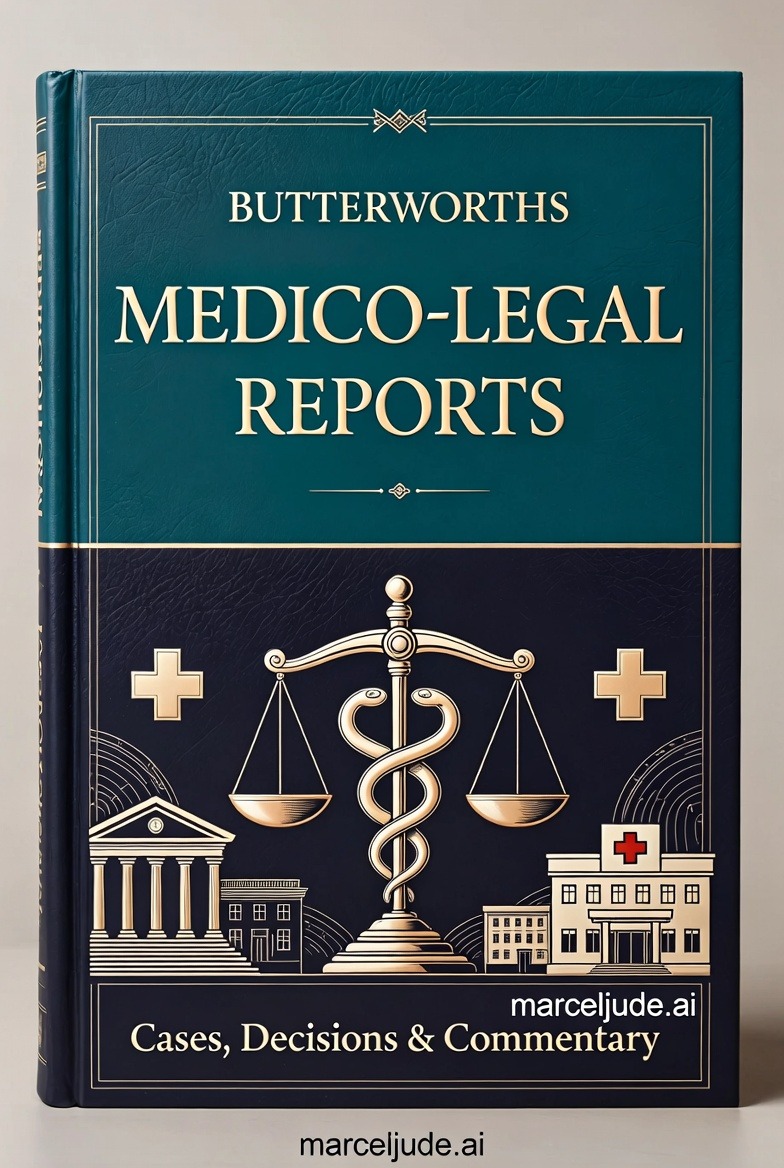
A REVIEW OF BUTTERWORTHS MEDICO-LEGAL REPORTS
Introduction
Butterworths Medico-Legal Reports, commonly abbreviated as “BMLR”, is a specialist series of law reports devoted to cases arising at the intersection of medicine and law. Its coverage extends beyond conventional medical-negligence claims to consent to treatment, mental health, pharmaceutical liability, healthcare administration, disciplinary proceedings, employment within the health service and the assessment of damages for personal injury.
The series is published by LexisNexis Butterworths and follows an accessible format modelled upon the All England Law Reports. It began publication as a continuing series in 1992 but incorporates earlier landmark judgments so that its coverage is not restricted to cases decided after its launch.
Its first reported decision is Bolam v Friern Hospital Management Committee (1957) 1 BMLR 1, the case that gave its name to the traditional “Bolam test” for professional medical negligence.
BMLR is not a medical-law textbook. It is a professionally edited collection of full judgments selected for their significance to medical law, healthcare regulation and clinical practice.
Publication Details
Title: Butterworths Medico-Legal Reports
Abbreviation: BMLR
Publisher: LexisNexis Butterworths
Country of publication: United Kingdom
Subject: Medical law, healthcare law and bioethics
Continuing publication commenced: 1992
Retrospective coverage: Includes earlier landmark judgments
ISBN for the complete set: 9780406440006
Format: Hardbound volumes and electronic access
Standard citation: (Year) Volume BMLR Page
The series as provides expert and accurate reports on medical negligence, consent, National Health Service administration and employment, pharmaceutical products, damages, mental health and the conduct of medical bodies. LexisNexis UK.
The series has grown into a very substantial collection. It reached volume 206 by December 2025. Six chargeable volumes are ordinarily published annually, supplemented periodically by consolidated tables and indexes. Wildy & Sons subscription record.
The Meaning of “Medico-Legal”
The expression “medico-legal” refers to legal questions involving medicine, healthcare, mental capacity, bodily injury or professional medical practice.
The field is inherently interdisciplinary. A court considering a medical dispute may need to apply:
negligence; contract; criminal law; evidence; administrative law; human rights; employment law; product liability; professional discipline; mental-health legislation; family law; and principles governing damages.
At the same time, the court may have to understand complex medical evidence concerning diagnosis, surgery, pharmacology, psychiatry, causation, prognosis or life expectancy.
BMLR’s specialist nature allows its editors to select and present judgments that might receive limited attention in a general report but are of great importance to medical-law practitioners.
Purpose of the Series
The principal purposes of BMLR are to:
report important medico-legal judgments in full; provide reliable and stable case citations; identify the central medical and legal issues through keywords; summarise the material facts and holdings in editorial headnotes; set out the procedural history of each case; preserve landmark decisions alongside current developments; and enable practitioners to trace the judicial development of medical-law principles.
A medical case may turn upon a highly specific factual distinction. Full-text reporting is therefore particularly important. A short summary cannot adequately explain conflicting expert evidence, the patient’s clinical history or the reasons why a judge accepted one medical opinion over another.
Historical Development
Although the continuing report series began in 1992, its numbered volumes include earlier landmark decisions. This explains why legal databases may display BMLR coverage beginning before 1992.
The first case selected for the retrospective collection was Bolam v Friern Hospital Management Committee (1957) 1 BMLR 1. The 100th volume was published in 2008, by which time BMLR had become an established specialist series supervised by academic editors associated with Cardiff University. New Law Journal.
The choice of Bolam as the opening case was symbolically appropriate. Much of modern medical-negligence law has developed through the acceptance, qualification and reconsideration of the professional-practice test articulated in that decision.
Structure of a BMLR Report
According to the publisher, each report normally contains:
keywords identifying the principal legal issues; a concise headnote summarising the relevant facts; a summary of the court’s decision; the procedural history; the full text of the judgment; and an accessible layout directed towards the relevant medico-legal questions.
This format allows the reader to begin with the editorial summary and then proceed to the court’s complete reasoning.
A properly prepared report will ordinarily identify:
the parties; the court; the judge or judges; the dates of hearing and decision; the nature of the medical dispute; the statutory and common-law principles involved; the expert evidence; the court’s findings; the remedy or damages awarded; and the final order. Citation
The standard BMLR citation generally appears in the following form:
(1999) 45 BMLR 162
The citation consists of:
(1999) — the year of decision or report; 45 — the volume number; BMLR — Butterworths Medico-Legal Reports; and 162 — the page upon which the report begins.
The year is normally placed in round brackets because the volume number is sufficient to locate the report. The year provides additional chronological information but is not essential to identifying the volume.
A pinpoint reference may be expressed as:
(1999) 45 BMLR 162 at 175
Where the judgment contains numbered paragraphs, the paragraph should also be given:
(1999) 45 BMLR 162 at [38]
The Incorporated Council of Law Reporting recognises BMLR as a commonly cited specialist report abbreviation. ICLR guide to law reports.
Where a case appears in the official Law Reports, that report may have citation priority. BMLR nevertheless remains useful for its specialised presentation and medico-legal emphasis.
Medical Negligence
Medical negligence is the central subject of BMLR. A claimant ordinarily must establish:
that the defendant owed a duty of care; that the applicable standard of care was breached; that the breach caused the relevant injury; and that the claimant suffered legally recoverable damage.
Each stage may raise difficult medical and legal questions.
Duty of care
A duty of care will ordinarily arise within the doctor–patient relationship. More difficult questions can occur where the defendant is:
a hospital; a laboratory; a specialist who did not personally examine the patient; an emergency telephone service; a pharmaceutical manufacturer; an occupational-health adviser; a public health body; or a medical professional whose report affects a third party.
BMLR enables researchers to compare the circumstances in which courts have recognised, limited or rejected a duty of care.
Standard of care
The standard of care examines whether the practitioner acted with the competence reasonably expected of a person performing the relevant professional function.
The question is not whether treatment succeeded. Medicine involves uncertainty, and an adverse outcome does not by itself establish negligence.
The court must distinguish between:
an unavoidable complication; a reasonable difference of professional opinion; an error of judgment consistent with competent practice; and conduct falling below the legal standard of care. The Bolam Principle
The foundational decision is Bolam v Friern Hospital Management Committee (1957) 1 BMLR 1.
Mr Bolam suffered fractures while undergoing electroconvulsive treatment. He alleged negligence arising from the failure to administer a muscle relaxant, the absence of physical restraint and the failure to warn him of the risk.
The traditional principle derived from the case is that a medical practitioner will not ordinarily be negligent if acting in accordance with a practice accepted as proper by a responsible body of medical professionals skilled in that particular field.
The principle recognises that judges should not choose between competing schools of responsible medical opinion merely because one body of experts would have acted differently.
The test, however, does not make medical opinion legally conclusive. The ultimate standard is imposed by law, and the court must determine whether the opinion relied upon can withstand rational scrutiny.
Bolitho and Logical Analysis
The later decision in Bolitho v City and Hackney Health Authority qualified a mechanical application of Bolam.
A defendant cannot escape liability merely by producing an expert who supports the treatment. The professional opinion must possess a logical basis. The expert should be capable of explaining the comparative risks and benefits and showing that the conclusion is defensible.
The relationship between Bolam and Bolitho is central to medical-negligence litigation:
Bolam recognises legitimate differences in professional judgment; Bolitho confirms that professional opinion remains subject to judicial evaluation.
BMLR is valuable because it allows the reader to trace how later courts have applied these principles to different medical disciplines.
Diagnosis
Diagnostic negligence cases may concern:
failure to take a proper history; failure to conduct an examination; failure to order appropriate investigations; misinterpretation of imaging or laboratory results; failure to recognise symptoms; failure to refer to a specialist; delay in diagnosis; and communication failures between healthcare professionals.
A wrong diagnosis is not automatically negligent. The court must determine whether the diagnostic process fell below the required standard.
The distinction matters because several diseases may present with similar symptoms. A diagnosis that later proves incorrect may still have been reasonable when made.
Treatment
Treatment cases may involve:
selection of treatment; surgical technique; anaesthesia; medication; dosage; post-operative monitoring; infection control; emergency care; rehabilitation; and discharge planning.
The court may need to decide whether the practitioner chose an acceptable treatment and whether that treatment was performed competently.
A responsible choice of treatment does not excuse negligent execution. Equally, the existence of a preferable alternative does not necessarily make the chosen treatment negligent.
Consent and Patient Autonomy
Consent is one of the most important subjects in modern medical law. A signature on a standard form does not necessarily constitute informed consent.
The legal questions may include:
whether the patient possessed decision-making capacity; whether the treatment was properly explained; whether material risks were disclosed; whether reasonable alternatives were discussed; whether consent was voluntary; whether the patient understood the information; whether consent extended to the procedure performed; and whether an emergency justified treatment without prior consent.
Modern law increasingly treats consent as a matter of patient autonomy rather than professional custom alone.
The relevant question is not simply whether other doctors would have warned of the risk. The court considers whether reasonable care was taken to ensure that the particular patient understood material risks and reasonable alternatives.
Material Risks
The materiality of a risk cannot always be determined by percentage alone.
A statistically small risk may be material if:
the consequence is catastrophic; the patient has expressed a particular concern; the treatment is elective; a safer alternative exists; the patient’s occupation makes the consequence unusually serious; or the risk would affect a reasonable patient’s decision.
This patient-centred approach has reshaped the law of consent and disclosure.
BMLR is especially valuable for tracing the movement from professional control of disclosure towards greater recognition of individual patient autonomy.
Causation
Even where breach is established, the claimant must ordinarily prove that the breach caused the injury.
Medical causation is often difficult because the patient may already have been ill or injured before the negligent act. The question may be whether the poor outcome resulted from:
the underlying disease; the original injury; an unavoidable complication; the negligent treatment; delayed diagnosis; or a combination of causes.
The conventional “but for” inquiry asks whether the injury would have occurred but for the defendant’s breach.
More difficult cases may involve:
several possible causes; loss of a chance of recovery; cumulative exposures; acceleration of disease; material contribution; evidential uncertainty; and intervening medical events.
The full judgments reported in BMLR are essential because causation cannot safely be reduced to a short general proposition.
Expert Medical Evidence
Expert evidence is fundamental to most medico-legal litigation.
An expert may be required to address:
the applicable professional standard; diagnosis; treatment alternatives; causation; prognosis; life expectancy; future care; rehabilitation; capacity; and quantum.
The expert’s duty is to assist the court, not to act as an advocate for the party instructing the expert.
BMLR cases may reveal recurring evidential problems, including:
experts acting outside their speciality; unsupported conclusions; failure to consider contrary literature; retrospective reasoning based on the outcome; disagreement over the factual assumptions; excessive partisanship; and failure to distinguish possibility from probability.
For advocates, these reports are valuable when preparing expert instructions and cross-examination.
Hospital Liability
Medical litigation often involves both the individual practitioner and the institution responsible for providing care.
A hospital may be liable through:
vicarious liability for employees; non-delegable duties; negligent systems; inadequate staffing; defective equipment; poor record keeping; failures in communication; infection-control failures; unsafe protocols; or negligent credentialing and supervision.
Systemic negligence differs from the negligence of an individual doctor. A practitioner may perform reasonably within an unsafe institutional system, or an institution may have reasonable systems that an individual failed to follow.
BMLR’s broad scope permits both forms of liability to be studied.
Pharmaceutical Products and Medical Devices
The reports cover cases involving:
defective medicines; inadequate warnings; adverse drug reactions; clinical testing; product recalls; manufacturing defects; regulatory duties; vaccines; implants; prostheses; and diagnostic or surgical devices.
Such cases may involve negligence, contract, statutory product liability and scientific evidence.
Causation may be particularly complex where an alleged injury occurs naturally in part of the population or where epidemiological evidence demonstrates association but does not conclusively establish individual causation.
Mental Health Law
BMLR includes decisions involving mental health and psychiatric treatment. These may concern:
involuntary admission; detention; compulsory treatment; mental capacity; risk assessment; suicide prevention; restraint; seclusion; discharge; community treatment; tribunal proceedings; and the rights of detained patients.
Mental-health cases bring medical judgment into direct contact with liberty, bodily integrity and human rights.
The court or tribunal must often balance:
the patient’s autonomy; the need for treatment; the protection of others; professional clinical judgment; statutory safeguards; and the least restrictive alternative. Medical Capacity
Capacity is distinct from the wisdom of the decision. A patient does not lack capacity merely because the patient refuses treatment that doctors consider beneficial.
The legal inquiry may examine whether the patient can:
understand relevant information; retain that information long enough to decide; use or weigh the information; and communicate the decision.
Capacity may be affected by illness, injury, medication or mental disorder. It can also be specific to the particular decision and time.
BMLR decisions help practitioners understand the relationship between capacity, consent, best interests and emergency treatment.
End-of-Life Treatment
Some of the most difficult medico-legal disputes involve:
withdrawal of life-sustaining treatment; artificial nutrition and hydration; resuscitation decisions; advance decisions; persistent disorders of consciousness; pain relief that may shorten life; disagreement between doctors and families; and treatment considered futile or overly burdensome.
These cases require courts to confront profound questions concerning dignity, autonomy, sanctity of life, best interests and the limits of medical intervention.
The complete reasons for judgment are vital because the decision cannot responsibly be understood through the final order alone.
Reproductive Medicine
The series may also contain decisions concerning:
sterilisation; contraception; pregnancy; termination; fertility treatment; assisted reproduction; embryo storage; genetic testing; wrongful birth; wrongful conception; and prenatal injury.
These disputes may engage negligence, statutory regulation, family law, consent and human rights.
They also demonstrate how rapidly scientific developments can create legal questions for which existing legislation provides only an incomplete answer.
Confidentiality and Medical Information
A healthcare professional ordinarily owes duties of confidentiality concerning patient information.
Cases may involve:
disclosure to relatives; disclosure to police; public-health reporting; safeguarding; medical research; employment references; insurance; litigation disclosure; electronic records; genetic information; and data breaches.
Confidentiality is not invariably absolute. The court may need to balance privacy against public safety, statutory duties or the prevention of serious harm.
Professional Discipline
BMLR reports cases concerning the conduct and regulation of doctors and other healthcare professionals.
Issues may include:
professional misconduct; deficient performance; dishonesty; sexual boundaries; impairment of fitness to practise; disciplinary procedure; interim suspension; restoration to practice; proportionality of sanction; and appeals from professional tribunals.
Disciplinary proceedings are distinct from negligence actions. The question is not necessarily whether a patient can recover damages but whether the practitioner remains fit to practise and what measures are required to protect the public.
Healthcare Administration and Employment
The series also covers National Health Service administrative and employment law.
Relevant cases may involve:
appointment and dismissal of clinicians; disciplinary procedures; clinical privileges; redundancy; whistleblowing; discrimination; public-law challenges; healthcare funding; allocation of resources; waiting-list decisions; commissioning of treatment; and institutional reorganisation.
This breadth distinguishes BMLR from a report limited to tort claims. It treats healthcare as a legal system involving patients, professionals, hospitals, regulators and public administrators.
Damages and Quantum
Where liability is established, the court must assess compensation.
BMLR includes decisions concerning:
pain and suffering; loss of amenity; past and future earnings; medical expenses; nursing care; rehabilitation; accommodation; assistive equipment; prostheses; transport; case management; life expectancy; future contingencies; and interest.
Catastrophic-injury cases may involve very substantial damages because the claimant may require lifelong care.
The assessment is necessarily individual. Two claimants with similar physical injuries may have different care needs, earning capacities and life expectancies.
Procedural Questions
Medico-legal litigation raises important procedural issues, including:
limitation; pre-action disclosure; expert reports; access to medical records; confidentiality; amendment of pleadings; interim payments; case management; settlement approval; anonymity; costs; and appeals.
A medical-negligence claim can fail because of a procedural defect even where the underlying complaint deserves investigation. BMLR’s inclusion of procedural history therefore adds considerable practical value.
Editorial Strengths 1. Specialist case selection
The editors select decisions for their medico-legal importance. This avoids the need to search every general report for cases involving treatment or healthcare.
2. Full judgments
The full reasoning is indispensable where the outcome depends upon expert evidence and detailed clinical facts.
3. Clear keywords
Keywords permit rapid identification of the principal legal questions.
4. Concise headnotes
The headnotes summarise the material facts, issues and decision, enabling the reader to assess relevance before reading the entire judgment.
5. Procedural history
The report explains how the case reached the deciding court, including earlier decisions where relevant.
6. Landmark cases
The inclusion of older landmark authorities allows the reader to trace the historical development of modern medical law.
7. Broad medico-legal coverage
The series extends beyond negligence to mental health, professional discipline, pharmaceutical products, employment and health administration.
8. Regular publication
Six volumes are ordinarily issued each year, helping subscribers remain current.
9. Consolidated indexes
Periodic consolidated tables and indexes make a large multi-volume collection easier to navigate.
10. Stable citation
BMLR supplies a recognised report citation suitable for legal submissions and academic writing.
Limitations 1. It is principally United Kingdom-centred
The series primarily reports UK cases. Its conclusions may depend upon English legislation or the institutional structure of the National Health Service.
2. It is selective
BMLR does not contain every medical-law judgment. Researchers must also consult official reports, general law reports and electronic databases.
3. It is not a textbook
The reports provide cases rather than a continuous explanation of medical law. A textbook or practitioner commentary remains necessary for systematic study.
4. Headnotes are not judicial reasons
A headnote is an editorial research aid. It must not be substituted for the judgment.
5. Medical knowledge changes
A clinical practice regarded as responsible at the time of an older case may no longer be accepted. The historical legal principle may remain useful while the medical evidence has become obsolete.
6. Legislation changes
Mental-health, healthcare-regulation and civil-procedure legislation may have changed since an older case was decided.
7. The physical collection is extremely large
The complete set comprises well over 150 bound volumes. It requires considerable library space.
8. Cost
LexisNexis currently lists the complete set at approximately Ł19,580. Individual 2025 volumes were marketed at approximately Ł429 each. Prices are subject to revision.
The cost makes the complete printed collection most suitable for courts, universities, specialist chambers, major firms, medical defence organisations and healthcare institutions.
The Authority of BMLR Cases
A judgment does not acquire binding force merely because it is reported in BMLR.
Its precedential authority depends upon:
the court that decided it; whether it is a first-instance or appellate decision; whether the relevant statement forms part of the ratio; whether it was affirmed or reversed on appeal; whether later cases followed or distinguished it; and whether legislation has changed.
A Supreme Court judgment reported in BMLR binds lower English courts according to the normal hierarchy of precedent. A High Court judgment carries a different level of authority. A foreign court ordinarily treats the decision as persuasive.
BMLR is the means through which the judgment is reported. The court remains the source of its authority.
Research Method
A responsible researcher should:
identify the precise medical and legal issue; locate applicable legislation; identify binding domestic authority; search BMLR by subject, treatment and legal principle; read the headnote; read the complete judgment; examine the expert evidence and factual assumptions; identify the ratio; check whether the decision was appealed; investigate subsequent judicial treatment; verify that the medical proposition remains current; and use the preferred report citation in court.
Medical cases are especially dangerous to cite without reading the facts. A proposition governing surgery may not apply to disclosure of risk, diagnosis, psychiatric care or emergency treatment.
Value to Medical-Negligence Practitioners
For lawyers specialising in medical negligence, BMLR is a major research source.
It can assist in:
evaluating whether a claim is legally sustainable; identifying the applicable standard of care; preparing pleadings; drafting instructions to experts; challenging expert opinions; analysing causation; assessing damages; advising on settlement; and preparing appeals.
The reports are useful to both claimant and defence practitioners. A specialist report should not be viewed as favouring either patients or healthcare professionals. Its function is to record the legal principles governing both liability and defence.
Value to Medical Practitioners
Doctors and healthcare administrators may use the cases to understand how courts evaluate clinical conduct.
The reports demonstrate the importance of:
taking a proper history; keeping accurate records; investigating warning signs; communicating results; referring when necessary; discussing material risks; explaining reasonable alternatives; monitoring treatment; obtaining valid consent; and maintaining safe institutional systems.
BMLR also shows that careful documentation is not merely bureaucratic. Medical records may become the most important evidence of what was examined, explained and decided.
Value to Expert Witnesses
Medical experts can use BMLR to understand their legal role.
An expert should:
remain independent; identify the relevant professional standard; state the factual assumptions; explain the reasoning; consider reasonable competing views; avoid deciding legal questions; distinguish possibility from probability; and identify the limits of the expert’s speciality.
The reported judgments reveal how courts assess expert credibility and why some opinions are rejected despite the witness’s medical qualifications.
Value to Law Students
For law students, BMLR demonstrates the application of negligence, consent and causation principles to medically complex facts.
It is particularly useful for studies in:
tort; medical law; evidence; mental-health law; human rights; bioethics; product liability; and professional regulation.
Students should use the series together with a medical-law textbook. The textbook explains the doctrine; BMLR supplies the judgments from which the doctrine is drawn.
Value to Medical Students
Medical students can also benefit from medico-legal cases. The reports reveal that competent care involves more than technical treatment.
Clinical responsibility includes:
communication; respect for autonomy; adequate records; continuity of care; teamwork; disclosure of risks; patient safety; and ethical decision-making.
Reading the cases can help future practitioners understand how clinical events appear when reconstructed years later through records, testimony and expert analysis.
Value to Academics
For professors and researchers, BMLR provides a chronological archive of the transformation of medical law.
It permits study of:
the development of the professional standard of care; the decline of medical paternalism; the rise of patient autonomy; judicial control of expert evidence; causation under scientific uncertainty; mental-health detention; healthcare rationing; medical confidentiality; professional discipline; and bioethical disputes.
The retrospective inclusion of landmark cases permits direct comparison between earlier and modern judicial approaches.
Relevance to Malaysian Law
BMLR has considerable value to Malaysian practitioners because Malaysian medical-negligence law developed within the common-law tradition and has been influenced by English, Australian and other Commonwealth decisions.
It may assist in Malaysian disputes involving:
negligent diagnosis; negligent treatment; surgical injury; failure to refer; delayed diagnosis; medication errors; hospital systems; consent; disclosure of material risks; expert evidence; causation; mental capacity; professional discipline; and assessment of damages.
English decisions are not automatically binding in Malaysia. Malaysian counsel must begin with the applicable Malaysian statute and decisions of the Federal Court, Court of Appeal and High Court.
Foo Fio Na and the Malaysian Position
The leading Malaysian authority is Foo Fio Na v Dr Soo Fook Mun & Anor [2007] 1 MLJ 593.
The appellant became paralysed following spinal surgery and alleged, among other matters, that she had not been warned of the inherent and material risks.
The Federal Court considered whether the Bolam test should apply to all aspects of medical negligence. It held that the test had no relevance to a medical practitioner’s duty and standard of care in advising a patient about the inherent and material risks of proposed treatment.
The practitioner is legally required to inform a patient capable of understanding the information about material risks so that the patient can make an informed choice whether to proceed.
The full Federal Court judgment is reproduced by the Malaysian Bar.
This decision demonstrates the direct relevance of the jurisprudential history preserved in BMLR. A Malaysian lawyer examining consent must understand Bolam, its later qualifications and the distinct patient-centred approach adopted by the Malaysian Federal Court.
Proper Use in Malaysian Courts
A Malaysian advocate relying upon a BMLR case should:
identify the controlling Malaysian principle; cite binding Malaysian authorities first; determine which aspect of medical negligence is involved; distinguish diagnosis, treatment, advice and consent; compare the English and Malaysian statutory frameworks; verify whether the English case remains good law; determine whether the medical practice remains current; and present the English decision as persuasive where appropriate.
The mere fact that an English judgment is reported in BMLR does not make it binding upon a Malaysian court.
Application in Sabah and Sarawak
BMLR may be useful in medical litigation arising in Sabah and Sarawak, including claims involving:
government hospitals; private hospitals; specialist clinics; delayed referral from rural facilities; emergency transport; lack of specialist availability; surgical complications; maternal and neonatal care; inadequate monitoring; hospital records; and long-term care following catastrophic injury.
The factual conditions of healthcare delivery may differ significantly from those in the United Kingdom. The court must consider the practitioner’s actual function, the facilities reasonably available and the Malaysian standard imposed by law.
Resource differences do not excuse basic failures such as ignoring a serious symptom or failing to communicate material information. They may, however, form part of the factual context in evaluating what reasonable care required.
Digital Research and Artificial Intelligence
Digital access allows BMLR to be searched by:
medical condition; treatment; speciality; defendant; allegation; legal test; injury; and remedy.
Artificial intelligence can assist in finding cases with similar clinical facts, extracting relevant passages and organising authorities by diagnosis, treatment, disclosure or causation.
However, AI-generated summaries require careful verification. An AI system may:
confuse the claimant’s allegation with the court’s finding; attribute counsel’s submission to the judge; overlook that an expert opinion was rejected; confuse breach with causation; rely on a reversed judgment; misstate a medical term; or merge facts from different cases.
The complete BMLR report must therefore remain the primary source.
Overall Assessment
Butterworths Medico-Legal Reports is one of the most substantial specialist collections of medical-law judgments. Its principal strengths are its expert selection, full-text reporting, clear headnotes, procedural histories and coverage of both foundational and contemporary cases.
Its scope is commendably broad. It recognises that medical law extends beyond negligence to mental health, consent, pharmaceuticals, healthcare administration, professional discipline and damages.
Its principal disadvantages are cost, physical size and its concentration upon United Kingdom law. It must be used alongside current legislation, domestic authority, medical literature and other law reports.
Value to Malaysian Lawyers, Law Students, Professors and the General Public
For Malaysian lawyers, BMLR provides a rich source of persuasive Commonwealth authority on medical negligence, consent, causation and healthcare regulation.
For law students, it shows how general principles of negligence operate in technically difficult and emotionally serious disputes.
For medical students and practitioners, it explains how courts assess clinical judgment, communication, records and patient autonomy.
For professors, it provides a historical archive of the movement from professional paternalism towards patient-centred decision-making.
For the general public, it explains the legal standards governing medical treatment and the circumstances in which a poor outcome may—or may not—amount to negligence.
Conclusion
Butterworths Medico-Legal Reports is an authoritative and practically important specialist reporting series. Commencing as a continuing publication in 1992 but incorporating earlier landmark cases, it preserves the judicial development of medical law from Bolam to the modern law of informed consent, logical professional practice and patient autonomy.
The series is valuable because medico-legal disputes cannot be understood through legal doctrine alone. They require close examination of clinical facts, expert evidence, institutional systems and the patient’s individual circumstances.
For Malaysian practitioners, BMLR is not a substitute for Malaysian legislation or binding domestic precedent. Its proper value lies in comparative reasoning and access to the common-law development that continues to influence medical litigation.
Its enduring lesson is that medical law must balance two forms of expertise: the clinician’s knowledge of medicine and the court’s responsibility to determine the legal standards governing care, consent, accountability and human dignity.
- MALAYSIA'S 1ST AI LAWYER - CLICK HERE
- ISMAIL – INTEGRATED SINGAPORE/MALAYSIA AI & LAW (Library)
- OPENING OF SINGAPORE MALAYSIA AI CENTRE AND LAW LIBRARY
- LIFT - LAW INSTRUMENTS FORMS & TEMPLATES
- LAWS OF MALAYSIA FOR SINGAPOREAN DUMMIES
- HANNAH YEOH'S ARTIFICIAL INTELLIGENCE LAW ENCYCLOPEDIA
- LEAD CR - Law Ecosystem Archive Databases on CD-ROM
- BREAKING NEWS FROM MJN
- CLICK HERE CO. PROFILE
- EXCITING NEW SERIES - THE ADVENTURES OF BOBBY TAN -ADVOCATE & SOLICITOR IN THE HIGH COURT OF NORTH BORNEO by marceljude.ai
- MEDICO LEGAL - BY PRISKILA AKWILA & GLORIOUS PETAL SDN BHD - powered by marceljude.ai
- MISCELLANOUS
- ANNOTATED STATUTES OF SABAH - A NEW SERIES
- e-library - marceljude.ai
- DRAFT - DOCUMENT RESEARCH & AUTOMATED FILING TECHNOLOGY
- CLARA – Case Law Analysis & Retrieval AI
- FOR RESEARCH REQUEST CLICK HERE
- CLICK HERE TO ASK ANYTHING
- RAMBO'S LAW - THE LAW OF THE LAW JUNGLE - EXCITING NEW SERIES - CASE ANALYSIS BY JOHN RAMBO @ +60138646786
- PRISKILA AKWILA ADVOCATES - High Court of Sabah & Sarawak @ Kota Kinabalu
- COLA - COMMONWEALTH ONLINE LAWCASES AI -marceljude.ai
- THE LAW LIBRARY THAT COMES TO YOU ANYWHERE AND ANYTIME
- marceljude.ai training academy
