
Company Resolutions by Dr Wong Kim Fatt (with 301 Company Resolutions) - marceljude.ai
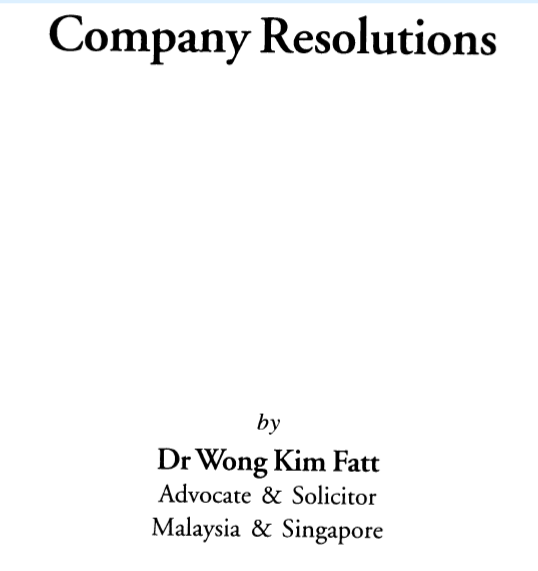
Company Resolutions
Review author: marceljude.ai
The book is structured in three main parts: a doctrinal legal discussion in Part I, a practical drafting bank of 301 specimen resolutions in Part II, and model notices/proxy forms in Part III.
List of Contents with Printed Page Numbers
The preliminary material includes the Preface at page vii, the Subject Index at page xxv, the Table of Cases at page xxvii, and the Table of Statutes at page xxxi. The contents show that Part I begins with legal doctrine, Part II moves into specimen resolutions, and Part III provides meeting notices and proxy forms.
Part I: Legal discussion
Chapter One, Introduction, begins at page 1.
Chapter Two, Resolutions, begins at page 9. Its subsections are: 2.1 Definition of resolutions, page 11; 2.2 Directors’ resolutions, page 12; 2.3 Members’ resolutions, page 17; 2.4 Resolutions passed at requisitioned meetings, page 18; Meetings, page 18; Requisitioned meetings, page 19; Requisition — notice of resolutions, page 22; 2.5 Types of resolutions, page 24; 2.6 Ordinary resolution, page 24; 2.7 Special resolutions, page 27; Acts of the company requiring special resolutions, page 28; and 2.8 Resolutions requiring special notice, page 30.
Chapter Three, Company Meetings, begins at page 33. Its subsections are: 3.1 Valid meetings, page 34; 3.2 Valid resolutions, page 34; 3.3 Void resolutions, page 38; 3.4 Adjournments, page 39; 3.5 Amendments to resolutions, page 39; 3.6 Minutes of meetings, page 41; and 3.7 Validation of proceedings, page 41.
Chapter Four, Registration of Resolutions, begins at page 45.
Chapter Five, Computation of Time, begins at page 53. Its subsections are: 5.1 “Within … after”; “in a stated time”; “during,” page 55; 5.2 A stated period from, page 57; 5.3 Month or a number of months, page 58; 5.4 Until expiration of a stated period, page 61; 5.5 Until, page 62; and 5.6 After … from, page 63.
Part II: Specimen Resolutions
Part II, Specimen Resolutions, begins at page 65. It covers Accounts, page 67; Advertising, page 73; Agent, page 73; Amalgamations and Mergers, page 74; Amendment, page 75; Arbitration, page 75; Articles of Association, page 76; Attorney — Power of Attorney, page 79; Auditors, page 79; Banking, page 80; Books and Records, page 81; Borrowing, page 82; Branch, page 90; Capital, page 92; Caveat, page 126; Committees, page 127; Compromise, page 130; Contracts, page 133; Directors, page 134; Dividends, page 139; Formal Resolutions, page 146; General Manager, page 147; Guarantee, page 148; Holding Companies, page 149; Injunction, page 150; Inspector, page 150; Insurance, page 151; Investment, page 151; Joint Venture, page 151; Judicial Management, page 152; Leases, page 152; Lien, page 153; Loans, page 153; Meetings, page 153; Membership, page 154; Memorandum of Association, page 156; Merger, page 156; Name of Company, page 157; Objects, page 157; Official Management, page 157; Private Company, page 158; Prospectuses, page 159; Public Officer, page 159; Receiver, page 159; Reconstructions, page 160; Registered Office, page 162; Register of Debentures, page 162; Register of Members, page 162; Remuneration, page 163; Representation, page 163; Rescission, page 163; Reserve Liability, page 164; Reserves, page 164; Sale and Purchase, page 166; Scheme of Arrangement, page 170; Seal, page 171; Secretary, page 172; Service Agreement, page 173; Share Option, page 173; Shares — Issue of, page 176; Sinking Fund, page 176; Solicitors, page 177; Stock Exchange, page 177; Take-Overs, page 177; Underwriting, page 185; and Winding-Up, page 185.
Part III: Notices of Meetings and Proxy Form
Part III, Notices of Meetings and Proxy Form, begins at page 191. It contains a Notice of Annual General Meeting at page 192, including a Malaysian company version at page 192 and a Singapore company version at page 195; a Notice of Extraordinary General Meeting at page 197; a Notice of Meeting by Order of Court at page 204; and a Proxy Form at page 207.
Overall Review of the Entire Book
Company Resolutions is best understood as a hybrid work: part company-law treatise, part procedural manual, and part drafting precedent book. Its central concern is not company law in the abstract, but the legal effectiveness of corporate decisions. The book asks a very practical question: when a company acts through a resolution, what must be done so that the act is valid, binding, properly recorded, and, where required, properly registered?
From a law professor’s perspective, the book’s strength lies in its disciplined movement from theory to practice. Part I explains the legal anatomy of resolutions. Part II then provides the drafting architecture for actual corporate decisions. Part III completes the procedural cycle by supplying notices and proxy forms. The result is a book that teaches not only what a resolution is, but how resolutions live inside meetings, notices, voting rules, articles of association, statutory registration, and court validation.
The book’s major intellectual premise is that corporate action is mediated through organs: directors in board meetings and members in general meetings. That premise is deceptively simple. Much of corporate litigation arises precisely because a decision is taken by the wrong organ, taken at the wrong meeting, taken without proper notice, taken without quorum, framed as the wrong kind of resolution, or filed too late. The book is therefore not merely about drafting words; it is about institutional authority.
Its greatest practical value is that it reminds lawyers, company secretaries, directors, shareholders, and students that a resolution is not valid merely because it sounds formal. Validity depends on power, procedure, notice, voting threshold, minutes, filing, and time computation. That is the book’s deepest lesson.
Its limitation is also clear: because company legislation changes, the precedents should not be used mechanically. The Preface itself warns that the specimen resolutions are guides to be varied according to the facts, circumstances, and law applicable to the company. That warning is important. A precedent book is useful only when the user understands why the precedent works.
Chapter One Review: Introduction
Printed page: Chapter begins at page 1
Chapter One lays the jurisprudential foundation for the whole book. It begins by situating companies among other business forms and then moves quickly to the legal consequences of incorporation. The company, once incorporated, becomes a separate legal person: it may contract, own property, sue, be sued, enjoy rights, and incur liabilities in its own name. This is not treated as a decorative doctrine; it is the root of why resolutions matter. Since the company is artificial, it must act through human organs.
The chapter’s first major legal concept is separate legal personality. The book relies on the classic line of authority beginning with Salomon v Salomon & Co Ltd and connects it to Malaysian and Singaporean company law. This is a strong pedagogical choice. A student cannot understand corporate resolutions unless they first understand that the company is not identical with its shareholders, directors, promoters, or controllers. The company is a legal subject of its own.
The second major concept is the proper plaintiff rule, associated with Foss v Harbottle. If a wrong is done to the company, the company is generally the proper party to sue. This principle reinforces the same corporate-personality logic: because the company is a separate person, corporate injuries belong to the company. The rule matters for resolutions because corporate decisions may determine whether the company itself acts, whether shareholders may act, or whether the court must intervene.
The third major concept is the corporate veil. The book explains that while corporate personality is fundamental, courts may pierce or lift the veil in appropriate circumstances, especially where the company is used as a façade, sham, device to evade obligations, or vehicle for fraud. This discussion is important because it prevents the chapter from becoming a simplistic celebration of incorporation. The book presents corporate personality as powerful but not absolute.
As a law professor, I would describe Chapter One as doctrinally conservative but practically sound. It does not attempt a broad theoretical critique of corporate personhood. Instead, it gives the reader the minimum conceptual equipment required to understand the rest of the book. The chapter is especially useful because it connects corporate personality to the human organs through which the company acts: directors, officers, and shareholders in meetings. That link prepares the reader for Chapter Two, where resolutions become the formal expression of corporate will.
The chapter’s weakness is that it is more introductory than analytical. It explains leading principles clearly, but it does not deeply explore minority remedies, oppression, derivative actions, or the modern evolution of corporate governance. Still, for the book’s purpose, that is acceptable. The chapter is not trying to be a full corporate-law textbook. It is building a foundation for the law of resolutions.
Law-professor assessment: Chapter One succeeds because it teaches that a company’s “decision” is not merely a business preference. It is a legal act by an artificial person, and that act must be attributed through the correct corporate organ.
Chapter Two Review: Resolutions
Printed page: Chapter begins at page 9
Chapter Two is the doctrinal heart of the book. It explains what resolutions are, who may pass them, where they may be passed, and what legal thresholds apply. The chapter starts from the basic idea that the company acts through two primary organs: the board of directors and the members in general meeting. The board and the general meeting do not possess interchangeable powers. The articles and the statute divide authority between them.
The chapter’s most important idea is the division of corporate power. If management powers are vested in directors, shareholders cannot simply take those powers over by passing a resolution in general meeting. Conversely, directors cannot validly decide matters that legally require member approval. This is one of the most important practical lessons in the book. Many defective resolutions fail not because the wording is poor, but because the wrong body made the decision.
2.1 Definition of Resolutions
Printed page: 11
The book explains that the statutes discussed do not give a general definition of “resolution.” In practice, a resolution is a formal decision taken at a meeting by vote, or a proposal put before a meeting for decision. The book also emphasizes that a resolution is not, simply by being passed, a contract. That distinction is legally significant. A resolution may bind the company internally, but it does not automatically create contractual rights unless the surrounding law, constitution, or facts support that conclusion.
This subsection is brief but conceptually important. A weak student may think a resolution is merely wording. A stronger lawyer knows that a resolution is a procedural act of corporate decision-making. The subsection helps separate “decision,” “proposal,” “contract,” and “binding internal act.”
2.2 Directors’ Resolutions
Printed page: 12
This subsection explains that directors act collectively as the board. Their powers are typically conferred by the company’s articles and are exercised at properly convened board meetings, subject to notice and quorum. The book discusses written or circular resolutions and the effect of articles that permit decisions without a physical meeting.
The treatment of directors’ resolutions is especially useful because it highlights a common corporate-law trap: a majority of directors cannot privately decide something without proper notice to the minority, unless all relevant procedural requirements are satisfied. A board resolution is not merely the will of whoever controls the board. It is the act of a properly constituted board.
The subsection also discusses delegation to committees and alternate directors. That is practical because real companies frequently operate through audit committees, executive committees, finance committees, and delegated authorities. The law professor’s point here would be this: delegation does not abolish the need for authority. A committee can only exercise powers validly delegated to it, and alternate directors operate within the constitutional framework permitting their appointment.
2.3 Members’ Resolutions
Printed page: 17
This subsection shifts from directors to shareholders or members. It explains that members may pass resolutions in general meeting and, in certain private-company contexts, may use written resolutions where permitted. The key legal theme is that members’ resolutions are expressions of shareholder decision-making, but only within the sphere assigned to members.
This subsection is valuable because it recognizes the reality of small private companies, where formal meetings may be replaced by written or paper procedures. Yet the book rightly treats such shortcuts as legally dependent on statutory and constitutional permission. In other words, convenience does not override legality.
2.4 Resolutions Passed at Requisitioned Meetings
Printed page: 18
This subsection examines resolutions initiated not by the board, but by members exercising requisition rights. It is one of the more important governance sections in the book because requisition rights protect shareholder participation, especially where directors may be unwilling to call a meeting.
Meetings
Printed page: 18
The book explains the difference between annual general meetings and extraordinary general meetings. This distinction matters because some business is ordinary annual business, while other business requires a specially convened meeting. The subsection also reminds the reader that the timing of meetings is not just administrative; it is regulated.
Requisitioned Meetings
Printed page: 19
The book explains that members with sufficient voting power may require directors to convene a meeting. If directors fail to act within the statutory timeframe, the requisitionists may themselves convene the meeting. The legal policy is clear: directors should not be able to suppress shareholder decision-making simply by refusing to call a meeting.
This is a strong part of the chapter because it shows corporate democracy operating through procedure. The right to requisition a meeting is not merely symbolic. It is a mechanism for accountability.
Requisition — Notice of Resolutions
Printed page: 22
This part explains the requirement that requisitioned resolutions must be capable of being “properly moved.” That phrase is crucial. Members cannot force the company to circulate or consider a resolution that the meeting has no legal capacity to pass.
The book’s treatment here is especially sophisticated. It shows that shareholder power is real but bounded. A requisition cannot be used to move an ultra vires resolution, to usurp management powers vested in directors, or to compel a meeting to decide something outside its competence.
2.5 Types of Resolutions
Printed page: 24
The book identifies ordinary and special resolutions as the two principal types passed at general meetings. This classification is foundational. The type of resolution determines the voting threshold, notice requirement, and sometimes registration consequences.
This subsection is short, but it frames the next two subsections. The professor’s point is that classification matters. Calling a resolution “ordinary” when the statute requires a special resolution is not a harmless drafting error. It may invalidate the act.
2.6 Ordinary Resolution
Printed page: 24
The book explains that an ordinary resolution is generally passed by a simple majority of those present and voting, personally or by proxy where proxies are allowed. Abstentions are not treated as votes for this purpose. The subsection also discusses voting rights and special voting arrangements, including the difficult issue of weighted voting in connection with removal of directors.
The chapter’s discussion of ordinary resolutions is valuable because it shows that “majority rule” is not always simple. The result depends on who is entitled to vote, how votes are counted, whether voting is by show of hands or poll, and whether special voting rights exist.
The law-professor critique is that this subsection is one of the book’s best teaching moments. It demonstrates that corporate democracy is mediated by shares, classes, articles, proxies, and statutory limits. A “simple majority” is only simple after the voting universe has been legally defined.
2.7 Special Resolutions
Printed page: 27
This subsection explains the stricter requirements for special resolutions, especially the higher voting threshold and longer notice requirement. Special resolutions are required for more fundamental corporate acts because such acts affect the company’s constitution, capital structure, identity, or existence.
The book provides examples of acts requiring special resolutions, including alteration of constitutional documents, change of name, conversion of company status, alteration of objects, reduction of capital, and voluntary winding up. The list is functionally important because it teaches the reader that special resolutions are used where corporate action is structurally serious.
Acts of the Company Requiring Special Resolutions
Printed page: 28
This portion is particularly practical. Instead of treating special resolutions abstractly, the book itemizes statutory situations in which they are required. For practitioners, this is the checklist function of the book. For students, it illustrates legislative policy: the more fundamental the change, the more demanding the approval procedure.
2.8 Resolutions Requiring Special Notice
Printed page: 30
This subsection explains resolutions that require special notice, particularly removal of directors and auditors. The book describes special notice as a procedural safeguard. It ensures that affected persons and members have adequate warning before sensitive resolutions are moved.
This subsection is legally important because special notice is not the same as a special resolution. That distinction is often misunderstood. A resolution may be ordinary in voting threshold but still require special notice. For example, removal of a director may be by ordinary resolution but subject to special notice. That is a crucial drafting and procedural point.
Law-professor assessment: Chapter Two is the strongest doctrinal chapter. It teaches that resolutions are not isolated documents. They are legal acts whose validity depends on corporate organs, statutory powers, articles, notice, voting rights, and classification.
Chapter Three Review: Company Meetings
Printed page: Chapter begins at page 33
Chapter Three moves from the resolution itself to the meeting environment in which resolutions are proposed, debated, amended, voted on, recorded, and sometimes challenged. This chapter is procedural, but not merely technical. Its deeper theme is that corporate power must be exercised through valid institutional process.
The chapter begins by emphasizing that companies must hold annual general meetings and that board meetings require proper notice and quorum. It also stresses that decisions requiring general meeting approval cannot be validly made at board level, even where directors and shareholders are the same individuals. That is a vital lesson for closely held companies.
3.1 Valid Meetings
Printed page: 34
The book explains that a valid meeting must be convened by someone with authority to convene it. This may be the board, properly empowered members, or the court. The point is elementary but essential. If the meeting itself is defective at birth, the resolutions passed at it may collapse.
This subsection is useful because it teaches that corporate meetings are jurisdictional events. One must first ask: who called the meeting, under what power, and in what manner?
3.2 Valid Resolutions
Printed page: 34
This subsection explains that notice must be issued to persons entitled to attend, and the notice must state the date, time, venue, and general nature of the business. The proposed resolution must be one that may properly be moved. A resolution outside the meeting’s legal capacity is invalid.
The subsection is especially strong because it links notice to fairness. Notice is not a ritual formality. It allows members to decide whether to attend, how to vote, whether to appoint a proxy, and whether to challenge the proposed business. A defective notice may therefore create real prejudice.
The book also considers whether directors’ motives may be examined where a resolution is challenged as having been passed for an improper purpose. That issue gives the subsection an important litigation dimension: resolutions are not immune from scrutiny merely because they are formally passed.
3.3 Void Resolutions
Printed page: 38
This subsection explains that where a meeting lacks quorum, any purported resolution may be void. Quorum is the minimum number of members or directors required for the meeting to transact business. The book also discusses the role of the chairman and the presumption of regularity where minutes record that business was properly conducted.
The subsection’s value lies in showing that invalidity can arise from procedural failure rather than substantive illegality. A perfectly sensible business decision may be legally void if passed at an inquorate meeting.
3.4 Adjournments
Printed page: 39
The book explains that adjournment usually requires the meeting’s consent unless the articles or circumstances permit otherwise. It discusses the chairman’s limited authority and recognizes a residual power to adjourn where disorder prevents the meeting from continuing.
This is a practical and important discussion. Chairpersons often assume they control the meeting absolutely. The book corrects that assumption. The chairman manages procedure but does not own the meeting. The meeting itself remains the deliberative body.
3.5 Amendments to Resolutions
Printed page: 39
This subsection considers whether a proposed resolution may be amended at the meeting. The book explains the general concern: if notice has been given of a particular resolution, a substantial amendment may mean that members were not properly notified of the actual business transacted.
The book’s discussion of amendments is one of its most legally refined sections. It distinguishes between harmless corrections and substantive changes. A grammatical correction is different from a change that alters the nature of what members are being asked to approve. The key test is whether an absent reasonable member might have attended had the amended resolution been notified.
3.6 Minutes of Meetings
Printed page: 41
The book explains that minutes must be kept for general meetings and board meetings, entered into minute books, and signed by the chairman. Once properly recorded and signed, minutes create a presumption that the meeting was duly held, properly convened, and that resolutions were validly passed.
This subsection is short but crucial. Minutes are the evidentiary memory of the company. In litigation, the question often becomes not simply what happened, but what the company’s official records show happened.
3.7 Validation of Proceedings
Printed page: 41
This subsection discusses the court’s power to validate or invalidate proceedings affected by defects, irregularities, omissions, or deficiencies. The central legal concept is “substantial injustice.” Not every irregularity destroys a meeting or resolution. The court asks whether the defect caused serious injustice that cannot otherwise be remedied.
This is one of the most important jurisprudential parts of the book. It prevents procedural law from becoming absurdly mechanical. Corporate procedure matters, but the court’s remedial discretion recognizes that not every technical defect should invalidate company action. At the same time, the book makes clear that the discretion is not unlimited; the court does not simply rewrite the company’s constitution.
Law-professor assessment: Chapter Three is a procedural chapter with strong litigation value. It teaches that meetings are not ceremonial gatherings. They are legally structured events, and their defects may determine whether corporate decisions stand or fall.
Chapter Four Review: Registration of Resolutions
Printed page: Chapter begins at page 45
Chapter Four addresses what happens after a resolution is passed. Its central point is that certain resolutions must be lodged with the Registrar within specified time periods. The chapter treats registration as part of the legal life of a resolution, not as a clerical afterthought.
The chapter explains that special resolutions and class-binding resolutions generally require lodgement within one month unless the statute provides otherwise. It also discusses shorter periods for voluntary winding-up resolutions and special rules for alterations to the memorandum or objects. The practical lesson is that passing a resolution is only one stage. For some corporate acts, the resolution’s legal effect or compliance status depends on timely lodgement.
From a law professor’s viewpoint, Chapter Four is valuable because it teaches compliance discipline. Corporate lawyers often focus on drafting and shareholder approval, but filing deadlines can be equally important. A beautifully drafted resolution passed unanimously may still create legal exposure if registration is neglected.
The chapter’s inclusion of prescribed forms also shows the administrative dimension of company law. Corporate law is not only case law and doctrine. It is also forms, lodgement, registers, penalties, certificates, and official records.
The chapter’s limitation is that it is primarily descriptive. It does not deeply theorize why registration matters. But that is not a serious flaw. The chapter’s purpose is practical: to tell the reader which resolutions must be filed, when, and with what consequences for default.
Law-professor assessment: Chapter Four is the compliance chapter. Its importance lies in showing that corporate validity and corporate publicity often require formal registration. A resolution may be passed in the meeting room, but company law may require it to be carried into the public registry.
Chapter Five Review: Computation of Time
Printed page: Chapter begins at page 53
Chapter Five is deceptively important. Time computation may seem mechanical, but in company law it can decide validity. A notice served one day too late, a filing made one day out of time, or a meeting called without the required notice period can invalidate action or expose the company and officers to penalties.
The chapter explains statutory rules and judicial approaches to phrases such as “within,” “after,” “from,” “until,” and “month.” Its practical message is cautionary: do not wait until the last day if the computation is arguable.
5.1 “Within … after”; “in a stated time”; “during”
Printed page: 55
This subsection explains that where an act must be done within a specified number of days after an event, the day of the event is generally excluded. If the last day falls on a weekly or public holiday, the period may extend to the next non-excluded day, depending on the relevant statutory rule.
This subsection is particularly useful for filing deadlines. It shows that “within seven days after passing a resolution” does not necessarily mean counting the day of passing as day one.
5.2 A Stated Period From
Printed page: 57
This subsection deals with periods calculated “from” a given event or date. The book uses case law to show that apparently simple time language can produce disputes. The point is that time computation depends on context, statutory wording, and sometimes the “corresponding date” principle.
The legal-professor point is that drafting should avoid ambiguity. If parties or lawmakers intend inclusion or exclusion of a particular date, the wording should say so expressly.
5.3 Month or a Number of Months
Printed page: 58
This is one of the chapter’s strongest sections. The book explains the corresponding-date principle: a period of one month or several months generally ends on the corresponding date in the later month, subject to complications where the later month has no equivalent date.
The discussion is highly practical. A “month” is not the same thing as 30 days. That distinction matters in notices, filing periods, contractual deadlines, and statutory compliance.
5.4 Until Expiration of a Stated Period
Printed page: 61
This subsection shows that language such as “until expiration of one month” may require a clear month to pass. The book uses case law to illustrate how easily a party may act one day too soon.
The teaching value here is excellent. Many legal errors occur because parties act early or late based on ordinary-language intuition rather than legal computation.
5.5 Until
Printed page: 62
This subsection explains that the word “until” can create uncertainty as to whether the terminal date is included. The book recommends clear drafting such as stating whether dates are inclusive.
This is a good example of the book’s practical drafting intelligence. The best way to win a time-computation dispute is to avoid creating one.
5.6 After … From
Printed page: 63
The final subsection deals with expressions involving “after” and “from,” especially in limitation or deadline contexts. Its lesson is consistent with the rest of the chapter: the first day may be excluded, the last day carefully identified, and the drafter should not rely on assumptions.
Law-professor assessment: Chapter Five is essential for practitioners. It proves that procedural law is not secondary. Time is a legal condition. In corporate practice, one day can separate validity from invalidity.
Review of Part II: Specimen Resolutions
Printed pages: Part II begins at page 65 and runs through page 188
Part II is the book’s practical engine. It contains 301 specimen resolutions and covers a wide range of corporate activity, from routine accounts approval to capital restructuring, directors’ appointments, dividend declarations, take-overs, schemes of arrangement, and winding up. The Preface states that these precedents are guides and must be varied to suit the facts and legal circumstances.
The specimen resolutions are valuable because they show the grammar of corporate authority. They teach the repeated drafting moves of company law: approving, authorising, ratifying, appointing, removing, delegating, adopting, declaring, convening, lodging, sealing, issuing, allotting, redeeming, reducing, winding up, and empowering officers to implement decisions.
The strongest portion of Part II is the material on capital, beginning at page 92. This section is extensive because share capital produces many forms of corporate action: allotments, calls, consolidations, conversions, forfeitures, increases, preference rights, redeemable preference shares, capital reductions, share subdivisions, and transfers. In teaching terms, this part demonstrates how resolutions translate corporate finance decisions into legally operative form.
The directors section, beginning at page 134, is also important. It covers appointment, alternate directors, chairmanship, declarations of interest, casual vacancies, managing directors, over-age directors, resignation, remuneration, removal, retiring allowances, and re-election. This section is useful because it shows that the legal status of directors is constantly mediated through resolutions.
The dividends section, beginning at page 139, demonstrates the relationship between profits, capitalisation, bonus issues, interim dividends, final dividends, and preference dividends. Its drafting forms show how financial decisions require precision about source of funds, class rights, timing, register date, and ranking of shares.
The meetings section, beginning at page 153, connects back to Part I. It gives specimen forms for adjournment, annual general meeting convening, extraordinary general meeting authority, fixed board meetings, scrutineers, statutory reports, and member adoption. This makes Part II more than a forms bank; it is a practical companion to the doctrinal chapters.
The sale and purchase, scheme of arrangement, take-over, and winding-up sections show the book’s ambition. It is not limited to small routine resolutions. It also supplies forms for major corporate transactions, restructuring, insolvency-adjacent decisions, liquidator powers, creditor meetings, and court winding up.
Part II’s weakness is that precedents can create false confidence. A form is not a substitute for legal analysis. A resolution that is perfect for one company may be invalid for another if its articles, share structure, statute, regulator, or factual background differ. The book recognizes this, but users must take the warning seriously.
Law-professor assessment: Part II is highly useful as a drafting laboratory. It teaches the structure and language of resolutions, but it should be used only after applying the doctrinal tests in Part I: power, meeting, notice, voting threshold, class rights, filing, and time.
Review of Part III: Notices of Meetings and Proxy Form
Printed pages: Part III begins at page 191
Part III completes the procedural chain. Resolutions do not exist in isolation; they must often be preceded by proper notice and accompanied by proxy machinery. The book provides models for annual general meetings, extraordinary general meetings, court-ordered meetings, and proxy forms.
The Notice of Annual General Meeting, beginning at page 192, is structured around ordinary business and special business. This distinction is important. Ordinary business includes matters such as receiving accounts, declaring dividends, electing or re-electing directors, and appointing auditors. Special business requires clearer specification because members need to know what extraordinary or non-routine decision is proposed.
The Singapore version beginning at page 195 performs a comparative function. It shows that although the book often treats Malaysian and Singaporean company law together, notice forms must still be adapted to jurisdiction-specific statutory language and practice.
The Notice of Extraordinary General Meeting, beginning at page 197, is useful for major transactions and corporate restructuring. It shows how special resolutions and ordinary resolutions can appear together in a single meeting notice, provided the resolutions are properly classified and described.
The court-ordered meeting notice, beginning at page 204, is important for schemes of arrangement. It reflects a different procedural setting: the meeting is not merely called by the board or members, but under court direction. That changes the legal atmosphere of the notice.
The Proxy Form, at page 207, is a necessary practical document. It allows members who cannot attend to participate through appointed representatives. The form’s voting structure also shows how resolutions are converted into voting choices.
Law-professor assessment: Part III is practical and necessary. It reminds readers that the validity of a resolution may depend on the notice that came before it and the voting instrument used at the meeting.
Major Themes Across the Whole Book 1. Corporate action depends on the correct organ
The book consistently teaches that directors and members occupy different legal spheres. A board resolution cannot do what only members may do. A members’ resolution cannot usurp powers vested in the board. This is one of the book’s most important lessons.
2. Procedure is substance
The book rejects the casual idea that procedure is mere formality. Notice, quorum, voting thresholds, minutes, registration, and time computation can determine whether a resolution is valid or void.
3. Drafting must follow authority
The specimens in Part II are useful only if the drafter first identifies the source of authority: statute, memorandum, articles, prior resolution, court order, or delegated power.
4. The book is both comparative and practical
The book repeatedly compares Malaysian and Singaporean provisions. That comparative approach is useful because it shows both similarity and difference. But it also means users must be careful not to assume that a form applicable in one jurisdiction automatically applies in the other.
5. Resolutions are governance tools
The book presents resolutions not merely as paperwork, but as instruments of governance. They allocate authority, record decisions, create accountability, and provide evidence of corporate action.
Strengths of the Book
The book’s first strength is clarity of purpose. It knows exactly what it is about: company resolutions. It does not wander into every corner of company law.
Its second strength is the movement from principle to precedent. The reader first learns the law of resolutions, meetings, registration, and time, and then sees hundreds of drafting examples.
Its third strength is procedural seriousness. The book understands that many corporate disputes turn on process rather than commercial wisdom.
Its fourth strength is its case-law orientation. The use of cases gives the discussion authority and helps readers understand why particular rules matter.
Its fifth strength is practical range. The specimen resolutions cover ordinary matters, such as accounts and banking, as well as complex matters, such as capital reduction, schemes of arrangement, take-overs, and winding-up.
Weaknesses and Cautions
The book’s main weakness is the natural risk of all precedent books: users may copy without understanding. A resolution must be fitted to the company’s constitution, share structure, jurisdiction, regulatory environment, and facts.
A second limitation is that some areas receive more practical treatment than theoretical analysis. For example, registration and time computation are clear and useful, but not deeply theoretical.
A third caution is that company law is time-sensitive. The book should be reviewed as a legal and drafting work, but any practical use of its forms must be checked against current legislation, current rules, and the company’s own constitution.
A fourth limitation is that the book is strongest for lawyers, company secretaries, and advanced students. A beginner may need additional background in company law to fully understand why the forms are drafted as they are.
Final Law-Professor Verdict
Company Resolutions is a serious, practical, and doctrinally grounded work on corporate decision-making. Its best quality is that it treats resolutions as legal acts, not as office paperwork. It shows that a company speaks through properly authorised organs, at properly convened meetings, by properly classified resolutions, recorded in proper minutes, registered where required, and filed within properly computed time.
For students, the book is valuable because it turns abstract company-law doctrine into operational legal practice. For practitioners, it is valuable because it supplies drafting models while repeatedly reminding the reader that precedents must be adapted. For company secretaries, it is especially useful because it links meetings, resolutions, notices, filings, and minutes into one procedural system.
As a whole, the book deserves to be read as a manual of corporate legality. Its central lesson is simple but powerful: a company’s decision is valid only when the law recognizes the path by which that decision was made.

- MALAYSIA'S 1ST AI LAWYER - CLICK HERE
- ISMAIL – INTEGRATED SINGAPORE/MALAYSIA AI & LAW (Library)
- OPENING OF SINGAPORE MALAYSIA AI CENTRE AND LAW LIBRARY
- LIFT - LAW INSTRUMENTS FORMS & TEMPLATES
- LAWS OF MALAYSIA FOR SINGAPOREAN DUMMIES
- HANNAH YEOH'S ARTIFICIAL INTELLIGENCE LAW ENCYCLOPEDIA
- LEAD CR - Law Ecosystem Archive Databases on CD-ROM
- BREAKING NEWS FROM MJN
- CLICK HERE CO. PROFILE
- EXCITING NEW SERIES - THE ADVENTURES OF BOBBY TAN -ADVOCATE & SOLICITOR IN THE HIGH COURT OF NORTH BORNEO by marceljude.ai
- MEDICO LEGAL - BY PRISKILA AKWILA & GLORIOUS PETAL SDN BHD - powered by marceljude.ai
- MISCELLANOUS
- ANNOTATED STATUTES OF SABAH - A NEW SERIES
- e-library - marceljude.ai
- DRAFT - DOCUMENT RESEARCH & AUTOMATED FILING TECHNOLOGY
- CLARA – Case Law Analysis & Retrieval AI
- FOR RESEARCH REQUEST CLICK HERE
- CLICK HERE TO ASK ANYTHING
- RAMBO'S LAW - THE LAW OF THE LAW JUNGLE - EXCITING NEW SERIES - CASE ANALYSIS BY JOHN RAMBO @ +60138646786
- PRISKILA AKWILA ADVOCATES - High Court of Sabah & Sarawak @ Kota Kinabalu
- COLA - COMMONWEALTH ONLINE LAWCASES AI -marceljude.ai
- THE LAW LIBRARY THAT COMES TO YOU ANYWHERE AND ANYTIME
- marceljude.ai training academy
