
COURTS OF JUDICATURE ACT 1964 ON CD ROM @ marceljude.ai
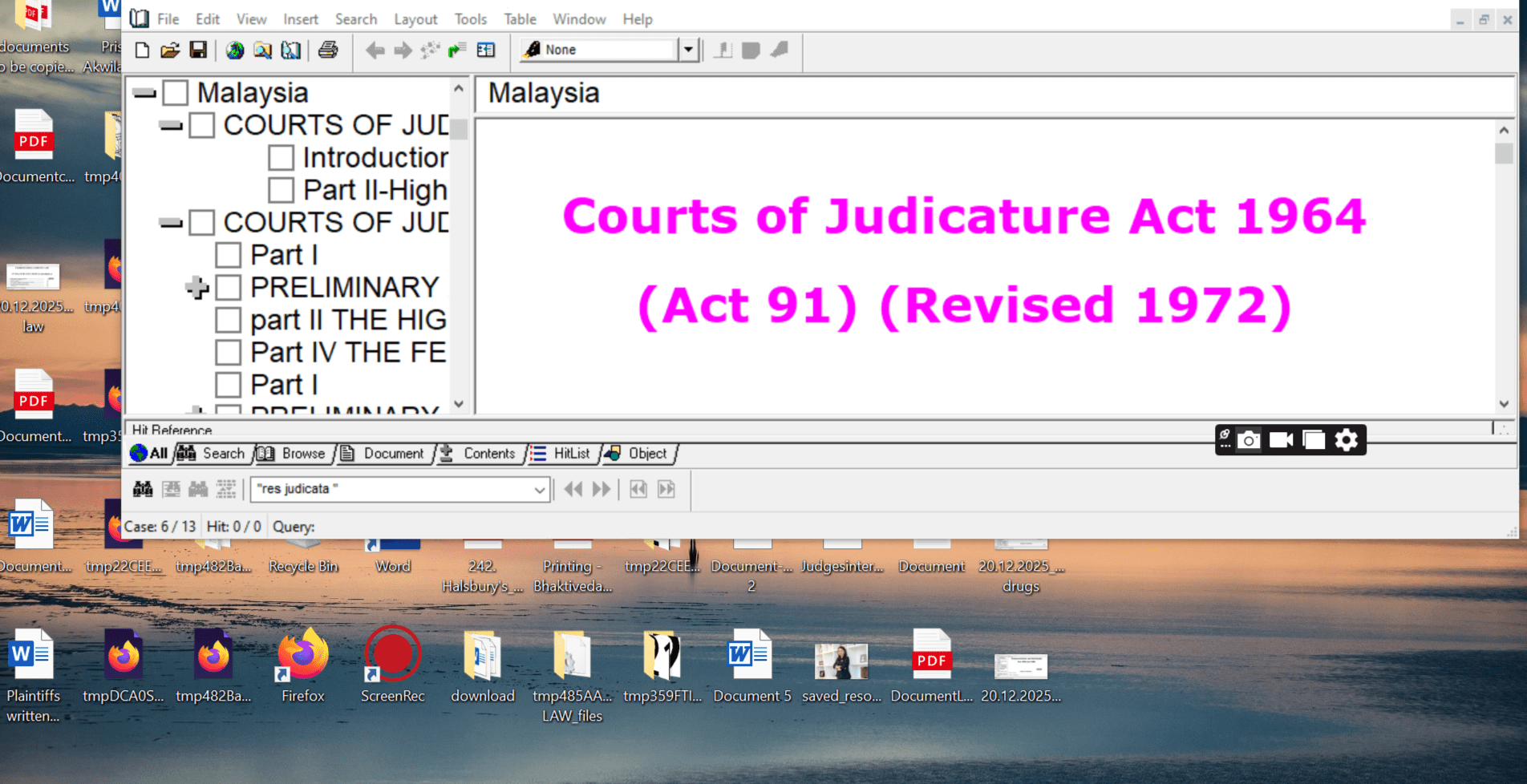


Description
COURTS OF JUDICATURE ACT 1964 Introduction
The Act came into force on 16 March 1964. It deals with matters concerning the organisation, jurisdiction, power and administration of the superior courts established under Part IX of the Federal Constitution ((1) 1 Constitutional Law). Prior to 24 June 1994, the superior courts consisted of the High Court in Malaya, the High Court in Borneo and the Supreme Court. By the Constitution (Amendment) Act 1994 (Act A885), an intermediate appellate court between the two High Courts and the Supreme Court (called the Court of Appeal) was established. The Amendment Act also changed the name of the High Court in Borneo to the High Court in Sabah and Sarawak, and the name of the Supreme Court to the Federal Court. Following these constitutional amendments, the Courts of Judicature Act 1964 was amended (by Act A886) to make provisions for the establishment of the new appellate court and the change of names. The Act is divided into four parts: Part I-Preliminary and General
This Part deals with general matters affecting the administration of the courts. It makes provision for the manner in which process of courts is to be issued; the order of precedence of judges; the exercise of powers of judges during incapacity or absence; the functions and powers of registrars and sheriffs; the protection of judges and other judicial officers; and the setting-up of the Rules Committee and its power to make rules of court. Part II-High Court
Provision is made as to the jurisdiction and powers of the two High Courts in this Part. The two High Courts are conferred with original jurisdiction to hear criminal and civil matters, appellate jurisdiction to hear appeals from subordinate courts, and supervisory and revisionary jurisdiction over subordinate courts. Except for offences committed on the high seas, the territorial jurisdiction of each High Court is confined to the territories assigned under section 3 of the Act (by the definition of 'local jurisdiction'). In the case of the High Court in Malaya, its territorial jurisdiction comprises all the states in West Malaysia and the Federal Territory of Kuala Lumpur. In the case of the High Court in Sabah and Sarawak, its territorial jurisdiction comprises the states of Sabah and Sarawak, and the Federal Territory of Labuan. Although not provided in the Act, the High Courts have no jurisdiction in respect of matters within the jurisdiction of the syariah courts. This is, however, provided in art 121(1A) of the Federal Constitution ((1) 1 Constitutional Law). Part Ill-Court of Appeal
The Court of Appeal does not have original jurisdiction to hear matters. The court is only conferred with appellate jurisdiction to hear:
(a) criminal appeals against decisions made by the High Court in the exercise of its original jurisdiction, and against decisions made by the High Court in the exercise of its appellate or supervisory jurisdiction on criminal matters decided by the Sessions Court or on question of law in criminal matters decided by a Magistrate's Court;
(b) civil appeals from any judgment or order made by the High Court in the exercise of its original or appellate jurisdiction.
In certain situations, no civil appeal can be brought to the Court of Appeal except with leave; for example, where the amount or value of the subject matter of the claim is less than RM250,000. The Court of Appeal is given all the powers which the High Court has.
This Part also deals with procedures for bringing appeals to the Court of Appeal and the conduct of such appeals. Part IV-Federal Court
The Federal Court is given original jurisdiction by the Constitution to determine questions as to the validity of a law made by Parliament or a State Legislature; and to determine disputes between the states or between the Federation and a state. Part IV of the Act makes provision to enable a Judge of the High Court to refer a constitutional point arising in a proceeding to the Federal Court for determination.
In the exercise of its criminal appellate jurisdiction, the Federal Court is restricted to hearing appeals against decisions of the Court of Appeal made in respect of criminal matters decided by the High Court in the exercise of the High Court's original jurisdiction. In civil matters, the appellate jurisdiction of the Federal Court can be exercised in respect of judgments or orders made by the Court of Appeal on matters decided by the High Court in the exercise of the High Court's original jurisdiction involving a question of general principle or of importance; and on any decision of the
Court of Appeal on constitutional issues. Save where constitutional issues are involved, this in effect makes the Court of Appeal the final arbiter of civil matters initiated in subordinate courts. COURTS OF JUDICATURE ACT 1964 (Act 91) (Revised 1972)
First enacted 1964 (Act No 7 of 1964)
ARRANGEMENT OF SECTIONS Part I
PRELIMINARY AND GENERAL
Preliminary
Section
1 Citation
2 (Omitted)
3 Interpretation
4 Provision to prevent conflict of laws
5 (Deleted) General
6 Seals of Courts
10 COURTS 8c PROCEDURE
7 Process of Courts
8 Precedence of Judges
9 Exercise of powers during incapacity or absence
10 Registrars
11 Commissioners for Oaths
12 Sheriffs
13 Contempt
14 Protection of Judges and other judicial officers
15 Courts to be open and public
16 Rules of court
17 Making of rules of court 17A Council of Judges
part II
THE HIGH COURT General
18 Proceedings in High Court to be disposed of by single Judge
19 Sittings of the High Court
20 Distribution of business
21 Vacations Original Jurisdiction
22 Criminal jurisdiction
23 Civil jurisdiction—general
24 Civil jurisdiction—specific 24A Reference under order of court
25 Powers of the High Court 25A Orders for interim payment Appellate Jurisdiction
26 Appellate criminal jurisdiction
27 Appellate civil jurisdiction
28 Civil appeals from subordinate courts
29 Civil appeals to be by way of re-hearing
30 Reference of constitutional question by subordinate court
Revision
31 Revision of criminal proceedings of subordinate courts
32 Power of High Court to call for records of civil proceedings in subordinate courts
33 Powers of High Court on revision of civil proceedings
34 No revision at instance of party who could have appealed
35 General supervisory and revisionary jurisdiction of High Court
36 Discretion of Court as to hearing parties
37 Special provision as to States of Malaya Part III
THE COURT OF APPEAL General
38 Composition of the Court of Appeal
39 Sittings of the Court
40 Vacations
41 Proceedings how decided
42 Continuation of proceedings notwithstanding absence of Judge
43 Applications
44 Incidental directions and interim orders Original Jurisdiction
45-49 (Deleted)
Appellate Jurisdiction — Criminal Appeals 50 Jurisdiction to hear and determine criminal appeals
51 Notice of appeal
52 Record of proceedings
53 Petition of appeal
54 Procedure where appellant in prison
55 Transmission of papers to Court of Appeal
56 Appeals out of time and formal defects 56A On appeal against acquittal, accused may be arrested
57 Appeal not to operate as stay of execution
58 Summary rejection of appeal
59 Notice and time of hearing
60 Powers of Court of Appeal
61 Additional evidence
62 Judgment
63 Certification of judgment 64-66 (Deleted)
Appellate Jurisdiction — Civil Appeals
67 Jurisdiction to hear and determine civil appeals
68 Non-appealable matters
69 Hearing of appeals
70 Costs of appeal
71 New trial
72 Immaterial errors
73 Appeal not to operate as stay of execution Part IV
THE FEDERAL COURT General
74 Composition of the Federal Court
75 Sittings of the Court
76 Vacations
77 Proceedings how decided
78 Continuation of proceedings notwithstanding absence of Judge
79 Applications
80 Incidental directions and interim orders Original Jurisdiction
81 Jurisdiction and powers
82 Judgment to be declaratory
83 Costs
84 Reference of constitutional question by High Court
85 Proceedings in Federal Court Appellate Jurisdiction—Criminal Appeals
86 Jurisdiction and powers
87 Jurisdiction to hear and determine criminal appeals
88 On appeal against acquittal, accused may be arrested
89 Appeal not to operate as stay of execution
90 Summary rejection of appeal
91 Notice and time of hearing
92 Powers of Federal Court
93 Additional evidence
94 Judgment
95 Certification of judgment Appellate Jurisdiction—Civil Appeals
96 Conditions of appeal
97 Leave to appeal
98 Procedure to enforce order of the Federal Court
99 Costs
100 New trial
101 Immaterial errors
102 Appeal not to operate as stay of execution
Schedule
- MALAYSIA'S 1ST AI LAWYER - CLICK HERE
- ISMAIL – INTEGRATED SINGAPORE/MALAYSIA AI & LAW (Library)
- OPENING OF SINGAPORE MALAYSIA AI CENTRE AND LAW LIBRARY
- LIFT - LAW INSTRUMENTS FORMS & TEMPLATES
- LAWS OF MALAYSIA FOR SINGAPOREAN DUMMIES
- HANNAH YEOH'S ARTIFICIAL INTELLIGENCE LAW ENCYCLOPEDIA
- LEAD CR - Law Ecosystem Archive Databases on CD-ROM
- BREAKING NEWS FROM MJN
- CLICK HERE CO. PROFILE
- EXCITING NEW SERIES - THE ADVENTURES OF BOBBY TAN -ADVOCATE & SOLICITOR IN THE HIGH COURT OF NORTH BORNEO by marceljude.ai
- MEDICO LEGAL - BY PRISKILA AKWILA & GLORIOUS PETAL SDN BHD - powered by marceljude.ai
- MISCELLANOUS
- ANNOTATED STATUTES OF SABAH - A NEW SERIES
- e-library - marceljude.ai
- DRAFT - DOCUMENT RESEARCH & AUTOMATED FILING TECHNOLOGY
- CLARA – Case Law Analysis & Retrieval AI
- FOR RESEARCH REQUEST CLICK HERE
- CLICK HERE TO ASK ANYTHING
- RAMBO'S LAW - THE LAW OF THE LAW JUNGLE - EXCITING NEW SERIES - CASE ANALYSIS BY JOHN RAMBO @ +60138646786
- PRISKILA AKWILA ADVOCATES - High Court of Sabah & Sarawak @ Kota Kinabalu
- COLA - COMMONWEALTH ONLINE LAWCASES AI -marceljude.ai
- THE LAW LIBRARY THAT COMES TO YOU ANYWHERE AND ANYTIME
- marceljude.ai training academy
