
COMMERCIAL LITIGATION: PRE-EMPTIVE REMEDIES
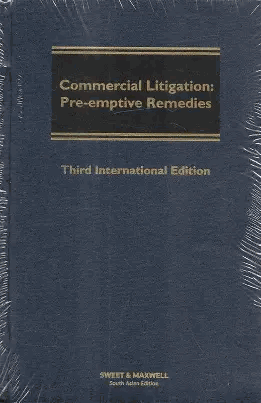


Description
COMMERCIAL LITIGATION: PRE-EMPTIVE REMEDIES
By
Iain S. Goldrein, M.A. (Cantab.) Barrister, Northern Circuit Sir Jack Jacob Visiting Professor of Litigation, Nottingham Law School
His Honour Judge Kenneth Wilkinson
His Honour Judge Kershaw, Q.C., Mercantile Judge
Assisted by Titus Gibson, M.A. Barrister, Northern Circuit
Review by marceljude.ai
I read the book as a litigation text rather than as a narrative treatise. Its central claim is that civil litigation is often won or lost before trial: through injunctions, freezing relief, search/preservation orders, summary judgment, default judgment, dismissal, and security for costs. The book is therefore not merely about “procedure.” It is about litigation power: who can force the pace, who can preserve assets or evidence, who can obtain judgment without trial, and who can stop an opponent from continuing unless procedural or financial safeguards are satisfied.
The work is practitioner-facing, but it is also jurisprudentially significant. It treats remedies as instruments that shape substantive justice. Lord Woolf’s foreword emphasizes that pre-emptive relief can determine the practical outcome of litigation and that litigants must have their “tackle in order” before the application is heard; the book’s organization reflects exactly that: legal principle, evidential burden, procedural mechanics, drafting, undertakings, costs, appeals, and forms.
The book’s great strength is its architecture. Part A gives a rapid-access operational summary of Cyanamid, Mareva, and Anton Piller relief. Part B contains the main analytical chapters. Part C gives forms and precedents. Part D supplies a large case-file on American Cyanamid and special injunction contexts. Part E gives a case digest and index. The result is a book that can be used both as a courtroom manual and as a conceptual map of pre-trial litigation strategy.
This review assesses the book on its own terms, using the book’s printed page numbers.
Contents Map with Book Page Numbers
Preliminary material: Foreword, Foreword to the First Edition, Preface, Table of Cases, Table of Statutes, Table of Statutory Instruments, Table of Rules of the Supreme Court, and Table of County Court Rules.
Part A: Cyanamid—Mareva—Anton Piller: A Quick Access Summary
Overview begins at page 1. It covers the interlocutory armoury, the injunction/undertaking interface, vitiating factors, ex parte and inter partes procedure, undertakings as to damages, appeals, and the American Cyanamid outline.
Mareva summary begins at page 16. It covers the Mareva checklist, the origin of the jurisdiction, detailed practice and procedure, and maximum-sum orders.
Anton Piller summary begins at page 27. It introduces the nature, caution, and procedural character of Anton Piller relief.
Part B: Main Chapters
Chapter 1, Interlocutory Injunctions—Practice and Procedure, begins at page 35.
Chapter 2, Mareva—Practice and Procedure, begins at page 175.
Chapter 3, Anton Piller Orders, begins at page 280.
Chapter 4, Order 14—Summary Judgment, begins at page 300.
Chapter 5, Judgment in Default of Notice of Intention to Defend Action, begins at page 412.
Chapter 6, Judgment in Default of Defence, begins at page 464.
Chapter 7, Dismissal, begins at page 486.
Chapter 8, Security for Costs, begins at page 540.
Part C: Forms, Precedents and Practice Direction
Injunction forms begin at page 558. Summary judgment forms begin at page 576. Default judgment forms begin at page 587. The Practice Direction on Mareva injunctions and Anton Piller orders begins at page 596.
Part D: Cyanamid Case File
The serious-issue examples begin at page 613. Adequacy of damages begins at page 635. Balance of convenience begins at page 648. Strength of the case begins at page 681.
Special-factor case files begin at page 684. They cover passing off, patent cases, copyright, trade disputes, cases where interlocutory relief has final effect, winding-up petitions, impossibility of suitable wording, restraint of trade, public/private interest conflicts, mandatory interlocutory injunctions, defamation, cases with no unresolved affidavit dispute, documentary credits and performance bonds, personal-services contracts, and planning.
Part E
The Case Digest begins at page 1010. The Index begins at page 1221.
Whole-Book Review
The book is a litigation professor’s dream because it refuses to treat procedure as neutral. Every chapter shows that pre-trial procedure is a battlefield of leverage. An interlocutory injunction may preserve the status quo, but it may also effectively decide the case. A Mareva order is not execution before judgment, yet it may prevent a defendant from making any judgment worthless. An Anton Piller order is not a search warrant, yet it may compel preservation of evidence with extraordinary pressure. Summary judgment and default judgment transform procedural failure or absence of a defence into immediate substantive consequences. Dismissal and security for costs give defendants pre-emptive weapons of their own.
The authors’ method is both doctrinal and forensic. They state jurisdiction, identify threshold tests, illustrate those tests through authority, then translate them into affidavit practice, drafting, undertakings, service, costs, and appeal. The book’s unusual value lies in that movement from principle to papers. It does not merely ask, “What is the law?” It asks, “What must counsel prove, disclose, draft, serve, preserve, and anticipate by 10:30 tomorrow morning?”
As a law professor, I would describe the book’s thesis as follows: pre-emptive remedies are the law’s controlled emergency powers in civil litigation. They are necessary because assets disappear, evidence is destroyed, commercial harm accelerates, debtors delay, and weak claims or defences can weaponize procedure. But they are dangerous because they are often granted on affidavit, sometimes without notice, and sometimes before the respondent has been heard. The book’s recurring moral is that urgency never abolishes fairness. It merely compresses it.
Its strongest chapters are Chapters 1 and 2. Chapter 1 gives the general theory of interlocutory relief, including American Cyanamid, undertakings, ex parte dangers, drafting, and costs. Chapter 2 gives a sophisticated anatomy of the Mareva injunction, including its limits, third-party effects, banks, disclosure, worldwide assets, variations, and ancillary orders. Chapter 3 is shorter but important because it isolates the Anton Piller order’s draconian character. Chapters 4 to 6 shift from equitable remedies to judgment without trial. Chapters 7 and 8 rebalance the book by giving defendants pre-emptive responses: dismissal and security for costs.
The book’s limitation is also its strength: it is intensely procedural and historically anchored in the procedural framework it analyzes. It is best read as a doctrinal and historical litigation text, not as a substitute for checking current procedural rules. But as a study of litigation method, evidential discipline, and equitable control, it remains intellectually rich.
Part A Review: Quick Access Summary, pages 1–27
Part A functions as a field manual. It compresses the three great pre-emptive themes: Cyanamid interlocutory injunctions, Mareva freezing orders, and Anton Piller preservation/search-style orders.
The Overview begins with the “interlocutory armoury” on page 1. The phrase is apt: the book treats interlocutory relief as a set of tactical weapons, each with different risks and safeguards. The overview then moves to the injunction/undertaking interface, vitiating factors, ex parte procedure, inter partes procedure, undertakings as to damages, appeals, and the American Cyanamid outline. The summary is not superficial. It emphasizes that even where the court acts quickly, the applicant must satisfy jurisdiction, evidential, drafting, disclosure, and fairness requirements.
The Mareva summary, beginning at page 16, is one of the best conceptual bridges in the book. It explains the freezing order as a protective remedy that does not create proprietary rights and does not itself amount to execution, but restrains dissipation so judgment will not be defeated. The book is particularly alert to banks and third parties, warning that orders must identify assets carefully and include proper undertakings where third parties may incur costs.
The Anton Piller summary, beginning at page 27, introduces a different kind of urgency. Unlike the Mareva order, which restrains asset dissipation, the Anton Piller order responds to the risk that evidence will be hidden or destroyed. The book repeatedly stresses caution: the order is exceptional, must not be wider than necessary, and requires full and frank disclosure.
As a teaching device, Part A is excellent. It lets a student or practitioner see the overall remedial landscape before entering the detailed chapters.
Chapter 1 Review: Interlocutory Injunctions—Practice and Procedure, pages 35–173
Chapter 1 is the theoretical and practical foundation of the whole book. It explains ordinary interlocutory equitable relief before the book moves into specialized remedies such as Mareva and Anton Piller orders.
Subsections and page numbers
Section A, The nature of interlocutory equitable relief, begins at page 35. It covers jurisdiction at page 35, principles at page 40, examples at page 43, drafting the order at page 46, the discretionary nature of the remedy at page 50, factors affecting discretion at page 50, types of interlocutory injunctions at page 50, interactions at page 54, affidavit practice at page 55, and the flexibility of interlocutory relief and related orders at page 60.
Section B, Vitiating factors, begins at page 61. It covers fraud and unclean hands at page 61, failure fully to disclose material facts at page 63, and acquiescence and delay in inter partes applications at page 70.
Section C, Practice and procedure, begins at page 83. It covers introduction at page 83, cross-applications at page 89, ex parte applications at page 90, London ex parte practice at page 95, the significance of undertakings at page 99, Sunday applications at page 100, provincial ex parte practice at page 101, the opposed ex parte motion at page 101, inter partes procedure at page 105, interlocutory consent orders at page 107, and secret processes/trade secrets at page 113.
Section D, Standing Motions Over, begins at page 115. It covers the problem at page 115, whether Pictograph is right at page 116, chronology at page 118, and summary at page 119.
Section E, Ancillary Orders, begins at page 120. It covers the plaintiff’s cross-undertaking as to damages at page 120, Crown and public authority cross-undertakings at page 125, enforcing the undertaking at page 128, quantum at page 133, special circumstances barring action on the cross-undertaking at page 135, inquiry at page 136, and other ancillary orders at page 137.
Section F, Appeals, begins at page 139. It covers ex parte injunctions pending appeal at page 139 and the appellate court’s approach at page 143.
Section G, American Cyanamid—an analysis, begins at page 146. It covers introduction at page 146, the guiding nature of the guidelines at page 148, serious issue to be tried at page 149, evidence for serious issue at page 152, damages and adequate remedy at page 154, balance of convenience at page 160, and special factors at page 165.
Section H, Interlocutory costs, begins at page 169. It covers the court’s costs options at page 169, Cyanamid and costs at page 170, and the contingency that the action may never reach trial at page 171.
Review and explanation
The chapter’s first major contribution is its insistence that interlocutory injunctions are discretionary, not automatic. A claimant does not win merely by showing urgency or apparent wrongdoing. The court asks whether the legal right exists, whether damages are adequate, whether the balance of convenience favours intervention, whether the order can be drafted precisely, and whether the applicant has behaved equitably.
The discussion of types of interlocutory injunctions is especially valuable. The book distinguishes interlocutory and interim injunctions, explains quia timet relief, and explores “half-way house” solutions. The point is pedagogically important: equitable relief is not binary. The court is not limited to granting or refusing the exact order requested. It can preserve property, restrain conduct temporarily, order undertakings, direct speedy trial, or craft ancillary relief.
The chapter’s treatment of ex parte applications is one of its strongest sections. The book is clear that applications without notice are exceptional. They require real urgency or secrecy, not mere convenience. The applicant must make full and frank disclosure, including matters adverse to its own case. This is a recurring theme throughout the book: the more drastic the remedy, the higher the burden of candour.
The American Cyanamid analysis is the intellectual heart of the chapter. The book treats the test not as a mechanical formula but as a disciplined exercise of judicial discretion. The four flexible criteria are: serious issue to be tried, adequacy of damages, balance of convenience, and special factors. The book’s caution against turning interlocutory hearings into mini-trials is important. It warns that too much evidence can tempt the court into deciding merits prematurely.
The chapter also shines in its handling of cross-undertakings as to damages. It recognizes that interim relief can injure defendants if wrongly granted. The undertaking is therefore the moral price of urgent equitable protection. This is one of the book’s finest jurisprudential insights: interim justice must be reversible in money if the claimant ultimately fails.
Overall, Chapter 1 is not just procedural instruction. It is a theory of equitable restraint.
Chapter 2 Review: Mareva—Practice and Procedure, pages 175–279
Chapter 2 is the book’s most substantial treatment of a single pre-emptive remedy. The Mareva injunction is presented as a remedy born of commercial necessity but constrained by principle.
Subsections and page numbers
Section A, Introduction, begins at page 175. It covers origins and jurisdiction at page 175, practice and procedure rudiments at page 182, and the “before and after” remedy at page 185.
Section B, Mareva—its limits, begins at page 188. It covers introduction at page 188, the Cretanor case at page 190, Mareva and bills of exchange at page 191, documentary credits and Mareva at page 192, avoiding the limits at page 194, and plaintiffs and the garnishee problem at page 196.
Section C, Evidence—the duty of full and frank disclosure, begins at page 197. It covers full and frank disclosure in practice at page 197 and failure to disclose as a working example at page 205.
Section D, Practice and procedure, begins at page 207. It covers introduction at page 207, legal or equitable right at page 208, jurisdiction at page 211, good arguable case at page 214, good arguable case in shipping cargo claims at page 216, assets not necessarily within the jurisdiction at page 218, categories of assets at page 220, risk of dissipation at page 223, burdens of proof at page 226, risk examples at page 230, and plaintiff’s undertaking as to damages at page 233.
Section E, Maximum sum orders, begins at page 234.
Section F, The position of banks, begins at page 235. It covers consequences of standard orders at page 235 and other points at page 237.
Section G, Third parties other than banks, begins at page 238. It covers intervention at page 238, investigating third parties at page 242, payment of outstanding debts at page 243, and third-party expenses at page 246.
Section H, Variations of a Mareva, begins at page 247. It covers general principles at page 247, variations at the defendant’s behest at page 249, whether the defendant must prove no other available assets at page 253, and third-party intervention practice at page 256.
Section I, Orders ancillary to a Mareva, begins at page 258. It covers discovery at page 258, interrogatories at page 261, oral examination at page 266, cross-examination at page 266, Anton Piller relief at page 270, delivery up at page 271, and delivery up of passport and similar documents at page 272.
Section J, Solicitors’ Mareva questionnaire and checklist, begins at page 277.
Review and explanation
The chapter’s main achievement is to demystify the Mareva injunction. Popularly, a freezing order can sound like a pre-judgment seizure of assets. The book carefully rejects that idea. A Mareva order operates in personam: it restrains the defendant’s dealings with assets, but it does not give the plaintiff ownership, security, or priority. This distinction matters because it preserves the conceptual boundary between interim protection and execution.
The chapter’s doctrinal structure is rigorous. The applicant needs a legal or equitable right, jurisdiction, a good arguable case, relevant assets, and evidence of risk of dissipation. The book is especially strong on risk of dissipation. It does not allow the applicant to say merely, “The defendant may not pay.” The fear must be supported by evidence: evasive conduct, asset movement, dishonesty, foreign removal, or other circumstances showing that judgment may be frustrated.
The chapter’s treatment of full and frank disclosure is rightly severe. It describes Mareva and Anton Piller orders as among the law’s most powerful pre-trial weapons and emphasizes that without candour, ex parte relief may be discharged. The applicant must put forward both its own case and, so far as known, the defendant’s answer.
The discussion of banks and third parties is unusually practical. A freezing order may bind the defendant, but banks and other third parties must understand what assets are covered, in what amount, and with what protection for their expenses. The book recognizes the burdens that poorly drafted orders impose on innocent third parties.
The chapter’s sections on variation and discharge are also important. A Mareva order is not meant to paralyze legitimate living expenses, ordinary business, legal advice, or third-party rights beyond what is necessary. The court’s supervisory role continues after the first order is made.
As a law professor, I would say Chapter 2 teaches the key constitutional lesson of freezing relief: the court may act urgently to preserve justice, but it must not convert suspicion into punishment.
Chapter 3 Review: Anton Piller Orders, pages 280–299
Chapter 3 is concise but crucial. It examines the Anton Piller order, a remedy that compels preservation and inspection of evidence in circumstances of grave risk.
Subsections and page numbers
Section A, Introduction, begins at page 280. It covers what an Anton Piller order is at page 280, the distinction from an order under R.S.C. Order 29 rule 2(2) at page 280, and why the adjective “basic” is used at page 281.
Section B, The reasons for an Anton Piller order, begins at page 281.
Section C, What the plaintiff must show, begins at page 282. It covers origin at page 282 and the four preconditions at page 282.
Section D, Practice and procedure, begins at page 283. It covers the court at page 283, evidence at page 284, form of order at page 285, execution at page 287, and appeal at page 287.
Section E, Search at premises out of jurisdiction, begins at page 287.
Section F, Search of premises in England and Wales by way of interim relief in the absence of substantive proceedings, begins at page 289.
Section G, Discharge and variation, begins at page 290. It covers ex parte discharge or variation at page 290, discharge or variation before execution at page 290, and discharge or variation after execution at page 291.
Section H, Interim Preservation Orders, begins at page 292. It covers scope at page 292, subject matter at page 294, questions arising in the cause or matter at page 295, usual orders and conditions at page 296, and practice and procedure at page 297.
Section I, Interim delivery of goods, begins at page 297 and covers jurisdiction at page 297.
Review and explanation
The Anton Piller order is treated as exceptional because it comes close to the edge of civil coercion. The book stresses that it is not a search warrant: it does not authorize forced entry. But it does exert powerful pressure because refusal may expose the defendant to contempt consequences.
The chapter’s emphasis on preconditions is vital. The applicant must show a strong case, serious potential damage, clear evidence that relevant material exists, and a real possibility that evidence will be destroyed or hidden. The remedy is not available merely because a claimant wants early discovery.
The chapter’s best insight is its treatment of proportionality before that word became the ordinary vocabulary of procedural justice. The order must be no wider than necessary. It must protect privilege, avoid unnecessary disruption, provide safeguards during execution, and preserve fairness even in surprise conditions.
The chapter also wisely places Anton Piller relief beside interim preservation orders and interim delivery of goods. That comparison prevents doctrinal overreach. If a less drastic preservation order will do, the court should not grant a more invasive order.
Chapter 3 is therefore a study in judicial self-restraint. Its message is simple: the more powerful the remedy, the more exacting the safeguards.
Chapter 4 Review: Order 14—Summary Judgment, pages 300–410
Chapter 4 shifts from equitable intervention to judgment without trial. It is one of the book’s most practically valuable chapters because it explains when a plaintiff may obtain judgment immediately on the ground that there is no real defence.
Subsections and page numbers
Section A, Introduction, begins at page 300. It covers origins at page 300, present scope at page 302, and foreign judgments at page 305.
Section B, Claims in contract other than bills of exchange, begins at page 310. It covers goods sold, work done, and services rendered at page 310; solicitors’ fees at page 310; accounts at page 311; and wrongful interference with goods at page 311.
Section C, Bills of exchange, begins at page 313. It covers the agreed rule at page 313, the bankruptcy exception at page 314, fraud/duress/illegality at page 316, possible misrepresentation at page 318, no consideration at page 319, and banks and customers at page 320.
Section D, Types of relief available other than claims in debt or damages, begins at page 321. It covers specific performance at page 321, injunctions at page 322, and declarations at page 323.
Section E, Damages claims other than contract, begins at page 325. It covers negligence at page 325 and copyright, trade marks, and passing off at page 326.
Section F, Documentary credits, begins at page 326. It covers letters of credit at page 326, performance bonds at page 328, and guarantees at page 329.
Section G, Possession and forfeiture, begins at page 330. It covers introduction at page 330, the Act of 1852 at page 331, and the ambit of discretion at page 332.
Section H, Acting for the plaintiff, begins at page 333. It covers introduction at page 333, notice of intention to defend at page 333, transfer applications at page 335, service of statement of claim at page 336, issue and service of the Order 14 summons at page 337, and the plaintiff’s affidavit at page 341.
Section I, Acting for the defendant, begins at page 343. It covers showing cause at page 343, defendant’s affidavit at page 345, preliminary technicalities at page 345, establishing a defence at page 347, interim payment at page 351, the court’s approach to interim payments at page 353, other substantive points at page 356, procedural requirements for interim payments at page 360, triable issues of fact at page 361, arguable points of law at page 363, Order 14A at page 365, foreign law/criminal law/arbitration stays at page 367, cross-claims at page 370, exceptions to cross-claims at page 377, and trial for some other reason at page 379.
Section J, The hearing, begins at page 380. It covers motion or summons at page 380, court options at page 381, absent defendant at page 381, evidence at page 382, affidavit evidence at page 383, dismissal at page 384, order for summary judgment at page 386, foreign currency at page 387, interest at page 388, costs at page 390, entering judgment at page 391, stay of execution at page 392, leave to defend at page 392, conditional leave at page 392, when conditional leave is appropriate at page 394, costs on leave to defend at page 397, and directions at page 397.
Section K, Appeals, begins at page 399. It covers appeals from master or district judge at page 399, procedural requirements at page 400, London papers at page 400, provincial papers at page 401, hearing of appeal at page 402, appeals to the Court of Appeal at page 403, and county court at page 410.
Review and explanation
The chapter opens historically, explaining summary judgment as a response to defendants using delay as economic leverage. The intellectual premise is that trial is normally required before judgment, but not where the defence is unreal. The book captures the exceptional character of the remedy: judgment first, no trial later.
The chapter is excellent on the plaintiff’s burden. The plaintiff must show a clear case. But the defendant does not need to prove the defence at this stage; the defendant must show a triable issue, an arguable point of law, a credible factual dispute, a cross-claim in proper circumstances, or some other reason for trial.
The discussion of documentary credits and guarantees is especially sophisticated. In commercial law, banks often undertake autonomous payment obligations. The chapter recognizes that summary judgment may be appropriate because documentary credit law values certainty, but it also recognizes fraud and exceptional circumstances.
The chapter’s handling of interim payments is also important. Where full summary judgment is not available, the court may still require money to move if part of the claim is effectively unanswerable. This is a subtle procedural compromise between all-or-nothing judgment and slow trial.
From a law professor’s standpoint, Chapter 4 teaches the difference between a weak defence and no defence. That distinction is fundamental. Summary judgment is not meant to punish a defendant for having a difficult case. It is meant to prevent abuse where trial would serve no legitimate forensic purpose.
Chapter 5 Review: Judgment in Default of Notice of Intention to Defend Action, pages 412–463
Chapter 5 concerns default at the earliest defensive stage: the defendant has not indicated an intention to defend, or has indicated no contest. The chapter is procedural, but it reveals deep principles of notice, service, regularity, and finality.
Subsections and page numbers
Section A, General Principles, begins at page 412. It covers the basic rule at page 412, qualifying requirements at page 414, multiple defendants at page 415, and time limits at page 417.
Section B, Service of Process, begins at page 418. It covers introduction at page 418, individuals at page 420, limited companies at page 421, other corporate bodies at page 422, patients and minors at page 422, firms at page 422, foreign states at page 424, H.M. Forces at page 424, Crown at page 425, possession of unoccupied land at page 425, substituted service at page 425, and service on the defendant’s solicitor at page 426.
Section C, When Does Time Begin to Run?, begins at page 427. It covers individuals at page 427, limited companies at page 428, foreign states at page 429, and Crown at page 429.
Section D, Liquidated Demands, begins at page 429. It covers introduction at page 429, meaning of liquidated demand at page 430, final judgment for liquidated sum at page 430, interest under Order 13 at page 433, and the judgment figure at page 435.
Section E, Interlocutory Judgment for Unliquidated Damages, begins at page 437. It covers introduction and assessment at page 437.
Section F, Wrongful Interference with Goods, begins at page 439. It covers introduction at page 439, judgment for value of goods at page 440, return of goods or value at page 440, and specific return at page 441.
Section G, Final Judgment for Possession of Land, begins at page 442. It covers introduction at page 442, differences in procedure at page 443, and mesne profits at page 445.
Section H, Multiple Claims, begins at page 446. It covers mixed claims at page 446 and other multiple claims at page 446.
Section I, Defendant’s Options under Order 13, begins at page 448. It covers introduction at page 448, admitting the claim and getting time to pay at page 448, Order 47 summons procedure at page 449, setting aside judgment at page 450, irregular judgments at page 451, regular judgments at page 453, and applications by strangers at page 458.
Section J, Costs on Setting Aside Judgment, begins at page 459. It covers costs thrown away at page 459, costs in cause at page 460, no costs at page 460, and discretion at page 461.
Section K, Priority of Writs of Fieri Facias, begins at page 461. It covers Supreme Court Act 1981 section 138 at page 461, reversal of the order setting aside judgment at page 461, intervening at page 462, and different priorities at page 462.
Review and explanation
The chapter’s central idea is that default judgment is not a mere clerical shortcut. It is a powerful conversion of silence into judgment. Therefore, the law insists on strict qualifying requirements: proper claim type, proper service, expired time, proof of service, and compliance with special leave requirements. If those requirements are missing, the judgment is irregular and vulnerable.
The section on service is the backbone of the chapter. Service is not technical trivia; it is the constitutional gateway to coercive judgment. The defendant cannot be treated as defaulting unless the law is satisfied that the defendant was properly brought within the process.
The chapter’s distinction between liquidated and unliquidated claims is equally important. A liquidated sum may justify final judgment because the sum is calculable. Unliquidated damages require assessment because liability and quantum are separate.
The discussion of setting aside is especially valuable. The book separates irregular judgments, which are generally set aside as of right, from regular judgments, where the court exercises discretion. For regular judgments, the defendant must show not only some explanation but a defence with real substance.
As a law professor, I would describe Chapter 5 as a chapter about procedural legitimacy. Default judgment is efficient, but efficiency depends on regularity. A judgment obtained without proper service or outside the rules is not strong; it is brittle.
Chapter 6 Review: Judgment in Default of Defence, pages 464–485
Chapter 6 deals with a later default: the defendant has acknowledged the action but has failed to serve a defence, or the defence has been struck out or withdrawn.
Subsections and page numbers
Section A, General Principles, begins at page 464. It covers the basic rule at page 464, default of defence at page 465, service of defence at page 465, late service at page 467, striking out and default judgment at page 468, unless orders at page 468, withdrawal of defence at page 469, and default in defence to counterclaim at page 469.
Section B, Two Classes of Judgment under Order 19, begins at page 470. It covers introduction at page 470, Class 1 relief at page 470, Class 2 relief at page 472, procedure for Class 2 relief at page 474, Chancery Division London hearing at page 475, Chancery district registry at page 476, Chancery district registry hearing outside London at page 476, Chancery London action hearing outside London at page 476, Queen’s Bench London hearing at page 477, Queen’s Bench district registry hearing outside London at page 477, Queen’s Bench district registry hearing in London at page 478, multiple defendants at page 478, costs at page 479, and form and carriage of judgment at page 479.
Section C, The Hearing, begins at page 479. It covers default of defence at page 479, pleadings and evidence at page 480, and relief granted at page 481.
Section D, The Position of the Defaulting Defendant, begins at page 483. It covers introduction at page 483, admitting the claim at page 483, and setting aside judgment at page 484.
Review and explanation
This chapter is a careful sequel to Chapter 5. It asks: what happens when the defendant has entered the litigation but fails to plead? The answer depends on the type of relief sought. The book separates claims where judgment can be entered more administratively from claims requiring application to the court.
The chapter is excellent on late defences. A late defence is not automatically a nullity. The court may examine whether it discloses a real defence and may prefer trial on the merits over mechanical default.
The discussion of Class 1 and Class 2 relief is central. Liquidated claims and other familiar categories may proceed more straightforwardly. But claims for injunctions, specific performance, declarations, or other more discretionary relief may require motion or summons, and sometimes trial is preferable.
The book’s handling of pleadings and evidence is particularly instructive. On default judgment applications, the plaintiff cannot assume that the court will grant whatever is asked. The statement of claim must support the relief. Poor pleading can defeat the application.
Chapter 6 is therefore about the boundary between procedural default and substantive justice. It recognizes that default matters, but it also recognizes that some remedies are too serious, discretionary, or declaratory to be granted automatically.
Chapter 7 Review: Dismissal, pages 486–539
Chapter 7 rebalances the book. Earlier chapters focus heavily on claimants’ pre-emptive remedies. This chapter turns to defendants and asks when they can stop a claimant’s action before trial.
Subsections and page numbers
Section A, General, begins at page 486. It covers the defendant’s objective at page 486, scope of dismissal at page 486, jurisdiction at page 486, categories of conduct at page 487, and consequences of dismissal at page 487.
Section B, Dismissal for Want of Prosecution, begins at page 489. It covers jurisdiction at page 489, historical overview at page 490, the 1960s sea change at page 490, Allen v. McAlpine at page 491, the basic Allen rule at page 491, Birkett v. James at page 492, dismissal within the limitation period at page 492, pre-writ delay at page 493, remedies against solicitor at page 494, law’s delays uncured at page 495, attempted modification of Birkett at page 495, closer analysis of Birkett at page 497, prejudice or impossibility of fair trial at page 500, delay and prejudice causal link at page 507, Limitation Act at page 510, second writs at page 510, originating summonses and official referees at page 511, County Court at page 511, arbitrations at page 511, and practice and procedure at page 513.
Section C, Dismissal for Failure to Comply with Court Orders, begins at page 515. It covers contumelious or contumacious conduct at page 515 and unless orders at page 516.
Section D, Dismissal for Non-compliance with R.S.C., begins at page 519. It covers preamble at page 519, rules stated at page 519, court approach at page 521, which application is heard first at page 523, standard/burden of proof at page 523, and the Costellow principle at page 524.
Section E, Dismissal for Non-compliance with County Court Rules, begins at page 524. It covers introduction at page 524, County Court Rules Order 19 rule 10 at page 525, County Court Rules Order 13 rule 3 at page 526, and failure to request trial date at page 526.
Section F, Stay of Proceedings, begins at page 536. It covers meaning and object at page 536, limited or general stay at page 537, effect of stay at page 537, High Court jurisdiction at page 537, County Court jurisdiction at page 537, inherent jurisdiction examples at page 537, stay under R.S.C. at page 538, stay under statute at page 539, and practice and procedure at page 539.
Review and explanation
Chapter 7 is historically rich. It traces the evolution from a tolerant culture of delay to a stricter approach emphasizing expedition, fairness, and case management. The book’s account of the “sea change” in the 1960s is especially useful because it shows that dismissal doctrine developed as a response to systemic delay, not merely individual default.
The chapter’s core doctrine is want of prosecution. A defendant seeking dismissal must usually show more than delay. The delay must be inordinate and inexcusable, and it must create serious prejudice or a substantial risk that a fair trial is no longer possible. This is a high threshold because dismissal prevents adjudication on the merits.
The chapter’s treatment of limitation periods and second actions is subtle. The book explains why dismissal before limitation expires may be futile if the claimant can simply issue again. But it also recognizes that repeated procedural abuse may justify stronger intervention.
The section on unless orders is one of the chapter’s most important practical discussions. An unless order converts procedural obligation into a sharp consequence: comply by the deadline or suffer dismissal or striking out. The book distinguishes neglect from contumacious disobedience and emphasizes that peremptory court orders are meant to be obeyed.
The closing discussion of stays of proceedings broadens the chapter. A stay does not dismiss the action; it pauses it. This distinction matters because a stay may protect against abuse or prejudice without ending the claim entirely.
As a law professor, I would say Chapter 7 teaches procedural proportionality from the defendant’s side. The court must protect defendants from stale, abusive, or non-compliant claims, but it must also avoid turning procedural failure into unjust forfeiture.
Chapter 8 Review: Security for Costs, pages 540–553
Chapter 8 completes the defendant-side remedies by examining security for costs. This is a pre-emptive remedy because it can prevent a claimant from continuing unless financial protection is provided.
Subsections and page numbers
Section A, Introduction, begins at page 540.
Section B, Jurisdiction, begins at page 541. It covers statutory jurisdiction at page 541, jurisdiction under Rules of Court at page 545, jurisdiction by reason of the cause of action at page 546, and jurisdiction removed because of the cause of action at page 546.
Section C, Discretion, begins at page 547.
Section D, Practice, begins at page 552.
Section E, Security for Costs of Appeal, begins at page 553.
Review and explanation
Chapter 8 is short but conceptually precise. Its first major lesson is the distinction between jurisdiction and discretion. The court may order security only if it has jurisdiction to do so. Once jurisdiction exists, the court must decide whether security should actually be ordered. The book criticizes older authorities for sometimes blurring that distinction.
The chapter explains that security for costs is not a rule that poor claimants cannot sue. Rather, in specific circumstances, a defendant may ask the court to require security so that a successful defence does not leave the defendant unable to recover costs. This is particularly important where a claimant company may be unable to pay, or where enforcement of a costs order may be difficult.
The chapter’s discussion of companies is especially important. The statutory jurisdiction focuses on limited companies where credible evidence suggests inability to pay the defendant’s costs if the defence succeeds. But the court still retains discretion.
The section on discretion is the chapter’s heart. Relevant considerations include whether the claim is bona fide, whether it has reasonable prospects, whether security is being used oppressively to stifle a genuine claim, whether the claimant’s lack of means was caused by the defendant, and whether offers or payments into court show substance in the claim.
The practice section is concise and useful. It explains that a request should normally be made first, that the application should identify the amount sought, that affidavit evidence should support the request, and that security may be staged, provided by payment or guarantee, and tied to a stay until given.
Chapter 8’s normative lesson is fairness between unequal risks. A claimant should not be shut out merely for being impecunious, but a defendant should not be forced to spend heavily defending a claim with no realistic prospect of recovering costs.
Part C Review: Forms, Precedents and Practice Direction, pages 558–610
Part C is the practitioner’s toolkit. It gives forms for injunctions, summary judgment, default judgment, and the practice direction governing Mareva and Anton Piller orders.
The injunction forms begin at page 558 and include special indorsements, affidavits, ex parte injunction orders before writ, certificates of urgency, continuation summonses, discharge and variation orders, interlocutory injunction orders, Mareva affidavits, Anton Piller affidavits, safe-custody summonses, and orders for immediate sale of perishable property.
The summary judgment forms begin at page 576 and include notices of appeal, affidavits, Order 14 judgments, conditional leave orders, summonses for different types of summary judgment, and affidavits in reply.
The default judgment forms begin at page 587 and include requests for search, affidavits of service, default judgments for liquidated demands, foreign currency default judgments, judgments for damages to be assessed, return of goods, possession of land, and summonses to set aside irregular or regular judgments.
The Practice Direction begins at page 596 and supplies standardized treatment for Mareva and Anton Piller orders.
As a law professor, I would not treat Part C as mere appendix material. It is part of the book’s argument. In pre-emptive litigation, form is substance. A badly drafted order may be unenforceable, oppressive, overbroad, or vulnerable to discharge. The forms teach the procedural discipline behind the doctrine.
Part D Review: Cyanamid Case File, pages 613–1009
Part D is a large case-based supplement to the book’s treatment of interlocutory injunctions. It begins with serious issue to be tried, adequacy of damages, balance of convenience, and strength of case. It then moves into special factors: passing off, patent disputes, copyright, trade disputes, cases where interim relief is effectively final, winding-up petitions, unsuitable wording, restraint of trade, public/private interest conflicts, mandatory injunctions, defamation, no unresolved affidavit dispute, documentary credits and performance bonds, personal services, and planning.
The pedagogical value of Part D is that it prevents American Cyanamid from becoming an empty slogan. Students often learn the test as a formula. Part D shows that the formula behaves differently in different legal environments. A passing-off case is not the same as a patent case. A trade dispute is not the same as a defamation injunction. A mandatory injunction is not the same as a prohibitory one. An injunction that effectively decides the case is not the same as one that merely preserves the position.
The book’s case-file method is especially useful for showing how “special factors” operate without displacing the general Cyanamid structure. The case file therefore turns doctrinal abstraction into applied judicial reasoning.
Part E Review: Case Digest and Index, pages 1010–end
Part E begins with the Case Digest at page 1010 and the Index at page 1221. The digest and index are not decorative. They make the book usable in urgent litigation, where counsel may need to move rapidly from issue to authority to procedural step.
The index is particularly valuable because the book is not organized around a single remedy only. It links topics such as Mareva, material non-disclosure, damages undertakings, default judgment, service, dismissal, security for costs, and American Cyanamid across the whole work.
Critical Evaluation
The book’s greatest strength is its integrated view of litigation. It does not isolate remedies. It repeatedly shows interaction: Mareva with default judgment, Mareva with Anton Piller, injunctions with undertakings, summary judgment with interim payments, default judgment with set-aside applications, dismissal with limitation, security for costs with access to justice.
Its second strength is its respect for procedural morality. The authors are clearly attracted to pre-emptive relief as a necessary commercial tool, but they are not reckless enthusiasts. They emphasize candour, precision, undertakings, proportionality, and judicial caution. This is especially apparent in the treatment of ex parte applications, Mareva orders, and Anton Piller orders.
Its third strength is its practical intelligence. The book knows that litigation is conducted through affidavits, notices, summonses, draft orders, service, bundles, skeleton arguments, and costs consequences. It is therefore far more useful than a purely theoretical remedies book.
Its main weakness is density. The book is not easy reading for beginners. It assumes familiarity with civil procedure, equitable remedies, commercial litigation, and older procedural terminology. Its lists, authorities, and procedural details can overwhelm readers who have not first grasped the remedial architecture.
The second weakness is that some procedural content must be read historically. The book is valuable as an exposition of its procedural world and as a conceptual guide, but a practitioner using it for live litigation would need to check current rules and practice directions.
Final Verdict
Commercial Litigation: Pre-emptive Remedies is a serious, technical, and strategically sophisticated work. It is best understood as a book about how civil litigation is controlled before trial. Its remedies are “pre-emptive” not simply because they occur early, but because they alter leverage, preserve assets, protect evidence, accelerate judgment, punish default, discipline delay, or require financial security.
As a law professor, I would assign this book to advanced civil procedure students, commercial litigators, and anyone studying the relationship between procedure and substantive power. Its enduring lesson is that procedural law is not secondary law. It is often the arena in which commercial justice is actually won, lost, preserved, or compromised
- MALAYSIA'S 1ST AI LAWYER - CLICK HERE
- ISMAIL – INTEGRATED SINGAPORE/MALAYSIA AI & LAW (Library)
- OPENING OF SINGAPORE MALAYSIA AI CENTRE AND LAW LIBRARY
- LIFT - LAW INSTRUMENTS FORMS & TEMPLATES
- LAWS OF MALAYSIA FOR SINGAPOREAN DUMMIES
- HANNAH YEOH'S ARTIFICIAL INTELLIGENCE LAW ENCYCLOPEDIA
- LEAD CR - Law Ecosystem Archive Databases on CD-ROM
- BREAKING NEWS FROM MJN
- CLICK HERE CO. PROFILE
- EXCITING NEW SERIES - THE ADVENTURES OF BOBBY TAN -ADVOCATE & SOLICITOR IN THE HIGH COURT OF NORTH BORNEO by marceljude.ai
- MEDICO LEGAL - BY PRISKILA AKWILA & GLORIOUS PETAL SDN BHD - powered by marceljude.ai
- MISCELLANOUS
- ANNOTATED STATUTES OF SABAH - A NEW SERIES
- e-library - marceljude.ai
- DRAFT - DOCUMENT RESEARCH & AUTOMATED FILING TECHNOLOGY
- CLARA – Case Law Analysis & Retrieval AI
- FOR RESEARCH REQUEST CLICK HERE
- CLICK HERE TO ASK ANYTHING
- RAMBO'S LAW - THE LAW OF THE LAW JUNGLE - EXCITING NEW SERIES - CASE ANALYSIS BY JOHN RAMBO @ +60138646786
- PRISKILA AKWILA ADVOCATES - High Court of Sabah & Sarawak @ Kota Kinabalu
- COLA - COMMONWEALTH ONLINE LAWCASES AI -marceljude.ai
- THE LAW LIBRARY THAT COMES TO YOU ANYWHERE AND ANYTIME
- marceljude.ai training academy
