
CONSTITUTIONAL LAW & HUMAN RIGHTS IN MALAYSIA BY KHAIRIL AZMIN MOHKTAR
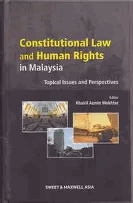


Description
review by marceljude.ai
This is an extensive law-professor review of Constitutional Law and Human Rights in Malaysia: Topical Issues and Perspectives. The book presents itself as an edited collection organized into three broad parts: principal organs of government, basic concepts and features of the Constitution, and human rights. That structure matters, because it shows the editor’s ambition: not merely to explain Malaysian constitutional doctrine, but to connect institutions, public law method, and rights discourse in one frame.
My overall judgment is that this is a serious, intellectually useful, and often reform-minded collection. It is not a perfectly unified monograph. It is an edited book, and it behaves like one: some chapters are doctrinal, some historical, some comparative, some openly argumentative. But taken as a whole, it offers a revealing portrait of Malaysian constitutional thought at a moment when institutional confidence, judicial independence, rights protection, and administrative accountability were all under pressure.
The book’s greatest strength is breadth without complete superficiality. It ranges from judicial review, Parliament, elections, and civil service law to disability rights, privacy, forced eviction, Orang Asli land rights, gender equality, and internet speech. Its greatest weakness is the familiar weakness of edited collections: unevenness in tone, depth, and method. Some chapters read like strong scholarly interventions; others read more like careful doctrinal surveys or reform memoranda. Still, there is far more substance here than padding.
Chapter One
The Doctrine of Separation of Powers: Judicial Review as a Check and Balance Tool
This opening chapter is well chosen. It sets the intellectual key of the volume by treating judicial review not as a mere technical remedy, but as a constitutional necessity in a federal democracy. It links constitutionalism, rule of law, separation of powers, check and balance, and judicial review into one normative chain. The chapter also squarely confronts the Malaysian difficulty over Article 121 and the post-amendment status of judicial power, especially through the debate around PP v Kok Wah Kuan. The authors plainly believe that the courts must reclaim a stronger reviewing role.
As scholarship, the chapter is strongest when it explains judicial review as the operating mechanism of constitutionalism. As criticism, it is strongest when it suggests that Malaysian courts have sometimes been too hesitant in policing the legislature and executive. As a law professor, I would say this is an effective opening chapter because it gives the reader both doctrine and thesis: the Constitution is not self-executing in spirit; it needs judges willing to act. Its only limitation is that it sometimes moves quickly across very large questions, so parts of the discussion feel more programmatic than deeply excavated. Still, it does exactly what an opening chapter should do: it announces the stakes.
Chapter Two
The Civil Service and the Doctrine of Holding Office at Pleasure
This chapter examines the constitutional position of public servants, the doctrine of pleasure, security of tenure, the contractual nature of public employment, procedural protections, service commissions, confidentiality, public-interest disclosure, union rights, and the future of the public service. It is a classic public law chapter in the best sense: technical on the surface, but constitutionally significant underneath.
Its strongest contribution is to show how a doctrine inherited from imperial constitutionalism sits awkwardly with modern ideas of fairness, due process, and administrative justice. The chapter does not romanticize the public service; it treats it as both a constitutional instrument and a site of vulnerability. I especially value its attention to procedural protections and its acknowledgment that constitutional guarantees can be hollow if public employment is still structured by archaic assumptions of executive supremacy. The later discussion of transformation and governance broadens the chapter beyond narrow service law and asks what kind of public administration a constitutional state requires. That gives the piece contemporary relevance.
Chapter Three
Crown Privilege under the Common Law and the Evidence Act
This is a highly doctrinal chapter, but an important one. It maps the move from “crown privilege” to “public interest immunity,” distinguishes class claims from content claims, examines balancing, and explains the court’s role under sections 123 and 162 of the Evidence Act. It also treats BA Rao v Sapuran Kaur as the seminal Malaysian authority. The chapter’s value lies in showing that evidentiary privilege is never merely evidentiary. It is constitutional in effect because it decides who controls state secrecy and under what conditions the executive may withhold information from adjudication. The author is at his best when he insists that the final question must remain judicial, not executive. That is a rule-of-law instinct. The weakness of the chapter is not in its analysis but in accessibility: it is dense, case-heavy, and not especially hospitable to the non-specialist reader. But as part of this volume, that density is justified. Constitutional orders are often protected or distorted through procedural doctrines, and this chapter reminds the reader of that fact.
Chapter Four
Accountability and Integrity of the Judiciary
This is one of the most important chapters in the book. It discusses judicial ethics, judicial misconduct, tribunals, the judges’ code of ethics, the judges’ ethics committee, and the continuing constitutional shadow cast by the Salleh Abas episode. It is not merely descriptive. It is haunted by constitutional trauma, and rightly so.
As a law professor, I find the chapter particularly strong because it treats judicial accountability and judicial independence not as opposites, but as ideas that must be held in tension without letting one destroy the other. The chapter understands that “discipline” can become a device of control if political actors dominate the process. Its criticism of the removal process under Article 125 is measured but unmistakable. At the same time, it does not defend judges by exempting them from ethical scrutiny. That balance is intellectually mature. If I had one reservation, it is that the chapter sometimes leans heavily on the 1988 crisis, which is unavoidable but can crowd out a broader theory of present-day institutional design. Even so, it remains one of the book’s anchor chapters.
Chapter Five
Contempt of Court vs Freedom of Speech and Expression: Rethinking the Courts’ Attitude
This chapter is bold, and it deserves credit for that. It argues that Malaysian contempt law, especially in scandalising and publication contempt, has produced a chilling effect on free speech because the courts have preferred a low-threshold “inherent tendency” approach instead of a more speech-protective standard. It also compares foreign approaches and urges greater openness to international and comparative reasoning.
The chapter’s great strength is its refusal to treat contempt doctrine as neutral housekeeping. It sees the doctrine for what it is: a site where judicial authority and democratic criticism collide. The author believes Malaysian courts have been too protective of their own institutional dignity and insufficiently protective of public discussion. That is a serious charge, but the chapter makes it with legal discipline rather than mere rhetoric. It is also insightful in pointing out the uneven Malaysian willingness to use foreign law: receptive in some rights areas, defensive in speech cases. I would call this one of the more normatively alive chapters in the volume.
Chapter Six
Access to Justice: Adversarial Costs in Public Interest Litigation
This chapter addresses one of the least glamorous but most decisive barriers to constitutional litigation: costs. It surveys judicial discretion, Malaysian practice, the United Kingdom, Canada, different cost mechanisms, and the Aarhus Convention. Its implicit question is simple: what good are constitutional rights if the cost of vindicating them is prohibitive?
That question gives the chapter its force. Many public law collections ignore litigation economics; this one does not. The chapter understands that costs rules can silently ration constitutional justice. Its reformist tone is justified. The conclusion, which warns that access to justice will remain conference rhetoric unless legal forms and procedures are refined, is sharp and deserved. If the chapter has a weakness, it is that it can feel more comparative-survey than doctrinal synthesis. But the comparative material is well chosen and serves a practical purpose. In a constitutional law classroom, I would assign this chapter to show students that procedure often decides principle.
Chapter Seven
Functions and Privileges of Parliament: An Overview
This chapter explains what Parliament is institutionally, how it is structured, what privileges it possesses, and why those privileges matter. It distinguishes between collective privileges of the House and immunities of individual members, and it closes by reflecting on contempt powers and parliamentary autonomy.
The chapter’s strength is its insistence that parliamentary privilege is defensive rather than offensive. That is the correct constitutional framing. Privilege exists so that Parliament can function independently, not so that legislators can enjoy feudal immunity. The chapter is pedagogically strong because it starts from first principles and clears up common public misunderstandings. It is less adventurous than some later chapters, but not every chapter needs to be insurgent. This one performs essential constitutional housekeeping and does it well. Its final reminder that parliamentary autonomy must be considered in light of separation of powers and checks and balances ties it neatly back to Chapter One.
Chapter Eight
The Election Commission: History and Functions
This chapter combines constitutional history and institutional analysis. It traces the Election Commission from the colonial period and the first municipal and federal elections through independence and later criticism, especially around delimitation and perceived bias. It covers organization, rolls, elections, and electoral reform demands. Its greatest merit is historical sobriety. Rather than beginning with present cynicism, it reconstructs why the Commission was created and why it once commanded respect. That makes later criticism more meaningful. The chapter seems to suggest that institutional legitimacy has eroded not because elections ceased to occur, but because formal regularity alone cannot sustain confidence if delimitation and administration appear politically tilted. That is a persuasive point. As a review, I would say this chapter is valuable but somewhat restrained; it explains the crisis of confidence more than it fully theorizes it. Still, for readers interested in how electoral administration became constitutionally contested in Malaysia, it is indispensable.
Chapter Nine
Elected Members and the Right to Change Party
This chapter tackles party-hopping and anti-defection law. It places the issue within elections, representation, party systems, and even Islamic theory of democratic government. It then compares Malaysia with India and weighs whether anti-defection legislation is desirable or constitutionally hazardous.
This is one of the book’s more politically concrete chapters. It asks a question many constitutional texts avoid: to whom does an elected seat morally belong — the person, the party, or the voters? The chapter refuses easy answers. It recognizes both the instability produced by defections and the rights problem created by punishing them. That tension is handled honestly. The conclusion, which gestures toward the need for anti-defection law while conceding the dilemma with freedom of association, is intellectually responsible. I would have welcomed an even more developed theory of representative mandate, but the chapter still succeeds because it puts a live democratic wound on the constitutional table.
Chapter Ten
Islamic Law within the Federal Framework and Legal System of Malaysia and Nigeria
This comparative chapter studies Malaysia and Nigeria as postcolonial, legally plural polities grappling with the place of Islamic law. It addresses the nature of the state, the scope of Islamic law, civil and criminal dimensions, the jurisdiction of Islamic and civil courts, harmonisation efforts, and colonial inheritance.
Its comparative move is smart. It prevents Malaysian debates from appearing unique or inevitable and shows instead how colonial legal structures continue to shape present jurisdictional boundaries. The chapter’s strongest insight is that the real issue is not abstract theology but institutional allocation: who gets to decide which legal order governs which subject. Its conclusion is unapologetically critical of continued civil-court intrusion into Islamic law matters. Some readers will find that position contestable, but the chapter is serious and coherent in making it. In an edited collection, this kind of comparative broadening is very valuable.
Chapter Eleven
Enforcing the Law against Enforcers: The Enforcement Agency Integrity Commission
This chapter uses the EAIC as a lens on accountability in law enforcement. It situates the EAIC within ombudsman and integrity-commission models, examines the background of the institution, explains the statute, and asks whether the reform is enough.
The piece is strongest in its institutional realism. It neither celebrates the EAIC as salvation nor dismisses it as meaningless. Instead it measures structure against function. The author understands that the question is not simply whether an accountability body exists, but whether it has the design, legitimacy, specialization, and operational culture to affect law-enforcement behavior. That is exactly the right question. The suggestion that specialist divisions, especially for policing, may be needed is sensible. As scholarship, this chapter is policy-oriented rather than theoretically ambitious, but that is entirely appropriate for the subject.
Chapter Twelve
General Principles of Good Governance in Public Administration: A Judicial Approach
This chapter is almost a handbook of Malaysian administrative legality. It defines public authority and then walks through a long list of principles applied through judicial review: jurisdiction, good faith, proper purpose, relevant facts, non-dictation, non-abdication, rationality, procedural fairness, hearing, absence of bias, reasoned decisions, and more. Its major virtue is clarity. It translates “good governance” into justiciable standards. Too often good governance is treated as slogan. Here it is reduced to legal tests that courts can apply. The weakness is also related to that strength: the chapter can feel schematic. It is more taxonomy than deep argument. But in a book like this, that is not a fault so much as a function. Students, practitioners, and researchers need such mapping chapters. It gives the collection a durable doctrinal backbone.
Chapter Thirteen
Malaysian Constitution, Political Parties and the Party System
This chapter studies political parties not as sociology alone but as constitutional actors. It describes Malaysia’s dominant-party system, the parliamentary framework, the possibility of two-party competition, and the constitutional implications of party development after the electoral shocks of 2008.
What I appreciate here is the refusal to confuse alternation of power with democratization itself. The chapter suggests that movement from dominant-party to two-party competition does not by itself guarantee constitutional renewal. Good governance remains the test. That is a mature point, and it stops the discussion from collapsing into mere electoral romanticism. At the same time, the chapter could perhaps have done more with constitutional silence: political parties are structurally central but often textually underdeveloped in constitutional law. Even so, this is a useful bridge between formal constitutionalism and lived politics.
Chapter Fourteen
Living in Limbo: Constitutional and Legal Issues of Unregistered Births
This is one of the most morally compelling chapters in the book. It presents birth registration not as bureaucratic bookkeeping but as legal personhood, social visibility, and access to nationality, education, health, juvenile justice, benefits, and participation. It also catalogues barriers — political, administrative, legislative, economic, geographical, and sociocultural.
The phrase “living in limbo” is apt. The chapter shows how a technical administrative failure can become a constitutional catastrophe for a child. The strength of the chapter lies in making the invisible visible. It takes a problem that may seem marginal to constitutional lawyers and reveals it as a deep issue of citizenship, belonging, and state responsibility. This is excellent constitutional scholarship because it joins doctrine to human consequence. If one wanted a criticism, perhaps the chapter could have explored remedial strategies more fully. But its diagnostic power is already substantial.
Chapter Fifteen
Effective Federal-State Coordination Mechanism for Good Governance and Sustainable Land Administration
This chapter is a federalism chapter disguised as a land administration chapter. It reviews land governance, policy, law, institutions, the National Land Council, DGLM, comparative initiatives, and proposed reforms such as MyeLAS and a more national coordinating structure.
Its best insight is that land administration failures are often constitutional failures of coordination. The chapter does not argue for brute centralization. It argues for “dynamic federalism” through consultation, consensus, coordination, and cooperation. That is a sophisticated position because it recognizes the danger of both fragmentation and overreach. As a professor, I would say this is one of the most practically useful chapters for understanding how constitutional division of powers affects everyday governance. It is less dramatic than rights chapters, but no less important.
Chapter Sixteen
Eviction of Unlawful Occupiers of Land: Judicial Responses and Policies
This chapter addresses unlawful occupation, squatter settlements, state and private land, forced eviction, judicial responses, and international human rights standards. It also considers alternatives to forced eviction and the procedural safeguards that ought to accompany any displacement.
The chapter is strongest when it resists the old legal reflex of seeing squatters only as trespassers. It widens the frame to include dignity, housing, rehabilitation, notice, consultation, relocation, and compensation. That does not mean it denies property rights; rather, it insists that dispossession in a constitutional order must be mediated by legality and humanity. The chapter’s recommendations to study the housing and squatter-management experience of other jurisdictions are pragmatic, not merely utopian. This is a very good example of doctrinal law opening itself to social justice without becoming legally careless.
Chapter Seventeen
Legal Status of the States in Malaysia before Independence: Were we Colonised?
This is a historical-constitutional chapter with a sharp legal thesis. It distinguishes protected states, protectorates, crown colonies, and different forms of sovereignty and argues that the answer to whether Malaysian states were “colonised” depends on legal status, not nationalist shorthand. It also differentiates between Malacca and Penang, the Malay states, and the Borneo territories.
The chapter is valuable because it imposes legal precision on a subject often handled sentimentally. Its distinction between de jure and de facto perspectives is especially useful. The conclusion is nuanced: some territories were clearly crown colonies; some Malay states remained sovereign under protection except during the Malayan Union period; Sabah and Sarawak occupy yet another trajectory. Not every reader will love the analytical coolness of the chapter, but from a constitutional-law standpoint that coolness is a virtue. It reminds us that historical vocabulary matters.
Chapter Eighteen
Religious Rights and Freedom: Comparative Perspectives
This chapter argues against simplification on both sides of the religion-state debate. It suggests that giving a religion special constitutional status does not automatically destroy religious freedom, and that proclaiming secular democracy does not automatically secure it. It compares Malaysia with Greece, Ireland, Australia, Nigeria, international instruments, and the jurisprudence of the European Court of Human Rights.
I find this chapter intellectually stimulating because it rejects slogan-level constitutionalism. It does not let “Islamic state” or “secular state” function as automatic conclusions. Instead it asks how rights are actually structured and limited. That is the correct comparative method. The chapter may strike some readers as only “precursory,” and indeed it says it is not an exhaustive treatment. But even as a shorter comparative intervention, it succeeds in challenging easy assumptions and widening the terms of debate.
Chapter Nineteen
Right to Development as a Human Right: A Challenge for Malaysia
This chapter takes on an often dismissed subject and treats it seriously. It surveys the history and controversy of the right to development, clarifies its content, identifies right-holders and duty-holders, explains rights-based approaches, and then discusses Malaysia’s challenges in rule of law, participation, and public-service capacity.
The strength of the chapter is conceptual discipline. “Development” is often a rhetorical escape hatch used against rights; here the author tries to reverse that and make development itself rights-accountable. The chapter is especially good when it identifies participation and constitutionalism as not optional extras but integral to development. Its conclusion is candid that Malaysia has historically not integrated human-rights norms deeply enough into development thinking. That frankness is welcome. This is one of the more theoretically ambitious chapters in the book.
Chapter Twenty
Balancing Business and Human Rights: Conflicts, Challenges and Prospects
This chapter studies the intersection between economic growth and human rights in Malaysia. It treats business not only as potential rights violator, but also as possible protector and promoter. It then diagnoses business-related human-rights abuses, including regulatory vacuum and confusion about CSR, before proposing regulatory and voluntary responses.
What I like most here is that the chapter avoids caricature. It does not simply demonize corporations, nor does it hide behind soft CSR language. It sees that rights harm can arise from both state weakness and business opportunism. The recommendation to harmonize regulatory and voluntary approaches is sensible. The chapter may perhaps underplay the structural power asymmetries between vulnerable communities and large firms, but it still makes a sound contribution by bringing business into the constitutional-human-rights frame rather than leaving it outside.
Chapter Twenty One
Rights of the Orang Asli under the Federal Constitution
This chapter is a vital inclusion. It defines indigenousness in Malaysian legal categories, discusses Orang Asli rights under the Constitution, especially Article 8(5)(c) and Article 13, and explores law as an instrument for their advancement. It also treats the courts as central actors in protecting customary land rights.
The chapter’s power lies in refusing to see Orang Asli issues as peripheral ethnography. They are constitutional issues. The discussion of the Aboriginal Peoples Act as potentially quasi-constitutional in spirit is especially important. The conclusion, which places hope in judicial willingness to defend constitutional and moral commitments rather than act from pity, is one of the more eloquent endings in the book. This chapter belongs among the collection’s strongest contributions because it shows how constitutional law must confront the state’s treatment of first peoples.
Chapter Twenty Two
Right to Health: International Human Rights Law and the Experience of Other Countries
This chapter is a substantial survey of health as a human right. It defines health, links health and human rights, canvasses international and regional instruments, reviews constitutional models in selected countries, and reflects on the Malaysian position. It also notes that the right to health is linked to but not reducible to medical services, and that implementation depends on resources and policy choices.
Its doctrinal breadth is impressive. The chapter is at its strongest when it argues that health is an extension of the right to life and that denial of healthcare indirectly undermines the exercise of other rights. At the same time, the author is realistic about judicial limits in matters of resource allocation. That balance between aspiration and institutional realism makes the chapter credible. This is a strong teaching chapter because it exposes students to the social-rights debate without pretending there are easy enforcement answers.
Chapter Twenty Three
Rights of Persons with Disabilities (PWD): The “Almost Forgotten” Protection under the Federal Constitution This chapter addresses disability as a constitutional blind spot. It defines disability, surveys the CRPD and Malaysian legislation, and explores how Articles 5, 8, and 12 can be used to protect PWD rights. Its conclusion is direct: Malaysian constitutional protection for PWD remains thin, and the relevant statute is still too weak in practice. This chapter earns respect because it names the problem honestly. “Almost forgotten” is not rhetorical excess. The author demonstrates that constitutional protection is still mostly indirect, and calls for explicit inclusion of disability among non-discrimination grounds. That is a strong proposal. The chapter would have benefited from more sustained case analysis, but it succeeds in its principal mission: to expose how formally liberal constitutions can still neglect structurally marginalized groups unless protection is made explicit and enforceable.
Chapter Twenty Four
Freedom of Information: Principles and Challenges Towards Vision 2020
This chapter treats freedom of information as the oxygen of democracy and connects it to transparency, accountability, participation, and national development. It tracks the international history of FOI through UN instruments and then examines the idea in relation to Malaysia’s developmental aspirations and good governance.
The chapter’s main strength is normative clarity. It sees information not as administrative property but as a democratic condition. That alone is important in a system where secrecy and administrative insulation have often been normalized. The link to Vision 2020 may now feel historically situated, but the underlying argument remains sound: open government is not ornamental. It is foundational to trust, investment, social cohesion, and democratic participation. This is not the most theoretically subtle chapter in the book, but it is principled and useful.
Chapter Twenty Five
Right to Privacy: Development, Cases and Commentaries
This is a rich chapter. It surveys privacy in United States and United Kingdom common law, develops an Islamic perspective, analyzes privacy in the Malaysian Constitution as linked to life, liberty, and property, and reviews recent Malaysian court decisions. It argues that privacy in Malaysia is gaining recognition and should be protected more fully, especially in the context of digital technologies and personal data.
The chapter’s excellence lies in its layered method. It is comparative, constitutional, doctrinal, and culturally grounded at once. It does not merely import Western privacy theory; it also shows the local Islamic normative resources for privacy protection. The discussion of Malaysian case law is particularly useful because it reveals a judiciary cautiously moving from denial of privacy as an independent tort toward greater recognition. As a law professor, I would call this one of the most forward-looking chapters in the volume. It sees the future legal problem before it fully arrives.
Chapter Twenty Six
Slavery and Human Trafficking: Constitutional Provisions and Domestic and International Laws
This chapter links trafficking to the constitutional prohibition of slavery and forced labour in Articles 5 and 6, explains the concept of trafficking, distinguishes trafficking from smuggling, surveys international instruments, and maps the Malaysian statutory framework, including the Anti-Trafficking in Persons and Anti-Smuggling of Migrants Act. It also discusses enforcement and the national anti-trafficking plan.
Its value is twofold. First, it insists that trafficking is not merely a criminal-law issue but a constitutional and human-rights issue. Second, it embeds domestic law in the wider international effort against modern slavery. The chapter is strongest when it emphasizes that legal prohibition means little without coordinated enforcement, remedies for victims, and international cooperation. It is less theoretically subtle than some chapters, but that may be an advantage: clarity is essential in this field. The chapter does serious public-education work without sacrificing legal structure.
Chapter Twenty Seven
Beatrice Fernandez v Sistem Penerbangan Malaysia: A Constitutional Critique
This is one of the most openly argumentative chapters in the book, and rightly so. It revisits the Federal Court’s treatment of gender discrimination in Beatrice Fernandez and criticizes the public/private law divide, the narrow reading of Article 8, the failure to compare male and female cabin crew properly, and the failure to engage CEDAW adequately. It also uses the later Noorfadilla approach as the better path.
As critique, the chapter is powerful. It is not content to describe the case; it dismantles its reasoning point by point. Some readers may prefer a more detached tone, but on this issue detachment would be false neutrality. The chapter is persuasive in arguing that a constitutional commitment to gender equality becomes hollow if private employment relations are cordoned off from constitutional scrutiny. Its use of CEDAW and treaty-incorporation questions also gives it broader significance beyond one case. This is among the volume’s most impressive chapters because it combines doctrinal precision with moral urgency.
Chapter Twenty Eight
Freedom of Speech on the Internet: Shariah and Malaysian Perspectives The closing chapter is an apt finale. It treats freedom of speech as central to dem ocracy and also grounded in Shariah, explains the nature of the internet as decentralized and hard to regulate, surveys international and domestic protections, and then turns to regulation of harmful or negative content, including comparative approaches from the EU, Singapore, Brunei, the United States, and Malaysia’s Communications and Multimedia Act.
The chapter’s best quality is that it does not choose between liberty and regulation as absolutes. It argues instead that regulation should target genuinely harmful content without becoming a tool for suppressing legitimate speech. That is a sound constitutional position. The treatment of internet architecture is also useful because it shows why online regulation cannot simply mimic print or broadcast control. If the chapter has a weakness, it is that some categories of harmful content are treated broadly and could invite overregulation if translated uncritically into policy. Still, the conclusion is commendably careful: regulation must be transparent, reasonable, fair, and apolitical. That is exactly right.
Final assessment of the entire book
This is a substantial and worthwhile collection. Its editor assembled a volume that is broader than many constitutional-law books and more legally serious than many human-rights readers. The book’s core achievement is that it refuses to isolate institutional law from rights law. Parliament, the judiciary, the civil service, elections, land administration, and evidence rules are shown to be part of the same constitutional ecology as privacy, disability, indigenous rights, health, trafficking, and gender equality. That integration is the book’s deepest strength.
A second strength is intellectual courage. Several chapters do not merely summarize Malaysian law; they challenge it. The contributors are often reformist, sometimes openly dissatisfied, and usually willing to say that a court, institution, or statutory framework has fallen short. That makes the collection livelier and more useful than a neutral digest. Its principal weakness is unevenness. Some chapters are deeply analytical; others are more catalogic. Some are tightly argued interventions; others feel like extended doctrinal overviews. There is also the ordinary problem of edited books: recurrent themes — judicial review, good governance, constitutional supremacy, international norms — appear across chapters without always being synthesized into a single overarching theory. But that is not fatal. In fact, the repetition sometimes helps reveal the collection’s real thesis: Malaysian constitutional law cannot be understood unless one sees how power, legality, and rights constantly press against one another.
My verdict, as a law professor, is clear. This is not a decorative collection. It is a working constitutional book: useful for scholars, serious students, public lawyers, judges’ researchers, and anyone trying to understand how Malaysian constitutionalism actually operates across institutions and rights claims. Its most memorable chapters are those on judicial review, judicial accountability, contempt and speech, unregistered births, Orang Asli rights, privacy, gender equality, and internet speech. But even the more technical chapters earn their place because they show how constitutionalism lives or dies in legal detail.
If judged by one final question — does the book make the reader think harder about the Constitution as a living struggle rather than a frozen text? — the answer is yes. And that is high praise.
 marceljude.ai @ +60128285778 |
- MALAYSIA'S 1ST AI LAWYER - CLICK HERE
- ISMAIL – INTEGRATED SINGAPORE/MALAYSIA AI & LAW (Library)
- OPENING OF SINGAPORE MALAYSIA AI CENTRE AND LAW LIBRARY
- LIFT - LAW INSTRUMENTS FORMS & TEMPLATES
- LAWS OF MALAYSIA FOR SINGAPOREAN DUMMIES
- HANNAH YEOH'S ARTIFICIAL INTELLIGENCE LAW ENCYCLOPEDIA
- LEAD CR - Law Ecosystem Archive Databases on CD-ROM
- BREAKING NEWS FROM MJN
- CLICK HERE CO. PROFILE
- EXCITING NEW SERIES - THE ADVENTURES OF BOBBY TAN -ADVOCATE & SOLICITOR IN THE HIGH COURT OF NORTH BORNEO by marceljude.ai
- MEDICO LEGAL - BY PRISKILA AKWILA & GLORIOUS PETAL SDN BHD - powered by marceljude.ai
- MISCELLANOUS
- ANNOTATED STATUTES OF SABAH - A NEW SERIES
- e-library - marceljude.ai
- DRAFT - DOCUMENT RESEARCH & AUTOMATED FILING TECHNOLOGY
- CLARA – Case Law Analysis & Retrieval AI
- FOR RESEARCH REQUEST CLICK HERE
- CLICK HERE TO ASK ANYTHING
- RAMBO'S LAW - THE LAW OF THE LAW JUNGLE - EXCITING NEW SERIES - CASE ANALYSIS BY JOHN RAMBO @ +60138646786
- PRISKILA AKWILA ADVOCATES - High Court of Sabah & Sarawak @ Kota Kinabalu
- COLA - COMMONWEALTH ONLINE LAWCASES AI -marceljude.ai
- THE LAW LIBRARY THAT COMES TO YOU ANYWHERE AND ANYTIME
- marceljude.ai training academy
