
Commercial Applications of Company Law in Malaysia by Aiman Nariman Mohd Sulaiman Aishah Bidin: Pamela Hanrahan: lan Ramsay: Geof Stapledon - marceljude.ai 073


Description
Book Review
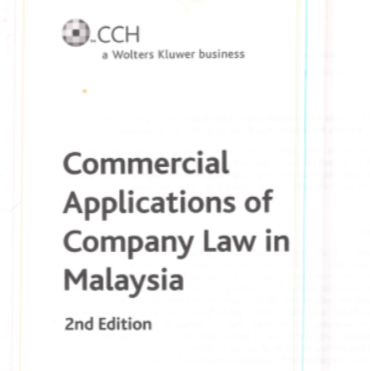
Book: Commercial Applications of Company Law in Malaysia
Editors/Authors:- Aiman Nariman Mohd Sulaiman Aishah Bidin: Pamela Hanrahan: lan Ramsay: Geof Stapledon
Review Author: marceljude.ai
Source note: I read the book text available here and reviewed it as a company law textbook.
The printed contents identify the book as organized into seven parts: the functions and structure of companies; company management; consequences of mismanagement; company reporting; company finance; companies and outsiders; and finding aids.
List of Contents - Page Numbers
Part A — The Functions and Structure of Companies Chapter 1, The Functions and Structure of Companies, pp. 23–42 Chapter 2, Company Law, pp. 43–68 Chapter 3, The Legal Nature of Companies, pp. 69–92 Chapter 4, Business Planning and Company Formation, pp. 93–126
Part B — Company Management Chapter 5, The Memorandum and Articles of Association, pp. 127–138 Chapter 6, Managing Companies, pp. 139–160 Chapter 7, Members Decision Making, pp. 161–180 Chapter 8, Company Meetings, pp. 181–200 Chapter 9, Limitation to Voting Power, pp. 201–216 Chapter 10, Company Directors, pp. 217–246 Chapter 11, Directors’ Duties, pp. 247–276 Chapter 12, Conflicts of Interest, pp. 277–314
Part C — Consequences of Mismanagement Chapter 13, Consequences of Breach of Duty, pp. 315–330 Chapter 14, Members’ Remedies, pp. 331–372
Part D — Company Reporting Chapter 15, Reporting and Disclosure, pp. 373–396
Part E — Company Finance Chapter 16, Shares and Shareholding, pp. 397–420 Chapter 17, Increasing and Reducing Share Capital, pp. 421–444 Chapter 18, Debt Finance, pp. 445–464
Part F — Companies and Outsiders Chapter 19, Contracting by Companies, pp. 465–478 Chapter 20, Corporate Liability, pp. 479–496 Chapter 21, External Administration, pp. 497–520 Chapter 22, Winding Up, pp. 521–540 Chapter 23, Securities, pp. 541–574 Chapter 24, Take-Overs, pp. 575–590
Part G — Finding Aids Table of Cases begins at p. 591 Legislation Finding List begins at p. 603 Index begins at p. 617
Whole-Book Review
As a company law textbook, Commercial Applications of Company Law in Malaysia is built around a practical premise: company law is not merely a list of statutory rules; it is a legal architecture for organizing business, allocating risk, raising capital, controlling managers, protecting outsiders, and resolving corporate failure. The book’s strongest feature is its commercial orientation. It repeatedly asks how legal rules function in ordinary company life: formation, governance, shareholding, financing, contracting, disclosure, insolvency, securities offerings, and take-overs.
From a law professor’s perspective, the book is especially useful because it teaches doctrine in sequence. It begins with the concept of the company, then moves to the legal personality of the company, then to formation, internal governance, directors’ powers, members’ voting, remedies, disclosure, finance, liability, insolvency, and market regulation. That sequence mirrors the life cycle of a company: creation, operation, financing, governance conflict, external dealing, distress, and exit.
The book’s intellectual center is the tension between commercial flexibility and legal control. Company law enables business people to create a separate legal person with limited liability, but it then imposes governance, disclosure, fiduciary, capital-maintenance, insolvency, and securities rules to prevent abuse. The authors are particularly effective in showing that limited liability and separate personality are not isolated doctrines; they shape almost every later topic, including creditors’ rights, directors’ duties, corporate groups, contracting, insolvency, and securities regulation.
Its main weakness is also a consequence of its strength: it is statute-heavy and practice-focused. Students who want a purely theoretical account of corporate personality, fiduciary theory, law-and-economics theory, or shareholder primacy will need supplementary reading. Also, because the book is tied closely to the Malaysian statutory framework stated in the book, readers must treat it as a review of that legal framework as presented in the text, not as current legal advice.
Overall, I would describe the book as a strong teaching text for company law students and a practical doctrinal map for professionals. It is best read not as a casebook, but as a structured guide to how Malaysian company law works in commercial settings.
Chapter-by-Chapter Review Chapter 1 — The Functions and Structure of Companies, pp. 23–42
Subsections covered: definition of a company; companies as a form of business organization; what companies are used for; listed and unlisted companies; the capital structure of companies; the management structure of companies; historical development of corporations, joint stock, general incorporation, limited liability, and small business companies; key company law terminology.
This opening chapter performs the essential conceptual work. It introduces the company as an artificial legal person created by law and distinct from its participants. The chapter explains why companies are useful: they allow people to pool capital, separate management from ownership, hold property in one legal entity, contract in the company’s name, and limit members’ exposure to business debts.
The chapter is particularly effective in introducing the “architecture” of a company. It separates the capital structure from the management structure. On the capital side, it explains members, shares, equity capital, debt capital, and retained profits. On the management side, it explains directors, officers, secretaries, and the distinction between executive and non-executive directors.
As a law professor, I would say this chapter is more than introductory. It gives students the vocabulary they need for the entire book: company, corporation, director, shareholder, member, share, listed company, private company, public company, limited liability, and articles of association. The chapter’s historical discussion is also valuable because it shows that modern company law did not appear fully formed; it evolved from older forms of collective trading, royal charters, joint stock enterprise, and statutory incorporation.
The chapter’s most important legal idea is that company law is a response to commercial scale. Once businesses become too large for a single trader or simple partnership, law must provide a legal vehicle that can own assets, raise capital, contract, sue, be sued, and survive changes in membership.
Chapter 2 — Company Law, pp. 43–68
Subsections covered: meaning and scope of company law; enforcement of company law; sources of company law; the Companies Act; history, content, and structure of the Companies Act; case law; regulations; securities legislation; accounting standards; Bursa Securities Listing Requirements; take-over regulation; corporate governance codes; offshore company law; regulatory bodies including the Securities Commission, Bursa Securities, Companies Commission of Malaysia, Registrar of Companies, and courts.
Chapter 2 explains the legal ecosystem surrounding companies. Its central message is that company law is not found in one place. The Companies Act is the principal source, but company law also includes case law, regulations, securities legislation, stock-exchange listing rules, accounting standards, governance codes, take-over rules, and regulatory practice.
The chapter is useful because it teaches students how lawyers actually research company law. A lawyer cannot stop at the Companies Act. For a listed company, Bursa Securities rules and Securities Commission requirements may be decisive. For securities offerings, prospectus regulation and disclosure rules matter. For take-overs, the relevant code and securities framework become central. For reporting, accounting standards and audit rules are unavoidable.
The chapter’s treatment of enforcement is also important. It distinguishes public sanctions, such as criminal liability or regulatory action, from private law remedies, such as compensation, injunctions, and actions brought by the company or members. This distinction becomes crucial later in Chapters 13 and 14.
The chapter’s strength lies in showing students that company law is a regulatory network. It is not merely private law between shareholders and directors. It is also public law, market regulation, financial regulation, disclosure law, and court-supervised corporate governance.
Chapter 3 — The Legal Nature of Companies, pp. 69–92
Subsections covered: separate legal personality; Salomon’s case; consequences of corporate personality; piercing the corporate veil; tort claimants; common-law veil-piercing; statutory veil-lifting; corporate capacity; powers of companies; internal limits on powers; limited liability; rationale for limited liability; contractual avoidance of limited liability; parent-company exposure.
Chapter 3 is one of the doctrinal pillars of the book. It explains the company as a separate legal person, distinct from its shareholders, directors, employees, and controllers. The chapter uses the classic company law idea associated with Salomon v Salomon: once incorporated, a company is not simply the agent, alias, or property of its shareholders.
The chapter carefully draws out the consequences. Company debts are the company’s debts. Company property is not shareholder property. The company can sue and be sued. It has perpetual succession. It can contract with its own controllers. These ideas may sound abstract, but the chapter shows their practical force: they determine who owns assets, who bears debts, who may sue, and who is exposed when the company fails.
The veil-piercing discussion is especially significant. The chapter does not treat veil-piercing as a general judicial discretion to “do justice.” Instead, it frames it as exceptional. Courts may sometimes disregard separate personality where the company is used to avoid existing legal duties, where agency is genuinely established, where statutes require veil-lifting, or where statutory provisions impose liability on officers or controllers.
The chapter also explains limited liability as a policy choice. Limited liability promotes investment and risk-taking, but shifts risk to creditors. The chapter is strong because it does not romanticize limited liability; it recognizes its economic benefits and its potential unfairness, especially to involuntary creditors.
Chapter 4 — Business Planning and Company Formation, pp. 93–126
Subsections covered: choosing a business form; non-business associations; companies compared with sole proprietorships, partnerships, and joint ventures; advantages and disadvantages of incorporation; types of companies; limited by shares, limited by guarantee, unlimited companies, public and private companies; company registration; company names; pre-registration contracts; listing on Bursa Malaysia; reasons to list; listing procedure; corporate groups; holding, subsidiary, and related companies.
Chapter 4 turns legal doctrine into business planning. It asks the practical question: when should parties use a company rather than a sole proprietorship, partnership, joint venture, or unincorporated association?
The chapter’s discussion of incorporation is balanced. It identifies the advantages of companies: limited liability, perpetual succession, transferability of shares, standardized governance rules, ability to raise larger capital, and ability to give certain forms of security. It also identifies disadvantages: cost, administrative burdens, disclosure obligations, and public law regulation.
The chapter is particularly useful for showing that “forming a company” is not only a filing exercise. It requires legal design choices: public or private company, share structure, directors, secretary, registered office, name, articles, and future financing plans. It also explains pre-registration conduct, including contracts made before the company legally exists.
The final section on corporate groups is important. Modern commerce frequently operates through groups, not single companies. The chapter explains why businesses use groups: risk segregation, organizational convenience, financing structures, and regulatory planning. It also warns that the law does not always treat the group as one enterprise; separate personality remains the starting point.
Chapter 5 — The Memorandum and Articles of Association, pp. 127–138
Subsections covered: memorandum and articles; relationship with statutory provisions; amendment of memorandum; amendment of articles; legal effect as statutory contract; interpretation; enforcement; consequences of non-observance.
Chapter 5 examines the constitutional documents of the company. Its central idea is that the company’s memorandum and articles are not merely paperwork; they form a legal framework for internal governance.
The chapter explains what these documents do. The memorandum historically defines basic matters such as name, objects, share capital, liability, and subscribers. The articles operate more like internal by-laws, governing directors, meetings, voting, share transfers, dividends, and internal procedures.
The strongest part of this chapter is its discussion of the articles as a statutory contract. The articles bind the company and members, and members among themselves, but not always in the same way as an ordinary contract. The chapter helps students understand why a member may enforce some constitutional rights, while outsiders usually cannot.
The chapter also explains alteration. The ability to amend articles is essential to corporate flexibility, but alteration is controlled by statute, procedure, and fairness principles. The chapter prepares the reader for later topics on voting power, minority protection, and shareholder remedies.
Chapter 6 — Managing Companies, pp. 139–160
Subsections covered: corporate decision-making; kinds of company decisions; division of powers between directors and members; directors’ management powers; limits on members overriding the board; options for dissatisfied members; members’ reserved and residual powers; roles of directors, secretary, and executive officers; corporate governance; governance mechanisms.
Chapter 6 is one of the book’s most important governance chapters. It explains that companies act through organs: primarily the board of directors and the members in general meeting. The chapter rejects the simplistic idea that shareholders manage the company. In most companies, management power belongs to the board, subject to matters reserved to members by statute or the articles.
The chapter’s distinction between enterprise decisions, capital decisions, and constitutional decisions is especially helpful. Enterprise decisions concern business operations. Capital decisions concern financing. Constitutional decisions concern the structure of the company and rights of participants.
The discussion of the division of powers is doctrinally central. Members cannot simply override board decisions when management power is vested in the directors. Their remedies are indirect: remove directors, amend articles, refuse re-election, or seek statutory remedies in cases of abuse.
The chapter’s corporate governance section broadens the analysis. It treats governance as the system by which companies are directed and controlled. It introduces board structure, audit, disclosure, shareholder voting, institutional investors, take-overs, remuneration, litigation, and regulatory enforcement as governance mechanisms. From a professor’s standpoint, this is one of the most conceptually mature chapters.
Chapter 7 — Members Decision Making, pp. 161–180
Subsections covered: member voting and corporate control; member control in listed companies; institutional investors; scope of voting rights; constitutional decisions; amendment of articles; name and type changes; class rights; share capital actions; appointment and removal of directors; directors’ remuneration; appointment and removal of auditors; related-party transactions; major corporate transactions; take-overs and reconstructions; voluntary winding up; common-law voting powers.
Chapter 7 examines what shareholders can actually decide. It is a corrective to the common assumption that shareholders “own” the company in the same way an individual owns personal property. Members have important rights, but those rights are defined by law and the constitution.
The chapter shows that shareholders are most powerful in structural matters: amending articles, changing company type, varying class rights, approving certain capital actions, appointing or removing directors, and voting on major transactions. Their power is not general management power; it is a set of reserved decision rights.
The discussion of institutional investors is valuable because it recognizes that corporate control is not only a legal matter but also a market reality. In widely held listed companies, dispersed shareholders may be passive, while institutional shareholders may exercise practical influence.
The chapter also explains why approval rules exist for related-party transactions and substantial corporate transactions. These rules respond to the risk that controllers or directors may use the company’s assets for private benefit. The chapter therefore links voting rights to investor protection.
Chapter 8 — Company Meetings, pp. 181–200
Subsections covered: statutory meetings; annual general meetings; extraordinary meetings; class meetings; convening meetings; requisitioning and calling meetings; agenda-setting; notice requirements; quorum; communications technology; proxies and representatives; chairperson’s role; adjournment; minutes; one-member meetings; voting; show of hands; poll voting; voting restrictions; proxies; ordinary and special resolutions; written consent; unanimous assent; procedural irregularities.
Chapter 8 is procedural, but it is not merely technical. It explains how corporate democracy is made legally valid. A shareholder right is only meaningful if meetings are properly called, notice is adequate, voting is lawful, and resolutions are valid.
The chapter’s treatment of notice is particularly important. Members must receive enough information to decide whether to attend and how to vote. Notice is therefore both a procedural and substantive protection.
The discussion of proxies and representatives is also practical. Modern company ownership often involves absentee shareholders, corporate shareholders, nominees, and institutional investors. The proxy rules enable participation without physical attendance.
The chapter’s discussion of procedural irregularities is important because company law must balance strict compliance with commercial certainty. Not every defect invalidates a meeting. Courts may overlook irregularities unless substantial injustice is caused.
This chapter is highly useful for examination and practice because many corporate disputes turn on meeting procedure: defective notice, invalid quorum, improper adjournment, misuse of proxies, or invalid resolutions.
Chapter 9 — Limitation to Voting Power, pp. 201–216
Subsections covered: why voting restrictions are needed; unclear cases; summary of restrictions; equitable limitation on majority power; cases not involving constitutional amendment; cases involving amendment of the constitution; bona fide alteration for the benefit of the company; procedural requirements; voting restrictions; minority protections; personal rights; limits on ratification of directors’ breaches.
Chapter 9 addresses majority power and minority protection. Its central question is: when may the majority use voting power, and when does majority rule become abuse?
The chapter explains that shareholders generally may vote in their own interests. Unlike directors, shareholders are not usually fiduciaries. But voting power is not unlimited. The equitable limitation on majority voting prevents shareholders from using formal voting power to appropriate company property, expropriate minority rights unfairly, or ratify misconduct in improper circumstances.
The chapter’s discussion of amendments to the articles is doctrinally important. A majority may amend the articles, but the amendment must be made bona fide for the benefit of the company as a whole. This is a difficult standard because courts do not simply substitute their business judgment for that of members. The chapter properly highlights the tension between majority autonomy and minority protection.
This chapter is one of the book’s best bridges between corporate procedure and equity. It teaches that valid voting is not only about numbers; it is also about purpose, fairness, and legal limits.
Chapter 10 — Company Directors, pp. 217–246
Subsections covered: Malaysian boards; board composition; corporate governance; executive directors; non-executive directors; chairperson; managing or governing directors; nominee directors; alternate directors; de facto and shadow directors; appointment and removal; eligibility; resignation; disqualification; board proceedings; meetings; delegation; directors’ access to information.
Chapter 10 focuses on directors as the central managers of corporate power. It explains both formal directors and functional equivalents, such as de facto and shadow directors. That is important because company law looks beyond labels. A person who acts as a director, or whose instructions the board follows, may attract director-like responsibilities.
The chapter’s treatment of board composition is valuable. It connects the legal category of “director” to governance questions: independence, executive versus non-executive roles, audit committees, remuneration committees, and board accountability.
The appointment and removal sections are practical. They explain eligibility, consent, age issues, disqualification, resignation, removal by members, removal by directors in private companies where allowed, and special rules for public companies.
The chapter’s strongest doctrinal point is that board power is collective. Directors act through board meetings or valid delegation. Individual directors do not automatically bind the company merely because they hold office, though authority issues arise later in contracting chapters.
Chapter 11 — Directors’ Duties, pp. 247–276
Subsections covered: role and classification of duties; who owes duties; to whom duties are owed; enforcement; consequences of breach; duty of care; sources of duty; standard of care; business judgment; duty to act bona fide in the company’s best interests; meaning of the company’s interests; proper purpose; duty to retain discretion; consequences.
Chapter 11 is a core fiduciary and governance chapter. It introduces directors’ duties as legal mechanisms that control managerial power. It classifies duties into care, skill and diligence on one side, and loyalty and good faith on the other.
The chapter explains that duties are owed primarily to the company, not generally to individual shareholders. That point is essential because it explains why the company is usually the proper plaintiff in actions for breach. It also prepares the reader for derivative actions in Chapter 14.
The duty of care discussion is important because it concerns competence rather than loyalty. Directors must act with reasonable diligence and care, but company law must avoid making directors insurers of business success. The business judgment idea reflects that courts should not punish every failed commercial decision.
The chapter’s discussion of good faith, proper purpose, and retention of discretion is especially strong. Directors must act honestly for the company’s interests, use powers for the purposes for which they were conferred, and not improperly surrender their decision-making discretion. These doctrines are central to share issues, corporate control, defensive tactics, and conflicts.
Chapter 12 — Conflicts of Interest, pp. 277–314
Subsections covered: duty to avoid conflicts; common-law conflict rule; transactions with the company; corporate property, information, and opportunities; conflicting duties; competing companies and nominee directors; company constitution and conflicts; statutory regulation; disclosure of interests; improper use of position or information; prohibited transactions with directors or connected persons; loans to directors or connected persons; transactions involving shareholders and directors; shareholder approval for substantial property transactions; consequences of common-law and statutory contraventions.
Chapter 12 is the natural sequel to Chapter 11. Where Chapter 11 explains general duties, Chapter 12 focuses on one of the most litigated areas: conflicts of interest.
The chapter’s key insight is that conflicts are regulated at multiple levels. Common law imposes fiduciary limits. The company’s constitution may modify or structure certain conflict rules. Statute imposes specific disclosure, approval, prohibition, and penalty rules.
The chapter is especially useful because it distinguishes between different conflict situations: a director contracting with the company, taking corporate opportunities, using corporate information, serving competing interests, or acting as a nominee director. Each raises a different legal and ethical risk.
The statutory discussion is practical and detailed. It shows that modern company law does not rely solely on broad fiduciary principles. It also uses targeted rules: disclosure of interests, restrictions on loans, prohibitions on improper use of office or information, and shareholder approval for substantial property transactions.
From a professor’s perspective, this chapter is one of the most commercially important in the book. Many corporate abuses are not theft in the simple sense; they are conflicts managed badly or concealed.
Chapter 13 — Consequences of Breach of Duty, pp. 315–330
Subsections covered: enforcement by Registrar of Companies and Securities Commission; enforcement powers; compounding offences; disqualification; criminal penalties; company civil remedies; remedies for breach of common-law duties; court relief; company ratification; insurance and indemnification.
Chapter 13 asks what happens after duties are breached. It separates enforcement into regulatory enforcement and civil enforcement.
The chapter’s treatment of enforcement is clear. Statutory duties may be enforced by regulators, leading to penalties, compounding, disqualification, or criminal consequences. Common-law duties are generally enforced by the company, although derivative procedures may allow members to act where the company’s controllers will not.
The civil remedies discussion is significant. Breach of duty may lead to compensation, account of profits, rescission, constructive trust, or other equitable remedies depending on the breach. The chapter also discusses relief from liability, including court relief and ratification by the company.
The ratification discussion is particularly important. Company law permits some breaches to be ratified, but not all. Ratification cannot be used to validate fraud on the minority, oppression, prejudice to creditors, or other improper conduct.
The chapter’s practical value is high because it tells readers that duties are not moral statements. They have consequences: civil, criminal, regulatory, financial, and governance-related.
Chapter 14 — Members’ Remedies, pp. 331–372
Subsections covered: overview of remedies; why remedies are needed; difference between derivative action and other remedies; statutory remedies; oppression remedy; winding up as a remedy; statutory injunction; statutory inspection rights; personal actions; personal rights; derivative action; exceptions to the proper plaintiff rule; fraud on the minority.
Chapter 14 is a major minority-protection chapter. It addresses the classic problem created by corporate personality: if the company is the proper plaintiff, what happens when wrongdoers control the company and prevent it from suing?
The chapter explains the difference between personal actions, statutory remedies, and derivative actions. This is one of the most important distinctions in company litigation. A personal action enforces a member’s own right. A derivative action enforces the company’s right. Oppression remedies protect members from unfairly prejudicial, discriminatory, or oppressive conduct.
The oppression remedy is the chapter’s centerpiece. It is flexible, practical, and powerful. It allows courts to respond to unfair conduct that may not fit neatly into older common-law categories. The winding-up remedy is also discussed as a drastic but sometimes necessary response where the company relationship has broken down.
The derivative action discussion connects back to Foss v Harbottle and fraud on the minority. This is vital for understanding why minority shareholders are not automatically allowed to sue for wrongs done to the company, yet may do so in exceptional circumstances.
This chapter is excellent for teaching corporate litigation strategy.
Chapter 15 — Reporting and Disclosure, pp. 373–396
Subsections covered: accounting records; minute books; registers of members, option holders, debenture holders, and charges; annual returns; disclosure to the Registrar; lodging financial reports; periodic reporting; profit and loss account; balance sheet; directors’ reports and declarations; listed-company periodic disclosure; audit; auditor qualifications, appointment, removal, and duties; continuous disclosure by listed companies.
Chapter 15 shifts from governance power to information control. Its central thesis is that corporate accountability depends on records, reporting, audit, and disclosure.
The chapter begins with record-keeping: accounting records, minute books, registers, and charges. These are not minor administrative matters. They are the evidential foundation for corporate accountability.
The chapter then explains information lodged with the Registrar and periodic financial reporting. This is important because company law uses disclosure as a regulatory tool. Instead of prohibiting all risk, it often requires accurate information so members, creditors, regulators, and markets can respond.
The audit section is especially important. Auditors are gatekeepers. They do not manage the company, but they provide an independent check on financial reporting. The chapter discusses appointment, removal, qualifications, and duties, showing how audit independence is protected.
The continuous disclosure section connects company law to securities markets. For listed companies, information must reach the market promptly because share prices depend on informed trading.
Chapter 16 — Shares and Shareholding, pp. 397–420
Subsections covered: company finance; sources of finance; share capital versus debt finance; nature of share capital; classes of shares; partly paid shares; options; membership; becoming and ceasing to be a member; shareholder rights; voting rights; distribution rights; information rights; class rights.
Chapter 16 is the foundation of the finance part of the book. It explains shares as legal interests in the company, not ownership of the company’s assets. That distinction is fundamental.
The chapter’s comparison of share capital and debt finance is useful. Shareholders are residual claimants and usually bear greater risk. Creditors have contractual repayment rights and may hold security. This difference shapes corporate finance, insolvency, governance, and risk allocation.
The discussion of classes of shares is important because companies can design different rights for different investors. Ordinary shares, preference shares, partly paid shares, options, and class rights allow flexibility in raising capital and allocating control.
The membership discussion is also essential. Being a member is not just owning an economic interest; it gives legal status, voting rights, information rights, and potential remedies.
This chapter works well as a bridge between governance and finance. It shows that shares are both financial instruments and governance instruments.
Chapter 17 — Increasing and Reducing Share Capital, pp. 421–444
Subsections covered: issuing shares to first shareholders; process for new share issues; types of share issues; underwriting; legal rules on share issues; member approval; restrictions on allottees; disclosure for securities offers; capital maintenance; dividends from profits; consequences of improper dividends; prohibition on self-acquisition; exceptions; financial assistance; permitted assistance; share buy-backs; procedural requirements; permitted reductions of capital; consequences of breach.
Chapter 17 addresses the legal control of corporate capital. It explains how companies increase capital by issuing shares and reduce capital through buy-backs, reductions, or other permitted mechanisms.
The chapter’s discussion of share issues is practical. It covers first shareholders, new issues, underwriting, approval rules, and disclosure obligations. This is crucial because share issues can raise capital but can also dilute existing members or shift control.
The capital maintenance doctrine is the chapter’s doctrinal core. The basic idea is that capital contributed by shareholders should not be improperly returned to them at the expense of creditors. That is why dividends, buy-backs, financial assistance, and reductions of capital are regulated.
The financial assistance section is particularly important. A company assisting the purchase of its own shares can create risks for creditors and market integrity. The chapter explains both the prohibition and permitted exceptions.
The chapter is strong because it shows that corporate finance is not only economics. It is legal engineering constrained by creditor protection, shareholder fairness, disclosure, and statutory procedure.
Chapter 18 — Debt Finance, pp. 445–464
Subsections covered: nature of debt finance; sources and types of debt capital; debentures; reasons for issuing debentures; requirements for public debenture issues; company charges; fixed and floating charges; crystallisation; registration of charges; register of charges; effect of registration; invalidation of charges.
Chapter 18 completes the company finance section by turning from equity to debt. It explains how companies borrow money and secure repayment.
The distinction between fixed and floating charges is the chapter’s key concept. A fixed charge attaches to specific assets. A floating charge hovers over changing assets, such as stock or receivables, until crystallisation. This is commercially important because companies need to use circulating assets while still giving security to lenders.
The chapter also explains debentures as debt instruments and discusses why companies issue them. Public issue requirements connect debt finance to securities regulation.
Registration of charges is another crucial area. Registration protects transparency and priority. Creditors, purchasers, and insolvency officers need to know whether company assets are encumbered.
This chapter is concise but highly practical. It gives students the core legal vocabulary of secured corporate lending.
Chapter 19 — Contracting by Companies, pp. 465–478
Subsections covered: how companies contract; direct contracting; execution with common or official seal; execution without seal; contracting through agents; authority to act for a company; actual authority; express actual authority; implied actual authority; apparent authority; requirements and consequences of apparent authority.
Chapter 19 explains how an artificial person enters contracts. Since a company has no physical body or mind, it must act through human agents, organs, or formal execution rules.
The chapter distinguishes direct execution from agency. Direct execution concerns how the company formally executes documents, with or without a seal. Agency concerns how individuals bind the company through actual or apparent authority.
The actual authority discussion is practical: authority may be expressly granted or implied from office, conduct, or circumstances. Apparent authority protects outsiders who reasonably rely on representations that a person has authority.
This chapter is important because company contracting disputes often involve authority problems. Was the person really authorized? Did the company represent that they were authorized? Was the contract properly executed? The chapter prepares the reader for Chapter 20, which deals with defective contracts.
Chapter 20 — Corporate Liability, pp. 479–496
Subsections covered: defective contracts; enforcing defective contracts made by agents; common-law assistance to outsiders; indoor management rule; exceptions; statutory protection for outsiders; forgery; defective contracts made directly by the company; formal authority defects; substantive authority defects; civil wrongs; vicarious liability; direct liability; crimes; vicarious and direct criminal liability.
Chapter 20 examines when a company is liable for acts done by humans. It develops the outsider-protection theme introduced in Chapter 19.
The indoor management rule is central. Outsiders dealing with a company should not always be required to inspect internal compliance. If a transaction appears regular externally, the law may protect the outsider despite internal irregularities. But the chapter also explains exceptions, including knowledge, suspicion, and forgery.
The chapter’s treatment of civil and criminal liability is also important. Companies can commit civil wrongs through vicarious liability or direct attribution. They may also face criminal responsibility, though applying criminal concepts to artificial persons requires special reasoning.
This chapter is doctrinally significant because it shows company law interacting with contract, agency, tort, and criminal law. It reminds students that corporate personality is not merely about privileges; it is also about responsibility.
Chapter 21 — External Administration, pp. 497–520
Subsections covered: receivership; receiver eligibility; appointment of receivers; receiver as company agent; powers, duties, and liabilities of receivers; corporate restructuring; reasons for restructuring; schemes of arrangement under the Companies Act; formulation considerations; preliminary creditor meetings; scheme procedure; non-legal creditor arrangements; Pengurusan Danaharta Nasional Berhad; Corporate Debt Restructuring Committee.
Chapter 21 moves into corporate distress. It examines situations where normal management gives way to external control or restructuring mechanisms.
Receivership is the first major topic. A receiver is often appointed by a secured creditor to take control of charged assets. The chapter explains appointment, powers, duties, liabilities, and the receiver’s agency relationship with the company.
The restructuring section is equally important. Not every distressed company should be wound up. Schemes of arrangement provide a legal mechanism for reorganizing debts and binding creditors under court-supervised procedures.
The chapter’s inclusion of non-legal mechanisms such as Danaharta and the Corporate Debt Restructuring Committee reflects the book’s commercial realism. Corporate distress is not handled only in court; it may involve regulatory, institutional, and negotiated restructuring frameworks.
This chapter is especially useful because it treats insolvency as a process of value preservation, not merely liquidation.
Chapter 22 — Winding Up, pp. 521–540
Subsections covered: meaning of winding up; types of winding up; liquidator qualifications; liquidator functions, duties, and powers; funds available for distribution; voidable transactions; void charges; recovery rights; distribution of funds; deregistration; types of deregistration; liabilities of officers and members of defunct companies; effects of deregistration; reinstatement.
Chapter 22 addresses corporate death. Winding up is the legal process by which the company’s affairs are brought to an end, assets collected, liabilities paid, and surplus distributed.
The chapter’s discussion of the liquidator is central. The liquidator replaces directors as the key decision-maker for winding-up purposes. The liquidator collects assets, examines transactions, pays creditors according to priority, and distributes any surplus.
Voidable transactions and void charges are especially important. Insolvency law must prevent unfair depletion of company assets before liquidation. Transactions that prefer certain creditors, undervalue assets, or improperly encumber property may be challenged.
The deregistration section completes the life-cycle analysis. A company does not simply disappear when it stops trading. Legal steps are needed to remove it from the register, and reinstatement may be possible in appropriate cases.
This chapter is clear, practical, and essential for understanding creditor protection.
Chapter 23 — Securities, pp. 541–574
Subsections covered: regulation of securities offers and issues; disclosure-based regulation; Securities Commission approval; offers subject to disclosure rules; contents of disclosure; procedure for offers; inaccurate or incomplete prospectuses; secondary trading; laws governing trading; short selling; insider trading.
Chapter 23 shifts from general company law to capital market regulation. Its central theme is disclosure. Investors need reliable information when securities are offered or traded.
The chapter explains the difference between primary securities offerings and secondary trading. Primary offerings involve issuing or offering securities to investors. Secondary trading concerns trading already-issued securities.
The prospectus discussion is important. A prospectus is not mere marketing; it is a legal disclosure document. If it is misleading, incomplete, or defective, civil and criminal consequences may follow.
The insider trading section is one of the chapter’s most important parts. Insider trading undermines market fairness by allowing informed insiders to profit at the expense of uninformed investors. The chapter explains the logic of regulating information asymmetry.
From a professor’s view, this chapter is a necessary expansion beyond internal corporate governance. Companies raising money from public markets become subject to market integrity rules.
Chapter 24 — Take-Overs, pp. 575–590
Subsections covered: meaning of take-over; reasons for take-overs; frequency in Malaysia; purposes of take-over regulation; overview of take-over rules; compulsory acquisition; substantial holding disclosure; tracing substantial shareholdings.
Chapter 24 concludes the substantive text with corporate control transactions. A take-over is not just a share purchase; it is a transfer of control.
The chapter explains why take-overs occur: business expansion, synergy, undervaluation, restructuring, or acquisition of control. It also explains why regulation is needed. When control shifts, minority shareholders may be vulnerable. Take-over law tries to ensure fair treatment, adequate disclosure, and equal opportunity to exit.
The mandatory offer concept is especially important. If a person obtains control or crosses a regulatory threshold, they may be required to make an offer to other shareholders. This prevents controllers from privately selling control premiums while leaving minorities trapped.
The compulsory acquisition section explains the other side of take-over regulation: once an acquirer reaches a high level of ownership, the law may allow remaining minority shares to be acquired compulsorily, subject to safeguards.
The substantial holding and tracing provisions are important transparency tools. They help companies and markets identify who actually controls voting power.
Final Evaluation
As a law professor, I would rate this book highly as a structured, practice-oriented company law text. It is especially strong in five areas.
First, it teaches company law as a system. The early chapters on company personality and formation are not isolated; they prepare the reader for governance, finance, liability, and insolvency.
Second, it balances doctrine and commerce. The book consistently asks why the rule matters in business practice.
Third, it gives proper attention to Malaysian regulatory institutions. The Securities Commission, Bursa Securities, Companies Commission, Registrar, courts, listing requirements, and take-over rules are treated as part of the legal environment, not as side notes.
Fourth, it integrates shareholder protection and director accountability. Chapters 9, 11, 12, 13, and 14 together form a strong treatment of abuse of power, fiduciary duty, ratification, oppression, and derivative litigation.
Fifth, it has a clear life-cycle structure: company formation, internal governance, finance, external contracting, liability, distress, winding up, securities, and take-overs.
Its limitations are predictable. The book is dense, and some chapters are more descriptive than theoretical. It also depends heavily on the statutory framework it presents, so a reader using it for present-day legal practice must verify current law separately. But as a teaching and review text, it is coherent, commercially intelligent, and doctrinally serious.
Overall verdict: Commercial Applications of Company Law in Malaysia is a strong company law textbook because it shows that company law is not only about rules. It is about organizing business power, limiting risk, disciplining managers, protecting investors and creditors, and maintaining confidence in corporate markets.
 marceljude.ai @ +60128285778 |
- MALAYSIA'S 1ST AI LAWYER - CLICK HERE
- ISMAIL – INTEGRATED SINGAPORE/MALAYSIA AI & LAW (Library)
- OPENING OF SINGAPORE MALAYSIA AI CENTRE AND LAW LIBRARY
- LIFT - LAW INSTRUMENTS FORMS & TEMPLATES
- LAWS OF MALAYSIA FOR SINGAPOREAN DUMMIES
- HANNAH YEOH'S ARTIFICIAL INTELLIGENCE LAW ENCYCLOPEDIA
- LEAD CR - Law Ecosystem Archive Databases on CD-ROM
- BREAKING NEWS FROM MJN
- CLICK HERE CO. PROFILE
- EXCITING NEW SERIES - THE ADVENTURES OF BOBBY TAN -ADVOCATE & SOLICITOR IN THE HIGH COURT OF NORTH BORNEO by marceljude.ai
- MEDICO LEGAL - BY PRISKILA AKWILA & GLORIOUS PETAL SDN BHD - powered by marceljude.ai
- MISCELLANOUS
- ANNOTATED STATUTES OF SABAH - A NEW SERIES
- e-library - marceljude.ai
- DRAFT - DOCUMENT RESEARCH & AUTOMATED FILING TECHNOLOGY
- CLARA – Case Law Analysis & Retrieval AI
- FOR RESEARCH REQUEST CLICK HERE
- CLICK HERE TO ASK ANYTHING
- RAMBO'S LAW - THE LAW OF THE LAW JUNGLE - EXCITING NEW SERIES - CASE ANALYSIS BY JOHN RAMBO @ +60138646786
- PRISKILA AKWILA ADVOCATES - High Court of Sabah & Sarawak @ Kota Kinabalu
- COLA - COMMONWEALTH ONLINE LAWCASES AI -marceljude.ai
- THE LAW LIBRARY THAT COMES TO YOU ANYWHERE AND ANYTIME
- marceljude.ai training academy
