
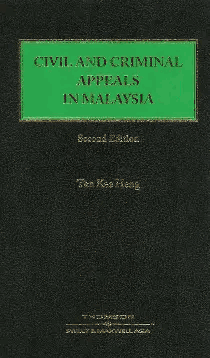
Civil and Criminal Appeals in Malaysia by Tan Kee Heng.


Description
Civil and Criminal Appeals in Malaysia credited author is Tan Kee Heng.
Book review by marceljude.ai
My overall judgment is that this is a very strong practitioner’s textbook. It is not written like a broad, theory-heavy academic book. It is written like a working appellate manual: rules, time limits, forms, checklists, sample documents, practice directions, and case authorities are organized so that a lawyer can move from “What is the rule?” to “What do I file?” very quickly. The foreword stresses exactly that practical problem: appeals can fail because counsel miss procedural requirements, and the preface shows the author deliberately built the second edition to be current for 2007, with new cases, amendments, appendices, practice directions, and sample documents. That practical focus is the book’s biggest strength.
That said, the book also has a built-in limi because it is procedure-centered, it can feel dense and technical, especially for students reading appellate law for the first time.
Chapter 1: Appeal from the Subordinate Courts to the High Court
This is an excellent opening chapter because it begins at the most basic but most important point: there is no appeal unless statute gives it. From there it moves into the two-tier system, restrictions on appeal, the High Court’s revisionary and supervisory jurisdiction, the distinction between appeals from non-trial decisions and trial decisions, extension of time, cross-appeals, amendments, absence of parties, fresh evidence, withdrawal, and the idea that civil appeals are generally by way of re-hearing. It ends with a checklist.
As a chapter, it works because it immediately teaches the reader that appellate practice is not just about arguing merits; it is about route, form, timing, and jurisdiction. That is exactly where many weaker students and junior practitioners go wrong. The chapter’s scope is broad, but it is still coherent because all the subsections answer one practical question: “How do I get a civil appeal from the lower court properly before the High Court?”
Its weakness is that it can feel like being dropped into deep water. The chapter moves very quickly through statutory restrictions, procedural distinctions, and case law. For a first-time reader, a visual flowchart or a worked example would have made it even better. But as a professional handbook, it is extremely useful.
Chapter 2: Appeal from Certain Decisions of the Registrar of the High Court to the High Court Judge in Chambers
This chapter narrows the focus to appeals from a registrar’s decision to a judge in chambers. It covers the governing provisions, when a registrar’s order can be challenged, restoring an appeal, the required notice, service, bankruptcy-related complications, the nature of the rehearing, fresh evidence, and extension of time, again ending with a checklist.
This is one of the book’s most practically valuable chapters because registrar practice is the kind of area that is often poorly taught but frequently important in real litigation. The discussion of bankruptcy appeals shows the author understands that appellate procedure is never just one clean general rule; it is often shaped by specialized statutory contexts.
As criticism, the chapter is less inviting for general readers because it is narrower and more technical. But for a lawyer doing chamber work, it is precisely the sort of chapter that earns its place on the shelf.
Chapter 3: Appeal from Persons or Body of Persons to the High Court
This chapter deals with statutory appeals from bodies outside the ordinary court hierarchy, including land authorities, employment-related decisions, small estates, and professional bodies.
What makes this chapter important is that it maps an area many books leave scattered across separate statutes. The value here is not stylistic elegance but consolidation. The author is showing that appellate law in Malaysia is not just court-to-court; it also includes appeals from administrative and professional decision-makers where the right of appeal depends heavily on the wording of the statute.
As a reading experience, this is probably one of the less unified chapters because the subject itself is fragmented. But as a reference tool, it is excellent. It saves readers from having to rediscover the existence of these routes one statute at a time.
Chapter 4: Appeal from the High Court to the Court of Appeal
This is one of the central chapters of the book. It deals with jurisdiction, non-appealable matters, disputed questions about whether leave is needed, practice directions on when leave is not required, language requirements, leave applications, the full set of procedural steps, non-compliance, extension of time, court fees, costs, the Court of Appeal’s powers, further evidence, new points, new trials, inherent powers, and judgment.
This chapter is where the book becomes more than a filing guide. It starts to show how appellate litigation is shaped by threshold control. The leave requirement, the definition of non-appealable matters, and the court’s ability to admit fresh evidence or new points all show that appeals are not automatic second rounds; they are filtered, structured, and disciplined.
The best thing about this chapter is its balance between procedure and power. The author does not stop at “file this form by this date.” He also explains what the Court of Appeal can actually do once the appeal is before it. That makes the chapter intellectually stronger than a simple practice note.
Its weakness is density. A student may find this chapter overwhelming because it reads like an operating manual. But for serious legal use, this is one of the book’s strongest sections.
Chapter 5: Appeal from the Court of Appeal to the Federal Court
This chapter is arguably the most sophisticated chapter in the civil part. It explains that the Federal Court’s civil appellate jurisdiction is restricted, that leave must be obtained first, that the Federal Court does not hear every civil appeal, and that its role is shaped by questions of principle and the structure of Malaysian appellate hierarchy. It also covers procedure, core bundles, written submissions, costs, powers, and judicial precedent.
The chapter is especially strong because it treats apex-court appeals as a distinct subject. The book makes clear that the Federal Court is not just a “higher Court of Appeal”; it is a selective, principle-focused court. The sections on leave, framed questions, and precedent make that very clear.
The discussion of precedent is a major plus. It gives the chapter a jurisprudential weight that lifts it above bare procedure. This is where the author shows he is interested not only in getting the appeal filed, but in explaining how final appellate authority shapes the whole legal system.
This is also where the age of the book matters most. Because apex-court practice evolves, this chapter is best read today as a structural and historical foundation rather than a current procedural endpoint. Still, as a textbook chapter, it is excellent.
Chapter 6: Interference by Appellate Court
This is one of the best chapters in the book, even though it is shorter. It addresses when an appellate court should interfere with findings of fact, discretionary decisions, and concurrent findings. The text emphasizes that appellate courts are generally slow to disturb trial findings, especially where credibility is central, but are more willing to intervene where findings depend on inferences from established facts or where the lower court’s evaluation is clearly wrong.
Why is this chapter so good? Because it answers the question too many procedure books neglect: What is the appellate court actually for? This chapter gives the logic of restraint. It explains why appeals are not simply opportunities to retry everything. That makes the whole book more intellectually satisfying.
My only criticism is that the chapter could have been expanded. Because it is so conceptually important, it might have benefited from a few worked illustrations showing the difference between credibility findings, inference-based findings, and discretionary rulings. Even so, this is the chapter that most clearly turns the book from a manual into a real legal text.
Chapter 7: Stay of Execution Pending Appeal
This chapter deals with a highly practical issue: how to stop enforcement while an appeal is pending. It covers the general rule, the relevant provisions, where the application should first be made, mode of application, jurisdiction pending leave, special circumstances, what may count as special circumstances, what does not, and when an appellate court will interfere with the first-instance discretion. The text emphasizes that stay is exceptional and that mere disagreement with the judge’s discretion is not enough.
This is a very strong practitioner chapter because it teaches legal strategy, not just law. A stay application is often the point where litigation becomes urgent and commercial reality bites. The author handles that well by organizing the chapter around the idea of “special circumstances” and judicial restraint.
The chapter would be even stronger with scenario-based comparison between money judgments, possession orders, and other types of relief. But as a practical chapter, it is highly useful.
Chapter 8: Appeal from Subordinate Courts to the High Court (Criminal)
This chapter begins the criminal half by stressing that there is no general right of appeal in criminal law, only rights conferred by statute. It then goes through cases where no appeal lies, guilty pleas, acquittal appeals, procedure under the Criminal Procedure Code, extension of time, transmission of records, hearing, additional evidence, the appellate court’s powers, stays pending appeal, arrest pending acquittal appeal, bail appeals, costs, and a checklist.
This chapter is excellent in scope. It mirrors the civil chapters in structure, but criminal procedure raises sharper issues: guilty pleas, acquittals, retrials, sentence review, and bail. The author’s strength here is that he treats criminal appeals not as a side appendix to civil practice, but as a full procedural world of their own.
For the reader, the main challenge is complexity. The chapter is packed with CPC-based distinctions, and a reader without some prior criminal procedure background may struggle. But for serious use, that density reflects the subject honestly.
Chapter 9: Revisionary Powers of the High Court
This chapter explains criminal revision: its jurisdictional basis, purpose, when it may be used, the relationship between revision and appeal, discretion, powers on revision, hearing rights, enhancement of sentence, and the limit that revision cannot convert an acquittal into a conviction.
This is a very important chapter because revision is one of those powers that students often confuse with appeal. The author treats that distinction seriously. He shows revision as a corrective supervisory jurisdiction with its own boundaries, not a substitute appeal.
As a chapter, it is clear and disciplined, though a little compressed. I would have liked more procedural examples showing when a lawyer should pursue revision rather than appeal. Still, it is doctrinally valuable.
Chapter 10: Appeal from the High Court to the Court of Appeal (Criminal)
This chapter takes the reader through criminal appeals from the High Court to the Court of Appeal: jurisdiction, restrictions, guilty plea issues, leave where required, notice, record, petition of appeal, transmission, withdrawal, out-of-time appeals, arrest on acquittal appeal, no-stay rule, summary rejection, hearing, additional evidence, powers, and checklist.
This is a strong chapter because it carefully maps the special statutory mechanics of criminal appeals rather than assuming they resemble civil ones. The sections on petition of appeal and summary rejection are especially important, since those are exactly the areas where procedural misunderstanding can ruin a case.
The chapter’s weakness is the same as the rest of the criminal part: it demands concentration. But that is not really a flaw of the author; it is a feature of the subject.
Chapter 11: Appeal from the Court of Appeal to the Federal Court (Criminal)
This chapter closes the main text by dealing with criminal appeals to the Federal Court. It explains the two-tier system, the Federal Court’s criminal jurisdiction, the importance of the High Court’s original criminal jurisdiction, procedural steps, out-of-time appeals, arrest on acquittal appeal, the no-stay principle, summary rejection, hearing, further evidence, powers, and judgment. The text also makes clear that the Court of Appeal is final for criminal cases that originated in subordinate courts, while the Federal Court’s criminal appellate role is limited to the statutory structure laid down for cases coming from the High Court’s original jurisdiction.
This is a very good final chapter because it corrects a common misconception: not every criminal case can travel endlessly upward. The author ends the book by reasserting a theme that runs through the whole work—appellate jurisdiction is statutory and limited.
As with Chapter 5, this chapter is strongest when read as an explanation of structure and jurisdiction, not merely a checklist of filings.
Part C and the appendices
Part C briefly surveys the highest appellate courts in other jurisdictions and explicitly warns readers not to rely too much on foreign procedural authorities because each legal system has its own statutes, rules, powers, and limits. That is a smart inclusion: comparative material is useful, but the author keeps the reader anchored in Malaysian procedure.
The appendices are one of the book’s biggest assets. Parts D and E provide sample civil and criminal appeal documents; Part F collects practice directions; Part G reproduces the key procedural legislation; and Part H gives filing fees. This turns the book from a textbook into a desk manual. For practice, that is gold. For teaching, it also helps students see how doctrine becomes paperwork.
Final evaluation
This is a serious, well-structured, highly practical appellate textbook. Its greatest strengths are:
clear organization by appellate route;
strong focus on procedural traps;
repeated use of checklists and specimen documents;
balanced treatment of both civil and criminal appeals;
useful attention to the powers and limits of appellate courts, not just filing steps.
Its main weaknesses are:
it is dense for beginners;
it sometimes reads more like a practitioner’s manual than a teaching narrative As a textbook review, I would rate it very highly: it is disciplined, useful, and unusually complete for its subject.
 marceljude.ai @ +60128285778 |
- MALAYSIA'S 1ST AI LAWYER - CLICK HERE
- ISMAIL – INTEGRATED SINGAPORE/MALAYSIA AI & LAW (Library)
- OPENING OF SINGAPORE MALAYSIA AI CENTRE AND LAW LIBRARY
- LIFT - LAW INSTRUMENTS FORMS & TEMPLATES
- LAWS OF MALAYSIA FOR SINGAPOREAN DUMMIES
- HANNAH YEOH'S ARTIFICIAL INTELLIGENCE LAW ENCYCLOPEDIA
- LEAD CR - Law Ecosystem Archive Databases on CD-ROM
- BREAKING NEWS FROM MJN
- CLICK HERE CO. PROFILE
- EXCITING NEW SERIES - THE ADVENTURES OF BOBBY TAN -ADVOCATE & SOLICITOR IN THE HIGH COURT OF NORTH BORNEO by marceljude.ai
- MEDICO LEGAL - BY PRISKILA AKWILA & GLORIOUS PETAL SDN BHD - powered by marceljude.ai
- MISCELLANOUS
- ANNOTATED STATUTES OF SABAH - A NEW SERIES
- e-library - marceljude.ai
- DRAFT - DOCUMENT RESEARCH & AUTOMATED FILING TECHNOLOGY
- CLARA – Case Law Analysis & Retrieval AI
- FOR RESEARCH REQUEST CLICK HERE
- CLICK HERE TO ASK ANYTHING
- RAMBO'S LAW - THE LAW OF THE LAW JUNGLE - EXCITING NEW SERIES - CASE ANALYSIS BY JOHN RAMBO @ +60138646786
- PRISKILA AKWILA ADVOCATES - High Court of Sabah & Sarawak @ Kota Kinabalu
- COLA - COMMONWEALTH ONLINE LAWCASES AI -marceljude.ai
- THE LAW LIBRARY THAT COMES TO YOU ANYWHERE AND ANYTIME
- marceljude.ai training academy
