
CARRIERS/TRANSPORTATION & LOGISTICS - ENCYCLOPEDIA OF FORMS & PRECEDENTS
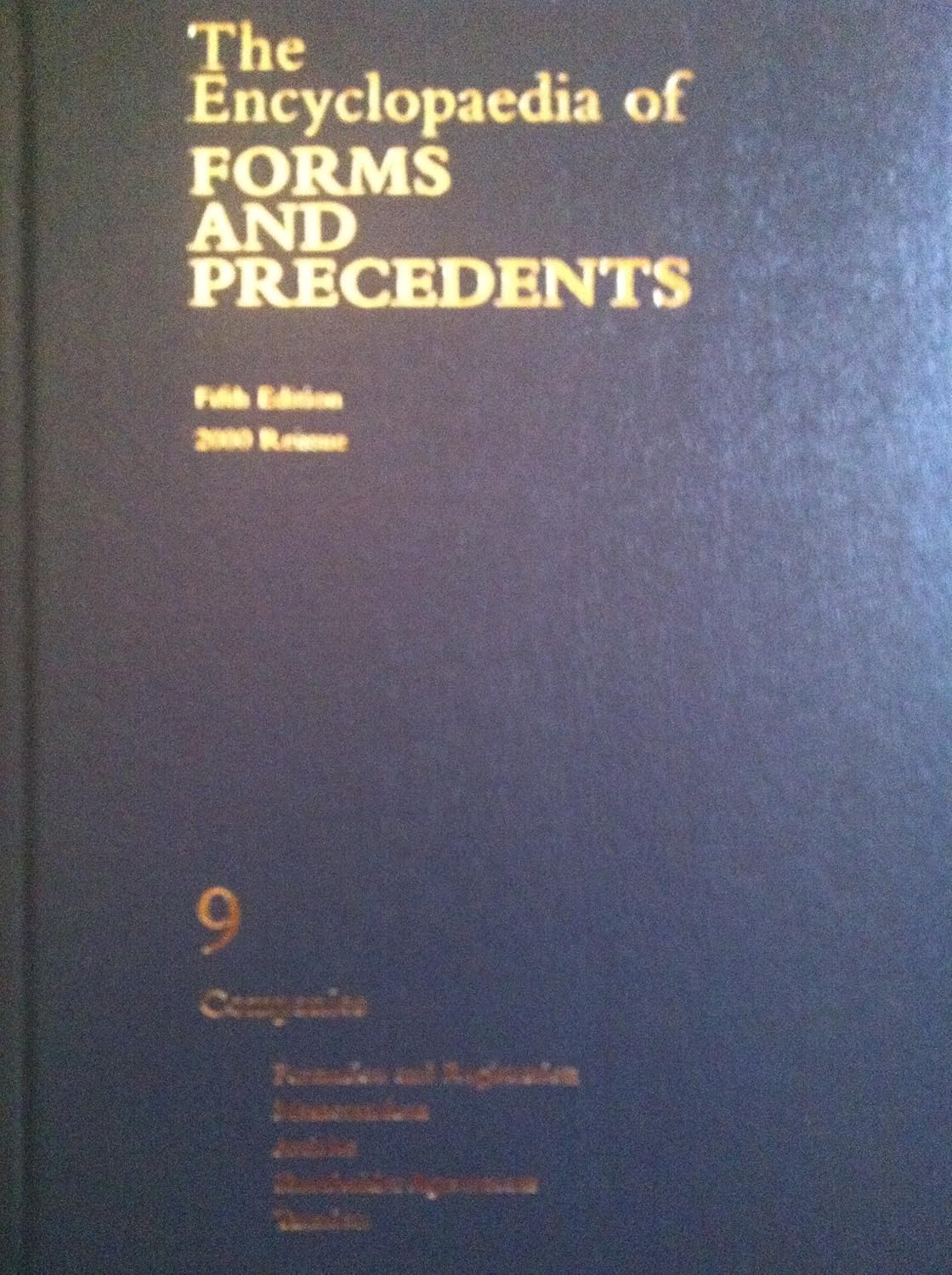


Description
Carriers - a drafting book review for Malaysian carrier agreements
Review by marceljude.ai
This book is far more valuable as a drafting quarry than as a jurisdictional guide. Its real worth lies in the Forms and Precedents: short conditions of carriage, parcel and courier conditions, furniture-removal terms, delivery-service agreements, fleet contract hire, passenger hire forms, and cargo conditions. Read that way, it is still a serious working tool, because it shows how carrier documents are built clause by clause rather than merely discussed in theory.
What makes the book strong is that it understands a carrier contract as a workflow, not as a single risk clause. Again and again, the precedents define when custody starts, when it ends, who may give instructions, when delivery is treated as complete, what happens if delivery fails, how claims are notified, whether the carrier may subcontract, and whether unpaid charges justify retention or disposal of goods. That is exactly the right drafting instinct. A good carrier agreement needs a clock, a value mechanism, and an exit route; this book consistently supplies all three.
The most reusable material is concentrated in the road-goods and service-agreement forms. The short conditions at carrier’s risk with limited liability are a clean model for a house set of standard terms. The parcel-delivery and courier forms are especially useful because they show how to combine booking data, exclusions, delivery promises, claims windows and customer warranties in a compact commercial instrument. The delivery-service agreement is probably the best commercial precedent in the book: it deals with exclusivity, collection windows, proof of delivery, cash collection, returned consignments, pricing and invoicing in one coherent structure. The fleet contract-hire agreement is also highly reusable, because it separates vehicle provision, driver provision, operational compliance, payment and goods liability in a way that modern dedicated-fleet deals still need. Even the cargo conditions remain valuable because they treat documentation, rates, delivery, successive carriers, claims and liability as one operating system rather than scattered clauses.
A second strength is the book’s modularity. It does not pretend that one carrier document can do everything. It distinguishes between a one-off consignment, a repeating parcel service, a subcontracted movement, a dedicated-fleet arrangement, a furniture-removal job, a chauffeur-driven hire and an air-cargo movement. That is good drafting discipline. For a Malaysian carrier business, this is a very useful reminder that you should not try to force all operations into one bloated set of terms. You need a document family.
Its weaknesses are just as clear. First, a lot of the surrounding commentary is tied to old, place-specific scaffolding and should not be transplanted. Second, the book often drafts from the carrier’s most defensive position. That is useful as a starting point, but not always as a finished commercial position. In practice, customers in Malaysia - especially larger manufacturers, e-commerce sellers, and logistics buyers - usually accept a capped liability model more readily than a near-total exclusion model. Third, many forms assume a paper world: overleaf conditions, notices by post, wet signatures, physical consignment notes, and manual proofs. For current operations, that is dated.
That paper-world limitation matters because the Malaysian logistics environment is now visibly multi-layered. Official Malaysian investment material describes the cargo ecosystem as including container haulage, freight forwarding, warehousing, distribution-related services, port and customs clearance, local branches and agent networks, with some hauliers operating modern tracking systems and cargo moving through both road and rail links. That means Malaysian carrier drafting has to do more than allocate liability. It has to manage handoffs, tracking evidence, agent performance, depot storage, and multimodal breaks in custody.
Local courier terms also show where Malaysian market practice has already settled. Public terms from local operators place responsibility for packaging on the shipper, use short written claim windows, cap standard liability at modest levels, allow remeasurement by volumetric weight, impose outskirt surcharges, and separate basic cover from optional enhanced protection or insurance. City-Link’s published terms, for example, make the shipper responsible for packaging, require written claims within 48 hours for damaged or delayed consignments and 21 days for lost consignments, use volumetric-weight pricing, and limit ordinary liability to RM200. GDEX publicly advertises basic coverage up to RM200 per consignment note with enhanced liability available, while Pos Malaysia offers an optional parcel service warranty up to RM5,000.
That point is important because it shows how the book should be adapted, not copied. The book’s old “owner’s risk versus carrier’s risk” logic is still sound, but in Malaysia it should usually be expressed as a tiered commercial offering: basic liability included in the standard rate, a declared-value or enhanced-liability option for higher-value consignments, and a separate insurance mechanism where appropriate. That is more saleable, easier to price, and much closer to what customers already see in the market.
The same goes for special-movement drafting. One especially useful Malaysian adaptation is to create a distinct annex for East Malaysia and cross-border consignments. City-Link’s public terms require a commercial invoice or descriptive declaration for non-document consignments to East Malaysia and international destinations. That is a practical drafting cue: your standard Malaysian conditions should not leave special-document requirements buried in operations manuals. They should sit in a visible schedule or annex tied to service territory and shipment type.
Another modernising step is to convert the book’s evidence model from paper to digital. Malaysia’s e-Invoice rollout is designed around near real-time validation and storage for B2B, B2C and B2G transactions. A modern Malaysian carrier agreement should therefore recognise electronic booking records, e-waybills, scan events, digital proofs of delivery, and e-invoices as operative commercial records. The book’s logic is still right - define the evidence trail - but the medium has changed.
So how should this book actually be used in Malaysia? Not as a single template, but as a sourcebook for a document suite. The most useful suite would contain: a short public-facing standard conditions of carriage for one-off shipments; an account-customer master services agreement for repeat B2B clients; a subcontractor terms pack that mirrors customer-facing obligations; a warehouse/storage and undelivered-goods addendum; a dedicated-fleet agreement; and a special-cargo or East Malaysia/international annex. That structure is already latent in the book. The Malaysian drafter’s job is to modernise it and localise the schedules.
If I were drafting from this book for a Malaysian carrier, I would preserve six things almost exactly in spirit. First, the custody wording: be precise about when goods are deemed received, when delivery is deemed tendered, and when the consignee’s failure to accept ends transit. Second, the instruction wording: define who may change instructions, by what channel, and at whose cost. Third, the subcontracting wording: keep the carrier’s right to use agents and subcontractors, and expressly protect those parties from direct claims where the contract permits. Fourth, the undeliverable-goods machinery: failed delivery, storage, return, redelivery, lien and disposal should all be tied together. Fifth, the claims machinery: notice periods, inspection rights, proof requirements and suit-limitation language need to sit in one place, clearly. Sixth, the schedule technique: keep variable commercial items - rates, service windows, territory, excluded goods, surcharges, declared values - out of the body where possible and put them in schedules that operations teams can actually maintain.
What I would change is equally important. I would add electronic POD language; actual-versus-volumetric measurement language; fuel, waiting-time, toll, ferry, remote-area and re-delivery surcharge schedules; a cleaner returns logistics clause for failed e-commerce deliveries; a stronger data/confidentiality section; a clearer carve-out for fraud or deliberate misconduct; and service-level wording for premium time-definite jobs. I would also soften the most absolute exclusion clauses and replace them, where commercially sensible, with capped liability plus optional enhanced cover. That produces documents that are not only protective, but also usable in sales and procurement.
The final verdict is simple. As a Malaysian law book, this is not the answer. As a drafting book, it is excellent. Its value is not in its jurisdictional commentary; its value is in the way it teaches carrier contracts to think. It knows that the real problems are unclear custody, vague instructions, unpriced deviations, subcontracted performance, under-described goods, undelivered consignments, weak proof, and uncontrolled claims. For marceljude.ai, that makes it a very strong precedent bank for building Malaysian carrier agreements - provided it is treated as structure to be rebuilt, not text to be transplanted.
- MALAYSIA'S 1ST AI LAWYER - CLICK HERE
- ISMAIL – INTEGRATED SINGAPORE/MALAYSIA AI & LAW (Library)
- OPENING OF SINGAPORE MALAYSIA AI CENTRE AND LAW LIBRARY
- LIFT - LAW INSTRUMENTS FORMS & TEMPLATES
- LAWS OF MALAYSIA FOR SINGAPOREAN DUMMIES
- HANNAH YEOH'S ARTIFICIAL INTELLIGENCE LAW ENCYCLOPEDIA
- LEAD CR - Law Ecosystem Archive Databases on CD-ROM
- BREAKING NEWS FROM MJN
- CLICK HERE CO. PROFILE
- EXCITING NEW SERIES - THE ADVENTURES OF BOBBY TAN -ADVOCATE & SOLICITOR IN THE HIGH COURT OF NORTH BORNEO by marceljude.ai
- MEDICO LEGAL - BY PRISKILA AKWILA & GLORIOUS PETAL SDN BHD - powered by marceljude.ai
- MISCELLANOUS
- ANNOTATED STATUTES OF SABAH - A NEW SERIES
- e-library - marceljude.ai
- DRAFT - DOCUMENT RESEARCH & AUTOMATED FILING TECHNOLOGY
- CLARA – Case Law Analysis & Retrieval AI
- FOR RESEARCH REQUEST CLICK HERE
- CLICK HERE TO ASK ANYTHING
- RAMBO'S LAW - THE LAW OF THE LAW JUNGLE - EXCITING NEW SERIES - CASE ANALYSIS BY JOHN RAMBO @ +60138646786
- PRISKILA AKWILA ADVOCATES - High Court of Sabah & Sarawak @ Kota Kinabalu
- COLA - COMMONWEALTH ONLINE LAWCASES AI -marceljude.ai
- THE LAW LIBRARY THAT COMES TO YOU ANYWHERE AND ANYTIME
- marceljude.ai training academy
