
CALCUTTA LAW REPORTS
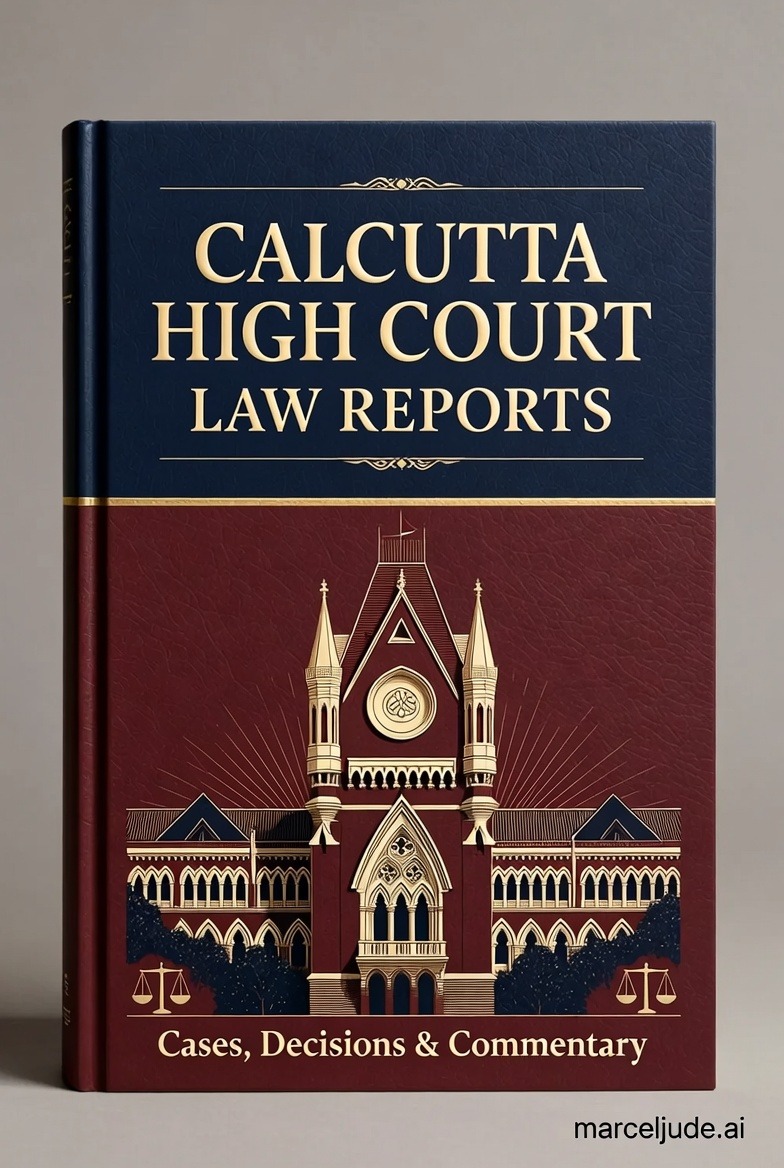
A REVIEW OF THE CALCUTTA HIGH COURT REPORTS Introduction
The expression Calcutta High Court Reports is commonly used in two senses. In its broad sense, it refers to the large body of reported decisions delivered by the High Court at Calcutta. In its narrower historical sense, it refers to the nineteenth-century collections through which the early decisions of that court were published.
It is important not to mistake the expression for one uninterrupted modern report bearing a single abbreviation. Decisions of the Calcutta High Court have appeared in several recognised series, including:
the Bengal Law Reports; the Weekly Reporter; the Indian Jurist; the Indian Law Reports, Calcutta Series; the Calcutta Weekly Notes; the Calcutta Law Journal; the Calcutta High Court Notes; the All India Reporter, Calcutta; and other specialised and general Indian reports.
Taken collectively, these reports constitute one of the richest archives of common-law, statutory and personal-law jurisprudence in Asia. They document legal developments from the colonial period through Indian independence, the commencement of the Constitution of India and the growth of modern constitutional and commercial law.
The Calcutta High Court
The Calcutta High Court is the oldest High Court in India. It was established as the High Court of Judicature at Fort William under the Indian High Courts Act 1861 and formally opened on 1 July 1862.
Its present jurisdiction extends over the State of West Bengal and the Union Territory of the Andaman and Nicobar Islands. Its principal seat is in Kolkata, with circuit benches in Port Blair and Jalpaiguri.
The court’s official history identifies Sir Barnes Peacock as its first Chief Justice. Justice Sumboo Nath Pandit, appointed in 1863, was the first Indian judge of the court. Calcutta High Court official history.
The court retained the name “Calcutta High Court” even after the city was officially renamed Kolkata. It remains one of India’s Chartered High Courts, together with the Bombay and Madras High Courts.
Historical Background
Before 1862, the judicial structure in Bengal was divided between the Supreme Court of Judicature at Fort William and the East India Company’s system of Sadar courts.
The Supreme Court exercised jurisdiction principally over British subjects and specified persons and transactions connected with Calcutta. The Sadar Diwani Adalat dealt with civil justice, while the Sadar Nizamat Adalat dealt with criminal matters within the Company’s judicial system.
Early law reporting was fragmented. Decisions appeared in private collections prepared by judges, barristers and legal writers. These included reports associated with Morton, Bignell, Fulton, Montriou, Boulnois and other reporters.
The Bengal Sadar Diwani Adalat Reports began in the nineteenth century and are frequently described as among India’s earliest official law reports. When the Calcutta High Court was established, it inherited and combined important parts of the earlier judicial jurisdictions.
The creation of the High Court produced an immediate need for more systematic reporting. The court was deciding questions that affected not only Bengal but also the wider administration of British Indian law.
The Early Reporting Series The Weekly Reporter
The Weekly Reporter began reporting decisions associated with the Calcutta High Court during the 1860s. It is commonly cited by the abbreviation “WR”.
The series was valuable because it provided relatively prompt publication of decisions. However, the quality and completeness of early private reports could vary. Some reports contained detailed facts and arguments, while others provided only abbreviated judgments or propositions.
A citation generally identifies the volume, abbreviation and page:
Volume WR Page
The precise citation should always be copied from a reliable catalogue, scanned volume or legal database. Older citations should never be reconstructed through assumption.
The Bengal Law Reports
The Bengal Law Reports, ordinarily abbreviated as “BLR”, comprised approximately 15 volumes published from the late 1860s into the 1870s.
They are among the most important early reports of the Calcutta High Court. Historical accounts commend them for including reasonably full facts and, where necessary, the decisions of the courts below.
The series contains important decisions on:
Hindu law; Mohammedan law; succession; land; revenue; civil procedure; criminal law; contract; evidence; jurisdiction; and commercial disputes.
The reports are valuable not merely as precedents but as evidence of how the early High Court reconciled English legal concepts, Indian legislation and indigenous systems of personal law.
The Indian Jurist
The Indian Jurist was another private legal publication reporting decisions from Calcutta and elsewhere. It contributed to the expanding nineteenth-century body of reported Indian case law.
Private reporting made decisions accessible, but it also created difficulties. The same case could appear in several reports with different summaries, spellings or levels of detail. Some judgments were omitted, and others were reported without a sufficient statement of facts.
These concerns eventually contributed to the creation of the official Indian Law Reports system.
The Indian Law Reports Act 1875
By the 1870s, the number of private reports had grown considerably. The quality of reporting was uneven, and judges and practitioners faced difficulty determining which version of a judgment should be relied upon.
The Indian Law Reports Act 1875 was enacted to establish an authorised system for reporting High Court decisions and to reduce the indiscriminate use of unofficial reports.
The legislation led to the creation of the official Indian Law Reports series for the principal High Courts. In Calcutta, this became the Indian Law Reports, Calcutta Series, cited as “ILR Cal” or through its historical volume format.
The official series began during the 1870s and succeeded the earlier period in which decisions were scattered among the Bengal Law Reports, Weekly Reporter and other private publications.
The Indian Law Reports, Calcutta Series
The Indian Law Reports, Calcutta Series became the principal authorised report of Calcutta High Court decisions.
A traditional citation may appear in a form such as:
(Year) Volume ILR Cal Page
or:
ILR Volume Cal Page
The exact style varies according to the period and citation guide.
The series reports selected judgments regarded as sufficiently important to contribute to the development of the law. A report ordinarily contains:
the case name; the court and judges; the dates of hearing and judgment; the material facts; the procedural history; the arguments or principal contentions; the legislation considered; the authorities cited; the judgment; and the final order.
The official character of ILR Cal distinguishes it from purely private reports, but the authority of the decision still comes from the court, not from the reporter.
The Calcutta Weekly Notes
The Calcutta Weekly Notes, commonly abbreviated as “CWN”, began publication in 1896. It became one of the best-known Calcutta specialist reporting publications.
A conventional citation takes the following form:
Volume CWN Page
The volume number traditionally corresponds to the annual sequence of the publication.
CWN has reported significant decisions of the High Court on both its Original and Appellate Sides. It often provides access to decisions that may not have appeared promptly—or at all—in the official reports.
Its continuity and close association with Calcutta practice make it particularly important to lawyers researching West Bengal law.
The Calcutta Law Journal
The Calcutta Law Journal, abbreviated as “CLJ”, is another recognised source of Calcutta decisions.
It reports judgments across a range of civil, criminal, constitutional and commercial subjects. A citation normally identifies:
Volume CLJ Page
It must not be confused with other Indian publications using similar abbreviations.
Parallel citations are common. A single decision may appear in ILR Cal, CWN, CLJ and AIR. These are not different decisions. They are separate published versions of the same judgment.
The All India Reporter: Calcutta
The All India Reporter provides nationwide reporting of decisions from the Supreme Court and Indian High Courts. A Calcutta High Court citation normally appears as:
AIR Year Cal Page
For example, “Cal” identifies the Calcutta High Court.
AIR citations became widely used because the series allowed practitioners to locate cases from different Indian jurisdictions through a standard citation structure.
A decision reported as AIR Cal may also have parallel citations in ILR Cal, CWN, CLJ or another report.
Scope of the Calcutta Reports
The reports cover an exceptionally wide range of law. This reflects the court’s combination of constitutional, appellate, original civil, criminal, admiralty, testamentary and company jurisdictions.
Original and Appellate Jurisdiction
The Calcutta High Court possesses an important Original Side jurisdiction, historically associated with civil and commercial disputes arising within specified territorial limits in Calcutta.
It also exercises Appellate Side jurisdiction over decisions from subordinate courts and tribunals.
The distinction is important because rules, procedures and institutional traditions may differ between the two sides.
Reported decisions may therefore involve:
original civil suits; interlocutory applications; appeals from decrees; revisional jurisdiction; constitutional writs; criminal appeals; company proceedings; probate; admiralty; and arbitration. Constitutional Law
After the Constitution of India came into force in 1950, the Calcutta High Court assumed an important role in constitutional adjudication.
The reports include cases concerning:
equality; personal liberty; freedom of speech; freedom of religion; property rights; preventive detention; administrative action; legislative competence; federalism; judicial review; public employment; natural justice; and constitutional remedies.
Article 226 of the Indian Constitution gives High Courts extensive authority to issue writs and directions for the enforcement of fundamental and other legal rights.
This jurisdiction has made the court a major source of Indian administrative and constitutional jurisprudence.
Judicial Review and Administrative Law
Calcutta decisions have addressed:
acting outside statutory powers; jurisdictional error; improper purpose; relevant and irrelevant considerations; procedural fairness; bias; legitimate expectation; reasoned decisions; proportionality; administrative discretion; and remedies.
These decisions are useful beyond India because many of the underlying principles derive from the broader common-law tradition.
However, the Indian constitutional writ jurisdiction is not identical to Malaysian judicial review under Order 53 of the Rules of Court 2012 and the Courts of Judicature Act 1964.
Civil Procedure
The Calcutta reports contain extensive interpretation of the Indian Code of Civil Procedure and earlier procedural enactments.
Subjects include:
jurisdiction; institution of suits; service; pleadings; amendment; parties; injunctions; receivers; discovery; evidence; trial; judgments; decrees; execution; appeals; review; revision; res judicata; and limitation.
Calcutta’s Original Side also developed a sophisticated body of procedural law for commercial and property litigation.
Older procedural cases must be used carefully. The applicable statutory provision may have been amended, and the current Indian procedural regime may differ substantially from the historical rule.
Contract Law
The reports contain significant decisions interpreting the Indian Contract Act 1872 and associated common-law and equitable principles.
Issues include:
offer and acceptance; consideration; capacity; agency; mistake; misrepresentation; fraud; coercion; undue influence; illegality; restraint of trade; indemnity; guarantee; bailment; damages; frustration; and restitution.
This material can be relevant to Malaysian lawyers because the Malaysian Contracts Act 1950 shares part of its legislative ancestry with Indian contract legislation.
Similarity of origin does not establish identity. Malaysian amendments and binding Malaysian cases must be considered before an Indian decision is relied upon.
Specific Relief
Calcutta decisions have contributed to the development of principles concerning:
specific performance; injunctions; declarations; rectification; rescission; cancellation of instruments; recovery of possession; and equitable discretion.
These cases frequently involve land-sale agreements, family arrangements and commercial contracts.
Older cases may have been decided under historical versions of the Specific Relief Act. The current Indian and Malaysian enactments are not identical in every respect.
Property and Land Law
The reports contain a vast body of land jurisprudence arising from Bengal’s distinctive history.
Subjects include:
landlord and tenant; zamindari interests; permanent settlement; revenue; mortgages; leases; possession; adverse possession; easements; transfer of property; partition; co-ownership; trusts; specific performance; and succession to land.
Much of the historical land law was tied to Bengal’s revenue and tenure systems. Such cases may possess considerable historical importance but limited direct applicability to modern Malaysian registered land.
A lawyer must distinguish a general equitable principle from a proposition dependent upon a repealed Bengal tenancy or revenue statute.
Hindu Law
The Calcutta reports are a major historical source of Anglo-Hindu law.
Reported cases consider:
joint Hindu families; coparcenary; succession; adoption; marriage; maintenance; partition; religious endowments; gifts; wills; and women’s property rights.
Colonial judges frequently relied upon Sanskrit texts, translations, commentaries and expert pandits while developing judicial doctrines that became known as Anglo-Hindu law.
These decisions must be understood historically. Modern Indian Hindu personal law has been substantially affected by post-independence legislation and constitutional equality principles.
Mohammedan Law
The reports also contain extensive decisions on what colonial reports called “Mohammedan law”, now more commonly described as Muslim personal law.
Subjects include:
marriage; divorce; dower; maintenance; legitimacy; gifts or hiba; wakaf; inheritance; guardianship; and family property.
These cases are historically important but cannot be transferred mechanically to Malaysian Islamic law.
Malaysian Islamic law is administered through federal and state constitutional arrangements, state enactments and Syariah courts. Indian High Court decisions are not binding upon Malaysian civil or Syariah courts.
Succession and Probate
The Calcutta High Court’s testamentary and intestate jurisdiction generated an important body of law on:
execution of wills; testamentary capacity; undue influence; suspicious circumstances; revocation; probate; letters of administration; construction of wills; executors; administrators; family settlements; and succession rights.
The reports are particularly valuable where a testamentary dispute involves both English-derived probate principles and Indian personal law.
Company and Insolvency Law
Calcutta’s commercial importance produced substantial litigation concerning:
incorporation; directors; shareholders; capital; meetings; oppression; winding up; liquidators; creditors; schemes; fraudulent transactions; insolvency; and company jurisdiction.
Older company decisions may interpret British Indian enactments modelled upon English companies legislation.
Their reasoning can remain historically or comparatively useful, but current Indian and Malaysian company legislation has developed considerably since those decisions.
Commercial Law
Calcutta was a major colonial and post-colonial commercial centre. The reports therefore contain important decisions on:
sale of goods; banking; insurance; negotiable instruments; agency; partnerships; carriage of goods; shipping; bills of exchange; letters of credit; commodities; and commercial remedies.
The court’s Original Side became especially important for complex mercantile disputes.
Admiralty and Maritime Law
The Calcutta High Court inherited an important admiralty jurisdiction connected with the Port of Calcutta and trade through the Hooghly River.
Reported cases may concern:
maritime claims; arrest of ships; cargo damage; charterparties; bills of lading; collisions; salvage; seamen’s claims; ship mortgages; port authorities; and limitation of liability.
The reports preserve the development of Indian admiralty law from colonial jurisdiction to modern statutory practice.
Arbitration
The Calcutta reports contain extensive arbitration jurisprudence because of the city’s commercial activity.
Cases may address:
arbitration agreements; appointment of arbitrators; jurisdiction; stays of court proceedings; interim relief; misconduct; public policy; setting aside awards; enforcement; foreign awards; and court supervision.
Older cases often reflect a more interventionist judicial approach. Modern arbitration law increasingly emphasises party autonomy and limited court interference.
Researchers must identify the legislation applicable when the case was decided.
Criminal Law
The reports contain decisions on substantive offences and criminal procedure, including:
murder; culpable homicide; hurt; theft; cheating; criminal breach of trust; forgery; conspiracy; abetment; obscenity; public order; evidence; confessions; identification; bail; trial procedure; and sentencing.
The Indian Penal Code 1860 and Indian Evidence Act 1872 profoundly influenced the development of criminal law in other British territories.
This makes some Calcutta decisions potentially useful to Malaysian criminal lawyers, but only where the statutory wording remains materially comparable.
Evidence
Calcutta High Court decisions form an important part of the jurisprudence interpreting the Indian Evidence Act 1872.
The reports consider:
relevance; admissions; confessions; hearsay; expert evidence; burden of proof; presumptions; documentary evidence; privilege; estoppel; witness competency; corroboration; and proof of execution.
Malaysia’s Evidence Act 1950 was also shaped by the Indian codification tradition. Indian authorities can therefore be persuasive where the provisions are materially similar.
Nevertheless, Malaysian Federal Court and Court of Appeal decisions remain controlling.
Taxation and Revenue
The reports include cases involving:
income tax; customs; excise; stamp duty; land revenue; sales taxation; municipal rates; and statutory assessment.
Tax cases are highly dependent upon the precise statutory language and assessment year. They should be used comparatively only after close examination of the relevant legislation.
Labour and Industrial Law
Calcutta and West Bengal’s industrial history produced significant decisions involving:
trade unions; industrial disputes; dismissal; retrenchment; wages; disciplinary proceedings; standing orders; public employment; domestic inquiries; and labour tribunals.
These cases often combine statutory interpretation with principles of natural justice and administrative review.
Intellectual Property
The court’s commercial jurisdiction has also generated decisions on:
trademarks; copyright; patents; passing off; trade names; confidential information; interim injunctions; and territorial jurisdiction.
Many modern intellectual-property decisions are commercially significant beyond West Bengal, although their binding force within India depends upon the normal judicial hierarchy.
The Value of Full Judgments
The headnote of a reported case is useful, but it is not the judgment.
A Calcutta decision may involve:
several separate judgments; agreement on the result but disagreement on reasoning; a reference to a Full Bench; an appeal from the Original Side; an earlier decision of a subordinate court; an appeal to the Privy Council or Supreme Court; or a statutory provision later amended.
A lawyer must read the full reasons before relying upon the case.
The historical reports can be especially difficult because the language, spelling and citation conventions differ from modern practice. Scanned copies may also contain OCR errors.
Full Bench Decisions
A Full Bench decision of the Calcutta High Court generally carries greater internal precedential weight than a decision of a smaller bench.
Researchers should identify:
the number of judges; whether the matter was referred because of conflicting decisions; the precise question referred; the answer given by the Full Bench; and whether a higher court later considered the case.
The Full Bench procedure played an important role in resolving disagreement within the High Court.
Appeals to the Privy Council
During the colonial period, appeals from the Calcutta High Court could reach the Judicial Committee of the Privy Council.
The Privy Council’s decision may have:
affirmed the High Court; reversed it; modified its reasoning; or decided the matter on a different ground.
A researcher should therefore check whether an early Calcutta decision was appealed. The High Court report alone may no longer represent the final outcome.
Privy Council decisions from India also influenced law throughout the British Empire, including territories that later became Malaysia.
Appeals to the Supreme Court of India
After the establishment of the Supreme Court of India, Calcutta High Court decisions became subject to the Supreme Court’s appellate and constitutional authority.
A High Court decision reversed by the Supreme Court cannot be cited as representing current Indian law.
The researcher must examine:
subsequent appeal history; later Supreme Court treatment; legislative amendments; and constitutional developments. Strengths of the Reports 1. Historical depth
The reports extend back to the establishment of the oldest High Court in India and preserve more than a century and a half of jurisprudence.
2. Breadth
They cover constitutional, commercial, civil, criminal, personal, property, maritime and procedural law.
3. Judicial quality
The Calcutta High Court has included many distinguished judges whose reasoning influenced Indian and Commonwealth law.
4. Original commercial jurisdiction
The Original Side produced detailed judgments on complex commercial and equitable disputes.
5. Development of codified law
The reports reveal how courts interpreted major Indian codes governing contract, evidence, criminal law and civil procedure.
6. Personal-law scholarship
The early reports constitute an important archive of Anglo-Hindu and Anglo-Mohammedan jurisprudence.
7. Comparative value
The shared colonial and legislative history makes some decisions useful in Malaysia, Singapore and other Commonwealth jurisdictions.
8. Multiple report series
Parallel reporting can assist verification where one version is incomplete or unclear.
9. Availability of historical material
Many older volumes have been digitised by libraries and legal databases, making formerly rare materials more accessible.
Limitations 1. There is no single uniform “Calcutta High Court Reports” series
The expression covers several publications with different abbreviations, dates and editorial methods. A citation must identify the actual report used.
2. Private reports varied in quality
Some early reports are detailed; others contain limited facts or abbreviated reasoning.
3. Old legislation may have been repealed
A sound nineteenth-century decision may no longer apply under present legislation.
4. Colonial assumptions
Some early judgments reflect colonial attitudes and social assumptions inconsistent with contemporary constitutional values.
5. Personal-law reform
Modern legislation has altered many historical rules of Hindu and Muslim personal law.
6. Procedural differences
The Indian Code of Civil Procedure and the procedural rules of the Calcutta High Court are not identical to Malaysian civil procedure.
7. Difficult citations
Older cases may have several parallel citations, inconsistent party names and variant spellings.
8. Subsequent appeals
A reported High Court decision may have been reversed by the Privy Council or Supreme Court.
9. Jurisdiction-specific doctrines
Bengal revenue, tenancy and land cases may have little relevance outside their statutory context.
Citation Practice
The correct citation depends upon the report:
Volume BLR Page
Volume WR Page
Volume CWN Page
Volume CLJ Page
(Year) Volume ILR Cal Page
AIR Year Cal Page
Where a neutral citation exists for a modern judgment, it should also be included according to the applicable citation rules.
A proper citation should not merely say “Calcutta High Court Reports”. That description is insufficient to locate the case unless accompanied by the actual series, volume and page.
Value to Indian Practitioners
For Indian lawyers, the reports are indispensable when researching:
West Bengal law; the High Court’s own precedents; historical statutes; Original Side practice; Full Bench decisions; personal law; commercial law; and the development of national legal principles.
A practitioner should normally begin with current Supreme Court authority and then examine the relevant High Court jurisprudence.
Value to Judges
For judges, the reports provide an institutional record of earlier interpretation and judicial practice.
They can assist in:
tracing the origin of a doctrine; resolving conflicts; examining Full Bench reasoning; identifying historical statutory context; evaluating long-standing practice; and determining whether a proposition has survived legislative reform. Value to Law Students
For students, the reports demonstrate how Indian law developed through the interaction of:
English common law; equity; Indian statutory codes; Hindu and Muslim personal law; colonial administration; and constitutional transformation.
They are especially valuable for research in legal history, comparative law and statutory interpretation.
Value to Professors and Historians
For academics, the reports are a primary historical archive.
They support research into:
colonial courts; legal pluralism; codification; judicial administration; land tenure; personal law; commerce; constitutionalism; legal education; and the relationship between courts and government.
The reports also show how legal concepts moved between Britain, India and other parts of the Empire.
Relevance to Malaysian Law
Calcutta High Court decisions can have persuasive value in Malaysia because several Malaysian statutes emerged from the same codification tradition as Indian legislation.
Potentially relevant areas include:
contract; evidence; criminal law; specific relief; trusts and equity; civil procedure; arbitration; company law; insolvency; administrative law; and maritime law.
The degree of usefulness depends upon the similarity of the statutory provision and the subsequent legal development in Malaysia.
Contract Law in Malaysia
The Malaysian Contracts Act 1950 bears important similarities to the Indian Contract Act 1872.
A Calcutta decision interpreting materially similar language may assist with questions concerning:
consideration; coercion; undue influence; fraud; misrepresentation; agency; guarantee; indemnity; and damages.
However, Malaysian lawyers must first consider the text of the Contracts Act 1950 and binding Malaysian authority.
Evidence Law in Malaysia
The Malaysian Evidence Act 1950 and Indian Evidence Act 1872 share a common codification history.
Calcutta decisions may provide persuasive reasoning concerning:
admissions; confessions; relevancy; presumptions; expert evidence; burden of proof; documentary evidence; and estoppel.
The persuasive force is strongest where the section is substantially identical and no binding Malaysian authority decides the question differently.
Criminal Law in Malaysia
The Malaysian Penal Code was influenced by the Indian Penal Code.
Historical Calcutta decisions may help explain concepts such as:
intention; knowledge; common intention; abetment; cheating; criminal breach of trust; forgery; hurt; and culpable homicide.
The Malaysian statutory text, local amendments and Malaysian appellate decisions remain controlling.
Indian criminal cases should not be cited merely because the section number appears similar. The actual wording and legislative history must be compared.
Judicial Review
Modern Calcutta constitutional decisions may provide comparative reasoning on administrative fairness, natural justice and statutory power.
Their use in Malaysia requires caution because Article 226 of the Indian Constitution gives Indian High Courts a distinctive writ jurisdiction.
A Malaysian application proceeds under the Malaysian constitutional and statutory framework, including Order 53 of the Rules of Court 2012. An Indian case may illuminate a general principle but cannot determine Malaysian jurisdiction or procedure.
Property Law
Calcutta land cases generally have limited direct application to Malaysia because the two systems differ substantially.
Malaysia applies registered land systems under:
the National Land Code in Peninsular Malaysia; the Land Ordinance in Sabah; and the Land Code in Sarawak.
Historical Bengal cases concerning zamindari, revenue tenure or the Transfer of Property Act should not be treated as authorities on Malaysian registered title.
General equitable principles concerning trusts, fraud or specific performance may nevertheless remain useful.
Personal Law
Historical Hindu and Muslim personal-law cases from Calcutta should be used with extreme caution in Malaysia.
Malaysian Islamic family and succession law operates through the Federal Constitution, state legislation and Syariah institutions. Indian decisions cannot displace Malaysian Islamic law.
Historical cases may possess comparative or academic value, but they are not binding authority in Malaysian Syariah or civil proceedings.
Value to Sabah and Sarawak Practitioners
Calcutta reports may be useful to practitioners in Sabah and Sarawak when they concern a statute or common-law principle sharing a genuine historical connection with Malaysian law.
Potential areas include:
contracts; evidence; criminal law; trusts; specific relief; company law; insolvency; and administrative fairness.
They are less likely to assist with:
native customary rights; Sabah land law; Sarawak land law; local native law; state constitutional arrangements; and statutory regimes unique to Borneo.
The comparative value must be demonstrated, not assumed.
Proper Research Method
A lawyer using a Calcutta authority should:
identify the exact report series; verify the full case name; reproduce the correct volume and page; read the complete judgment; identify the deciding bench; determine whether it was a Full Bench decision; check whether the case was appealed; identify the legislation then in force; check for amendments or repeal; examine later Indian judicial treatment; compare the Indian and Malaysian provisions; and cite binding Malaysian authority first.
This process is essential when using historical reports.
Overall Assessment
The Calcutta High Court reports constitute one of the most significant judicial archives in the Commonwealth legal tradition.
Their greatest strength is historical and doctrinal depth. They document the development of Indian law from the earliest Chartered High Court period through codification, colonial administration, independence and constitutional government.
Their subject coverage is extraordinarily broad. Few report collections combine commercial law, personal law, land tenure, criminal justice, constitutional review, admiralty and civil procedure on the same historical scale.
Their principal weakness is complexity. “Calcutta High Court Reports” is not one uniform modern series. The materials are distributed across several publications, and older decisions may have multiple citations, incomplete reports or difficult statutory contexts.
Value to Malaysian Lawyers, Law Students, Professors and the General Public
For Malaysian lawyers, the reports can provide persuasive historical and comparative reasoning where Indian and Malaysian legislation share a common origin.
For law students, they demonstrate how legal doctrines develop through cases, legislation and institutional change.
For professors and historians, they are a primary archive of colonial and post-colonial legal development.
For lawyers in Sabah and Sarawak, selected decisions may assist with general common-law and statutory principles, but they should not be used to displace state-specific land or native law.
For the general public, the reports reveal how courts translate broad ideas of justice into rules governing contracts, liberty, property, family relations and government power.
Conclusion
The Calcutta High Court Reports are best understood as a family of historical and modern reporting series preserving the decisions of India’s oldest High Court.
From the Weekly Reporter and Bengal Law Reports to ILR Cal, CWN, CLJ and AIR Cal, these publications record more than judicial outcomes. They preserve the reasoning through which Indian law was constructed, codified, challenged and transformed.
For Indian practitioners, they remain an essential source of precedent and legal history. For Malaysian practitioners, their value is persuasive and comparative, especially where the legislation shares a common historical source. Their use requires verification of the report, statute, subsequent appeal and current legal position.
The reports ultimately stand as a record of one of Asia’s most influential courts and of the long legal conversation between statute, common law, equity, indigenous personal law and constitutional justice.
- MALAYSIA'S 1ST AI LAWYER - CLICK HERE
- ISMAIL – INTEGRATED SINGAPORE/MALAYSIA AI & LAW (Library)
- OPENING OF SINGAPORE MALAYSIA AI CENTRE AND LAW LIBRARY
- LIFT - LAW INSTRUMENTS FORMS & TEMPLATES
- LAWS OF MALAYSIA FOR SINGAPOREAN DUMMIES
- HANNAH YEOH'S ARTIFICIAL INTELLIGENCE LAW ENCYCLOPEDIA
- LEAD CR - Law Ecosystem Archive Databases on CD-ROM
- BREAKING NEWS FROM MJN
- CLICK HERE CO. PROFILE
- EXCITING NEW SERIES - THE ADVENTURES OF BOBBY TAN -ADVOCATE & SOLICITOR IN THE HIGH COURT OF NORTH BORNEO by marceljude.ai
- MEDICO LEGAL - BY PRISKILA AKWILA & GLORIOUS PETAL SDN BHD - powered by marceljude.ai
- MISCELLANOUS
- ANNOTATED STATUTES OF SABAH - A NEW SERIES
- e-library - marceljude.ai
- DRAFT - DOCUMENT RESEARCH & AUTOMATED FILING TECHNOLOGY
- CLARA – Case Law Analysis & Retrieval AI
- FOR RESEARCH REQUEST CLICK HERE
- CLICK HERE TO ASK ANYTHING
- RAMBO'S LAW - THE LAW OF THE LAW JUNGLE - EXCITING NEW SERIES - CASE ANALYSIS BY JOHN RAMBO @ +60138646786
- PRISKILA AKWILA ADVOCATES - High Court of Sabah & Sarawak @ Kota Kinabalu
- COLA - COMMONWEALTH ONLINE LAWCASES AI -marceljude.ai
- THE LAW LIBRARY THAT COMES TO YOU ANYWHERE AND ANYTIME
- marceljude.ai training academy
