
BUTTERWORTHS PROPERTY REPORTS - marceljude.ai
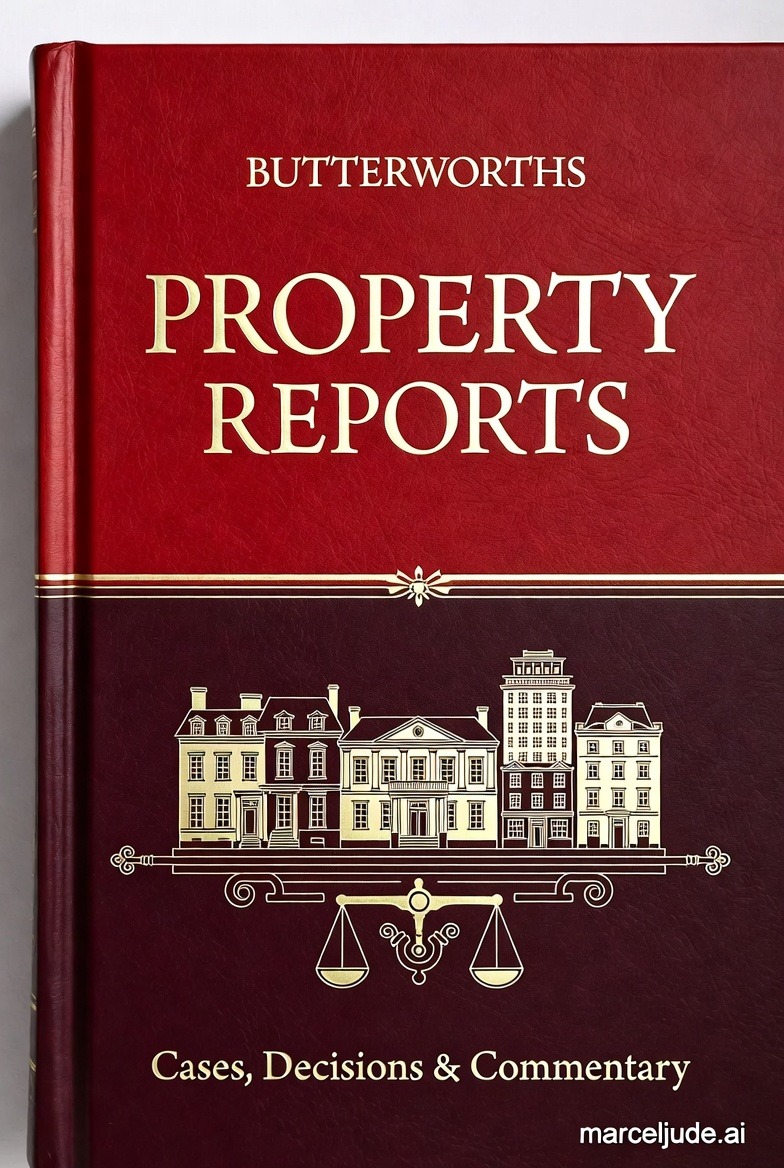
.
A REVIEW OF BUTTERWORTHS PROPERTY REPORTS
Introduction
Butterworths Property Reports, commonly abbreviated as “BPR”, is a specialist law-reporting series devoted principally to court decisions concerning real property, conveyancing and related equitable doctrines. It also reports appellate decisions arising from those property disputes.
The full bibliographical description of the series states that it contains reports of decisions relating to conveyancing and property matters, together with reports of decisions on appeal.
The series is particularly valuable because it applies a Torrens system of land registration. Many of the questions considered in BPR—registered title, indefeasibility, fraud, priorities, caveats, easements, mortgages and co-ownership—are therefore relevant to other Torrens jurisdictions, including Malaysia.
Publication Details
Title: Butterworths Property Reports
Abbreviation: BPR
Publisher: Butterworths, subsequently LexisNexis Butterworths Australia
Country: Australia
Principal jurisdiction: New South Wales
Subject: Real property and conveyancing
ISSN: 0729-4263
Format: Printed volumes, loose-leaf service and electronic access through Lexis+
Associated service: Conveyancing Service New South Wales
Coverage: Supreme Court of New South Wales property decisions and relevant appeals
The Supreme Court Library Queensland describes BPR as reporting decisions of the Supreme Court of New South Wales concerning conveyancing and property matters, together with appellate decisions. Its catalogue records the publication from Sydney under the Butterworths imprint from 1982 onwards. Supreme Court Library Queensland.
The series is integrated with the Conveyancing Service New South Wales, which includes current BPR reports and accompanying case notes.
Nature of the Publication
BPR is a law-reporting series, not a conventional property-law textbook.
A textbook attempts to explain the law systematically by arranging principles into chapters. A report series collects and edits judicial decisions. Its principal function is to preserve the court’s actual reasoning and make the judgment accessible through a recognised citation.
BPR is consequently most valuable when the researcher needs:
the complete judgment; an accurate account of the material facts; the statutory provisions considered; the court’s treatment of earlier cases; the exact legal principle applied; the remedy ordered; and a stable citation for use in legal proceedings.
It should be used together with legislation, practitioner commentaries and current case-treatment research.
Historical Development
The modern bibliographical record dates BPR from the early 1980s. The series developed as part of Butterworths’ New South Wales conveyancing service and became a specialist repository for decisions that might otherwise have been scattered through general Australian reports or left unreported.
The need for a specialist series arose from the technical character of property law. A judgment may concern a narrow point under the Real Property Act 1900 (NSW) or the Conveyancing Act 1919 (NSW) that is of great importance to conveyancers and property litigators but insufficiently general to justify publication in a mainstream report.
BPR has continued into the twenty-first century. The LexisNexis service contains volumes from volume 1 onwards and has reached at least volume 21. A 2025 New South Wales Court of Appeal decision, for example, was reported as (2025) 21 BPR 45.
The series is therefore both historical and current. It permits researchers to examine the development of New South Wales property law across several decades.
Authors and Editors
The BPR material has been associated with the Conveyancing Service New South Wales, including work by:
the Honourable P W Young AO KC; C J Rossiter; G A Moore; and other specialist contributors.
Justice Elisabeth Peden of the Supreme Court of New South Wales is identified by the Court as an editor of Butterworths Property Reports. Barrister and academic David Pittavino is also identified as a present editor of the series. Supreme Court of New South Wales.
The involvement of judges, senior practitioners and property-law academics strengthens the editorial quality of the series. Property reporting requires close attention to statutory language, title documents, plans, instruments and equitable doctrines.
Courts Covered
The series principally reports decisions from:
the Supreme Court of New South Wales; the Equity Division; other relevant divisions of the Supreme Court; the New South Wales Court of Appeal; and appellate courts determining appeals from New South Wales property cases.
The court from which the judgment originates determines its precedential authority.
A Court of Appeal judgment carries greater precedential weight than a single-judge Supreme Court decision. Publication in BPR does not itself make a case binding. The report is the medium through which the judicial authority is communicated.
Citation
A BPR citation ordinarily takes the following form:
(2025) 21 BPR 45
The elements are:
(2025) — the year of the decision or report; 21 — the BPR volume; BPR — Butterworths Property Reports; and 45 — the opening page.
The decision may also possess a medium-neutral citation. For example:
Hellenic Property Holdings Pty Ltd v Makaritis [2025] NSWCA 13; (2025) 21 BPR 45
The neutral citation identifies the New South Wales Court of Appeal judgment. The BPR citation identifies its publication in the specialist report.
Some older BPR volumes use long or cumulative page numbers. Those numbers should be reproduced exactly as they appear in the report. A lawyer should not shorten or reconstruct the citation from memory.
Where the judgment contains numbered paragraphs, a pinpoint reference should identify the relevant paragraph:
Hellenic Property Holdings Pty Ltd v Makaritis [2025] NSWCA 13 at [42]; (2025) 21 BPR 45
Structure of a Report
A professionally prepared BPR report will ordinarily contain:
the names of the parties; the deciding court; the judge or judges; the hearing and judgment dates; catchwords identifying the property-law issues; the material statutory provisions; an editorial headnote; the procedural history; the cases considered; the parties’ representation; the full or substantially complete judgment; and the final disposition.
The accompanying case notes within the conveyancing service provide a shorter analysis of significant decisions and developments.
The headnote is an editorial summary. It helps the researcher determine whether the case is relevant, but it is not part of the court’s reasons. The legal proposition must be verified in the judgment itself.
Principal Legislation
The reports frequently engage with New South Wales legislation such as the:
Real Property Act 1900; Conveyancing Act 1919; Strata Schemes Development Act 2015; Strata Schemes Management Act 2015; Residential Tenancies Act 2010; Retail Leases Act 1994; Environmental Planning and Assessment Act 1979; and legislation relating to duties, valuation, compulsory acquisition and land administration.
The continuing service is especially important because these enactments are amended periodically. A decision under an earlier version of a section may not govern the present provision.
The Torrens System
The Torrens system lies at the heart of New South Wales real-property law. Instead of relying primarily upon an historical chain of deeds, the system treats registration as central to the creation and protection of title.
The register is intended to provide certainty. A person dealing with a registered proprietor should generally be able to rely upon the register without investigating the entire history of earlier transactions.
The principal Torrens concepts considered in BPR include:
registered ownership; indefeasibility; statutory exceptions; fraud; personal equities; priorities; caveats; mortgages; easements; erroneous registration; compensation; and rectification of the register.
The reports reveal, however, that registration does not eliminate all disputes. It changes their legal form. The courts must still determine the effect of fraud, unregistered interests, equitable obligations and defective instruments.
Indefeasibility of Title
Indefeasibility means that a registered proprietor ordinarily receives the protection conferred by registration, subject to statutory exceptions and recognised personal claims.
Disputes may concern:
whether indefeasibility is immediate or deferred; the meaning of fraud; whether an agent’s knowledge is attributable to the registered proprietor; forged instruments; unauthorised transactions; trusts; in personam claims; statutory exceptions; and entitlement to compensation.
BPR is useful because the complete factual setting is often decisive. The legal effect of registration may depend upon who committed the wrongdoing, what the registered proprietor knew and whether the claim attacks the title itself or seeks to enforce a personal obligation.
Fraud
Fraud under Torrens legislation is a specialised legal concept. It is not necessarily equivalent to every form of dishonesty, negligence or equitable misconduct.
The courts may examine:
whether there was actual dishonesty; whether the registered proprietor participated in the fraud; whether an agent acted fraudulently; whether knowledge can be attributed to another person; whether the conduct occurred before or after registration; and whether wilful blindness is sufficient.
BPR reports permit practitioners to study the factual circumstances in which fraud has or has not defeated registered title.
This material has considerable comparative value to Malaysian lawyers because fraud is also a central issue under Malaysian registered-land legislation.
Caveats
A caveat is designed to protect a claimed unregistered interest by preventing dealings from being registered without notice to the caveator.
BPR decisions may address:
whether the caveator possesses a caveatable interest; the description of the interest; whether the caveat is too broad; lapsing procedures; extensions; withdrawal; compensation for an unjustified caveat; competing caveats; contractual interests; equitable liens; purchaser’s interests; constructive trusts; and disputes between family members.
A caveat is not itself the source of the interest. The caveator must identify an independently recognised proprietary or equitable interest.
This distinction is essential in both Australian and Malaysian land litigation.
Priorities
Priority disputes arise when more than one person claims an interest in the same land.
The court may need to determine priority between:
two equitable interests; a registered and an unregistered interest; successive purchasers; mortgagees; beneficiaries; lien holders; caveators; and persons claiming through fraud or mistake.
The result may depend upon:
the order in which interests were created; registration; notice; postponing conduct; possession of title documents; failure to lodge a caveat; representations; and statutory priority rules.
BPR is especially useful because priority cases are highly fact-sensitive. Small differences in conduct may alter the outcome.
Contracts for the Sale of Land
Property litigation frequently begins with a contract rather than the register.
BPR reports cases involving:
formation of contracts; certainty; exchange; deposits; completion; finance conditions; vacant possession; misdescription; requisitions; defects in title; time stipulations; notices to complete; rescission; termination; damages; specific performance; and equitable relief.
A land sale is not simply an ordinary exchange of goods. Equity may treat the purchaser as acquiring an equitable interest before legal completion, while the vendor retains legal title subject to contractual obligations.
The cases demonstrate the interaction between contract, equity and registered-title legislation.
Specific Performance
Specific performance is an important remedy in land transactions because each parcel of land is traditionally regarded as unique.
The applicant must nevertheless satisfy equitable requirements. The court may consider:
whether a binding and sufficiently certain contract exists; whether the applicant is ready, willing and able to perform; whether damages are inadequate; whether delay or acquiescence occurred; whether hardship would result; whether third-party rights have intervened; and whether the applicant acted equitably.
BPR gives practitioners access to the detailed circumstances in which specific performance has been ordered or refused.
Rescission and Termination
A party may seek to terminate or rescind a transaction because of:
breach; failure to complete; misrepresentation; mistake; undue influence; unconscionable conduct; repudiation; failure of a condition; or defective title.
The legal consequence depends upon the basis of the remedy. Contractual termination, equitable rescission and statutory relief are distinct doctrines.
A practitioner must identify:
the source of the right; whether an election was made; whether the right was lost by affirmation; whether restitution is possible; and what happens to the deposit and possession.
The reports are useful because they preserve both the doctrinal analysis and the practical orders made by the court.
Mortgages
BPR covers registered and equitable mortgages, including disputes concerning:
creation of security; priority; default; acceleration; possession; exercise of the power of sale; duties of mortgagees; redemption; discharge; unconscionable lending; guarantees; forged mortgages; equitable mortgages; and surplus sale proceeds.
The mortgagee’s power of sale is a recurring source of litigation. A mortgagee must exercise the power for a proper purpose and take reasonable steps to obtain an appropriate price, although the precise standard depends upon the governing law.
The relationship between mortgagee, mortgagor, guarantor, purchaser and later encumbrancers makes the full judgment particularly valuable.
Leases
Lease disputes may concern:
creation of the tenancy; registration; covenants; rent; rent review; repair; permitted use; assignment; subletting; options to renew; forfeiture; relief against forfeiture; repudiation; termination; possession; and compensation.
Commercial and retail leases often involve detailed contractual documentation. Residential tenancies are more heavily affected by protective legislation.
BPR helps the researcher distinguish between common-law principles, equitable relief and statutory rights.
Options to Purchase or Renew
Options are technically demanding because their exercise must generally comply strictly with the contractual requirements.
Cases may involve:
whether the option was validly created; the required method of exercise; timing; delivery of notice; conditions precedent; rent arrears; waiver; estoppel; uncertainty; and relief from defective exercise.
A seemingly minor mistake in a notice may determine whether a tenant obtains a further lease or whether a purchaser acquires valuable land.
Easements
Easements confer rights over another person’s land, such as:
rights of way; drainage; access; support; services; parking; water supply; and rights connected with utilities.
BPR cases may consider:
creation by express grant; implication; necessity; prescription; registration; interpretation; excessive use; abandonment; modification; and extinguishment.
Disputes often turn upon plans, historical use and the wording of the registered instrument. Full reports are therefore indispensable.
Restrictive Covenants
Restrictive covenants may limit the use or development of land.
Cases may address:
whether the covenant benefits identifiable land; whether the burden runs with the land; construction of the covenant; standing to enforce it; changed neighbourhood conditions; modification; discharge; inconsistency with planning approval; and remedies for breach.
Planning permission does not necessarily extinguish private property restrictions. A development may be permissible under public planning law but prohibited by an enforceable private covenant.
Boundaries and Encroachments
Boundary disputes can involve:
survey evidence; title plans; monuments; fences; historical occupation; adverse possession; encroaching buildings; mistaken improvements; and statutory adjustment.
The legal boundary may not correspond precisely with a fence or physical occupation.
BPR’s reports are useful because they record how courts evaluate competing surveys, historical documents and evidence of possession.
Adverse Possession
Adverse possession concerns the acquisition or defence of rights through possession maintained for the required period under the applicable legislation.
The court may consider whether possession was:
factual; exclusive; continuous; open; adverse to the paper owner; and accompanied by the necessary intention to possess.
The Torrens system can modify or restrict the operation of adverse possession. The statutory provisions must therefore be examined closely.
This is an area where comparative use in Malaysia requires particular caution because Malaysian, New South Wales, Sabah and Sarawak limitation and land-registration rules differ.
Co-ownership and Partition
Property may be held jointly or in shares. Disputes may arise concerning:
joint tenancy; tenancy in common; severance; sale; partition; occupation rent; improvements; mortgage payments; accounting; unequal contributions; and equitable ownership.
The registered title may not always resolve the beneficial interests between the co-owners. Equity may recognise resulting or constructive trusts based upon contributions, intentions or unconscionable retention of benefit.
Resulting and Constructive Trusts
BPR’s coverage is not confined to statutory land registration. It also includes significant equitable property cases.
A resulting trust may arise where one person contributes to the acquisition of property placed in another’s name, subject to the applicable presumptions and evidence.
A constructive trust may arise where it would be unconscionable for the legal owner to deny another person’s beneficial interest.
The 2025 decision in Hellenic Property Holdings Pty Ltd v Makaritis concerned a joint endeavour and constructive trust. It illustrates how property disputes may depend upon shared purposes, financial contributions, family arrangements and the consequences of the endeavour’s failure.
These cases are useful in disputes where the register identifies legal ownership but does not conclusively resolve the parties’ equitable relationship.
Proprietary Estoppel
Proprietary estoppel may arise where:
one person makes or encourages an assumption concerning rights in land; another reasonably relies upon that assumption; the relying party suffers detriment; and it would be unconscionable to depart from the assumption.
The remedy is not invariably transfer of the entire property. The court seeks relief proportionate to the unconscionability and the claimant’s expectation or detriment.
BPR assists practitioners in understanding how courts evaluate representations, reliance and family property arrangements.
Strata Property
Strata law is particularly important in New South Wales because of the large number of apartments, commercial strata developments and mixed-use schemes.
BPR may report disputes concerning:
common property; lot boundaries; owners’ corporations; by-laws; levies; repairs; defects; exclusive-use rights; access; alterations; nuisance; voting; redevelopment; and duties owed to lot owners.
Strata property combines individual ownership with collective management. Disputes often require close analysis of plans, by-laws and statutory duties.
This material has comparative value in Malaysia, where strata development is governed by Malaysian land and strata legislation, but the statutory differences must be respected.
Conveyancing Negligence
Although BPR is principally a property report, some decisions may involve the professional responsibilities of conveyancing solicitors and advisers.
Potential issues include:
failure to search the title; failure to lodge a caveat; failure to protect priority; incorrect advice about easements; failure to identify planning restrictions; defective settlement arrangements; failure to obtain discharge of a mortgage; identity fraud; misuse of trust money; and negligent drafting.
These cases demonstrate that conveyancing is not a purely clerical process. It requires accurate legal analysis and careful control of registration, settlement and money.
Revenue and Stamp Duties
Transactions involving land may attract duties or other revenue liabilities.
BPR case notes have included matters concerning whether an instrument constituted a dutiable transfer, the timing of assessment and the consequences of registration.
Revenue cases are highly statute-specific. They may be useful for understanding the legal characterisation of a transaction but ordinarily cannot be transferred directly to another jurisdiction’s tax legislation.
Editorial Strengths 1. Specialist focus
BPR concentrates upon real-property and conveyancing decisions. This makes it more efficient than searching general law reports without a clear property filter.
2. Supreme Court coverage
The series reports decisions from the principal superior court exercising New South Wales property jurisdiction and includes relevant appeals.
3. Full judgments
The full decision permits examination of title documents, statutory provisions, factual findings and equitable reasoning.
4. Integration with case notes
The accompanying case-note service provides concise guidance on recent developments while the report preserves the full authority.
5. Torrens-system depth
The series provides extensive material on registered title, fraud, caveats, priorities and other Torrens concepts.
6. Combination of law and equity
BPR recognises that land disputes cannot be resolved solely through registration legislation. Trusts, estoppel, specific performance and unconscionability remain important.
7. Stable citations
A recognised BPR citation enables courts, lawyers and academics to refer to the same published text.
8. Continuing publication
The series remains current, with cases reported into volume 21 and beyond.
9. Editorial expertise
Its association with experienced judges, practitioners and academics strengthens the quality of selection and presentation.
Limitations 1. It is principally a New South Wales report
The statutory conclusions are based primarily upon New South Wales legislation. They do not automatically apply in another Australian state or foreign jurisdiction.
2. It is not a comprehensive textbook
The series reports cases but does not provide a complete narrative explanation of property law.
3. It is selective
Not every relevant property judgment is published in BPR. Researchers must also consult authorised reports and official judgment databases.
4. Headnotes are not judgments
The editorial headnote cannot replace the court’s reasons.
5. Statutory amendments may displace older cases
An older decision may interpret a provision that has since been amended or repealed.
6. Comparative use requires care
The fact that both jurisdictions employ Torrens registration does not mean that their statutory provisions are identical.
7. Loose-leaf administration
The physical conveyancing service must be updated and filed correctly. Missing or misfiled pages can undermine research.
8. Access may require a subscription
Full electronic access is generally through Lexis+. Public access may therefore depend upon a court, university or professional library subscription.
Value to New South Wales Practitioners
For New South Wales property lawyers, BPR is a highly valuable specialist research source.
It assists in:
preparing conveyancing advice; drafting pleadings; assessing caveatable interests; advising mortgagees and mortgagors; resolving priority disputes; seeking specific performance; enforcing easements and covenants; determining beneficial ownership; handling strata disputes; and preparing appellate submissions.
Its greatest practical value arises when a dispute turns upon a precise property-law issue that may not have received extensive treatment in general reports.
Value to Conveyancers
Conveyancers can use BPR and its associated case notes to understand the litigation risks arising from:
title searches; settlement; registration; easements; caveats; mortgage discharge; identity verification; contractual conditions; and communications with clients.
The reports help translate abstract legal duties into practical warnings.
Value to Judges
For judges, BPR offers a concentrated collection of property authorities supported by specialist editorial materials.
It is particularly useful where the court must determine the relationship between:
registered and equitable interests; statute and equity; title and personal obligations; contractual rights and proprietary remedies; and private restrictions and public planning approval. Value to Law Students
For students, BPR demonstrates that property law is not merely a collection of technical rules.
The judgments show how property rights arise through:
registration; contracts; possession; trusts; estoppel; mortgages; leases; and statutory processes.
The series is especially useful for research assignments involving Torrens title, indefeasibility, caveats, priorities and equitable interests.
Value to Academics
For professors and researchers, BPR provides a chronological archive of New South Wales property jurisprudence.
It supports research into:
the Torrens system; fraud; registered title; equitable interests; caveat practice; priority disputes; constructive trusts; proprietary estoppel; strata property; and conveyancing reform.
It also allows comparative study of how statutory registration interacts with traditional equitable doctrine.
Relevance to Malaysian Property Law
BPR has genuine comparative value to Malaysian property lawyers because Malaysia and New South Wales both employ systems of title registration influenced by Torrens principles.
However, Malaysia does not have one completely uniform land statute.
In Peninsular Malaysia, the principal statute is the National Land Code. The current revised citation is the National Land Code [Act 828]. It came into force on 1 January 1966 throughout the states of Peninsular Malaysia. Sabah and Sarawak retain their own land laws. Department of Director General of Lands and Mines.
In Sabah, land is principally governed by the Land Ordinance (Cap. 68).
In Sarawak, the principal legislation is the Land Code (Cap. 81).
A New South Wales decision may therefore be persuasive, but its applicability must be tested against the relevant Malaysian, Sabah or Sarawak provision.
Indefeasibility in Malaysia
BPR decisions concerning indefeasibility, fraud and registered interests may assist Malaysian lawyers in understanding the policy questions surrounding title registration.
Nevertheless, the governing Malaysian question must be determined under:
section 340 of the National Land Code in Peninsular Malaysia; the Sabah Land Ordinance in Sabah; or the Sarawak Land Code in Sarawak.
The wording and judicial history of these provisions are not identical to the Real Property Act 1900 (NSW).
A Malaysian advocate must therefore begin with binding Malaysian decisions before relying upon Australian Torrens authorities.
Caveats in Malaysia
BPR’s treatment of caveatable interests can assist Malaysian practitioners because similar practical questions arise:
Does the applicant possess an interest in land? Is the interest proprietary or merely personal? Does a purchaser under a contract have a caveatable interest? Can a beneficiary protect a trust interest? Is the caveat drafted too broadly? Should the caveat be removed? Is compensation payable for an unjustified caveat?
However, the procedures, statutory tests and available remedies must be determined under the applicable Malaysian land legislation.
The underlying conceptual distinction remains useful: a caveat protects an existing interest; it does not create one.
Value to Sabah Lawyers
BPR can be particularly useful to Sabah lawyers handling disputes involving:
registered titles; dealings under the Land Ordinance; caveats; charges; native titles; competing claims; fraud; equitable interests; sale agreements; leases; access rights; co-ownership; and trusts affecting land.
Its value is greatest at the level of general Torrens reasoning and equitable doctrine.
Its value is weakest where the New South Wales decision turns upon statutory language with no equivalent under the Sabah Land Ordinance.
Native title and customary land questions require special caution. Australian property decisions cannot displace Sabah’s particular statutory and customary framework.
Value to Sarawak Lawyers
Sarawak property law presents its own distinctive issues involving:
registered title; categories of land; dealings and restrictions; native customary rights; caveats; charges; compulsory acquisition; leases; development; and administrative land decisions.
BPR may provide comparative reasoning on registration, priority, fraud and equity. It should not be treated as authority on the interpretation of the Sarawak Land Code unless the statutory comparison is established.
Native customary rights are particularly dependent upon Sarawak legislation and binding Malaysian jurisprudence. A conventional New South Wales Torrens case may offer little assistance unless it addresses a genuinely analogous principle.
Proper Use in Malaysian Courts
A Malaysian lawyer relying upon a BPR case should:
identify the applicable Malaysian land statute; determine whether the matter arises in Peninsular Malaysia, Sabah or Sarawak; cite binding Malaysian authority first; identify the New South Wales provision considered in the BPR decision; compare the statutory wording; determine whether the case concerns a general Torrens or equitable principle; verify that the decision remains good law; explain its persuasive relevance; and avoid presenting it as binding Malaysian authority.
The strongest comparative submission explains both the similarities and the differences between the two systems.
Research Method
A responsible BPR research process should include the following:
define the disputed property interest; obtain the current title and registered instruments; identify the governing legislation; determine whether the claim is statutory, contractual or equitable; locate binding domestic authority; search BPR for analogous decisions; read the headnote; read the full judgment; examine the plans and instruments discussed by the court; check subsequent judicial treatment; verify legislative amendments; and use an accurate citation and pinpoint reference.
Property cases should not be researched from summaries alone. The precise wording of an instrument may determine the result.
Overall Assessment
Butterworths Property Reports is a valuable specialist collection of New South Wales property and conveyancing decisions. Its strongest features are its focus upon Supreme Court and appellate judgments, depth of Torrens-system coverage and integration with specialist conveyancing case notes.
It is particularly useful for disputes involving registered title, fraud, caveats, priorities, mortgages, sale contracts, easements, trusts and proprietary estoppel.
Its principal limitation is jurisdictional. It is a New South Wales report, and many decisions depend upon New South Wales legislation. Its comparative value must therefore be separated from its domestic precedential authority.
For Malaysian lawyers, BPR is useful because of the shared Torrens heritage. It can illuminate general questions concerning registration, indefeasibility, priorities and equitable interests. It cannot replace the National Land Code, Sabah Land Ordinance, Sarawak Land Code or binding Malaysian decisions.
Value to Malaysian Lawyers, Law Students, Professors and the General Public
For Malaysian lawyers, BPR offers a substantial source of persuasive Australian property reasoning.
For lawyers in Sabah and Sarawak, it may assist with general principles while reinforcing the need to identify the state-specific land statute.
For law students, it demonstrates the interaction of registered title, contract and equity.
For professors, it supplies material for comparative research into Torrens registration and the survival of equitable doctrines within a statutory title system.
For conveyancers, it illustrates the consequences of errors involving caveats, priorities, instruments and settlement.
For the general public, the reports demonstrate that the name appearing on a title is extremely important but does not always answer every dispute. Contracts, fraud, trusts, estoppel and statutory exceptions may also affect the parties’ rights.
Conclusion
Butterworths Property Reports is a specialist Australian law-reporting series of considerable practical and academic value. It preserves decisions of the Supreme Court of New South Wales and relevant appellate courts concerning conveyancing and property law.
Its enduring importance lies in its treatment of the relationship between registration and equity. The Torrens system seeks certainty through the register, while courts must still resolve disputes arising from fraud, contracts, trusts, mistakes, family arrangements and unregistered interests.
For New South Wales practitioners, BPR is a core specialist resource. For Malaysian practitioners, it is a useful comparative source that must be applied through the language of the relevant Malaysian land statute.
The series ultimately demonstrates that property law is not concerned solely with physical land. It is concerned with the legal ordering of ownership, security, occupation, expectation and fairness—and with the methods by which those competing interests are reconciled.
- MALAYSIA'S 1ST AI LAWYER - CLICK HERE
- ISMAIL – INTEGRATED SINGAPORE/MALAYSIA AI & LAW (Library)
- OPENING OF SINGAPORE MALAYSIA AI CENTRE AND LAW LIBRARY
- LIFT - LAW INSTRUMENTS FORMS & TEMPLATES
- LAWS OF MALAYSIA FOR SINGAPOREAN DUMMIES
- HANNAH YEOH'S ARTIFICIAL INTELLIGENCE LAW ENCYCLOPEDIA
- LEAD CR - Law Ecosystem Archive Databases on CD-ROM
- BREAKING NEWS FROM MJN
- CLICK HERE CO. PROFILE
- EXCITING NEW SERIES - THE ADVENTURES OF BOBBY TAN -ADVOCATE & SOLICITOR IN THE HIGH COURT OF NORTH BORNEO by marceljude.ai
- MEDICO LEGAL - BY PRISKILA AKWILA & GLORIOUS PETAL SDN BHD - powered by marceljude.ai
- MISCELLANOUS
- ANNOTATED STATUTES OF SABAH - A NEW SERIES
- e-library - marceljude.ai
- DRAFT - DOCUMENT RESEARCH & AUTOMATED FILING TECHNOLOGY
- CLARA – Case Law Analysis & Retrieval AI
- FOR RESEARCH REQUEST CLICK HERE
- CLICK HERE TO ASK ANYTHING
- RAMBO'S LAW - THE LAW OF THE LAW JUNGLE - EXCITING NEW SERIES - CASE ANALYSIS BY JOHN RAMBO @ +60138646786
- PRISKILA AKWILA ADVOCATES - High Court of Sabah & Sarawak @ Kota Kinabalu
- COLA - COMMONWEALTH ONLINE LAWCASES AI -marceljude.ai
- THE LAW LIBRARY THAT COMES TO YOU ANYWHERE AND ANYTIME
- marceljude.ai training academy
