
BULLEN & LEAKE & JACOB'S PRECEDENTS OF PLEADINGS - VOL 1 -Review by marceljude.ai
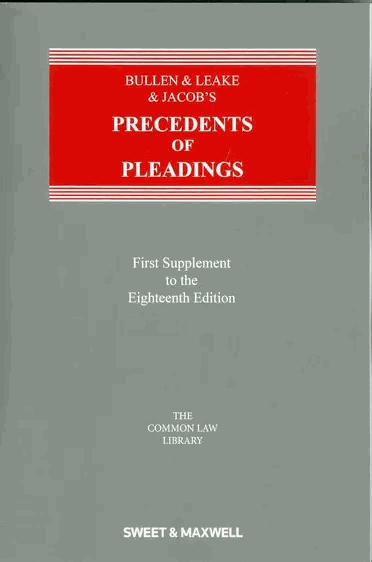


Description
BULLEN & LEAKE & JACOB'S
PRECEDENTS OF PLEADINGS
Volume 1
General Editors
LORD BRENNAN Q.C. A Barrister of Matrix Chambers, Gray's Inn Chairman of the Bar, 1999
WILLIAM BLAIR Q.C. A Barrister of 3 Verulam Buildings Gray's Inn
Advisory Editors
BRAIN LANGSTAFF Q.C. A Barrister of Cloisters Chambers, Temple Judge of the Employment Appeal Tribunal Chairman of the Personal Injuries Bar Association (1991-2001) Chairman of the Clinical Negligence and Personal Injury Committee of the Civil Justice Council
THE RT. HON. LORD JUSTICE ROBIN JACOB Judge of the Chancery Division of the High Court Consulting Editor to Kerly 's Law of Trade Marks and Trade Names Advisory Editor to Civil Procedure 2000
Book Review by marceljude.ai of Bullen & Leake & Jacob’s Precedents of Pleadings, Volume 1
I read the book as a law professor would read a procedural classic: not merely as a collection of drafting precedents, but as a jurisprudential statement about how legal disputes should be framed before trial. Its central concern is disciplined pleading: how facts, causes of action, defences, remedies, statutory requirements, and procedural consequences must be translated into a statement of case capable of doing real work in litigation. Lord Woolf’s foreword treats the book as an indispensable litigation guide in the post-Civil Procedure Rules landscape, emphasizing succinctness, economy, and accuracy in written litigation. The preface likewise warns that the precedents are not to be copied mechanically, but are guides to be adapted to the facts of each case.
This review covers the book I read: Volume 1, Sections 1–40. The book’s printed contents also continue into Volume 2, and I list that continuation below, but the detailed chapter-by-chapter review here is of Volume 1.
Overall Review of the Entire Book Read
The book is best understood as a bridge between old pleading culture and modern statements of case. It preserves the craft of common-law pleading while accepting the Civil Procedure Rules’ demand for openness, proportionality, truth verification, and case management. The Introduction makes clear that the CPR replaced the language of “pleadings” with “statements of case,” introduced the statement of truth, and placed pleading inside the overriding objective of dealing with cases justly and proportionately.
Its great merit is that it does not treat drafting as clerical form-filling. Each chapter explains the cause of action or defence before offering forms. The book repeatedly teaches that a lawyer must know the law before drafting the pleading. A form is dangerous unless the pleader knows which facts are material, which facts are evidence, which matters must be particularised, and which allegations carry special professional or procedural risk.
I would describe the work as a practical treatise disguised as a precedent book. Its learning lies in the commentary: the causes of action are broken into elements; statutory provisions are linked to pleading consequences; defences are separated from mere denials; and remedies are tied to facts. The strongest chapters are those where procedural technique and substantive law are inseparable: the Introduction, Assault and False Imprisonment, Consumer Credit, Sale of Goods, Undue Influence, Defamation, Employment Tribunal Proceedings, and Nuisance.
Its weakness is the weakness of any procedural precedent work tied closely to statutes and rules: a practitioner must update the law before relying on it. That is especially important in employment, equality, defamation, consumer credit, financial services, information technology, and education law. But as a model of legal method, it remains excellent. It teaches the habits of a careful pleader: identify the legal theory, isolate the facts, plead the necessary particulars, anticipate defences, and ask only for relief that the pleaded facts can sustain.
The book’s legal philosophy is that pleading is not a technical trap but a discipline of fairness. A statement of case tells the court and opponent what the dispute is really about. That is why the book repeatedly values clarity over flourish, concision over verbosity, and factual structure over rhetorical assertion.
Contents of the Book
Front Matter
List of Contributors — p. v
Foreword — p. xiii
Preface — p. xvii
Table of Cases — p. xxiii
Table of Cases before the European Court of Justice — p. xcv
Table of Cases before the European Court of Justice and European Court of First Instance — p. xcviii
Table of Cases before the European Court of Human Rights and European Commission of Human Rights — p. c
Table of Statutes — p. cii
Tables of Statutory Instruments — p. cxxv
Table of Civil Procedure Rules — p. cxxxvi
Table of Practice Directions — p. cxli
Table of Rules of Supreme Court — p. cxliii
Table of the European Convention on Human Rights — p. cxliv
Table of European Legislation — p. cxlv
Table of EC Procedure Rules — p. cxlvii
Table of Foreign Legislation — p. cxlviii
Volume 1 Contents Reviewed Introduction — pp. 1–31 Assault, False Imprisonment and Malicious Prosecution — pp. 33–67 Aviation — pp. 69–79 Carriage by Air — pp. 79–97 Bankers — pp. 97–119 Bills of Exchange — pp. 119–135 Bills of Sale — pp. 135–141 Bonds — pp. 141–149 Cheques — pp. 149–155 Financial Services — pp. 155–167 Guarantees — pp. 167–179 Money Lent — pp. 179–185 Mortgages and Charges — pp. 185–201 Promissory Notes — pp. 201–207 Sale of Shares — pp. 207–213 Stock Exchange — pp. 213–221 Undue Influence — pp. 221–237 Business Law: Introduction — pp. 237–243 Credit, Finance and Leasing — pp. 243–329 Commission Agents — pp. 329–345 Factoring — pp. 345–351 Lien — pp. 351–355 Set-off — pp. 355–363 Sale of Goods — pp. 363–445 Title to Goods — Torts against Goods — pp. 445–469 Surety — pp. 469–481 Computers and Information Technology — pp. 481–501 Libel and Slander — pp. 501–541 Malicious Falsehood — pp. 541–549 Education — pp. 551–573 Employment Tribunal — pp. 573–607 Proceedings in the High Court and County Court — pp. 607–621 Industrial Action — pp. 621–633 Trade Unions — pp. 633–643 Discrimination in Employment — pp. 643–675 Entertainment Law — pp. 675–705 Environmental Claims: Introduction — pp. 705–709 Nuisance — pp. 709–741 Rylands v Fletcher — pp. 741–747 Trespass — pp. 747–759
The printed table of contents for Volume 1 identifies these sections and their paragraph starting points.
Printed Contents Continuing into Volume 2 Introduction Injunction Specific Performance Rectification Rescission Accounts Receivers Civil Claims in Fraud: An Introduction Fraudulent Misrepresentation or Deceit Conspiracy Inducing Breach of Contract and Unlawful Interference Bribery Constructive Trust and Tracing Harassment Human Rights Act 1998 References to the European Court of Justice Immigration Insurance: Introduction Motor Insurance Miscellaneous Non-Marine Insurance Marine Insurance Life Insurance Intellectual Property: Introduction Patents Confidential Information Copyright Designs Registered Trade Marks Passing Off Applications for Judicial Review Personal Injury Clinical Negligence Product Liability Multi-Party Actions Professional Negligence Property: Introduction Adverse Possession Business Tenancies Common, Rights of Construction and Rent Review Co-ownership Distress and Replevin Easements and Drainage Fences, Boundaries and Access to Neighbouring Land Landlord and Tenant — Covenants against Assignment Landlord and Tenant — Other Covenants Landlord and Tenant — Flats Landlord and Tenant — Possession Proceedings Landlord and Tenant — Protection from Eviction Landlord and Tenant — Rent and Service Charges Landlord and Tenant — Repairs and Improvements Landlord and Tenant — Third Party Rights and Obligations Mesne Profits and Use and Occupation Mortgages and Charges Restrictive Covenants Sale of Land Trespass to Land Restitution Sports Law
The book’s printed contents show this continuation into the later volume.
Chapter-by-Chapter Review 1. Introduction — pp. 1–31
The Introduction is the intellectual foundation of the book. It explains that every legal system needs a method of defining the dispute before the court, and in the common-law tradition that role was historically performed by pleadings. The chapter then places that tradition inside the Civil Procedure Rules, where the language and culture shift from “pleadings” to “statements of case.”
The chapter’s first major subsection concerns the overriding objective. Here the book treats drafting not as private advocacy alone but as part of the court’s public function of managing disputes justly, proportionately, and efficiently. This is one of the most important conceptual moves in the book. A statement of case is not merely the advocate’s weapon; it is a case-management tool.
The historical perspective traces pleading from Roman procedural formulae through early English formalism, the forms of action, nineteenth-century reform, and the Judicature Acts. The value of this history is not decorative. It teaches why pleading became both powerful and dangerous: a procedural system can clarify disputes, but it can also degenerate into technical gamesmanship.
The comparative perspective discusses the European Court of Justice, Australia, New Zealand, and United States federal procedure. The comparison with United States notice pleading is especially useful because it highlights what English pleading after the CPR is not. English statements of case remain more fact-structured and issue-defining than pure notice pleading.
The functions of pleadings subsection identifies the classic functions: giving fair notice, defining issues, setting the limits of the action, assisting settlement, aiding case management, and creating a record for doctrines such as res judicata and issue estoppel. This is excellent teaching material because it reminds lawyers that every paragraph in a pleading should serve a procedural function.
The Woolf reforms subsection is central. The book explains the old abuses: overlong pleadings, evasive denials, excessive reliance on causes of action rather than facts, and tactical ambiguity. The CPR reforms are presented as a cultural correction, not merely a technical revision.
The statements of case under the CPR subsection explains the importance of statements of case after McPhilemy v Times Newspapers Ltd. Pleadings are no longer expected to contain every evidential detail, because witness statements and documents also define the trial landscape. Yet they remain essential because they mark the parameters of the dispute and identify the issues.
The drafting subsections are among the most valuable in the whole book. They address brevity, plain English, directness, layout, facts, law, evidence, consistency, and fraud. As a law professor, I would stress the fraud discussion: the book rightly treats fraud pleading as a serious professional act requiring proper particularisation, not suspicion dressed as allegation.
The chapter concludes by explaining individual statements of case: claim form, particulars of claim, defence, reply, Part 20 claims, requests for further information, amendment, and specialist proceedings. The chapter is not merely introductory. It teaches the reader how to think like a pleader.
Law professor’s assessment: This is the best possible beginning for a precedent book. It warns the reader that forms are not substitutes for judgment. The chapter’s enduring lesson is that pleading is a disciplined statement of legally material fact.
2. Assault, False Imprisonment and Malicious Prosecution — pp. 33–67
This chapter moves from procedural theory to sharply practical tort pleading. Its subject matter is coercive power: bodily contact, restraint of liberty, police arrest, prosecution, abuse of process, and misfeasance in public office.
The assault and battery subsection distinguishes assault as the threat of hostile contact from battery as physical touching. The discussion is careful about intention, hostility, lawful arrest, reasonable force, and nominal damages. It is especially strong in police cases because it ties tort analysis to the legality of arrest and the reasonableness of force.
The defences subsection deals with self-defence, ex turpi causa, consent, and contributory fault. The book’s treatment is practical because these defences do not merely answer liability; they shape how the defendant must plead the facts of confrontation, necessity, proportionality, and claimant conduct.
The false imprisonment subsection explains total restraint of liberty, submission to authority, arrest by police, arrest at the instigation of third parties, detention by court process, and the burden on the defendant to justify imprisonment. This is one of the chapter’s strongest doctrinal parts because false imprisonment is deceptively simple: liability often turns on whether the defendant can justify every stage of restraint.
The Police and Criminal Evidence Act subsections address arrest powers, reasonable suspicion, arrestable and non-arrestable offences, and the duty to inform the arrested person of the fact and grounds of arrest. These subsections convert statutory powers into pleading requirements.
The malicious prosecution subsection identifies the essential elements: prosecution by the defendant, termination in the claimant’s favour, lack of reasonable and probable cause, malice, and damage. The treatment is particularly useful because malicious prosecution is difficult to plead properly; the claimant must plead more than acquittal.
The abuse of civil process and misfeasance in public office subsections widen the chapter from police arrest to malicious misuse of legal machinery and public power.
The pleadings subsection is practical and precise. It explains how personal injury particulars, medical reports, aggravated damages, exemplary damages, prior convictions, and interest should be addressed. The chapter’s list of forms includes 2-A1 through 2-A28.
Law professor’s assessment: This chapter is an excellent example of pleading as constitutional discipline. It teaches that claims against police and public authorities must be pleaded with factual precision, because liberty claims cannot rest on outrage alone.
3. Aviation — pp. 69–79
This chapter is short but conceptually rich. It deals with aircraft as a source of nuisance, trespass-like interference, surface damage, collision, wrongful landing, airport charges, and psychiatric injury.
The overflight subsection explains that a landowner’s rights in airspace are limited to the airspace necessary for ordinary use and enjoyment of land. The legal point is important because it prevents a simplistic “everything above my land is mine” argument.
The surface damage subsection addresses statutory liability for damage caused by aircraft in flight, taking off, or landing. This is where the chapter shows its practical purpose: aviation pleading often requires the lawyer to know whether the cause of action is statutory, common law, or both.
The collision subsections cover surface collisions and mid-air collisions, separating aircraft-owner claims from third-party injury claims.
The airport charges and wrongful interference material shows that aviation litigation is not only about accidents. It also includes commercial disputes between aircraft owners and airport operators.
The psychiatric damage material is valuable because aviation accidents often produce secondary victim claims. The forms force the pleader to confront proximity, foreseeability, and recognised psychiatric harm.
Law professor’s assessment: The chapter is narrow but disciplined. Its strength is that it refuses to treat aviation as exotic. It translates aircraft disputes into familiar pleading categories: nuisance, negligence, statutory liability, property damage, personal injury, and commercial interference.
4. Carriage by Air — pp. 79–97
This chapter is more international and treaty-driven than Section 3. It concerns contractual and statutory claims arising out of passenger, baggage, and cargo carriage by air.
The international carriage subsections explain the Warsaw and Montreal regimes, including carrier liability, financial limits, defences, and time limits. The lawyer is reminded that aviation carriage is not ordinary negligence litigation. Treaty regimes may govern liability, limitation, and remedy.
The passenger claims subsections include personal injuries caused by in-flight accident, claims by minors, and death claims. These forms require careful pleading of the “accident,” the carrier relationship, and applicable convention.
The baggage and cargo subsections distinguish loss, damage, and delay. That distinction matters because notice requirements, financial limits, and defences differ.
The successive carrier discussion adds another layer: identifying the proper defendant may be as important as identifying the loss.
The tour-operator subsection shows the chapter’s practical awareness that modern air travel is often packaged through intermediaries.
Law professor’s assessment: This chapter is useful because it disciplines the pleader to begin with the governing regime, not with the injury. In carriage by air, the first pleading question is often jurisdictional and conventional: what legal regime governs the claim?
5. Bankers — pp. 97–119
The chapter on bankers is one of the strongest commercial sections. It begins from the banker-customer relationship and develops claims involving accounts, mandates, forged signatures, wrongful dishonour, mistaken payments, conversion, restitution, and constructive trusteeship.
The accounts in credit and overdrawn accounts subsections show the bilateral nature of banking litigation: sometimes the bank sues for debt; sometimes the customer sues for repayment.
The set-off subsection is practical because banks often rely on contractual or equitable set-off as a defence.
The breach of mandate subsection is doctrinally important. A bank paying without authority may be liable even where the customer ultimately suffers complex or indirect loss.
The notice of fraud and breach of duty subsection moves into the modern terrain of bank responsibility when suspicious transactions arise.
The forged signature and wrongful debit subsections are highly practical. They require precise pleading of authority, mandate, debit, and loss.
The wrongful dishonour subsection captures the reputational and commercial harm that may arise when a bank refuses payment without justification.
The conversion, restitution, mistaken payment, and constructive trust material shows the chapter’s breadth. It does not reduce banking law to contract; it recognises tort, restitution, and equity.
Law professor’s assessment: The chapter is excellent for teaching how banking claims depend on the precise legal character of money movements. A debit, dishonour, payment, receipt, or mandate breach must be pleaded according to its legal effect.
6. Bills of Exchange — pp. 119–135
This chapter is technical but necessary. It treats bills of exchange as formal instruments whose enforceability depends on parties, delivery, consideration, presentment, notice, dishonour, and holder status.
The definition and parties subsections introduce drawer, drawee, acceptor, payee, holder, and holder in due course.
The delivery and consideration material reminds pleaders that negotiable instruments are formal but not magical. Defences may still arise from delivery, value, fraud, or alteration.
The holder in due course subsection is central. A claimant’s status may defeat ordinary defences, so the pleading must identify why the claimant is protected.
The presentment and notice of dishonour subsections show why old commercial law remains procedural. Failure to plead presentment or notice may undermine the action.
The defences include forged signature, material alteration, total failure of consideration, misrepresentation, time given, conditional delivery, discharge, and renunciation.
Law professor’s assessment: The chapter is a model of old commercial pleading. It teaches that formal instruments require formal pleading, but the pleader must still identify the facts that create liability.
7. Bills of Sale — pp. 135–141
This chapter is concise and statutory. Bills of sale are historically important security instruments, and the chapter focuses on validity, statutory form, registration, redemption, declaration that the bill is void, and seizure of goods.
The statutory form and registration subsections are the chapter’s core. The lesson is simple: with bills of sale, procedural validity is substantive validity.
The redemption and seizure forms show the competing positions of debtor and secured creditor.
Law professor’s assessment: Though brief, the chapter is valuable because it reminds the practitioner that some instruments fail not because of broad equitable unfairness but because statutory formalities were not satisfied.
8. Bonds — pp. 141–149
This chapter deals with common money bonds, special condition bonds, performance bonds, payment, discharge, alteration, penalties, and injunctions restraining payment.
The common money bond subsection is historically rooted, while the performance bond material is commercially modern.
The restraining payment form is especially important because performance bonds often function as near-autonomous payment instruments. A claimant seeking to restrain payment must plead facts justifying intervention.
The defence subsections address performance, payment, penalty, tender, discharge, and material alteration.
Law professor’s assessment: The chapter’s strength lies in showing that old forms of obligation still appear in modern commercial litigation. A bond is both a document and a litigation strategy.
9. Cheques — pp. 149–155
This chapter treats cheques as negotiable instruments but in a more familiar commercial setting than bills of exchange.
The claims subsections cover payee against drawer and antecedent debt.
The defences include forgery, conditional delivery, partial failure of consideration, misrepresentation, and discharge by payment.
The chapter also links cheques to set-off and banking disputes.
Law professor’s assessment: The chapter is short but useful. It teaches that cheque litigation may look simple, but the defendant’s answer often depends on underlying consideration, delivery, authority, and payment.
10. Financial Services — pp. 155–167
This chapter is statute-heavy and demands careful updating before modern use. It addresses regulated activity, authorised persons, exempt persons, the general prohibition, unlawful communications, assignment of proceedings, breach of statutory duty, enforcement of agreements, parties, and defences.
The regulated activity and investment subsections identify the threshold issue: does the statutory regime apply at all?
The authorised and exempt persons subsections determine whether the defendant was legally permitted to conduct the activity.
The general prohibition and unlawful communications material shows how statutory illegality can create civil consequences.
The breach of statutory duty and enforcement subsections are especially practical. They show how financial regulation enters private litigation through enforceability and remedies.
The forms include 10-C1 through 10-C4, covering unauthorised persons, breach of statutory duty, defences, and enforcement replies.
Law professor’s assessment: This chapter is valuable as a pleading map of financial regulation. Its modern use requires statutory checking, but its method is sound: identify the regulated act, the status of the actor, the statutory consequence, and the remedy.
11. Guarantees — pp. 167–179
The guarantees chapter is doctrinally careful. It addresses the nature of a guarantee, contract formation, formalities, time of liability, parties, counterclaims, set-off, subrogation, limitation, revocation, misrepresentation, non-disclosure, discharge, and pleading.
The nature and formalities subsections distinguish guarantee from indemnity and require attention to writing and consideration.
The time of liability and parties subsections are practical. A guarantee claim may fail if the wrong party is sued or the principal liability has not matured.
The misrepresentation, non-disclosure, and special features subsections show equity’s influence on suretyship.
The discharge subsections deal with giving time, releasing the principal debtor, and other conduct affecting the surety.
Law professor’s assessment: This is a strong creditor-security chapter. It teaches that guarantees should not be pleaded as generic promises to pay. The pleader must plead principal liability, guarantee obligation, default, and the absence of facts discharging the surety.
12. Money Lent — pp. 179–185
This is a short but foundational debt chapter. It addresses claims for loans, contractual interest, denial of loan, payment, tender, gift, novation, repayment, and premature action.
The chapter’s strength lies in its simplicity. It shows that even a basic loan claim requires careful pleading of advance, agreement or implication, repayment obligation, due date, interest, and default.
The gift defence is practically important. The claimant may say “loan”; the defendant may say “gift.” The pleaded facts must explain the parties’ intention.
Law professor’s assessment: This chapter is modest but pedagogically useful. It is a reminder that simple causes of action still require disciplined factual pleading.
13. Mortgages and Charges — pp. 185–201
This chapter deals with mortgage possession, redemption, foreclosure, regulated agreements, adjournment, costs, counterclaims, non-execution, non est factum, debt denial, undue influence, overriding interests, and statutory relief.
The possession procedure material is practical because mortgage actions are procedurally distinctive.
The foreclosure and redemption subsections retain equitable vocabulary while operating inside modern procedure.
The regulated loan material links mortgage litigation to consumer credit controls.
The defence subsections are especially important: non-execution, non est factum, undue influence, and occupier overriding interests can radically alter the case.
Law professor’s assessment: This chapter is strong because it treats mortgage pleading as both procedural and equitable. It does not assume that possession follows automatically from arrears; it teaches the pleader to identify the security, default, right to possession, and available equitable or statutory answer.
14. Promissory Notes — pp. 201–207
This chapter follows naturally from bills and cheques. It deals with claims on promissory notes and defences such as denial, lack of consideration, time given, accommodation party, and debt not yet due.
The claim subsections identify maker, payee, indorsee, demand, maturity, and interest.
The defence subsections show that promissory-note liability may still be answered by consideration, discharge, timing, or underlying debt issues.
Law professor’s assessment: The chapter is concise but technically useful. It shows that negotiability does not remove the need to plead instrument, status, maturity, and default.
15. Sale of Shares — pp. 207–213
This chapter covers claims involving share-sale contracts, specific performance, orders, and non-acceptance.
The specific performance material is important because shares may be unique or not readily substituted, depending on the facts.
The chapter also links share sale to stock transfer mechanics and payment obligations.
Law professor’s assessment: This is a compact commercial-equity chapter. It illustrates how a sale transaction may generate both debt remedies and equitable relief.
16. Stock Exchange — pp. 213–221
This chapter deals with stockbrokers, commission, differences claims, wrongful closing of accounts, rescission, statutory damages, and related securities dealings.
The commission and money paid material is straightforward.
The differences claims subsections are more specialised and require attention to the broker-client relationship.
The wrongful closing of account material is useful because securities litigation often arises from disputed account management rather than a single sale.
Law professor’s assessment: The chapter is narrow but sophisticated. It shows that financial-market claims must plead the relationship, transaction, regulatory setting, and loss with precision.
17. Undue Influence — pp. 221–237
This is one of the strongest chapters in Volume 1. It deals with actual undue influence, presumed undue influence, manifest disadvantage, independent legal advice, burden of proof, affirmation, agency, constructive notice, and banker reasonable steps.
The actual and presumed influence subsections distinguish proof of improper pressure from relationships giving rise to evidential presumptions.
The independent advice subsection is central because it often determines whether a transaction survives challenge.
The constructive notice material is especially important in bank-security cases involving spousal guarantees or family charges.
The affirmation subsection reminds pleaders that equity may be lost by subsequent conduct.
Law professor’s assessment: This chapter is excellent because it turns a subtle equitable doctrine into pleadable issues: relationship, transaction, disadvantage, notice, advice, reliance, affirmation, and rescission.
18. Business Law: Introduction — pp. 237–243
This chapter introduces the business-law part of the book. It links surety, torts against goods, statutory framework, meanings, and pleading method.
Its main function is structural. It prepares the reader for the dense commercial chapters that follow: credit, finance, leasing, commission, factoring, lien, set-off, sale of goods, title to goods, and surety.
Law professor’s assessment: The chapter is a useful hinge. It teaches that business pleading is neither purely contractual nor purely statutory. Commercial disputes often combine contract, tort, equity, statute, and restitution.
19. Credit, Finance and Leasing — pp. 243–329
This is one of the largest and most complex chapters in Volume 1. It covers conditional sale, hire-purchase, credit-sale, loans, credit tokens, hire of chattels, security, the Consumer Credit Act framework, enforcement, licensing, formalities, default notices, termination, pawn agreements, extortionate credit, procedure, defences, and time orders.
The transaction-type subsections are crucial. Hire-purchase, conditional sale, credit-sale, instalment loans, credit tokens, and chattel hire each generate different rights and remedies.
The statutory framework subsections are the heart of the chapter. The pleader must identify whether the agreement is regulated, whether formalities were satisfied, whether the creditor was licensed, whether default notice requirements were met, and whether enforcement needs an order.
The procedure subsections are unusually important. Consumer credit litigation often fails or succeeds on procedural compliance before merits are reached.
The claims by creditor, owner, assignee, debtor, hirer, supplier, and surety show the chapter’s breadth. It recognises that credit litigation is multi-party: creditor, debtor, supplier, broker, owner, hirer, assignee, and surety may all appear.
The defence subsections are extensive: absence of licence, defective prescribed terms, failure to serve default notice, misrepresentation, statutory unenforceability, wrongful repossession, and surety defences.
The printed index identifies the chapter as containing precedents 19-D1 through 19-D61.
Law professor’s assessment: This is a formidable chapter. Its greatest value is organisational: it prevents the lawyer from pleading “debt” when the real case is a regulated consumer-credit enforcement problem.
20. Commission Agents — pp. 329–345
This chapter concerns commission, account, quantum meruit, sole agency, lost opportunity, indemnity, termination, secret profits, agency denial, and defences.
The commission and account subsections are practical for agents claiming remuneration.
The sole agency and lost opportunity material captures commercial claims where the wrong is not simply non-payment but deprivation of earning opportunity.
The secret profits subsections show fiduciary discipline in agency relationships.
The wrongful termination and compensation subsections connect common-law and regulatory agency protections.
The chapter’s forms run from 20-D1 through 20-D16.
Law professor’s assessment: This is a strong agency chapter. It teaches that commission litigation requires the pleader to identify authority, work done, causal entitlement to commission, and any fiduciary breach.
21. Factoring — pp. 345–351
The factoring chapter deals with debt enforcement, reassignment of bad debt, indemnity, no notice of assignment, and denial that the debt is payable.
The notice of assignment subsection is especially important. A factoring claim depends on the debtor knowing whether the debt has been effectively assigned.
The reassignment and indemnity material addresses the relationship between factor and client.
Forms are identified as 21-D1 through 21-D5.
Law professor’s assessment: This chapter is concise but commercially sharp. It teaches that factoring claims turn on assignment, notice, debtor defences, and recourse.
22. Lien — pp. 351–355
This short chapter deals with common-law liens, equitable liens, possession, particular liens, and practical examples such as stockbroker liens and unpaid work.
The key doctrinal point is that lien depends on possession or equitable entitlement. A lien is not merely a moral claim to be paid.
The forms are 22-D1 and 22-D2.
Law professor’s assessment: The chapter is small but elegant. It teaches the pleader to distinguish a debt claim from a right to retain property.
23. Set-off — pp. 355–363
This chapter explains legal and equitable set-off, counterclaims, set-off in bills and cheques, freight, contracting out, and capacity.
The legal set-off material concerns liquidated cross-demands.
The equitable set-off material is more subtle: the cross-claim must be sufficiently connected with the claim to make it unjust to enforce one without taking the other into account.
The chapter’s forms run from 23-D1 through 23-D4.
Law professor’s assessment: This is a procedurally important chapter because set-off can function as defence, counterclaim, or both. It teaches that the form of pleading affects the remedy.
24. Sale of Goods — pp. 363–445
This is one of the central commercial chapters. It covers sale contracts, price, property, title, delivery, acceptance, non-acceptance, non-delivery, specific performance, implied terms, satisfactory quality, fitness for purpose, correspondence with description and sample, consumer remedies, exclusion clauses, auction sales, seller claims, buyer claims, and defences.
The contract and price subsections show how to plead the basic seller’s claim.
The property and title subsections distinguish ownership transfer from delivery and payment.
The delivery, acceptance, and rejection subsections are essential. Sale-of-goods litigation often turns on timing: when goods were delivered, when defects were discovered, whether the buyer accepted, and whether rejection was still available.
The implied terms subsections are the doctrinal heart of the chapter: title, quiet possession, description, quality, fitness, sample, and consumer guarantees.
The exclusion clause subsections require statutory and common-law analysis. A pleader must not simply assert exclusion; the clause’s incorporation and validity must be addressed.
The auction subsections cover commission, reserve price, failure to pay, and failure to remove goods.
The printed index identifies the chapter’s precedents as 24-D1 through 24-D58, including claims by sellers, buyers, consumers, auctioneers, and corresponding defences.
Law professor’s assessment: This is a superb commercial pleading chapter. Its lesson is that sale-of-goods claims should be pleaded chronologically and legally: contract, term, breach, response, loss, remedy.
25. Title to Goods — Torts against Goods — pp. 445–469
This chapter deals with conversion and trespass to goods. Its subsections include taking, transfer, detention, destruction, bailment, competing rights, jus tertii, loss of title, voidable title, buyer or seller in possession, mercantile agents, lien, limitation, stoppage in transit, and mitigation by improvement.
The conversion subsections are the core. They distinguish conversion by taking, sale, delivery, detention, destruction, transfer, and bailee conduct.
The right to sue subsections are important because conversion protects possessory and proprietary interests. The claimant must plead title or right to possession.
The loss of title and statutory title defences show the commercial setting of goods torts.
The damages material reminds the pleader that conversion may involve value, consequential loss, return of goods, or injunction.
Forms are identified in the index as 25-D1 through 25-D31.
Law professor’s assessment: This chapter is doctrinally strong. It teaches the distinction between contract claims about goods and tort claims protecting property or possessory rights.
26. Surety — pp. 469–481
This chapter overlaps with guarantees but focuses more broadly on suretyship, indemnity, formalities, consumer credit, surety defences, rights against principal debtor, contribution, discharge, release of security, negligent realisation, and variation of principal contract.
The guarantee and indemnity subsections distinguish secondary and primary obligations.
The formalities subsection connects suretyship to writing requirements.
The consumer credit contracts material adds statutory protection.
The surety’s rights subsections cover indemnity, subrogation, and contribution.
The defence subsections are practical: lack of consideration, discharge, release of security, cross-claims, variation, and negligent realisation.
The forms run from 26-D1 through 26-D12.
Law professor’s assessment: This is a useful companion to the guarantees chapter. It teaches that suretyship is legally relational: creditor, principal debtor, co-surety, and security all matter.
27. Computers and Information Technology — pp. 481–501
This chapter addresses IT contracts, express and implied terms, defects, delay, exclusion and limitation clauses, misrepresentation, negligence, duty of care, termination, rejection, total failure of consideration, damages, and venue.
The defects and delay subsections are the practical centre. IT disputes often involve systems that do not perform, are delivered late, or fail to meet specifications.
The express and implied terms material reminds pleaders that software and systems claims often depend on technical contractual promises.
The exclusion and limitation clauses subsections are important because IT contracts frequently contain elaborate risk allocation.
The misrepresentation and negligence material widens the pleading beyond contract.
The forms are 27-E1 through 27-E4.
Law professor’s assessment: This chapter is significant because it recognises IT litigation as a distinct commercial field. Modern use requires updating, but the pleading method remains sound: specify the system, promise, defect, reliance, breach, causation, and loss.
28. Libel and Slander — pp. 501–541
This is a sophisticated defamation chapter. It covers defamatory meaning, libel, slander, parties, publication, reference to claimant, innuendo, falsity and malice language, remedies, special damage, injunctions, justification, fair comment, absolute privilege, qualified privilege, leave and licence, innocent dissemination, offer of amends, mitigation, exemplary and aggravated damages, replies, malice, and spent convictions.
The meaning subsections are fundamental. Defamation pleading begins with what the words mean.
The publication and reference subsections show that defamatory words must be published of and concerning the claimant.
The innuendo subsections distinguish natural meaning from legal or true innuendo.
The remedies subsections cover damages, injunctions, special damage, aggravated damages, and exemplary damages.
The defences are carefully separated: justification, fair comment, absolute privilege, qualified privilege, Reynolds/public-interest privilege, innocent dissemination, consent, and offer of amends. The book’s treatment of privilege is especially detailed.
The reply subsections are important because malice is often pleaded in reply to defeat fair comment or qualified privilege.
Law professor’s assessment: This is one of the most intellectually demanding chapters. It teaches that defamation pleading is a battle over meaning, occasion, privilege, truth, malice, and damage. Modern statutory updating is essential, but the analytical architecture remains valuable.
29. Malicious Falsehood — pp. 541–549
This chapter distinguishes malicious falsehood from defamation. The claimant must plead falsity, malice, and damage or statutory likelihood of pecuniary damage.
The special damage subsection is central. Unlike defamation, malicious falsehood is economically focused.
The mere puff subsection prevents ordinary sales talk from becoming litigation.
The malice subsection requires improper motive or knowledge/recklessness as to falsity.
The slander of title and slander of goods subsections show the doctrine’s commercial significance.
The forms are 29-F1 through 29-F4.
Law professor’s assessment: This chapter is excellent because it prevents conceptual confusion. A false commercial statement is not automatically defamation; the pleader must identify falsity, malice, and pecuniary harm.
30. Education — pp. 551–573
This chapter is divided between private law and public law. It covers negligent education, bullying, local education authority liability, special educational needs, judicial review, standing, grounds of challenge, remedies, Human Rights Act points, claim forms, witness statements, and acknowledgments of service.
The private law subsections address negligence in education, including bullying and failure to identify or respond to learning difficulties.
The public law subsections explain judicial review in education: decisions about school organisation, admissions, transport, expulsions, special educational needs, and public authority duties.
The judicial review procedure material is practical. It covers claim form, statement of facts and grounds, witness statement, essential reading, acknowledgment of service, and grounds for resisting the claim.
The chapter’s forms include 30-G1 through 30-G6.
Law professor’s assessment: This chapter is valuable because education disputes often sit between tort and administrative law. It teaches the lawyer to choose the proper route: negligence claim, judicial review, statutory appeal, or human-rights argument.
31. Employment Tribunal — pp. 573–607
This chapter is heavily practical. It covers originating applications, notices of appearance, unfair dismissal, capability, conduct, redundancy, constructive dismissal, trade union activity, employee representatives, national minimum wage, transfer of undertakings, jurisdictional defences, industrial action, health and safety, public interest disclosure, time off, working time, annual leave, part-time work, fixed-term work, and agreements not to institute proceedings.
The originating application and notice subsections teach how tribunal litigation begins.
The unfair dismissal subsections separate claimant grounds of complaint from employer grounds of resistance: ill health, job performance, conduct, redundancy, and constructive dismissal.
The jurisdictional defences are essential: status, qualifying period, age limit, time limit, excluded employment, and industrial action.
The protected rights subsections address trade union membership, employee representatives, national minimum wage, health and safety, and whistleblowing.
The working time and leave subsections cover daily rest, weekly rest, annual leave, and annual leave payment.
The book identifies employment tribunal precedents running from 31-H1 through 31-H51.
Law professor’s assessment: This chapter is a practitioner’s chapter. Its form-driven structure is useful, but employment law changes rapidly. The enduring value is not the current statutory detail, but the technique of separating merits defences from jurisdictional defences.
32. Proceedings in the High Court and County Court — pp. 607–621
This chapter concerns employment-related civil proceedings outside the tribunal system. It covers wrongful dismissal, negligent references, stigma damages, and post-contractual restraints.
The wrongful dismissal subsections distinguish contractual claims from statutory unfair dismissal.
The negligent reference material addresses employer liability for inaccurate or careless references.
The stigma damages subsection is important because reputational employment harm may affect future earning capacity.
The restrictive covenant subsections show how employment litigation may become equitable, particularly through injunctions.
Forms run from 32-H1 through 32-H8.
Law professor’s assessment: This chapter is valuable because it reminds lawyers that employment disputes are not confined to tribunals. Contract, tort, and equity remain important.
33. Industrial Action — pp. 621–633
This chapter deals with industrial torts: inducing breach of contract, interference with performance of contract, intimidation, conspiracy, interference with trade or business, trade union liability, immunities, picketing, political disputes, secondary action, employer losses, and injunctions.
The industrial torts subsections are doctrinally demanding. They require pleading intention, knowledge, causation, unlawful means, and loss.
The trade union immunity subsections are central. The pleader must know not only the tort but whether statutory immunity protects the conduct.
The injunction subsections are practically important because industrial action litigation often seeks urgent interim relief.
The forms include 33-H1 through 33-H8.
Law professor’s assessment: This chapter is strong on tactical litigation. It teaches that industrial action claims are urgent, political, statutory, and fact-sensitive.
34. Trade Unions — pp. 633–643
This chapter covers union legal status, unions as parties, membership contracts, agency, members’ rights, union property, dissolution, and disciplinary action.
The membership contract subsection is central. Many union disputes are framed as contractual rights between member and union.
The disciplinary action subsection is important because internal union discipline may be challenged where rules are breached or action is unjustifiable.
The property subsection reminds pleaders that union funds and trustees may be involved.
Forms run from 34-H1 through 34-H4.
Law professor’s assessment: This chapter treats trade unions as legal associations with enforceable internal obligations. It is a useful reminder that labour law includes private-law governance.
35. Discrimination in Employment — pp. 643–675
This chapter covers discrimination applications, notices of appearance, amendments, questionnaires, direct discrimination, indirect discrimination, victimisation, prohibited areas, equal pay, disability discrimination, gender reassignment, and respondent replies.
The originating application and notice of appearance subsections provide the procedural framework.
The direct discrimination subsections address comparator-based pleading and prohibited grounds.
The indirect discrimination subsections require pleading provision, criterion, practice, group disadvantage, individual disadvantage, and justification.
The victimisation material requires protected act, detriment, and causal connection.
The questionnaire subsections are historically important because they show how information-gathering interacts with discrimination pleading.
The equal pay and disability subsections are especially practical.
The forms run from 35-H1 through 35-H31.
Law professor’s assessment: The chapter is valuable for method but must be updated against modern equality legislation. Its lasting lesson is that discrimination pleading is intensely factual: comparator, protected ground, treatment, reason why, and remedy must be identified.
36. Entertainment Law — pp. 675–705
This chapter covers restraint of trade, undue influence, management disputes, fiduciary duties, partnership, authorship in musical works, copyright ownership, and band names.
The restraint of trade subsections are especially relevant to artist-management contracts.
The undue influence material recognises the vulnerability of artists in unequal bargaining relationships.
The management dispute subsections address termination, commission, control, and accounting.
The fiduciary duty material is important because managers, agents, and advisers may owe duties beyond contract.
The partnership and band-name subsections are practical for disputes among performers.
The authorship and musical copyright subsections connect entertainment law to intellectual property.
Forms run from 36-I1 through 36-I13.
Law professor’s assessment: This chapter is one of the most interesting because it treats entertainment law as a fusion of contract, equity, partnership, agency, and intellectual property. It recognises that creative labour often produces legally complex commercial relationships.
37. Environmental Claims: Introduction — pp. 705–709
This short introductory chapter prepares the way for nuisance, Rylands v Fletcher, and trespass. It addresses venue, group actions, and damage.
The venue subsection matters because environmental disputes may be technically complex and fact-heavy.
The group action subsection recognises that environmental harm often affects multiple claimants.
The damage subsection frames the evidential burden: environmental claims require proof of harm, causation, and often continuing risk.
Law professor’s assessment: The chapter is brief but important. It shows that environmental claims are procedurally demanding before one even reaches the tort.
38. Nuisance — pp. 709–741
This is a major tort chapter. It covers private nuisance, public nuisance, reasonable user, character of neighbourhood, standard of comfort, reasonable care, statutory authority, isolated acts, state of affairs, causation, damage type, acts intended to annoy, claimants, defendants, damages, injunctions, trespasser acts, relator actions, and practical nuisance examples.
The private nuisance subsections explain the balancing of competing land uses. The chapter properly treats nuisance as contextual: locality, duration, intensity, sensitivity, and reasonableness matter.
The causation and damage subsections are vital. Nuisance claims often fail because the claimant cannot link the defendant’s activity to the alleged harm.
The claimants and defendants subsections address who has standing and who is responsible for the nuisance.
The public nuisance material distinguishes private land-use interference from broader interference with public rights.
The remedies subsections emphasize damages and injunctions, including future claims.
Forms run from 38-J1 through 38-J7.
Law professor’s assessment: This is one of the strongest tort chapters. It teaches nuisance as both legal doctrine and remedial strategy. The pleader must plead not only interference, but unreasonable interference.
39. Rylands v Fletcher — pp. 741–747
This chapter covers strict liability, escape, non-natural use, and defences such as acts of trespassers.
The strict liability subsection explains the doctrine’s distinctive role: liability without ordinary negligence where dangerous things escape from land.
The escape subsection is central. Without escape, Rylands v Fletcher is not the correct theory.
The non-natural use subsection gives the doctrine its limiting principle.
The forms are 39-J1 and 39-J2.
Law professor’s assessment: The chapter is concise and doctrinal. It teaches that Rylands v Fletcher is not a general environmental claim; it is a narrow tort with specific elements.
40. Trespass — pp. 747–759
This final reviewed chapter covers trespass to land: meaning, relevant acts, continuing acts, affected property, claimants, co-owners, summary possession, damages, limitation, and defences.
The meaning and relevant acts subsections define trespass as direct interference with possession of land.
The continuing trespass subsection is important for injunctions and ongoing occupation.
The claimants and co-owners subsections remind pleaders that possession, not merely ownership, is central.
The summary possession material is practical for landowners facing occupation.
The defences include justification, licence, statutory authority, jus tertii, adverse possession, and co-ownership issues.
Forms run from 40-J1 through 40-J12.
Law professor’s assessment: The volume ends with a foundational property tort. It is fitting: after all the specialised commercial, employment, and statutory material, the book returns to the simple but powerful idea that possession is legally protected.
List of Forms and Form Numbers Section 1 — Introduction
No forms.
Section 2 — Assault, False Imprisonment and Malicious Prosecution
2-A1 — Claim against Chief Constable of Police for assault.
2-A2 — Claim for assault as a result of excessive force used by police to make lawful arrest.
2-A3 — Defence containing factual denial of claim for assault.
2-A4 — Defence of self-defence to claim for assault.
2-A5 — Defence of contributory fault to claim for assault.
2-A6 — Defence to claim for assault, claiming that force used by police was not excessive.
2-A7 — Defence alleging no vicarious liability by Chief Officer of Police.
2-A8 — Particulars of claim alleging wrongful arrest: no reasonable grounds and no honest belief.
2-A9 — Particulars of claim alleging false imprisonment through wrongful exercise of discretion to arrest.
2-A10 — Particulars of claim alleging arrest for non-arrestable offence.
2-A11 — Particulars of claim alleging false imprisonment for failure to inform arrested person of the facts and grounds for arrest.
2-A12 — Particulars of claim alleging false imprisonment arising out of unnecessarily lengthy detention.
2-A13 — Particulars of claim alleging wrongful refusal of bail by police.
2-A14 — Particulars of claim alleging aggravated and exemplary damages.
2-A15 — Particulars of claim alleging wrongful arrest at instigation of defendant.
2-A16 — Particulars of claim alleging wrongful arrest on ship.
2-A17 — Particulars of claim alleging wrongful arrest by court.
2-A18 — Defence alleging reasonable grounds for arrest and honest belief.
2-A19 — Defence alleging proper exercise of discretion to arrest.
2-A20 — Defence alleging arrest for non-arrestable offence under s.25 of the Police and Criminal Evidence Act 1984.
2-A21 — Defence alleging it was not reasonably practicable to inform arrested person of fact and grounds for arrest until after arrest.
2-A22 — Defence denying unnecessary lengthy detention.
2-A23 — Defence denying wrongful refusal of bail by police.
2-A24 — Claim for malicious prosecution.
2-A25 — Particulars of claim alleging malicious prosecution following conviction by magistrates’ court and acquittal on appeal.
2-A26 — Particulars of claim alleging malicious prosecution at instigation of third party.
2-A27 — Particulars of claim alleging malicious presentation of a winding-up petition.
2-A28 — Defence to malicious prosecution denying malice and absence of reasonable and probable grounds.
Section 3 — Aviation
3-B1 — Claim by aircraft owner and pilot for aircraft collision on the ground.
3-B2 — Claim by aircraft owner against airport for wrongful interference.
3-B3 — Claim against aircraft owner and pilot for personal injury and property damage caused by articles dropped from aircraft.
3-B4 — Claim by occupier of land for damage caused by wrongful landing.
3-B5 — Claim by occupier of land for injunction and damages for nuisance and trespass.
3-B6 — Third-party claim for injury or damage caused by aircraft collision in flight.
3-B7 — Claim for psychiatric damage caused by witnessing an air crash.
3-B8 — Statutory defence to nuisance or trespass claim.
3-B9 — Defence and counterclaim alleging non-payment of airport charges.
3-B10 — Defence to claim for psychiatric damage caused by witnessing an air crash.
Section 4 — Carriage by Air
4-B1 — Claim for hire of aircraft and crew.
4-B2 — Claim for charges for carriage of goods.
4-B3 — Passenger personal injury claim caused by in-flight accident.
4-B4 — Personal injury claim by minor passenger.
4-B5 — Claim arising from death of passenger.
4-B6 — Claim for loss of or damage to baggage during flight.
4-B7 — Claim for loss of or damage to cargo during flight.
4-B8 — Claim for delay of cargo.
4-B9 — Defence to passenger injury claim.
4-B10 — Defence of contributory negligence.
4-B11 — Defence to cargo claim.
4-B12 — Defence to baggage claim.
4-B13 — Defence based on time limit.
4-B14 — Defence under cargo-liability provisions.
Section 5 — Bankers
5-C1 — Claim by bank for overdrawn account.
5-C2 — Customer claim against bank for account in credit.
5-C3 — Defence asserting bank’s right of set-off.
5-C4 — Claim against banker for breach of mandate.
5-C5 — Claim for breach of duty of care or notice of fraud.
5-C6 — Claim for wrongful debit or forged signature.
5-C7 — Defence to forged-signature or wrongful-debit claim.
5-C8 — Alternative defence to forged-signature or wrongful-debit claim.
5-C9 — Claim for wrongful dishonour.
5-C10 — Claim in conversion or restitution concerning cheques.
5-C11 — Defence to conversion or restitution claim.
5-C12 — Claim for mistaken payment.
5-C13 — Defence of change of position or estoppel.
5-C14 — Claim against bank as constructive trustee.
5-C15 — Defence of ministerial receipt.
Section 6 — Bills of Exchange
6-C1 — Payee against acceptor.
6-C2 — Payee against drawer.
6-C3 — Payee against drawer following dishonour by non-acceptance.
6-C4 — Holder in due course against acceptor.
6-C5 — Drawer against acceptor.
6-C6 — Transferee claim.
6-C7 — Defence of forged signature.
6-C8 — Defence concerning dishonour by non-acceptance.
6-C9 — Defence of want of notice of dishonour.
6-C10 — Defence of material alteration.
6-C11 — Defence concerning holder in due course and material alteration.
6-C12 — Defence of total failure of consideration.
6-C13 — Defence of misrepresentation.
6-C14 — Defence of time given.
6-C15 — Defence involving set-off or cross-claim.
6-C16 — Defence of conditional delivery or no value given.
6-C17 — Defence of payment or discharge.
6-C18 — Defence of renunciation in writing.
Section 7 — Bills of Sale
7-C1 — Claim for repayment of loan secured by bill of sale.
7-C2 — Redemption claim.
7-C3 — Declaration that bill of sale is void.
7-C4 — Defence of non-compliance with statutory form.
7-C5 — Defence of non-registration.
7-C6 — Defence justifying seizure and removal of goods.
Section 8 — Bonds
8-C1 — Claim on common money bond.
8-C2 — Claim on bond with special condition.
8-C3 — Performance bond claim.
8-C4 — Performance bond as conditional guarantee.
8-C5 — Claim to restrain payment under performance bond.
8-C6 — Defence of payment.
8-C7 — Defence of performance of condition.
8-C8 — Defence of penalty.
8-C9 — Defence of tender and payment into court.
8-C10 — Defence of discharge or material alteration.
Section 9 — Cheques
9-C1 — Payee against drawer.
9-C2 — Payee against drawer with underlying debt pleaded in alternative.
9-C3 — Drawer claim involving antecedent debt.
9-C4 — Defence of forgery.
9-C5 — Defence of conditional delivery.
9-C6 — Defence of partial failure of consideration.
9-C7 — Defence of misrepresentation.
9-C8 — Defence of discharge by payment.
Section 10 — Financial Services
10-C1 — Claim concerning unauthorised person carrying on regulated activity.
10-C2 — Claim for breach of statutory duty.
10-C3 — Financial-services defence.
10-C4 — Reply concerning enforcement of agreement.
Section 11 — Guarantees
11-C1 — Claim on guarantee for price of goods sold and supplied.
11-C2 — Claim on guarantee of mortgage debt.
11-C3 — Defence to guarantee claim.
11-C4 — Defence of misrepresentation.
11-C5 — Defence of failure to disclose special features.
Section 12 — Money Lent
12-C1 — Claim for money lent.
12-C2 — Claim for money lent with interest.
12-C3 — Defence denying loan.
12-C4 — Defence of payment or tender before action.
12-C5 — Defence that advance was a gift.
12-C6 — Defence of repayment.
12-C7 — Defence of novation.
12-C8 — Defence that action is premature.
Section 13 — Mortgages and Charges
13-C1 — Summons for possession of mortgaged property.
13-C2 — Particulars of claim for possession of mortgaged property.
13-C3 — Reply form in possession proceedings.
13-C4 — Defence of non-execution or non est factum.
13-C5 — Defence denying debts due.
13-C6 — Defence of undue influence.
13-C7 — Defence by occupier claiming overriding interest.
13-C8 — Defence seeking statutory relief or suspension.
Section 14 — Promissory Notes
14-C1 — Claim by drawer against maker on note payable on demand.
14-C2 — Claim by indorsee against maker on note payable on fixed date with interest.
14-C3 — Claim by indorsee against payee or indorser.
14-C4 — Promissory-note claim.
14-C5 — Defence denying liability.
14-C6 — Defence of lack of consideration.
14-C7 — Defence by accommodation party or based on time given.
14-C8 — Defence that underlying debt is not yet due.
Section 15 — Sale of Shares
15-C1 — Claim by stockbroker or agent for price or commission.
15-C2 — Claim for specific performance of share sale.
15-C3 — Minute or order for specific performance.
15-C4 — Defence involving non-acceptance.
Section 16 — Stock Exchange
16-C1 — Stockbroker claim for commission or money paid.
16-C2 — Difference claim by broker.
16-C3 — Difference claim against broker.
16-C4 — Claim for wrongful closing of account.
16-C5 — Rescission or statutory damages claim.
Section 17 — Undue Influence
17-C1 — Claim for repayment or return of property procured by undue influence.
17-C2 — Rescission of security based on undue influence.
17-C3 — Rescission where presumption and constructive notice arise.
17-C4 — Rescission of security.
17-C5 — Constructive notice of influence.
17-C6 — Counterclaim based on undue influence.
17-C7 — Defence denying undue influence.
17-C8 — Banker’s defence relying on reasonable steps.
Section 18 — Business Law Introduction
No forms.
Section 19 — Credit, Finance and Leasing
19-D1 — Claim by owner for delivery of goods following non-payment and termination.
19-D2 — Claim by owner under unregulated corporate agreement.
19-D3 — Claim by owner under regulated agreement.
19-D4 — Claim based on regulated-agreement breaches other than non-payment.
19-D5 — Claim following termination by hirer or buyer.
19-D6 — Claim for arrears of instalments.
19-D7 — Claim for arrears under regulated agreement.
19-D8 — Claim for failure to keep goods in proper condition.
19-D9 — Claim for money due under acceleration clause.
19-D10 — Claim for delivery based on arrears of rent and termination.
19-D11 — Claim based on arrears and minimum payment clause.
19-D12 — Instalment loan claim.
19-D13 — Order in instalment loan claim.
19-D14 — Unregulated instalment loan claim.
19-D15 — Claim for balance of moneys due.
19-D16 — Claim for return of credit token and injunction.
19-D17 — Claim for misuse of credit token.
19-D18 — Assignee delivery claim.
19-D19 — Assignee claim under unregulated loan.
19-D20 — Creditor claim against debtor and surety.
19-D21 — Application for enforcement order.
19-D22 — Particulars incorporating enforcement application.
19-D23 — Creditor claim against supplier for misrepresentation.
19-D24 — Part 20 claim involving supplier misrepresentation.
19-D25 — Creditor claim against supplier where rescission is claimed.
19-D26 — Part 20 claim in related supplier dispute.
19-D27 — Claim against supplier for repudiation or breach.
19-D28 — Claim against supplier for breach of warranty.
19-D29 — Hirer claim against creditor for misrepresentation.
19-D30 — Hirer claim against creditor for wrongful repossession.
19-D31 — Debtor claim against creditor.
19-D32 — Debtor claim for damages only.
19-D33 — Debtor claim for rescission and damages.
19-D34 — Debtor claim for wrongful repossession.
19-D35 — Pawn-agreement claim.
19-D36 — Time-order application.
19-D37 — Debtor claim against supplier for misrepresentation or collateral warranty.
19-D38 — Hirer claim against supplier.
19-D39 — Debtor claim against credit-broker.
19-D40 — Debtor defence to regulated-agreement claim.
19-D41 — Statutory or procedural defence in regulated credit claim.
19-D42 — Regulated credit defence.
19-D43 — Contractual or statutory credit defence.
19-D44 — Defence based on misrepresentation.
19-D45 — Defence to minimum payment clause.
19-D46 — Defence of absence of licence.
19-D47 — Reply to absence-of-licence defence.
19-D48 — Defence under Consumer Credit Act provisions.
19-D49 — Statutory formality defence.
19-D50 — Defence based on failure to include prescribed terms.
19-D51 — Alternative prescribed-terms defence.
19-D52 — Reply to prescribed-terms defence.
19-D53 — Defence based on statutory document requirements.
19-D54 — Defence based on unenforceability/formality.
19-D55 — Defence of cancelled agreement.
19-D56 — Defence based on failure to serve default notice.
19-D57 — Defence under Consumer Credit Act s.93.
19-D58 — Defence under Consumer Credit Act ss.123–124.
19-D59 — Surety defence under Consumer Credit Act provisions.
19-D60 — Supplier defence based on hire-purchase legislation.
19-D61 — Reply to supplier defence.
Section 20 — Commission Agents
20-D1 — Commission and account claim outside regulations.
20-D2 — Commission, account, or quantum meruit claim.
20-D3 — Lost opportunity to earn commission.
20-D4 — Breach of sole agency agreement.
20-D5 — Indemnity claim.
20-D6 — Wrongful termination or compensation claim.
20-D7 — Claim for sums due to principal.
20-D8 — Claim for breach of instructions.
20-D9 — Claim for receipt of secret profits.
20-D10 — Defence based on settlement by agent.
20-D11 — Defence to secret-profits claim.
20-D12 — Defence denying agency.
20-D13 — Defence denying provision of services.
20-D14 — Defence based on settlement by principal.
20-D15 — Defence based on secret profits.
20-D16 — Defence to wrongful termination, indemnity, or compensation claim.
Section 21 — Factoring
21-D1 — Enforcement of assigned debt.
21-D2 — Reassignment of bad debt.
21-D3 — Indemnity claim.
21-D4 — Defence of no notice of assignment.
21-D5 — Defence denying debt payable.
Section 22 — Lien
22-D1 — Stockbroker’s general lien and unpaid commission.
22-D2 — Particular lien for unpaid work.
Section 23 — Set-off
23-D1 — Set-off and counterclaim.
23-D2 — Rent set-off and counterclaim.
23-D3 — Equitable set-off arising on assignment.
23-D4 — Equitable set-off arising from related breach.
Section 24 — Sale of Goods
24-D1 — Price of goods sold and delivered.
24-D2 — Price of goods agreed to be sold.
24-D3 — Reasonable price or price fixed by valuation.
24-D4 — Goods sold on approval or sale or return.
24-D5 — CIF contract claim.
24-D6 — FOB contract claim.
24-D7 — Non-acceptance claim.
24-D8 — Repudiation by buyer.
24-D9 — Instalment payments or repudiation.
24-D10 — Recovery of price on non-delivery.
24-D11 — Damages for non-delivery.
24-D12 — Special damage on resale.
24-D13 — Delivery claim.
24-D14 — Specific performance claim.
24-D15 — Breach of condition or warranty.
24-D16 — Quiet possession claim.
24-D17 — Satisfactory quality claim.
24-D18 — Satisfactory quality or reasonable fitness claim.
24-D18.1 — Further quality or fitness variant.
24-D19 — Fitness for purpose.
24-D20 — Correspondence with description or sample.
24-D20.1 — Consumer repair, replacement, or specific performance.
24-D20.2 — Abatement or rescission.
24-D20.3 — Consumer guarantees.
24-D21 — Auctioneer commission.
24-D22 — Auctioneer remuneration and expenses.
24-D23 — Indemnity against loss.
24-D24 — Failure to pay for and remove goods.
24-D25 — Reserve-price claim.
24-D26 — Auction non-delivery or reserve issue.
24-D27 — Defence or denial of non-delivery.
24-D28 — Defence or denial of late delivery.
24-D29 — Supervening event.
24-D30 — Counterclaim or wrongful refusal to accept delivery.
24-D31 — Lien.
24-D32 — Resale, stoppage, or lien.
24-D33 — Misrepresentation or condition defence.
24-D34 — Denial of breach of condition or warranty.
24-D35 — Denial of fitness or satisfactory quality.
24-D36 — Denial of reasonable fitness or quality.
24-D36.1 — Further quality or fitness denial.
24-D37 — Denial of correspondence with description or sample.
24-D38 — Rejection after acceptance or affirmation.
24-D39 — Right-to-reject denial.
24-D39.1 — Repair or replacement denial.
24-D39.2 — Repair or replacement defence.
24-D39.3 — Allowance for use.
24-D40 — Exemption clause defence.
24-D41 — Exemption clause defence variant.
24-D42 — Denial of making contract of sale.
24-D43 — Denial of delivery.
24-D44 — Denial that price is due.
24-D45 — Denial that buyer is unwilling to pay.
24-D46 — Tender or refusal by seller to deliver.
24-D47 — Reasonable price denial.
24-D48 — Sale on approval or sale-or-return denial.
24-D49 — CIF or FOB document sufficiency denial.
24-D50 — Rejection defence.
24-D51 — Set-off for breach of condition.
24-D52 — Rejection or set-off defence.
24-D53 — Sale-of-goods defence variant.
24-D54 — Rejection or public-statement reliance.
24-D54.1 — Reliance on public statements.
24-D55 — Rejection defence variant.
24-D56 — Rejection defence variant.
24-D57 — Set-off and Part 20 counterclaim for breach of implied conditions.
24-D58 — Exemption clause reply or defence.
Section 25 — Title to Goods — Torts against Goods
25-D1 — Conversion by taking.
25-D2 — Conversion by sale.
25-D3 — Conversion by delivery.
25-D4 — Conversion by detention.
25-D5 — Conversion by destruction.
25-D6 — Trespass to goods causing damage.
25-D7 — Conversion by transfer.
25-D8 — Conversion by bailee.
25-D9 — Detention claim.
25-D10 — Destruction claim.
25-D11 — Destruction variant.
25-D12 — Trespass to goods damage claim.
25-D13 — Goods-interference relief form.
25-D14 — Interim delivery up.
25-D15 — Injunction for trespass to goods.
25-D16 — Defence that claimant is not owner.
25-D17 — Defence denying acts complained of.
25-D18 — Defence based on return of goods.
25-D19 — Defence of jus tertii.
25-D20 — Interpleader or competing rights.
25-D21 — Extinction of title.
25-D22 — Voidable title.
25-D23 — Seller in possession.
25-D24 — Buyer in possession.
25-D25 — Mercantile agent.
25-D26 — Hire Purchase Act defence.
25-D27 — Limitation.
25-D28 — Lien.
25-D29 — Stoppage in transit.
25-D30 — Goods-tort defence variant.
25-D31 — Mitigation by improvement.
Section 26 — Surety
26-D1 — Creditor claim against surety.
26-D2 — Indemnity or revocation of security.
26-D3 — Surety claim against principal debtor.
26-D4 — Surety claim against co-surety.
26-D5 — Defence of lack of consideration.
26-D6 — Defence based on formalities.
26-D7 — Defence denying default by principal debtor.
26-D8 — Discharge of principal debtor.
26-D9 — Cross-claims.
26-D10 — Release of security.
26-D10A — Negligent realisation of security.
26-D11 — Variation of principal contract.
26-D12 — Further surety defence.
Section 27 — Computers and Information Technology
27-E1 — Claim for IT defects.
27-E2 — Defence to IT defects claim.
27-E3 — Claim for IT delay.
27-E4 — Defence to IT delay claim.
Section 28 — Libel and Slander
28-F1 — Libel and slander by letter; natural and legal innuendoes.
28-F2 — Local newspaper libel; reference to claimant; business loss and aggravated damages.
28-F3 — Company and director libel in national newspaper; exemplary damages; injunction.
28-F4 — Radio broadcast libel; foreign publication.
28-F5 — Television broadcast libel; injunction.
28-F6 — Internet libel; republication; injunction.
28-F7 — Foreign-language book libel.
28-F8 — Slander and libel from press conference; republication; innuendo.
28-F9 — Slander in trade or business; special damage.
28-F10 — Defence putting circulation, publication, reference, meaning, and repetition in issue.
28-F11 — Defence of justification using convictions.
28-F12 — Defence of absolute or qualified privilege.
28-F13 — Defence of fair comment.
28-F14 — Defence of absolute privilege for criminal-investigation documents.
28-F15 — Defence of qualified privilege based on common interest or duty.
28-F16 — Public-interest qualified privilege defence.
28-F17 — Defence of leave and licence or consent.
28-F18 — Internet service provider defence.
28-F19 — Offer of amends.
28-F20 — Reply pleading malice and denying comment or qualified privilege.
Section 29 — Malicious Falsehood
29-F1 — Claim for malicious falsehood.
29-F2 — Claim for slander of goods and injunction.
29-F3 — Claim for slander of title.
29-F4 — Defence to malicious falsehood.
Section 30 — Education
30-G1 — Claim against community school for bullying.
30-G2 — Defence in bullying case.
30-G3 — Judicial review claim in public-law education case.
30-G4 — Witness statement in judicial-review application.
30-G5 — List of essential reading.
30-G6 — Acknowledgment of service and grounds resisting education judicial review.
Section 31 — Employment Tribunal
31-H1 — Originating application.
31-H2 — Notice of appearance.
31-H3 — Employee claim for statement of particulars.
31-H4 — Employer claim for statement of particulars.
31-H5 — Claim seeking statement of reasons for dismissal.
31-H6 — Capability: ill-health complaint.
31-H7 — Capability: job-performance complaint.
31-H8 — Conduct at work complaint.
31-H9 — Conduct away from work complaint.
31-H10 — Redundancy complaint.
31-H11 — Constructive dismissal complaint.
31-H12 — Capability: ill-health resistance.
31-H13 — Capability: job-performance resistance.
31-H14 — Misconduct resistance.
31-H15 — Redundancy resistance.
31-H16 — Constructive dismissal resistance.
31-H17 — Trade union membership or activities.
31-H18 — Employee representatives.
31-H19 — National minimum wage complaint.
31-H20 — National minimum wage defence.
31-H21 — Dismissal on transfer of undertaking.
31-H22 — Defence to unfair dismissal on transfer.
31-H23 — Status of applicant.
31-H24 — Qualifying period.
31-H25 — Age limit.
31-H26 — Time limit.
31-H27 — Excluded class of employment.
31-H28 — Unfair dismissal: industrial action.
31-H29 — Trade union activities: action short of dismissal.
31-H30 — Health and safety cases.
31-H31 — Public interest disclosure to employer.
31-H32 — Public interest disclosure to prescribed person.
31-H33 — Public interest disclosure defence: disclosure to employer.
31-H34 — Public interest disclosure defence: disclosure to prescribed person.
31-H35 — Public interest disclosure defence: other cases.
31-H36 — Time off work with pay: trade union official.
31-H37 — Time off work with pay: redundant employee seeking new employment.
31-H38 — Time off for ante-natal care.
31-H39 — Time off for trade union activities.
31-H40 — Time off for public duties.
31-H41 — Unlawful deduction from wages.
31-H42 — Daily rest claim.
31-H43 — Weekly rest claim.
31-H44 — Annual leave claim.
31-H45 — Annual leave payment claim.
31-H46 — Defence to daily or weekly rest claim.
31-H47 — Defence to annual leave claim.
31-H48 — Defence to annual leave payment claim.
31-H49 — Part-time work statement of reasons.
31-H50 — Fixed-term work statement of reasons.
31-H51 — Agreement to refrain from instituting proceedings.
Section 32 — Proceedings in the High Court and County Court
32-H1 — Wrongful dismissal claim.
32-H2 — Defence and counterclaim to wrongful dismissal.
32-H3 — Negligent reference claim.
32-H4 — Negligent reference defence.
32-H5 — Stigma damages claim.
32-H6 — Stigma damages defence.
32-H7 — Post-contractual restraint claim.
32-H8 — Post-contractual restraint defence.
Section 33 — Industrial Action
33-H1 — Industrial action claim form.
33-H2 — Particulars of claim.
33-H3 — Defence.
33-H4 — Application notice.
33-H5 — Application notice variant.
33-H6 — Application notice variant.
33-H7 — Witness statement.
33-H8 — Draft order.
Section 34 — Trade Unions
34-H1 — Claim for breach of trade-union membership contract.
34-H2 — Claim for breach of disciplinary rules.
34-H3 — Claim against union trustees for unlawful application of property.
34-H4 — Complaint alleging unjustifiable disciplinary action.
Section 35 — Discrimination in Employment
35-H1 — Originating application.
35-H2 — Notice of appearance.
35-H3 — Sex discrimination: pregnancy.
35-H4 — Race discrimination: segregation.
35-H5 — Sexual-orientation direct discrimination.
35-H6 — Race discrimination: discriminatory policy.
35-H7 — Race discrimination: prohibited grounds.
35-H8 — Race discrimination: genuine occupational qualification.
35-H9 — Race discrimination: denial of prohibited grounds.
35-H10 — Indirect discrimination: selection criteria.
35-H11 — Indirect discrimination variant.
35-H12 — Defence to indirect discrimination.
35-H13 — Defence variant.
35-H14 — Victimisation.
35-H15 — Victimisation defence.
35-H16 — Race discrimination: contract workers.
35-H17 — Discrimination by trade union.
35-H18 — Discrimination in vocational training.
35-H19 — Prohibited areas.
35-H20 — Prohibited areas defence.
35-H21 — Prohibited areas defence variant.
35-H22 — Questionnaire.
35-H23 — Respondent’s reply to questionnaire.
35-H24 — Equal pay: race.
35-H25 — Equal pay: sex.
35-H26 — Equal pay defence: genuine material factor.
35-H27 — Disability discrimination: less favourable treatment.
35-H28 — Disability discrimination: reasonable adjustments.
35-H29 — Denial of disability.
35-H30 — Justified treatment.
35-H31 — Gender reassignment.
Section 36 — Entertainment Law
36-I1 — Undue influence claim.
36-I2 — Undue influence defence.
36-I3 — Restraint of trade claim.
36-I4 — Restraint of trade defence.
36-I5 — Management dispute claim.
36-I6 — Management dispute defence.
36-I7 — Fiduciary-duty claim.
36-I8 — Fiduciary-duty defence.
36-I9 — Partnership defence.
36-I10 — Partnership claim.
36-I11 — Authorship or copyright ownership in musical work claim.
36-I12 — Authorship or copyright ownership defence.
36-I13 — Additional authorship or copyright ownership defence.
Section 37 — Environmental Claims Introduction
No forms.
Section 38 — Nuisance
38-J1 — Claim for injunction and damages for noxious manufacture nuisance.
38-J2 — Claim for damages in nuisance or negligence and declaration for future claims.
38-J3 — Claim for injunction and damages for dust, noise, and vibration.
38-J4 — Claim concerning encroaching tree roots.
38-J5 — Defence to noxious-manufacture nuisance claim.
38-J6 — Defence to dust, noise, and vibration claim.
38-J7 — Defence to future-claims nuisance claim.
Section 39 — Rylands v Fletcher
39-J1 — Claim for damages under Rylands v Fletcher.
39-J2 — Defence to Rylands v Fletcher claim.
Section 40 — Trespass
40-J1 — Claim for damages for trespass to land.
40-J2 — Claim for possession and damages for trespass.
40-J3 — Claim for injunction and damages.
40-J4 — Injunction claim where claimant has no possession.
40-J5 — Claim for damages and exemplary damages.
40-J6 — Summary possession claim.
40-J7 — Trespass defence.
40-J8 — Trespass defence variant.
40-J9 — Defence of jus tertii.
40-J10 — Defence of adverse possession.
40-J11 — Defence of justification under statutory powers.
40-J12 — Defence justifying acts as joint tenant.
Final Law Professor’s Verdict
This book is a masterclass in legal drafting because it teaches that a pleading is not a narrative, not a witness statement, not a skeleton argument, and not a formality. It is the legal architecture of the case.
Its best chapters show the same disciplined pattern: define the cause of action, identify the necessary facts, state the remedy, anticipate the defence, and respect procedural rules. Its forms are valuable, but its method is more valuable.
For a practitioner, the book is a drafting aid.
For a student, it is a map of civil liability.
For a law professor, it is an argument about legal civilization: disputes should be narrowed, clarified, and made justiciable through disciplined language.
The book’s ultimate teaching is simple and severe: good litigation begins before trial, at the moment the lawyer decides what facts matter and how they should be pleaded.
- MALAYSIA'S 1ST AI LAWYER - CLICK HERE
- ISMAIL – INTEGRATED SINGAPORE/MALAYSIA AI & LAW (Library)
- OPENING OF SINGAPORE MALAYSIA AI CENTRE AND LAW LIBRARY
- LIFT - LAW INSTRUMENTS FORMS & TEMPLATES
- LAWS OF MALAYSIA FOR SINGAPOREAN DUMMIES
- HANNAH YEOH'S ARTIFICIAL INTELLIGENCE LAW ENCYCLOPEDIA
- LEAD CR - Law Ecosystem Archive Databases on CD-ROM
- BREAKING NEWS FROM MJN
- CLICK HERE CO. PROFILE
- EXCITING NEW SERIES - THE ADVENTURES OF BOBBY TAN -ADVOCATE & SOLICITOR IN THE HIGH COURT OF NORTH BORNEO by marceljude.ai
- MEDICO LEGAL - BY PRISKILA AKWILA & GLORIOUS PETAL SDN BHD - powered by marceljude.ai
- MISCELLANOUS
- ANNOTATED STATUTES OF SABAH - A NEW SERIES
- e-library - marceljude.ai
- DRAFT - DOCUMENT RESEARCH & AUTOMATED FILING TECHNOLOGY
- CLARA – Case Law Analysis & Retrieval AI
- FOR RESEARCH REQUEST CLICK HERE
- CLICK HERE TO ASK ANYTHING
- RAMBO'S LAW - THE LAW OF THE LAW JUNGLE - EXCITING NEW SERIES - CASE ANALYSIS BY JOHN RAMBO @ +60138646786
- PRISKILA AKWILA ADVOCATES - High Court of Sabah & Sarawak @ Kota Kinabalu
- COLA - COMMONWEALTH ONLINE LAWCASES AI -marceljude.ai
- THE LAW LIBRARY THAT COMES TO YOU ANYWHERE AND ANYTIME
- marceljude.ai training academy
