
BUTTERWORTHS COMPANY LAW CASES - marcelude,ai
A REVIEW OF BUTTERWORTHS COMPANY LAW CASES
Introduction
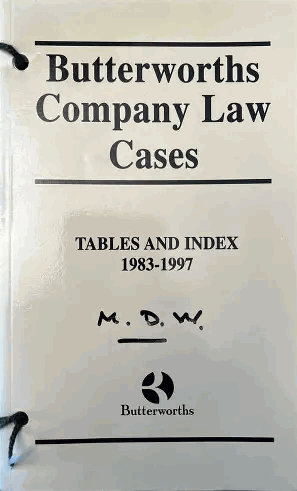
Butterworths Company Law Cases, universally abbreviated as “BCLC”, is one of the principal specialist series reporting decisions concerning United Kingdom company law, corporate insolvency, directors’ duties and related commercial subjects. It has reported cases from 1983 to the present day.
Published by Butterworths, now part of LexisNexis, the series was created to solve a practical research problem. Important company-law decisions were formerly scattered among general law reports and, in some instances, were not reported at all. BCLC gathers significant corporate decisions into a specialised and professionally edited collection.
The series covers cases under the Companies Acts, insolvency legislation, directors’ disqualification legislation, financial-services law and associated equitable and commercial doctrines. Its scope extends to such matters as constructive trusts, set-off, fiduciary responsibility and the protection of creditors. LexisNexis UK.
BCLC is not a textbook or narrative commentary. It is a collection of reported judgments. Its authority lies in the decisions of the courts whose judgments it reproduces, while its practical value comes from editorial selection, accurate reporting, informative headnotes and reliable citation.
Publication History
The series began with cases decided in 1983, with the first volumes appearing under the Butterworths imprint in 1984. Bibliographical records identify Professor Daniel D. Prentice as editor and Mary Stokes as an assistant editor of the early series. CiNii Books catalogue.
The decision to establish a specialist company-law report was justified by the expansion of corporate regulation during the latter part of the twentieth century. Company law was no longer confined to incorporation, shares and directors. It increasingly overlapped with:
insolvency; financial regulation; securities; banking; employment; taxation; trusts and equity; civil procedure; and international business.
General law reports could not publish every judgment of importance to corporate practitioners. A specialist series could report decisions that might be too detailed or commercially specialised for a general report but which possessed considerable practical importance.
BCLC has consequently developed into a substantial archive covering more than four decades of corporate jurisprudence.
Publication Details
The principal details of the series are:
Title: Butterworths Company Law Cases
Abbreviation: BCLC
Publisher: LexisNexis Butterworths
Jurisdictional emphasis: United Kingdom
Commencement: Cases from 1983 onwards
Format: Printed reports and online access through Lexis+
Editorial association: D. D. Prentice
Back-set ISBN: 9780406998583
The physical back set comprises more than 50 volumes together with a consolidated index. The current annual subscription is ordinarily issued through ten updates, two bound volumes and an index. LexisNexis UK.
Purpose of the Series
The central purpose of BCLC is to identify and report decisions that matter to company-law practitioners.
Company-law research presents a special difficulty because the relevant principles do not come exclusively from legislation carrying the word “company” in its title. A dispute may involve statutory corporate powers, common-law agency, equitable fiduciary duties, insolvency legislation, property rights, trusts, contractual interpretation and procedural rules.
BCLC recognises this interconnected character. It does not restrict itself mechanically to judgments decided under a Companies Act. Instead, it reports decisions possessing a real bearing on corporate practice.
The series therefore serves several functions:
preserving the full text of significant judgments; identifying the governing legal propositions; bringing corporate decisions together in one specialist collection; providing a stable and accepted citation; listing the authorities considered by the court; and assisting practitioners in tracing related cases and legislation. Principal Areas Covered Companies legislation
BCLC reports decisions interpreting the United Kingdom Companies Acts, including cases concerning:
incorporation and corporate personality; company constitutions; corporate capacity; shares and share capital; allotment and transfer of shares; class rights; distributions and dividends; reduction of capital; meetings and resolutions; corporate records; accounts and disclosure; restructuring; and schemes of arrangement.
The importance of this coverage lies in the detail of company legislation. A statutory provision that appears straightforward may conceal difficult questions concerning notice, voting, standing, jurisdiction or the consequences of procedural non-compliance.
Directors’ duties
Directors’ duties form one of the strongest areas of the series. BCLC reports cases involving:
the duty to act within powers; the duty to promote the success of the company; independent judgment; reasonable care, skill and diligence; conflicts of interest; secret profits; diversion of corporate opportunities; disclosure of interests; misuse of company property; and liability following insolvency.
These cases are particularly valuable because statutory duties often preserve or reflect earlier equitable and common-law principles. A complete understanding of the present legislation therefore requires access to the older cases from which the modern statutory language developed.
Minority-shareholder protection
The series contains decisions involving unfair prejudice, derivative proceedings and disputes over control of closely held companies.
Such cases commonly concern allegations that:
majority shareholders excluded a minority participant from management; controllers diverted business or assets; directors paid themselves excessive remuneration; shares were issued to alter voting control; legitimate expectations were defeated; or company affairs were conducted for an improper purpose.
These disputes are highly fact-sensitive. Full judgments are therefore more useful than short summaries because the court’s decision frequently turns on the history of the parties’ relationship and the commercial context of the company.
Corporate insolvency
BCLC is also an important insolvency report. Its coverage includes decisions concerning:
winding up; administration; liquidation; proof of debts; statutory demands; preferences; transactions at an undervalue; fraudulent trading; wrongful trading; misfeasance; priorities; insolvency set-off; officeholders’ powers; creditor standing; and distributions of assets.
The intersection between company law and insolvency is unavoidable. Once a company becomes insolvent or approaches insolvency, the practical significance of directors’ decisions changes. The interests of creditors become increasingly important, and transactions that appeared ordinary at the time may later be challenged by a liquidator or administrator.
Directors’ disqualification
The series reports decisions under the Company Directors Disqualification Act 1986. These cases help explain:
what constitutes unfitness; the factors relevant to the period of disqualification; the relationship between commercial failure and culpable conduct; the use of company assets and records; responsibility for tax and trading debts; and applications for permission to act despite disqualification.
This material is useful not only to litigation practitioners but also to corporate advisers assessing the personal risks faced by directors.
Financial services and markets
BCLC includes decisions arising under financial-services legislation, including the Financial Services and Markets Act 2000. These cases may address:
regulated activities; investment schemes; market conduct; investor protection; authorisation; civil liability; and the powers of regulatory authorities.
Their inclusion reflects the modern reality that company law and financial regulation cannot be placed in entirely separate compartments.
Equity, trusts and restitution
Some of the most important corporate disputes involve equitable principles rather than a Companies Act provision. A director who improperly receives company property may incur fiduciary liability, hold gains on constructive trust or be required to account for profits.
BCLC consequently includes cases dealing with:
constructive trusts; knowing receipt; dishonest assistance; tracing; account of profits; equitable compensation; proprietary remedies; and fiduciary responsibility.
This wider coverage substantially increases the series’ usefulness. It permits the reader to follow the consequences of corporate wrongdoing beyond the immediate statutory breach.
Structure of a BCLC Report
A typical report contains:
the names of the parties; the deciding court; the judges; the dates of hearing and judgment; catchwords identifying the subject matter; a headnote setting out the material facts and legal holdings; the statutory provisions considered; a list of cases cited; the representation of the parties; the full or substantially complete judgment; and the final disposition or order.
The headnote provides a valuable entry point. It permits a researcher to determine quickly whether the case concerns the relevant statutory provision or legal principle.
However, the headnote is written by the reporter’s editor. It is not part of the court’s reasons. A lawyer preparing submissions must identify the proposition in the judgment itself and examine the context in which it was expressed.
Citation
The standard abbreviation is “BCLC”. A typical citation appears as:
Regentcrest plc (in liquidation) v Cohen [2001] 2 BCLC 80
The elements are:
[2001] — the year of the report; 2 — the volume for that year; BCLC — Butterworths Company Law Cases; and 80 — the page on which the report begins.
Because the year is essential to locating the report, square brackets are generally used. A pinpoint reference to a particular page may be added after the opening page:
[2001] 2 BCLC 80 at 105
Where the judgment uses numbered paragraphs, it is preferable to include the relevant paragraph number:
[2001] 2 BCLC 80 at [120]
A case may also possess parallel citations in the official Law Reports, Weekly Law Reports, All England Law Reports or another specialist series. When preparing court documents, counsel should comply with the applicable practice direction governing the preferred report.
The Authority of BCLC Decisions
BCLC is frequently cited in courts, but the series itself does not determine the precedential status of a judgment.
The authority of a reported case depends upon:
the court that decided it; whether it was a first-instance or appellate decision; the composition of the bench; whether the relevant statement formed part of the ratio; whether the decision has been followed or distinguished; whether it was reversed on appeal; and whether subsequent legislation displaced it.
A Supreme Court decision reported in BCLC binds lower courts according to the ordinary doctrine of precedent. A High Court decision may be persuasive or binding in a more limited sense. A decision from another Commonwealth jurisdiction is persuasive only.
The report is the medium. The court is the source of the legal authority.
Editorial Strengths 1. Specialist selection
BCLC’s most important strength is its focus. Editors familiar with company law select decisions according to their value to corporate practitioners.
This enables the series to include judgments that may be too specialised or lengthy for a general law report but which resolve an important question of corporate practice.
2. Full judgments
The publication generally provides the full text of significant judgments. This is particularly important in company law, where the facts may involve elaborate corporate structures, shareholder agreements, financial transactions and insolvency histories.
3. Clear headnotes
The headnotes summarise the material facts and the principles applied. They are especially useful at the preliminary research stage when several apparently similar cases must be compared.
4. Lists of cited authorities
Each report includes a list of the cases referred to in the judgment, normally with full citations. This permits researchers to trace the doctrinal path followed by the court.
5. Stable citation
A BCLC citation gives lawyers, judges and academics a stable reference to the same published text. This remains valuable even when the judgment is also freely available online.
6. Long chronological coverage
The series covers the period from 1983 onwards. It therefore documents the transition through several major stages of United Kingdom company law, including the Companies Acts of 1985, 1989 and 2006 and the development of modern insolvency and financial-services legislation.
7. Consolidated index
The back set includes a consolidated index, allowing research by subject, statutory provision and case name.
8. Digital integration
Online availability through Lexis+ permits full-text searching, linking to legislation and commentary, checking subsequent case treatment and moving between parallel citations.
Importance of the Full Judgment
Company cases are particularly unsuitable for research based solely upon headnotes. The legal result may depend on matters such as:
the company’s articles; the terms of a shareholders’ agreement; the sequence of board decisions; the company’s financial condition at a particular date; the director’s actual belief; the identity of the claimant; the remedy sought; or the procedural basis of the application.
A headnote may accurately state that a director was found liable, but the judgment may show that the decision rested upon an unusual provision in the company’s constitution. Unless the judgment is read, the lawyer may wrongly present a fact-specific conclusion as a general rule.
BCLC’s practice of reporting substantial judgments is therefore one of its greatest advantages.
Relationship with General Law Reports
Many leading company-law decisions appear in more than one report. The official Law Reports may publish the case in the Appeal Cases or Chancery series. The same decision may also be reported in the Weekly Law Reports, All England Law Reports, BCLC or British Company Cases.
BCLC does not eliminate the need to consult other reports. Its value is specialist coverage and convenience.
Where an official report exists, English citation practice generally gives preference to that report. BCLC remains useful because:
it may publish the decision earlier; it may report a company case omitted from general series; its headnote may be particularly responsive to company-law issues; it brings related corporate decisions together; and it may be the report most readily available to a practitioner. Research Method
A responsible researcher using BCLC should proceed as follows:
identify the relevant subject or statutory provision; locate potentially applicable decisions; read the headnote to assess relevance; read the complete judgment; isolate the precise ratio; check whether the case was appealed; examine subsequent judicial treatment; verify that the statutory provision remains in force; compare the case with any later amendments; and use the preferred report when citing the decision in court.
Historical cases require particular care. A decision under the Companies Act 1985 may remain relevant to materially similar language in the Companies Act 2006. It must not, however, be assumed that the former and current provisions are identical.
Limitations 1. It is a selective report
BCLC does not report every company-law judgment. The absence of a case from the series does not establish that no relevant authority exists.
2. It is principally United Kingdom-centred
The work is primarily concerned with UK law. Although it may report selected Commonwealth or foreign decisions of interest to British practitioners, it is not a comprehensive report of international company law.
3. It is not a narrative textbook
A reader seeking a systematic explanation of corporate personality, capital, governance and insolvency will still require a textbook or practitioner commentary. BCLC supplies the cases rather than a complete doctrinal narrative.
4. Headnotes can be over-relied upon
The editorial summary is valuable but cannot replace the reasons for judgment.
5. Historical legislation may have changed
A large archive necessarily contains cases decided under repealed or amended legislation. Their continuing relevance must be assessed provision by provision.
6. Subscription cost
A current physical subscription is expensive, and the complete back set represents a substantial institutional investment. The full back set is marketed by LexisNexis at a price exceeding £15,000, while annual subscriptions are separately priced and subject to change. This places private ownership beyond the practical reach of many students and small firms.
7. Physical size
More than 50 bound volumes and a consolidated index require substantial shelf space. Online access is far more convenient for rapid searching, although printed volumes remain useful for archival research and sustained reading.
Value to Company-Law Practitioners
For solicitors and barristers practising corporate law, BCLC is a highly effective first point of case research.
It is especially useful when advising on:
directors’ duties; shareholder disputes; unfair-prejudice petitions; derivative claims; capital transactions; schemes of arrangement; insolvency proceedings; recovery actions by liquidators; directors’ disqualification; corporate fraud; and regulatory liability.
The reports enable practitioners to move beyond general statements of principle and identify how courts have treated comparable corporate arrangements.
Value to Insolvency Practitioners
The series is particularly valuable to insolvency lawyers, liquidators, administrators and restructuring advisers. Corporate insolvency frequently requires the practitioner to combine statutory provisions with equitable doctrines and general company law.
A claim against a director, for example, may involve:
breach of statutory duty; breach of fiduciary duty; misfeasance; transaction avoidance; constructive trust; tracing; and limitation.
BCLC brings many of these overlapping decisions into one series. This makes it more useful than a report confined narrowly to the wording of insolvency statutes.
Value to Directors and Corporate Advisers
Although the reports are written primarily for lawyers, they contain important lessons for company directors and professional advisers.
The cases demonstrate that directors must:
understand the source and limits of their powers; act for proper purposes; consider the company’s interests honestly; avoid undisclosed conflicts; maintain adequate records; exercise appropriate care; monitor the company’s financial position; and treat creditors’ interests seriously when insolvency threatens.
The reports also show that incorporation does not provide directors with personal immunity from liability for their own breaches of duty.
Value to Law Students
For students, BCLC provides direct access to the judicial reasoning from which company-law principles are derived. It is especially useful for essays, dissertations, moots and problem questions.
It teaches students to distinguish between:
a textbook writer’s summary; an editor’s headnote; counsel’s submission; an obiter observation; and the court’s ratio.
Students should not cite a case merely because its headnote contains a useful sentence. They should read the material passage in the judgment and understand why the court reached its conclusion.
Value to Academics
BCLC is a valuable chronological record of changes in corporate law. It allows scholars to trace the development of:
corporate personality; the proper-purpose doctrine; directors’ fiduciary duties; shareholder remedies; creditor protection; corporate rescue; insolvency avoidance; disqualification; and financial regulation.
Because the series spans more than 40 years, it also enables comparison between judicial approaches under successive statutory regimes.
Value to Malaysian Lawyers
Butterworths Company Law Cases has considerable value to Malaysian corporate and insolvency practitioners. Malaysian company law developed within the Commonwealth tradition and retains doctrines derived from English company law and equity.
BCLC decisions may be persuasive in Malaysian disputes involving:
separate corporate personality; lifting or piercing the corporate veil; directors’ duties; improper exercise of powers; conflicts of interest; minority oppression; derivative proceedings; capital maintenance; fraudulent transactions; corporate insolvency; liquidators’ recovery proceedings; constructive trusts; and fiduciary remedies.
English cases must nevertheless be used with discipline. The Malaysian Companies Act 2016 and Insolvency Act 1967 operate within Malaysia’s own statutory and constitutional framework. Provisions that resemble English legislation may differ in language, history or purpose.
A Malaysian lawyer should therefore:
begin with the Malaysian statutory provision; locate binding decisions of the Federal Court, Court of Appeal and High Court; identify the English provision considered in the BCLC case; compare the two provisions closely; examine whether the BCLC case has been overtaken by later legislation; and present it as persuasive rather than binding authority.
The series is most valuable when the Malaysian provision shares a common legislative origin with the English provision or when the case concerns a general equitable principle received into Malaysian law.
Overall Assessment
The principal strength of Butterworths Company Law Cases is that it treats company law as a specialised but interconnected field. It covers not only Companies Act decisions but also insolvency, financial regulation, directors’ disqualification, equity, trusts and other subjects directly affecting companies and their stakeholders.
Its full judgments, detailed headnotes, lists of cited cases and stable citation system make it dependable for serious legal research. Its chronological depth gives it additional value as an archive of modern corporate jurisprudence.
Its limitations are manageable. It is selective, costly and primarily UK-centred. It must be supplemented with legislation, current case-treatment research, textbooks and other reports. These qualifications do not detract from its standing as one of the most useful specialist collections of company-law authorities.
Conclusion
Butterworths Company Law Cases is an indispensable research series for practitioners who regularly advise or litigate in company and insolvency law. Since 1983, it has assembled significant corporate decisions that might otherwise have remained dispersed across numerous general and specialist sources.
For English practitioners, it provides reliable and convenient access to company-law precedent. For students and academics, it preserves the judicial development of modern corporate doctrine. For Malaysian and other Commonwealth lawyers, it offers a rich source of persuasive authority, provided that differences in legislation and precedent are carefully examined.
Its enduring value lies in the quality of its selection and presentation. Company law develops through the interaction of legislation, equity and judicial interpretation. BCLC records that interaction in full and makes it available in a form suitable for advice, advocacy, scholarship and comparative research.
- MALAYSIA'S 1ST AI LAWYER - CLICK HERE
- ISMAIL – INTEGRATED SINGAPORE/MALAYSIA AI & LAW (Library)
- OPENING OF SINGAPORE MALAYSIA AI CENTRE AND LAW LIBRARY
- LIFT - LAW INSTRUMENTS FORMS & TEMPLATES
- LAWS OF MALAYSIA FOR SINGAPOREAN DUMMIES
- HANNAH YEOH'S ARTIFICIAL INTELLIGENCE LAW ENCYCLOPEDIA
- LEAD CR - Law Ecosystem Archive Databases on CD-ROM
- BREAKING NEWS FROM MJN
- CLICK HERE CO. PROFILE
- EXCITING NEW SERIES - THE ADVENTURES OF BOBBY TAN -ADVOCATE & SOLICITOR IN THE HIGH COURT OF NORTH BORNEO by marceljude.ai
- MEDICO LEGAL - BY PRISKILA AKWILA & GLORIOUS PETAL SDN BHD - powered by marceljude.ai
- MISCELLANOUS
- ANNOTATED STATUTES OF SABAH - A NEW SERIES
- e-library - marceljude.ai
- DRAFT - DOCUMENT RESEARCH & AUTOMATED FILING TECHNOLOGY
- CLARA – Case Law Analysis & Retrieval AI
- FOR RESEARCH REQUEST CLICK HERE
- CLICK HERE TO ASK ANYTHING
- RAMBO'S LAW - THE LAW OF THE LAW JUNGLE - EXCITING NEW SERIES - CASE ANALYSIS BY JOHN RAMBO @ +60138646786
- PRISKILA AKWILA ADVOCATES - High Court of Sabah & Sarawak @ Kota Kinabalu
- COLA - COMMONWEALTH ONLINE LAWCASES AI -marceljude.ai
- THE LAW LIBRARY THAT COMES TO YOU ANYWHERE AND ANYTIME
- marceljude.ai training academy
