
BOMBAY HIGH COURT - marceljude.ai
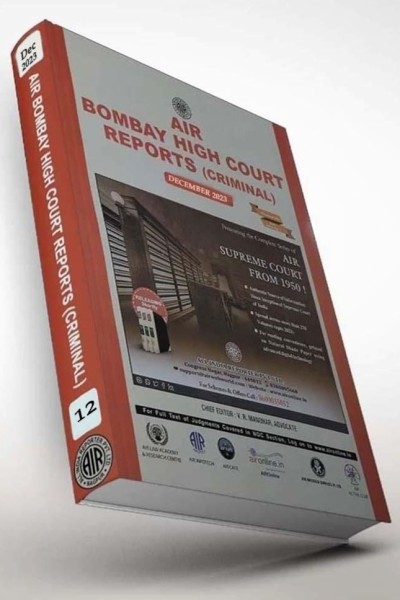
THE BOMBAY LAW REPORTER: A LEGACY OF INDIAN LEGAL SCHOLARSHIP AND JUDICIAL PRECEDENT Introduction
The Bombay Law Reporter, commonly abbreviated as “Bom LR” or “BLR”, is one of India’s oldest and most respected legal reporting publications. Established in Bombay in 1899, it has preserved more than a century of judicial reasoning, legal development and institutional history.
The publication should not be confused with the Indian Law Reports, Bombay Series, usually cited as “ILR Bom”. Although both report decisions associated with the Bombay High Court, they are distinct publications. The Indian Law Reports, Bombay Series forms part of the official Indian Law Reports system, whereas the Bombay Law Reporter originated as a privately published specialist law reporter.
The value of the Bombay Law Reporter lies not merely in recording the results of decided cases. Its volumes reveal how courts interpreted statutes, developed common-law principles and adapted inherited English legal doctrines to the circumstances of India. For advocates, judges, academics and legal historians, it remains an important bridge between colonial jurisprudence and modern Indian law.
Origins and Historical Development
The first volume of the Bombay Law Reporter was published in 1899 by the Bombay Law Reporter Office. Library records identify the publication with Ratanlal Ranchhoddas and record that it commenced publication in Bombay in that year. The historical series consisted of separately paginated “Journal” and “Reports” sections, particularly from 1901 onwards. Its publication frequency also changed over time, including semimonthly and monthly periods. Berkeley Law Library, HathiTrust catalogue.
Its establishment must be understood against the growth of the Bombay High Court as one of British India’s principal superior courts. The High Court had been established in 1862, succeeding the Supreme Court of Bombay and the Sadar Adalats. By the end of the nineteenth century, the volume and complexity of litigation had increased sufficiently to create a need for regular and reliable specialist reporting.
The Bombay Law Reporter emerged within this expanding professional environment. It enabled judges and practitioners to follow decisions affecting commercial law, property, civil procedure, criminal law, succession, taxation, local government and numerous other subjects.
The first volume is catalogued as having been issued by the Bombay Law Reporter Office in 1899, with the Bombay High Court identified as a contributor. Google Books bibliographical record.
The Function of a Law Report
A judgment and a law report are related but not identical.
A judgment is the court’s decision and reasons. A law report is the professionally prepared publication through which that judgment is organised and made accessible to the legal profession. Traditionally, a reported decision may contain:
the names of the parties; the court and judges constituting the bench; the date of decision; the material facts; the procedural history; the legal issues; the arguments presented by counsel; the authorities considered; a headnote summarising the legal propositions; and the full or substantially complete reasons for judgment.
The reporter therefore performs an editorial and archival function. It identifies decisions considered sufficiently important to contribute to the body of precedent and presents them in a form suitable for citation and research.
A headnote is useful for identifying the subject and apparent holding of a case, but it is not itself the judgment. A lawyer must read the court’s actual reasons before relying upon the case. The binding or persuasive proposition is derived from the judgment, especially its ratio decidendi, and not from an editor’s summary.
The Bombay High Court’s Jurisprudential Importance
The continuing importance of the Bombay Law Reporter is closely connected to the standing of the Bombay High Court. Bombay developed into a major centre of trade, banking, insurance, shipping, finance and industry. The High Court consequently decided a large number of commercially significant disputes.
Its judgments also addressed questions involving:
contracts and commercial transactions; company and insolvency law; banking and negotiable instruments; trusts, probate and succession; land and property; mortgages and securities; landlord and tenant relations; civil and criminal procedure; constitutional and administrative law; taxation; intellectual property; arbitration; and equity and judicial remedies.
Many of these fields were governed by statutes or principles common to other parts of British India. A Bombay decision could therefore influence courts far beyond the territorial jurisdiction of the Bombay High Court.
The Bombay High Court also produced many distinguished judges whose decisions combined close statutory construction with careful engagement with English and Indian authorities. The Bombay Law Reporter preserved those judgments and made their reasoning available to succeeding generations.
Citation of the Bombay Law Reporter
A citation to the Bombay Law Reporter ordinarily identifies the year or volume, the abbreviated title of the report and the page on which the case begins. Older Indian citations frequently follow a volume-based form, for example:
54 Bom LR 513
This means that the decision begins at page 513 of volume 54 of the Bombay Law Reporter.
Depending upon the period and database concerned, a citation may appear in a slightly different form, such as:
(1952) 54 Bom LR 513
The advocate should reproduce the citation appearing in the reliable report or legal database being used. Where the case has parallel citations, it is often useful to provide more than one citation, particularly when the court or opposing counsel may have access to a different set of reports.
A proper citation should enable the reader to locate the actual case. It should never be reconstructed through guesswork.
Relationship with the Indian Law Reports, Bombay Series
The Bombay Law Reporter must be distinguished from the Indian Law Reports, Bombay Series. The latter began in the 1870s as part of the official Indian Law Reports system. The Bombay High Court’s Judges’ Library presently provides digitised volumes of the series beginning with the 1876–77 volume. Bombay High Court Judges’ Library.
The distinction may be summarised as follows:
Publication Common abbreviation Character Bombay Law Reporter Bom LR or BLR Specialist/private law reporter founded in 1899 Indian Law Reports, Bombay Series ILR Bom Part of the official Indian Law Reports series
The same decision may sometimes appear in the Bombay Law Reporter, the Indian Law Reports, the All India Reporter or another specialised reporter. These are known as parallel citations. The existence of several citations does not create several different judgments. They are different published reports of the same judicial decision.
Colonial Law and the Transition to Modern India
The Bombay Law Reporter spans several constitutional eras:
British colonial administration; the constitutional reforms introduced before independence; Indian independence in 1947; the commencement of the Constitution of India in 1950; and the subsequent development of modern constitutional and statutory jurisprudence.
Its volumes therefore document an extraordinary legal transition. Early cases reflect the institutional structure of British India, including the influence of the Judicial Committee of the Privy Council and English legal doctrine. Later volumes demonstrate how Indian courts re-examined inherited principles under an independent Constitution.
This continuity is particularly valuable to legal historians. A modern doctrine often cannot be fully understood merely by reading its most recent formulation. Its meaning may depend upon earlier statutory language, procedural practices and judicial assumptions. The Bombay Law Reporter enables researchers to trace that development across generations.
Precedential Authority
The authority of a reported case depends upon the court that decided it, not upon the name or prestige of the reporter in which it appears.
A decision does not become binding merely because it was published in the Bombay Law Reporter. Its precedential force depends upon matters such as:
the deciding court; the composition and numerical strength of the bench; whether a superior court subsequently approved or overruled it; whether the relevant statutory provision has been amended; whether the statement relied upon forms part of the ratio or is merely obiter; whether conflicting authorities exist; and whether later constitutional or legislative developments have displaced the principle.
A report is the vehicle through which the authority is communicated. The authority itself comes from the court and the applicable doctrine of precedent.
Older decisions must therefore be used carefully. A proposition that was correct under a former enactment may no longer represent current law. The responsible researcher must verify the present statute and examine the subsequent judicial treatment of the case.
Relevance Outside India
Bombay decisions may be persuasive in other common-law jurisdictions, especially where the relevant statutory language or legal history is similar. Their usefulness is strongest when the case concerns:
an enactment adopted from a common legislative source; an equitable or common-law principle shared by both jurisdictions; a procedural rule materially similar to the local rule; a doctrine not yet fully considered by the local courts; or a historical question arising from the colonial legal system.
However, foreign decisions do not automatically carry binding authority. Their weight depends upon the similarity of the law, facts and institutional context.
Relevance to Malaysian Legal Research
The Bombay Law Reporter can be useful to Malaysian lawyers because India and Malaysia inherited substantial parts of their legal systems from British colonial administration. Both jurisdictions have dealt with statutes and principles derived from English law, although their laws have since developed independently.
An Indian authority may assist a Malaysian court where:
the Malaysian and Indian statutory provisions are identical or substantially similar; both provisions originated from the same colonial enactment or legislative model; there is no controlling Malaysian decision; the Indian court’s reasoning is logically compelling; and the Indian decision remains good law.
Nevertheless, Bombay High Court decisions are not binding upon Malaysian courts. Malaysian counsel should ordinarily begin with the Federal Constitution, Malaysian statutes and binding decisions of the Federal Court, Court of Appeal and relevant High Courts. Indian authorities should be used as persuasive support, not as substitutes for controlling Malaysian law.
Particular care is necessary with older cases. Similar wording does not always mean identical meaning. Differences in constitutional structure, statutory amendments, procedural rules and local judicial interpretation may make an Indian authority distinguishable.
Researching a Bombay Law Reporter Case
A sound research method involves more than locating a headnote. The researcher should:
identify the full and correct citation; obtain the reported judgment or an authenticated copy; read the material facts and procedural history; identify the precise question decided; distinguish the ratio from observations made in passing; verify the statutory language applicable at the time; investigate subsequent judicial treatment; determine whether the decision was appealed, reversed, approved or distinguished; and compare the decision with present legislation.
Older volumes may be found in institutional libraries and digitised historical collections. The Bombay High Court also maintains the Bombay Digital Law Report Repository, which allows searches by year, volume, page number, judgment and enactment. Bombay Digital Law Report Repository.
Digitisation makes these historical materials substantially more accessible. It also enables researchers to search large collections for particular expressions, statutes or judicial doctrines. OCR-generated text, however, must be compared against the scanned page because names, section numbers and citations are particularly susceptible to recognition errors.
Editorial Value and Limitations
The Bombay Law Reporter’s principal strengths are its historical depth, continuity and concentration on the jurisprudence of an important superior court. Its weaknesses are those common to traditional law reporting.
First, no selective reporter contains every judgment delivered by a court. The absence of a case from the reporter does not prove that no relevant decision exists.
Second, editorial selection may favour decisions regarded as important at the time of publication. A case overlooked by an editor may later become significant.
Third, a headnote necessarily compresses the court’s reasoning and may omit a qualification essential to the decision.
Fourth, old reports can be difficult to search unless they have been accurately digitised and indexed.
Fifth, historical cases may use terminology, social assumptions or procedural concepts that no longer accord with contemporary constitutional standards.
These limitations do not diminish the reporter’s importance. They emphasise the need to use it as part of a complete legal research process.
The Bombay Law Reporter in the Digital Age
Digital databases have changed the manner in which lawyers locate cases, but they have not eliminated the need for authoritative law reporting. Electronic search can retrieve thousands of judgments within seconds. The difficult legal work begins after retrieval: determining which judgment is relevant, authoritative and still good law.
The Bombay Law Reporter continues to matter because it provides stable citations and an organised historical record. Digitisation gives an old publication a new function. Decisions that were once accessible only through bound library volumes may now be searched across decades and compared with later authorities.
The best modern legal research combines:
the stability and editorial discipline of traditional law reports; the speed of full-text electronic search; citator or subsequent-treatment analysis; verification against the judgment itself; and professional legal evaluation.
Artificial intelligence may assist in discovering patterns and extracting passages, but it should not be trusted to invent missing citations or determine the binding effect of a case without verification. Historical law reports are especially vulnerable to mistakes caused by incomplete scans, OCR errors and confusion between parallel citations.
Importance to Legal Education
For students, the Bombay Law Reporter offers more than a collection of precedents. It demonstrates the judicial method in operation. By reading the complete judgments, students learn how courts:
identify material facts; frame legal issues; construe legislation; distinguish earlier decisions; apply precedent; evaluate competing arguments; and formulate orders and remedies.
It also teaches an important lesson: law develops incrementally. Principles that now appear settled were often produced through a long series of disagreements, qualifications and refinements. A historical report allows the reader to witness that process rather than seeing only its modern conclusion.
Conclusion
The Bombay Law Reporter is an enduring institution in Indian legal publishing. Founded in 1899, it has preserved decisions across colonial rule, independence, constitutional transformation and the development of modern Indian law.
Its significance rests on three foundations. First, it records the jurisprudence of one of India’s most influential superior courts. Second, it supplies stable citations and structured reports for professional legal research. Third, it preserves the historical development of doctrines shared across the wider common-law world.
For Indian practitioners, it remains an important source of precedent. For Malaysian and other Commonwealth lawyers, it can provide persuasive reasoning where legislation and legal history are comparable. For scholars and students, it is an archive of judicial thought extending over more than a century.
The Bombay Law Reporter is therefore more than a collection of old cases. It is a record of how law is reasoned, preserved, challenged and renewed across generations.
- MALAYSIA'S 1ST AI LAWYER - CLICK HERE
- ISMAIL – INTEGRATED SINGAPORE/MALAYSIA AI & LAW (Library)
- OPENING OF SINGAPORE MALAYSIA AI CENTRE AND LAW LIBRARY
- LIFT - LAW INSTRUMENTS FORMS & TEMPLATES
- LAWS OF MALAYSIA FOR SINGAPOREAN DUMMIES
- HANNAH YEOH'S ARTIFICIAL INTELLIGENCE LAW ENCYCLOPEDIA
- LEAD CR - Law Ecosystem Archive Databases on CD-ROM
- BREAKING NEWS FROM MJN
- CLICK HERE CO. PROFILE
- EXCITING NEW SERIES - THE ADVENTURES OF BOBBY TAN -ADVOCATE & SOLICITOR IN THE HIGH COURT OF NORTH BORNEO by marceljude.ai
- MEDICO LEGAL - BY PRISKILA AKWILA & GLORIOUS PETAL SDN BHD - powered by marceljude.ai
- MISCELLANOUS
- ANNOTATED STATUTES OF SABAH - A NEW SERIES
- e-library - marceljude.ai
- DRAFT - DOCUMENT RESEARCH & AUTOMATED FILING TECHNOLOGY
- CLARA – Case Law Analysis & Retrieval AI
- FOR RESEARCH REQUEST CLICK HERE
- CLICK HERE TO ASK ANYTHING
- RAMBO'S LAW - THE LAW OF THE LAW JUNGLE - EXCITING NEW SERIES - CASE ANALYSIS BY JOHN RAMBO @ +60138646786
- PRISKILA AKWILA ADVOCATES - High Court of Sabah & Sarawak @ Kota Kinabalu
- COLA - COMMONWEALTH ONLINE LAWCASES AI -marceljude.ai
- THE LAW LIBRARY THAT COMES TO YOU ANYWHERE AND ANYTIME
- marceljude.ai training academy
