
From Dusty Shelves to an AI That Reads the Law for You By marceljude.ai


Description
From Dusty Shelves to an AI That Reads the Law for You
By marceljude.ai
marceljude.ai is a legal research and drafting platform built for Malaysian law. Its flagship tool, the AI Lawyer, targets students, professors, lawyers, and firms who need fast, citation-backed output instead of generic chatbot answers.
The core pitch is explainability. Every claim is footnoted to statutes or case law, with IRAC maps—issue, rule, application, conclusion—plus counter-authority notes and audit trails. It formats output in numbered paragraphs and bilingual citation styles, which matters in a jurisdiction where procedural defects can sink a filing.
It runs on retrieval-augmented generation with multiple AI instances checking each other, and it markets a "3S system": speed, strength, and safety. The claim is that tasks that used to take hours—research, drafting opinions, preparing submissions—can be done in under thirty minutes, with sixty to seventy percent time savings.
It's tied to Malaysian entities, including Priskila Akwila and Glorious Petal Sdn Bhd, and sits alongside a broader "AI Law Matrix" that also publishes commentary and legal-adjacent content under the marceljude.ai name.
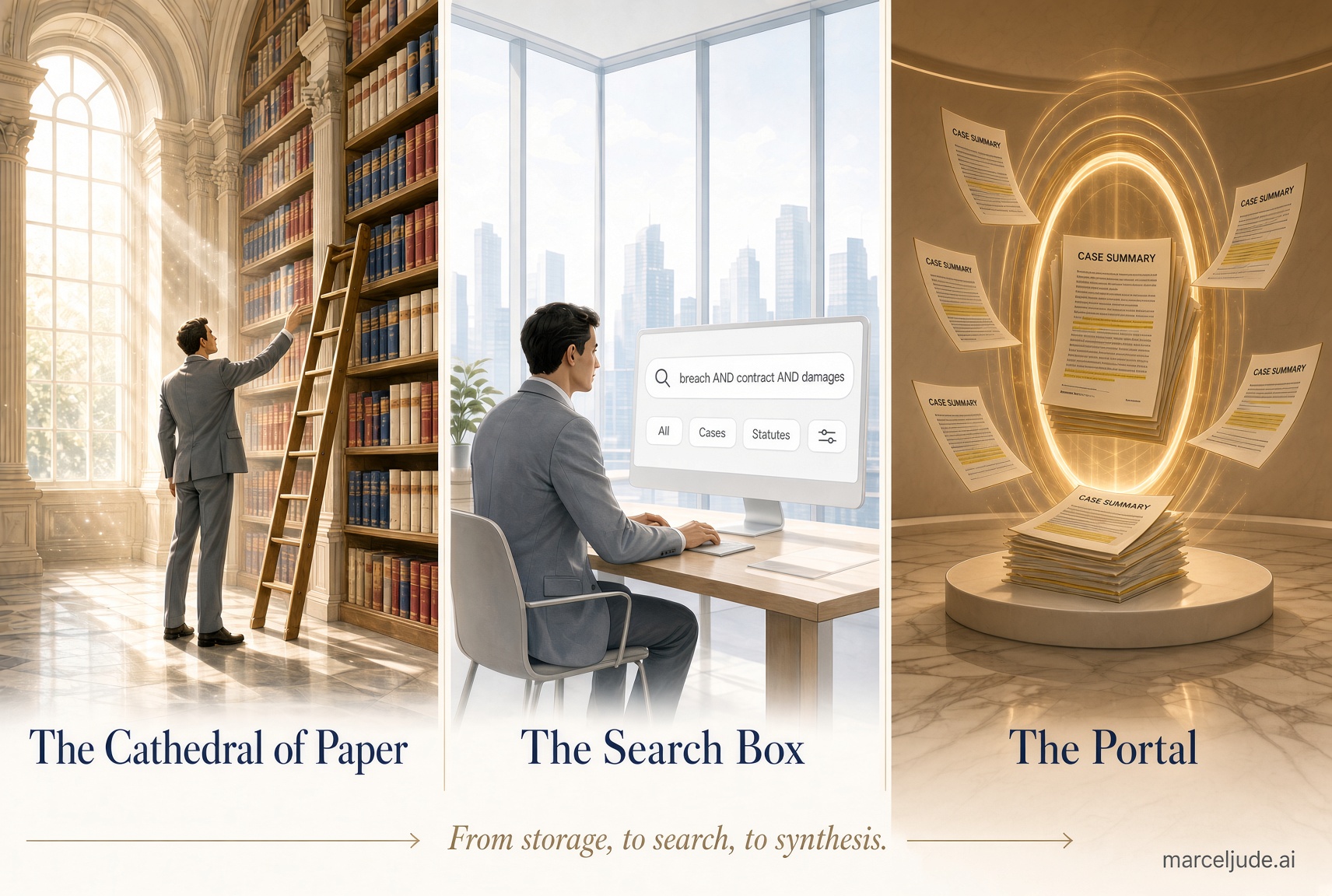
IN THE BEGINING - The traditional law library is a cathedral of paper. Floor to ceiling, row after row of bound volumes — statutes, law reports, digests, commentaries — each one heavy enough to strain a shelf, and there are thousands of them. The room itself is large, climate-controlled, and expensive to maintain, because paper demands it. Dust settles into the bindings, insects find their way in, humidity warps the pages, and a single flood or fire can erase decades of precedent in an afternoon. Research in this world is a physical pilgrimage. You start with an index — a digest, a table of cases, a citator — and you trace citations by hand, volume to volume, page to page. A single question can send you across three or four rooms, pulling down one book, checking a footnote, finding another reference, climbing a ladder. It's thorough, but it's slow, and it rewards the person with the strongest memory for where things are shelved. The cost isn't just time. It's space — prime real estate turned into storage. It's staff — librarians and clerks to reshelve, repair, and track what's been borrowed. It's the quiet tax of maintenance: rebinding, pest control, air filtration, insurance. And it's the access problem — if the volume you need is checked out, misfiled, or in another branch, your research stops until someone finds it
THE NEXT STAGE - EVOLUTION ....Then came the databases. Instead of walking the aisles, you sat at a terminal and typed. LexisNexis, Westlaw, and their local equivalents turned the law library into a search box — you entered keywords, combined them with Boolean operators like AND, OR, and NOT, and the system returned a ranked list of hits from millions of documents at once. It was a genuine leap. No more ladders, no more dust, no more waiting for a volume to be reshelved. A researcher in Kuala Lumpur could pull a Singapore Court of Appeal judgment in seconds, and a firm could subscribe to the same corpus without owning a single physical book. The index didn't disappear — it just moved inside the query. Boolean logic became the new art: too narrow and you missed the case, too broad and you drowned in noise. But the database had its own friction. You were still searching blind — guessing which combination of words the court actually used, hoping the right phrase was indexed the way you imagined. Relevance ranking was a black box, and a poorly phrased query could bury the one authority that mattered under a hundred near-misses. The librarian's expertise got replaced by the researcher's keyword instinct, and that instinct took years to build.
AND NOW THE MARCELJUDE.AI REVOLUTION
marceljude.ai, developed by Marcel Jude AI, is the third stage — and it doesn't search the library at all. It asks it a question in plain language. You don't open a volume, you don't build a Boolean string, you don't guess at keywords. You just say what you need. I want cases on breach of contract, calculation of damages, and the ways a contract can be terminated. That's the entire query. The system returns the cases, with commentary and highlights already marked inside them, ready to drop into a court bundle. It goes further. Ask for ten cases on specific performance and it hands you a printout with the key passages flagged. Tell it to tie those cases to the submission you're drafting, and it maps the authorities to your arguments. Point it at a leading textbook — Chitty on Contracts — and say analyze the chapters on specific performance, then summarize the principles, and it reads the text, extracts the structure, and gives you the distilled version. No page-turning, no highlighter, no marginalia.
The mechanism underneath is code. The AI doesn't skim the way a human does — it parses the document structurally, identifies the holdings, the ratios, the dissenting notes, and surfaces what matters. That's the shift: the book stops being something you read and becomes something the system reads for you. And the library itself changes shape. It's no longer a room of shelves or a database of records. It's a portal. You can ask it to write the research memo, to draw a map of the authorities you should chase next, or to teach you the gaps in your own understanding before you file. The library doesn't store knowledge anymore — it produces it, on demand, in the form you asked for.
That's the breakthrough marceljude.ai represents. Not a better search engine. A different relationship with the law entirely.
- MALAYSIA'S 1ST AI LAWYER - CLICK HERE
- ISMAIL – INTEGRATED SINGAPORE/MALAYSIA AI & LAW (Library)
- OPENING OF SINGAPORE MALAYSIA AI CENTRE AND LAW LIBRARY
- LIFT - LAW INSTRUMENTS FORMS & TEMPLATES
- LAWS OF MALAYSIA FOR SINGAPOREAN DUMMIES
- HANNAH YEOH'S ARTIFICIAL INTELLIGENCE LAW ENCYCLOPEDIA
- LEAD CR - Law Ecosystem Archive Databases on CD-ROM
- BREAKING NEWS FROM MJN
- CLICK HERE CO. PROFILE
- EXCITING NEW SERIES - THE ADVENTURES OF BOBBY TAN -ADVOCATE & SOLICITOR IN THE HIGH COURT OF NORTH BORNEO by marceljude.ai
- MEDICO LEGAL - BY PRISKILA AKWILA & GLORIOUS PETAL SDN BHD - powered by marceljude.ai
- MISCELLANOUS
- ANNOTATED STATUTES OF SABAH - A NEW SERIES
- e-library - marceljude.ai
- DRAFT - DOCUMENT RESEARCH & AUTOMATED FILING TECHNOLOGY
- CLARA – Case Law Analysis & Retrieval AI
- FOR RESEARCH REQUEST CLICK HERE
- CLICK HERE TO ASK ANYTHING
- RAMBO'S LAW - THE LAW OF THE LAW JUNGLE - EXCITING NEW SERIES - CASE ANALYSIS BY JOHN RAMBO @ +60138646786
- PRISKILA AKWILA ADVOCATES - High Court of Sabah & Sarawak @ Kota Kinabalu
- COLA - COMMONWEALTH ONLINE LAWCASES AI -marceljude.ai
- THE LAW LIBRARY THAT COMES TO YOU ANYWHERE AND ANYTIME
- marceljude.ai training academy
